
You've got a payroll gap, a supplier discount that expires today, or equipment that failed at the worst possible time. A bank loan won't solve a problem that must be fixed this afternoon. That's where business loans with same-day funding can help, but only if you understand what “same day” means.
A fast approval isn't the same as cash in your operating account. The lender still needs complete documents, verified bank information, an underwriting decision, signed contracts, and a transfer that clears before the relevant cutoff. Miss one step, and today's funding becomes tomorrow's problem.
The FDIC's 2024 Small Business Lending Survey found that three in ten banks, including more than half of large banks, can approve a small, simple loan within one business day. Many standard bank loans still take weeks, while online lenders often fund within 1 to 7 days and merchant cash advances may fund within 24 to 48 hours or even the same day. (Crestmont Capital's business loan timing overview)
Table of Contents
- When Same-Day Funding Actually Matters
- Lender Types That Can Fund Fastest
- How to Qualify Before You Apply
- The Application-to-Deposit Timeline
- True Cost and Risk of Fast Capital
- When You Should Skip Same-Day Funding
- Your Next Steps to Funding Today
When Same-Day Funding Actually Matters
A contractor landed a $90,000 job on a Friday morning. The work started Monday, but the contractor needed labor, materials, and equipment before the weekend ended. A same-day funding decision put the cash in the business account at 4:47 p.m., allowing the owner to staff the project and purchase supplies instead of turning down profitable work.
That's the right use of speed. The financing solved a timing problem tied to revenue that was already visible. It wasn't used to cover a vague expansion plan or make an unaffordable business model look healthy.
The emergencies that justify the premium
Same-day capital earns its higher price when waiting creates a larger, immediate loss.
- Payroll protection: A missed payroll run can disrupt operations, damage employee trust, and trigger penalties or other costs.
- Inventory access: A supplier may offer terms that expire before a conventional lender can finish reviewing the application.
- Equipment failure: A broken vehicle, refrigeration unit, or production machine can stop revenue entirely.
- Lease or contract deposits: A business may need to place a deposit before another qualified applicant takes the opportunity.
- Receivables timing: A company can have strong sales but still need cash before a customer pays an invoice.
Borrowers surveyed in Lendio's SMB Lending Index showed how strongly speed now shapes financing expectations. Forty percent expected funds within one business day, while another 31% expected funding within 2 to 3 business days, meaning 71% wanted capital in under four business days. (The Broker Shop's summary of small-business funding expectations)
Practical rule: Pay for speed only when the cost of waiting is greater than the cost of borrowing.
If the expense can wait several business days, compare a bank line, SBA-backed financing, or a lower-cost term loan. Same-day funding is a tool for urgency, not a default financing strategy. This guide to quick short-term business loans is useful when you need to distinguish a real cash-flow emergency from a problem that deserves slower, cheaper capital.
Lender Types That Can Fund Fastest
“Online lender” tells you almost nothing about speed or price. The underlying product determines how the lender evaluates risk, how repayment works, and how quickly money can move.
Four products built for urgency
Merchant cash advances purchase a portion of future card receipts. The lender focuses on card volume, deposit consistency, and repayment history rather than relying primarily on tax returns or traditional debt-service calculations. They can move quickly for businesses with steady card sales, but the fixed repayment obligation and factor-rate pricing can make them expensive.
Short-term working capital loans usually rely on bank deposits and automated cash-flow analysis. The business receives a lump sum and repays through fixed daily or weekly withdrawals over a short term. They're often more flexible than an MCA for companies that receive money through ACH, checks, and card payments, but the frequent withdrawals can strain uneven revenue.
Revenue-based lines of credit give the borrower access to a revolving facility, with draws available the same day after approval and bank verification. They're useful when the business needs repeated access rather than one large advance. Read the draw fees, repayment cadence, renewal conditions, and whether the lender charges for unused capacity.
Invoice and purchase-order financing underwrite the strength of the customer obligation or purchase order. This can fit a B2B company with reliable receivables but uneven cash flow. Funding often takes 24 to 48 hours and sometimes happens the same day, depending on documentation and verification. (Crestmont Capital's same-day funding guide)
Same-Day Funding Products Compared
| Product Type | Typical Funding Window | Underwriting Basis | Indicative Cost per $10K (6 mo) |
|---|---|---|---|
| Merchant cash advance | Same day to 48 hours | Card receipts, bank deposits, repayment history | Varies by factor rate and contract |
| Short-term working capital loan | Same day to 24 hours | Bank deposits, cash flow, existing obligations | Varies by lender and borrower |
| Revenue-based line of credit | Same day after approval and verification | Revenue history, bank connectivity, account health | Varies by draw fee and repayment terms |
| Invoice or purchase-order financing | 24 to 48 hours, sometimes same day | Verified invoices, purchase orders, customer credit | Varies by advance and fee structure |
The fastest products usually ask for less traditional documentation because automated systems can analyze connected bank data. That convenience doesn't make the capital cheap. It shifts the comparison from “What rate did the lender advertise?” to “How much will leave my business account, and how often?”
For a broader view of why digital lenders often move faster than branches, compare the workflow differences in fintech and bank approvals. The useful question isn't whether a lender is online. It's whether the product matches your revenue pattern and deadline.
How to Qualify Before You Apply
Fast-funding lenders don't underwrite your application the way a traditional bank does. They want evidence that money consistently enters your business account and that the proposed repayment won't immediately disrupt operations.
Use these checkpoints before submitting an application.
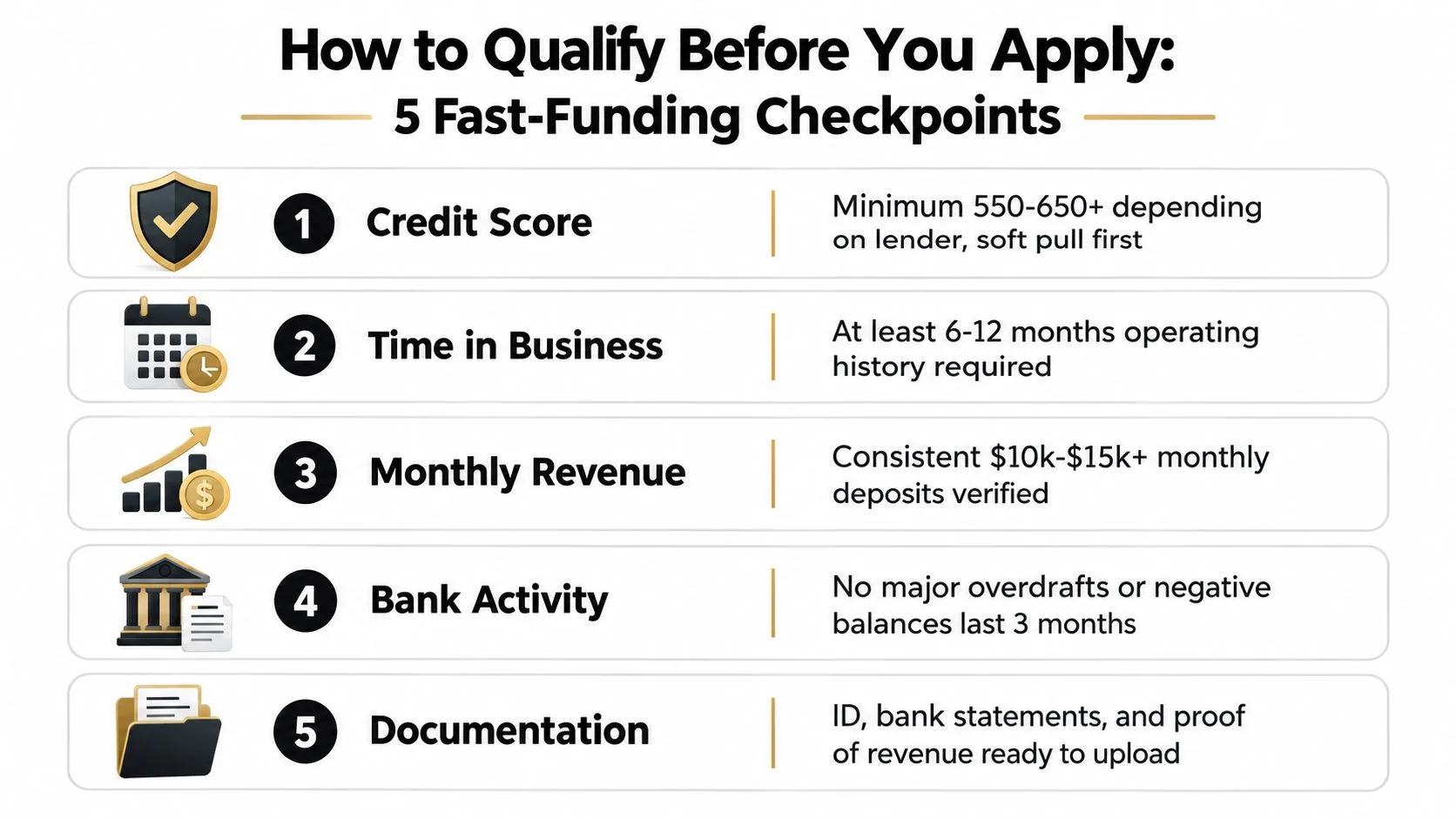
Five qualification checkpoints
Operating history: Many fast-funding products look for at least 6 to 12 months in business. A longer operating history gives the lender more bank activity to analyze and usually creates more product choices.
Revenue: Consistent monthly deposits matter more than a single strong month. Many fast lenders look for roughly $10,000 to $15,000 or more in monthly revenue, while bank-card-heavy products may expect about $20,000 or more. These are screening ranges, not guarantees.
Business banking: Use a U.S. business bank account with a clear legal-entity name and predictable deposits. Personal-account activity, unexplained transfers, and frequent account changes create verification questions that slow an otherwise simple file.
Credit profile: Personal FICO requirements often fall around 500 to 650, depending on the product and lender. A weaker score doesn't automatically end the conversation when bank cash flow is strong, but it can narrow the choices and increase the cost.
Public-record concerns: Open bankruptcies, recent tax liens, unresolved judgments, and serious payment issues can derail approval or require a different product structure.
Fast lenders commonly request 3 to 6 months of business bank statements, merchant-processing statements for card-heavy businesses, identification, and a voided check. Have the documents ready before you apply. The business funding document checklist can help you organize the file, while a framework for identifying high-value prospects offers a useful parallel for sorting strong signals from distracting information.
Bank activity can decide the outcome
Underwriters look for NSF activity, negative balances, large unexplained deposits, sudden changes in account behavior, and existing withdrawals that already consume too much cash flow. Don't move money between accounts to make the statement look cleaner. Explain unusual deposits and provide supporting records when asked.
Before applying, confirm that the legal business name, tax information, bank account, ownership details, and application answers all match. A mismatch creates manual review, and manual review is where same-day timelines go to die.
The Application-to-Deposit Timeline
A same-day file moves through several separate decisions. Prequalification may use a soft credit inquiry. Final approval can involve a hard inquiry. Signing the contract doesn't mean the transfer has cleared. The lender still has to release the funds through a payment rail that follows its own cutoff rules.
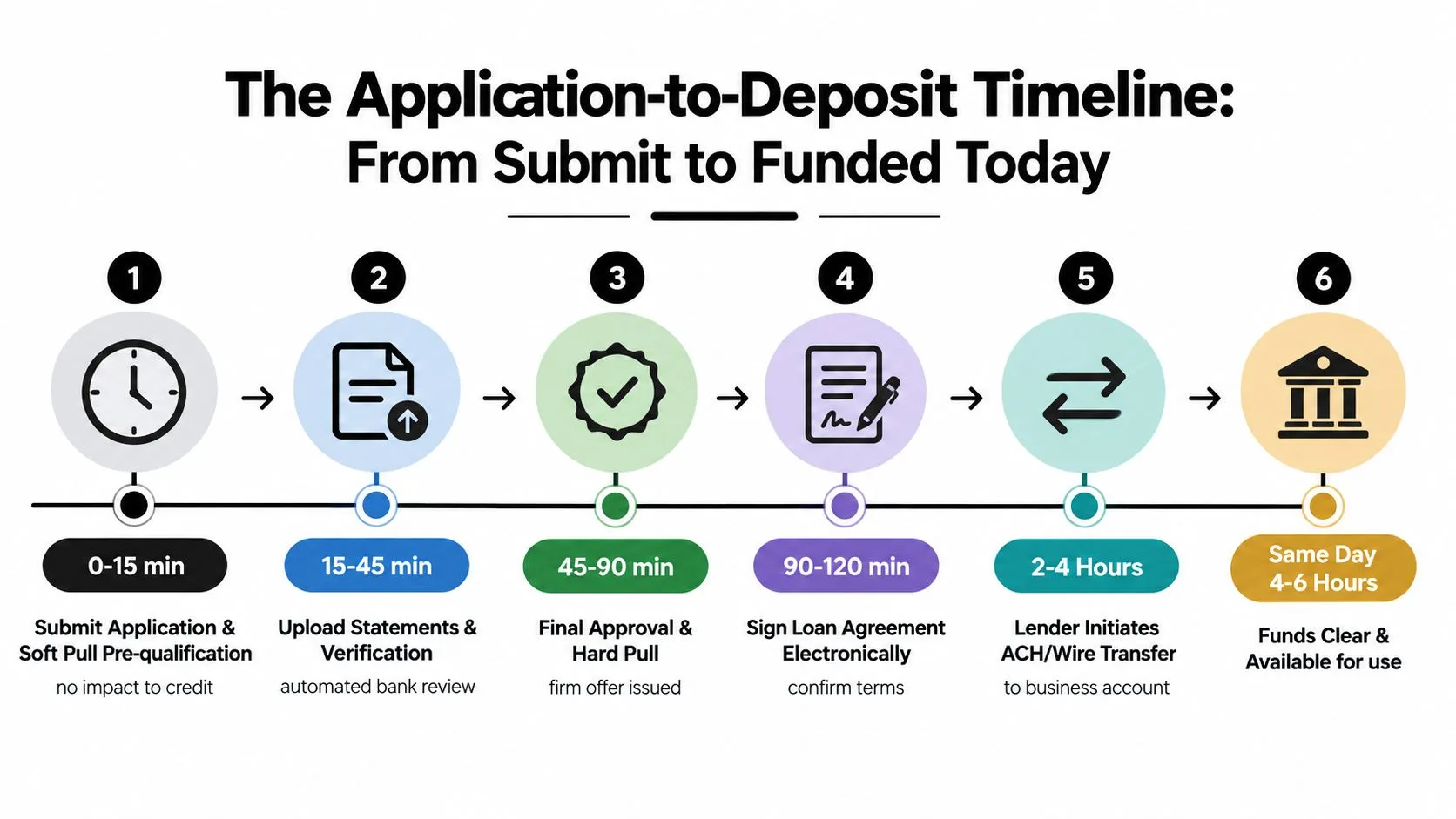
What happens after submission
- Application and initial screening: You provide business details, revenue information, ownership data, and permission to review accounts. A soft pull may help the lender show preliminary options without treating that stage as final approval.
- Bank verification: The lender reviews connected accounts or uploaded statements. Missing pages, unclear deposits, and mismatched legal names create delays.
- Final underwriting: The lender confirms the amount, repayment structure, fees, and existing obligations. A hard credit pull may occur at this stage, depending on the lender.
- Contract execution: You sign the agreement and confirm the receiving account. Read the total repayment, payment frequency, default terms, and transfer method before signing.
- Transfer release: The lender initiates an ACH or wire transfer. The timing depends on the lender's internal cutoff and the receiving bank's processing.
- Funds availability: The money must post to the operating account and become available for use. “Approved” and “sent” are not the same as “available.”
Same-day funding depends on three clocks. Bank verification must finish, the payment rail cutoff must remain open, and underwriting must release the file before the lender's close-of-business process. Industry guidance says a clean file can move from application to approval and wiring within one business day when statements, identification, a voided check, and a debt schedule arrive up front and verification clears within 1 to 2 hours. (PIRS Capital's same-day funding workflow guidance)
Why morning applications win
Submit early. A late-morning application gives the lender time to request clarification, complete verification, and release the transfer before the day's payment cutoff. An afternoon application can be approved quickly and still miss same-day settlement.
ACH commonly settles on the next business day, while a wire may arrive sooner if the lender and bank support it and the request reaches the cutoff. Review the practical ACH transfer time factors before deciding whether the transfer method matches your deadline.
The speed benchmark also varies by lender type. Online lenders are commonly reported at 24 to 72 hours to approval, with about 80% of non-bank borrowers funded within a week, while major banks often take 21 to 35 days and non-bank ADIs 10 to 18 days. (ScaleSuite's lending timing overview)
True Cost and Risk of Fast Capital
Fast money is expensive because the lender is taking operational and repayment risk while skipping the slower review used by banks. Compare total repayment, not just the label attached to the price.
An MCA may use a factor rate. A 1.25 factor on $50,000 means $62,500 in scheduled repayment, regardless of how quickly the business pays it off. A short-term loan may quote APR, while a line of credit may charge draw fees, origination costs, or periodic maintenance charges.
Compare dollars before percentages
The cost table below uses illustrative structures rather than a universal market quote. A lender's actual offer depends on revenue, credit, product, term, existing obligations, and transfer method.
| Product | Total Repayment | Effective APR | Term | Key Risk |
|---|---|---|---|---|
| Merchant cash advance | Depends on the contract's factor rate | Can be difficult to compare directly | Often short | Fixed collection pressure, limited early-payoff benefit |
| Short-term working capital loan | Principal plus stated interest and fees | Can be high for short terms | Commonly short | Daily or weekly withdrawals may outpace cash flow |
| Revenue-based line of credit | Draw amount plus draw fees and applicable charges | Depends on utilization and repayment schedule | Revolving or short draw periods | Repeated draws can create persistent debt |
| Invoice financing | Advance plus financing fee | Depends on invoice timing and fee structure | Linked to customer payment | Customer delays can extend the cost |
A short term can make a product look manageable because the balance disappears quickly, but the payment may be punishing. A daily debit that works during a strong sales month can become a serious problem when receivables slow.
Contract risks that deserve attention
- Stacking: Taking another advance while an existing position remains open can multiply daily withdrawals and make cash flow harder to predict.
- Personal guarantees: A guarantee can expose personal assets when the business cannot repay.
- UCC filings: A blanket lien may give the lender rights across business assets.
- Confession-of-judgment language: Where permitted, this can create severe legal exposure after default.
- Buyout and prepayment clauses: Some contracts don't reduce the cost proportionally when you repay early.
A fast approval is useful only if the payment fits the cash your business collects. If the proposed debit leaves no room for payroll, taxes, suppliers, and ordinary volatility, reject the offer.
When You Should Skip Same-Day Funding
Speed is the wrong priority for an established company that can wait. A business generating $20 million to $50 million in annual sales, with strong credit, clean tax returns, and limited existing debt, should not automatically accept a short-term advance because the application is easy.
The Federal Reserve's survey of employer firms found that 86% use financing regularly, but only 42% of applicants received the full amount they sought, showing that demand for capital and available credit terms don't always align. (Federal Reserve's 2026 report on employer firms)
Match the product to the deadline
If the need is expansion inventory, planned hiring, a location buildout, or refinancing existing debt, start with lower-cost financing. SBA 7(a), SBA 504, conventional term loans, and bank lines generally require more documentation and patience, but they can be far more appropriate for a stable company with predictable cash flow.
SBA-backed loans can't realistically close in under 30 days, according to the market guidance summarized in the Federal Reserve discussion above. That delay is unacceptable for a failed payroll run or a machine that stopped production. It may be perfectly acceptable for a planned capital project.
Decision test: If the expense can wait, don't buy same-day speed.
The right calculation is simple. Estimate the loss created by waiting, then compare it with the full financing cost, payment burden, and legal exposure of the fast product. A time-sensitive vendor term may generate enough margin to justify expensive capital. A speculative inventory purchase usually doesn't.
Same-day funding makes sense for an emergency equipment repair, an immediate payroll shortfall, or a contract deposit that expires today. It makes less sense for a project that can be scheduled, negotiated, or financed through a conventional channel.
Your Next Steps to Funding Today
If cash needs to land today, stop sending incomplete applications. Use the next hour to make the file easy to verify and choose a product that matches the urgency.
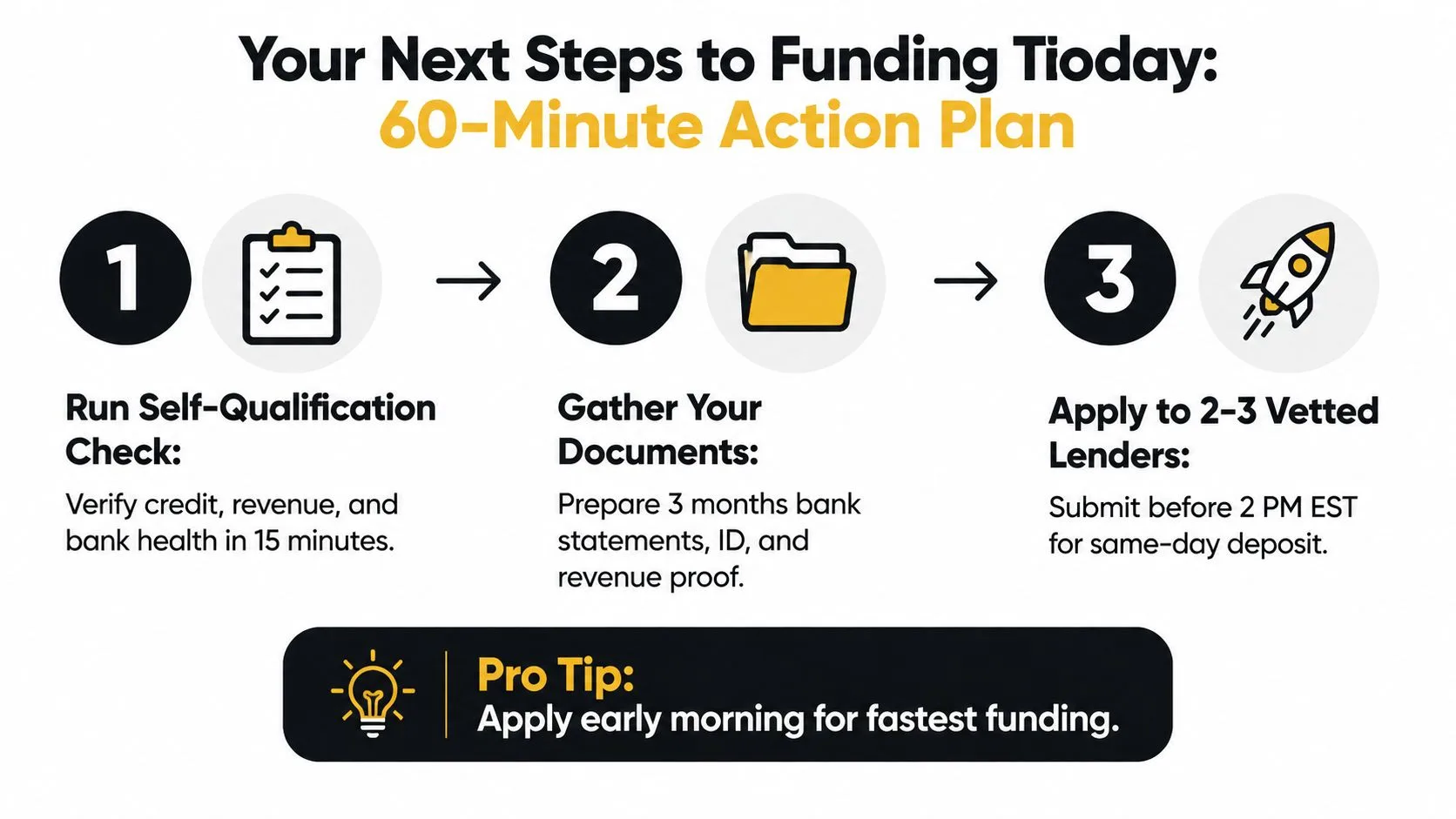
The 60-minute preparation plan
First 15 minutes, self-audit. Check your operating history, monthly deposits, bank-account health, credit position, existing debt, and public-record issues. Decide whether you need funds today, tomorrow, or within several business days. That answer determines whether you should consider an MCA, working capital loan, line of credit, or invoice product.
Next 20 minutes, gather the file. Pull the latest 3 months of business bank statements, a government-issued ID, a voided business check, ownership information, and any documents supporting unusual deposits. Have the legal name and account details exactly as they appear at the bank.
Final 25 minutes, submit carefully. Use one application path that lets you compare preliminary options before committing to a hard inquiry. Business Loan Warrior offers a single application for business financing options, including working capital, lines of credit, SBA processing, equipment financing, invoice financing, and merchant cash advances.
Rules for accepting an offer
- Confirm total payback: Don't rely on a headline rate or factor alone.
- Check payment frequency: Make sure daily or weekly withdrawals fit your collection cycle.
- Review prepayment treatment: Verify whether early repayment reduces the cost.
- Confirm the receiving account: Funds should go directly to the operating account, not an unfamiliar third-party debit card.
- Ask about cutoff timing: Get the actual ACH or wire deadline in writing before signing.
- Submit early: A morning submission gives verification and underwriting more time before settlement windows close.
Same-day approval is possible. Same-day deposit is conditional. Your preparation, product choice, document completeness, and submission time control the outcome more than the marketing headline.
If you need working capital today, Business Loan Warrior lets you submit one application, review financing paths, and connect with lender types suited to your timing and risk profile. Start the comparison with your documents ready, confirm the total repayment before signing, and apply early enough for the transfer cutoff.