
You've built a business that produces real revenue, yet a lender keeps looking at your personal credit history and saying no. Perhaps a late payment from a difficult season, an old collection account, or a thin credit file is blocking the working capital you need for payroll, inventory, equipment, or expansion. The frustration is understandable, but the phrase business loans with no personal credit check can create the wrong expectation.
These products usually don't remove underwriting. They change the evidence the lender uses. Instead of relying mainly on your consumer credit history, the lender may study business deposits, card sales, invoices, equipment, or payment-platform activity. The business has to demonstrate repayment capacity through its operations.

That distinction matters because personal credit remains embedded in U.S. small-business lending. The Federal Reserve's Small Business Credit Survey reported that 86% of small employer firms and 94% of non-employer firms used personal credit scores to obtain financing, while the FDIC's 2024 Small Business Lending Survey indicates that many banks still typically require a personal score even for relatively small startup loans of $25,000. The FDIC's Small Business Lending Survey helps explain why alternatives have developed around cash flow, receivables, and collateral rather than conventional bank underwriting.
This guide will help you identify what “no personal credit check” means, match funding types to your business model, understand the substitute signals lenders review, and uncover risks such as personal guarantees and UCC liens. If damaged credit is narrowing your choices, this broker guide to bad-credit funding can provide additional context before you compare offers.
Table of Contents
- Introduction Why No Personal Credit Check Loans Attract Owners
- What Business Loans With No Personal Credit Check Really Mean
- Types of Funding That May Skip Personal Credit Checks
- How Lenders Underwrite Without Your Personal Credit Score
- Pros Cons Costs and Legal Implications You Must Weigh
- Red Flags Compliance Issues and How to Spot Predatory Offers
- Smarter Next Steps and Alternatives to Get Funded Faster
Introduction Why No Personal Credit Check Loans Attract Owners
A café owner may have steady deposits, loyal customers, and a profitable catering operation, but a traditional lender can still focus on the owner's personal score. A contractor may have signed projects waiting to begin, yet lack the personal credit profile required for a bank line. In both situations, the business is generating evidence of repayment, but the lender's preferred evidence comes from the individual.
The demand for alternatives reflects that mismatch. The Federal Reserve reported an overall denial rate of 22% for loan, line of credit, and merchant cash advance applications in 2023, followed by a roughly similar 21% rate in 2024. Among non-employer businesses denied financing in 2024, 45% cited low credit score as the primary reason, according to the credit-score approval analysis based on Federal Reserve survey data.
The practical question: If a lender won't use your personal score as the main signal, what will it use instead?
The answer is usually business performance. A lender may examine whether deposits arrive consistently, whether existing obligations consume too much cash, whether customers pay reliable invoices, or whether an asset can secure the transaction. That can help an owner with weak personal credit, but it also changes the cost, repayment schedule, and legal exposure of the financing.
“No personal credit check” can therefore mean several different things. It may mean no hard inquiry, a soft prequalification review, or a product where personal credit has little influence because the lender is evaluating receivables or revenue. It rarely means automatic approval, unlimited funding, or no consequences if cash flow weakens.
The right choice depends on why you need capital and how your business gets paid. A retailer with strong card volume may fit a revenue advance, while a B2B manufacturer with dependable invoices may fit factoring. A service company with uneven deposits may need a smaller secured facility or a slower path to conventional credit instead of a daily-payment product.
What Business Loans With No Personal Credit Check Really Mean
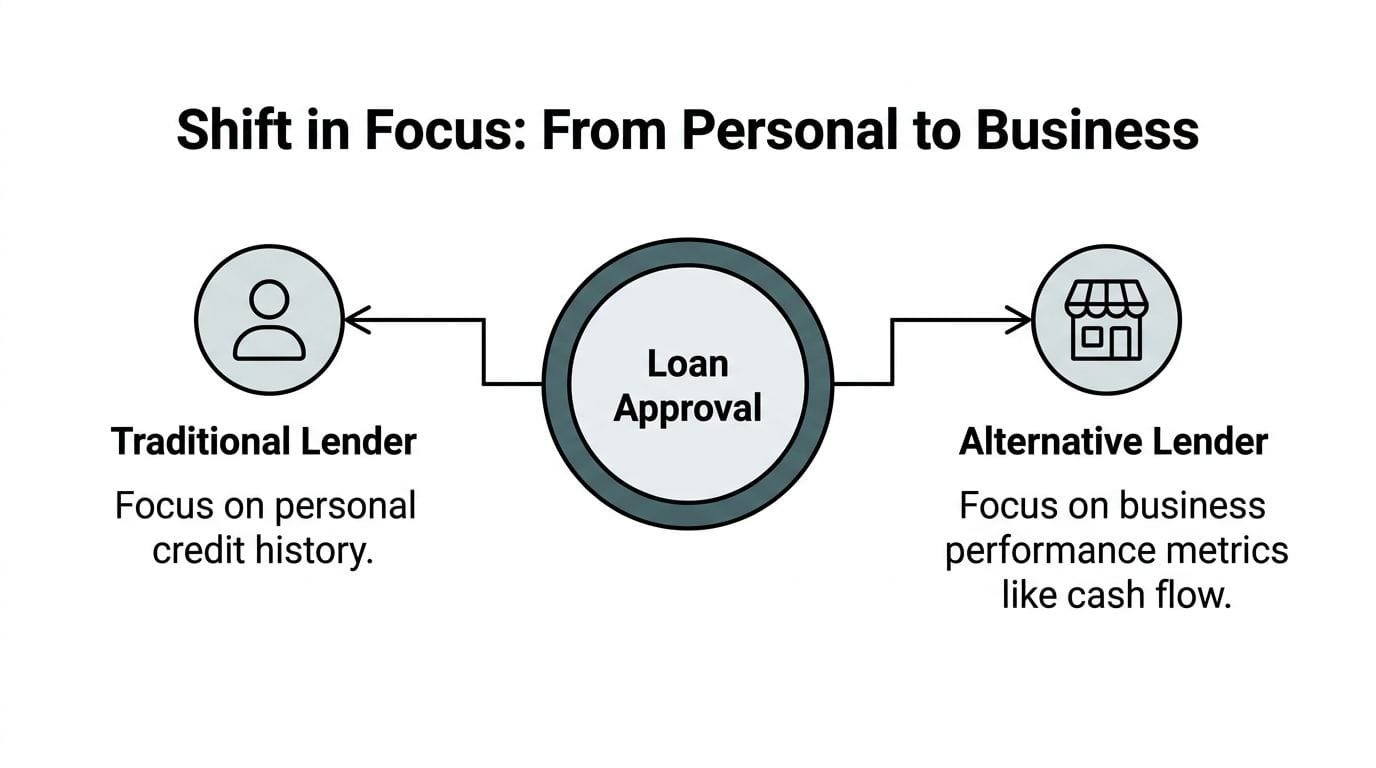
Think of underwriting as a dashboard. A traditional lender may place the owner's personal credit history in the center of that dashboard because it provides a familiar record of repayment behavior. An alternative lender may move the focus to live business indicators, including deposits, sales, invoices, and collateral.
That doesn't mean the dashboard is empty. It means the lender is watching different gauges.
Three meanings of “no credit check”
First, no hard personal credit pull means the lender may avoid an inquiry that affects the owner's credit profile. Some revenue-based products use soft-pull prequalification, so the owner can review an initial option without the same type of hard inquiry associated with a conventional application. The lender may still inspect business records and other risk information.
Second, deemphasized personal credit means the score may be considered but won't carry the same weight as business performance. A lender could still review the owner's identity, existing obligations, or public records while making the approval decision primarily from bank activity or receivables.
Third, no credit review at all is a much narrower idea. Invoice factoring can sometimes avoid a personal credit minimum because the lender focuses on the creditworthiness of the business's customers. Even then, the factoring company is reviewing risk. It's assessing whether those customers are likely to pay.
Credit checks, guarantees, and liens are separate questions
A personal guarantee is a promise that the owner will repay if the business doesn't. A lender can skip a hard personal credit check and still require that guarantee. Likewise, a UCC filing can give a lender a public security interest in specified business assets or broad business collateral. Neither issue is automatically resolved by the words “no credit check.”
SBA-style lending generally doesn't fit a true no-personal-credit-check strategy because personal guarantees remain part of the structure. A business owner who wants to avoid personal credit reliance should ask directly whether the offer includes a guarantee, a UCC filing, or both.
The same separation applies to property-backed funding. If you're exploring ways to secure property without a bank, remember that asset-based approval still involves valuation, title, lien, and repayment analysis. “No personal credit check” changes one part of the review, not the lender's need to protect its capital.
Types of Funding That May Skip Personal Credit Checks
The best product depends on the way money enters your business. Revenue advances follow sales. Factoring follows invoices. Equipment financing follows an asset. Payment-processor financing follows platform history. Treating all of them as interchangeable can lead to a repayment schedule that conflicts with your operating cycle.
| Funding Type | What Lender Evaluates Instead | Best Fit | Key Tradeoff |
|---|---|---|---|
| Revenue-based financing | Bank deposits, operating cash flow, and transaction history | Businesses with recurring or visible revenue | Payments can reduce operating cash during slow periods |
| Merchant cash advance | Card sales or other eligible receivables | Retail, restaurants, salons, and other card-heavy businesses | Speed and flexible qualification can come with high cost |
| Invoice factoring | Customer creditworthiness and invoice quality | B2B companies with unpaid commercial invoices | Customer relationships and recourse terms require careful review |
| Invoice financing | The value and collectability of outstanding invoices | Firms waiting on dependable customer payments | The advance is tied to receivables, not general growth spending |
| Equipment financing | Equipment value and the business's ability to make payments | Companies buying identifiable machinery, vehicles, or technology | The lender may repossess the asset after default |
| Payment-processor financing | Historical sales through a linked platform | Businesses selling through a processor or marketplace | Funding may be limited to platform-linked performance |
| No-credit-check business line | Cash flow and account activity, sometimes with collateral | Owners needing repeat access to working capital | Availability and terms vary, and a guarantee may still apply |
A restaurant with steady card receipts may use a merchant cash advance for a short emergency, but the same structure may be uncomfortable for a consulting firm that invoices clients and collects irregularly. The restaurant's repayment follows transaction volume. The consultant needs a product connected to invoices or a facility that can tolerate delayed billing.
Invoice factoring can suit a staffing company, wholesaler, or manufacturer that bills creditworthy businesses and waits for payment. The factor is moving the default-risk question toward the customer. If the customer has weak payment behavior or disputes the invoice, the business may not receive the expected benefit.
Equipment financing works differently. The asset supports the transaction, so the lender can focus less on the owner's personal profile than an unsecured lender might. That doesn't make the financing cheap or risk-free. The business still needs enough cash flow to make payments, and the equipment may be at risk if it defaults.
For businesses comparing revolving access, review this business line of credit without a personal credit check resource carefully. A line can be more flexible than a lump-sum advance, but “prequalified” doesn't guarantee that the final agreement will omit a hard inquiry, personal guarantee, or lien.
How Lenders Underwrite Without Your Personal Credit Score
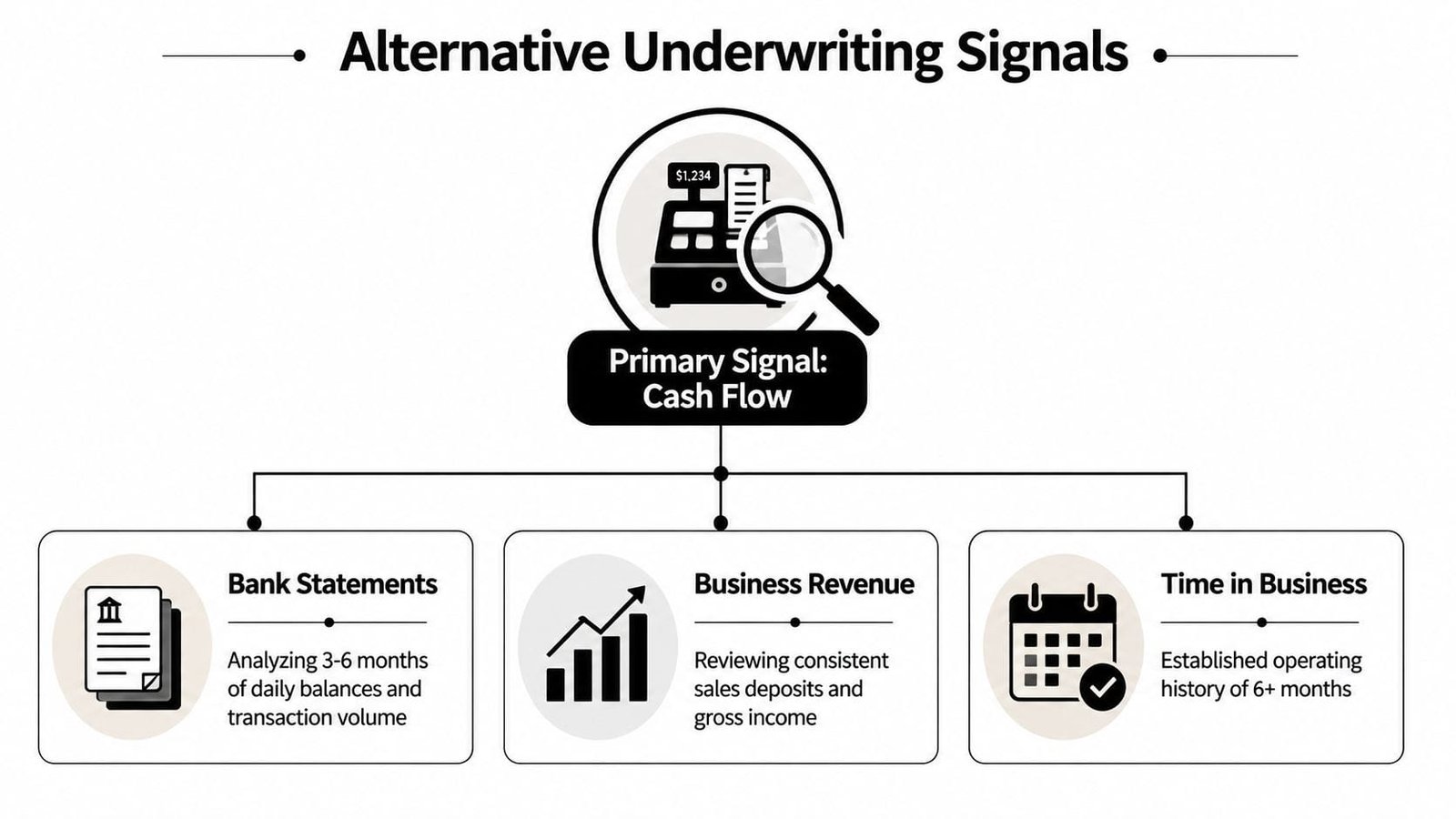
Lenders replacing personal credit with cash-flow analysis are trying to answer one question: Can the business repay this obligation from normal operations? They don't answer that question from one number. They assemble a picture from deposits, balances, expenses, obligations, and the timing of incoming cash.
The signals inside a business bank account
Bank statements show more than revenue. They can reveal whether deposits are consistent, whether balances fall sharply after payroll, whether negative-balance events occur, and whether another funder is already taking automatic payments. A business with strong gross deposits may still struggle if rent, payroll, taxes, supplier payments, and existing advances consume most available cash.
Cash-flow underwriting can also expose seasonality. A landscaping company may generate healthy deposits during its busy period but face a much thinner winter. A lender that studies only the strongest month may overestimate repayment capacity, while a lender reviewing the full operating pattern can structure a more realistic offer.
The lender may also calculate an informal or formal view of debt service coverage. In plain language, it compares cash available for repayment with the payments the business already owes and the new payment proposed. Hidden obligations matter because an offer that looks manageable before payroll can become unaffordable after payroll.
The evidence changes by product
For invoice factoring, the lender reviews invoice aging, customer concentration, disputes, payment history, and whether the customer is responsible for paying the invoice. For card-based products, the lender studies transaction volume, refund patterns, chargebacks, and the stability of the payment account. For equipment financing, it considers the asset's resale value, condition, useful life, and the business's operating history.
A bank-feed connection can let a lender analyze transaction history directly. Before granting permission, ask what accounts will be accessed, what period will be reviewed, how the data will be stored, and whether you can revoke access. Uploading statements manually gives you more control over the documents shared, but it may require additional verification.
Prepare a clean application package:
- Business statements: Gather recent business bank statements and make sure deposits can be explained.
- Revenue records: Keep sales reports, processor statements, and accounts-receivable details organized.
- Obligation list: Identify existing loans, advances, leases, tax debts, and automatic debits.
- Use-of-funds plan: Explain whether the capital supports inventory, payroll, equipment, a contract, or a temporary timing gap.
- Seasonality context: Show why high and low revenue periods occur instead of allowing an unusual month to define the business.
For a deeper explanation of lender review, use this business loan underwriting process guide. The more clearly your records show recurring repayment capacity, the less the lender has to rely on assumptions.
Pros Cons Costs and Legal Implications You Must Weigh
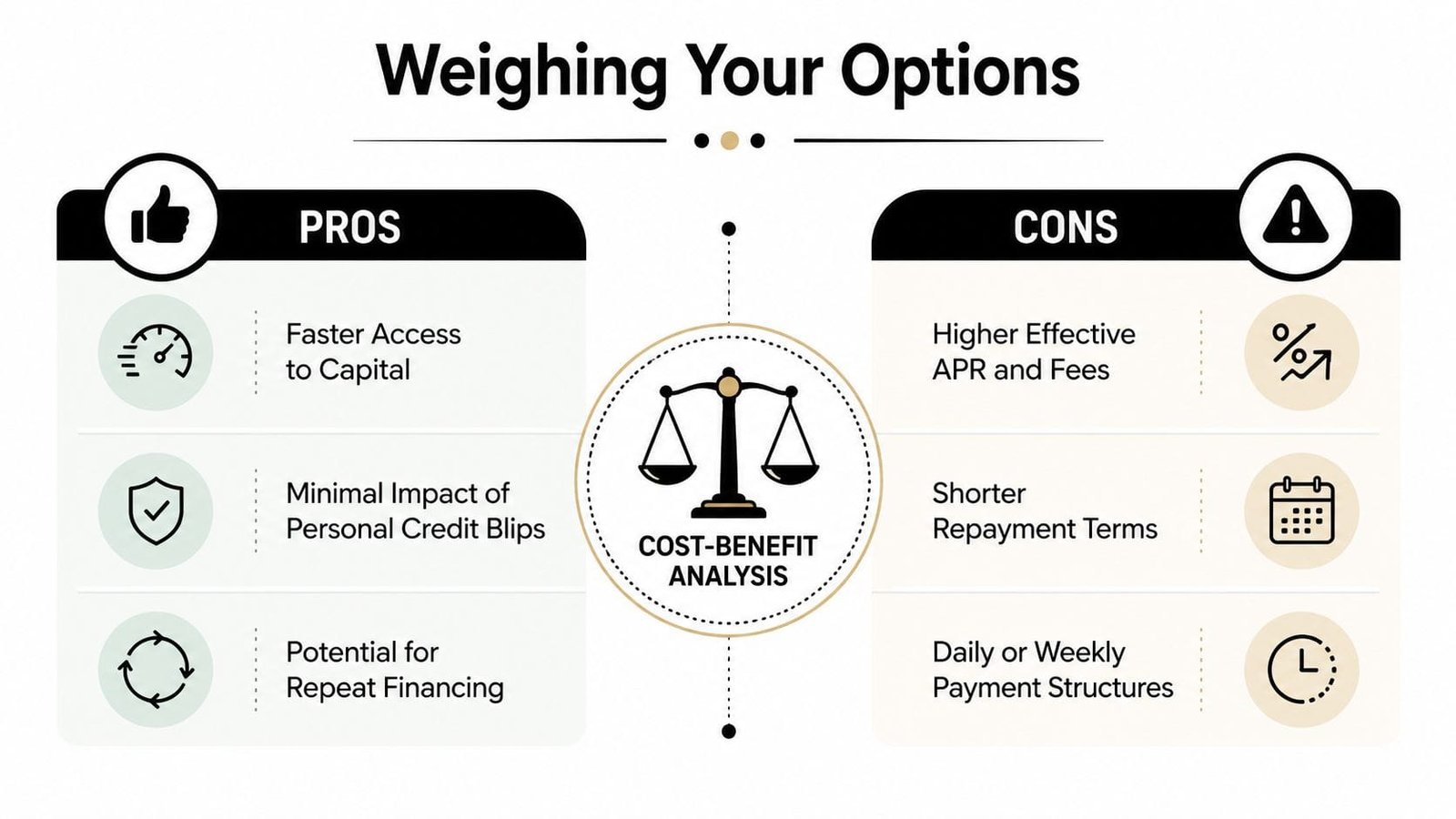
No-personal-credit-check funding can solve a timing problem, but it can also create a new cash-flow problem. The approval model is often more flexible because the lender is taking comfort from business activity, receivables, sales, or equipment. That flexibility usually comes with a higher price, less repayment time, or tighter control over incoming revenue than a conventional term loan.
Core tradeoff: You may exchange a personal-score hurdle for a business-cash-flow obligation that starts immediately.
Speed is the obvious advantage. A business can pursue working capital without making its personal score the central qualification test. A revenue-linked payment may also move with sales, which can be less rigid than a fixed installment during uneven weeks.
The risks deserve equal attention:
- Higher effective cost: Factor rates and fixed fees can obscure the cost when compared with an interest rate. Convert the offer into total dollars and ask how long repayment is expected to take.
- Short repayment windows: A short term can make the periodic payment large even when the total advance seems reasonable.
- Daily or weekly withdrawals: Frequent automated debits reduce the cash available for ordinary operating expenses.
- Margin compression: If the business already runs on narrow margins, repayment can consume money needed for labor, supplies, taxes, or maintenance.
- Limited scaling: Some products are sized around recent revenue or a specific asset, so they may not support a large expansion plan.
- Renewal dependence: A business can become reliant on refinancing or another advance if the original funding doesn't produce enough cash to repay itself.
The contract matters as much as the approval
“No personal credit check” doesn't answer whether you're personally liable. Read the guarantee language, default provisions, security agreement, and any restrictions on future financing. A UCC filing may affect how another lender views your available collateral or borrowing capacity, even if the current product doesn't appear on a consumer credit report.
Some agreements also contain aggressive default remedies, including provisions that can accelerate collection or permit legal action. A confession-of-judgment clause can carry serious consequences where enforceable, so have a qualified attorney review unfamiliar language before signing.
If your priority is specifically to avoid personal liability, compare the structure described in this business loan without a personal guarantee guide. A lender may advertise flexible credit requirements while still requiring a guarantee, so ask for a direct answer in writing.
Red Flags Compliance Issues and How to Spot Predatory Offers
Urgency makes borrowers easier to pressure. A legitimate provider can explain what it evaluates, how repayment works, what the total cost will be, and what happens if revenue declines. If the representative avoids those questions, the speed of funding isn't an advantage.
Start with the offer itself. A factor rate may be legitimate for a receivables-based product, but you still need the advance amount, total payback, fees, estimated repayment period, withdrawal frequency, and any minimum payment stated clearly. Don't compare a factor rate from one offer with an APR from another as though they measure the same thing.
Questions to ask before signing
- What is the total repayment amount? Ask for the amount in dollars, not only a rate or factor.
- What happens in a slow month? Confirm whether payments adjust with revenue or remain fixed.
- Is there a personal guarantee? Request the exact provision and identify which obligations it covers.
- Will you file a UCC lien? Ask what collateral it covers, when the filing will be released, and whether it is blanket or limited.
- Can I obtain other financing? Check for restrictions on stacking, additional liens, or future borrowing.
- Are there broker or origination fees? Make sure no fee is deducted unexpectedly from the proceeds.
- Who collects the payment? Understand whether the lender, factor, processor, or another party controls the withdrawal.
- What are the default remedies? Review acceleration, bank-account control, legal fees, and dispute provisions.
Guaranteed approval is a warning sign because every legitimate provider still has to verify identity, business activity, and repayment risk. Requests to falsify revenue, leave blanks in an agreement, send an upfront fee through an unusual payment method, or sign immediately should end the conversation.
Pay attention to “double dipping.” A provider may describe a product as revenue-based while imposing a fixed minimum that doesn't decline when sales fall. The contract should match the sales pitch.
MCA and revenue contracts can also be treated differently from conventional loans, depending on their structure and governing law. That's one reason an attorney familiar with commercial finance can be valuable before you accept an agreement that includes broad guarantees, confession-of-judgment language, or sweeping security rights.
Smarter Next Steps and Alternatives to Get Funded Faster
Begin with the funding purpose, not the advertised product. Emergency repairs, inventory tied to confirmed demand, and a temporary receivables gap may justify fast alternative funding. General expansion, permanent working capital, and debt consolidation often deserve a slower comparison because the wrong repayment schedule can weaken an otherwise healthy company.
Use this decision path:
- Map the cash source. Identify whether repayment will come from card sales, bank deposits, customer invoices, an asset, or a future contract.
- List every existing obligation. Include automatic withdrawals, leases, advances, taxes, and supplier balances.
- Set a survivable payment. Model repayment during a slow period, not only during your strongest month.
- Compare the full contract. Review total payback, fees, guarantees, UCC filings, default terms, and early-payment provisions.
- Choose the least restrictive structure that fits. Consider supplier terms, secured credit, invoice financing, equipment financing, or business-credit-building steps before accepting a costly advance.
For example, a card-heavy retailer with predictable deposits may reasonably investigate revenue-based funding for a short inventory opportunity. A professional-services firm with lumpy invoices may be better served by invoice financing or by negotiating customer deposits, rather than accepting daily withdrawals unrelated to its billing cycle.
Business Loan Warrior offers a single application that can support pre-approval review without affecting credit, secure bank-account connection, offer comparison through a dashboard, and communication with underwriters. Treat that as one comparison route, not a substitute for reading the final agreement or obtaining legal advice when the terms are complex.
Build stronger options over time by separating business and personal finances, keeping accurate books, paying suppliers on time, and asking whether vendors report business payment activity. A stronger business profile can eventually make lower-cost financing more accessible, reducing dependence on products marketed primarily around flexible personal-credit requirements.
If you're comparing business loans with no personal credit check, visit Business Loan Warrior to submit one application, review potential funding paths, and compare offers based on your business cash flow. Use the platform to organize your options, then confirm the total cost, repayment schedule, personal guarantee, and UCC terms before you sign.