
A manufacturer can own its warehouse, carry substantial equity, and still face a cash squeeze when payroll, inventory, receivables, and an expansion project arrive on different schedules. The owner may not need a large lump sum today. They may need dependable access to capital that can be drawn, repaid, and used again as conditions change.
That's where a commercial equity line of credit, often called a CELOC, can enter the conversation. It converts part of a commercial property's equity into revolving borrowing capacity, but it also places the property at risk and usually carries a variable interest rate.
For businesses in the $20 million to $50 million revenue range, the decision is rarely just “Can we qualify?” The more important question is whether a CELOC is the most sensible form of flexible capital compared with an unsecured business line, a term loan, an SBA-backed option, or a refinance.
Core idea: A CELOC can turn dormant property equity into reusable liquidity, but flexibility has a price. You need to understand both sides before pledging the building.
This guide explains how the product works, what lenders evaluate, how it compares with other financing, and where the cost and collateral tradeoffs become material. A sound decision starts with understanding the property's value and equity position, including the fundamentals covered in this guide to commercial real estate valuation.
Table of Contents
- Introduction Why Property Equity Matters for Growth
- What a Commercial Equity Line of Credit Really Is
- How a Commercial Equity Line of Credit Compares to Other Options
- How Qualification Works and What Lenders Evaluate
- Smart Ways Businesses Use a Commercial Equity Line of Credit
- True Costs Benefits and Risks to Weigh Before You Draw
- Choosing and Using Your Line With Confidence
Introduction Why Property Equity Matters for Growth
Consider an established regional distributor whose operating company owns its facility. Customer demand is strong, but several large invoices won't be collected until later. At the same time, the business has an opportunity to add inventory and renovate part of the building. A term loan could provide cash, but the owner doesn't want to borrow the full amount before knowing exactly when each expense will occur.
A commercial equity line of credit may fit that timing problem because it's designed around revolving access. The business can draw when a cash need appears, repay as receivables arrive, and preserve unused capacity for the next need. That structure differs from receiving one fixed amount and beginning scheduled principal repayment immediately.
The property creates borrowing power, but it doesn't make the facility risk-free. Lenders still examine operating cash flow, debt obligations, credit history, property condition, and the amount of equity remaining after existing liens. Owners must also consider whether a variable-rate facility could become uncomfortable during a period of weaker sales or higher expenses.
The product has become part of a broader, long-established property-backed lending environment. Federal Reserve data show that commercial banks held $278.8 billion in revolving home equity loan balances in December 2025, compared with $259.4 billion in October 2024, representing roughly 7.5% year-over-year growth in that public banking proxy for revolving property-backed credit (Federal Reserve balance data summarized by HEL News).
The purpose of a CELOC isn't to maximize borrowing. It's to give an operating company room to manage uneven cash flow without repeatedly refinancing. Used carefully, it can support growth. Used casually, it can tie a core business asset to short-term spending and expose the owner to rate and refinancing pressure.
What a Commercial Equity Line of Credit Really Is
The simplest analogy is a credit card secured by commercial real estate. A lender approves a maximum limit based partly on the equity in a warehouse, office, retail property, industrial building, or other eligible commercial asset. The company then draws only the amount it needs rather than taking the full approved limit at closing.
The revolving structure works in four connected steps:
- The lender establishes a limit. The limit reflects property value, existing debt, borrower strength, and the lender's risk requirements.
- The business draws funds. It can use the line for an approved business purpose, subject to the facility's terms.
- The business repays the balance. Interest generally applies to the amount outstanding, not the unused portion.
- Available capacity returns as principal is repaid. That replenishment is what makes the facility revolving.

The pieces that determine how it behaves
Property value is the starting point, but it isn't the same as borrowing capacity. Equity generally means the property's value minus mortgages and other liens. The lender then applies its own limit, often using a credit-limit loan-to-value benchmark around 70% to 75%, as described in commercial equity line guidance from Agora Real.
The facility may have a draw period, when the borrower can access funds, followed by a repayment period with different payment requirements. The exact arrangement varies by lender, so an owner should confirm whether the line remains available throughout repayment, how the rate resets, and whether a balloon payment or refinance will be required.
A CELOC isn't a commercial term loan. A term loan delivers a lump sum, usually with a defined amortization schedule. It also isn't automatically the same as a residential HELOC. Commercial properties, business finances, documentation, covenants, and lender policies can make underwriting more involved.
The value of a CELOC is not the approved limit sitting on paper. It's the ability to match borrowing with the timing of the business need.
For working capital, that distinction matters. If cash needs rise and fall, drawing the full amount upfront can create unnecessary interest expense and repayment obligations. A revolving facility can preserve flexibility, provided the business maintains enough cash flow to handle changing payments.
How a Commercial Equity Line of Credit Compares to Other Options
A CELOC makes the most sense when a business has meaningful commercial property equity and needs reusable liquidity. An unsecured line may be easier to understand and avoids putting real estate directly at risk, but the lender has less collateral protection and may price or size the facility differently. A term loan is often more predictable for a defined project, while a refinance can reorganize existing property debt rather than provide a revolving reserve.
| Feature | Commercial Equity Line of Credit | Unsecured Business Line of Credit | Commercial Term Loan |
|---|---|---|---|
| Collateral | Commercial property equity | Usually no specific property collateral | May be secured by property, equipment, or other assets |
| Funding structure | Revolving draws up to an approved limit | Revolving draws up to an approved limit | One lump-sum disbursement |
| Repayment | Payments change with the balance and terms | Payments change with the balance and terms | Scheduled payments over a defined term |
| Rate type | Often variable | May be variable or fixed, depending on the lender | Fixed or variable |
| Best use | Uneven working capital, expansion liquidity, or recurring needs | Short-term operating needs when avoiding property collateral matters | A known project with a clear total cost |
| Primary risk | Property exposure and rate changes | Potentially higher pricing or smaller capacity | Paying interest on funds before they're needed |
What the tradeoff means in practice
A property-backed line can offer a larger borrowing base than an unsecured facility because the lender can look to the building as collateral. That advantage comes with a serious consequence: missed payments can place the property at risk. An unsecured line may protect the building, but it can require stronger cash flow, tighter limits, or different pricing.
A commercial term loan can be preferable when the company knows the exact cost of an expansion, equipment purchase, or construction project. The business receives the money once and repays it on a planned schedule. The drawback is reduced flexibility if the project changes or costs arrive gradually.
A commercial refinance may be more appropriate when the primary goal is to replace existing real estate debt, alter its maturity, or access equity in a larger one-time transaction. It may not offer the same draw-and-repay convenience as a CELOC.
Owners comparing unsecured products can also review a practical guide to the best line for broader context. The right choice depends on more than the headline rate. Compare collateral, draw rules, fees, repayment mechanics, covenants, and what happens if the business needs the facility longer than expected.
How Qualification Works and What Lenders Evaluate
A company may own a valuable building and still fail to qualify for a commercial equity line of credit. Lenders assess two connected questions: how much usable collateral supports the request, and whether the operating business can repay debt as conditions change. For a $20M-$50M business, that review also helps compare a property-backed line with an unsecured facility or term debt when rates are variable.
Collateral strength
The lender starts with a recent appraisal or another accepted valuation. It reviews mortgages, liens, property type, physical condition, occupancy, tenant concentration, and how easily the property could be sold. A mixed-use building may receive closer scrutiny if the owner occupies only part of it, because residential and commercial areas can have different income, valuation, and market risks.
Appraisal recency can affect the advance rate. An older valuation may lead the lender to request an update, especially if local conditions or the property itself have changed. The approved line also reflects existing debt, which uses part of the available borrowing capacity. As covered in the earlier LTV discussion, the lender does not normally advance against the entire appraised value.
Owners should review the company's overall borrowing position before applying. A tool to calculate debt to equity ratio can support an initial review, although the lender will use its own definitions and underwriting standards.
Cash flow health
Repayment capacity is the second pillar. Underwriters may examine business and personal credit, revenue consistency, operating history, tax returns, financial statements, bank activity, existing obligations, and ownership information. They want evidence that ordinary operations can support payments, rather than a plan dependent on selling the property or refinancing later.
Many commercial lenders look for a DSCR of about 1.25x, meaning annual net operating income or operating cash flow should exceed annual debt service by at least 25% (commercial lending discussion on BiggerPockets). Requirements vary by lender and borrower profile. A cash-flow cushion matters because collections may slow, costs may rise, and a variable line rate may increase.

Prepare property records, debt schedules, financial statements, tax filings, ownership details, and a clear use-of-funds explanation. Line of credit eligibility guidance can provide a broader documentation checklist.
Smart Ways Businesses Use a Commercial Equity Line of Credit
A CELOC is most useful when the need is real but the timing is uneven. A regional food distributor, for example, may draw to purchase inventory before a large customer payment arrives, then repay the balance after collections. The revolving structure fits the gap better than borrowing a permanent lump sum for a temporary need.

A coffee business that owns its premises might use the line for a renovation that proceeds in stages. It could draw for contractor deposits, equipment, fixtures, and final work as invoices arrive. A term loan may still be better when the renovation has a fixed budget and a predictable completion schedule, but a CELOC can reduce the pressure to borrow every dollar at the beginning.
Other operating situations may fit for different reasons:
- Receivables bridging: A service company can use available credit while waiting for customers to pay approved invoices. The repayment plan should rely on realistic collection timing, not optimistic assumptions.
- Equipment purchases: A company may use a line for an urgent replacement when the amount and timing aren't suitable for a separate equipment loan. A dedicated equipment facility may be preferable when the purchase is large and clearly defined.
- Expansion preparation: A multi-location operator can preserve liquidity for leases, build-out costs, hiring, or inventory while deciding which opportunities will proceed.
- Higher-cost debt management: Refinancing expensive short-term obligations may reduce payment pressure, but the owner must not convert unsecured debt into property-secured debt without carefully weighing the consequence.
For a $20 million to $50 million business, the key question is whether the line supports a repeatable operating cycle. If the company is cyclical, expanding rapidly, or already carries significant real estate debt, a CELOC may create more risk than flexibility.
A short visual explanation can reinforce the draw-and-repay structure:
True Costs Benefits and Risks to Weigh Before You Draw
The stated interest rate is only one part of CELOC pricing. Owners should ask about the index, margin, rate-reset frequency, minimum payments, unused-line fees, draw fees, appraisal expenses, legal charges, closing costs, and any early termination terms. A line that appears inexpensive at approval can become less comfortable if the variable rate rises while operating margins narrow.
The main benefit is liquidity without repeated refinancing. The business can draw only what it needs, pay interest on the drawn balance, and restore available capacity by repaying principal. That can make the facility more efficient than borrowing a full lump sum for expenses that will occur over time.
The main risk is the connection between business performance and property ownership. A business that misses payments may put a warehouse, office, or other commercial asset at risk. Pledging that asset can also reduce future borrowing capacity because another lender will see the existing lien and associated debt.
Federal Reserve data show that commercial real estate loans at U.S. commercial banks reached $3.119 trillion in July 2026, while the delinquency rate on commercial real estate loans was 1.53% in the second quarter of 2026 (Federal Reserve commercial real estate loan series). Those figures show a large active collateral market alongside measurable credit stress. They don't predict an individual borrower's result, but they help explain why lenders continue to monitor property values, cash flow, and financial risk carefully.
A flexible line can solve a timing problem, but it can't solve a permanently unprofitable business model.
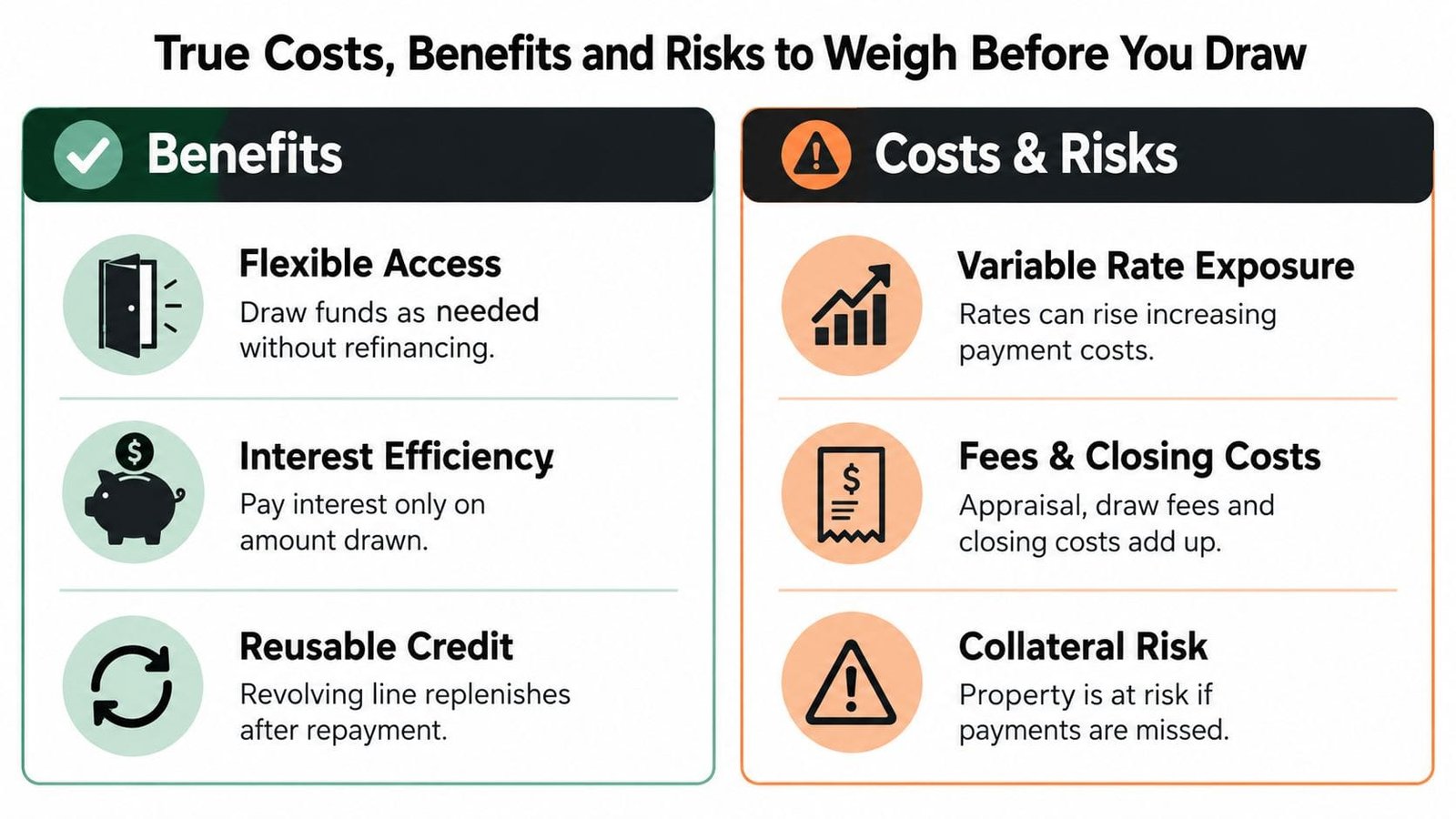
Before signing, model a range of rate and revenue conditions. Review the pros and cons of a business line of credit alongside the specific CELOC offer, because a generic benefit such as “pay interest only on what you use” doesn't capture fees, collateral exposure, or the possibility of a mandatory refinance later.
Choosing and Using Your Line With Confidence
A CELOC may be a strong fit when your business owns valuable commercial property, maintains dependable cash flow, needs recurring access rather than one lump sum, and can tolerate variable-rate exposure. An unsecured line may be safer for the property when the required limit is modest. A term loan may fit a defined project, while an SBA-backed option may deserve consideration when its structure and eligibility better match the company's purpose.
Use a simple decision filter:
- Match the structure to the need: Use revolving credit for recurring or uneven expenses, and term debt for a known project.
- Protect the property: Don't pledge a core building unless repayment remains realistic under less favorable operating conditions.
- Price the whole facility: Compare the margin, resets, fees, covenants, draw rules, and repayment period, not just the starting rate.
- Preserve capacity: Avoid drawing for expenses that don't generate a credible operating return or improve cash-flow resilience.
- Review alternatives: Compare secured and unsecured offers before accepting the first approval.
A lender may evaluate the same company differently depending on its property, debt structure, revenue stability, and intended use. Gather the documents early, ask how the line behaves after the draw period, and have your finance team test the payment under higher-rate conditions.
Business Loan Warrior offers business lines of credit and other financing paths through a single application process, giving owners a way to compare potential funding options for working capital and growth. Visit Business Loan Warrior to review available pre-approval options and determine whether a commercial equity line or another structure better fits your company's cash-flow needs.