
The most popular advice about equipment loans rates is also the least useful: find the lowest advertised APR. That number rarely tells you what your business will pay. Two companies with similar credit profiles can receive materially different quotes because one is buying a late-model commercial truck with a strong resale market, while the other needs a specialized machine that a lender may struggle to liquidate.
Your quote reflects three pricing layers. The first is the benchmark-rate environment. The second is the equipment's collateral quality, including resale value, depreciation, and market demand. The third is the speed premium attached to lenders willing to approve and fund quickly. A smart borrower doesn't chase a headline rate. A smart borrower puts the deal in the right lending channel, then compares APR, term, down payment, fees, and funding time together.
Table of Contents
- Why Published Rate Ranges Mislead Most Borrowers
- Current Equipment Loans Rates by Lender Type
- The Speed Versus Cost Tradeoff in Equipment Financing
- How Equipment Type and Collateral Quality Shape Your Rate
- Actionable Steps to Qualify for Lower Equipment Loan Rates
- Real Payment Scenarios Across Rate and Term Combinations
- Getting Competitive Equipment Financing Offers Through Business Loan Warrior
Why Published Rate Ranges Mislead Most Borrowers
A broad APR range can create false confidence. It suggests that equipment financing has one market price, when lenders price the borrower, the asset, and the transaction structure at the same time. A strong applicant buying easily resold equipment may receive a conventional quote near the lower end of the market, while an equally qualified owner financing specialized or used equipment may face a materially higher rate.
That spread isn't explained by credit score alone. Current market commentary places conventional equipment loans around 9.0% to 12.0%, SBA 7(a) equipment financing around 9.5% to 12% APR, and qualified bank equipment loans around 6.5% to 9.5%. The same source reports promotional captive financing from 0% to 8% on select offers, while alternative lenders can reach 20% or more, with some cases reaching 26% (2026 equipment financing rate survey).
The three layers inside your quote
Benchmark pricing sets the starting point. Lenders generally price equipment loans as a spread over broader market rates, so changes in prime and other benchmarks affect even strong borrowers. One 2026 industry commentary placed U.S. prime at approximately 7.5% in June 2026, compared with roughly 3.25% in early 2022, helping explain why top-tier equipment pricing had risen toward 7% rather than the sub-5% levels seen before the tightening cycle (industry commentary on typical equipment financing rates).
Collateral quality determines how much protection the lender has if you default. A lender can recover more predictably from a common commercial vehicle than from a niche machine with few potential buyers. Assets with uncertain resale value usually bring larger down-payment requirements, shorter terms, or higher APRs.
Execution speed creates another premium. SBA-backed structures may offer attractive long-term economics, but their documentation and approval process can take longer. Online and alternative lenders often move faster, but they price that convenience into the loan.
Practical rule: Don't compare a bank's fully underwritten quote with a fast lender's preliminary offer until you've matched the term, collateral requirements, fees, and funding timeline.
You should also separate the interest rate from the APR. The difference between APR and interest rate matters because fees and financing costs can raise the true annual cost even when the stated rate looks competitive. Ask every lender for the total repayment amount and an amortization schedule, not just the percentage printed on the proposal.
Current Equipment Loans Rates by Lender Type
Published lender ranges are useful for orientation, not prediction. Two businesses with identical credit profiles can receive materially different APRs because the lender is pricing the equipment's resale value, the repayment structure, and the cost of delivering funds quickly. Those factors can create a spread of 15% or more between offers.
The 2026 benchmarks separate the main channels. Traditional banks commonly quote 7.0% to 12.5% APR for highly qualified businesses. Credit unions often fall around 6.75% to 11.75%, online lenders around 8.5% to 25.0% or higher, and SBA-linked financing commonly prices at Prime plus 2.75% to 4.75% (equipment financing benchmark report).
| Lender Type | APR Range | Typical Term | Best For |
|---|---|---|---|
| Traditional banks | 7.0% to 12.5% | Structured around asset life and borrower strength | Established businesses with strong financials and patience for underwriting |
| Credit unions | 6.75% to 11.75% | Structured around the equipment and repayment capacity | Qualified owners seeking competitive relationship-based pricing |
| SBA-linked programs | Prime + 2.75% to 4.75% | Often longer amortization than conventional options | Businesses prioritizing repayment structure and lower monthly strain |
| Online and alternative lenders | 8.5% to 25.0% or higher | Often shorter or more flexible | Owners prioritizing speed, accessibility, or flexible underwriting |
How each channel prices risk
Banks typically require clean financial statements, dependable cash flow, manageable debt, and equipment they can value confidently. Credit unions may price well when the borrower has an established relationship and the asset fits their policy. Both can increase pricing for specialized equipment with a thin resale market, even when the borrower looks strong on paper.
SBA structures can improve repayment flexibility, but a longer term does not guarantee the lowest APR. SBA 504 CDC financing has been quoted around 5.50% to 6.50% with 10 to 25 year terms, while SBA 7(a) equipment loans have commonly appeared around 9.5% to 13.25% with terms up to 10 years (2026 equipment financing commentary). The tradeoff is more documentation and slower execution.
A fast lender charges for speed. That premium may be justified when equipment must be installed immediately, but compare the added interest with the revenue the asset can produce. For a slower purchase, give a bank or credit union time to underwrite the collateral properly.
Restaurants and hospitality operators should assess lenders that understand kitchen assets. This overview of Silverchef financing for kitchen gear offers context for comparing specialized funding structures.
Before applying, use a guide to equipment financing lenders to identify providers that finance your asset category. Build a short list around collateral fit, then compare APR, fees, term, down payment, and funding timeline.
The Speed Versus Cost Tradeoff in Equipment Financing
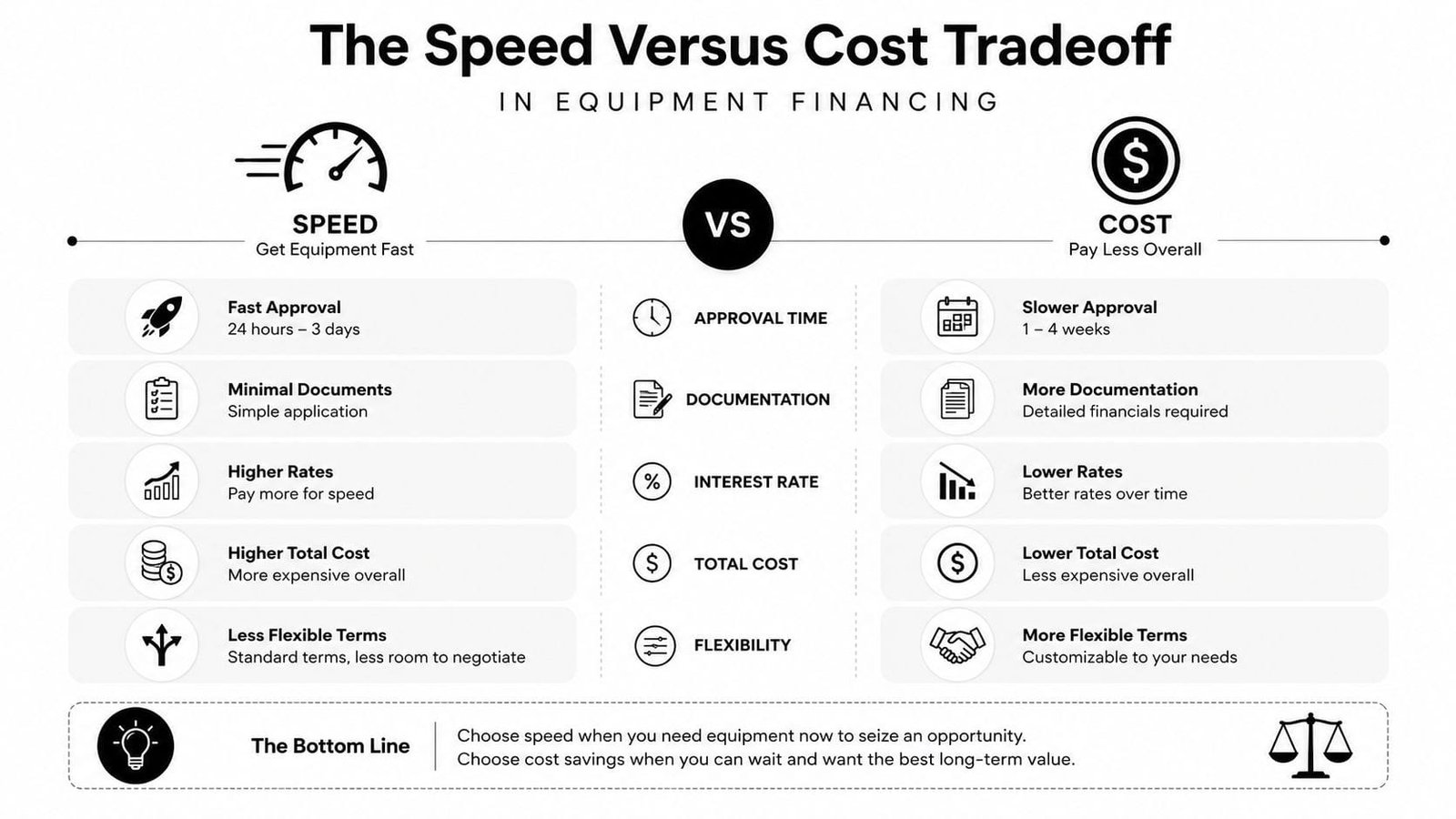
The cheapest loan is not always the cheapest business decision. If a delayed equipment purchase prevents you from accepting a profitable contract, serving a peak season, or replacing a failing production asset, waiting for a lower APR can cost more than the interest savings.
SBA-backed financing often offers a stronger long-term structure, especially where a longer amortization improves cash flow. The drawback is a heavier documentation process and slower execution. Conventional lenders sit between SBA and fast online funding, with pricing and speed depending heavily on the borrower's financial presentation and the equipment itself. Alternative lenders can approve faster, but their pricing may rise from roughly 8% to 25% or higher (equipment financing rate and speed commentary).
When a higher rate makes sense
Start with the opportunity, not the loan. Estimate the incremental gross profit the equipment can produce during the waiting period. Then compare that amount with the additional interest and fees attached to the faster option.
A rate premium can be rational when:
- The contract has a deadline: You'll lose the work if the equipment isn't operational in time.
- The asset replaces a bottleneck: Existing capacity is limiting production, billable work, or customer orders.
- The equipment protects revenue: A replacement vehicle or machine keeps an active operation running.
- The opportunity is seasonal: Missing the operating window may delay revenue until the next cycle.
The calculation should include more than monthly payment. Compare the faster loan's total repayment with the expected profit generated by earlier deployment. If the equipment can't produce enough cash to cover the premium, speed is expensive convenience, not strategic financing.
Structure matters as much as APR
A lower rate with a large down payment can strain liquidity more than a higher rate with a smaller upfront contribution. Likewise, a long term can reduce the monthly payment while increasing total interest and leaving the business paying for equipment after its useful life.
Market commentary has also pointed to 60-month A-credit structures around 7.5% to 9.25% and a modestly lower 2- to 5-year rate curve, but those structures still need to be matched against asset life and operating cash flow (equipment financing rate guidance). Ask lenders to quote the same amount, same term, same down payment, and same fee assumptions. Otherwise, you're comparing different products, not different lenders.
How Equipment Type and Collateral Quality Shape Your Rate
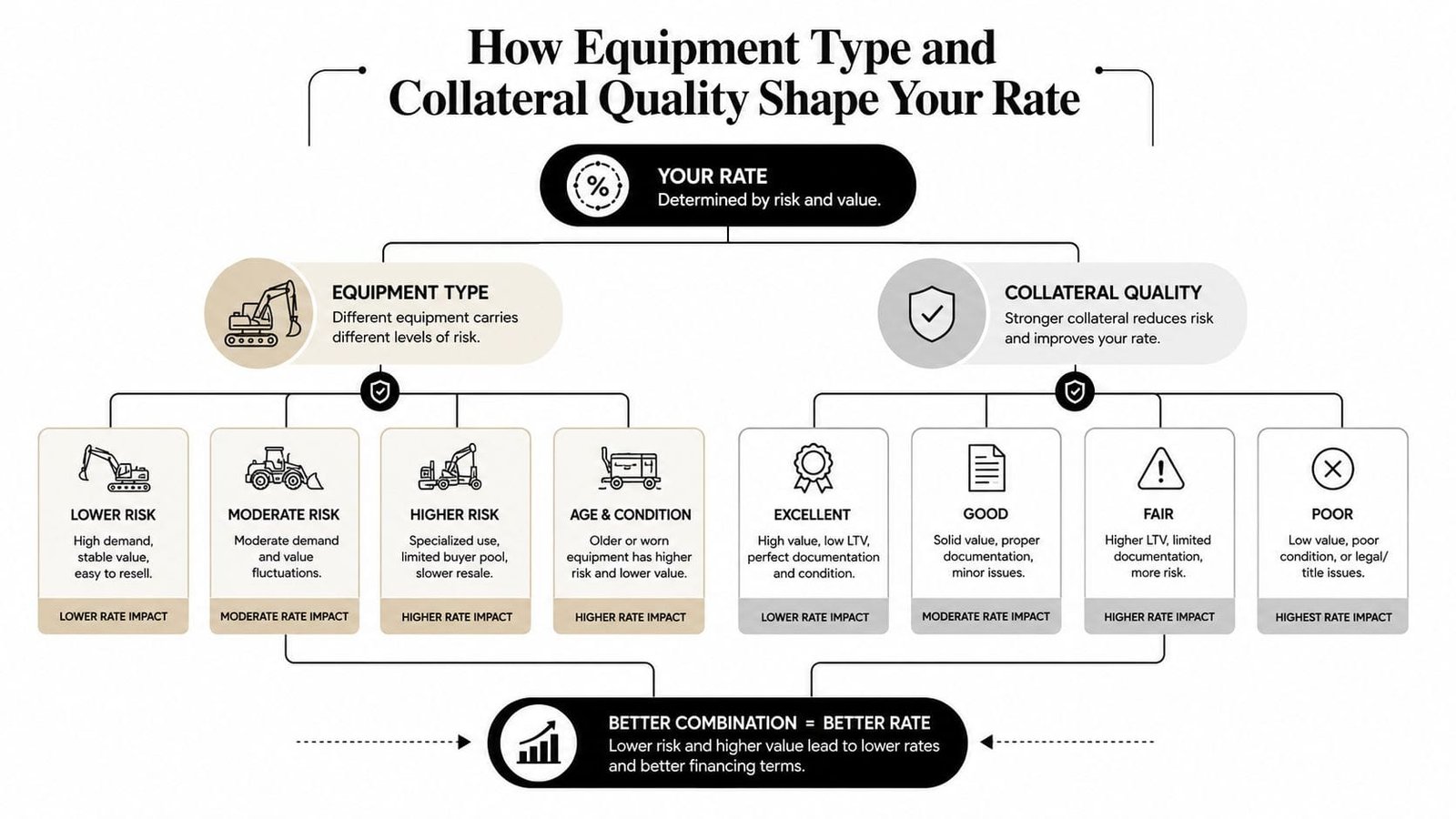
Equipment type can create a 15% or greater APR spread between otherwise similar borrowers. Lenders price the asset's resale risk, not just your credit profile. The key question is simple: if the borrower defaults, how confidently can the lender resell the asset at a predictable value?
A late-model commercial truck has a recognizable market, established buyers, and observable pricing. A standard restaurant equipment package remains usable collateral, but individual items may depreciate quickly and prove difficult to remove or resell. A specialized CNC machine can generate substantial value for the right operator while attracting few buyers outside its narrow market.
Recent coverage places mainstream bank or captive financing around 4.99% to 9.50%, while used or specialized equipment can reach 12% to 22%. Narrow resale markets may also lead lenders to require larger down payments, as outlined in this equipment financing guide on collateral and pricing.
A practical collateral test
Classify the equipment before requesting quotes. That classification helps you predict the lender's exit options and challenge an unnecessarily wide rate spread.
Tier one assets have broad demand, transparent secondary pricing, and straightforward resale. Commercial vehicles, common construction equipment, and widely used production assets may qualify when they are in good condition and properly documented.
Tier two assets have value but require a narrower buyer search. Restaurant packages, industry-specific vehicles, and older machinery often receive more conservative terms because the lender has fewer resale options.
Tier three assets are highly specialized, heavily modified, obsolete, or difficult to transport. These deals commonly require stronger borrower support, more equity, additional collateral, or a lender with sector expertise.
Credit still sets the starting point. Well-qualified borrowers generally receive the lowest available pricing, fair-credit borrowers pay more, and higher-risk alternative files can exceed 25% APR, according to equipment loan rates by industry. Strong credit cannot fully offset weak collateral.
For excavators, loaders, cranes, and similar assets, compare lenders experienced with heavy equipment loans. Their ability to value and liquidate the equipment can matter as much as your score, especially when funding speed limits the lender's time to verify condition and resale demand.
Actionable Steps to Qualify for Lower Equipment Loan Rates
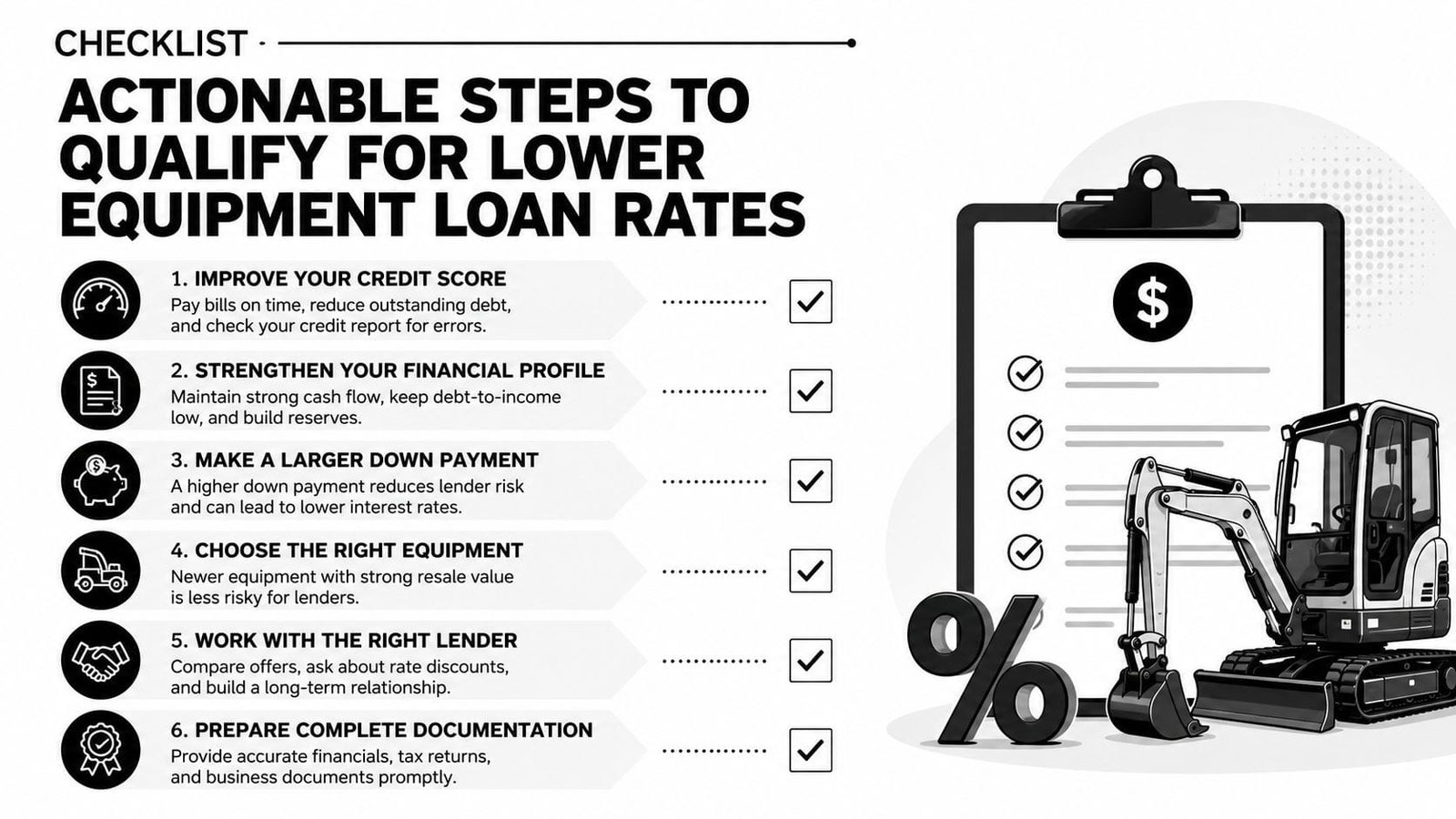
Lower pricing comes from reducing uncertainty. Give the lender a clean view of repayment capacity, contribute enough equity to show commitment, and make the asset easy to value. Start preparing before you need the equipment.
Begin well before the application
Review business credit: Check commercial credit files for inaccurate balances, outdated defaults, or inconsistent business identifiers. Resolve errors before underwriting begins. A lender can't price a problem correctly if the file contains avoidable inaccuracies.
Organize financial statements: Prepare recent profit-and-loss statements, balance sheets, business tax returns, bank statements, existing debt schedules, and a clear equipment quote. Make the lender's job easy. Missing documents create delays and can weaken confidence even when the underlying business is sound.
Explain the equipment's economics: Show what the asset will do. Tie the purchase to production capacity, contract fulfillment, route expansion, replacement needs, or operating efficiency. Don't rely on a vague growth narrative.
Structure the transaction deliberately
Use a sensible down payment: More equity can reduce the lender's exposure and improve the overall structure, particularly for used, specialized, or rapidly depreciating assets. Don't drain working capital to chase a lower rate. Liquidity keeps the business stable after closing.
Match the term to useful life: A long amortization can reduce monthly strain, but the business shouldn't still be paying for an asset after its productive value has materially declined. Ask for multiple terms and compare total repayment.
Shop by collateral fit: Send the same equipment description and financial package to a bank, credit union, equipment specialist, and appropriate alternative lender. A lender that understands your asset may beat a lender with a lower advertised range but a poor collateral appetite.
Use the final week wisely
Confirm the purchase invoice, serial numbers, condition, seller information, insurance requirements, and lien position. Ask for a written proposal showing APR, payment schedule, fees, down payment, prepayment terms, and total repayment. If a lender won't provide that information, you don't have a complete quote.
Timing matters, too. Rate environments change, but you can't control benchmark markets. You can control whether your application is complete, your statements reconcile, and your requested structure makes sense.
Real Payment Scenarios Across Rate and Term Combinations
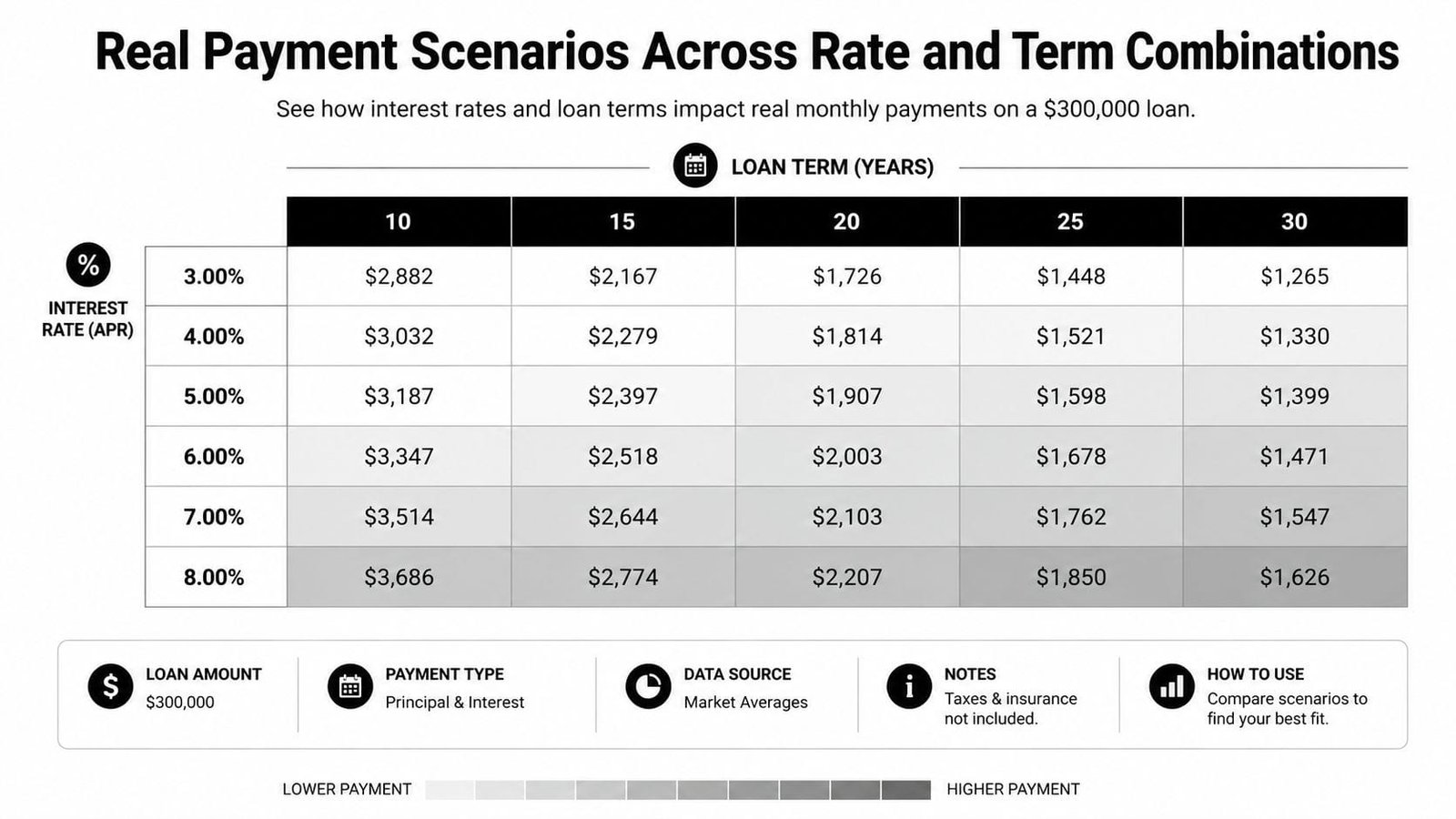
A quoted APR matters only after you convert it into cash flow and total repayment. Identical borrower profiles can still receive materially different economics because equipment type, resale value, and funding speed affect the lender's risk. Compare the full structure, not the rate displayed at the top of the proposal.
One credit union example shows how payment figures work. At 9.5% APR, the quoted payment is $12.94 per $1,000 borrowed over 120 monthly payments (equipment loan rate and payment example). Treat that figure as a starting point. Review total interest, fees, expected asset life, and whether the equipment will produce cash throughout the repayment period.
Three ways to think about the payment
For a $50,000 restaurant equipment package, start with useful life and resale value. A longer term can preserve monthly cash flow, but it should not leave the owner paying for appliances or fixtures after their productive value has declined. Compare a bank or captive offer with a specialized hospitality lender. Include installation, delivery, and required upgrades in the financing analysis.
For a $150,000 construction vehicle, utilization controls the decision. If the truck or machine supports contracted work, calculate the cash contribution from those jobs before choosing the term. A slightly higher APR can make sense when faster funding puts the vehicle to work sooner, provided the added profit exceeds the financing premium.
For a $300,000 manufacturing machine, even a modest rate difference can materially change repayment over a long amortization. Require each lender to show the monthly payment, total interest, final maturity, prepayment treatment, and any balloon obligation. Approve the structure only after reviewing those figures together.
Run your own comparison
Use a loan calculator or spreadsheet with identical inputs for every proposal:
- Principal: The amount financed after down payment and eligible fees.
- APR: The complete annual cost, not merely the note rate.
- Term: The number of monthly payments.
- Total repayment: Principal plus interest and finance charges.
- Asset life: The period during which the equipment should generate useful operating value.
A lower payment may reflect a longer term rather than a cheaper loan. A lower APR may require more cash upfront. Choose the structure that preserves liquidity, matches the asset's productive life, and keeps total cost acceptable. That comparison exposes the hidden premium attached to weak resale value or rushed funding.
Getting Competitive Equipment Financing Offers Through Business Loan Warrior
Once you understand how lenders price the asset, credit profile, structure, and speed, the practical problem is comparison. Most owners don't want to complete separate applications with every bank, credit union, equipment specialist, SBA lender, and alternative provider.
Business Loan Warrior offers a single, no-fee application for businesses seeking funding, including equipment purchases. The platform can support pre-approval without affecting credit, connect financial accounts, provide a secure dashboard, and give borrowers a way to communicate with underwriters. Available financing categories include SBA processing, conventional equipment loans, lines of credit, short-term financing, and other business funding structures.
The value is not a promise of one universal rate. The value is putting a specific transaction in front of financing channels that can assess the borrower, equipment type, collateral quality, and required timeline together. That's the only reliable way to compare an attractive long-term loan with a faster, more expensive option.
Owners should also evaluate supplier pricing separately from financing. A resource covering MA Hydraulics pricing strategies can help frame the equipment purchase itself, including how vendor pricing and financing decisions interact. A cheaper asset can improve the financing profile, but poor equipment quality can create maintenance and resale problems later.
The right quote is the one that fits your cash flow, asset life, and deadline, not simply the one with the smallest advertised APR.
Submit one no-fee application through Business Loan Warrior to compare equipment financing options suited to your asset, credit profile, and funding timeline. Ask for complete proposals showing APR, payment, term, fees, and total repayment before you commit.