
Cash flow management is the process of tracking, analyzing, and optimizing when money enters and leaves a business so enough liquid cash is available for obligations and growth. In 2024, 43% of small businesses reported cash-flow-related financial challenges, while the median small business held only 27 days of cash buffer.Federal Reserve and JPMorgan Chase Institute benchmark summary
You can have signed contracts, strong sales, and a profitable income statement, yet still stare at your bank balance wondering how payroll will clear. A customer may pay after your supplier invoice is due. Inventory may sit on a shelf while rent and wages leave the account every week. That gap between accounting profit and available cash is where otherwise healthy businesses get hurt.
Cash flow management closes that gap. It gives you a working view of when cash will arrive, when it must leave, and what you can change before the two schedules collide. It isn't a bookkeeping afterthought. It's an operating discipline that affects purchasing, hiring, pricing, collections, borrowing, and growth decisions.
Table of Contents
- The Cash Flow Reality Every Business Owner Faces
- How Cash Flow Actually Works Inside Your Business
- Key Metrics and Statements You Need to Monitor
- Common Cash Flow Problems That Catch Owners Off Guard
- Practical Strategies to Manage and Improve Cash Flow
- Real-World Warning Signs and When Financing Makes Sense
- Building Your Cash Flow Management Action Plan
The Cash Flow Reality Every Business Owner Faces
A contractor completes a profitable project, sends the invoice, and waits weeks for payment. Payroll, fuel, rent, subcontractor bills, and taxes are due first. The income statement looks healthy while the checking account is nearly empty.
That timing mismatch causes many cash crunches. Profit measures performance over an accounting period, while cash flow measures liquidity at a specific time. Revenue can be recorded before money reaches the bank, and expenses can become obligations before the related payment arrives. Owners who monitor only sales and profit miss the immediate question: “Will enough cash be available when this bill is due?”
What cash flow management means in practice
Cash flow management gives you a current view of four operating realities:
- Cash inflows: Customer payments, deposits, financing proceeds, asset sales, and other money entering the business.
- Cash outflows: Payroll, rent, supplier payments, taxes, loan payments, equipment purchases, and operating expenses.
- Timing gaps: The days between committing to an expense and collecting the revenue expected to cover it.
- Available liquidity: Cash you can use now, excluding unpaid invoices and optimistic sales forecasts.
Use that information before month-end, not only when preparing a report. A forecasted shortage gives you time to collect an overdue invoice, delay a nonessential purchase, adjust an order quantity, negotiate with a vendor, or arrange financing. Waiting until the account is nearly empty removes those choices and makes every solution more expensive or disruptive.
Practical rule: Treat cash dates as seriously as profit targets. A profitable sale that pays late can still create an immediate operating problem.
Why the problem matters to small businesses
As noted earlier, Federal Reserve and JPMorgan Chase Institute data show that many small businesses face cash-flow pressure while operating with a limited cash buffer. That leaves little room for a delayed customer payment, an unexpected repair, or a sudden inventory requirement.
Cash flow management acts as an operating control system. It connects the sales pipeline to receivables, purchasing plans to payables, and staffing decisions to the bank balance. Review those connections on a regular schedule, then act before the dates collide. A profitable business can still run out of cash, but owners who manage timing directly are less likely to treat the shortfall as a surprise.
How Cash Flow Actually Works Inside Your Business
Cash moves through a business like water through connected pipes. Customers feed money into one end, while suppliers, employees, landlords, lenders, and tax authorities draw it out. A business can have plenty of water moving through the system overall and still run dry at a particular outlet if the inflow arrives too slowly.
The cash conversion cycle, or CCC, measures how long cash remains tied up between paying suppliers and collecting customer receipts. Its standard formula is:
CCC = Days Inventory Outstanding + Days Sales Outstanding − Days Payable Outstanding
The SCORE cash flow basics guide explains how these components isolate different operating levers that affect liquidity.
The three timing levers
Days Inventory Outstanding measures how long cash remains invested in inventory before products are sold. Overstocking traps money in items that haven't produced a customer payment. Understocking creates a different problem, because missed sales can weaken future inflows.
Days Sales Outstanding measures how long it takes to collect after making a sale. Slow invoicing, unclear terms, billing disputes, and weak follow-up all lengthen this part of the cycle. You may have earned the revenue, but you can't use it until the customer pays.
Days Payable Outstanding measures how long the business takes to pay suppliers. Extending terms responsibly can preserve cash while receivables come in. Paying late without agreement damages trust, risks supply interruptions, and can remove useful vendor flexibility.
What a shorter cycle gives you
A shorter CCC returns cash to the business faster. That cash can fund the next purchase order, cover payroll, repay debt, or support a growth opportunity without immediately relying on outside working capital. A longer CCC indicates that more money is trapped in inventory or unpaid invoices, increasing pressure on short-term funding.
Start by mapping a typical transaction from purchase to collection. Write down when you pay the vendor, when the product is delivered, when you invoice, and when the customer usually pays. Then adjust the lever causing the greatest delay. Faster collections won't fix excessive inventory, and better supplier terms won't help if customers routinely dispute invoices.
The most effective owners don't ask only whether sales are growing. They ask how long each sale takes to become usable cash.
Key Metrics and Statements You Need to Monitor
Your accounting system contains plenty of information, but not all of it deserves equal attention every week. Cash flow management works when you turn that information into a short operating dashboard that shows what has arrived, what is committed, and what may go wrong next.
Start with the cash flow statement
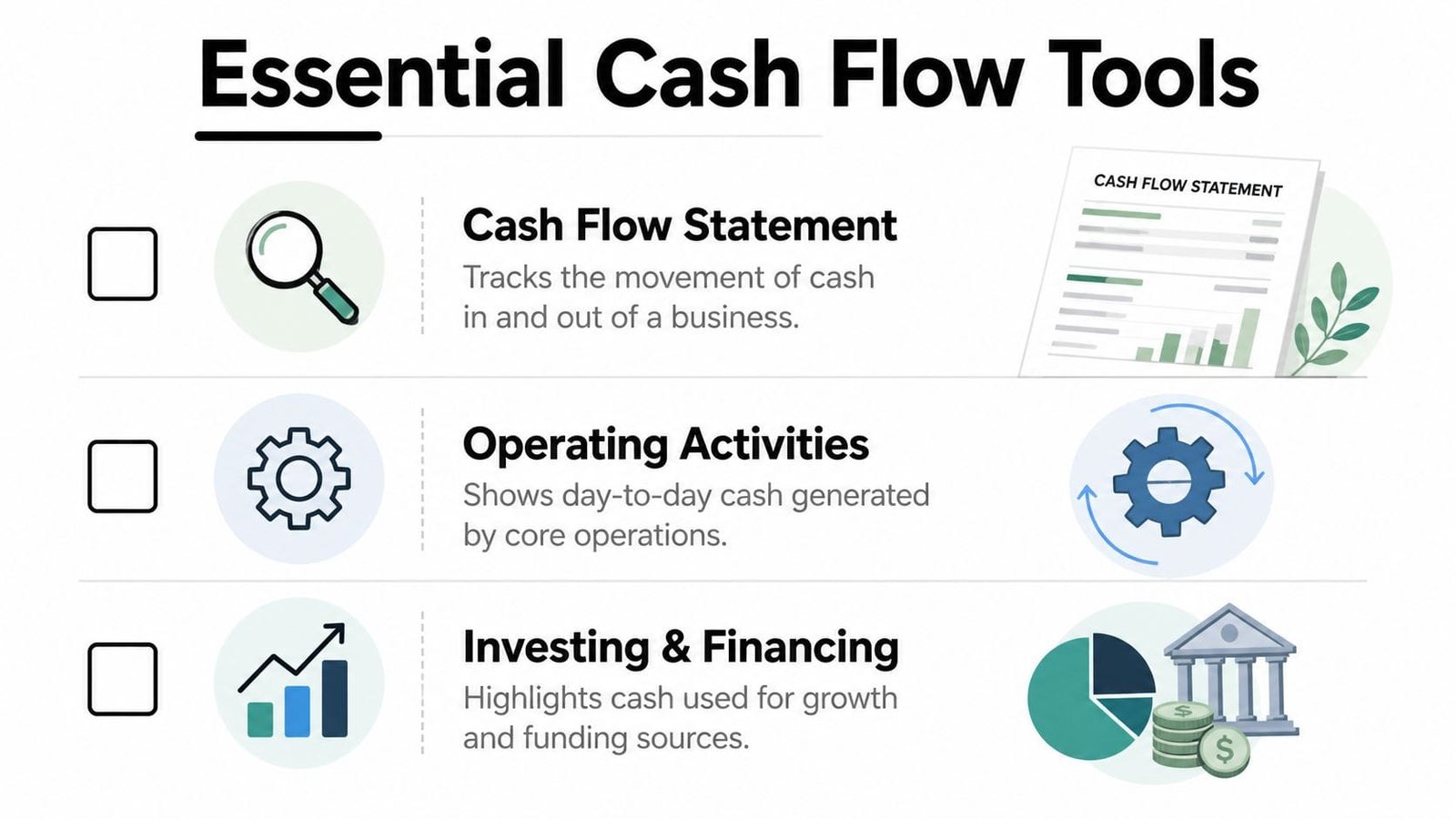
The cash flow statement organizes movement into three categories:
| Category | What it reveals |
|---|---|
| Operating activities | Whether normal sales and expenses generate or consume cash |
| Investing activities | Cash used for or received from equipment, property, and other investments |
| Financing activities | Borrowing, repayments, owner contributions, and distributions |
Operating cash flow deserves the closest scrutiny because it shows whether the core business supports itself. Investing cash flow can turn negative when you purchase equipment or expand, which isn't automatically bad. Financing cash flow shows whether lenders or owners are supplying liquidity, and whether repayment obligations may tighten future cash availability.
Owners who want a deeper technical explanation can review this indirect method for statement of cash flows, especially when reconciling net income with actual cash movement.
Build a forecast that updates with reality
A static monthly budget becomes stale as soon as a customer pays late, payroll changes, or a supplier moves a delivery date. Cash forecasting should combine top-down assumptions about sales and expenses with bottom-up updates from actual receivables, payables, payroll, and financing schedules. The World Bank's guidance on forecasting and targeting cash balances supports layered forecasting and frequent refinement.
Use a rolling forecast and update it at a frequency that matches your risk. A business with tight liquidity needs a much closer review than one with substantial flexibility. Each review should compare forecast cash with actual bank activity, then replace assumptions with known payment dates wherever possible.
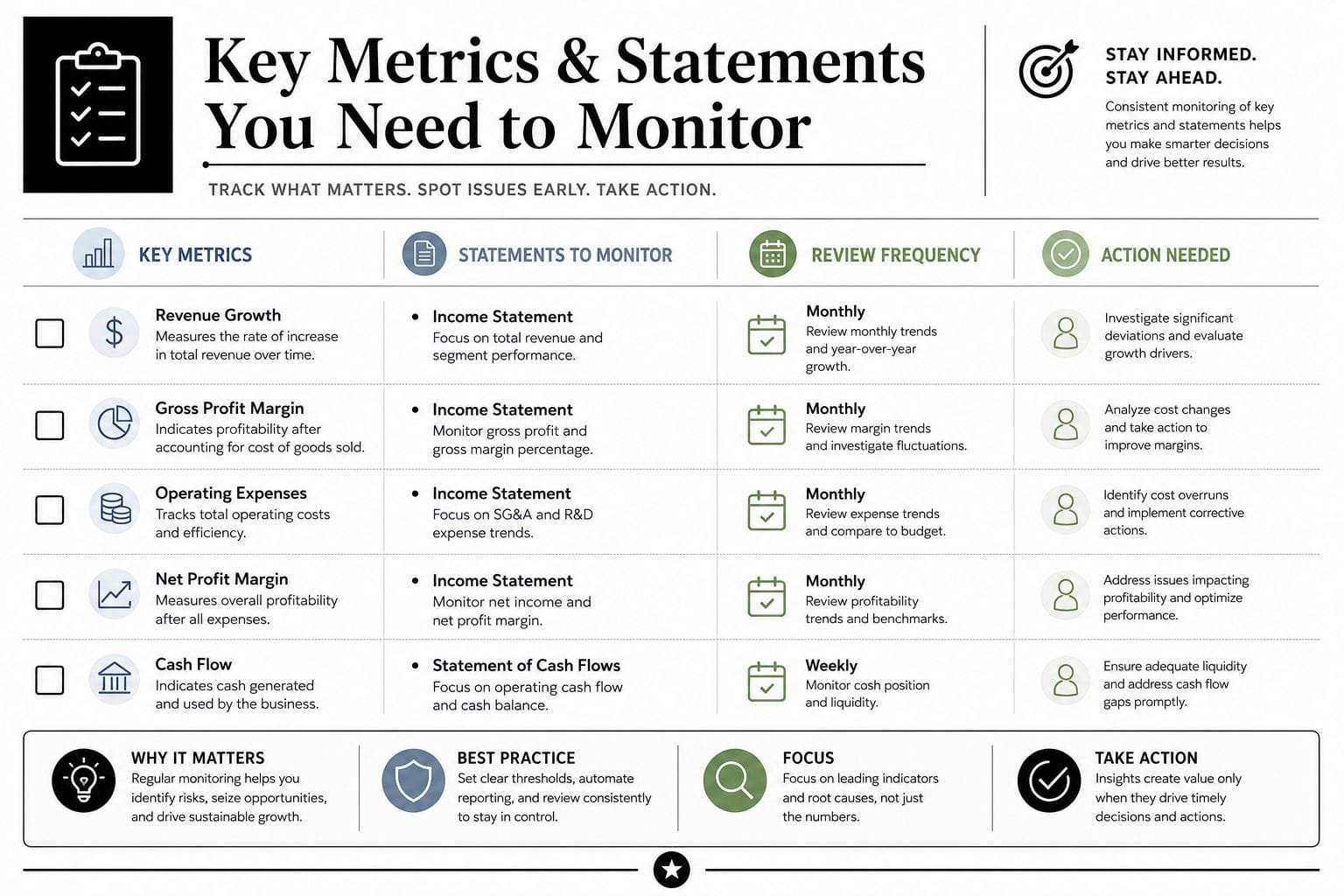
Track cash runway, which means how long current liquid funds can support operations if expected revenue stops. Also monitor free cash flow, operating cash flow, overdue receivables, upcoming payables, inventory commitments, and debt payments. If you operate across currencies, keep exchange-rate timing and settlement differences visible. A practical multi currency bookkeeping guide can help organize those records without hiding the liquidity impact of foreign transactions.
Common Cash Flow Problems That Catch Owners Off Guard
Revenue growth doesn't automatically solve a cash problem. In some businesses, growth makes the problem worse because every new order requires inventory, labor, shipping, or subcontractor costs before the customer pays.
The first trap is selling faster than you collect. A service company may complete more work, issue more invoices, and show stronger revenue while its receivables balance expands. If the payment schedule doesn't match payroll and supplier dates, the owner may need to borrow just to deliver work that is already profitable.
The second trap is inventory. Buying in bulk can reduce unit costs, but it also converts available cash into products that may take time to sell. Owners often notice the margin and overlook the date when the money returns.
Seasonality creates a similar mismatch. A retailer, landscaper, restaurant, or tourism business may collect strongly during its busy period and still face a difficult off-season if it doesn't plan for recurring costs. Unexpected equipment repairs, tax obligations, chargebacks, and customer disputes can widen the gap without changing the underlying business model.
The cost of cash constraints
Intuit's 2019 QuickBooks study reported that 61% of small businesses worldwide struggled with cash flow, while 32% said they couldn't pay vendors, repay loans, or pay themselves or employees because of cash-flow problems.Intuit study summary The same source reported that U.S. small business owners lost an average of $43,394 per year by turning down projects or sales because they lacked sufficient cash flow.Intuit study summary
That last point changes the diagnosis. Cash flow isn't only a defensive concern about paying bills. It can also determine whether you accept a profitable opportunity. A business may have demand, staff, and healthy margins, but cash tied up in receivables or inventory can prevent it from saying yes.
In Q4 2025, 77% of small businesses said they had enough cash to cover at least one month of operating expenses, while 42% said they were making only minimum credit card payments.OnDeck small-business trends Those figures point to a timing and liquidity problem, not necessarily a failed business. The right response is to identify which operating commitment is consuming cash and fix that mechanism.
Practical Strategies to Manage and Improve Cash Flow
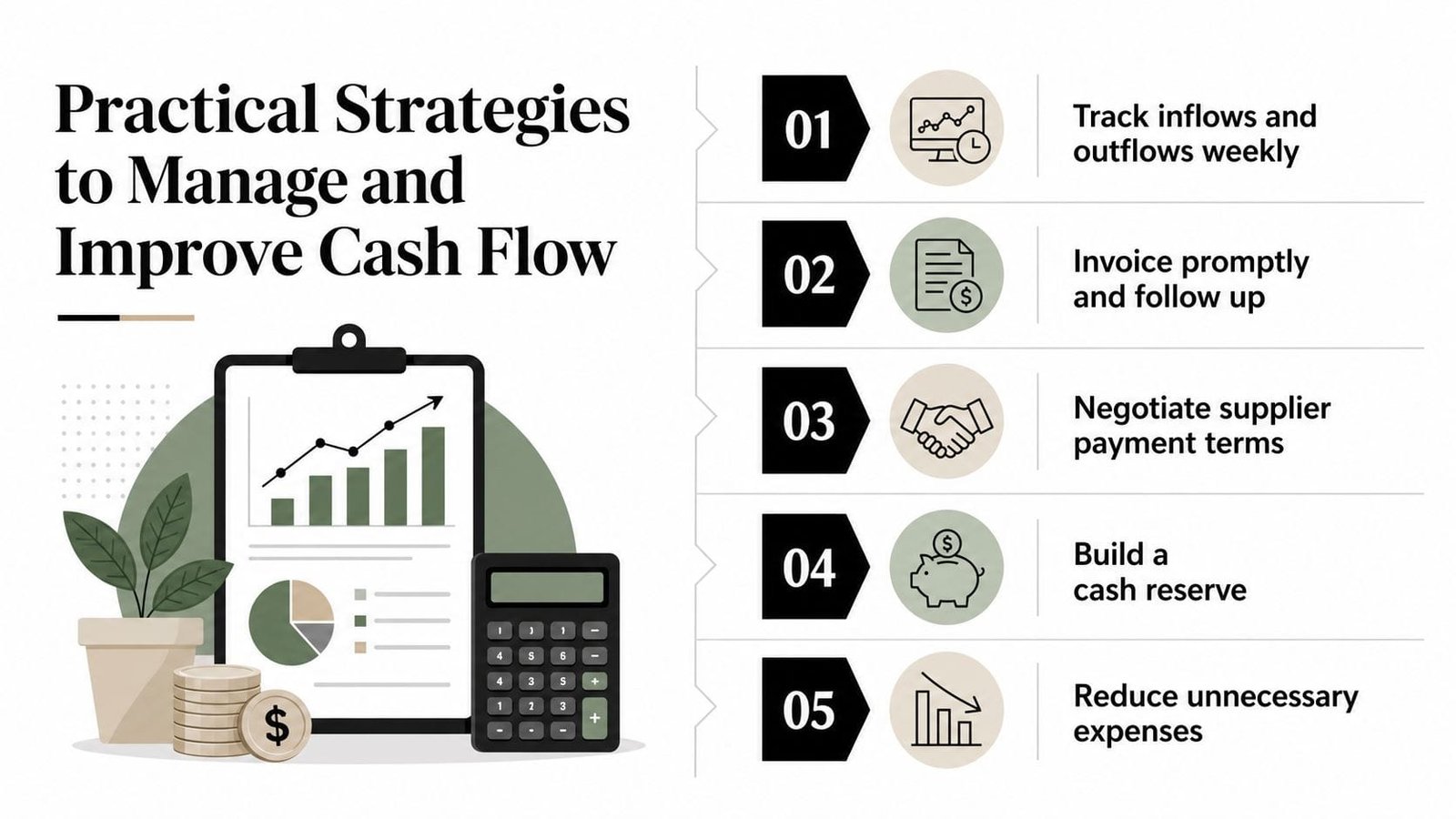
Start with actions that change the timing of cash, not cosmetic cuts that make the business weaker. The strongest plan combines immediate collection work with structural changes to purchasing, terms, forecasting, and financing.
Actions to take this week
Invoice immediately. Send accurate invoices as soon as the product or service is delivered. Put the due date, accepted payment methods, deposit requirements, and late-payment policy in plain language. Assign one person to own follow-up, because unpaid invoices rarely resolve themselves.
Call overdue customers. Don't hide behind automated reminders when an important account is late. Ask whether the invoice is approved, disputed, or waiting on a missing document. Resolve the actual obstacle and record the promised payment date in your forecast.
Review the next payment run. Separate essential obligations from purchases that can wait. Don't delay agreed vendor payments casually, but do negotiate before the due date when a timing mismatch is visible.
Control new inventory commitments. Pause low-priority purchasing and identify slow-moving stock. Cash tied up in products that aren't selling deserves a direct decision, such as a promotion, return, bundle, or revised reorder policy.
For businesses with vehicle-heavy operations, recurring fuel expenses can also affect weekly liquidity. A resource on a no deposit fuel card may be useful when evaluating payment arrangements for fleet costs.
Changes that make liquidity more durable
Negotiate supplier terms that better match your collection cycle. Offer early-payment incentives selectively when the savings exceed the value of keeping the cash. Require deposits for custom work or large orders, and stop extending generous terms to customers who repeatedly pay late.
Build a rolling forecast that includes best-case and downside assumptions. Diversify revenue where seasonality creates predictable valleys, and consider invoice financing when receivables are sound but payment timing is the obstacle. Establish a line of credit before a crisis, not after a missed payment has weakened your options.
A cash flow improvement framework can help you organize these operational decisions into a repeatable process.
Use the video below as a practical complement to the written checklist, particularly when turning cash flow review into a weekly management habit.
The goal isn't to preserve cash by refusing every investment. It's to know which spending creates future cash, which spending merely consumes it, and when financing can bridge a temporary mismatch without disguising a permanent loss.
Real-World Warning Signs and When Financing Makes Sense
An owner usually knows the business is under pressure before the financial statements make it obvious. The warning appears in small decisions: using personal savings for payroll, postponing a vendor payment without calling, or charging routine expenses to a credit card because receivables haven't arrived.
In Q4 2025, 42% of small businesses reported making only minimum credit card payments, according to OnDeck's small-business trends report.OnDeck small-business trends Minimum payments can preserve short-term flexibility, but they also signal that the business may be using expensive revolving debt to cover a recurring timing gap.
Match the funding to the problem
| Cash-flow condition | Financing that may fit |
|---|---|
| Recurring short-term gaps | A business line of credit that can be drawn and repaid as working capital changes |
| Invoices are valid but slow to pay | Invoice financing tied to receivables |
| A defined timing mismatch | Short-term financing with a clear repayment source |
| Longer-term expansion or stability | SBA-backed or other structured term financing |
A line of credit makes sense when the business has predictable inflows and needs flexible access between collection dates. Invoice financing fits a company whose customers are creditworthy but slow to pay. A short-term loan can bridge a specific purchase or project, but it shouldn't fund recurring losses. Longer-term financing is more appropriate for equipment, expansion, or a durable capital need that shouldn't be repaid from one immediate sales cycle.

Before borrowing, identify the exact cash event that will repay the debt. If the answer is “future growth” without a dated collection plan, the financing may only postpone the problem. You should also compare total repayment cost, payment frequency, collateral requirements, prepayment terms, and the effect on future borrowing capacity.
A working capital line of credit is one option to investigate when operating cash repeatedly falls short between receivables and payables. Business Loan Warrior allows owners to submit a no-fee application, check pre-approval without affecting credit, connect bank accounts, and compare funding options through a secure dashboard. Use any lender as a tool, not a substitute for fixing weak collections, excessive inventory, or unprofitable pricing.
Building Your Cash Flow Management Action Plan
Cash flow management becomes useful when it turns into a weekly routine. Set a fixed review time and update the bank balance, expected customer receipts, vendor commitments, payroll, taxes, loan payments, and planned purchases.
Use this decision framework:
- Operations problem: If cash is trapped in slow collections, excess inventory, or poor terms, fix the process first.
- Timing problem: If profitable work creates a temporary gap between costs and customer payment, consider a correctly matched facility.
- Structural problem: If normal revenue can't cover normal expenses, change pricing, costs, or the business model before borrowing more.
- Combined problem: Improve operations while arranging financing for a defined transition, not an indefinite shortfall.
Keep a written reserve policy and adjust it for your business model, seasonality, payroll structure, and supplier exposure. Review forecast versus actual results every week, then investigate every material variance while the cause is still clear.
Cash flow management isn't a one-time spreadsheet exercise. It's the discipline of knowing what your cash can support today, what it can support later, and which decision protects both.
Business Loan Warrior helps small businesses compare funding options, including lines of credit, term loans, SBA financing, invoice financing, and short-term capital. Visit Business Loan Warrior to check pre-approval without affecting your credit and evaluate financing against your actual cash-flow timeline.