

You've got a set of plans open, a bid date coming fast, subs trickling numbers in late, and one question sitting underneath all of it: if you win this job, can you build it profitably without starving your cash flow?
That's where most advice on how to bid a construction job falls short. It teaches takeoffs, unit pricing, and markup, but it skips the part that hurts in real life. A bid can be accurate on paper and still be a bad decision if you can't fund mobilization, cover retainage pressure, or absorb the gaps between pay apps.
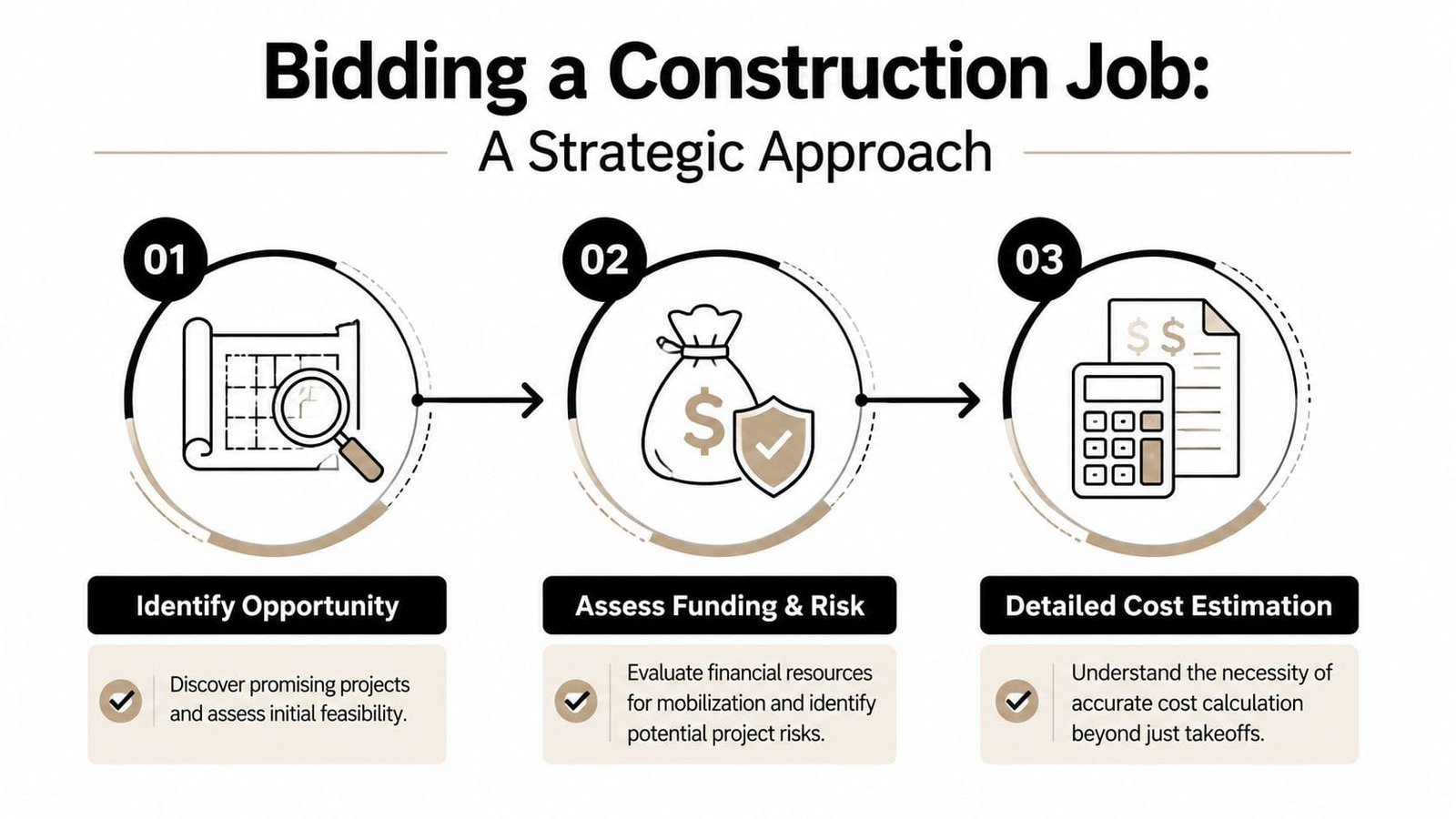
Good bidding is part estimating, part risk management, and part capital planning. The contractors who stay healthy don't just ask, “What should this job cost?” They ask, “Should we chase it, can we fund it, and does the final price leave room for the work to go sideways without taking the company with it?”
If you're searching for opportunities, especially in municipal and agency work, a live source of public sector construction work can help you see what's being released instead of waiting for invites to show up by chance.
Table of Contents
- Introduction to Bidding a Construction Job
- Qualify Projects and Ensure Capital Readiness
- Perform Detailed Quantity Takeoffs
- Calculate True Labor Material and Equipment Costs
- Apply Overhead Profit and Pricing Strategies
- Coordinate Subcontractors and Normalize Scope
- Finalizing Your Bid and Ensuring Success
Introduction to Bidding a Construction Job
A lot of jobs look good at first glance. The drawings seem clean, the client looks legitimate, and the scope lines up with work your team already knows. Then the hard questions begin. Are the plans coordinated enough to price cleanly? Are your crews available when the schedule says they need to be? Can you float mobilization and early materials before the first draw lands?
That's the practical frame for how to bid a construction job without buying yourself a problem. Pricing is only one layer. A workable bid has to survive labor burden, equipment usage, subcontractor gaps, overhead, financing pressure, and contract terms.
What a solid bid actually does
A solid bid does three things at once:
- Screens the opportunity: It filters out jobs your team shouldn't chase.
- Builds the number correctly: It turns takeoffs and quotes into a price you can defend.
- Protects execution: It checks whether the business can carry the job after award.
Practical rule: Don't treat bid day as the finish line. Treat it as the point where your company commits its balance sheet.
The workflow that follows is the one estimators use when they want fewer surprises after award. Qualify the project. Verify capital readiness. Measure carefully. Build true costs. Price with intention. Level sub quotes. Then package the bid in a way that protects profit and cash flow.
Qualify Projects and Ensure Capital Readiness
Bid day problems usually start weeks earlier. A job gets chased because the revenue looks good on paper, then the team finds out the owner is slow-pay, the schedule collides with another project, or the company cannot carry payroll and materials through the first draw.
Estimating time is expensive. Use it on work your company can both win and finance.
The Associated General Contractors of America advises contractors to weigh project type, location, contract terms, available staff, equipment, and owner characteristics before deciding to pursue work in its Contractors Guide to Prequalification. That is the practical starting point for bid or no-bid decisions. The point is not to avoid hard jobs. The point is to avoid jobs that strain your field capacity, cash position, or risk tolerance before production starts.
Score the opportunity before you spend real estimating effort
A quick internal screen saves a lot of wasted effort and a few bad awards.
| Qualification factor | What to ask |
|---|---|
| Crew fit | Do you have the superintendent, foremen, and labor capacity for this schedule? |
| Equipment fit | Can you cover the equipment need with owned assets, rentals, or reliable supplier support? |
| Client fit | Does the owner or GC have a record of paying cleanly and resolving issues in a reasonable time? |
| Scope fit | Is this work inside your normal production range, or does it depend on unfamiliar means, methods, or subcontract markets? |
| Contract fit | Are retainage, liquidated damages, insurance requirements, and pay-if-paid terms workable for your balance sheet? |
| Competition fit | Do you have a real edge on location, relationships, self-perform scope, or schedule, or are you just filling out the bid list? |
McKinsey notes that construction firms are using more digital tools and analytics to improve decisions across estimating and project delivery in its report on the next normal in construction. That shift matters because qualification works better when it is scored the same way every time. Shops that track hit rate, job size, client type, and post-award margin by market usually get sharper about where to spend pursuit effort.
For win-rate context, Deltek's annual Clarity Architecture and Engineering Industry Study regularly tracks proposal activity and capture performance across firms. The exact number varies by market, client mix, and firm size, but the practical lesson is the same. Winning every bid is not the target. Pursuing the right bids is.
Capital readiness decides whether the job is actually workable
A bid can be accurate and still hurt the company.
Early cash leaves faster than it comes in. Mobilization, permits, bonds, insurance, deposits on long-lead materials, temporary facilities, and first-cycle payroll often hit before the first meaningful payment. If the project requires heavy front-end spending, the question is not only whether the job pencils out. The question is whether the business can carry that spend without starving other active work.
That is why I treat funding review as part of qualification, not a cleanup task after award. Before a serious pursuit, confirm where startup cash will come from. That may be a line of credit, supplier terms, equipment financing, owner mobilization billing, or a lender that understands construction draw timing. A useful overview of construction project financing options can help you match the funding tool to the cash-flow shape of the job.
Check the hidden pressure points
A project can look profitable and still fail the screen for reasons that do not show up in a simple estimate summary:
- Long payment cycles that force the contractor to float labor and materials
- Contract terms that push too much risk downstream
- Front-loaded equipment or procurement needs
- Weak document coordination that invites rework and disputed scope
- An owner team that changes direction faster than approvals get issued
Those items affect whether margin survives long enough to be collected.
Consider two jobs. One is a smaller residential project with vague selections and an owner who approves change orders slowly. The other is a larger commercial project with cleaner documents, stricter reporting, and a bigger cash need in the first sixty days. The smaller job may look safer, but it can absorb management time and create slow-pay stress. The larger job may be the better bid if field capacity is there and funding is lined up.
The right pursuit is the one your company can price, execute, and carry without damaging the rest of the backlog.
Perform Detailed Quantity Takeoffs
A bid can survive a tough owner meeting and still die in the takeoff. Miss a repeat condition, carry the wrong wall height, or measure from an outdated sheet set, and the problem shows up later as extra buys, lost crew hours, and scope fights no one budgeted for.
Set up the takeoff before you click anything
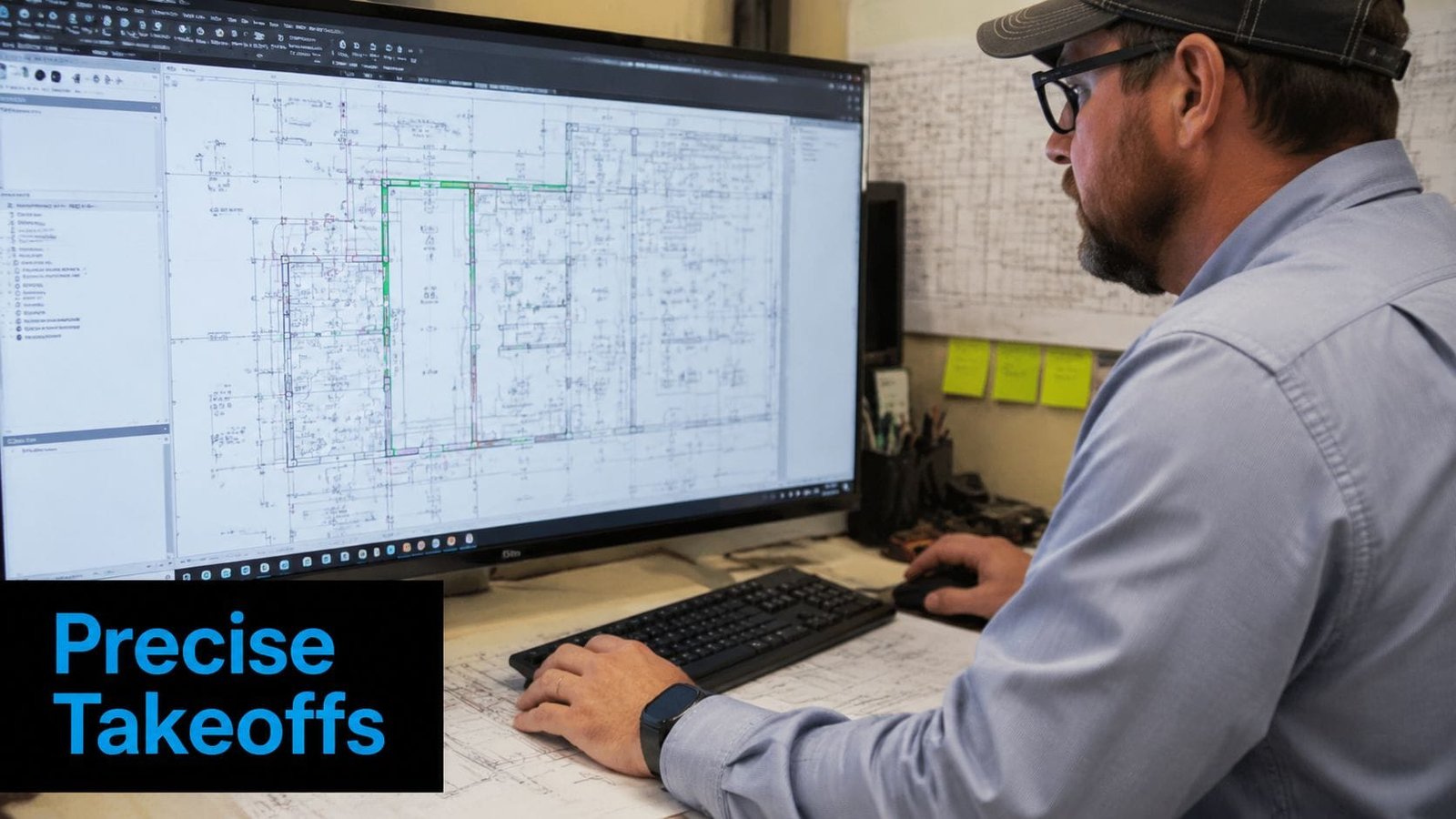
Digital takeoff software speeds up measurement. It does not fix bad setup. The first pass should verify scale on each sheet, confirm the current addenda set, and flag anything that changes who is carrying scope. The National Institute of Building Sciences has long pushed disciplined quantity workflows through its National CAD Standard resources, and the point is practical. Consistent measurement starts with consistent document control.
Start with the basics, then get specific:
- Verify sheet scale one sheet at a time: Architectural plans, structural plans, enlarged details, and shop-level reference sheets often do not match.
- Confirm revision status: Fold every addendum and bulletin into the working set before measuring.
- Mark scope splits early: Blocking, embeds, patching, demolition infill, firestopping, and temporary protection need an owner before quantities mean anything.
- Tag owner-furnished and allowance items: They affect handling, staging, labor, and cash timing even when they do not hit material buyout the same way.
- Build assemblies by system: A takeoff organized by wall type, floor type, room finish, or area phase prices better than one built from random clicks.
That last point matters more than many estimators admit. A clean assembly structure does not just help pricing. It helps purchasing, scheduling, and billing. If a package needs early procurement or a deposit, the takeoff should make that visible before the bid goes out.
Where quantity errors actually happen
On a house takeoff, framing usually looks straightforward until the odd conditions start stacking up. A simple residence can hide extra studs at intersections, dropped beams, stair framing changes, porch transitions, and wall-height shifts that never show on the floor plan alone.
Use software for speed. Use manual review for judgment.
A reliable check usually looks like this:
- Compare wall type tags to the sections and details, not just the plan graphics.
- Review openings for both deductions and added framing requirements.
- Check repeated details and mirrored plans so assemblies are not counted twice.
- Match roof, floor, and foundation transitions against structural notes and general notes.
- Review edge conditions at garages, stairwells, mechanical chases, and rated assemblies.
Takeoffs fail at the edges of the drawing set. That is where the money leaks out.
Build a takeoff that pricing can trust
A usable takeoff is more than measured area and length. It should separate quantities in a way the field can build, purchasing can buy, and accounting can fund. If tall walls install slower than standard walls, split them. If exterior-rated sheathing has a different lead time or supplier term than interior board, split that too.
That structure also helps with capital readiness, which many bidding guides ignore. A bid can be accurate and still strain cash if the takeoff lumps early-buy materials into broad categories that hide front-loaded procurement. Roofing packages, steel components, switchgear, specialty doors, and long-lead finishes can change deposit needs and draw timing. Estimators should know that before final pricing, not after award.
The takeoff is the first cost map and the first cash-flow warning.
A practical handoff format looks like this:
| Takeoff category | Why it matters |
|---|---|
| Framing lumber by size and location | Supports purchasing, waste review, and crew planning |
| Sheathing by type and exposure | Prevents substitution mistakes and separates lead-time risk |
| Openings, headers, and specialty framing | Captures labor-heavy conditions that flat counts miss |
| Long-lead or deposit-driven items | Flags cash needs that can affect whether the bid is financeable |
| Specialty conditions and patchwork | Catches small scope that often turns into disputed extras |
Good estimators do not chase perfect precision at any cost. They spend time where the risk lives, then organize the result so pricing and funding decisions rest on the same job picture. That is how a takeoff helps produce a bid you can win and carry.
Calculate True Labor Material and Equipment Costs
A bid can look profitable on paper and still choke the company in the field. The usual cause is not one giant miss. It is a string of underbuilt cost lines, then a cash squeeze when payroll, deposits, fuel, and vendor terms hit before the first meaningful draw.
Labor has to be burdened or it isn't real
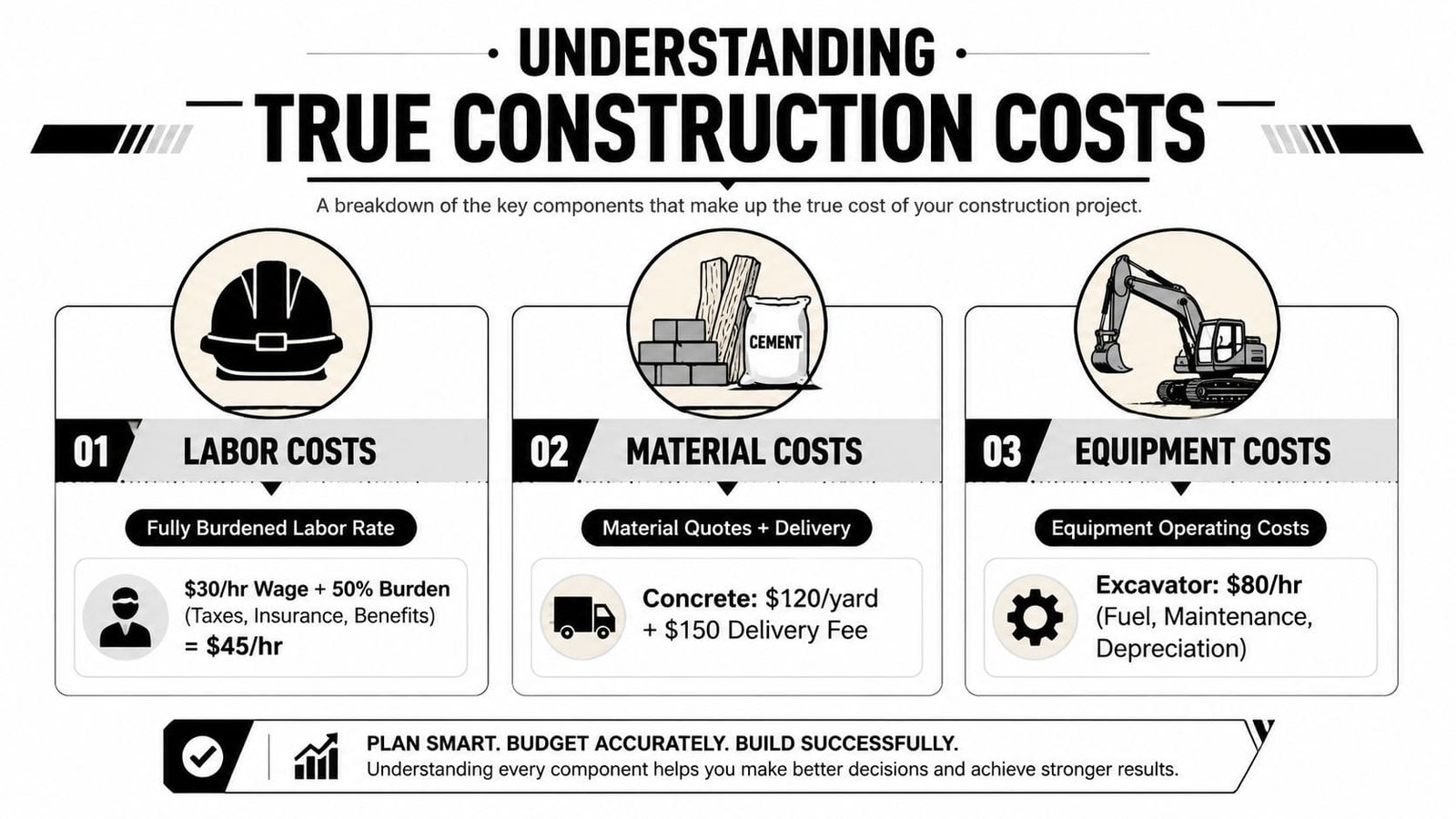
A wage rate is only the starting point. Labor cost needs payroll taxes, insurance, and every employer-paid load that follows that worker onto the job. If those costs stay outside the estimate, they still show up on the ledger.
For a plain example of FICA burden math, ADP explains that employers pay 6.2% Social Security tax up to the wage base and 1.45% Medicare tax on all wages, which is 7.65% combined for many employees. Applied to an $80.00 per hour base crew rate, that produces $6.12 per hour in employer FICA, or a labor rate of $86.12 before workers' compensation, unemployment, and other burdens are added. See ADP's overview of employer payroll tax responsibilities.
Use a cost build like this:
| Labor component | Amount |
|---|---|
| Base crew rate | $80.00 per hour |
| Employer FICA at 7.65% | $6.12 per hour |
| Labor rate before other burdens | $86.12 per hour |
That table is still incomplete for most contractors. Workers' comp, general liability allocation, unemployment taxes, paid time off, small tools, travel time, and supervision often belong in the labor build, depending on how the company tracks cost.
The funding side matters here too. Understated labor does not just hurt margin. It distorts working capital needs. A job with heavy self-perform labor can be bid low enough to win and still create a payroll strain by week two.
Materials need purchase reality, not catalog reality
Supplier quotes beat price-book assumptions every time, but the quote itself is rarely the full material cost. Estimators need to read terms line by line. Freight may be excluded. Taxes may still apply. The supplier may require a deposit on custom fabrication or release long-lead items only after payment clears.
Price materials with the buying conditions you will live with:
- Delivery charges: Common on concrete, steel, aggregates, trusses, and split shipments.
- Handling and storage: Real costs if material must be protected, double-handled, or warehoused offsite.
- Waste exposure: Drywall, roofing, tile, and finish materials do not waste at the same rate.
- Escalation and quote validity: A number is only useful if it holds through award and release.
- Deposit terms: Front-loaded purchasing can turn an accurate estimate into a cash-flow problem.
A supplier quote that requires 40% down changes the bid conversation. You may still carry the job at the right price, but only if the company can fund that release without starving payroll or delaying other projects.
Here's a short visual explainer before the next step:
Equipment needs an hourly cost whether you rent or own
Rental equipment is usually easier to price. Start with the rental quote, then add fuel, delivery, pickup, attachments, permits if required, and the duration tied to the schedule you believe, not the schedule the owner hopes for.
Owned equipment gets underpriced more often. No rental invoice shows up, so some estimators treat the machine as covered overhead. That is a mistake. The job still consumes fuel, maintenance, wear parts, field repairs, operator coordination, and depreciation or replacement value. If the project needs an excavator for trenching, grading, or utility work, build an hourly rate that reflects its real use, not wishful thinking.
There is also a financing angle many bidding guides skip. If winning the job depends on adding or replacing iron, the cost of capital belongs in the go or no-go decision before bid day. Review equipment financing options for small businesses if equipment acquisition affects whether the bid is workable.
If a machine touches the job, the job should pay for it.
A cost matrix catches what memory misses
The cleanest approach is one worksheet that forces every direct cost through the same review, then shows which items hit cash early.
| Cost bucket | What belongs in it |
|---|---|
| Labor | Burdened crew rates by task or crew type, plus supervision if job-specific |
| Materials | Supplier quotes, freight, handling, storage, waste, taxes where applicable, deposit terms |
| Equipment | Rental or owned operating cost by hour, day, or production unit |
| Miscellaneous direct costs | Permits, disposal, temporary protection, testing, mobilization, and job-specific small tools |
| Early cash requirements | Payroll-heavy startup periods, material deposits, and advance equipment commitments |
That matrix does two jobs. It tightens direct cost pricing, and it shows whether the company can carry the front end of the work long enough to get paid. That is the difference between a bid that only wins and a bid the business can afford to perform.
Apply Overhead Profit and Pricing Strategies
A bid can be accurate on paper and still put the company in a cash squeeze. That usually happens here, at pricing, when overhead is guessed, profit is treated like a leftover, and nobody checks whether the job's payment terms can carry the front-end spend.
Markup and margin are different numbers with different consequences
Estimators mix these up all the time, and the mistake usually shows up after award, not before. A 10% markup on cost does not produce a 10% margin on the contract value. If the team talks about “adding ten points,” make sure everyone means the same thing.
| Pricing view | Result |
|---|---|
| 10% markup on costs | Adds 10% to the cost base |
| Margin outcome | Produces less than a 10% margin on the final selling price |
That difference matters because overhead, risk, and fee all sit on top of direct cost, but owners and lenders judge the job by the final contract price. If you want a plain-language refresher on the terms, Audit Genius helps clarify O&P.
Price in layers so you can defend every dollar
A workable pricing stack is simple, but it has to stay visible:
- Direct costs. Labor, material, equipment, permits, and job-specific expenses.
- Overhead. The company cost this project must carry.
- Profit. Return for taking execution risk, schedule risk, and warranty exposure.
- Contingency. A separate line for known unknowns.
Keep contingency separate from profit. If it is buried in fee, the team cannot tell whether the job beat budget or merely survived a few misses.
For a cleaner method of assigning company expense to jobs, use this guide on how to calculate overhead cost.
Price strategy has to match both the market and your cash position
Two bids with the same estimated cost do not always deserve the same selling price. A school job with slow retainage release, certified payroll administration, and a heavy submittal load carries a different overhead burden than a fast private renovation. A project that requires large material deposits or early manpower ramp-up also puts more strain on working capital.
That financing piece gets ignored in a lot of bidding advice. It should not. If the owner pays in 45 days, suppliers want deposits, and payroll hits weekly, a thinly priced job can force the business to fund the gap out of its line of credit. Interest cost, covenant pressure, and reduced borrowing capacity are real job costs, even if they do not appear in the takeoff.
A low number can win the award and still create a funding problem by month one.
Use historical win rates and actual job performance, but do not copy one target markup across every bid. Negotiated work, public hard bid work, tenant improvements, and ground-up jobs each justify different pricing discipline. The floor is the point where the job still covers overhead, risk, and the cash it takes to carry the work until payment arrives.
The best estimators I know do not chase volume at any price. They submit numbers the company can build, bill, and finance without weakening the rest of the backlog.
Coordinate Subcontractors and Normalize Scope
Bid day gets ugly fast when the apparent low electrical number is missing temp power, core drilling, and patch-back, and nobody catches it until buyout. The estimate looked tight. The job was underfunded before the contract was signed.
That is why subcontractor coordination is not just a pricing exercise. It is a scope control exercise and a cash control exercise. If a gap survives bid day, the general contractor usually funds it later through change disputes, schedule drag, or self-performed cleanup that was never in the number.
The hard part is not collecting quotes. The hard part is turning uneven quotes into a comparable scope package. ConstructConnect's bidding tips ebook stresses the need to review subcontractor bids for exclusions and qualifications because missed scope regularly shows up after award, when it is expensive to fix.
Price is only useful after scope is aligned
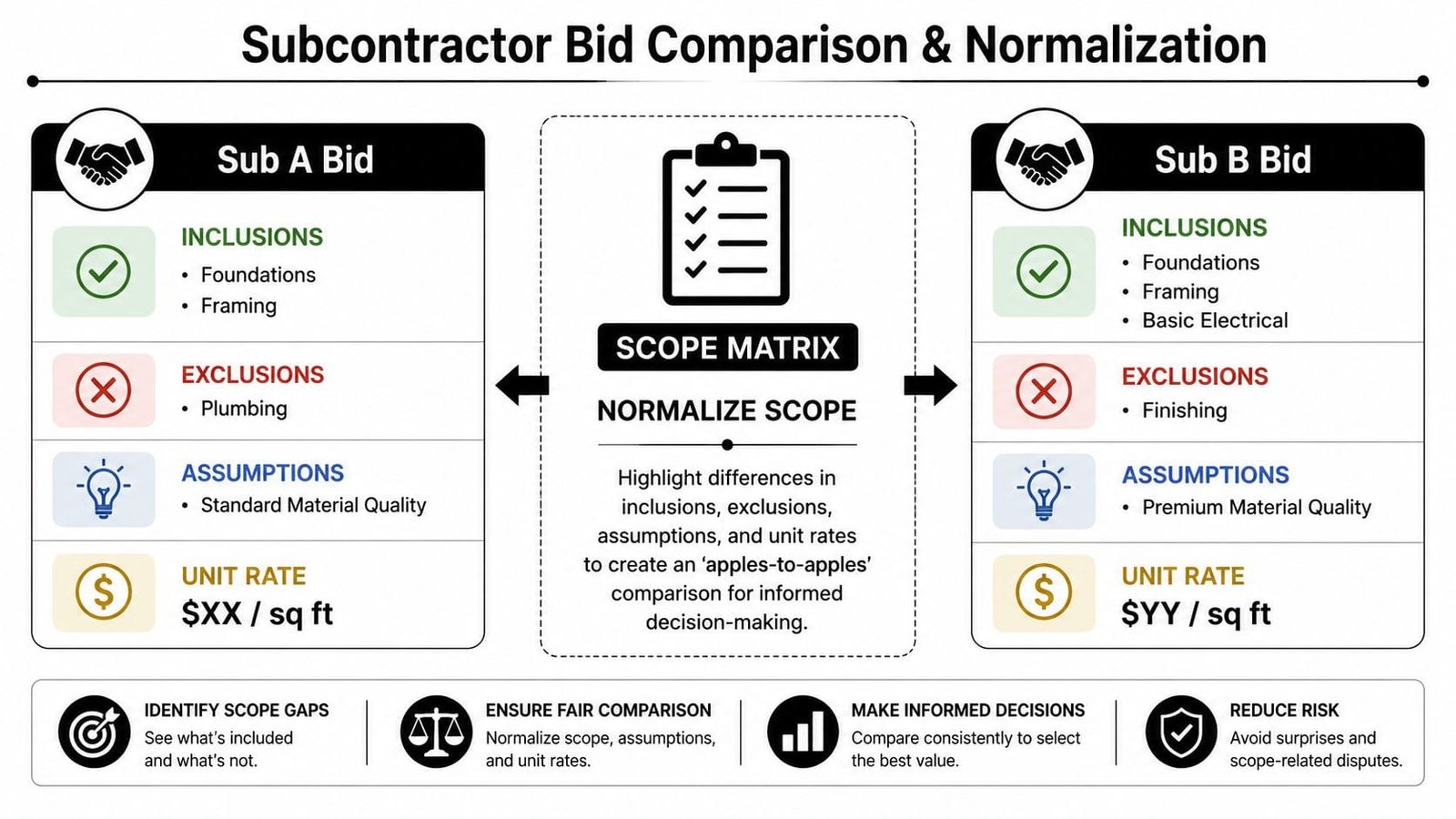
Concrete, drywall, roofing, mechanical, and electrical quotes rarely arrive in the same format. One subcontractor carries layout and survey coordination. Another excludes it. One includes submittals, hoisting, and weekend work. Another assumes straight-time production with clean access and no phasing.
A scope matrix fixes that. Every quote gets broken into the same buckets so the estimator can compare responsibility, not just totals.
| Scope item | Sub A | Sub B | Sub C |
|---|---|---|---|
| Inclusions | Listed | Listed | Listed |
| Exclusions | Listed | Listed | Listed |
| Clarifications | Listed | Listed | Listed |
| Unit pricing or alternates | Listed | Listed | Listed |
If one quote excludes temporary protection, cleanup, permit coordination, startup, closeout documents, or off-hours work, that quote is incomplete. It is not cheaper in any meaningful way.
What leveling actually requires
Good leveling takes line-by-line review and phone calls. Email alone misses too much.
- Confirm base scope: Make sure each subcontractor priced the same drawings, addenda, details, and spec sections.
- Price back exclusions: If the contract still requires an excluded item, carry that cost somewhere before comparing totals.
- Test production assumptions: Crew size, access, laydown area, shift work, phasing, and material handling can swing a quote hard.
- Check quote validity: Expiration dates, material escalation language, and schedule assumptions matter if award slips.
- Assign ownership clearly: If two trades exclude the same handoff item, the GC owns the gap unless someone is named before award.
For competitive trades, many estimators carry three to five qualified quotes when the market gives them enough coverage to see outliers and test scope. The point is not hitting a target count. The point is getting enough qualified coverage to know whether a number is low because a subcontractor is hungry, efficient, or missing work. The U.S. Small Business Administration guidance on construction estimating and bidding supports using competitive market comparisons as part of a disciplined pricing process.
The low quote can strain working capital before the first pay app
This is the funding angle many bidding guides skip. A subcontractor with the lowest number may also demand a large mobilization, front-loaded material deposits, or tighter payment terms than the owner contract allows. If the owner pays in forty-five days and the sub expects faster draws, the spread lands on the general contractor's cash position.
That does not mean passing on every aggressive quote. It means checking whether the subcontractor's commercial terms fit the project's cash cycle. A quote that is $20,000 lower but requires early funded deposits can be worse for the company than a slightly higher quote that bills cleanly with the schedule of values and can carry standard terms.
Common bidding mistakes still apply here. ProjectMark's bidding strategies article notes that unverified subcontractor quotes and missed scope items can produce pricing outliers and problems after submission.
The estimator's job is to assign every required scope item, then confirm the company can afford the way that scope gets bought.
That is what normalization is for. It protects margin, reduces post-award surprises, and keeps a winning bid from turning into a financing problem.
Finalizing Your Bid and Ensuring Success
Bid day exposes weak spots fast. A number can look sharp on the spreadsheet and still fail once payment timing, exclusions, buyout terms, and owner requirements are checked side by side. The final review is the point where experienced contractors decide whether they are submitting a buildable price or volunteering to finance the job with their own cash.
A surprising amount of self-inflicted damage happens at this stage. ProjectMark's bidding strategies article calls out recurring errors such as weak bid preparation, inconsistent bid formats, unverified subcontractor quotes, and missed scope items. Those mistakes do more than hurt accuracy. They create outlier pricing, invite scope disputes, and can sink margin before the job starts.
Put contingency and risk where everyone can see them
Hidden risk does not disappear. It just gets buried until the field team finds it.
Unknown conditions, long-lead materials, owner decision lag, weather exposure, phased turnover, and permit timing all affect whether a bid can survive real job conditions. Folding those issues into markup makes the number look tidy, but it also makes the bid harder to defend internally. Estimating needs to show where the risk sits and how much the company is carrying.
A final review should answer these questions:
- Is contingency visible: If risk exists, is money assigned to it clearly?
- Are assumptions written down: Working hours, access limits, exclusions, and allowances should be explicit.
- Do contract terms match the bid: Estimating assumptions need to line up with what operations will sign.
- Can the company carry the cash cycle: Retention, payment timing, stored materials, and front-loaded costs all affect viability.
Tie financing to the structure of the bid
This part gets ignored too often. A bid can win and still hurt the company if the cash demands arrive before reimbursement.
Lines of credit, equipment financing, and project-based lending all solve different problems. Payroll float, material deposits, crane rentals, early mobilization, and retention pressure do not hit the same way. The financing choice should match the job's cash profile, not just the total contract value.
That affects how the bid is written. If the project needs heavy early spending, the proposal may need tighter payment terms, a larger mobilization item, more caution on schedule commitments, or a different contingency posture. A number that works on paper can become dangerous once retainage, owner pay timing, and subcontractor deposit demands are layered in.
Review the proposal like the owner and like the PM
Run two separate checks before submission.
First, review it like the owner:
| Owner-facing check | What to confirm |
|---|---|
| Scope clarity | The proposal states what is included and excluded |
| Price transparency | The breakdown makes the number understandable |
| Compliance | Forms, addenda, bonds, and submission requirements are complete |
| Schedule position | The start window and duration are realistic |
Then review it like the project manager who has to build it:
- Confirm labor assumptions match actual crew availability.
- Confirm major buyout items are based on verified quotes.
- Confirm subcontractor scope handoffs are assigned.
- Confirm permitting, site prep, temporary conditions, and closeout are carried.
- Confirm mobilization can be funded without starving active jobs.
Submit a bid you would still defend after award, when every assumption gets tested in the field.
A strong final package is clear, specific, and internally consistent. It protects margin, gives operations a fair starting point, and checks whether the company has the capital to execute the work under the payment terms offered. Winning the bid matters. Winning it on terms the business can carry matters more.
If you've got a solid bid but need the capital to mobilize, cover equipment, or smooth out project cash flow, Business Loan Warrior can help you explore funding options built for contractors and other growing businesses.