
Your customer approved the job. You delivered the goods. The invoice is sitting in accounts receivable, and payroll is due before that customer pays.
That's when most owners start comparing invoice financing vs. factoring. Not because they love specialty finance, but because they need cash this week and the bank won't move fast enough.
Here's the plain-English version. Invoice financing is borrowing against unpaid invoices while you keep ownership of the receivable and keep collecting from your customer. Factoring is selling the receivable to a factor, who owns it and collects from your customer directly. That single split matters more than most fee charts admit.
Table of Contents
- Why Small Businesses Compare These Two Cash-Flow Tools
- How Invoice Financing and Factoring Actually Work
- Cost Structure and True Pricing Comparison
- Recourse vs Non-Recourse and Who Eats the Loss
- Credit Impact and Balance-Sheet Treatment
- Choosing the Right Fit for Your Business
- Decision Framework and Pre-Application Checklist
Why Small Businesses Compare These Two Cash-Flow Tools
A small business usually lands here after the same sequence of events. Sales look good. Revenue is booked. Cash is tight anyway because customers pay on net terms while payroll, rent, freight, and materials get paid now.
That mismatch is exactly why receivables finance keeps showing up in the market at scale. Factoring alone is already enormous globally, with one industry estimate putting worldwide factoring turnover at about EUR 2,658 billion in 2025, with Europe at roughly 65.8% of global volume and Asia-Pacific at about EUR 995 billion. That same source says turnover fell in 2020, then rebounded 13.46% in 2021 and 18.28% in 2022 before slowing to 3.61% in 2023 and 2.72% in 2024, which tells you this category rises and falls with the broader credit environment, not with hype alone (global factoring market estimate).
The real question isn't rate first
Owners often ask the wrong opening question: “Which one is cheaper?”
Start here instead: Who owns the receivable, and who talks to the customer?
If you keep ownership and keep collections, you're in invoice financing territory. If the provider buys the receivable and steps into collections, you're looking at factoring. That operational difference affects customer experience, accounting treatment, contract structure, and total cost.
Practical rule: If you hate the idea of a third party contacting your customer, factoring is already on thin ice for your business.
Why this comparison matters right now
Delayed payment pressure is real. One benchmark reported that 55% of U.S. B2B invoiced sales were overdue in 2023, and 81% of businesses globally saw more delayed payments in 2023 (payment delay benchmarks). When customers drag out payment, owners need a way to turn receivables into operating cash without waiting.
Before you fund anything, fix the collection process you can control. If you need help tightening billing cadence and follow-up discipline, this guide on how to get paid faster with Bookkeeping and Accounting is worth reading. And if you're comparing broader short-term cash options alongside receivables funding, review common working capital financing options before you lock yourself into the wrong structure.
How Invoice Financing and Factoring Actually Work
Most explanations stay abstract. That's a mistake. You need to see the workflow, because the products really separate there.
Mechanics Side by Side
| Step | Invoice Financing | Factoring |
|---|---|---|
| You issue the invoice | You bill your customer as usual | You bill your customer, then assign or sell the receivable |
| Provider's role | Advances cash against the invoice | Purchases the receivable and advances cash |
| Ownership of receivable | You keep it | The factor owns it |
| Collections | You collect from the customer | The factor collects from the customer |
| Customer communication | Usually stays with your team | Usually shifts to the factor |
| When cash arrives | Established providers often fund within 24 to 48 hours (funding speed and benchmarks) | Often similar timing once invoices are verified |
| Typical advance | Structured around the financed amount | Many providers advance roughly 70% to 95% of face value (advance benchmarks) |
| Final settlement | Customer pays you, then you repay provider plus fees | Customer pays factor, then factor releases reserve minus fees |
What invoice financing looks like in practice
You send the invoice. The finance company reviews it and advances cash against it. You still manage your accounts receivable ledger, send reminders, answer disputes, and collect payment.
This structure fits businesses that want to protect the customer relationship and keep control over cash application. It behaves more like a secured loan against receivables than a sale.
If you want a deeper look at this broader category, Business Loan Warrior has a basic overview of accounts receivable financing.
What factoring looks like in practice
With factoring, the receivable changes hands. The factor buys it, advances part of the value, then takes over collection. The customer typically gets notice that payment should go to the factor.
That sounds administrative. It isn't. The moment someone else sends the reminder email or makes the follow-up call, the financing decision becomes a customer-experience decision too.
According to Corpay's explanation, in invoice financing the business keeps collecting from its customer and retains ownership of the receivable, while in factoring the factor purchases the receivable, owns it, and collects directly from the customer (ownership and collections distinction).
The shortest useful way to compare invoice financing vs. factoring is this: one lets you borrow against the invoice, the other lets you hand off the invoice.
Why the workflow matters more than the brochure
Two products can advertise similar speed and still be a bad fit for very different reasons. If your team is strong at collections and your customers value a direct relationship, invoice financing usually creates less friction. If your back office is overloaded and you'd rather outsource the chase, factoring can solve an operational problem that a simple advance won't.
The fee discussion only makes sense after you understand that split.
Cost Structure and True Pricing Comparison
Headline rates fool people. The true cost is driven by time outstanding, advance rate, and the pile of small contract charges owners ignore until the first settlement statement shows up.
What providers actually charge
For factoring, pricing commonly shows up as a monthly discount of about 1% to 5% of invoice value, with a widely cited average around 2.5% for the first 30 days. Providers also often advance roughly 70% to 95% of face value, and funding often happens within 24 to 48 hours. The same benchmark notes that a 2% fee over a 60-day collection period can effectively double to 4% of invoice value, and charges like lockbox, ACH, and minimum-volume fees can push the all-in annualized cost much higher (factoring cost benchmarks).
That's the part too many owners miss. A “low” fee on a slow-paying account is not low.
True Cost Across Collection Speeds
| Product | Net-30 | Net-60 | Net-90 | Implied APR |
|---|---|---|---|---|
| Factoring at 2% of invoice value for first 30 days | 2% of invoice value | 4% of invoice value if the collection period extends as described in the benchmark | Costs continue rising as the invoice remains outstanding | Higher as payment slows |
| Invoice financing | Varies by lender structure and days outstanding | Varies more than owners expect because the borrower still carries servicing burden and timing risk | Usually worsens on slow-paying customers | Depends on fee method and repayment timing |
Because verified data here gives a precise benchmark for factoring cost sensitivity, but not a precise invoice-financing fee schedule from an approved source, the right way to compare is qualitative on the financing side and exact on the factoring side.
The hidden charges that change the deal
A lot of bad decisions happen because owners compare only the discount fee.
Watch for these:
- Minimum volume requirements: Some contracts punish you if you don't send enough invoices.
- ACH and wire charges: Small fees become real money when you fund repeatedly.
- Reserve holdbacks: The provider keeps part of the invoice proceeds until collection closes.
- Lockbox or account-management charges: Administrative fees that don't show up in marketing.
- Termination fees: Leaving early can cost more than expected.
If you want a primer on how providers quote these deals, review common invoice factoring rates.
Don't ask, “What's your factor rate?” Ask, “What do I net if my customer pays in 30 days, 60 days, and late?”
My blunt take on pricing
If your customer often pays late, factoring can get expensive fast, even when the headline number looks tolerable. If your margins are thin, that cost can wipe out the reason you took the job.
The right comparison isn't “2% versus 3%.” It's “How much cash do I receive today, how long does the invoice usually sit, and what do I give up in control to get it?”
Recourse vs Non-Recourse and Who Eats the Loss
This is the contract clause owners skim and regret later.
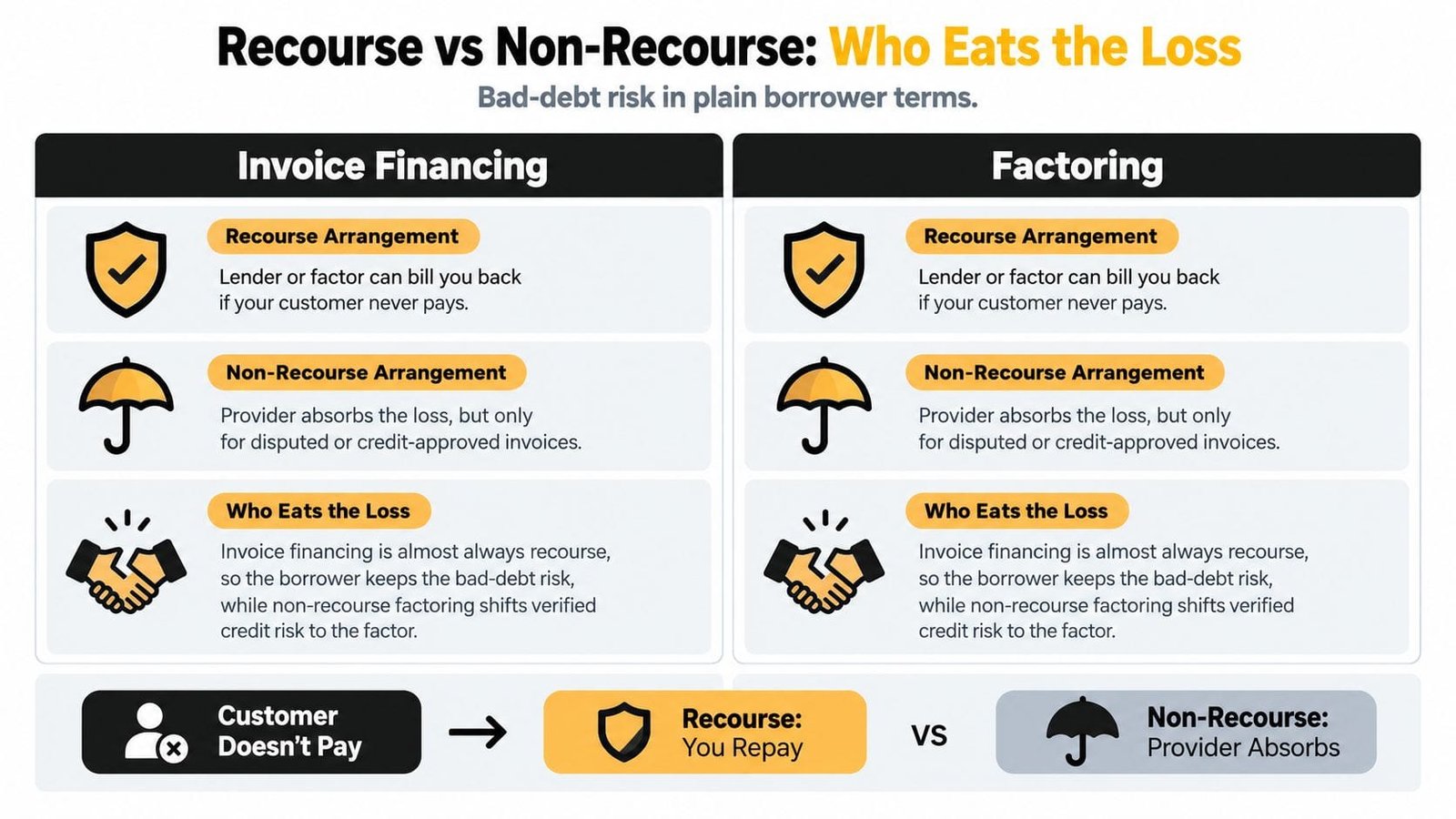
Recourse means if the customer doesn't pay, you still owe the provider. Non-recourse means the provider absorbs certain approved credit losses under the agreement. That sounds simple, but the details matter because non-recourse protection is usually narrower than owners assume.
Where the risk usually lands
Invoice financing is typically the structure where the borrower keeps more of the servicing and repayment burden. Factoring can be written as either recourse or non-recourse, with non-recourse structures holding 62.2% share in 2025 in one market projection (invoice-financing market outlook).
That share matters because it shows how many businesses are willing to pay for credit-risk transfer when receivables quality matters.
What to ask before you sign
Non-recourse doesn't mean “every nonpayment is their problem.” It usually covers defined credit events on approved invoices, not every dispute, short pay, or service complaint.
Ask these questions in plain English:
- What exact event triggers provider loss coverage
- Whether customer disputes are excluded
- Whether only pre-approved debtors qualify
- How long before the invoice is charged back
- Whether dilution, offsets, or returns stay on your side
If the customer refuses to pay because they claim defective work, many “non-recourse” deals stop feeling very non-recourse.
My recommendation
If your customers are stable and your invoices are clean, recourse pricing may be fine. If you sell to concentrated buyers, export customers, or industries where credit failures would punch a hole in your cash flow, paying up for non-recourse can be rational.
But read the exclusions line by line. Risk transfer only counts if it survives the fine print.
Credit Impact and Balance-Sheet Treatment
Owners usually focus on funding speed and ignore what the transaction does to their books. That's shortsighted, especially if you'll be asking a bank for a line or term loan later.
Accounting Treatment Comparison
| Treatment Area | Invoice Financing | Factoring |
|---|---|---|
| Basic structure | Usually behaves like borrowing against receivables | Usually behaves more like a receivables sale |
| Receivable on books | Typically remains on the books | May come off the books if the transfer qualifies as a sale |
| Liability impact | Usually creates or preserves a financing liability | May reduce receivables instead of adding debt-like exposure, depending on treatment |
| AR control | You keep it | Provider takes over |
| Future lender optics | Can affect leverage and covenant discussions | Can simplify some metrics, but only if structured and recorded properly |
Why owners should care
Invoice financing is usually closer to secured lending. You still own the receivable, so the asset remains tied to your books while the financing obligation sits alongside it.
Factoring can look cleaner in some situations because a true sale may remove the receivable from your books. But that isn't automatic. The transaction has to meet sale-treatment requirements, and your accountant needs to evaluate that properly.
The practical lending effect
If you plan to seek bank financing later, this distinction matters. A lender reviewing your statements will care whether you borrowed against receivables or sold them outright, how concentrated your customers are, and how dependent your working capital is on specialty finance.
That doesn't make one product better by default. It means you should choose with the next financing event in mind, not just the current cash squeeze.
A short-term cash fix can complicate the next loan if you don't understand how it shows up on the statements your bank will review.
My advice here
Bring your controller, CPA, or outside accountant into the decision before you sign. Don't call them after the agreement is live and the first month-end close turns messy.
If your lender relationships and balance-sheet optics matter, that accounting conversation belongs upfront.
Choosing the Right Fit for Your Business
The best option isn't the one with the prettiest rate sheet. It's the one that matches how your company sells, bills, collects, and protects customer relationships.
Choose factoring when operations are the real bottleneck
I recommend factoring when your business has:
- Heavy invoice volume: Lots of invoices create real back-office drag.
- Weak internal collections capacity: Your team can't keep up with follow-up.
- Customers who won't care about third-party contact: Some industries treat it as normal.
- Long payment cultures: You need cash conversion more than relationship insulation.
This is why factoring stays relevant at huge scale. Separate market reporting estimates the invoice factoring market at about $3.46 trillion in 2025 and projects $3.87 trillion in 2026, implying 11.7% CAGR, while another outlook projects growth from about $2.86 trillion in 2024 to $7.75 trillion by 2034, or roughly 10.5% CAGR. Multiple reports identify Europe as the leading market in 2025 (invoice factoring market projections).
That scale tells you businesses aren't using factoring as a fringe fix. They're using it because outsourcing receivables administration can be a legitimate operating decision.
Choose invoice financing when customer control matters most
I recommend invoice financing when:
- Your customer relationships are strategic: You don't want another party touching them.
- Your team can collect effectively: You already run AR well.
- You want less visibility with customers: Keeping collections internal matters.
- You only need selective funding: You don't want to factor your whole ledger.
This is often the better fit for firms that sell complex services, manage repeat accounts, or worry that a blunt collections process could create friction where none needs to exist.
Cross-border and supply-chain cases need a different lens
If you sell across borders or inside large buyer-led supply chains, don't reduce this to a simple two-product comparison. One market segmentation says domestic invoice financing accounted for 78.5% of share in 2025, while cross-border invoice financing is projected to grow faster at 5.8% CAGR through 2031. The same outlook says traditional invoice financing plus factoring held 87.9% of the market, while reverse factoring and supply-chain finance are projected to grow at 8.9% CAGR (cross-border invoice financing segmentation).
In those cases, debtor geography, assignment mechanics, and buyer approval processes can matter more than the quoted advance rate.
One practical note on provider shopping
If you're comparing fintech-style cash-flow tools alongside bank-linked business accounts, product review sites can help you understand how digital providers package funding and treasury tools. For example, this overview about Bluevine at BankStatementWizard is useful context when you're evaluating newer business-finance ecosystems, even if you ultimately choose a different provider.
My short version: choose factoring when you want outsourced AR muscle. Choose invoice financing when you want to keep your hands on the customer.
Decision Framework and Pre-Application Checklist
You don't need another vague pros-and-cons list. You need a same-day filter you can use.
Three rules that settle most cases
Start with these:
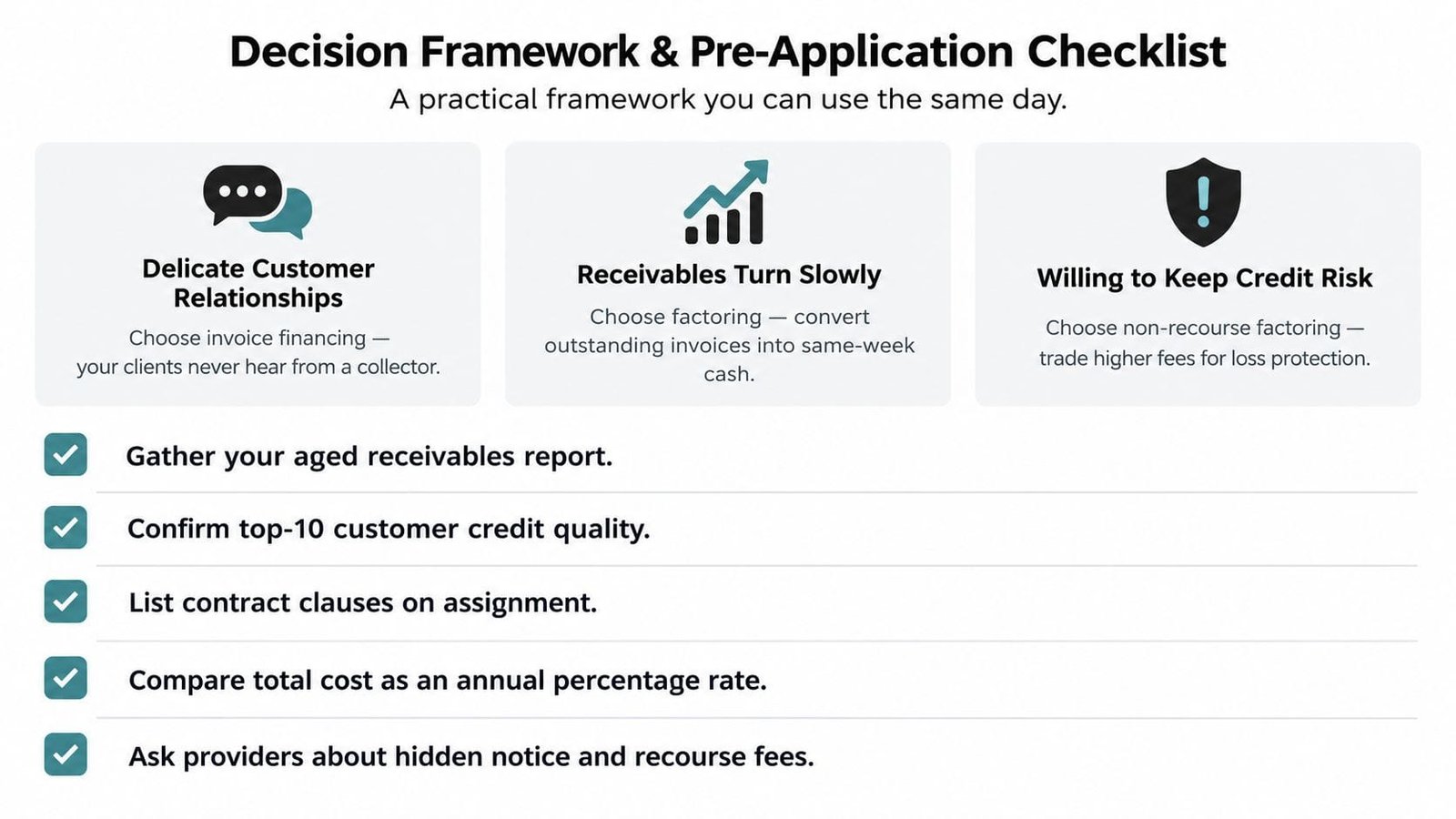
- If customer relationships are delicate, invoice financing usually wins. You keep the conversation.
- If receivables are big, messy, and admin-heavy, factoring usually wins. You're buying back-office relief, not just cash.
- If credit loss risk is a serious concern, pay attention to non-recourse options. The premium may be worth it if one buyer default would hurt badly.
Those three rules won't solve every case, but they eliminate a lot of bad-fit deals fast.
A simple decision tree
Ask these questions in order:
- How large are the invoices? Bigger invoices make specialty funding more worth the effort.
- How strong is customer credit? Weak debtor quality makes everything harder and pricier.
- Can your team handle collections well? If not, ownership of the receivable becomes less valuable.
- Do you need clean customer communication? If yes, don't hand off contact lightly.
- Do balance-sheet optics matter this year? If a bank review is coming, treat structure carefully.
If you answer “customer relationship matters most” and “we already collect well,” lean toward invoice financing. If you answer “our AR process is overloaded” and “we mainly need speed and admin relief,” lean toward factoring.
Pre-application checklist
Get these ready before you talk to any provider:
- Aged receivables report: Current, not last quarter's version.
- Sample invoices: Use invoices tied to completed work or delivered goods.
- Customer list: Especially your top accounts.
- Payment terms summary: Net terms, dispute patterns, and actual payment behavior.
- Customer concentration view: Know whether one buyer dominates your receivables.
- Recent charge-offs or write-downs: Don't let the provider discover them first.
- Existing debt agreements: Check whether receivables are already pledged.
- Assignment clauses in customer contracts: Some contracts restrict transfer.
- Proof of delivery or service completion: Missing support slows approval.
- Bank statements: Most funders ask for recent business statements.
- AR contact process: Who sends reminders, who escalates, who reconciles cash.
- Open disputes and credits: These can kill eligibility.
- Margin by customer or job: Expensive funding on thin-margin work can be a bad trade.
- Cash-use plan: Know exactly what the advance solves.
- Thirty-, sixty-, and ninety-day cost scenarios: Don't review only the headline quote.
Run the deal against your customers' actual payment habits, not the payment terms printed on the invoice.
Final recommendation
For most healthy small businesses, invoice financing is the better first step if preserving customer communication matters and your team can manage collections. Factoring is the stronger tool when your back office is stretched, customer contact is less sensitive, or you want to offload the receivables grind entirely.
Pick the structure that matches how your business operates. Then pressure-test the actual cost under fast-pay, normal-pay, and slow-pay scenarios before you sign anything.
If you want help comparing these options without guessing from rate sheets, Business Loan Warrior helps owners review funding structures like invoice financing and factoring through one application and a broader working-capital lens. If your receivables are solid but cash timing is the problem, it's a practical place to compare how different products fit your customer relationships, reporting needs, and short-term cash goals.