
Payroll is due Friday, and the month has been slow. A retailer in that spot doesn't need a lecture on capital structure. They need a way to cover wages, then put the money back when sales pick up. A line of credit online is built for that kind of gap. The application is the easy part. The hard part is the rate, the fees, and how much of the requested limit shows up.
This walkthrough treats those harder questions as the key decision. You'll see how a revolving facility works, how costs move when rates rise, and why an online "yes" can still mean a smaller limit than you asked for.
Table of Contents
- Why Online Lines of Credit Became Mainstream
- How a Revolving Online Line of Credit Works
- Comparing Business, Personal, Secured and Unsecured Lines
- Understanding Costs and Stress-Testing Your Repayments
- Eligibility, Documents and Ways to Strengthen Approval
- Applying Online Step by Step and Avoiding Common Pitfalls
- Choosing Between Alternatives and Your Next Step
Why Online Lines of Credit Became Mainstream
A shop owner checks the bank app on a Tuesday and sees enough cash for rent, but not for Friday's payroll. Calling a branch means a meeting next week, a packet of forms, and a decision sometime after that. The payroll date does not move.
That is the situation that made digital credit useful. An online line of credit is not a new kind of financing. It is the same revolving product, delivered through a website or app instead of a branch. The Federal Reserve describes fintech lenders as combining digital applications with data-based underwriting, often for credit products below $100,000, according to its March 2025 community context note.
How the channel opened up
The shift started after the 2007–09 Global Financial Crisis. Banks tightened lending, and small firms still needed working capital. Technology-enabled lenders filled part of that gap with faster applications and cash-flow data instead of a long branch review. Digital lending platforms now sit beside traditional banks as a normal way to start a credit request.
The numbers show a mainstream channel, not a niche. In the Federal Reserve's 2023 Small Business Credit Survey, 37% of small employer firms had applied for a loan, line of credit, or merchant cash advance in the prior 12 months. Among those applicants, 23% sought financing from online lenders, the same Federal Reserve note reports. That same survey found 34% of employer firms regularly used or carried a balance on a business line of credit, compared with 53% on business loans.
Practical rule: If the need repeats (payroll, inventory, a slow month), a revolving line fits better than a one-time lump sum. If the need is a single purchase with a known price, a term loan is usually cleaner.
Online credit is a delivery and underwriting channel for a familiar product. It fits owners who manage payroll, inventory, seasonal demand, or expansion costs and cannot wait weeks for a branch decision. Speed is real. Price and approval size still need a careful look, which is where most lender explainers stop too early.
How a Revolving Online Line of Credit Works
Think of a checking account with a ceiling. The ceiling is your credit limit, the most you can borrow. You take out only what you need. That withdrawal is a draw. You pay the principal back, and the room you just freed up is available again. Interest is charged on the amount outstanding, not on the unused ceiling.
A credit card works the same way, with one difference that matters. A business line is usually larger, priced off a benchmark, and tied to business cash flow rather than everyday card spending.
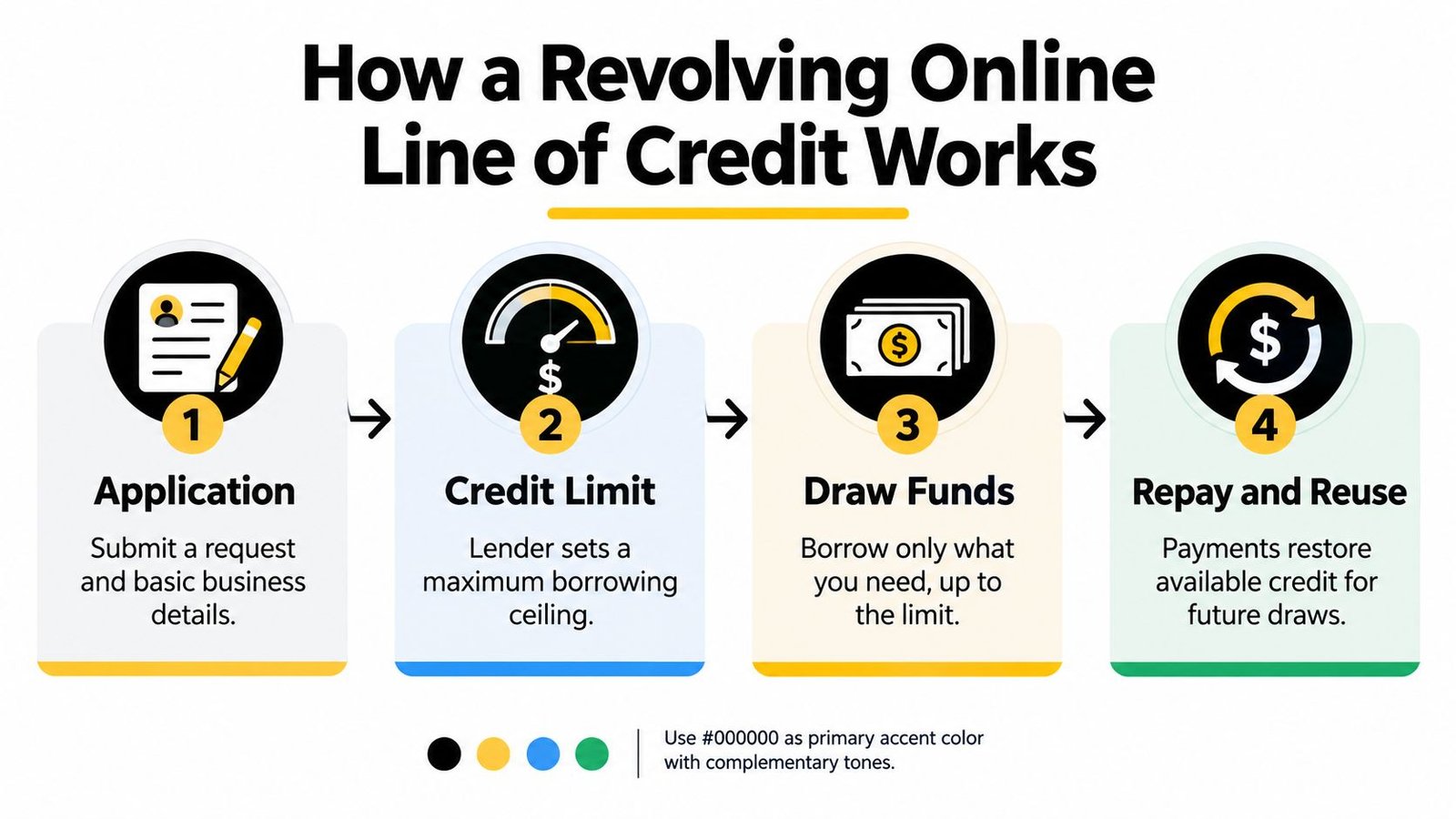
One draw, start to finish
- You request $20,000 against a $80,000 limit to cover two weeks of payroll.
- The lender sends the funds. Available credit drops to $60,000. Interest starts on the $20,000, not on the other $60,000.
- Sales recover and you repay the $20,000 plus interest.
- Available credit returns to $80,000. You can draw again without a new application, as long as the lender has not reduced or frozen the line.
That cycle is what "revolving" means. You borrow, repay, and reuse. A term loan does the opposite. You receive the full amount once, then pay it down on a fixed schedule, and the paid-down portion does not come back.
Where the rate comes from
Many variable-rate facilities price as a benchmark plus a spread (also called a margin). Prime is a common benchmark. If prime is the base and your spread is 3 percentage points, your rate is prime plus 3. When the base rate rises, interest on outstanding draws rises even if your limit never changes.
SBA 7(a) loans show how spreads can shrink as size grows. Maximum variable spreads are the base rate plus 6.5% up to $50,000, plus 6.0% from $50,001 to $250,000, plus 4.5% from $250,001 to $350,000, and plus 3.0% above $350,000, per SBA lender guidance. Those caps apply to SBA 7(a) pricing, not to every online lender. They are a useful reference point when you ask what index, spread, floor, and reset frequency a private line uses.
A low advertised rate only describes today's draw. Ask what the payment becomes if the benchmark rises two points while you still owe the money.
Comparing Business, Personal, Secured and Unsecured Lines
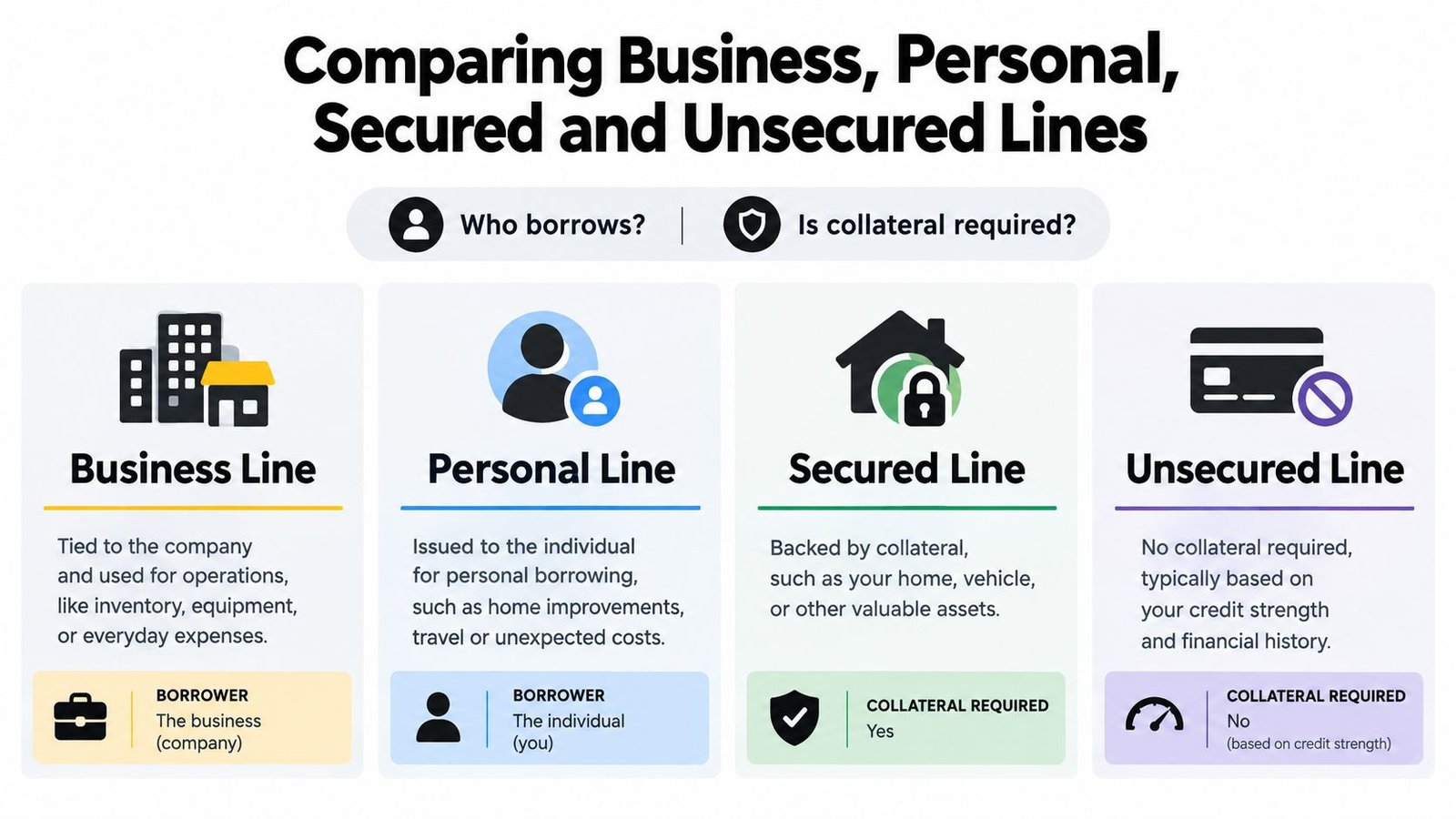
Two questions sort almost every offer. Who is the borrower, the company or you? And does the lender take collateral, or is the line based on credit strength alone?
| Question | Business line | Personal line | Secured | Unsecured |
|---|---|---|---|---|
| Who borrows? | The company | You, as an individual | Either | Either |
| Collateral? | Sometimes | Rarely for small amounts | Yes | No |
| Typical use | Payroll, inventory, operations | Personal bills, not business ops | Larger limits, asset-heavy firms | Smaller working-capital needs |
| Main risk | Business default, plus any guarantee | Your own credit and assets | Lender can claim the asset | Higher rate, tighter limit |
What each combination means in practice
A business line is issued to the company and used for operations. Payroll, inventory, and a short receivable gap belong here. A personal line is issued to you. Using one to fund the business mixes personal and company obligations, and a missed payment hits your consumer credit directly.
Secured means the lender has a claim on something if you don't pay. Common collateral is accounts receivable, equipment, or inventory. A borrowing base then caps draws at a percentage of eligible assets, so the limit can move as receivables are collected. Unsecured means no specific asset backs the line. Approval rests on revenue, cash flow, and credit. Limits are often smaller, and pricing is often higher, because the lender has less to recover.
A personal guarantee is easy to skip past and hard to undo. You promise to repay from your own assets if the business cannot. Your house, savings, and personal credit can be exposed even when the line is "in the business name."
Matching the line to the job
- Ongoing liquidity: An unsecured or lightly secured business line fits repeating gaps such as payroll and a slow season.
- Seasonal inventory: A secured line tied to inventory or receivables can support a bigger limit, with draws that rise and fall with the asset.
- A one-time expansion: A term loan, including an SBA-backed option, often beats a revolving line because the payment stays predictable.
Online applications may look at both business and personal credit signals. That does not make a personal line and a business line the same product. Read who signs, what is pledged, and whether you are guaranteeing the debt before you compare rates.
Understanding Costs and Stress-Testing Your Repayments
The rate in the ad is the starting number, not the bill. A fully loaded cost adds every fee to the interest: annual, origination, draw, maintenance, and unused-line fees. A facility with a low spread can cost more than a higher-rate line if fees apply to the whole limit or to every draw.
Variable rates dominate this market. In the Kansas City Fed's Q3 2025 Small Business Lending Survey, about 91% of bank-issued credit-line usage was tied to variable-rate lines. Median offered rates were 7.9% at urban banks and 7.6% at rural banks, while credit-line spreads still rose slightly from the prior quarter, per the Kansas City Fed survey. Those are bank medians, not online-lender prices. They show how benchmark-linked pricing behaves.
A simple stress test
Say the line is $100,000 at 8% and you pay interest only on what you draw. Run three utilization levels, then raise the rate by 2 points. A business credit line calculator makes the same math faster once you plug in your own limit and fees.
| Utilization | Amount drawn | Interest per year at 8% | Interest per year at 10% |
|---|---|---|---|
| 25% | $25,000 | $2,000 | $2,500 |
| 50% | $50,000 | $4,000 | $5,000 |
| 100% | $100,000 | $8,000 | $10,000 |
That table is interest only. It ignores fees. An unused-line fee of even a small percent on the undrawn balance changes the 25% row more than the 100% row. A draw fee on each advance punishes owners who take many small draws.
Revolving line versus fixed-rate term loan
On a revolving line, interest floats with the index and applies only to the outstanding draw. On a fixed-rate term loan, the rate is set at closing and the payment stays the same. Seasonal or thin-margin businesses feel the difference first. A lower starting rate can hide a payment that jumps when the benchmark resets.
Before you accept an offer, write down five items: the rate index, the spread, any floor, the reset frequency, and the payment if rates rise while you are fully drawn. If that higher payment would strain payroll, the line is too large or the wrong product.
Eligibility, Documents and Ways to Strengthen Approval
Getting a screen that says "approved" is not the same as receiving the limit you typed in. The Federal Reserve's 2025 Small Business Credit Survey found that 22% of employer firms applied for a line of credit, while nearly 4 in 10 sought a loan, line of credit, or merchant cash advance. The share of applicants fully approved stayed below prepandemic levels, according to the 2025 employer-firm report. Partial approvals, staged limits, and later reductions are common enough to plan for.
What underwriters actually weigh
Lenders look past a single credit score. The variables that move a decision are recurring revenue, cash-flow volatility, existing debt service, tax obligations, customer concentration, and time in business. A firm with steady monthly deposits and several customers looks safer than one with one large client and lumpy receipts, even at the same annual sales.
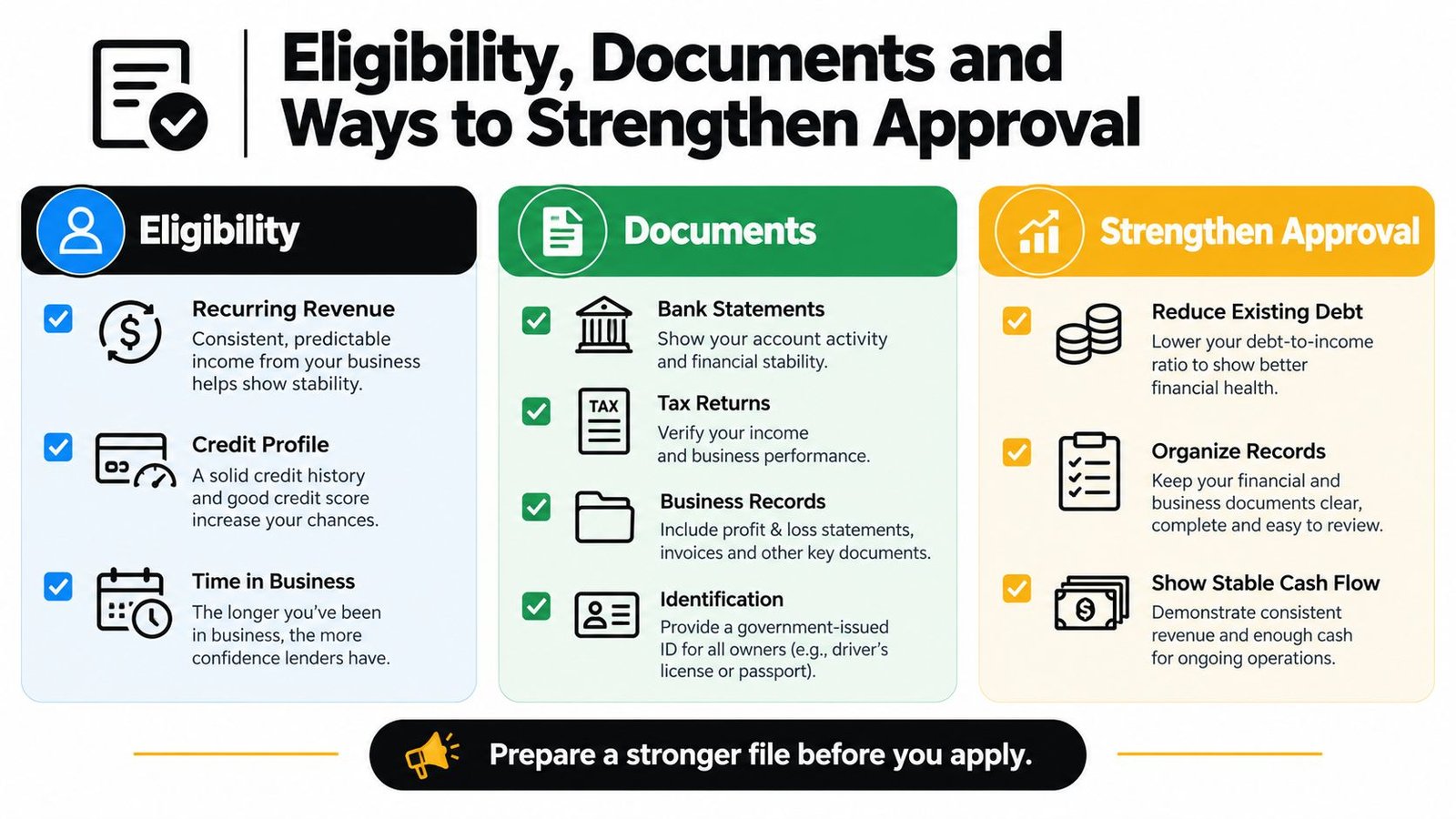
Gather these before you apply, and keep them in one folder. A clear list of documents you need keeps the file from stalling once an underwriter asks for more.
- Bank statements: Usually several recent months, showing deposits that match the revenue you claim.
- Tax returns: Business returns, and personal returns if a guarantee is required.
- Accounts receivable aging: Who owes you, and how late they are. Old invoices weaken a receivables-backed request.
- Debt schedule: Every loan, lease, and card payment the business already carries.
- Use of funds: A short written note on what the draws will cover, such as payroll or seasonal inventory.
Moves that improve the file
Ask for a limit you can support with current cash flow, not the largest number the form allows. A smaller, fully usable line beats a large limit you cannot draw. Clean up bank-statement trends before you connect accounts. Avoid large unexplained transfers in the weeks before you apply. If revenue is seasonal, say so in writing and show last year's pattern, so a slow month is not read as a decline.
Keep an internal draw cap below the approved maximum, and hold a cash buffer. A temporary dip in sales then does not become a missed payment.
Online files often blend business data with personal credit signals. Tidying one side and ignoring the other leaves an easy reason for a smaller offer.
Applying Online Step by Step and Avoiding Common Pitfalls
A fast online decision feels like funding. It often isn't. Prequalification estimates what you might receive. Final underwriting, a signed agreement, and an available limit are what let you draw. Between those points, lenders cut amounts, stage the limit, or add monitoring rules.
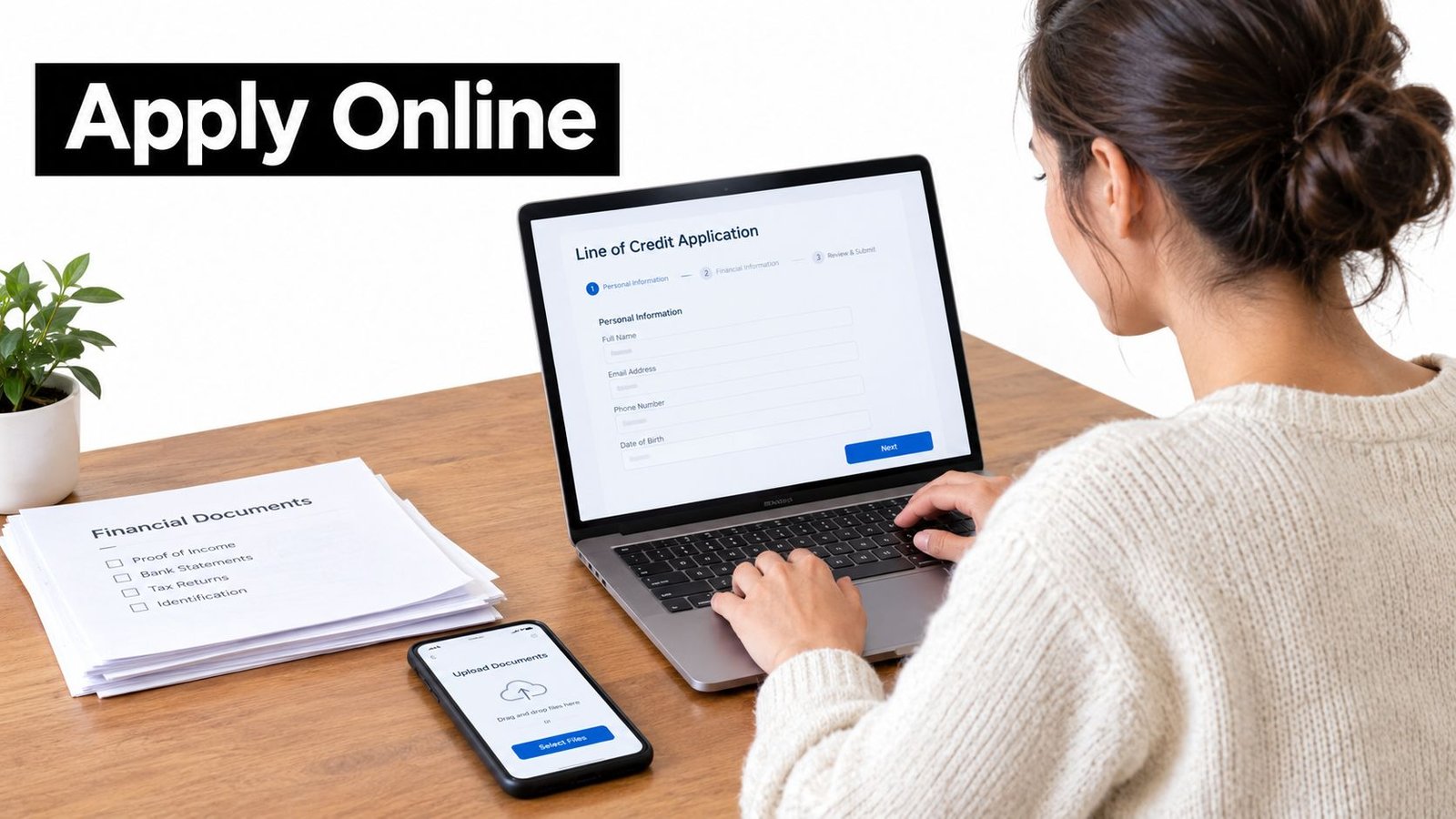
The path from click to first draw
A typical online file moves through five stages.
- Soft-check prequalification. You enter basic revenue and time-in-business figures. A no-impact check is not a hard inquiry and is not a commitment to fund.
- Documents or a bank connection. Connecting accounts lets the lender see transaction-level cash flow, which can shorten review. You still need clean records.
- Underwriting. The lender tests revenue, volatility, existing debt, taxes, and concentration. Partial approvals can happen at this stage.
- Offer comparison. Read the limit, the rate index, fees, any personal guarantee, collateral, and whether the lender can freeze the line.
- Signing and first draw. Funds are available only after the agreement is executed and any conditions are cleared.
A hard inquiry usually happens at final underwriting, not at the soft check. Applying at several lenders on the same day can stack inquiries if each one pulls a full report.
Connected bank data speeds review, but it does not decide how the account is reported afterward. The CFPB found that only about 15% of furnishers that reported business loans or commercial installment loans also furnished any business line of credit to consumer credit bureaus, a pattern that held from 2012 through 2019, in its consumer credit trends report. Repayment on a business line may not show up on a consumer file the way a personally guaranteed product does. Policies differ by lender, so ask.
Mistakes that stall or shrink the offer
- Treating prequalification as cash: Wait for the final limit and conditions before you promise payroll or a vendor payment.
- Skipping the reporting question: Confirm whether the lender reports to commercial bureaus, consumer bureaus, both, or neither.
- Ignoring a freeze clause: Some agreements let the lender cut or pause the limit if deposits weaken.
- Comparing only the rate: Stack APR against any factor-style pricing, plus unused-line fees, draw fees, and renewal terms.
Owners comparing who backs these products can browse lending sector investors to see which firms fund U.S. lending. That context helps when you are choosing between a bank line, an SBA option, and an online working-capital product. Confirm the guarantee, the inquiry type, and the reporting policy in the contract before you sign.
Choosing Between Alternatives and Your Next Step
A revolving line is the right tool when the cash need repeats and the amount changes. Payroll gaps, inventory builds, and slow months fit that pattern because you can draw, repay, and draw again. A fixed installment loan fits a one-time cost with a known price, such as equipment or a renovation, because the payment does not reset when a benchmark moves.
Other tools cover needs a line handles poorly. Invoice financing advances cash against specific unpaid invoices, which helps firms with slow-paying customers and less need for an open-ended limit. A merchant cash advance is repaid from future sales and is priced differently from interest on a draw, so compare it on total cost, not on speed alone. Early-stage companies that are not ready for debt sometimes look at crowdfunding for early-stage founders before they take on a repayment at all.
Business Loan Warrior is one place to compare a line of credit with business loans, SBA loan processing, short-term financing, and invoice financing through a single no-fee application that checks pre-approval without affecting credit. Use it as a comparison point, not as a substitute for reading the rate index, fees, and guarantee on any offer.
Your next step is short. List the cash needs for the next 90 days. Run the 25%, 50%, and 100% utilization test, then add 2 points to the rate. If the higher payment still fits, request a pre-approval and compare at least two structures side by side before you draw a dollar.
Business Loan Warrior lets you check pre-approval for a business line of credit, alongside loans and invoice financing, through one no-fee application that does not affect your credit. You can connect bank accounts, track the offer, and talk with underwriters before you commit to a limit or a rate. If payroll gaps or seasonal inventory are the reason you are looking, visit Business Loan Warrior and compare a line against the other options in the same application.