
A couple in their seventies may have plenty of equity in the house, yet still feel financially boxed in. Their savings have thinned, a bank has reduced an existing credit line, and selling investments during a weak market could create a problem they'd rather avoid. A line of credit reverse mortgage can deserve a separate look in that situation because it turns home equity into a reserve they can draw from without the monthly mortgage payments required by many conventional borrowing tools.
The product isn't free money, and it doesn't remove the need to pay property taxes, homeowners insurance, and maintain the home. But its mechanics are different enough from a HELOC that treating the two as interchangeable can lead to poor retirement planning. The sections below clarify how the HECM line works, how it differs from other credit lines, what it costs, who may qualify, and what to do before applying.
Table of Contents
- When a Regular Line of Credit Comes Up Short
- How a HECM Line of Credit Actually Works
- HECM Line of Credit vs HELOC vs Traditional Line of Credit
- Eligibility Rules and the Real Cost Breakdown
- Two Worked Examples for Different Retirement Styles
- Why a Reverse Mortgage Line of Credit Can Be a Debt-Stabilization Tool
- Applying for a HECM Line of Credit Step by Step
- Deciding If This Tool Fits and What to Do Next
When a Regular Line of Credit Comes Up Short
Elaine and Robert have lived in the same house for decades. They're retired, their home has appreciated, and their investment account covers ordinary bills. A large roof repair, a family emergency, or an extended period of poor investment returns could still put pressure on their cash flow.
Their first instinct is to use a HELOC. The bank, however, reviews their retirement income and offers less credit than they expected. Even if the line remains open, they'd have to make monthly payments, and the lender could change the account's terms. Their savings account provides more certainty, but every withdrawal immediately reduces the cash available for the next emergency.
That's the gap a federally insured HECM line of credit is designed to address. The Home Equity Conversion Mortgage, or HECM, was authorized in 1989, and it became the dominant reverse mortgage structure in the United States. A Federal Reserve review of the HECM program found that HECMs represented more than 90% of the U.S. reverse mortgage market, with fewer than 400,000 HECM loans originated from the program's beginning through the end of 2007. NRMLA later reported 1,357,246 total HECMs through FY2025, with annual originations ranging from 21,533 in FY2025 to 64,489 in FY2022 in its program summary.
Why the product is its own category
A conventional HELOC is a revolving account. You borrow, repay, and generally regain access to the amount you repaid. A HECM line of credit typically works differently. Its unused capacity can grow, but amounts you repay generally aren't restored for future draws, so the account is nonrevolving.
That distinction changes the planning question. Elaine and Robert aren't asking, “How much can we borrow today?” They're asking, “How much liquidity can we preserve for a later health expense, home repair, or market downturn?”
Planning lens: A HECM line of credit is best evaluated as a reserve with borrowing costs, not as a credit card attached to the house.
The rest of the decision depends on the mechanics. A homeowner needs to understand the principal limit, the growth feature, the trade-offs against a HELOC or personal line of credit, the costs and eligibility rules, and the steps required before funds become available.
How a HECM Line of Credit Actually Works
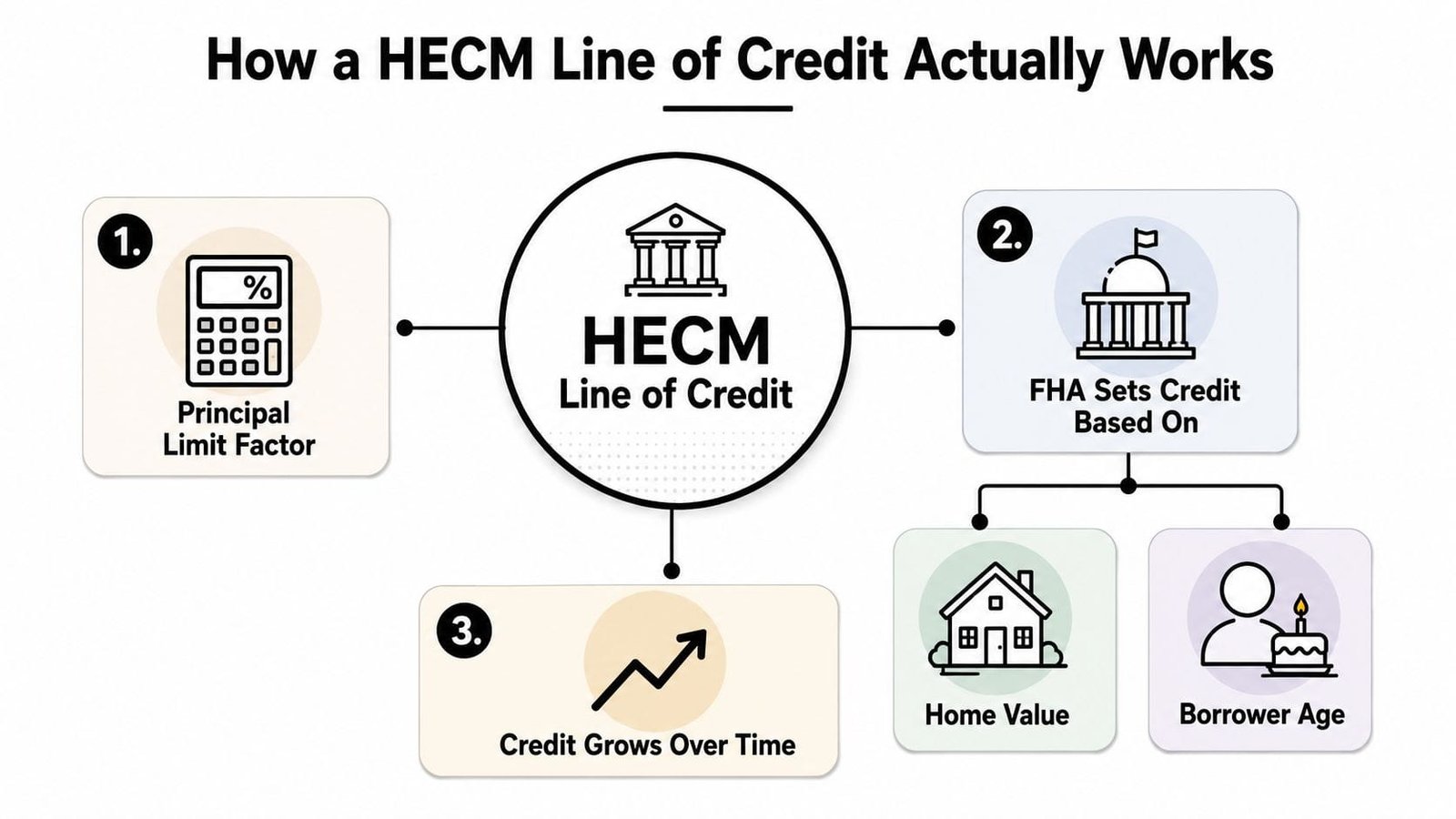
A HECM line of credit starts with a calculation called the principal limit. The FHA uses the home's eligible value, the age of the youngest borrower, and the expected interest rate to determine the initial amount that can support the loan. Existing liens and required charges can reduce the amount available for future borrowing because they must be addressed as part of the transaction.
The process is easier to picture as a series of steps:
- The home establishes the base. An appraisal supports the property value used in the loan calculation, subject to FHA program limits and requirements.
- The youngest borrower affects the formula. Age matters because the loan is designed to remain in place over the borrower's occupancy, and the youngest borrower's age is part of the principal-limit calculation.
- Interest rates influence the opening amount. Higher expected rates can affect how much credit the formula makes available at closing.
- The borrower chooses when to draw. The available line can be used for a large expense, smaller advances, or held for later needs.
- The unused portion grows. The growth applies to credit that remains available, not to cash the borrower has already taken.
The growth feature
The unused borrowing capacity increases at the loan's current interest rate plus the FHA annual mortgage insurance premium of 0.50%, as explained in this overview of HECM mechanics. In the current rate environment described by that source, untouched capacity may grow by roughly 7% to 7.5% annually.
That doesn't mean the borrower earns an investment return. It means the amount available to borrow later can become larger. Interest and other loan charges accrue on funds advanced, while the unused line expands under the contract's growth rules. The HECM mechanics guide describes the line as tied to principal-limit calculations and adjusted over time as the loan balance and available credit change.
Suppose a borrower has $10,000 of unused capacity. At a hypothetical 7% annual growth rate, the untouched amount would be about $19,700 after ten years, before considering draws, loan terms, or changes that could affect the calculation. That illustration is compound-growth math, not a loan quote. The lender's disclosures control the actual result.
The most useful analogy is a fire extinguisher that becomes larger while it sits on the wall. You don't pay interest on cash you haven't taken, but the reserve isn't endlessly refillable. Once you draw and later repay funds, the nonrevolving structure generally means those repaid amounts don't return to the available line.
For a broader explanation of credit facilities, see this guide to how a credit facility works, but don't assume a business or personal credit facility follows HECM rules.
HECM Line of Credit vs HELOC vs Traditional Line of Credit
The three products can all provide access to cash, but they place different demands on the borrower. A HELOC is secured by the home and normally requires repayment. A personal line of credit is usually unsecured, which means the lender relies more heavily on credit and income. A HECM line of credit uses home equity within an FHA-insured reverse mortgage framework.
| Feature | HECM Line of Credit | HELOC | Personal Line of Credit |
|---|---|---|---|
| Ownership requirement | Borrower owns and occupies the home as a primary residence | Borrower owns the home securing the line | No home ownership requirement in principle |
| Repayment rules | No required monthly mortgage payment, but taxes, insurance, maintenance, and loan obligations remain | Monthly payments are required under the account terms | Monthly payments are required under the account terms |
| Growth on unused balance | Unused capacity can grow under HECM rules | Unused capacity generally doesn't compound | Unused capacity generally doesn't compound |
| Tax treatment of proceeds | Loan proceeds generally aren't income, but personal tax advice matters | Treatment of interest depends on use and tax rules | Loan proceeds generally aren't income, but personal tax advice matters |
| Impact on heirs | Balance is generally settled when the borrower leaves the home; remaining equity may be affected | Balance must be repaid or refinanced when due | Estate remains responsible for the balance |
| Federal insurance backing | FHA insurance applies to HECM loans | No HECM federal insurance | No HECM federal insurance |
The differences retirees feel most
A HELOC behaves like a revolving bucket. During the draw period, the homeowner can generally borrow and repay within the approved limit, but the lender can impose account restrictions under its agreement. The borrower must also keep making payments, which can be uncomfortable when income is fixed or irregular.
A personal line of credit doesn't use the home as collateral in the same way. That may protect the house from a direct lien, but the lender can set a tighter limit, charge a different rate, or rely more heavily on the borrower's income and credit profile. A retiree with substantial equity but modest monthly income may not receive the amount expected.
The HECM line addresses a different need. It typically offers adjustable-rate access, no required monthly mortgage payment, and a growth feature on unused capacity. It also carries a loan balance that grows as advances and charges accumulate.
The nonrevolving detail
The most frequently missed point is nonrevolving access. If a borrower draws $20,000 and later repays $5,000, that repayment doesn't necessarily restore $5,000 of future borrowing capacity. A homeowner who wants a permanent emergency fund should therefore avoid treating the HECM line as a revolving checking account.
A HELOC may fit someone with stable income who can manage payments and expects to repay the balance. A personal line may fit a borrower seeking a smaller, unsecured facility. A HECM line may fit an older homeowner who plans to stay put and values future liquidity more than immediate low-cost borrowing. For additional background on conventional borrowing structures, this business line of credit guide offers useful comparison context, although HECM rules remain distinct.
Eligibility Rules and the Real Cost Breakdown
A HECM isn't approved solely because a homeowner has equity. The borrower must satisfy program, property, occupancy, and financial obligations.
The core requirements include:
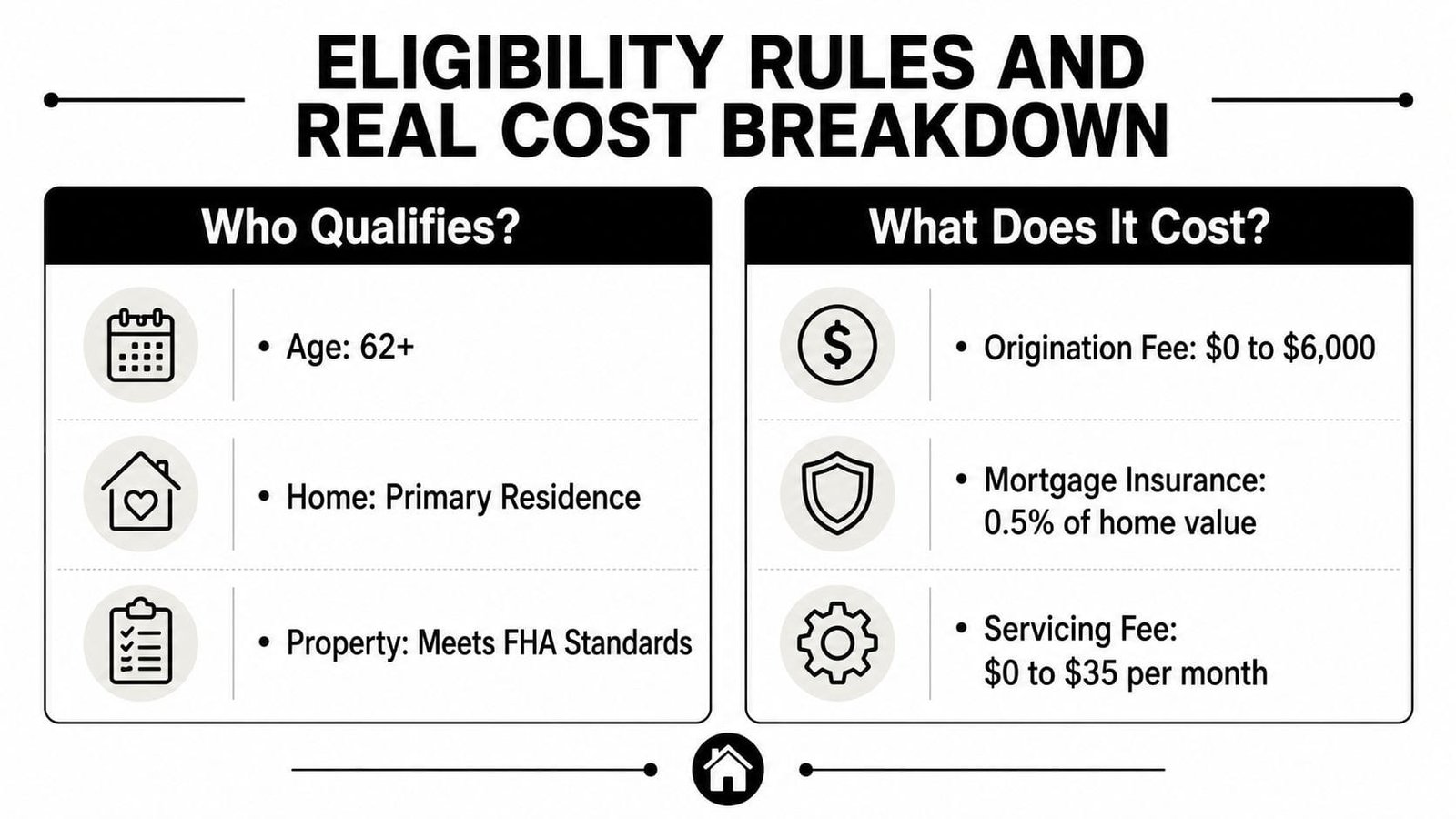
- Age: The borrower must be at least 62 years old.
- Residence: The property must be the borrower's primary residence.
- Property condition: The home must meet applicable FHA standards, or required repairs must be addressed under the lender's process.
- Counseling: The borrower must complete counseling with a HUD-approved reverse mortgage counselor before closing.
- Ongoing charges: The homeowner must continue paying property taxes, homeowners insurance, and maintenance expenses.
The HUD-backed consumer discussion guide is a useful resource for reviewing the responsibilities and questions that accompany the loan.
Where the money goes
The cost has several layers. The upfront mortgage insurance premium is part of the HECM structure, and the annual mortgage insurance premium is 0.50%, which also contributes to the line-growth formula. The lender may charge an origination fee, while third parties may charge for the appraisal, title work, recording, credit checks, and other closing services.
The loan also has an interest rate structure. Many HECM lines use an adjustable rate, and the rate affects both the cost of borrowed funds and the growth rate applied to unused capacity. That creates an important distinction: interest accrues on amounts advanced, while undrawn capacity can expand under the contract.
Why a quote matters more than a generic estimate
A lender should provide a detailed loan estimate rather than a vague statement that the line is “low cost.” Ask for the following in writing:
- Initial availability: How much is available at closing after existing liens and required charges?
- Mortgage insurance: Which premiums apply, and when are they added?
- Origination: What lender fee applies, and can it be financed?
- Third-party charges: What are the appraisal, title, recording, and other settlement costs?
- Servicing: Are there servicing charges, and how are they assessed?
- Rate assumptions: What rate affects drawn balances and unused-line growth?
- Net proceeds: How much remains available after all required payoffs and financed costs?
A homeowner can use the same disciplined approach described in this guide to calculating borrowing costs, separating the advertised facility from the amount available for use.
The right comparison isn't just “reverse mortgage versus no fee.” It's the cost of establishing and carrying the line compared with the value of preserving a reserve for future needs. A borrower who expects to move soon may not recover those upfront costs, while someone planning to age in place may value the long-term access.
Two Worked Examples for Different Retirement Styles
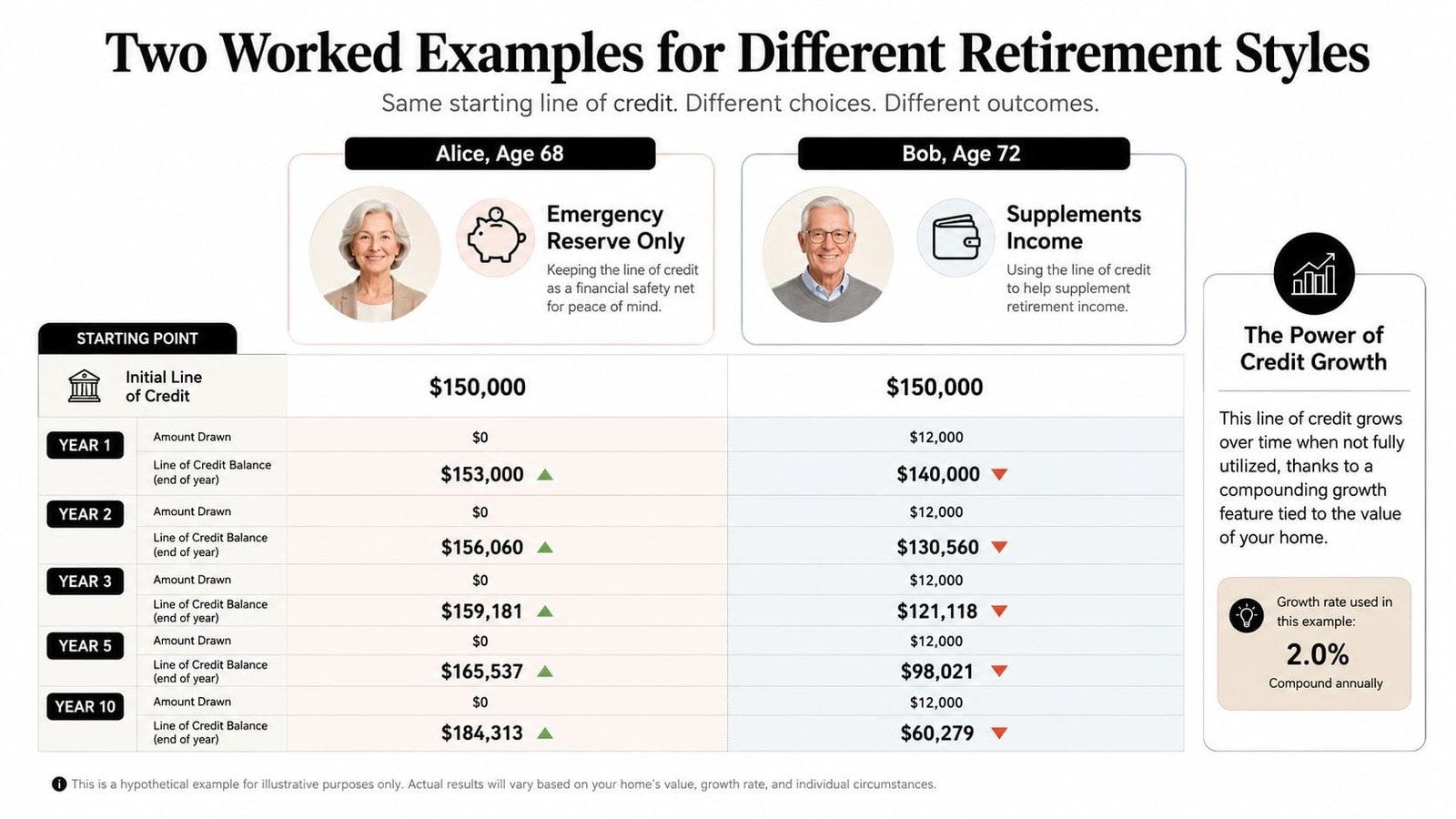
The growth feature becomes clearer when two homeowners use the same type of reserve differently. The examples below use the amounts shown in the accompanying visual and illustrate the planning principle, not a personalized loan projection.
Alice keeps the line for emergencies
Alice is 68 and starts with a $150,000 line. She wants a reserve for home repairs, medical needs, or a market downturn, but she doesn't need additional cash in the first year.
| Alice's first-year path | Amount |
|---|---|
| Starting available line | $150,000 |
| Year-one draw | $0 |
| Illustrative remaining line after growth | $153,000 |
The visual uses a 2% illustrative growth amount for that first year. In an actual HECM, the growth rate follows the loan's applicable interest rate plus the FHA annual mortgage insurance premium, so the lender's disclosures determine the result.
Alice's restraint preserves more future capacity. If she later draws a modest amount during a period when her investment portfolio has fallen, she may avoid selling investments immediately. That can give her retirement-income plan more flexibility, although it also increases the loan balance and reduces the equity that may remain for heirs.
Bob spends early for cash flow
Bob is 72 and begins with the same $150,000 line. He uses $12,000 in the first year to supplement income and pay for home upgrades.
| Bob's first-year path | Amount |
|---|---|
| Starting available line | $150,000 |
| Year-one draw | $12,000 |
| Illustrative remaining line before later growth | $140,000 |
Bob has solved an immediate cash-flow problem, but he has less unused capacity available to grow. If he later repays part of the advance, he shouldn't assume the repaid amount will become available again because a HECM line is typically nonrevolving.
The contrast is the central planning lesson:
- Emergency reserve strategy: Draw as little as possible while preserving future optionality.
- Income supplement strategy: Accept a smaller future cushion in exchange for current spending power.
- Home improvement strategy: Use the line when the repair or modification supports safety, occupancy, or another clear retirement goal.
- Portfolio buffer strategy: Coordinate draws with investment withdrawals rather than selling automatically in every market condition.
The retirement savings and bankruptcy resource can help readers explore how broader financial distress may affect retirement assets, though it isn't a substitute for advice about a specific reverse mortgage.
The video below provides another visual explanation of the product's financial comparison.
Why a Reverse Mortgage Line of Credit Can Be a Debt-Stabilization Tool
At 68, a homeowner may face a leaking roof, an uneven investment account, and a mortgage payment that leaves little room each month. A HECM line of credit can serve as a reserve for those pressures. It is still debt, and the balance can grow as funds are drawn and interest and charges accrue, but the planning question is also what that debt may replace.
Without this reserve, a retiree might use credit cards, postpone necessary repairs, sell investments during a poor market, or keep making a conventional mortgage payment from limited income. Used carefully, a line of credit reverse mortgage can shift those pressures into a financing structure designed around the home. The potential benefit is debt stabilization, not free cash.
Research summarized in the University of Michigan consumer-finance discussion material reports that seniors using reverse mortgages had greater reductions in consumer debt and were less likely to become delinquent or face foreclosure three years after origination than comparable households. That result does not make every reverse mortgage appropriate. It does show why a review should include the debts and risks the line may help manage, rather than focusing only on its future balance.
Stability has conditions
The reserve works like a financial shock absorber only while the homeowner maintains the conditions attached to it. Property taxes, homeowners insurance, home maintenance, and occupancy requirements remain the borrower's responsibility. Missing those obligations can create default risk even when the line itself still has unused capacity.
Heirs also need a plain explanation before the loan is opened. If the borrower sells the home, permanently moves out, or dies, the loan generally becomes due under the contract. The estate may sell the property, use other funds to settle the balance, or choose not to keep the home. HECM nonrecourse protections can limit personal liability, but the loan may still consume much of the home's remaining value.
The best use of the line may be the expense it helps you avoid, not the cash it puts in your checking account.
Opening a reserve before a crisis preserves an option. That option may help absorb housing volatility, health-related expenses, or an interruption in income, while allowing the homeowner to delay a forced investment sale or expensive unsecured borrowing. The trade-off is lower equity and a contract that demands ongoing attention.
A family discussion should identify who will pay taxes and insurance, what happens if the borrower moves into care, and whether heirs expect to sell or keep the home. Written expectations are safer than assumptions made after a health event. The line can support retirement timing decisions, but only when the household understands both its available liquidity and its obligations.
Applying for a HECM Line of Credit Step by Step
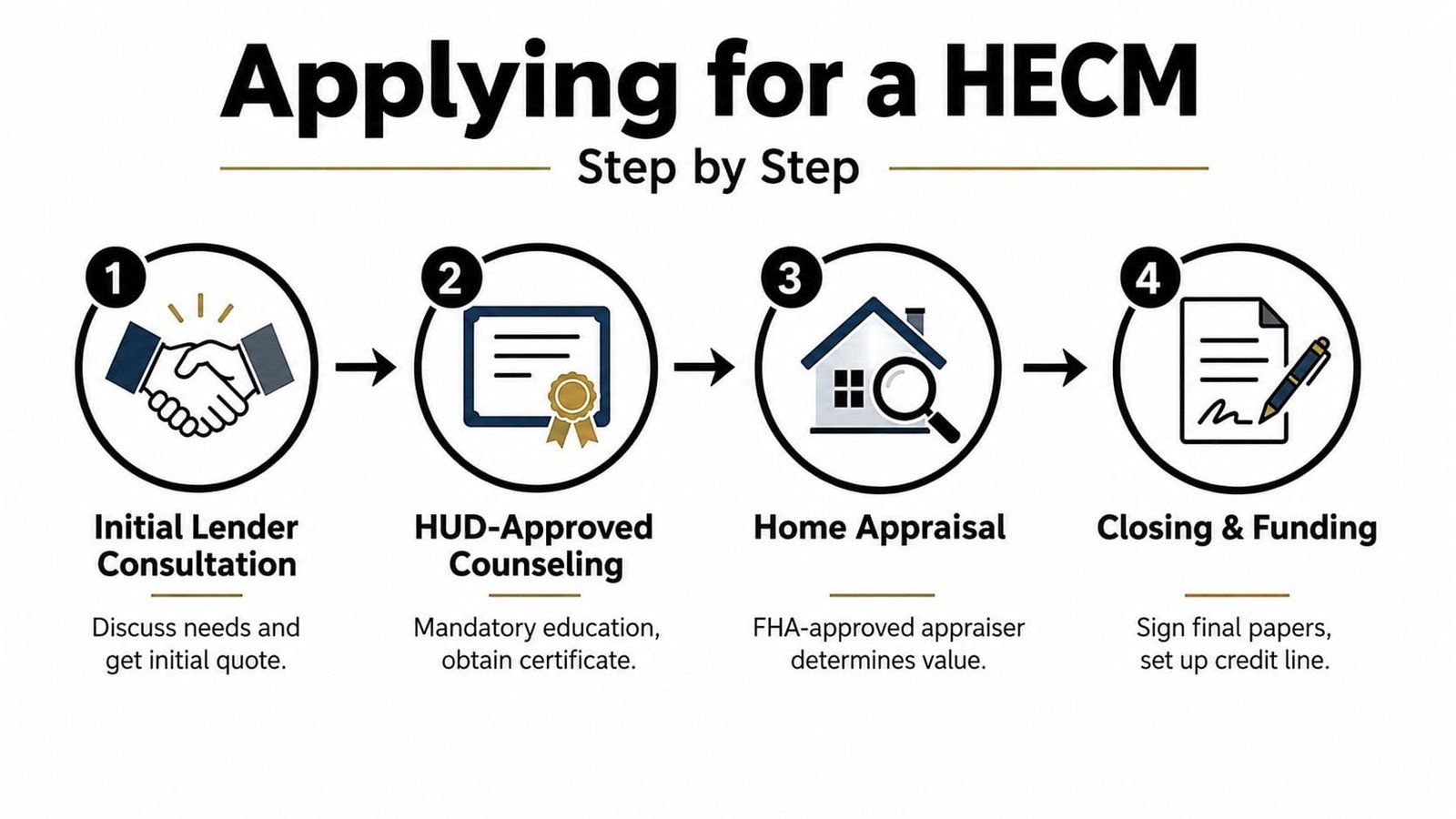
The process begins with a conversation with an FHA-approved HECM lender. Ask for a preliminary estimate of the principal limit, available proceeds, required payoffs, interest-rate structure, and projected costs. Don't treat the first estimate as final because the appraisal and underwriting review can change the result.
The application path
- Initial lender review: Share basic information about the borrowers, property, existing mortgage, income, and obligations. The lender explains the possible loan structures.
- HUD-approved counseling: Complete the required counseling session and receive the counselor's certificate. The counselor isn't there to sell the loan. Their role is to explain alternatives, obligations, and risks.
- Application and disclosures: Review the formal application, loan estimates, projected payments or advances, interest assumptions, and required documents.
- Appraisal and property review: An FHA-approved appraiser evaluates the home. Repairs or documentation issues can delay the file.
- Underwriting: The lender reviews title, debts, property charges, financial capacity, and the appraisal.
- Closing: Sign the final documents, confirm how existing liens and costs will be handled, and verify the available line.
- Rescission period: The borrower generally has a three-day right of rescission after closing for a covered transaction. Confirm the exact timing and exceptions with the lender.
Documents to gather
Prepare proof of age, ownership records, current mortgage statements, property-tax bills, homeowners-insurance information, and records concerning other liens. Having these documents ready can reduce avoidable back-and-forth.
Ask the lender whether the line uses adjustable-rate growth mechanics, whether draw limits apply, and whether any minimum advance is required. Newer second-lien products demonstrate why this question matters. Finance of America's 2026 California HomeSafe Second Line of Credit includes a 25% initial draw, a 10-year draw period, 1.5% growth on unused balance for seven years, and a nonrevolving structure, according to the company's product announcement.
That product isn't the same as a standard HECM. Ask which program you're being offered before comparing features.
Deciding If This Tool Fits and What to Do Next
A line of credit reverse mortgage may fit a homeowner who plans to remain in the property, has meaningful equity, wants flexible access rather than a fixed monthly advance, and values the possibility that unused capacity can grow. It may be especially useful when the household wants a reserve for unpredictable expenses or wants another option besides selling investments during a difficult market.
Caution makes sense when the homeowner expects to move soon, has a highly specific plan to leave the house free of debt, or wants to preserve as much home equity as possible for heirs. The product also deserves extra review when taxes, insurance, maintenance, Medicaid eligibility, or a likely move into long-term care could affect the plan.
Before contacting a lender, take these actions:
- Complete independent counseling: Use a HUD-approved reverse mortgage counselor to review the HECM and alternatives.
- Run a personalized estimate: Use a reputable reverse mortgage calculator, then compare the result with an official lender disclosure.
- Map future uses: List possible needs, such as repairs, care, debt reduction, or portfolio withdrawals.
- Review the household plan: A mortgage versus retirement decision guide can help frame the broader question of how home equity fits with savings and debt priorities.
- Prepare lender questions: Ask about growth assumptions, draw rules, nonrevolving treatment, costs, occupancy requirements, and the effect on heirs.
Take this checklist to the next conversation:
- What is the estimated initial line after liens and closing costs?
- Which rate controls drawn balances and unused-line growth?
- What obligations must be paid every year?
- What happens if one borrower moves out or enters care?
- How will the loan affect the equity heirs may receive?
- Which alternatives should be compared before signing?
A qualified counselor, tax professional, estate attorney, and retirement planner can each address a different part of the decision. No single calculator or lender conversation can replace that broader review.
Business Loan Warrior offers objective financing education and comparisons across lending categories, including resources that help borrowers evaluate credit facilities and funding costs. Visit Business Loan Warrior to review practical borrowing guidance and use a structured approach before your next lender conversation.