
Your P&L says the business is fine. Your bank account says otherwise.
That's the moment owners feel finance stop being abstract. A customer is slow to pay, payroll lands on Friday, sales tax is due, and a business that looks healthy on paper suddenly feels fragile. If you want to manage business finances like a pro, you have to stop treating bookkeeping, cash flow, and borrowing as separate jobs. They are one operating system.
The practical question isn't just whether the business is profitable. It's whether you have enough runway for the way your business earns, collects, and spends cash. That answer changes when revenue is lumpy, when one customer makes up too much of the book, or when seasonality turns one good quarter into a weak one. Owners who understand that difference make better decisions about hiring, equipment, and debt. Owners who don't usually find out the hard way.
Table of Contents
- Why Profitable Businesses Still Run Out of Cash
- Set Up Financial Organization and Bookkeeping That Actually Holds Up
- Build a 13-Week Rolling Cash Forecast
- Right-Size Your Cash Buffer for Your Specific Business
- Match the Funding Option to the Problem You Are Solving
- Package Your Financials So Lenders Move Fast
- Your 30-Day Financial Control Playbook
Why Profitable Businesses Still Run Out of Cash
A business can post a profit and still miss payroll.
That happens because profit measures performance over a period, while cash measures timing right now. A sale may sit on the income statement as revenue long before the money reaches the bank. Meanwhile, payroll, rent, software, taxes, loan payments, and vendor bills keep leaving the account on schedule whether customers have paid or not.
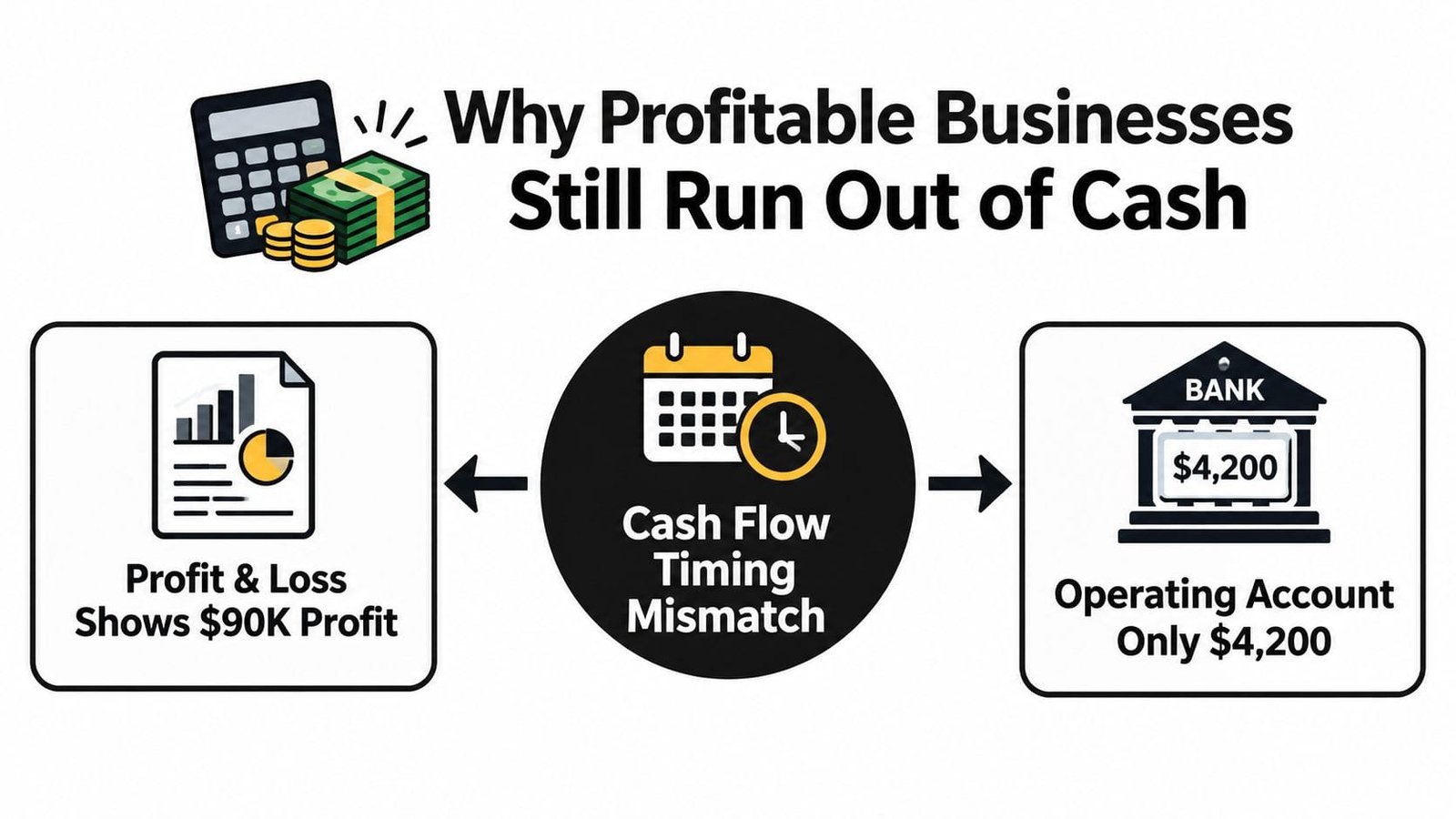
Profit is not the same as liquidity
This mismatch is more common than most owners think. A Federal Reserve small-business credit survey summary noted that 51% of employer firms cited uneven cash flow as a financial challenge in 2025, and a separate industry compilation reported that 39% of small and mid-sized businesses had less than one month of cash reserves on hand while the median small business held only 27 cash buffer days in 2026 (cash reserve and buffer data).
If your business has less than four weeks of buffer, one late invoice can create a real operating problem. That's why bank balance matters more than accounting profit when you're deciding whether to hire, order inventory, or take on debt.
Practical rule: Never approve a major spend from the P&L. Approve it from expected cash collected and cash left after the spend.
The failure pattern tells the same story. About 20% of businesses fail within the first year, roughly 45% within five years, and about 65% within ten years. A widely cited small-business study also attributes cash flow problems to 82% of business failures (business failure and cash flow data). Plenty of those businesses weren't failing because no one wanted what they sold. They failed because cash arrived too late.
What owners should watch instead
To manage business finances well, owners need a different lens:
- Track collection timing: Revenue booked this month doesn't help payroll if the customer pays next month.
- Separate fixed from flexible outflows: Payroll and rent don't care whether sales were slow.
- Decide from runway: Every hire and purchase should be tested against how many weeks of operating room remain.
If you want a practical model for cash flow visibility for your business, start with a short-horizon cash view that shows what happens over the next quarter, not just what happened last month. For a plain-language grounding in the mechanics, this overview of cash flow management is a useful companion.
Set Up Financial Organization and Bookkeeping That Actually Holds Up
Most bookkeeping problems aren't software problems. They're structure problems.
Owners buy a platform, connect a bank feed, and assume the numbers will become useful on their own. They won't. Good books come from clean account design, a chart of accounts built around decisions, and a review cadence that catches errors before they poison reporting.
Start with separation
Your first layer is bank-account discipline. At minimum, split business cash into operating, payroll, tax, and owner draw buckets. Then put one rule in writing: business spending never runs through personal cards unless you want every report to become an argument later.
A second layer is the chart of accounts. Don't just accept the default template your accounting software gives you. Build categories that help you run the company. Revenue by product line or service type. Cost of goods sold by delivery model or channel. Operating expenses by function, such as sales, admin, operations, and occupancy.
If you need a clean refresher on how to read the output once your structure is fixed, this profit and loss statement 2026 guide is worth reviewing.
Build a close process you can repeat
Without cadence, even a good setup drifts.
Use a rhythm like this:
- Daily check: Confirm bank and card feeds are flowing and scan for duplicates or obvious miscoding.
- Weekly cleanup: Categorize uncoded transactions, review owner spending, and flag unusual vendor charges.
- Monthly close: Finish reconciliations and close the books by the 10th so the numbers are still useful.
- Quarterly review: Compare actual results with your forecast and cut dead categories that no longer matter.
| Setup Layer | What It Includes | Cheap Mistake That Breaks It |
|---|---|---|
| Bank account structure | Operating, payroll, tax, owner draw accounts | Mixing business and personal spending |
| Chart of accounts | Revenue, COGS, and operating categories tied to management decisions | Keeping bloated default categories nobody uses |
| Transaction coding | Consistent rules for draws, reimbursements, taxes, and transfers | Recording owner draws as wages or expenses |
| Reconciliation cadence | Bank and card reconciliation, monthly close, quarter-end review | Letting unreconciled items stack up for months |
Good bookkeeping should answer operating questions fast. If it can't tell you where cash is going or which line of business is carrying margin, it's organized for tax filing, not management.
Know when DIY stops making sense
At some point, the owner shouldn't be the one cleaning feeds and fixing coding logic. Once the transaction volume gets steady and the business becomes more operationally complex, a bookkeeper usually costs less than the mistakes DIY books create.
That handoff matters because accounting and bookkeeping are not the same job. Bookkeeping records clean history. Accounting interprets it for decisions. This breakdown of the difference between accounting and bookkeeping helps owners assign each role correctly.
Build a 13-Week Rolling Cash Forecast
The most useful cash tool for an operating business isn't a yearly budget. It's a 13-week rolling cash forecast.
Why 13 weeks? It's long enough to expose pressure building ahead and short enough to force real assumptions. You can't hide behind vague monthly averages when payroll, rent, tax payments, and customer collections all hit on different days.
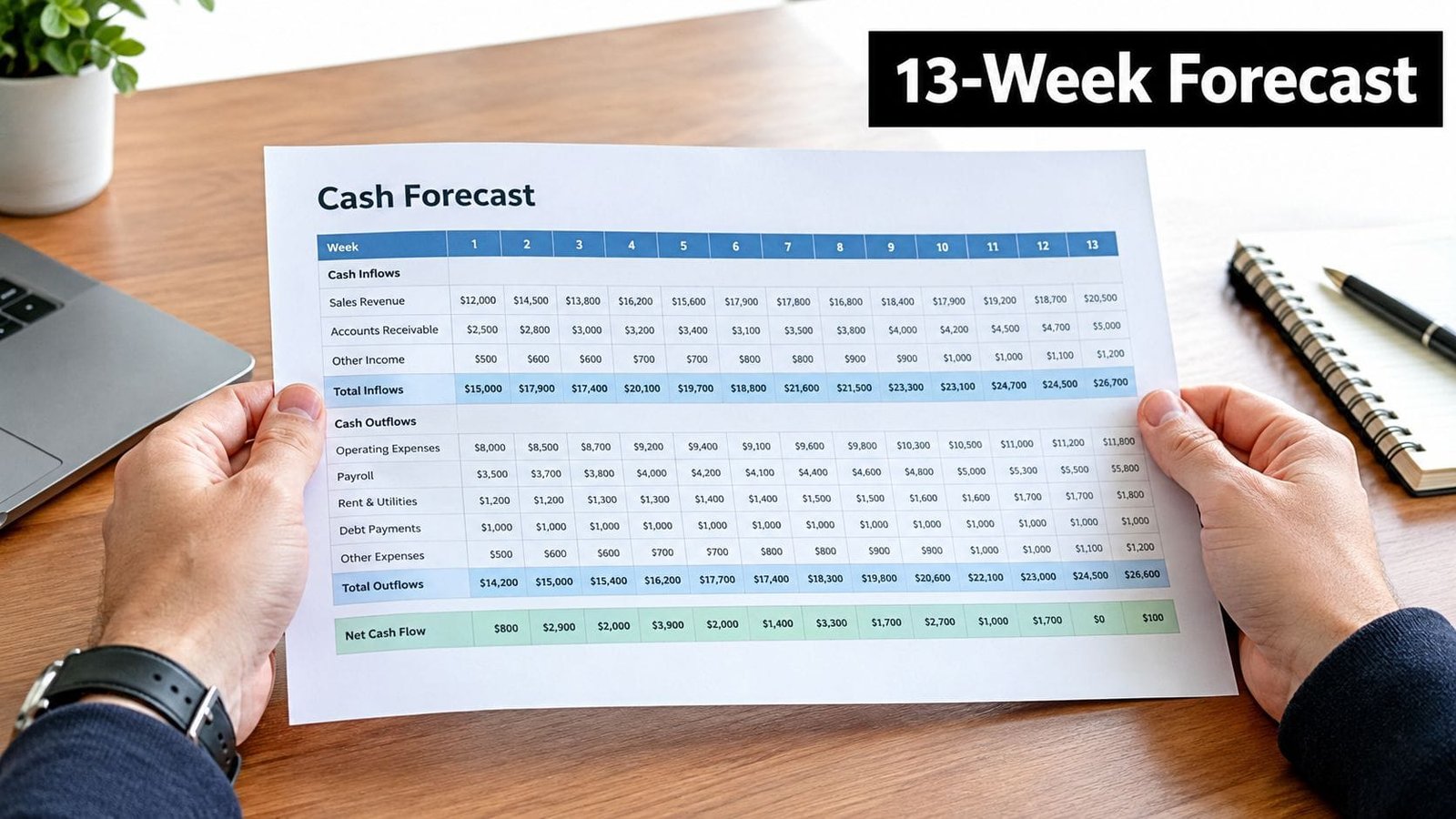
What goes into the forecast
Start with cash you can use. That means opening bank balance plus committed cash that is available, not theoretical receivables.
Then map weekly outflows in two buckets:
- Fixed outflows such as payroll, rent, debt service, software subscriptions, and tax payments.
- Variable outflows such as materials, contractor costs, marketing, freight, and discretionary owner spending.
Inflows should be entered by expected collection week, not invoice date. If a client has a habit of paying late, forecast that reality. Don't forecast hope.
Why this works better than annual planning
A 12-month forecast is useful for direction. A 13-week forecast is useful for action.
JPMorgan Chase Institute found the typical small business has median daily balances of about $12,100, while median inflows and outflows are only about $380 per day, leaving limited room for shocks (small business balance and flow data). That's exactly why weekly forecasting matters. In many businesses, the margin for error is smaller than owners assume.
Forecast cash at the speed bills are due. Monthly views are too blunt for weekly obligations.
A strong weekly model should include:
- Opening balance: starting point each week
- Cash in: Collections by customer or invoice batch
- Cash out: Fixed and variable payments
- Closing balance: The number that tells you whether the week is safe
- Minimum floor: A line you don't cross without taking action
For operators who want an external reference on method, these tips for financial forecasting line up well with how disciplined teams build assumptions. If you want a lending-oriented version, this guide on how to build a cash flow forecast that empowers your loan strategy is useful because it connects the forecast to borrowing decisions.
The mistake that breaks the model
Owners often plug in invoiced revenue as if it were collected cash. That one shortcut destroys the forecast.
Global suppliers reported late payments in 55% of cases in 2025 across 129 countries, and businesses took an average of 51 days to get paid in 2025 (late payment and collection timing data). If your model assumes customers pay on terms when they rarely do, you'll approve spending too early and borrow too late.
Right-Size Your Cash Buffer for Your Specific Business
The usual advice says to keep a few months of cash and move on. That's too generic to be useful.
A stable retainer-based firm doesn't need the same runway as a contractor with milestone billing, long receivable cycles, and two dominant customers. To manage business finances well, size your buffer around actual risk, not borrowed rules of thumb.
Use a simple risk matrix
Score your business on three variables:
- Revenue volatility: Are monthly sales fairly stable or do they swing sharply?
- Customer concentration: What happens if your largest account slows, churns, or delays payment?
- Seasonality: Does the business produce evenly through the year or does one peak season carry the whole model?
Then assign a target buffer. The point isn't mathematical perfection. The point is a defensible number you can use before hiring, buying equipment, or taking on debt.
| Risk Profile | Volatility (CoV) | Top-Customer % | Seasonality Ratio | Target Buffer (Months) |
|---|---|---|---|---|
| Low risk | Low | Low | Low | 1 to 2 months |
| Moderate risk | Moderate | Moderate | Moderate | 2 to 4 months |
| High risk | High | High | High | 4 to 6 months |
Translate risk into runway
Take your average monthly operating outflow from the 13-week forecast and multiply it by your target buffer range. That gives you a cash reserve target you can manage toward.
Recent survey evidence shows many owners are operating with less room than they think. A 2026 SMB survey found that 62.9% of surveyed small businesses had less than three months of operating cash if revenue slowed, 33.9% had less than one month, and 72.6% said managing month-to-month cash flow was harder than a year earlier (runway pressure and cash flow difficulty data).
If your top customer disappeared tomorrow, your buffer target should already reflect that risk. Don't wait for the event to redesign the policy.
Stress-test before you commit
Before any major move, run one ugly scenario. Assume revenue drops materially for a period, collections slow, or your biggest customer stretches payment. Then ask one question: does the current buffer still protect payroll, taxes, and critical vendors?
If the answer is no, the hire can wait, the equipment purchase needs a different structure, or the business needs financing arranged before the pressure shows up.
Match the Funding Option to the Problem You Are Solving
Funding is a tool. It is not a strategy.
Owners get in trouble when they use long-term debt for a short-term gap, short-term capital for a long-lived asset, or expensive financing to cover a collections process that should have been fixed first. The right move depends on what problem you're solving and how fast that use of cash pays back.
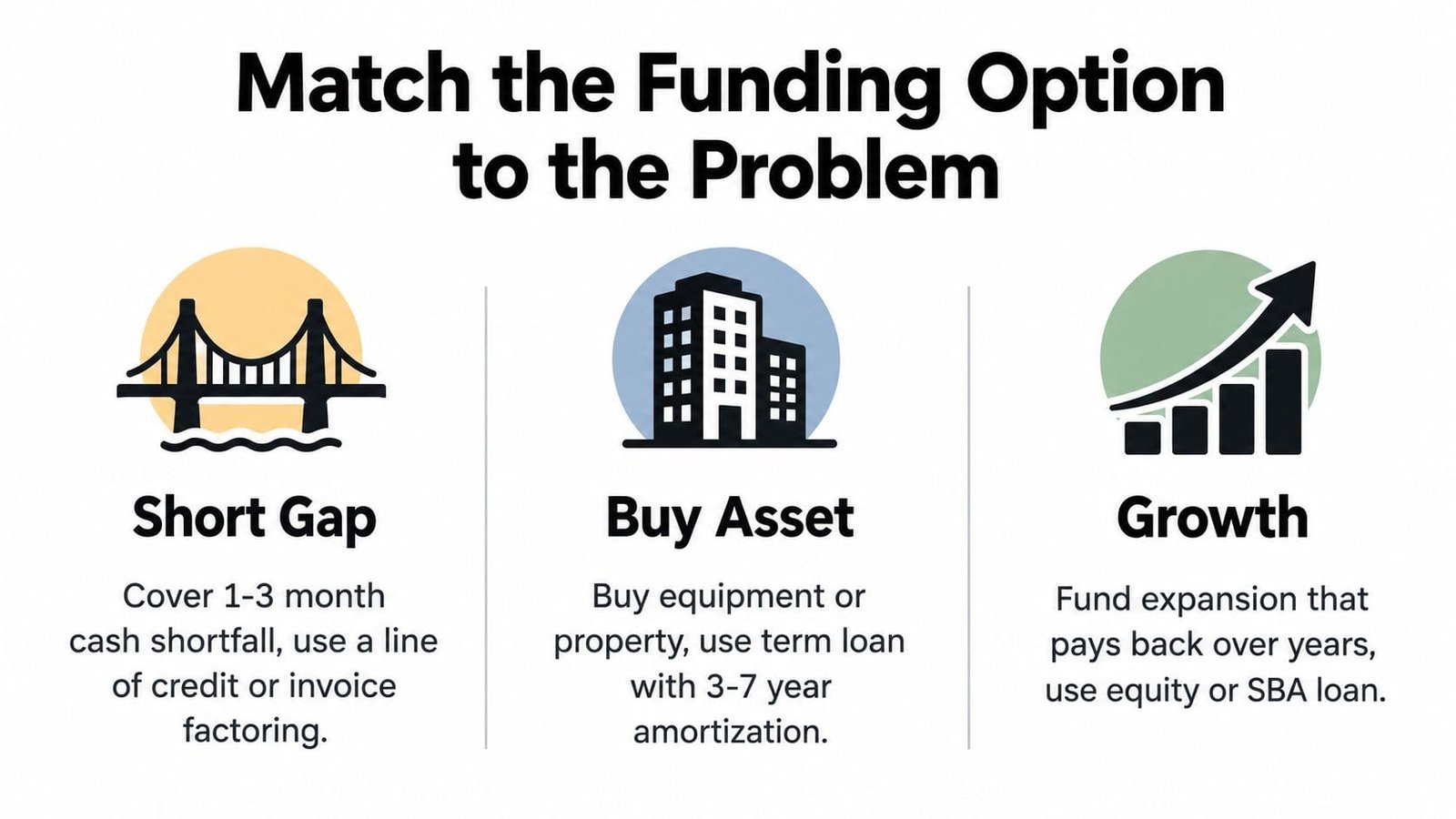
Short gap, long asset, or multi-year growth
Start with the life of the need.
If you're covering payroll while waiting on receivables, that's a short-gap problem. If you're buying machinery, vehicles, or specialized equipment, that's an asset problem. If you're opening a location, expanding capacity, or acquiring a business line, that's a growth investment that should be matched to a longer payback period.
Here's the practical fit:
- Line of credit: Best for uneven working capital needs, recurring gaps, and seasonal drawdowns.
- Term loan: Best when the need is defined up front and repayment can be matched to useful life.
- SBA 7(a) or SBA Express: Usually more attractive on cost when the borrower can tolerate a slower process and provide a fuller package.
- Equipment financing: Strong fit when the asset itself supports the structure and retains collateral value.
- Invoice financing: Can make sense when receivables are solid but collections are slow.
- Merchant cash advance: Sometimes useful for urgent situations, but often a costly fix for a deeper operating problem.
What owners often get wrong
The common mistake is borrowing because cash feels tight without diagnosing why it feels tight.
In Intuit QuickBooks' 2026 small business data, 59% reported waiting more than 30 days to get paid, 48% said they request immediate payment of invoices, and 44% reported cash flow problems. Another 2026 survey found 57% of owners said cash flow had become more challenging since January (invoice timing and cash flow pressure data). That's why collections strategy belongs in the funding conversation. If your receivables process is weak, new debt often just papers over the leak.
A line of credit works well when timing is the issue and the business can revolve in and out cleanly. Equipment financing works when the asset lasts for years and supports revenue over those years. Invoice financing can be rational when you need to bridge real receivables, not doubtful ones. An MCA is usually the tool of last resort, not because it never solves a problem, but because it often solves one week while creating stress for many after.
Use a simple decision rule
Ask these questions in order:
- Is this a timing gap or a structural margin issue?
- How long will the cash be tied up?
- Does the thing I'm funding produce value over months or years?
- Would fixing collections be cheaper than borrowing?
One practical option in the market is Business Loan Warrior, which uses a single application to let owners check pre-approval without affecting credit and connect business banking data for funding review. That kind of platform is most useful after the use case is clear, not before.
Package Your Financials So Lenders Move Fast
Lenders don't slow down because they enjoy paperwork. They slow down when the file is messy.
Clean, consistent financials give underwriters fewer reasons to pause. Sloppy books force them to question everything else in the package, including the story you're telling about the business.
What the file should contain
A lender-ready package usually includes:
- Profit and loss statements: Trailing history plus current year to date
- Balance sheet: Current enough to reflect what the business owns and owes
- Cash support: Either a cash flow statement or the weekly forecast used to manage liquidity
- Aging reports: Receivables and payables, so timing risk is visible
- Debt schedule: What's outstanding, with payment obligations
- Tax returns: Business returns and, when required, related owner information
The point isn't to overwhelm the lender with exports. The point is to present one set of numbers that ties together.
What kills momentum
Applications stall when the lender sees issues that suggest the records can't be trusted.
The usual offenders are familiar:
- Commingled expenses: Personal spending mixed through the business account
- Unreconciled transactions: Feed balances that don't match statements
- Inconsistent owner draws: Recorded one way in one month and another way the next
- Tax sloppiness: Sales tax or filing gaps that suggest hidden liabilities
Organized financials don't guarantee approval. They do make the lender's risk decision cleaner and faster.
Why connected applications help
Modern application workflows can speed the front end of the process because they pull bank data, accounting records, and identity information directly through secure connections. That makes pre-qualification more useful and reduces back-and-forth on missing documents.
What matters, though, is not the technology by itself. It's whether the numbers inside the systems are complete and reconcilable. Owners often focus on the application form and ignore the books behind it. Lenders do the opposite.
Your 30-Day Financial Control Playbook
Strong finance habits don't come from heroic quarter-end cleanups. They come from a repeatable weekly cadence.
If you want to manage business finances with control, keep the routine short enough to maintain and sharp enough to catch issues early. Most owners don't need more dashboards. They need a small set of reviews that change decisions.
Weekly rhythm that keeps you ahead
Use Monday to look forward and Friday to clean up.
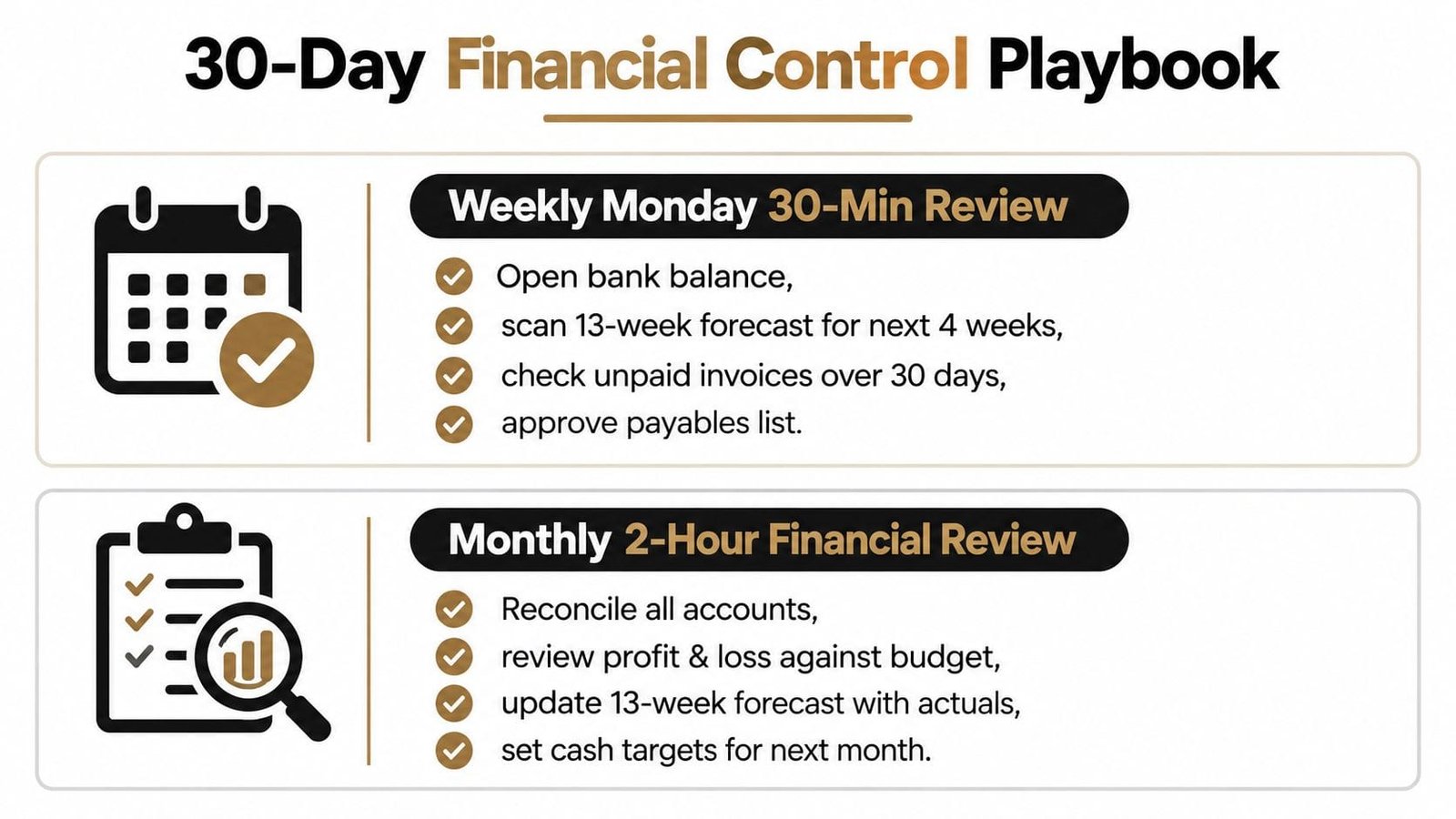
On Monday, spend about half an hour on the items that affect the next month:
- Open the bank balance: Know the starting point.
- Review the 13-week forecast: Focus on the next four weeks first.
- Flag low-balance weeks: Any week below your buffer floor needs action now.
- Identify the largest outflow: Big payments deserve a plan before they hit.
On Friday, keep the review tighter:
- Confirm invoices went out
- Check what got collected
- Review receivables that are drifting too old
- Categorize new transactions while memory is fresh
Monthly close that drives decisions
The first business day of the month should trigger a deeper review.
Use that session to reconcile accounts, review the P&L against budget, update the weekly forecast with actual results, and recalculate runway. If the runway is shrinking, decide whether the fix is collections, cost control, or financing. Don't call it a cash problem until you know which one it is.
A simple scorecard is enough:
| KPI | What you're checking |
|---|---|
| Cash balance | What is actually available now |
| Weeks of runway | How long fixed obligations are covered |
| Gross margin | Whether core work is priced correctly |
| AR aging over 60 days | Whether revenue is turning into cash |
| Current ratio | Whether near-term obligations are covered |
What to do in the next 30 days
If the business has drifted without a real finance system, start here:
- Separate accounts for operating, payroll, tax, and owner draws.
- Clean the chart of accounts so reports reflect how the business is run.
- Build the first 13-week cash forecast using realistic collection timing.
- Set a buffer target based on volatility, concentration, and seasonality.
- Assemble one lender-ready package before you urgently need capital.
The owner who reviews cash weekly borrows from a position of choice. The owner who reviews cash only when payroll is close usually borrows from pressure.
You don't need a perfect finance department to get control. You need a system that makes weak spots visible early enough to do something about them.
If you need capital after the books, forecast, and buffer target are in order, Business Loan Warrior gives you a practical way to explore options without turning the process into another full-time job. You can check pre-approval without affecting credit, connect business banking data, and compare funding paths that fit short gaps, equipment purchases, or expansion plans.