
You can have a polished marketing plan sitting in a folder, a kickoff meeting in the calendar, and a spreadsheet full of channel ideas, then still stall out the first week after launch. The owner is waiting on creatives, the ad person thinks someone else owns tracking, and the budget line gets spent before anyone agrees what success looks like. That's the core problem with marketing plan implementation, it's where strategy meets operational friction, and friction is what breaks momentum.
For small businesses, implementation has to be treated like a working system, not a document. Pennsylvania State University frames marketing plan success as a cycle of defining goals, assigning tasks, setting timelines and budgets, then tracking KPIs like website traffic, conversion rates, sales revenue, engagement, and email open rates against the original objectives so tactics can be adjusted from the data [Penn State Extension]. That closed loop is what separates “we're doing marketing” from actual execution. When the plan is specific about who owns what, what counts as done, and how fast the team will know if it's working, it becomes scalable instead of chaotic.
Table of Contents
- Why Most Marketing Plans Fail After Launch
- Building Your Pre-Launch Checklist and Kickoff Process
- Activating Your Channels with Precision
- Budgeting and Cashflow Realities for Small Business Campaigns
- Measuring What Actually Matters
- Common Pitfalls and How to Recover Mid-Campaign
- Your 90-Day Implementation Schedule and Next Steps
Why Most Marketing Plans Fail After Launch
A café owner I worked with once had a clean, thoughtful marketing plan on paper. The goals were smart, the channels made sense, and the messaging was solid. Two weeks later, nothing meaningful had happened because the team didn't know who was supposed to launch the email sequence, who was handling the ad account, or who was checking whether the landing page form worked.
That pattern shows up everywhere in small business marketing. Plans break less because the strategy is weak and more because the handoff from planning to execution is fuzzy.
Strategy is not implementation
A strategy can say, “we need more leads from search and email.” Implementation has to say who writes the page, who builds the campaign, when the assets are due, what budget gets released, and what KPI gets checked first. That distinction matters because the work only becomes measurable when tasks are broken into real deadlines and ownership, not just broad intentions. Penn State's guidance is blunt about the need for an action plan, deadlines, budgets, and a review against original objectives, because without that loop, you're only shipping activity, not outcomes [Penn State Extension].
A lot of small business teams also confuse motion with progress. A social feed can look active while lead flow stays flat, or an ad campaign can spend cleanly while sales never move. The key operational question is, “What part of the plan is supposed to move the business this week?”
Practical rule: if a task can't be assigned to a single owner and measured against a KPI, it isn't ready to launch.
That is why implementation has to be managed as a closed loop of planning, execution, measurement, and revision. In practice, that loop keeps content creation, social campaigns, paid ads, and follow-up emails tied to business outcomes instead of vanity activity. If you need a detailed planning companion for the content side of the workflow, small business content strategy is a useful reference point because it pushes planning toward production discipline, not just idea generation.
Building Your Pre-Launch Checklist and Kickoff Process
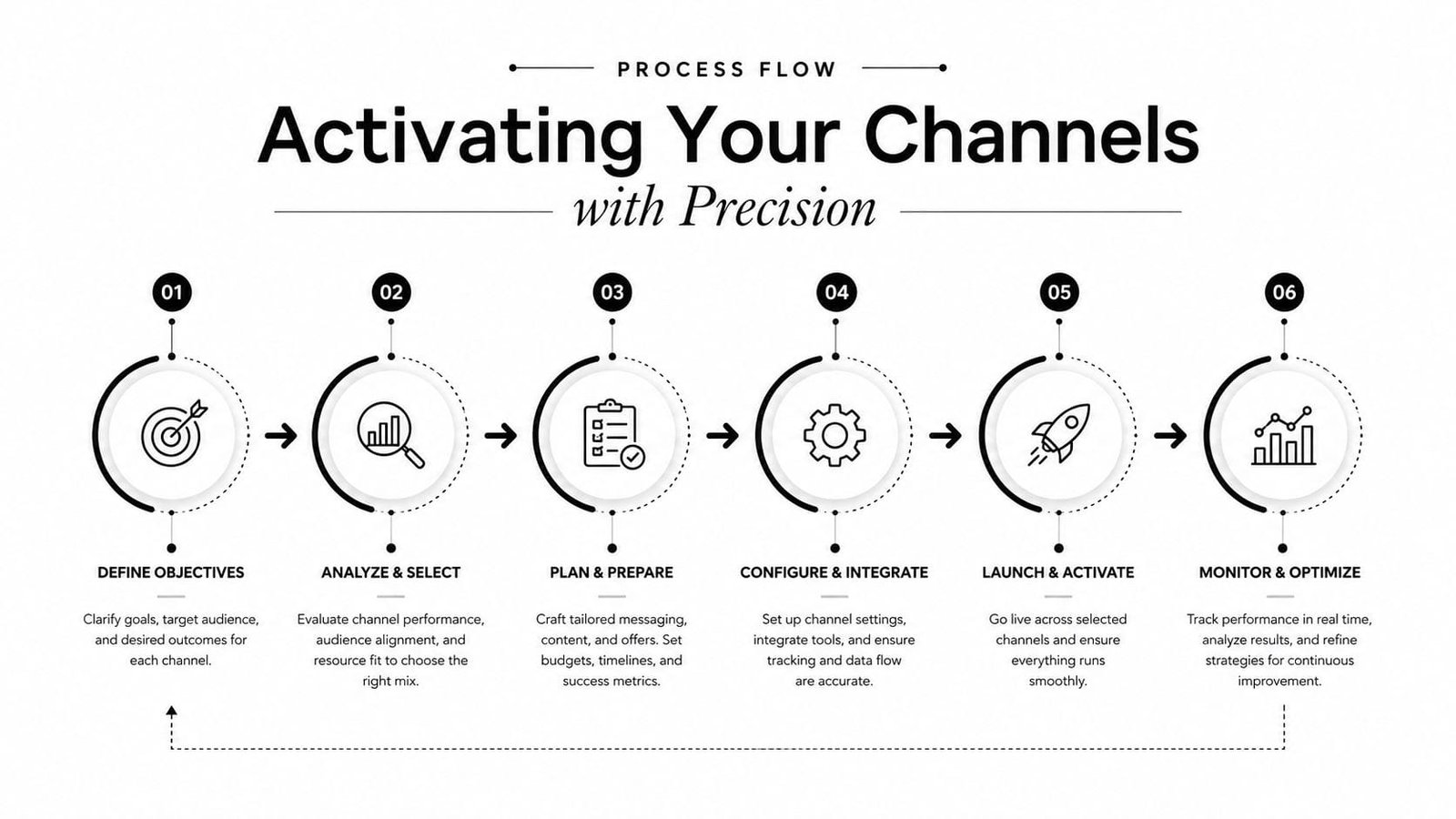
The two weeks before launch usually determine whether the campaign feels coordinated or improvised. The critical period determines if small businesses either remove friction early or carry it into every weekly meeting. The strongest setups I've seen use a simple discipline, assign owners, confirm assets, lock milestones, and make sure the reporting path exists before anyone spends a dollar.
Put names beside every task
A RACI-style matrix works because it forces clarity. Someone is responsible for doing the work, someone is accountable for the outcome, and the rest of the team knows whether they're contributing or just being informed. The Queensland government's implementation guidance emphasizes assigning owners, building a timeline, executing tactics, measuring performance, and then refining repeatedly, which is exactly why the team needs role clarity before launch [Queensland Government].
Start by checking the basics. Confirm who owns the website changes, who approves copy, who uploads creatives, who handles ad spend, and who checks tracking. Then define completion criteria for each task, not just a due date. “Landing page done” is too vague. “Form tested on mobile, thank-you page working, analytics event firing” is something a team can finish.
Build the kickoff around blockers, not buzz
The kickoff meeting should be short and operational. Review the timeline, confirm dependencies, and ask every owner to state the one thing that could block their task. That question surfaces the key risks early, which is usually more valuable than discussing goals again. Milestones should be realistic enough to survive the week, not so optimistic that the team misses them on day three.
For a planning partner on the content side, Business Loan Warrior's guide to ways to advertise your business is a helpful internal reference because it maps different promotion routes without pretending every channel needs the same setup.
The first check-in cadence should be fixed before launch, not invented after the team starts missing deadlines.
A strong kickoff ends with one thing, a shared list of deliverables and the date each one gets reviewed. If the team can't point to the next review meeting, the plan is already drifting.
Activating Your Channels with Precision
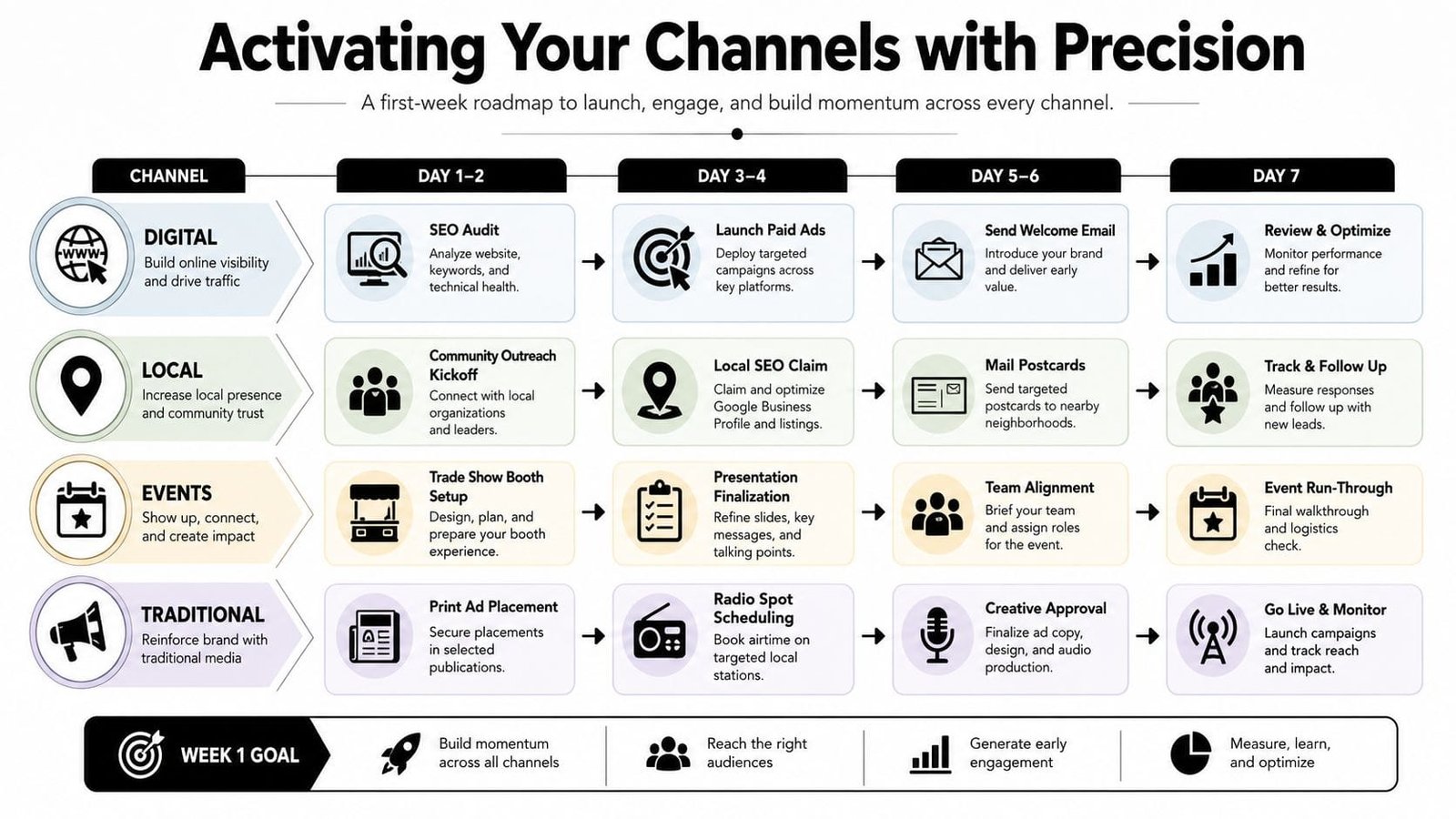
Channel activation breaks down when teams launch half-ready assets. The ad account is open, but the conversion event isn't tested. The event booth is booked, but the staff haven't been briefed. The local outreach list exists, but the follow-up sequence hasn't been written. Those gaps are where implementation leaks time and money.
Digital channels need instrumentation before spend
For SEO, make sure the pages you want indexed are live, crawlable, and mapped to the right search intent. For paid ads, the account setup matters as much as the creative. Audiences, conversion events, budgets, and landing pages should all be verified before spend turns on. For email, segment the list, test deliverability, and confirm that the first send has a clean subject line and a working link path.
The point isn't to make digital channels perfect. It's to keep them from going out in a state where you can't tell whether they're working. Once the account is live, every day of delay in fixing tracking creates noise in the data and makes later decisions worse.
Local, events, and partnerships need human prep
Local campaigns fail when no one owns the follow-up. If you're running community outreach, assign a person to track every reply and every introduction. If local SEO is part of the plan, make sure the listing and business details are consistent before traffic starts flowing. Direct mail works better when there's a response path ready, not just a postcard in the wild.
Events need a different kind of prep. Staff should know the offer, the qualification question, and the next step for every visitor. The booth can't rely on improvisation. Webinars, pop-ups, and trade shows all need a short script, a lead capture process, and a post-event handoff to sales or service.
Partnerships are the most under-briefed channel. Co-marketing and referral programs need onboarding emails that explain the audience, the offer, the tracking method, and the timing. If the partner doesn't know what to send, when to send it, or how success gets measured, the channel dies.
Practical rule: every channel needs a launch checklist specific to the work, not a generic “go live” note.
A useful way to think about this is in terms of access and activation, not just visibility. If you want more tactical ideas on offline and digital promotion, the internal guide on how to advertise your business can be a practical companion because it keeps the channel conversation grounded in execution rather than theory.
Budgeting and Cashflow Realities for Small Business Campaigns
A spreadsheet can make a marketing budget look neat right up until cash starts leaving the account. That's where small business implementation gets real. The question stops being “What should we spend across channels?” and becomes “What can we fund without starving the rest of the business while we wait for results?”
The most useful metrics here are conversion rate, CAC, LTV, and ROI, because they connect spend to business outcomes instead of vanity metrics [Breakthrough3x]. That matters when money is tight, because a channel that looks active isn't necessarily a channel that can pay back the cost. If a channel already contributes the majority of leads, it often deserves priority funding before experiments that are still unproven.
| Channel | Monthly Budget | Expected CAC Range | Priority Tier |
|---|---|---|---|
| SEO | Higher priority if it already drives lead flow | Not assigned here, track internally | Tier 1 |
| Paid search | Moderate and closely monitored | Not assigned here, track internally | Tier 1 or Tier 2 |
| Lower cash outlay, high leverage | Not assigned here, track internally | Tier 1 | |
| Local outreach | Small, tactical spend | Not assigned here, track internally | Tier 2 |
| Partnerships | Variable, depends on partner terms | Not assigned here, track internally | Tier 2 |
The practical trade-off is simple. Front-load spend only where the channel is already validated or where the launch window is short. Drip spend when you're testing creative, offer, or audience fit. If a campaign underperforms after committing spend, don't keep feeding it just because the budget is already approved. Reallocate based on the numbers you can defend.
For an internal worksheet that helps owners pressure-test the spend plan, the small business budget worksheet is a useful reference because it forces the conversation into cash flow, not wishful thinking.
Small businesses usually make their biggest budgeting mistake by planning spend in isolation from working capital. The better approach is to phase spending across the quarter, keep room for adjustment, and treat budget as a steering wheel rather than a promise.
Measuring What Actually Matters
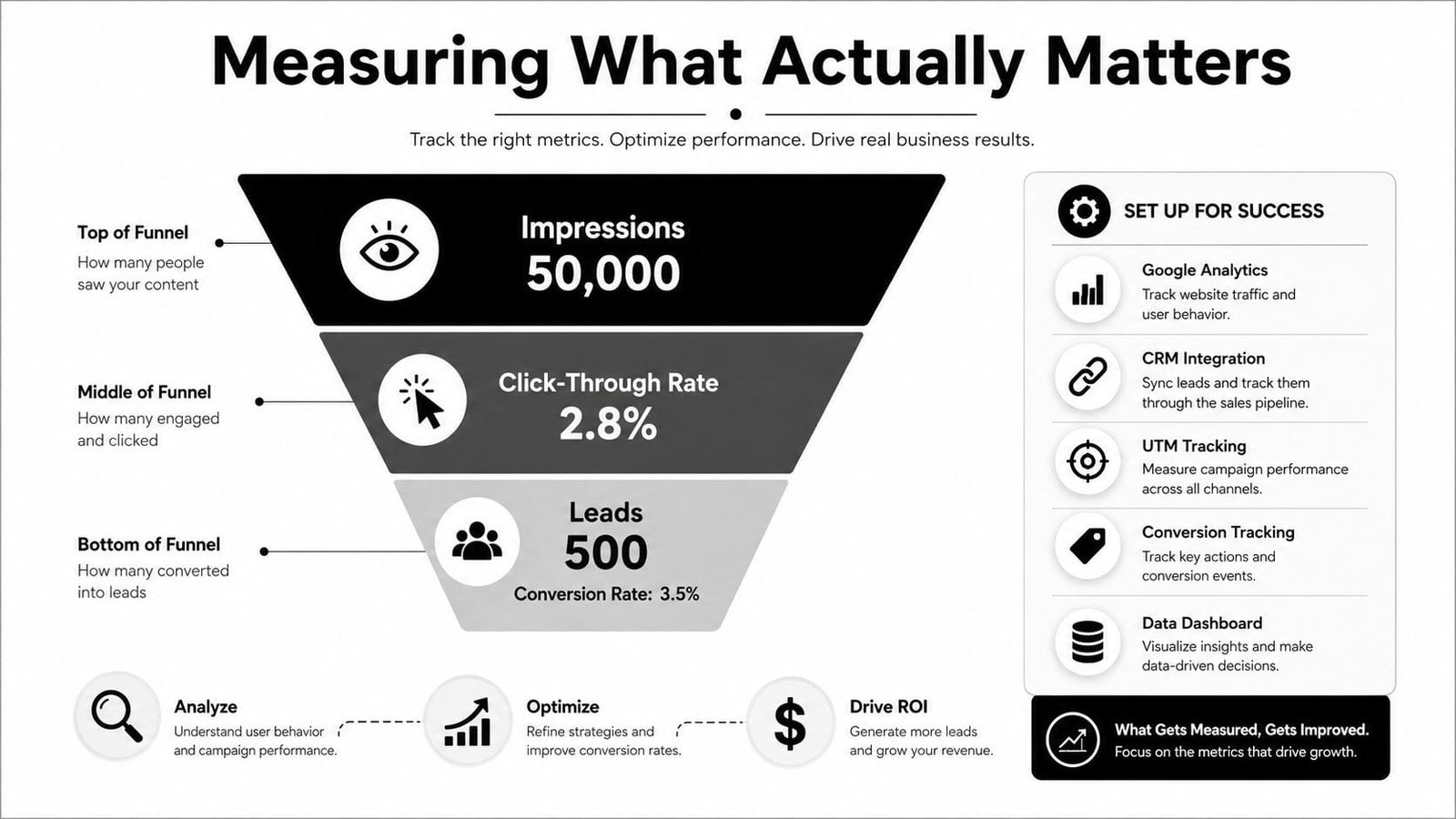
Marketing teams love easy numbers because they're clean and fast. Impressions, followers, and clicks feel productive, but they don't tell you whether the business is healthier. Revenue-linked metrics do, which is why the best measurement systems are built around action, not applause.
Build the dashboard around decisions
A strong dashboard doesn't need expensive software. It needs the right fields, a regular review cadence, and someone who owns each metric. At minimum, track top-of-funnel visibility, mid-funnel engagement, and bottom-funnel results in the same place so the team can see where the drop-off starts.
If you want a practical next step, use the goal framework from examples of goal statements to turn a vague target into something measurable. That makes it easier to decide which number belongs to which owner. One person should own traffic quality, another should own lead conversion, and another should own downstream revenue or retention, depending on the campaign.
Use the right review rhythm
A weekly review should answer one question, what moved and what didn't. A monthly review should answer a deeper one, which channel deserves more budget, less budget, or a better message. Quarterly reviews are where the bigger decision gets made, whether to keep the channel, re-segment the audience, or cut it entirely.
If you need a framework that helps move beyond surface metrics, the resource on beyond vanity marketing metrics is a strong complement because it reinforces the habit of measuring effectiveness, not just activity. That's the mindset shift that keeps teams from reporting numbers nobody can act on.
Practical rule: a metric only belongs on the dashboard if it changes a decision.
Penn State's implementation guidance supports this same loop, measure results against the original objectives, then adjust tactics based on the data [Penn State Extension]. That's the real value of measurement, not proving the team was busy, but making the next move smarter.
Common Pitfalls and How to Recover Mid-Campaign
Most plans don't fail dramatically. They wobble. Someone misses a deadline, the landing page sends the wrong signal, the partner link never goes out, or the message reaches the right audience with the wrong offer. The mistake is assuming the original plan has to survive untouched.
Treat the campaign like a live system
Queensland's guidance is useful here because it frames implementation as a cycle of planning, measuring, and refining, not a one-time launch event [Queensland Government]. That means the team should expect to make corrections. If role confusion is slowing execution, reset the ownership map immediately and stop pretending the issue will resolve itself. If deadlines are slipping, collapse the next milestone into something smaller and more observable.
Audience misalignment needs a different response. If the campaign is attracting attention but not qualified interest, revisit the segment before rewriting everything else. A message can fail because it's wrong, or because it's right for the wrong group. Those are different problems, and they need different fixes.
Know when to pivot, not panic
Channel underperformance doesn't always mean the channel is dead. Sometimes the offer is weak, sometimes the landing page is the bottleneck, and sometimes the timing is off. But if the same channel keeps underdelivering after the message, audience, and follow-up have been adjusted, it's time to re-budget or move on.
The goal is not to defend the original plan. The goal is to keep the business from spending another month on a broken assumption.
Stakeholders usually stay calm when you explain the change in terms of evidence and next actions. Say what was tested, what happened, what you're changing, and when the next review will happen. That structure protects confidence better than pretending everything is fine while the numbers tell a different story.
Your 90-Day Implementation Schedule and Next Steps
A 90-day plan works because it gives implementation enough time to learn without drifting into half-finished campaigns. Weeks 1 to 2 are for pre-launch setup, owner assignment, asset checks, and tracking. Weeks 3 to 6 are for activation, where channels go live and the team watches for friction. Weeks 7 to 10 are for optimization, when budget, message, and channel mix get adjusted. Weeks 11 to 13 are for review, where the team decides what to keep, what to cut, and what to rebuild.
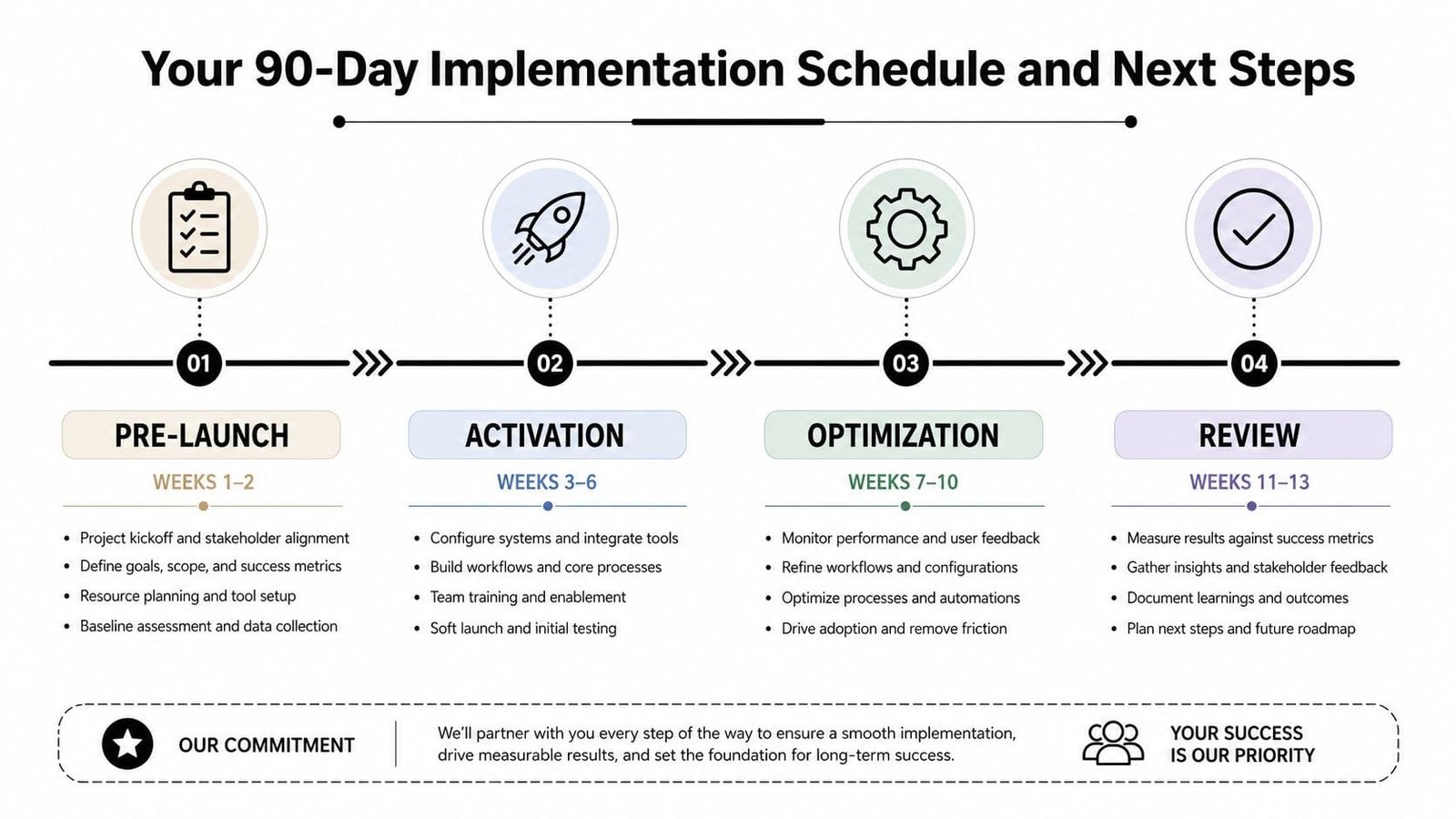
The best teams use the same four working templates throughout that window, a RACI matrix, a milestone timeline, a channel activation checklist, and a KPI dashboard. Each one keeps a different kind of failure from slipping through. The matrix keeps roles clear, the timeline keeps work moving, the checklist keeps launches complete, and the dashboard keeps the numbers honest.
If you're launching a new product, entering a new market, or trying to make an existing campaign work harder, start with the operational basics and keep the review cadence tight. That's what turns a marketing plan into a system the business can use.
Business Loan Warrior helps small businesses keep growth plans moving when cash flow, timing, or expansion needs create pressure on execution. If you're trying to fund the next campaign, stabilize working capital, or line up financing that fits your plan, visit Business Loan Warrior and see how their funding options can support the next phase of your marketing rollout.