
The bank has already said no. Your credit score is bruised, payroll is approaching, and the supplier won't release the next order without payment. Then your phone rings. A funder says yes, and an approval email lands within hours.
That relief is real. So is the danger. An MCA can put cash in your account quickly, but it can also remove money from your sales every day before you pay employees, restock inventory, or reserve money for taxes. For a business owner searching for a merchant cash advance with bad credit, approval is only the first question. The better question is whether your cash flow can survive the repayment.
Table of Contents
- The Call That Finally Says Yes
- What a Merchant Cash Advance Actually Is
- What an MCA Really Costs You
- How MCA Underwriting Works Without a Strong Credit Score
- The Honest Case For and Against an MCA
- Better Alternatives for Bad-Credit Borrowers
- How to Improve Your Approval Odds Before You Apply
- Making the Final Decision With Clear Numbers
The Call That Finally Says Yes
The restaurant manager had spent the morning moving money between accounts. The payroll balance looked thin, the freezer repair invoice was overdue, and the bank's rejection email was still open in another browser tab. The reason was familiar: weak credit, insufficient time under the bank's preferred lending standards, or both.
Then the phone rang.
The funder didn't lead with a lecture about FICO scores. The representative asked about card receipts, bank deposits, and recent statements. A few hours later, the manager received an approval email with an attachment labeled “Merchant Agreement.” The amount looked large enough to solve the immediate problem. The factor rate looked like a harmless decimal. The daily holdback appeared in smaller type.
That's where owners get into trouble. The offer feels like oxygen precisely because the business is already short of it.
Merchant cash advances first emerged as a niche product in the late 1990s and early 2000s, serving businesses such as restaurants and retail stores with substantial card volume. The category expanded sharply after the 2008 financial crisis, as bank lending to small businesses tightened. One industry history estimates that MCA funding reached roughly $20 billion to $25 billion per year by late 2021, across about 500,000 small-business transactions annually (industry history of merchant cash advances).
The approval isn't the finish line
A bad-credit MCA can be legitimate working capital. It can also be an expensive obligation that begins collecting before the owner has fixed the underlying cash shortage.
Before signing, you need clear answers to four questions:
- What arrives: How much cash will reach the operating account after fees?
- What gets repaid: What factor rate determines the total remittance?
- What leaves daily: Is the holdback tied to card receipts, total deposits, or a fixed bank withdrawal?
- What happens during a slow month: Can payroll, inventory, rent, and tax reserves survive the deduction?
If the salesperson can explain the approval but can't explain those mechanics in plain English, don't sign yet.
What a Merchant Cash Advance Actually Is
An MCA gives a business an upfront advance in exchange for a portion of future receipts. It is usually structured as a purchase of future sales rather than a traditional installment loan, but the agreement still creates a real repayment obligation.
A restaurant makes the mechanics clear. The business receives cash today, then sends an agreed share of future receipts to the funder. A strong dinner service produces a larger remittance when the contract uses a true percentage of sales. A slow service produces a smaller one. Collections continue until the agreed repayment total has been delivered.
Three terms determine how the deal affects your cash flow.
The advance
The advance is the lump sum deposited into the business account. It may be less than the amount shown in the offer. Origination, underwriting, administrative, and other contract fees can reduce the net proceeds, so compare the promised amount with the cash that arrives.
That difference matters immediately. If payroll, inventory, or tax reserves depend on the full advertised amount, a smaller deposit can leave the business short before repayment even begins.
The factor rate
The factor rate is a multiplier, not an interest rate. Multiply the advance by the factor rate to find the agreed repayment total. A factor of 1.20 means each dollar advanced corresponds to $1.20 remitted, before separate fees.
Interest generally accrues over time and may decline as principal is repaid. A factor rate commonly fixes the payback amount at the start, so early repayment may not produce the savings a borrower expects from an ordinary loan. Read the contract instead of assuming that faster payment lowers the cost.
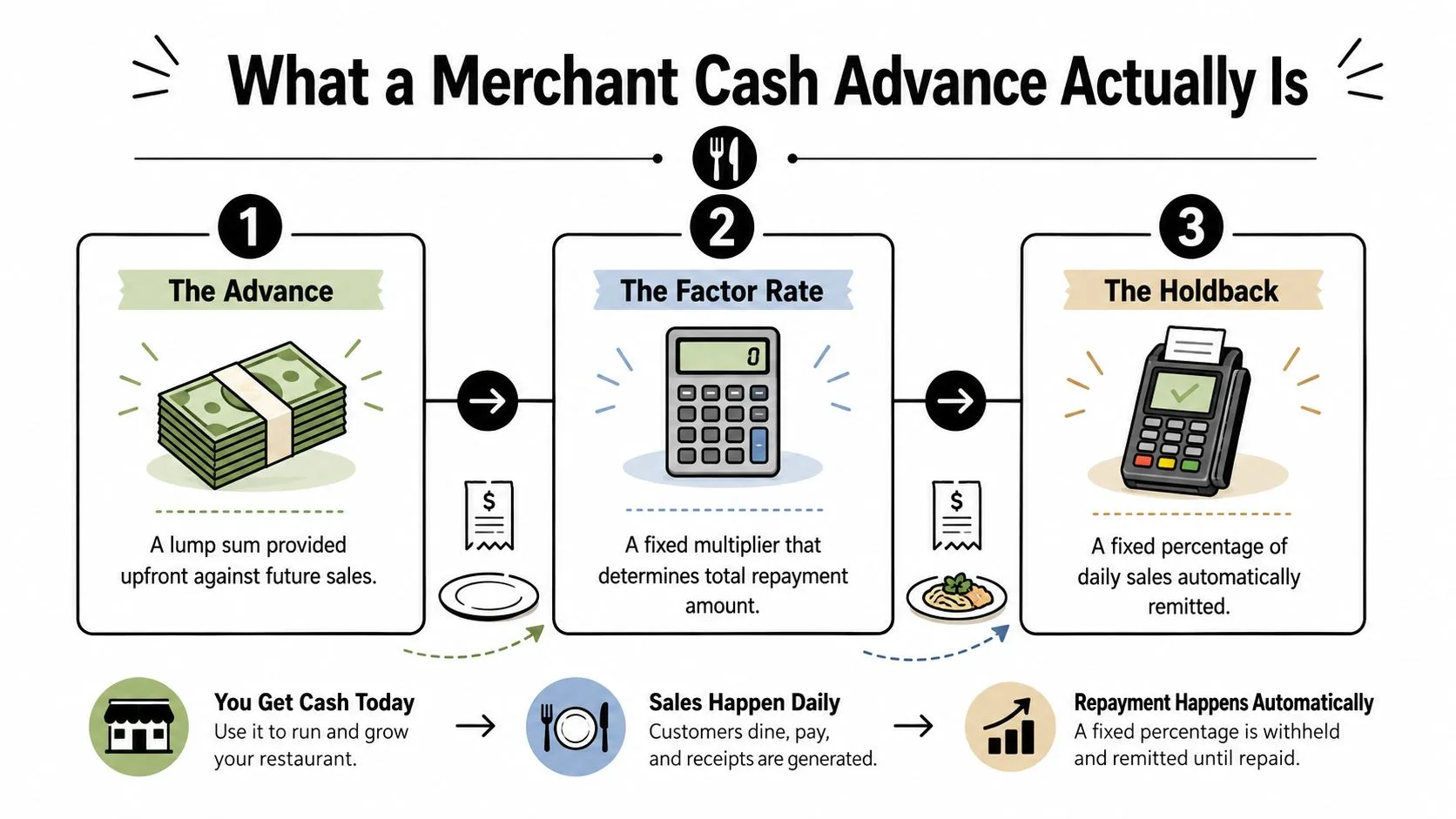
The holdback
The holdback is the share of receipts sent automatically to the funder. For bad-credit businesses, holdbacks commonly fall around 10% to 20% of receivables (MCA repayment structure and disclosures). The deduction may run through a payment processor or come from the business bank account, depending on the agreement.
A traditional loan usually demands a fixed scheduled payment. A sales-linked MCA changes the remittance as revenue changes. That can reduce the deduction during a soft week, but it does not remove the obligation or protect your margins. Strong sales can accelerate repayment and drain working capital before you have funded payroll, replenished inventory, or set aside taxes.
Online merchants face the same issue. Anyone reviewing a cash advance for ecommerce should confirm whether the holdback uses card sales, marketplace receipts, gross deposits, or another revenue base. If sales slow, calculate the remaining cash after that deduction before signing.
What an MCA Really Costs You
The headline advance is only the starting point. Your real cost is the factor rate, the repayment schedule, and the cash removed from daily operations.
Take a $50,000 advance at a 1.28 factor. Total repayment reaches $64,000, creating a contractual fee of $14,000. The tougher question is whether your business can produce that $64,000 while still paying employees, buying inventory, and reserving money for taxes.
The holdback determines how sharply the deal affects cash flow. At 10% of daily card sales, a business with healthy margins may retain enough operating cash. At 20%, the same sales volume sends twice as much to the funder each day. The repayment total stays fixed, while the pressure on payroll, inventory, and taxes increases.
Market factor rates commonly range from about 1.10 to 1.55, with weaker-credit files tending toward the upper end (MCA underwriting guide). Approval can be easier because the funder accepts more uncertainty, but that risk appears in the price and repayment structure. A slower sales period can make the daily deduction harder to absorb, even though the contract still requires full repayment.
Convert the offer before you compare it
You may not receive an APR that makes the cost easy to compare. Convert the offer yourself:
- Subtract the net cash received from the total repayment to find the dollar cost.
- Estimate the repayment period using realistic sales, not the salesperson's strongest month.
- Compare the cost with the length of time the capital remains outstanding.
- Add every fixed fee and default-related charge listed in the agreement.
For the underlying calculation, review this explanation of factor rates.
| Factor Rate | Total Repaid | Effective APR Range | Approx. Months to Repay |
|---|---|---|---|
| 1.10 | Advance × 1.10 | Depends on term and fees | Depends on sales |
| 1.28 | Advance × 1.28 | Depends on term and fees | Depends on sales |
| 1.55 | Advance × 1.55 | Depends on term and fees | Depends on sales |
A factor rate does not convert to one universal APR. The annualized cost changes with repayment speed, holdback, fees, and sales volatility. Rapid repayment can produce a much higher annualized cost than the same contract repaid over a longer period.
Practical rule: Never compare MCA offers by advance size alone. Compare net proceeds, total payback, holdback, fees, and the sales assumptions behind the projected payoff date.
How MCA Underwriting Works Without a Strong Credit Score
A weak personal credit profile does not automatically end an MCA application. Funders usually focus more on whether business revenue enters the account consistently and can support repayment. Industry summaries report that some providers accept scores as low as 500 to 550, while typical bank small-business loans often look for scores around 680 to 700 (bad-credit business financing statistics).
Approval still depends on cash flow. The funder is replacing one risk signal with several others, and a daily holdback can strain payroll, inventory purchases, and taxes when sales slow.
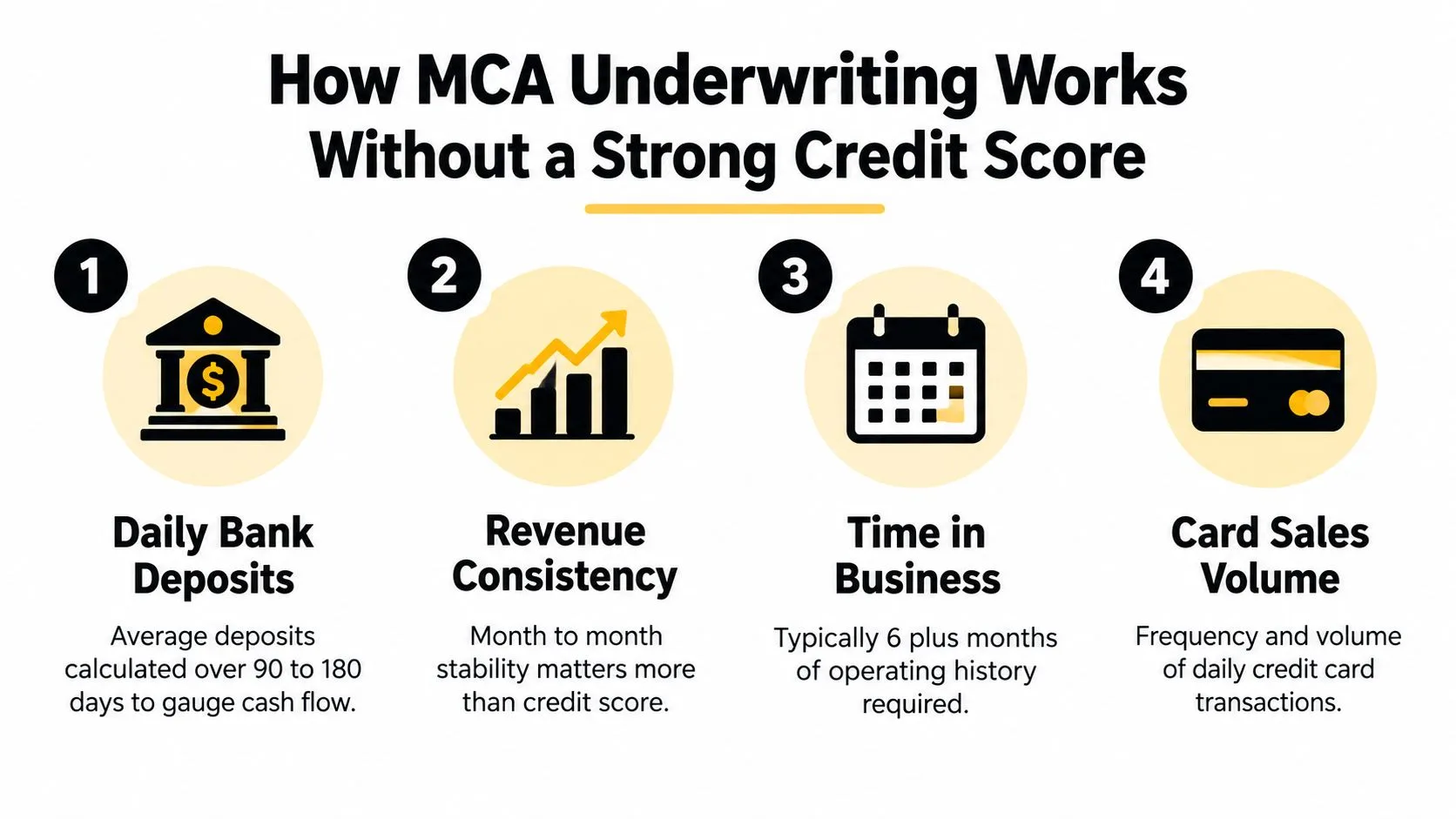
Four signals carry the file
Daily deposits: Funders review several months of bank activity for deposit volume, consistency, and enough cash movement to support repayment. Download unredacted statements and reconcile deposits against your bookkeeping. Review the merchant cash advance underwriting requirements before submitting anything.
Revenue consistency: Uneven spikes followed by weak periods can look riskier than lower but dependable receipts. Review recent sales in QuickBooks and identify seasonal drops before the underwriter does.
Time in business: Operating history helps the funder judge whether current sales are durable. Gather formation records, licenses, and statements that show an established operating pattern.
Bank-statement quality: Frequent negative days, overdrafts, and returned payments weaken the file. Keep a controlled buffer in the operating account, stop unnecessary transfers, and separate personal spending from business activity.
Screen yourself before applying
Underwriters may treat frequent negative days, repeated NSF activity, open bankruptcies, unresolved judgments, and prior MCA defaults as serious warning signs. A clean application package cannot repair weak cash flow, but disorganized records can make a viable business look worse.
Check for unfiled taxes, active judgments, liens, and revenue below the funder's minimum. Prepare business statements, current ownership records, a voided business check, and processor reports. Then calculate whether the projected daily remittance still leaves enough cash for payroll, stock replenishment, and tax payments during a slower sales period.
For a broader document checklist, review these merchant cash advance requirements.
The Honest Case For and Against an MCA
An MCA fits only a narrow situation. You have a defined short-term gap, steady visible sales, no affordable funding option that can arrive soon enough, and a repayment plan that leaves operating cash intact. Outside those conditions, an MCA usually postpones a larger cash-flow problem at a high cost.
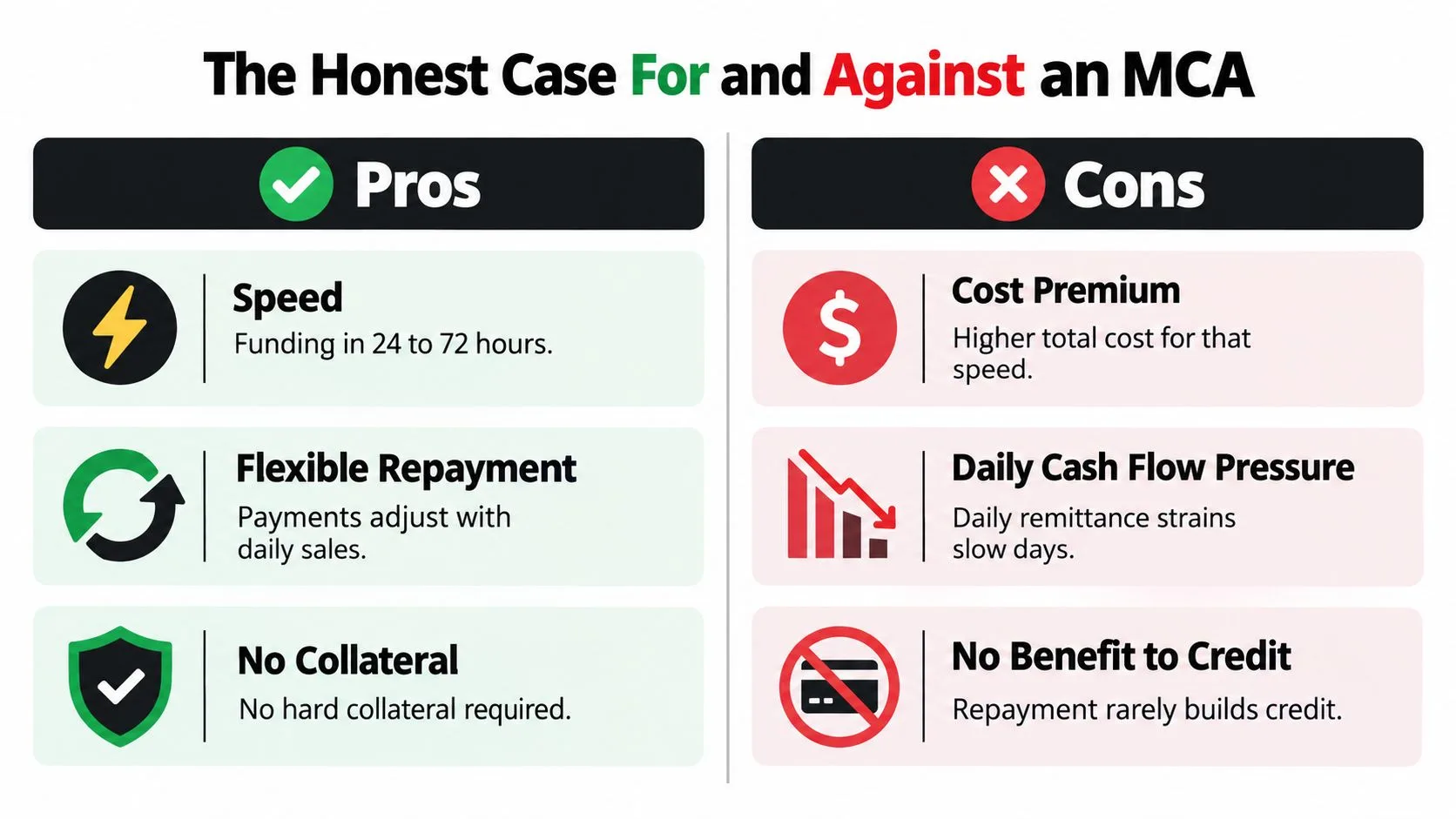
Speed is the clearest benefit. Underwriting may focus more on deposits and receipts than on the documentation a bank expects, so funding can arrive sooner. That convenience comes with higher expense and little room for a sales slowdown.
Sales-linked repayment can suit a seasonal merchant if the contract adjusts with receipts. It can also hide the pressure. The holdback removes cash from applicable sales, and a slower month can leave too little for payroll, inventory, or taxes. Review the MCA repayment structure and disclosures before signing.
Match each benefit with its price
- Weak-credit access: Revenue can matter more than a poor FICO score. A weaker file may receive a more expensive offer.
- No hard collateral: You may avoid pledging a building or vehicle. The agreement can still include a personal guarantee, aggressive default remedies, or a confession-of-judgment provision.
- Fast working capital: Quick funds can cover a specific inventory purchase or urgent repair. They can also push you to borrow before measuring the daily strain.
- Sales-linked remittance: Payments may fall with receipts. The funder still takes money before you pay taxes, employees, and suppliers.
- No traditional credit-building benefit: Repayment may not strengthen your business credit profile like a properly reported loan can.
Stacking turns a manageable deal into a cash-flow trap. If the first MCA already claims part of future receipts, a second funder sees less available cash and may charge more. New capital then pays old obligations instead of producing revenue.
If revenue dropped 20% next month, could the holdback still clear payroll without missing a tax payment?
Use last quarter's actual deposits to answer. Include tax reserves, labor, inventory replacement, and supplier payments. If the answer is no, the approval is not a solution. It is another fixed claim on sales during the period your business has the least room to absorb it.
Better Alternatives for Bad-Credit Borrowers
An MCA shouldn't be your first application because it has the lowest credit barrier. Start with the least expensive option you can realistically qualify for, then move toward faster and more expensive products only when the timing requires it.
A business line of credit is usually the best long-term target. It can provide reusable working capital and generally costs less than an MCA, but approval is harder when credit, financial statements, or operating history are weak. An online short-term term loan may sit between a bank product and an MCA. It can be faster than a bank and may offer a clearer amortization schedule, though the cost can still be substantial.
Community-based options deserve attention. SBA Community Advantage-style programs and microloans through nonprofit CDFIs often require more documentation and patience, but they may offer more constructive underwriting for owners who can explain the business story. Invoice factoring is only a fit when your company sells to commercial customers with reliable invoices. It doesn't solve a retail merchant's daily cash shortage.
Use an order, not a lottery
- Start with a nonprofit CDFI: Choose this route if you can wait through a longer review and provide a full business explanation.
- Try a line of credit: Apply when deposits are stable and you want flexible access rather than one immediate lump sum.
- Consider an online term loan: Use it when you need a defined amount and can manage scheduled payments.
- Reserve the MCA for last: Choose it only for a specific, revenue-producing gap that can withstand the holdback.
| Option | Typical APR / Cost | Funding Speed | Bad-Credit Access | Best For |
|---|---|---|---|---|
| Business line of credit | Usually lower than MCA cost | Moderate | Harder | Recurring working capital |
| Online short-term term loan | Mid-cost to high cost | Faster than banks | Moderate | Defined short-term needs |
| SBA or CDFI microloan | Often lower-cost than MCA financing | Slower | More flexible underwriting | Owners who can wait |
| Invoice factoring | Depends on invoice terms | Often quick | Based on customers' credit | B2B invoices |
| MCA | Factor-rate cost plus fees | Fast | Revenue-driven | Urgent, defined gaps |
Review alternative business loans before allowing a fast approval to narrow your choices. Taking an MCA first can make later underwriting harder because another funder already has a claim on incoming revenue.
How to Improve Your Approval Odds Before You Apply
Give yourself a week to improve the file. Don't submit applications while your statements contain avoidable problems.
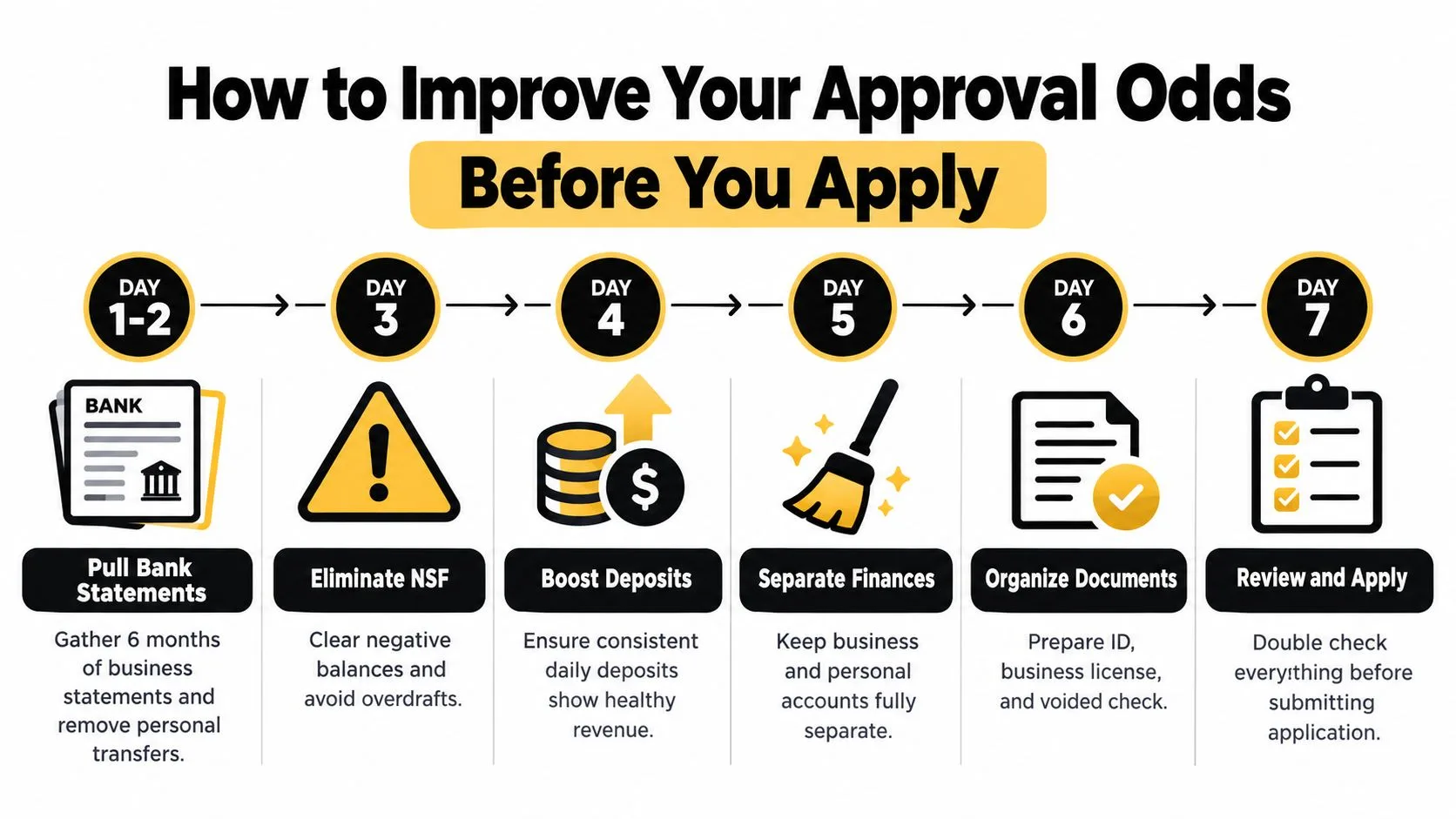
Run the cleanup in sequence
Days 1 and 2: Pull six months of business bank statements. Mark personal transfers, owner draws, tax payments, payroll, and unusual deposits so the underwriter can understand the activity.
Day 3: Eliminate avoidable NSF events. Bring the account current, stop overdraft-prone transfers, and identify recurring withdrawals that collide with payroll.
Day 4: Normalize deposit timing. Deposit business receipts consistently into the business account instead of scattering revenue across personal accounts or unrelated platforms.
Day 5: Separate finances. Keep personal spending, owner distributions, and business expenses clearly labeled. Confusion in the statements creates questions you don't need.
Day 6: Organize identity and business records, including ownership information, entity documents, licenses, processor reports, and a voided check.
Day 7: Request written offers and compare at least three versions side by side. Verbal promises about flexibility don't count unless the contract contains them.
Negotiate the terms that affect survival
Push back on the holdback first. Anything above 15% of gross card sales is aggressive for many operating businesses, especially those with thin margins. Then read the prepayment buyback formula. It determines whether retiring the advance early reduces the factor cost or merely satisfies the same fixed payback sooner.
Chargebacks and refunds can distort the funder's view of your receipts and strain available cash. If your business needs to handle excessive chargebacks, fix the processing problem before requesting revenue-based funding.
Don't sign a contract whose total payback you can't reconcile against last quarter's actual sales.
Making the Final Decision With Clear Numbers
Use your own books, not the funder's best-case projection. Three figures tell you whether the offer is workable.
First, calculate the dollar cost by subtracting net proceeds from total payback. Then estimate the repayment period in months using realistic sales, and use that period to create a rough APR-like comparison. This isn't a formal APR, but it exposes how expensive a fixed factor becomes when repayment happens quickly.
Second, express the holdback as a percentage of gross sales and compare it with the gross margin on every dollar affected by the deduction. If the business earns little margin after food, labor, shipping, or inventory costs, a seemingly manageable holdback can consume the cash needed to operate.
Third, calculate the breakeven weekly sales floor. Divide total payback by the number of weeks the funder projects for repayment. If actual sales fall below that floor for two consecutive weeks, the business may enter a renewal cycle, using new financing to cover the old remittance.
| Number to Calculate | How to Compute It | Pass/Fail Threshold |
|---|---|---|
| Factor cost | Total payback minus net proceeds | Pass only if the dollar cost serves a defined return |
| Daily holdback | Daily remittance divided by gross applicable sales | Preferably under 12% to 15% |
| Breakeven weekly sales | Total payback divided by projected repayment weeks | Should be at least 20% below current weekly averages |
My decision rule is strict. Take an MCA only when the money fills one defined gap, such as an inventory purchase, payroll bridge, or one-time equipment repair. The holdback should remain under 12% to 15%, and the breakeven sales figure should sit at least 20% below current weekly averages. Those thresholds are decision rules, not guarantees, so test them against your actual margins and seasonality.
Walk away when the advance funds general losses, pays another MCA, or leaves no reserve for taxes. A weak credit score may explain why the offer is available. It doesn't explain why your business should accept terms it can't survive.
If you're comparing a merchant cash advance with bad credit against a line of credit, term loan, or other working-capital option, visit Business Loan Warrior to review funding paths through a single no-fee application. Bring your recent statements and the three decision numbers above, then use the available pre-approval process to compare options before committing to an expensive holdback.