

A merchant cash advance can put money in your account quickly, but a 1.3 factor rate may translate to roughly 60% to 160% APR depending on how fast you repay it. The product is a purchase of future sales, not a conventional loan, so the fixed fee can look simple while the repayment speed determines the cost you feel.
Your restaurant has had a brutal week. Foot traffic is down, payroll is approaching, and the card terminal is still ringing often enough to show that customers haven't disappeared. An MCA provider sees those transactions differently. It sees a stream of future card receipts and offers cash today in exchange for collecting part of that stream tomorrow.
That arrangement can solve an urgent inventory, repair, or payroll problem. It can also turn a temporary cash shortage into a daily drain that limits every operating decision you make. The right question isn't whether an MCA is fast. It is whether your margins and daily sales can absorb the remittance without forcing you to take another advance.
Table of Contents
- What a Merchant Cash Advance Actually Is
- How MCAs Work Day to Day
- What the Factor Rate Really Costs
- MCAs vs Lines of Credit vs Short-Term Loans
- Who Qualifies and What Underwriters Look For
- Risks and Common Misconceptions
- Choosing a Provider and Watching for Compliance
- When an MCA Makes Sense and What to Do Next
What a Merchant Cash Advance Actually Is
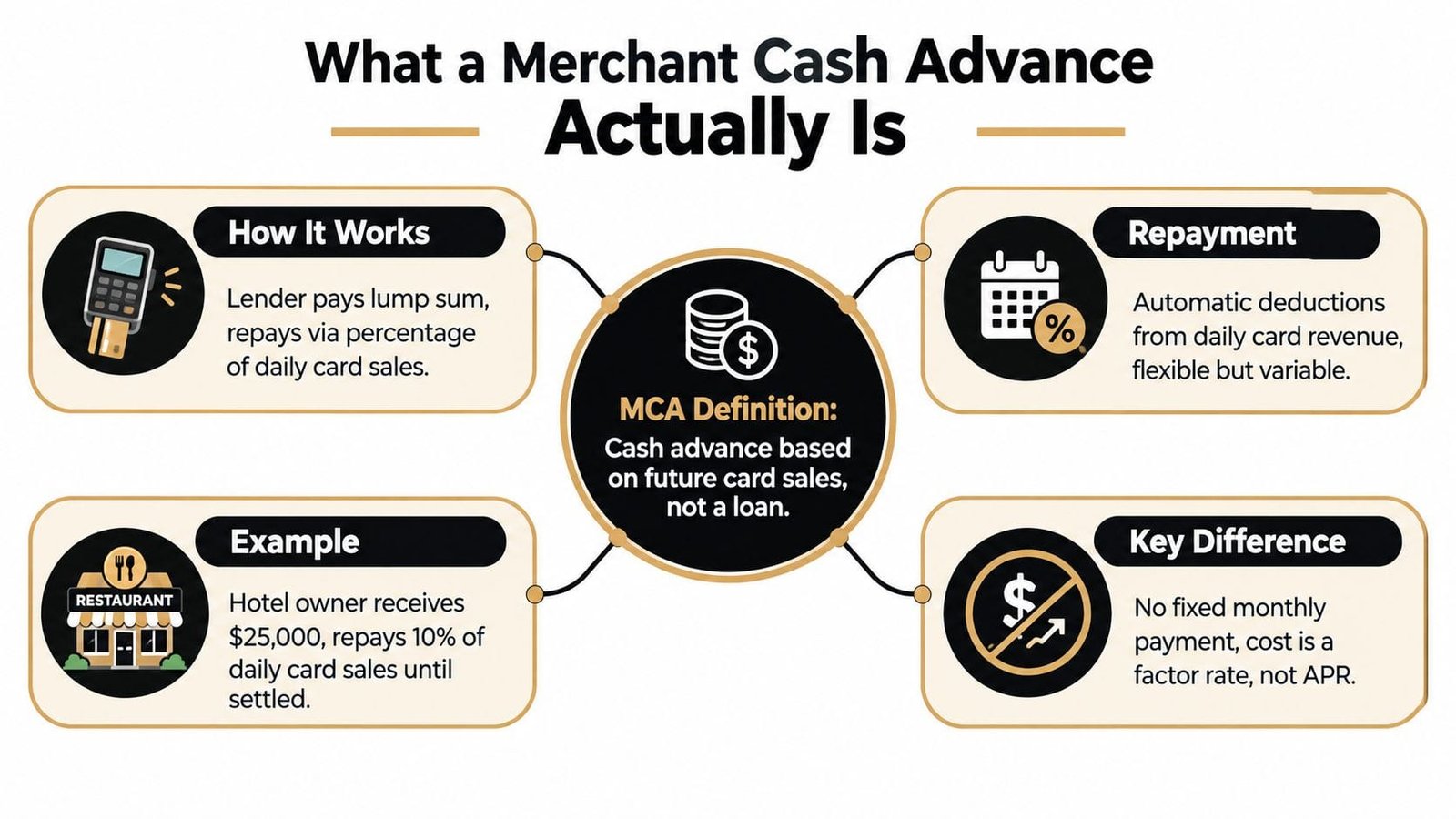
Merchant cash advances emerged in the late 1990s and early 2000s as a niche product for small businesses, especially restaurants and retail stores with substantial card-payment volume. The original structure involved a funder advancing a lump sum and purchasing a fixed portion of future credit card receivables, then collecting a percentage of daily card sales until the purchased amount was recovered, as described in this history of the merchant cash advance industry.
That legal distinction matters. An MCA is generally presented as a purchase of future receivables, not a loan with principal and interest. The provider pays you an advance, and you remit an agreed amount from future sales. Because the contract isn't framed as a traditional loan, lending protections such as usury caps may not apply in the same way. That doesn't make the transaction harmless or automatically enforceable. It makes the contract language critical.
Why the structure changes the decision
A bank loan usually has a stated interest rate, a defined maturity, and scheduled payments. An MCA uses a factor rate, which multiplies the advance to determine the total purchased amount. A factor rate of 1.30 means the contractual payback is 1.30 times the advance, before considering additional fees.
The factor itself doesn't tell you the annualized cost. Repay the same purchase quickly and the implied APR rises sharply. A 1.3 factor repaid over six months can annualize to roughly 60% to 80% APR, while repayment over three months can imply roughly 120% to 160% APR, according to Crestmont Capital's factor-rate analysis.
That's why I don't evaluate an MCA by asking only, “What's the factor?” I ask how much cash will leave the business each day, how long that will continue, and what happens if sales fall.
For a practical budgeting reference before you commit future revenue, review this budget guide for online shoppers. The same discipline applies to business funding: identify recurring obligations first, then decide what cash is available.
How MCAs Work Day to Day
The mechanics are straightforward, but borrowers often misunderstand the difference between the holdback percentage and the total cost.
The funder purchases a specified amount of future receivables at a discount. You receive the advance upfront. The provider then collects through one of two common channels:
- Card split: The processor routes an agreed percentage of card receipts to the provider before the remaining sales reach your account.
- ACH remittance: The provider withdraws a fixed daily or weekly amount based on an estimate of your receivables.
A holdback is the percentage of sales reserved for the provider. A remittance is the actual amount transferred toward the purchased receivables. A true-up or reconciliation adjusts the remittance when the contract allows the amount withdrawn to be compared with actual sales.
Worked example
Assume the business receives a $50,000 advance at a 1.25 factor rate. The total contractual payback is $62,500, so the financing cost is $12,500 before any separate fees. If the provider holds back 15% of monthly card volume and the business processes $25,000 per month, the estimated monthly remittance is $3,750.
The payoff period is calculated by dividing the total payback by the estimated remittance. At that sales pace, $62,500 divided by $3,750 produces approximately 16.7 months. Actual timing can change because card sales vary, and an ACH structure may not adjust automatically when revenue drops.
| Metric | Value |
|---|---|
| Advance received | $50,000 |
| Factor rate | 1.25 |
| Total payback | $62,500 |
| Total financing cost | $12,500 |
| Monthly card volume | $25,000 |
| Holdback percentage | 15% |
| Estimated monthly remittance | $3,750 |
| Estimated payoff period | Approximately 16.7 months |
The key point is that the holdback doesn't equal the cost. A 15% holdback on sales determines the cash-flow burden, while the factor determines the total purchased amount. You need both figures before you can judge affordability.
Practical rule: Underwrite the remittance against your worst realistic sales month, not your strongest month.
A business with uneven sales should ask whether the contract includes a genuine reconciliation process. Without one, an ACH withdrawal can remain fixed even while card revenue weakens. That mismatch is where a supposedly flexible product starts damaging payroll, supplier payments, and operating reserves.
What the Factor Rate Really Costs
A factor rate is a total-payback multiplier, not an interest rate. Receive $100,000 at a 1.30 factor, and the contract requires $130,000 back. The $30,000 financing cost is fixed, whether repayment takes six months or eighteen.
The payoff window determines how expensive that fixed cost feels each year. A faster payoff returns the provider's money sooner, so the same fee produces a higher annualized cost. The factor alone cannot show the burden. You must test it against the actual remittance schedule.
The comparison below uses repayment-speed ranges documented by Crestmont Capital. These figures remain approximate because APR depends on payment timing, remittance frequency, fee treatment, and the way the contract calculates repayment.
| Factor Rate | Repayment Period | Effective APR (approx.) |
|---|---|---|
| 1.30 | 6 months | Roughly 60% to 80% |
| 1.30 | 9 months | Lower than a six-month payoff, but still materially above conventional business credit |
| 1.30 | 12 months | Lower again because the fixed fee is spread across a longer period |
| 1.30 | 18 months | Lower annualized cost than shorter schedules, while the business remains committed longer |
An eighteen-month MCA is not cheap. The annualized figure falls because the same fixed fee is spread over more time. The business pays for that lower annualized figure by carrying restricted cash flow for longer.
Why speed can increase the cost
“No interest” does not mean inexpensive. In many MCA contracts, the factor amount is fixed. Early repayment may end the obligation sooner, but it does not necessarily reduce the purchased amount in proportion to the time saved.
Before signing, calculate:
- Total payback: Advance multiplied by the factor rate.
- Cash-flow burden: Expected daily or weekly remittance compared with realistic sales.
- Annualized cost: Total financing cost converted into an APR estimate at several payoff speeds.
Use this factor rate explainer to verify the arithmetic. Then require the provider to give you the repayment schedule, all fees, and any early-payoff terms in writing.
State compliance also matters. An MCA contract may be treated differently depending on its structure and the state involved. Review required disclosures and reconciliation language before focusing only on the factor. A low quoted factor does not protect you from a contract that permits fixed withdrawals, unclear adjustments, or repayment terms your state restricts.
Stacking creates another cash-flow problem. Taking a second advance before resolving the first makes the new remittance compete with the existing deduction. Revenue can look healthy while unrestricted cash is too thin for suppliers, payroll, and reserves. Refinancing then adds another fixed cost without correcting the margin problem underneath.
MCAs vs Lines of Credit vs Short-Term Loans
The right product depends on cash-flow consistency, credit quality, collateral, and urgency. An MCA usually wins on access and speed. It usually loses on cost.
A business line of credit works differently. You draw only what you need, pay for the amount used, and may reuse available capacity as you repay. A short-term loan provides a lump sum with an amortizing schedule, often landing between a revolving line and an MCA in flexibility and pricing.
| Criterion | Merchant Cash Advance | Business Line of Credit | Short-Term Loan |
|---|---|---|---|
| Cost structure | Factor rate and fixed payback | Interest rate on drawn balance, plus possible fees | Interest rate or stated financing charge with scheduled amortization |
| Payment pattern | Daily or weekly remittance, often tied to sales or a fixed ACH amount | Regular payments, sometimes interest-only during the draw period | Fixed daily, weekly, or monthly payments |
| Funding speed | Typically the fastest option for businesses with verifiable sales | Slower underwriting, especially for larger limits | Moderate, depending on documentation and lender |
| Collateral | Often unsecured, but contract protections and guarantees may apply | May be unsecured or secured | May require a guarantee, lien, or collateral |
| Underwriting focus | Card or bank-deposit volume and recent cash flow | Credit profile, bank statements, revenue, and repayment capacity | Revenue, profitability, credit, and overall debt service |
| Flexibility | Funds are usable, but remittance can restrict daily cash | Highest flexibility because you draw as needed | Moderate flexibility, with a defined lump sum |
| Best fit | Urgent short-term need with strong card sales | Established business with clean financials and recurring needs | Business seeking predictable payments and a defined payoff |
Select the lane that matches your business
Choose an MCA only when the need is urgent, the sales channel is reliable, and the expected return from using the funds comfortably exceeds the remittance burden. A restaurant replacing a failed refrigeration unit may have a defensible use case if the repair protects ongoing sales. That same restaurant shouldn't use an MCA to cover a recurring payroll shortfall caused by weak margins.
A line of credit is the better target for a business with predictable revenue, organized statements, and enough credit strength to qualify. It preserves liquidity because you don't pay financing cost on undrawn capacity.
A short-term loan fits an owner who values a known payment schedule and can document repayment capacity. It's less adaptable than a line but often easier to budget than a daily sales deduction.
Fast funding is a feature. It isn't a price comparison.
Who Qualifies and What Underwriters Look For
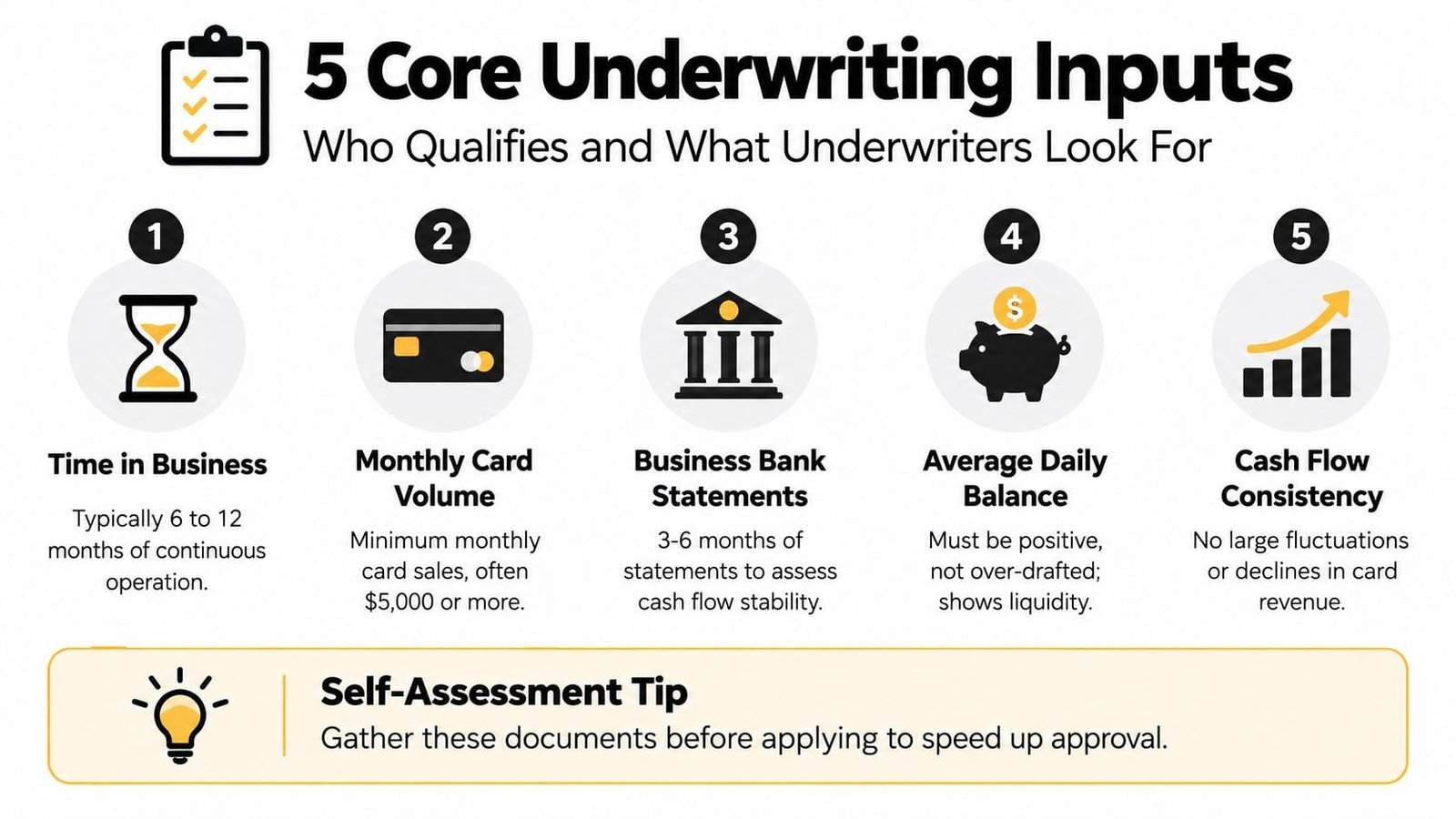
MCA underwriting centers on revenue behavior, not just a traditional credit score. Providers want to see that money consistently enters the business account or card-processing system and that the proposed remittance can be collected.
The core review usually includes:
- Time in business: Many providers look for an operating history of roughly 6 to 12 months, though requirements vary by provider and product.
- Monthly card or ACH volume: Underwriters examine recurring transaction volume, not a single strong week.
- Bank statements: Recent statements reveal revenue direction, average daily balance, overdrafts, returned payments, and existing withdrawals.
- Industry classification: Restaurants, retail stores, and salons often fit the sales-based model because they generate frequent card transactions. Professional services and SaaS companies may be less suitable when revenue arrives through invoices or irregular billing.
- Owner credit: Personal credit can serve as a secondary risk filter, particularly when the business has limited history.
The operational details matter more than many owners expect. An underwriter may care less about accounting profit than about whether your business receives enough dependable deposits to support the required remittance. A profitable company with lumpy invoices can be a weaker MCA candidate than a lower-margin retailer with consistent card receipts.
Fix the file before applying
Declines commonly follow from declining deposits, frequent nonsufficient-funds events, negative balances, unexplained transfers, existing advances, or revenue that doesn't match the application. Clean up bookkeeping and separate business transactions from personal spending before requesting offers.
For a broader document checklist, use this commercial loan requirements guide from Coto & Waddington, Attorneys at Law. Then compare your file with this merchant cash advance requirements guide before giving a broker permission to submit your information.
Risks and Common Misconceptions
The sales pitch often sounds harmless: fast approval, minimal paperwork, and repayment tied to sales. The contract can be much less forgiving.
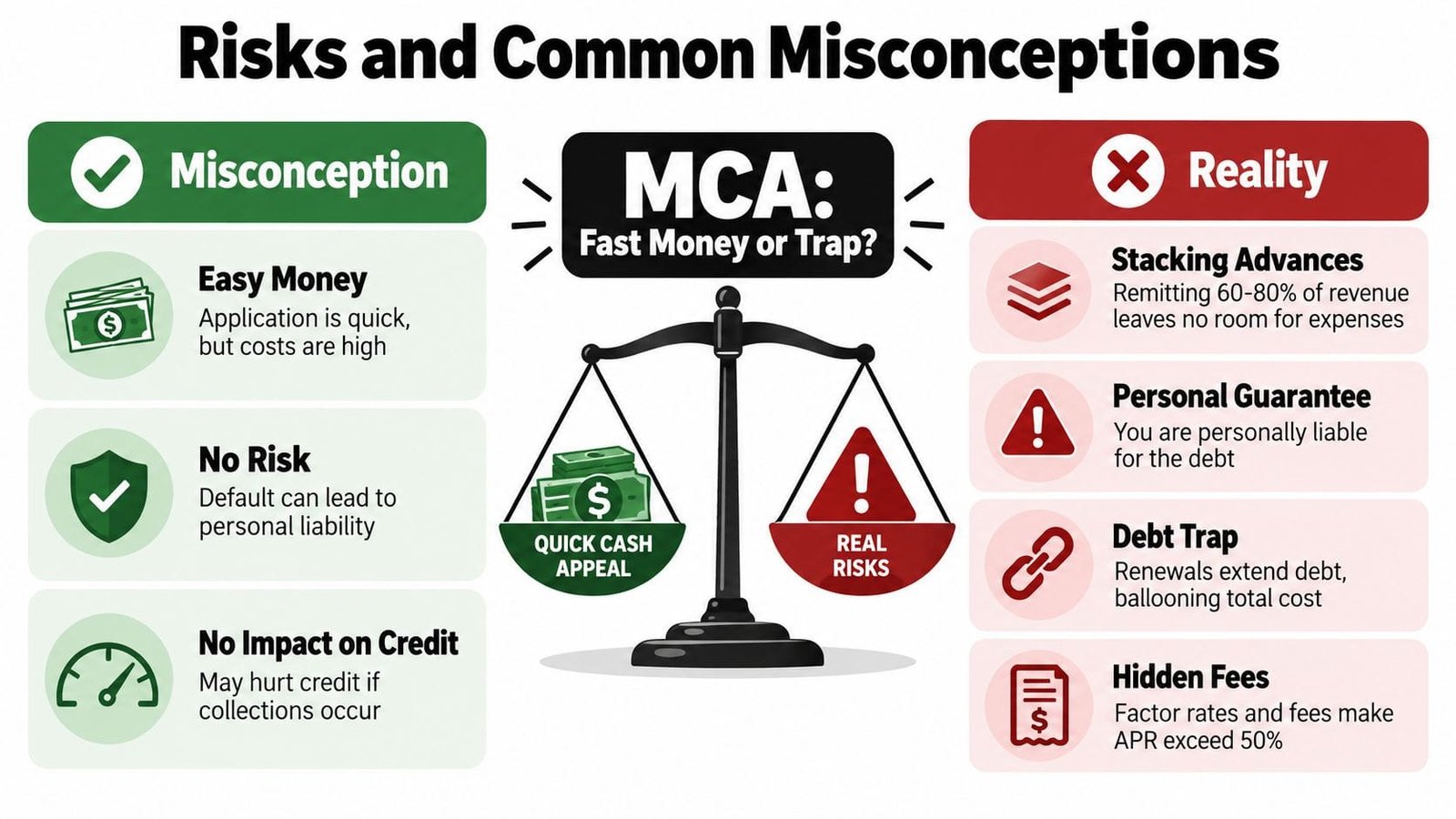
Merchant cash advances are not easy money. They transfer future operating cash to the provider. If your margins are thin, the deduction can remove the cash you need to buy inventory, pay staff, and handle taxes.
Four risks deserve direct attention:
- Stacking: Multiple advances create multiple remittances. If lenders collectively take most of your daily revenue, the business can't fund ordinary expenses.
- Personal guarantees: A guarantee can move the risk beyond the company and expose personal assets or income, depending on the contract and applicable law.
- Confession of judgment: This clause can give a provider a powerful collection remedy without the ordinary notice and litigation process borrowers expect. Never sign one without legal advice.
- Refinancing pressure: Replacing one advance with another may create a new fee and extend the repayment burden instead of reducing it.
A factor rate also isn't an interest rate. A 1.3 factor repaid over six months can imply roughly 60% to 80% APR, while repayment over three months can imply roughly 120% to 160% APR, based on Crestmont Capital's analysis. That annualized comparison helps you compare an MCA with a conventional loan, even though the contracts use different legal structures.
The misconception that “sales-based” means risk-free
Variable remittance may reduce the payment during a slow period when the contract tracks sales. A fixed ACH withdrawal doesn't provide that same protection. Read the mechanism, not the marketing description.
The “no loan” label also doesn't eliminate default consequences. Providers may allege that a business breached the receivables-purchase agreement, diverted receivables, violated a personal guarantee, or triggered a default clause. The legal theory varies by contract and jurisdiction, but the financial consequences can still be severe.
Choosing a Provider and Watching for Compliance
Start with the quote sheet, not the approval headline. A usable offer should show the advance amount, factor rate, total payback, holdback, remittance frequency, estimated duration, origination fees, broker fees, and default provisions. If the salesperson won't provide those items before you sign, stop the process.
Vet the provider and broker separately. Search for consistent complaints, review the company's litigation history where available, ask who funds the transaction, and confirm whether the broker's compensation is disclosed. A broker who presents one offer as the only option isn't giving you a comparison.
State rules are now part of underwriting your offer
Compliance isn't uniform across the country. Recent legal analysis reports that Texas enacted a commercial financing disclosure law in 2025 focused on sales-based financing, joining Connecticut and Virginia with transaction-level disclosure requirements for this product. By 2026, ten states had some form of disclosure regime, according to Venable's analysis of state commercial financing disclosure laws.
For a borrower, that means “Is an MCA legal?” is too broad a question. Ask whether the provider and broker meet the rules in your state, what disclosures must accompany the offer, whether factor-rate information must be translated into an APR-style comparison, and whether the structure could trigger lending-law obligations.
Review these clauses with a business attorney:
| Clause | Borrower-Friendly Version | Red Flag Version |
|---|---|---|
| Reconciliation | Remittance can be reviewed and adjusted against actual sales | Provider can reject adjustments or impose unclear conditions |
| Personal guarantee | Limited to clearly defined obligations | Broad liability extending beyond the business |
| Default | Specific, measurable events with notice and cure rights | Vague triggers, immediate acceleration, or sweeping remedies |
| Stacking and cross-default | Existing obligations disclosed and permitted | New funding creates automatic default or cross-default exposure |
| Confession of judgment | Omitted or reviewed with independent counsel | Required as a condition of funding |
Don't let a low factor distract you from a broad default section. The contract's remedies can matter as much as its price.
When an MCA Makes Sense and What to Do Next
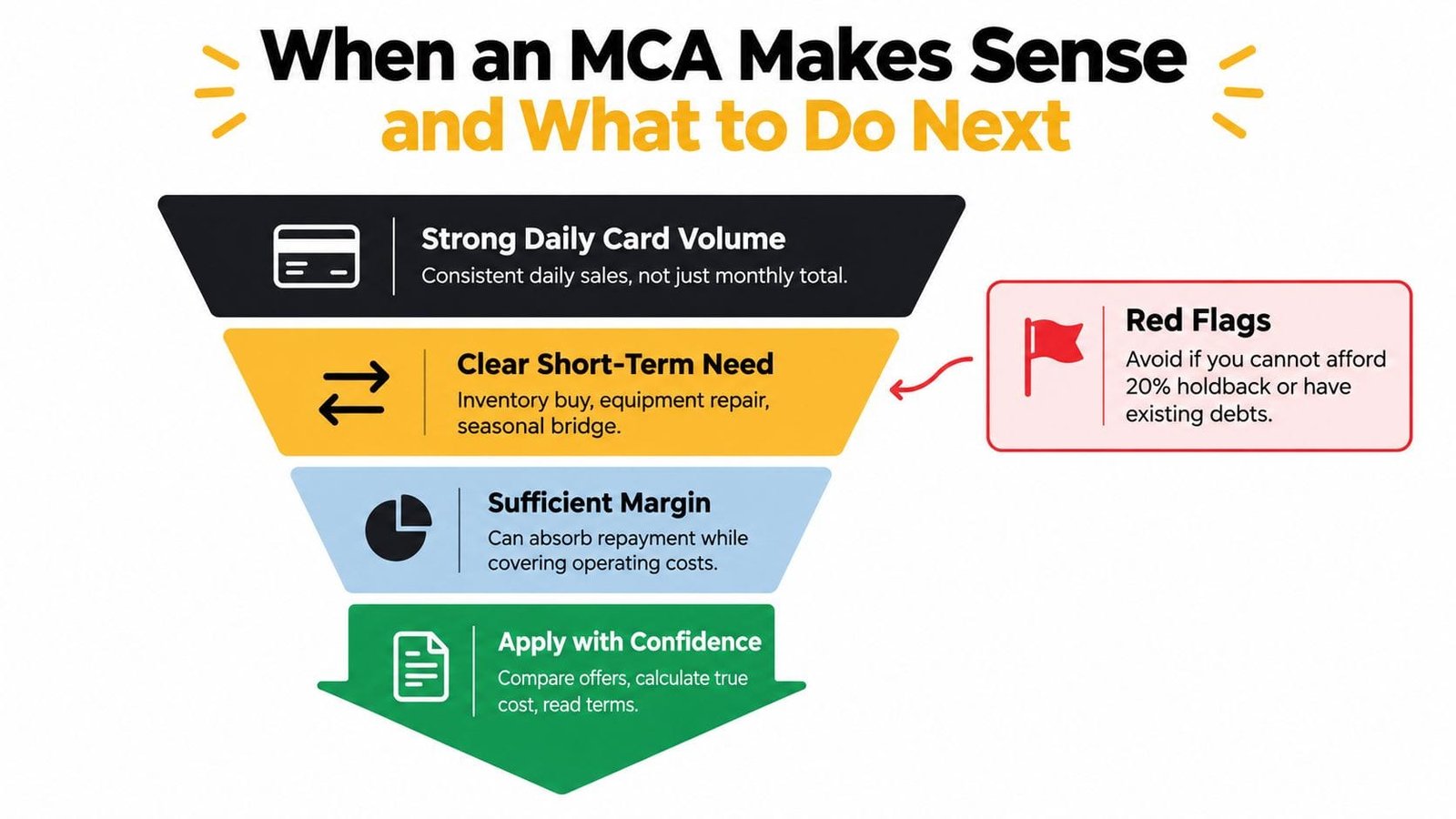
An MCA makes sense only when three conditions line up: strong daily card volume, a clearly defined short-term use, and enough operating margin to absorb the remittance. Inventory purchases, emergency equipment repairs, and seasonal bridges can fit that profile when the funding directly protects or produces near-term sales.
Walk away when the advance would cover recurring losses, when revenue is falling, when another provider already takes a meaningful share of receipts, or when the business needs a long repayment horizon. Don't use expensive short-term capital to solve a permanent profitability problem.
Use this decision filter
- Need cash immediately and generate dependable daily card sales? Compare an MCA with every available lower-cost option before accepting speed as the deciding factor.
- Have stable revenue and clean financial statements? Pursue a line of credit or short-term loan first.
- Can't explain exactly how the funds will produce or protect revenue? Don't borrow yet.
- Would the remittance force you to delay payroll, taxes, suppliers, or inventory? Reject the offer.
- Already have outstanding advances? Seek restructuring or professional debt guidance rather than stacking another contract. This MCA debt relief resource can help you assess the next step.
Pull your recent card-processing statements, map daily deposits, and calculate the expected remittance against a weak sales period. Request itemized offers from multiple funders, then have counsel review any large or complex agreement before signing.
A clean invoicing process can also improve your cash-flow picture. For project-based operators, this painting invoice workflow from AurenWell offers a practical way to organize billing and receivables before seeking funding.
If the numbers work, the contract is transparent, and the use is temporary, an MCA can be a cash-flow tool. If the offer depends on refinancing, optimistic sales assumptions, or unclear legal terms, decline it.
Business Loan Warrior helps small-business owners compare funding options, including merchant cash advances, loans, lines of credit, and other working-capital products, through a single application and funding dashboard. Visit Business Loan Warrior to review your options, compare the repayment burden, and speak with a funding team before you sign an MCA contract.