
You're probably looking at a profit and loss statement that says your business is selling well, yet the bank balance still feels tight. Payroll hits. Rent clears. Vendors want faster payment than your customers give you. Then you apply for funding and the lender starts asking about margins instead of revenue.
That can feel backward until you understand what underwriters are trying to answer.
Revenue tells us whether customers buy from you. Operating profit margin tells us whether your business model leaves enough room after direct costs and operating expenses to support debt. For a borrower, that distinction matters. A company can look busy, even impressive, and still be too thin operationally to carry a loan safely.
When I review a borrowing file, I don't treat operating margin as academic finance language. I treat it like a stress test for the engine of the business. It helps separate companies that are growing with control from companies that are growing while leaking cash.
Table of Contents
- Your Business Is Making Money But Where Is the Cash
- What Exactly Is Operating Profit Margin
- How to Calculate Your Operating Margin Step by Step
- Operating Margin Benchmarks and What Is Considered Good
- Why Lenders Scrutinize Your Operating Margin
- Practical Strategies to Improve Your Operating Margin
- Operating Margin FAQs for Business Borrowers
Your Business Is Making Money But Where Is the Cash
A borrower says this to me all the time: “We had a strong sales month, so why does cash still feel squeezed?”
The answer usually isn't one dramatic mistake. It's a pattern. Maybe product costs climbed gradually. Maybe admin payroll expanded faster than sales. Maybe marketing spend kept rising while the mix of work shifted toward lower-margin jobs. Revenue can grow while operating discipline slips.
That's why operating profit margin matters so much. It answers a simple question: how much profit is left from the core business before interest and taxes. If that number is weak, lenders know the company has less room to absorb surprises. If that number is strong, lenders see a business that may be able to handle repayment more comfortably.
Revenue can hide problems
A full calendar and strong top-line sales don't guarantee a fundable business. I've seen companies with healthy demand struggle because every new dollar of revenue brought along too much cost. They were working harder, not smarter.
Operating margin helps expose that. It strips away some of the noise and forces attention onto the day-to-day operating machine: pricing, vendor costs, payroll discipline, rent, software, and overhead.
Practical rule: If your sales are rising but cash stress keeps getting worse, look at operating margin before you blame the loan market.
Why borrowers should care before applying
Underwriters don't just want proof that you can sell. They want evidence that your operations produce enough profit to support future obligations. If your operating margin has drifted down, you need to know why before you submit an application.
That's also why cash flow work and margin work belong together. If you're trying to stabilize both, this guide on improving business cash flow is worth reading alongside your margin review.
A lender won't expect perfection. They will expect control. Operating margin is one of the fastest ways to show it.
What Exactly Is Operating Profit Margin
A borrower walks into underwriting with strong sales, a busy team, and a confident story. Then the lender opens the profit and loss statement and asks a harder question: after paying for the product, payroll, rent, marketing, and the rest of the operating load, how much of each revenue dollar is left?
That answer is operating profit margin.
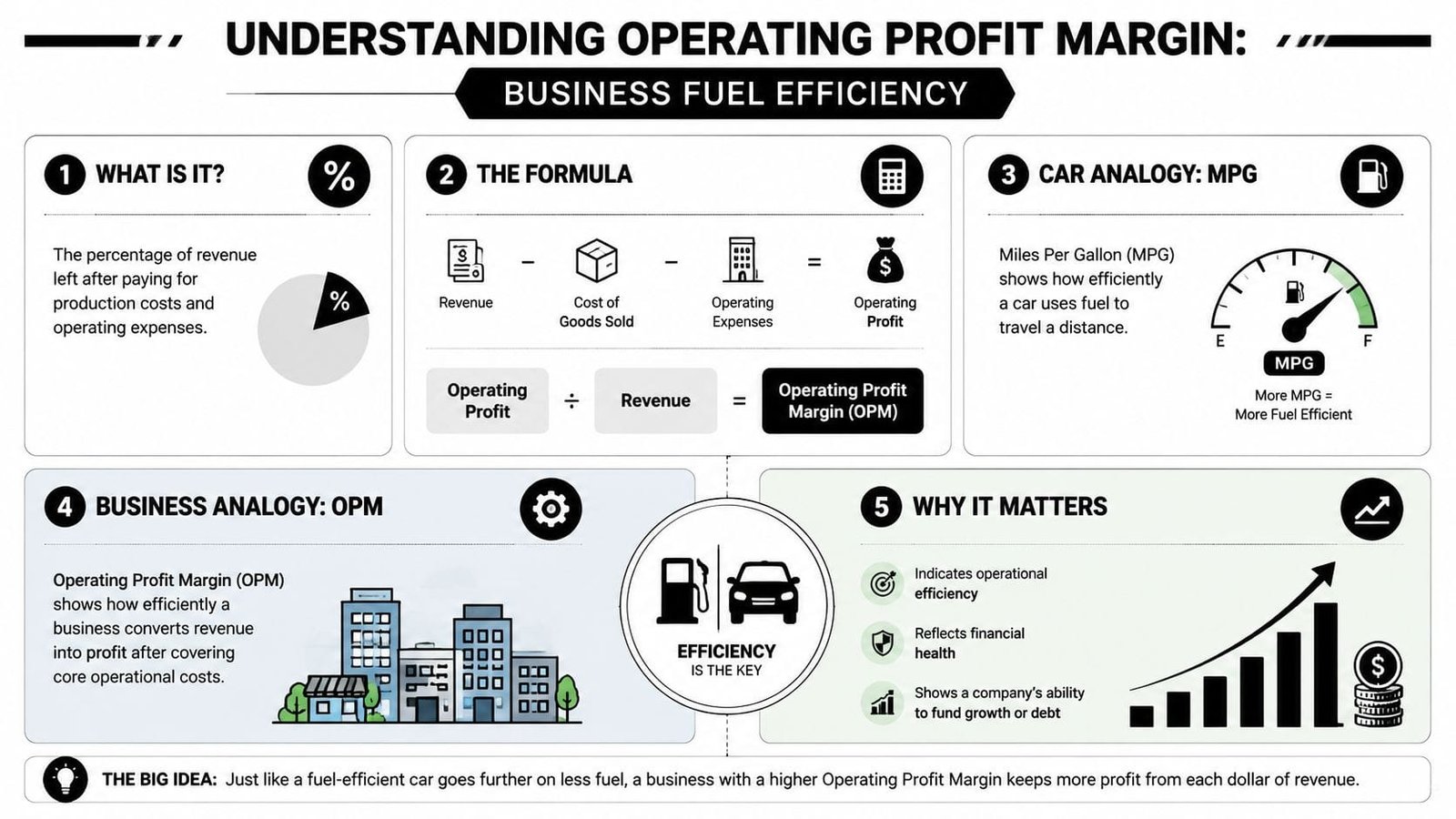
Revenue shows activity. Operating profit margin shows how efficiently the business turns that activity into profit from normal operations. Underwriters care because loan payments are not made with gross sales. They are made with the money left after the business does its everyday work.
The formula is straightforward: (Revenue − COGS − Operating Expenses) ÷ Revenue. If you want a clearer refresher on where operating profit sits compared with bottom-line earnings, this guide on how to find net income on financial statements helps clear up a common point of confusion.
Later in the section, this short video gives a useful visual explanation:
What goes into the formula
This metric only helps if the costs are classified correctly. I see borrowers get into trouble here all the time. If expenses are misfiled, the margin can look stronger or weaker than the business really is, and that raises questions fast in underwriting.
- Revenue is total sales for the period.
- COGS means direct costs tied to producing or delivering what you sell.
- Operating expenses are the ongoing costs of running the company, such as payroll, rent, software, admin, and marketing.
- Operating profit is what remains after direct costs and operating expenses are paid, before interest and taxes.
If a company reports a 15% operating margin, it keeps $0.15 of operating profit for each $1 of revenue. That does not prove the business is healthy on its own, but it gives a lender a fast read on whether management has control over pricing, labor, overhead, and day-to-day execution.
A good operating margin does not mean the business is perfect. It means the core operation is producing enough profit to make a lender keep reading.
Context matters. A contractor, retailer, manufacturer, and consulting firm will not carry the same margin profile, even if all four are run well. Underwriters know that. What they want to see is whether your margin makes sense for your model, whether it has held up over time, and whether it leaves enough room for debt service if sales soften or costs rise.
That is the practical definition borrowers should keep in mind. Operating profit margin is not just an accounting ratio. It is one of the clearest signals of whether a business has enough operating strength to support a loan.
How to Calculate Your Operating Margin Step by Step
Pull the numbers from your P and L
This calculation is easier than most owners expect. You don't need a finance degree. You need a clean profit and loss statement and the discipline to classify costs correctly.
Use this sequence:
- Start with revenue
- Subtract COGS
- Subtract operating expenses
- Take the result as operating profit
- Divide operating profit by revenue
That gives you your operating profit margin.
The key formula is (Revenue − COGS − Operating Expenses) ÷ Revenue, and it's useful because it isolates core operating performance, as summarized in this operating margin overview. That internal guide is about net income, but it's also useful because many borrowers confuse operating profit with bottom-line profit.
Two business models that behave differently
Here's where owners get tripped up. Two companies can have the same revenue and very different operating margins because their cost structures are different.
A retailer usually feels pressure in direct costs. Inventory, freight, shrink, and markdowns tend to squeeze the gross side first. A service firm usually feels pressure in payroll, subcontractors, account management, and overhead. Same revenue. Different leak points.
Consider the contrast below.
| Business type | Main pressure point | Typical underwriting question |
|---|---|---|
| Retail or restaurant | COGS and inventory economics | Are direct costs under control? |
| Professional services | Payroll and operating expense load | Is labor aligned with billable revenue? |
The same operating margin formula applies to both, but the interpretation changes.
What owners often misclassify
A bad calculation is worse than no calculation. These are the mistakes I see most often:
- Mixing net profit with operating profit. Interest and taxes don't belong in operating margin.
- Burying direct costs in overhead. If COGS is understated, margin looks stronger than reality.
- Ignoring expense timing. A month with unusual spending can distort the picture if you don't normalize it.
- Comparing against the wrong peer group. A service business should not benchmark itself like a retailer.
If your number surprises you, don't argue with it first. Audit the categories. Most margin confusion starts with bookkeeping, not business failure.
For borrowers, value isn't the math itself. It's what the math reveals. If the margin is weak, you can identify whether pricing, purchasing, staffing, or overhead is doing the damage. That gives you something lenders respect: a diagnosis with a plan.
Operating Margin Benchmarks and What Is Considered Good
Benchmarks help, but underwriters do not lend to averages
A borrower can show me a 12% operating margin and ask, “Is that good?” My answer is usually, “Compared to what?”
A broad reference point helps. The aggregate pre-tax operating profit margin for about 5,994 publicly traded U.S. firms was 14.39% as of January 2026, and the same Damodaran-based summary says a healthy small business operating margin often falls between 10% and 20%, with margins above 20% showing strong profitability, according to this industry profit margin summary.
That range gives you context. It does not give you approval odds.
A machine shop, a law firm, and a restaurant can all be decent businesses with very different normal margins. Underwriters know that. What hurts borrowers is using a generic benchmark to defend a weak number that does not fit their business model.
A simple benchmark table
Use category averages as guardrails, not a scorecard.
| Industry | Average Operating Margin |
|---|---|
| Professional services | 15–25% |
| Retail | 3–8% |
| Restaurants | 3–8% |
| Total U.S. public market benchmark as of January 2026 | 14.39% |
| Small business healthy range | 10–20% |
Those ranges are broad on purpose. A well-run retailer can win financing with a margin that would look mediocre for a consulting firm. A service business with a 6% margin usually gets harder questions because lenders expect more room after payroll and overhead.
What “good” looks like in a credit file
From an underwriting standpoint, “good” means the margin fits the industry, holds up over time, and leaves room for debt payments after normal operating strain.
Here is the practical read lenders often apply:
- Below typical industry range: higher risk unless there is a clean explanation and a visible improvement trend
- Within range: generally acceptable if financials are reliable and cash flow supports the request
- Above range: favorable, but only if the result is repeatable and not inflated by bookkeeping choices or one-time events
That last point matters. I have seen borrowers post strong margins on paper and still struggle to get approved because the number came from delayed expenses, owner add-backs that did not hold up, or revenue that was unusually concentrated.
If you want a lender-focused comparison point, this guide on what profit margin lenders want to see in small businesses is a useful companion.
Good operating margin is not about looking impressive. It is about proving your business has enough cushion to absorb normal problems and still make the loan payment.
Why Lenders Scrutinize Your Operating Margin

A borrower walks into a credit meeting with rising sales, a clean story, and confidence that revenue growth should carry the request. Then the underwriter sees a thin operating margin and the conversation changes fast. The question becomes simple: if costs rise, a key customer pays late, or payroll runs hot for a quarter, is there still enough earnings left to make the loan payment?
What the underwriter is really testing
Operating margin matters because it shows how much profit the business keeps from normal operations before interest and taxes. For a lender, that number is less about appearance and more about durability. We are trying to judge whether the company can handle ordinary business friction without relying on perfect execution every month.
That is why this ratio carries weight in credit decisions. According to Vena's lending-focused margin discussion, lenders often look for a minimum 10% operating margin on SBA-backed requests, and businesses with operating margins above 15% tend to post stronger approval and default outcomes than businesses under 10%.
In practice, underwriters make a simple comparison:
| Company | Revenue story | Operating margin story | Credit read |
|---|---|---|---|
| Business A | Sales look strong | Margin is thin | Higher stress if anything slips |
| Business B | Sales look similar | Margin is sturdier | Better cushion for repayment |
That distinction matters more than many owners expect. Revenue proves customers exist. Operating margin shows whether those customers leave enough behind to cover overhead, absorb mistakes, and still support debt.
Where operating margin can mislead
A healthy operating margin does not settle the credit decision by itself.
It leaves out interest and taxes, which means it can make a business look safer than it is if existing debt is already heavy. I have seen borrowers with respectable operating performance run into trouble because prior loan payments, equipment notes, or merchant cash advances were already consuming the cushion the margin seemed to promise on paper.
Service businesses create another underwriting wrinkle. Margin can swing hard when labor efficiency, staffing mix, overtime, or subcontractor use changes from month to month. A lender will treat a volatile 16% very differently from a steady 12%, because predictability supports repayment almost as much as the absolute number.
This is also why lenders care about the quality of sales, not just the amount. If a company is buying revenue through discounting or expensive customer acquisition, the margin may weaken as volume rises. That same discipline shows up in marketing analysis. Arlo’s insights on ROAS and ROI are useful here because they focus on whether growth is profitable after real costs, which is exactly how underwriters read financial performance.
Strong borrowers do one thing well. They explain the margin, not just report it. They can show why it changed, which costs are fixed versus variable, and whether the current level is repeatable over the life of the loan. That makes an underwriter’s job easier, and it usually gives the file a better chance of approval.
Practical Strategies to Improve Your Operating Margin
Tighten the revenue side
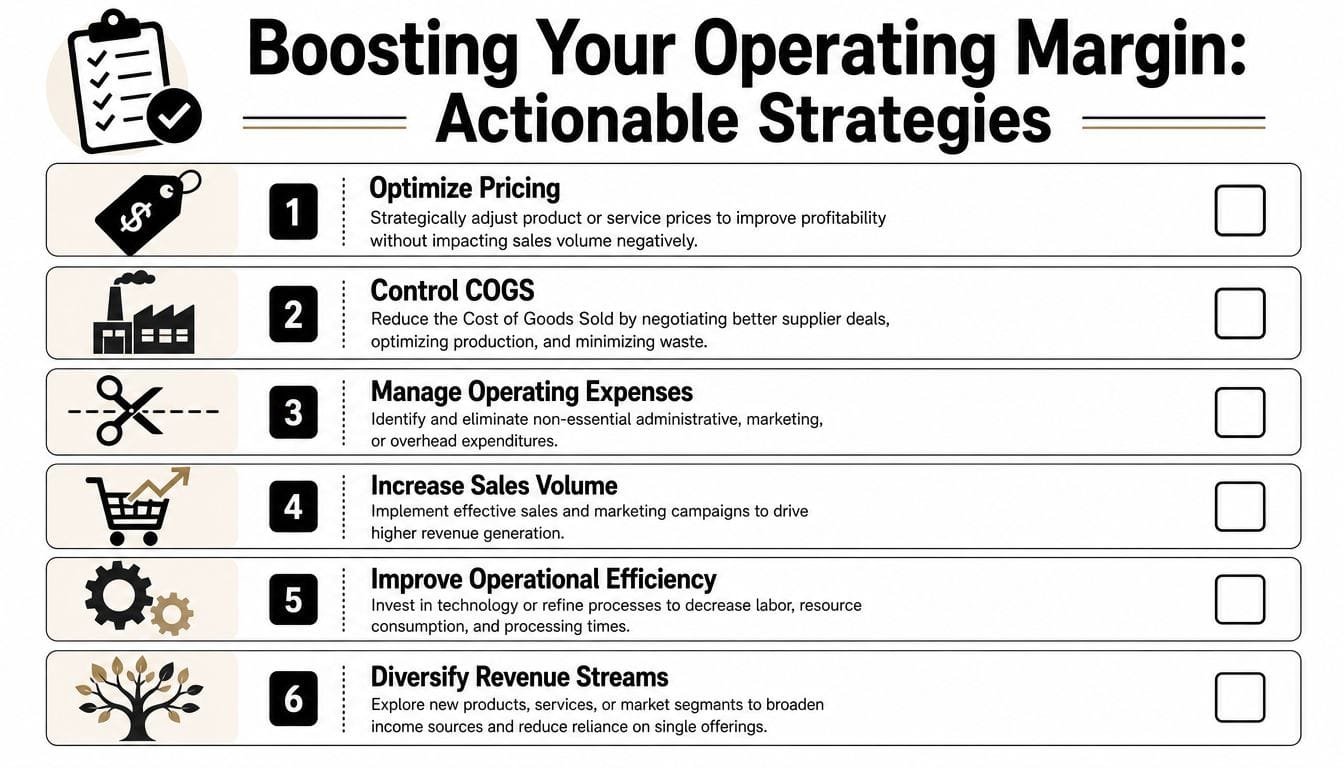
The fastest fix is not always “sell more.” It’s usually “sell better.”
Start by reviewing product and service mix. Some accounts create busyness without contributing enough operating profit. If a line is hard to deliver, discount-heavy, or labor-hungry, more volume can make the problem worse. Hence, marketing measurement matters. If you’re deciding whether campaigns are creating profitable growth, Arlo’s insights on ROAS and ROI are useful because they force the same discipline lenders want to see: revenue quality, not just activity.
A few revenue-side moves usually work:
- Reprice carefully when costs have changed and your value still supports the increase.
- Protect mix quality by pushing the offers that leave healthier contribution after delivery.
- Fire bad work if certain jobs consume management time and drag margin every month.
Attack cost creep where it hides
Operating margin often improves through cleanup, not heroics.
Look at purchasing first if you sell products. Vendor terms, freight habits, waste, and inventory discipline can gradually erode margin. On the expense side, small subscriptions, duplicated tools, underused contractors, and bloated admin layers are common offenders.
Try this review sequence:
- Pull six to twelve months of spending
- Group expenses by necessity
- Mark any cost that rose faster than revenue
- Cut or renegotiate the items that don’t clearly support profitable delivery
Most margin improvement comes from removing habits, not inventing new tactics.
For service businesses labor is the lever
Service firms have a special problem. Labor usually sits inside operating expenses, and that makes margin volatility harder to manage. Some service businesses can experience 20–30% swings in operating profit margin due to variable labor costs, and managing the labor-to-revenue ratio is the key stabilizer, according to this discussion of service-business OPM volatility.
That means owners should watch staffing decisions with unusual discipline:
- Match capacity to demand instead of hiring ahead of proven pipeline.
- Track utilization so highly paid staff are tied to billable or revenue-supporting work.
- Use subcontractors selectively when demand is uneven and fixed payroll would create drag.
The best improvement plans are boring on paper. Cleaner pricing. Better purchasing. Tighter labor management. Less overhead drift. Underwriters love boring when it produces reliable margins.
Operating Margin FAQs for Business Borrowers
What’s the difference between operating margin and net profit margin?
Operating margin looks at profit from core operations before interest and taxes. Net profit margin goes all the way to the bottom line after those items and other non-operating effects.
Can strong revenue growth offset a weak operating margin?
Usually not by itself. Lenders prefer growth that holds up operationally. Fast sales growth with thin margins can signal that the company is buying revenue with discounts, overspending, or weak cost controls.
How is operating margin different from EBITDA margin?
Operating margin includes operating expenses and reflects operating profit. EBITDA adds back some non-cash items, so it can present the business differently, especially in asset-heavy models.
Can a healthy operating margin still lead to a denial?
Yes. As noted in the debt-load blind spot in operating profit margin, a company with a 15% OPM can still be risky if debt service coverage is weak. That’s why lenders review margin alongside debt, cash flow, and repayment structure.
The takeaway is simple. If you want better financing options, don’t just grow revenue. Protect the amount your operations keep.
If you’re preparing for funding and want a lender-ready view of your numbers, Business Loan Warrior can help you understand where your business stands before you apply. Their platform lets you check options through one no-fee application, explore appropriate funding paths, and move faster with underwriting insight that goes beyond surface-level revenue.