
Most growth advice starts with the wrong question. It asks how quickly you can add revenue, locations, employees, or customers. A stronger question is whether your cash flow, margins, systems, and management capacity can absorb expansion without turning success into a liquidity crisis.
For mid-market owners, planning for business growth should begin with resilience, not ambition. That means building cash-flow scenarios, setting measurable execution triggers, and matching each funding product to the operational need it supports. Revenue still matters, but revenue that consumes margin, stretches receivables, or forces premature hiring can weaken the business it appears to strengthen.
Table of Contents
- Rethinking Expansion in a Volatile Economy
- Building Cash Flow Scenarios and Financial Forecasts
- Translating Strategy into an Execution System
- Matching Funding Sources to Operational Scaling Needs
- Designing KPI Dashboards for Adaptive Growth
- The Pre-Application Funding Readiness Checklist
Rethinking Expansion in a Volatile Economy
Expansion is not automatically progress. A new location can add overhead before demand stabilizes. A larger team can increase payroll faster than collections. More sales can create inventory commitments, service bottlenecks, and customer obligations that your current systems can't handle.
Recent business-leader survey data supports a more defensive starting point. Materials and other cost-of-goods inputs ranked among the top three sources of higher expenses for 57% of respondents, while new tariffs were cited by 48%. Uncertain economic conditions concerned 55% of leaders, and 44% said they had delayed plans to some extent. Among those changing plans, 74% pointed to policy uncertainty. These figures come from JPMorgan's midyear business outlook and related owner survey findings.
That environment changes the order of operations. Before committing to aggressive expansion, management should test pricing, protect contribution margin, reduce avoidable input exposure, and preserve working-capital flexibility. A business that grows sales while losing cash on every incremental order isn't scaling. It's financing a larger problem.
Decide what kind of growth you can carry
Use three questions before approving a major expansion initiative:
- Margin durability: Can the business absorb higher labor, materials, freight, or tariff costs without relying on optimistic price increases?
- Cash conversion: How long does cash remain tied up between purchasing, production, delivery, invoicing, and collection?
- Management capacity: Can current leaders supervise the added complexity, or will expansion create a dependency on a few overloaded people?
The planning horizon should also reflect reality. Recent SME outlook data found that 42% of leaders rely on six-to-24-month planning windows, while only 13% plan beyond five years. More than a third reported lacking the digital and AI capability needed to support growth. The same source highlights the $5.7 trillion MSME finance gap in emerging and developing economies, reinforcing why cash availability and capability building must sit inside the growth plan, not beside it. See the SME growth challenges and planning outlook for the underlying context.
Practical rule: If expansion requires perfect demand, perfect hiring, and perfect collections, the plan is too fragile to fund.
Short planning cycles don't mean weak strategy. They mean leadership sets a direction, defines financial guardrails, and revisits assumptions before sunk costs become irreversible. Owners who want a structured way to connect objectives with measurable outcomes can also review how OKRs drive growth, especially when translating broad priorities into accountable operating targets.
Building Cash Flow Scenarios and Financial Forecasts
A revenue forecast isn't a cash-flow forecast. Revenue records economic activity, while cash flow shows whether the company can pay employees, suppliers, lenders, and taxes when those obligations come due.
Build the model around cash timing. Start with opening cash, expected collections, supplier payments, payroll, taxes, debt service, capital expenditures, and other committed outflows. Then separate assumptions that management controls, such as hiring dates and payment terms, from assumptions it doesn't control, such as customer delays or input-cost changes.
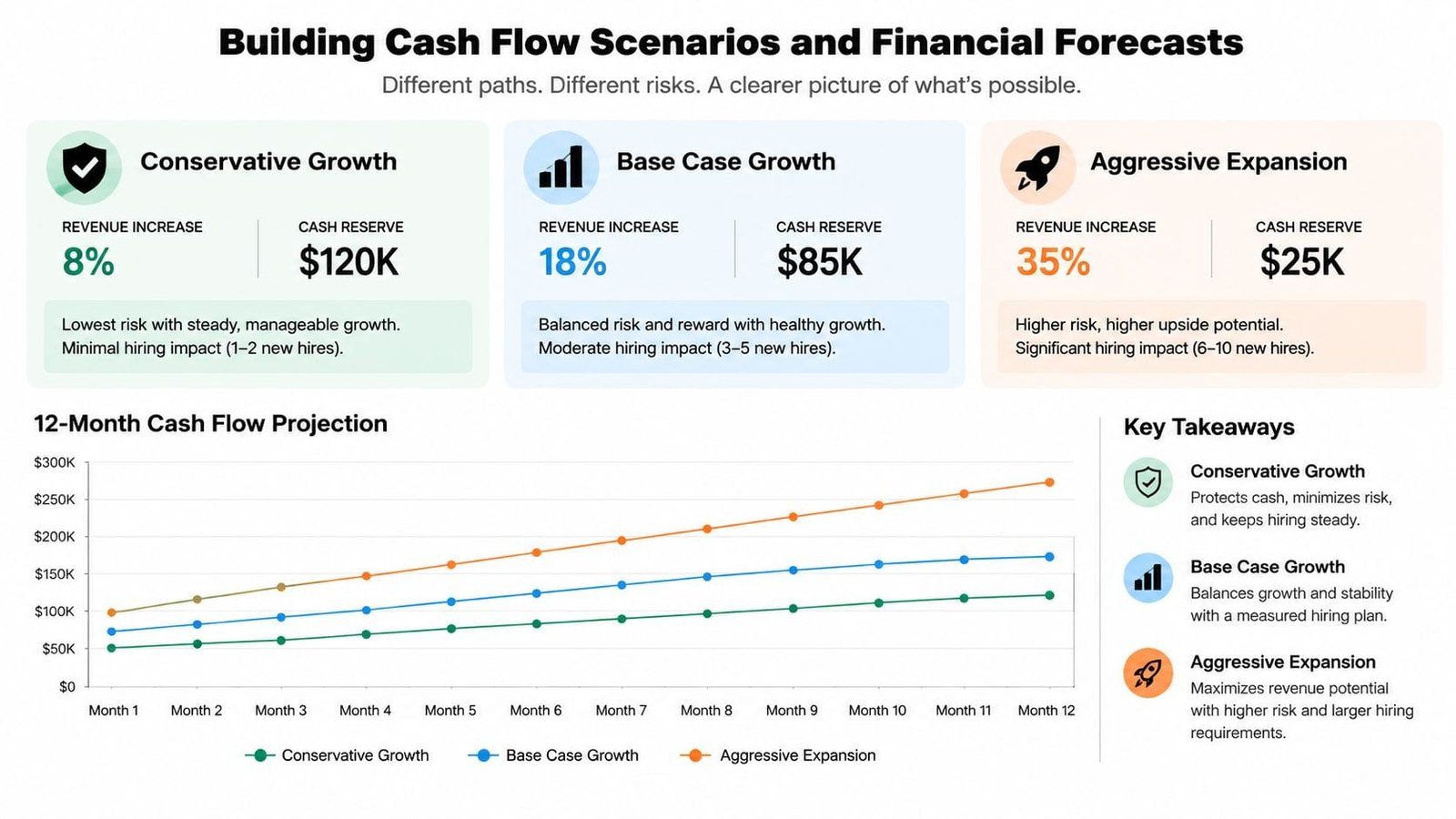
Build three operating cases
Use a conservative case, a base case, and a stress case. Each should change operational assumptions, not just revenue.
- Conservative case: Delay discretionary hiring, assume slower collections, preserve cash, and approve only essential equipment or inventory purchases.
- Base case: Use the most defensible demand forecast, realistic payment timing, planned staffing, and known financing costs.
- Stress case: Model weaker demand, delayed receivables, higher input costs, and an expansion milestone that arrives later than expected.
Don't hide hiring inside a general expense line. Assign every planned hire a start date, fully loaded cost, training period, and revenue or capacity trigger. If the trigger doesn't occur, the hiring decision should automatically return for review.
A useful model also separates fixed cash commitments from variable costs. Rent, core payroll, insurance, software contracts, and scheduled debt payments continue even when sales soften. Variable labor, inventory purchases, commissions, and discretionary marketing may move with demand, although cutting them too aggressively can damage future revenue.
Link liquidity to survival risk
Historical survival data shows why owners should protect liquidity during expansion. U.S. Small Business Administration data, summarized by Business Initiative's survival-rate reporting, indicates that 67.9% of new employer establishments survive their first two years, 49.2% survive five years, 33.8% survive ten years, and 25.6% remain operating after fifteen years.
The planning implication is practical. A company that reaches year five has cleared the steepest part of the early failure curve, but it still faces substantial long-term attrition. Expansion decisions should therefore use conservative liquidity buffers and milestone-based commitments, particularly when the company is entering a new market, adding capacity, or taking on fixed overhead.
Review the model monthly, but make formal scenario decisions quarterly. For a deeper walkthrough of the mechanics, use this guide to build a cash-flow forecast that supports your loan strategy. The objective isn't to predict the future perfectly. It's to identify the point at which management must slow hiring, renegotiate terms, draw available liquidity, or pause expansion.
Translating Strategy into an Execution System
A strategy document doesn't create growth. Managers, salespeople, operators, and finance teams create growth by making consistent decisions against clear priorities.
The OECD's SME indicators framework treats business statistics as core evidence for monitoring turnover, employment, profits, and scale-up potential. Its cross-country SME work draws on firm-level data across 17 OECD and accession-candidate countries from 2014 through 2020 and maps more than 2,500 SME and entrepreneurship policies from 520 institutions, as described in the OECD's research on unleashing SME scale-up potential. The management lesson is straightforward: growth planning needs a measurement system, not just a sales objective.
Turn annual ambition into quarterly commitments
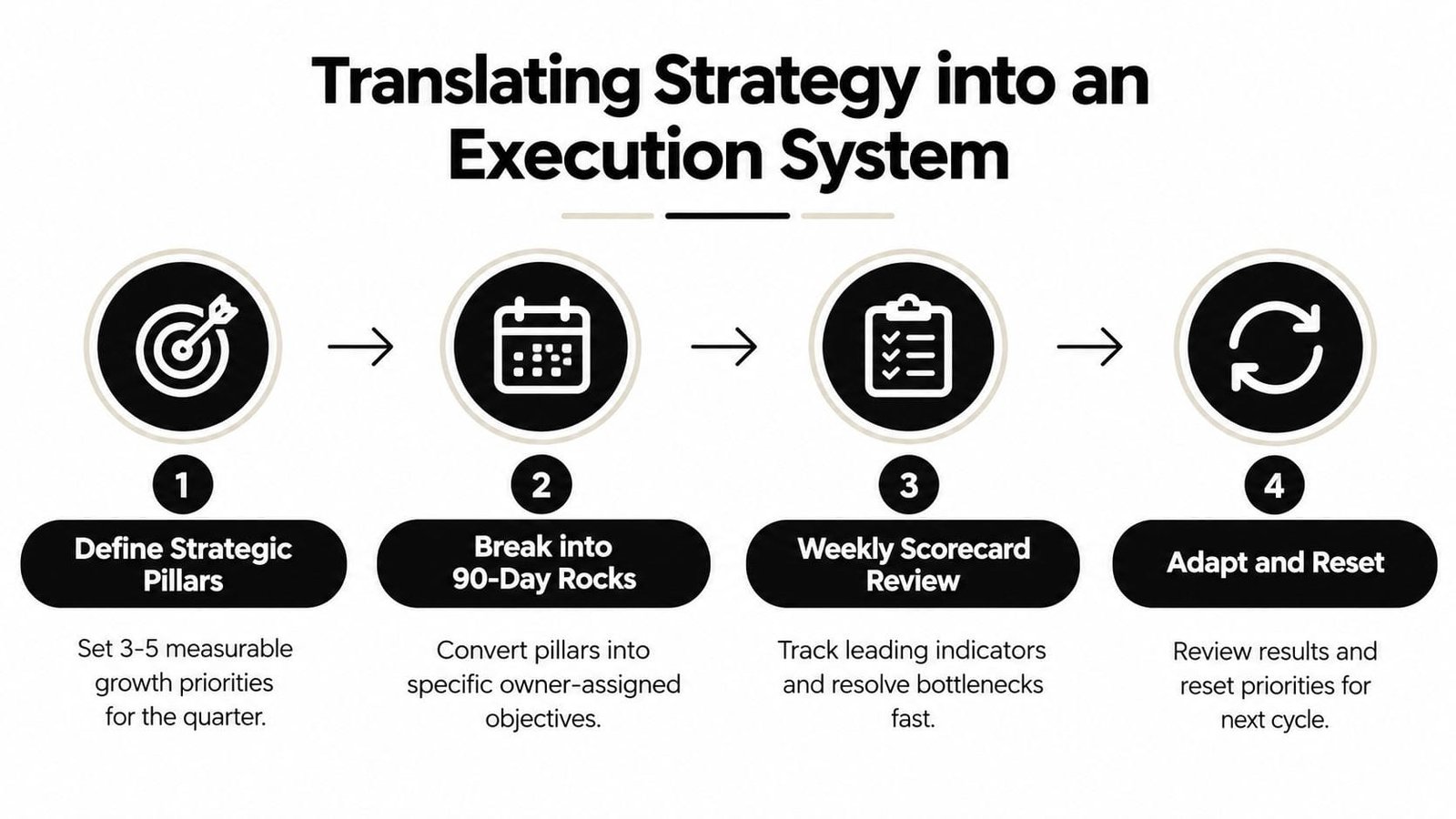
Choose a small set of strategic pillars for the quarter. Examples include improving gross margin, increasing production capacity, reducing receivables aging, or entering a defined customer segment. Each pillar needs an owner, a measurable outcome, a deadline, and a stated resource limit.
Then convert each pillar into work that a team can finish within a short cycle:
- Define the outcome: State what must change, not merely what the team should do.
- Assign accountability: One person owns the result, even when several departments contribute.
- Set a leading indicator: Track activity or capacity before the financial result appears.
- Create a decision trigger: Specify what happens if performance falls below plan.
- Review constraints: Identify hiring, technology, supplier, or financing dependencies.
The 2026 study supplied for this article found that strategic planning variables explained 61.4% of the variance in business growth, with implementation mechanisms the strongest predictor, at β=0.384 and p<0.001. Resource allocation followed at β=0.287, and environmental scanning at β=0.246. The same study reported revenue rising 42% from 2016 through 2023, while strategic-plan targets were missed by an average of 23% per year, demonstrating that a plan can coexist with repeated execution failure. Review the study on strategic planning and business growth for the cited findings.
Install a feedback loop
Hold a weekly scorecard review focused on exceptions. Managers should discuss missed milestones, bottlenecks, cash changes, capacity constraints, and decisions requiring escalation. A quarterly review should reset priorities, revise assumptions, and reallocate resources.
Marketing and sales execution often breaks down because ownership is spread across disconnected systems. A practical reference for coordinating campaigns, handoffs, reporting, and process governance is Crescade's marketing ops playbook.
The strongest execution systems make tradeoffs visible. If management funds a new sales channel, it should identify what won't be funded, which KPI will validate the decision, and when leadership will stop or expand the initiative.
Matching Funding Sources to Operational Scaling Needs
Debt should match the life of the asset or cash cycle it funds. Using a short-term product for a long-lived investment can force repayments before the investment produces returns. Using permanent capital for a temporary working-capital gap can create unnecessary cost and restrict future borrowing capacity.
Start with the operational need, then select the financing structure. Don't begin with the lender's product menu.
| Funding Type | Best Used For | Repayment Structure |
|---|---|---|
| SBA loan | Durable expansion, acquisition, real estate, or major working-capital needs | Longer-term scheduled amortization, subject to lender and program terms |
| Business line of credit | Receivables timing gaps, inventory purchases, seasonal working capital, and short operating cycles | Revolving draws with interest charged on outstanding balances, subject to facility terms |
| Equipment financing | Vehicles, machinery, technology, and other identifiable equipment | Scheduled payments tied to the financed asset |
| Merchant cash advance | Urgent short-term needs where repayment can be supported by card or receivables volume | Repayment through a portion of future receivables, often with a higher total financing cost |
Match the product to the phase
An equipment loan makes sense when a specific machine increases capacity and has a useful operating life that extends beyond the repayment period. A line of credit fits a receivables mismatch because the draw supports a defined cash conversion cycle and can be repaid as customers pay.
An SBA loan may suit a larger, durable expansion that requires a longer repayment horizon. Its application process can demand more documentation and patience, so it shouldn't be treated as emergency liquidity.
Merchant cash advances deserve caution. They may provide speed, but repayment tied to future receipts can compress cash flow precisely when sales weaken. Compare the total payback, remittance mechanics, and effect on daily operating cash before accepting one.
Financing discipline: Borrow for a measurable operational outcome, not for the emotional relief of having more cash in the bank.
Before applying, map each use of funds to a forecast line. Inventory financing should connect to purchase timing and expected collections. Equipment financing should connect to capacity, utilization, and operating margin. Expansion financing should include a downside case showing how the company will service debt if the ramp takes longer than planned.
Owners considering multiple facilities should review how to layer financing tools without over-leveraging the business. The goal is a coordinated funding stack, not a collection of obligations with overlapping repayment pressure.
Designing KPI Dashboards for Adaptive Growth
A dashboard should help leadership decide what to do next. If it only reports last month's revenue and profit, it may describe performance without warning you about the next cash-flow problem.
The OECD's emphasis on turnover, employment, profits, and other operational variables supports a broader view of scale-up measurement. Revenue belongs on the dashboard, but it should sit beside margin, cash conversion, capacity, customer quality, and financing capacity.

Combine lagging and leading indicators
Lagging indicators tell you what happened. Leading indicators show whether the current operating pattern is likely to produce the next result.
Track a focused set of measures:
- Margin per unit or engagement: Shows whether new revenue adds economic value after direct costs.
- Receivables aging: Signals when reported sales are failing to convert into usable cash.
- Capacity utilization: Identifies whether equipment, labor, or facilities can support additional demand.
- Customer acquisition payback: Tests whether growth spending returns cash quickly enough to justify its pace.
- Order backlog quality: Separates committed, profitable demand from speculative or low-margin work.
- Hiring triggers: Connects payroll additions to verified workload or capacity constraints.
- Debt-service coverage: Shows whether operating cash can support scheduled repayments under the current forecast.
Don't give every metric equal status. Assign thresholds and actions. If receivables aging worsens, tighten terms, accelerate collections, or slow discretionary purchasing. If utilization approaches a practical limit, assess equipment, scheduling, outsourcing, or hiring before accepting more volume.
Make the dashboard a decision tool
Finance should own data integrity, but operating leaders must own the actions. Hold a short review that answers three questions: which metric moved, why it moved, and what decision follows.
A dashboard also needs one version of the numbers. Finance, sales, and operations shouldn't maintain separate definitions for revenue, backlog, margin, or active customers. Shared definitions reduce arguments and let leadership spend the meeting on choices rather than reconciliation.
A useful dashboard doesn't merely display risk. It assigns someone the responsibility to respond to it.
The Pre-Application Funding Readiness Checklist
Lenders don't fund a story alone. They assess historical performance, current liquidity, repayment capacity, existing obligations, collateral, and the specific use of proceeds. A clean application makes those relationships easy to verify.
Start preparing before the expansion deadline. Last-minute document collection often produces inconsistent figures, unexplained deposits, missing liabilities, and projections that don't reconcile with bank activity.
Assemble the financial record
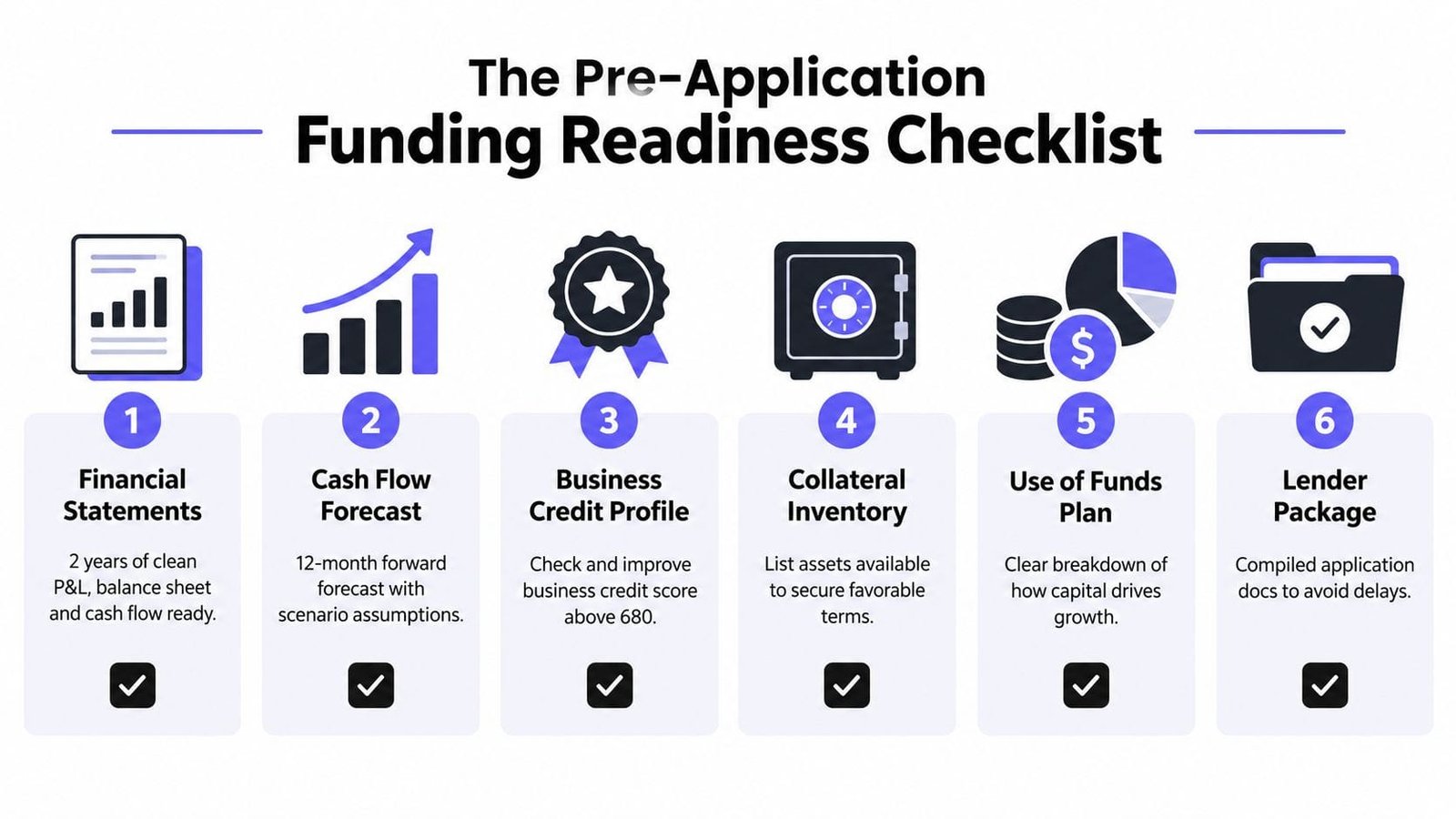
Prepare a secure data room containing:
- Financial statements: Organize historical profit and loss statements, balance sheets, and cash-flow statements. Make sure the statements reconcile to filed tax returns and accounting records.
- Forward forecast: Include a forward-looking cash-flow model with conservative, expected, and stress assumptions. Show how the requested capital changes revenue, costs, working capital, and debt service.
- Bank activity: Be ready to connect business bank accounts or provide statements so the lender can verify deposits, balances, recurring payments, and cash-flow patterns.
- Debt schedule: List every loan, line, advance, lease, payment amount, maturity, balance, and security interest.
- Receivables and payables: Provide aging reports and explain major concentrations, slow-paying customers, unusual balances, or supplier dependencies.
- Tax and ownership records: Gather requested returns, formation documents, ownership details, licenses, and beneficial-owner information.
Explain the use of funds
A lender should be able to trace each dollar from approval to operating result. Break the request into inventory, equipment, hiring, construction, acquisition, refinancing, or other categories. Tie each category to a timeline, expected operational effect, and repayment source.
Run a financial health assessment before submitting. Use it to identify weak margins, unstable cash conversion, excessive short-term obligations, or documentation gaps that could undermine the application.
Then prepare a concise lender narrative. State what the company does, why demand supports the initiative, what management has already completed, how much capital is needed, and what happens if the base case takes longer. Don't claim certainty. Demonstrate control.
Check readiness before requesting terms
Ask an internal reviewer to challenge the application as a credit analyst would. Can they reconcile the forecast to historical results? Can they identify the repayment source? Can they explain every major variance? Can they see how the company will preserve liquidity if the expansion underperforms?
The best time to discover a weakness is before the application reaches underwriting. Submit a complete package, respond quickly to follow-up questions, and avoid borrowing more than the operating model can responsibly carry.
Business Loan Warrior helps business owners compare funding options for working capital, equipment, SBA financing, construction, expansion, and other operational needs through a single application process. Visit Business Loan Warrior to assess funding choices, prepare for lender review, and match capital to your growth plan.