

Your contractor is ready to order materials, payroll is approaching, and the renovation money you thought was available still needs lender authorization. You've secured financing, but you can't yet use it to keep the job moving.
That's the distinction to understand before signing for a renovation construction loan. For an established business, the challenge isn't just getting approved. It's coordinating contractor payments, lender requirements, and business expenses without draining the cash that keeps your operation running.
Table of Contents
- Why Renovation Projects Hit a Funding Wall
- What a Renovation Construction Loan Actually Is
- How It Differs from a Standard Business Loan
- Eligibility, Terms, and What Underwriters Actually Review
- How Draws, Inspections, and Contingency Reserves Actually Work
- Retail and Restaurant Build-Outs in Practice
- The Hidden Risk Most Owners Underestimate
- Choosing a Lender and Preparing to Apply
Why Renovation Projects Hit a Funding Wall
Consider a hypothetical retailer renovating an occupied location. The owner approves a contractor's budget and assumes the financing will cover each invoice as it arrives. Then the contractor requests payment for materials while the lender is still reviewing the preceding work.
The owner now has competing obligations: preserve cash for the business or advance money to prevent a construction stoppage. Neither choice appeared clearly in the original renovation budget.
A project can be fully financed and still run short of usable cash. The mistake is treating the approved loan amount as though it were an unrestricted bank balance.
The lender is financing an unfinished outcome
Renovation lending requires attention to both repayment capacity and construction execution. HUD's historical review of the Section 203(k) program illustrates that dual focus: the financing combines acquisition or refinancing with rehabilitation, while project controls help protect the lender against incomplete work and uncertain collateral value (HUD's review of rehabilitation lending).
That residential program isn't a commercial build-out product. It's a useful illustration of why lenders care about who performs the work, what gets built, and whether the finished property supports the financing.
Before discussing loan size, identify the points where money must leave your account:
- Before installation: Ask which deposits and material purchases require advance payment.
- During construction: Match contractor billing expectations to the lender's authorization process.
- While operating: Protect payroll, rent, and supplier payments from construction-related cash demands.
Even ordinary finish work deserves careful scoping. For background when discussing wall repairs and finishing with a contractor, review CS1 Real Interiors drywall tips. Use that preparation to ask better questions, not as a substitute for a project-specific bid.
Practical rule: Don't approve a contractor payment schedule until you've compared it with the lender's disbursement requirements.
The right starting question isn't how much you can borrow. It's whether the financing arrangement lets you pay the right party when payment becomes due.
What a Renovation Construction Loan Actually Is
A renovation construction loan finances a defined improvement project through a controlled lending arrangement. For business owners, the useful definition rests on the relationship among the finished property, the approved work, and access to proceeds.
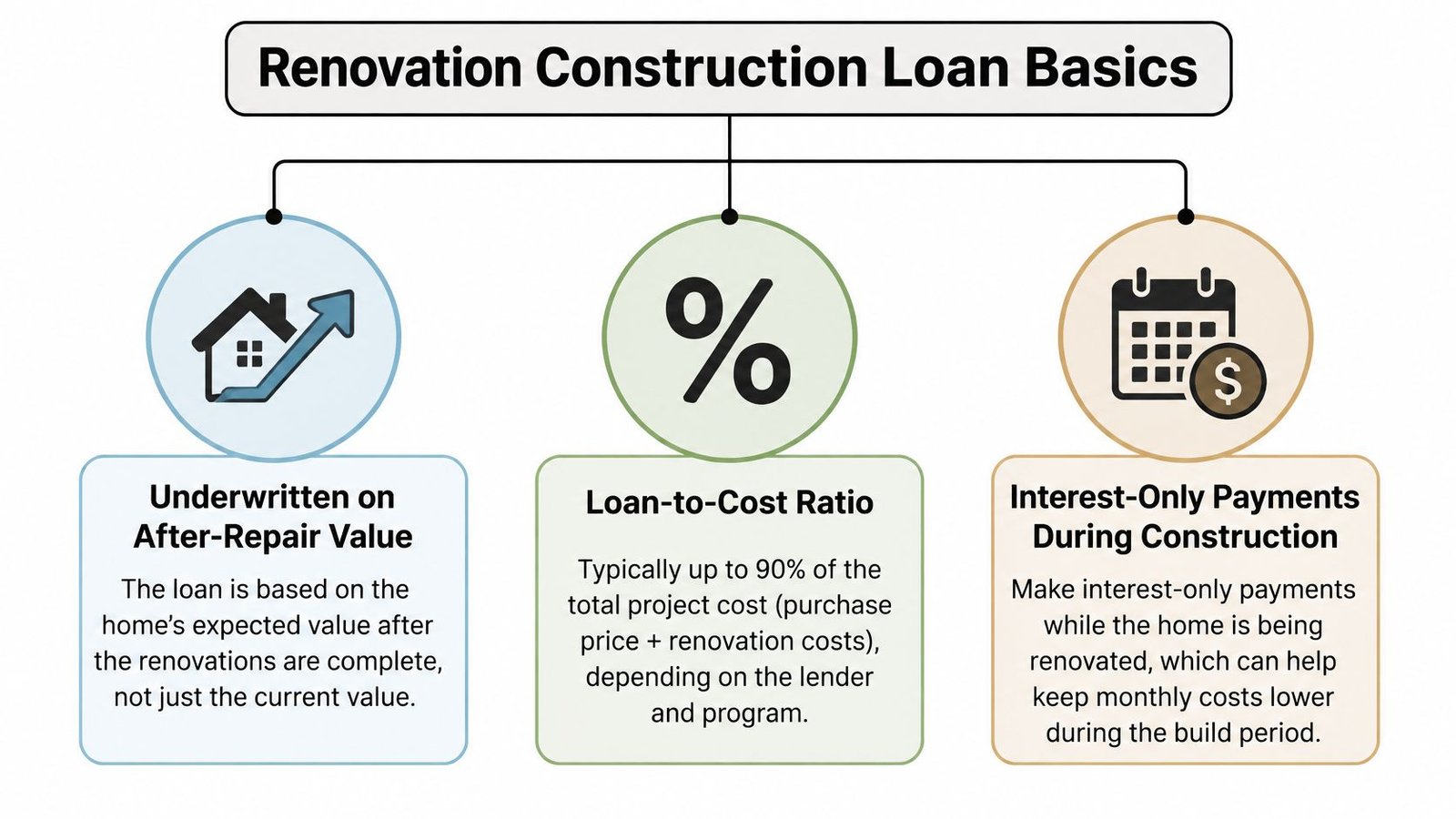
The following concept map provides an orientation. Treat loan-to-cost limits and interest-only payments as terms to verify, not universal features promised by the product name.
The finished property supports the financing
As-completed value means the property's projected value after the approved improvements. It isn't the same as today's value, and it isn't automatically equal to the purchase price plus everything you spend.
Fannie Mae's HomeStyle Renovation process requires an as-completed appraisal before closing, supported by plans, specifications, and the renovation budget. That appraisal supports the maximum mortgage amount and applicable loan-to-value calculation (Fannie Mae's HomeStyle origination requirements).
For a commercial project, ask the lender exactly how it evaluates the completed property and determines your required contribution. Don't assume an expensive improvement creates an equivalent increase in collateral value.
Access follows the approved project
The other defining features are staged funding and budget control. Rather than treating the proceeds as general spending money, the arrangement connects disbursements to approved construction activity. The lender's requirements determine when funds become available and how changes receive authorization.
Think of it as a controlled reimbursement arrangement, although individual lenders may permit certain advances. You're managing both the construction job and the evidence needed to support funding.
That creates an important division of responsibility:
- Your contractor delivers the agreed work and supporting billing.
- Your lender applies the financing agreement's release conditions.
- You reconcile those requirements with the business's payment obligations.
The label alone doesn't settle the structure. A commercial renovation facility, residential rehabilitation mortgage, and working-capital product may all appear in searches for renovation financing, but they aren't interchangeable.
Identify the borrower, property use, and eligible expenses first. Then evaluate the financing structure. A residential program's published limits don't establish what a restaurant, retailer, or service business can obtain.
How It Differs from a Standard Business Loan
Compare how the money behaves, not just the quoted rate. An attractive price won't fix a facility that can't pay the expenses your project requires.
For an initial comparison, use the questions below to distinguish a project-controlled renovation facility from a standard term-loan proposal, SBA 504 financing, or a business line of credit. These are diligence prompts, not promises about any lender's terms.
Renovation Construction Loan vs Standard Business Financing
| Feature | Renovation Construction Loan | Standard Term Loan | SBA 504 | Business Line of Credit |
|---|---|---|---|---|
| Primary fit question | Does the facility match this defined renovation? | Can proceeds cover the intended improvements? | Does the property project meet program eligibility? | Is the need a temporary cash gap or permanent project funding? |
| Access to funds | Review construction release conditions | Confirm initial disbursement conditions | Confirm the project's financing and funding sequence | Review availability and borrowing conditions |
| Property considerations | Establish treatment of the finished property | Confirm collateral requirements | Verify property-use requirements with the provider | Confirm collateral and borrowing-base restrictions |
| Operating expenses | Identify expenses excluded from the project budget | Verify permitted uses | Separate eligible project costs from operating needs | Confirm permitted uses and repayment expectations |
| Exit or repayment | Clarify construction completion and permanent financing | Review payment schedule and maturity | Review the proposed financing structure | Confirm renewal, repayment, and reduction provisions |
A term-loan proposal deserves consideration when your priority is predictable financing for clearly eligible expenses. Ask whether the offered disbursement and payment schedule fit the work rather than assuming the phrase business loan means unrestricted use.
A line-of-credit proposal deserves a different test: Can the business repay advances from operating cash flow without depending on a delayed opening? Don't use short-duration liquidity as a substitute for a viable long-term project budget.
Separate the property decision from the cash-flow decision
Ask an SBA provider to evaluate whether SBA 504 or SBA 7(a) financing fits the transaction. Don't choose between those labels based on a simplified comparison chart; obtain an actual eligibility assessment and proposed structure.
Likewise, don't assume every expense belongs in the construction facility. Contractor work, opening inventory, staff training, and continuing overhead should appear separately in your financing discussion.
The strongest financing plan assigns each expense to a permitted funding source and identifies how that source gets repaid.
My recommendation is to compare written proposals against the same expense list and payment calendar. If a lender can't explain how its structure handles your specific project, you don't yet have enough information to compare its price meaningfully.
Eligibility, Terms, and What Underwriters Actually Review
Prepare a business file and a project file. A strong operating company doesn't eliminate construction risk, and a compelling renovation doesn't establish the company's ability to repay.
The business loan underwriting process provides useful context for organizing the borrower side. For renovation financing, make the connection between financial performance and the proposed project explicit.
Build an approval file that answers real questions
- Repayment capacity: Prepare current financial statements, tax returns for the periods requested, existing debt obligations, and cash-flow projections. Separate established revenue from sales you expect only after completion.
- Borrower background: Be ready to explain ownership, operating history, credit issues, and experience managing comparable work.
- Property and intended use: Assemble ownership or lease documents and identify zoning, landlord approvals, and permitting questions that need resolution.
- Contractor readiness: Request a signed, itemized bid, construction schedule, payment terms, and applicable licensing and insurance documentation.
- Budget credibility: Separate construction work, professional fees, financing expenses, and operating cash needs. Make exclusions visible instead of burying them in a miscellaneous category.
Ask the lender to confirm its document list before ordering reports or paying nonrefundable third-party fees. A commercial owner renovating owned premises and a tenant improving leased space need different conversations.
Read the limits in context
Residential program rules illustrate why precise definitions matter. HomeStyle permits eligible renovation financing up to 75% of the lesser of purchase price plus renovation costs or completed appraised value for purchases; for refinancing, the limit is generally 75% of completed appraised value (Fannie Mae's HomeStyle program overview).
Those are renovation-financing limits within that program, not a universal commercial loan-to-value rule. Don't copy them into a business expansion model.
For your proposal, obtain written answers on:
- Loan Structure: Which valuation and cost measures determine the loan amount?
- Pricing: Is the rate fixed or adjustable, and what triggers a change?
- Payments: What must you pay during construction and after completion?
- Deadlines: What happens if the project misses its completion requirement?
- Exit: Does financing continue after construction, or must you arrange repayment or refinancing?
Underwrite the disruption yourself, too. Give the lender a credible explanation of how the business will function while customers, employees, or deliveries can't use the premises normally.
How Draws, Inspections, and Contingency Reserves Actually Work
Draw administration is a project-management responsibility. Assign it to someone who can reconcile contractor billing, collect documents, and follow up with the lender when a payment stalls. Keep contingency approvals separate from ordinary progress payments.
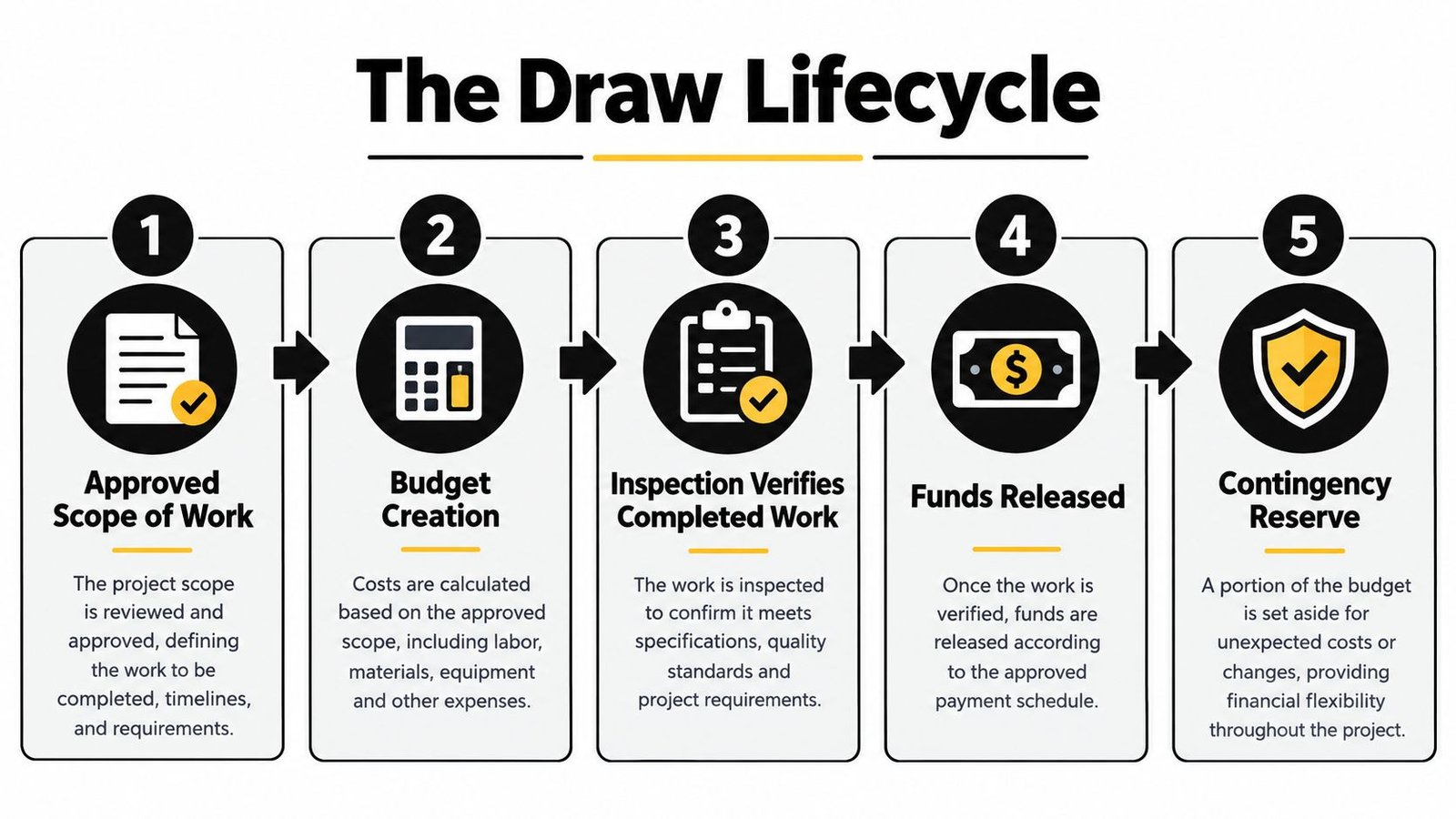
From invoice to authorized payment
The approved scope becomes the reference point for evaluating completed work. In HUD's 203(k) procedure, the draw request identifies prior payments and completion percentages by work item; an inspector reviews the request, the lender may reduce the approved amount, and the program permits a financed contingency reserve of up to 20% of eligible repair and improvement costs, with unused reserves applied to mortgage principal (HUD's draw and contingency provisions). That residential allowance is a program ceiling, not a recommended reserve percentage for your commercial project. Set your own reserve based on the age of the building and the number of unknowns behind finished walls.
Before accepting contractor billing terms, reconcile the estimate with the lender's categories. For a residential estimating example that can help frame questions about scope detail, consult Epic Remodeling's contractor estimate process for baths. Your commercial bid still needs project-specific specifications and exclusions.
Build a draw-ready package
- Budget reconciliation: Show requested payment against the approved amount and prior disbursements.
- Supporting invoices: Identify the work, supplier, amount due, and relevant budget category.
- Lien documentation: Collect the waivers or releases your lender requires.
- Change authorization: Attach approved revisions rather than expecting an inspector to authorize added work.
- Inspection coordination: Confirm site access and who receives the report.
- Cash forecast: Track payments due before expected disbursement and any retainage withheld until completion.
Treat the construction loan draw schedule as part of your operating calendar. File it away after closing and you'll discover the gap between finished work and funded work at the worst possible time.
For timing perspective, PNC's construction guide describes inspections within 48 hours of notice and a related draw within 24 hours after receipt of the inspection report and required documentation (PNC's construction financing guide). Those are that guide's stated procedures, not a universal service guarantee.
Use the video below as a discussion aid when reviewing the process with your contractor and lender.
Ask when the processing clock starts. An incomplete package, unavailable inspector, or unresolved invoice can leave a payment pending even after the contractor considers the work finished, and your payroll doesn't wait for the lender's queue.
Retail and Restaurant Build-Outs in Practice
The following are hypothetical planning scenarios, not borrower case studies. Their purpose is to test whether an opening plan remains workable when construction and operating schedules overlap.
A retailer renovating while trading
A retailer plans new flooring, lighting, and a back-of-house reconfiguration. The owner wants to preserve customer access while contractors move through different areas of the premises.
Flooring installation makes the scheduling problem tangible: the work area can't simultaneously serve as construction space, inventory storage, and a normal customer route.

I'd ask the owner to separate construction completion from commercial readiness. Finished flooring doesn't mean shelves are stocked, fixtures are usable, or employees can serve customers normally.
Before approving the sequence, resolve:
- Work zones: Which areas remain accessible to customers and staff?
- Delivery windows: Where will materials and merchandise go without blocking work?
- Payment responsibility: Who confirms that each requested payment matches the agreed phase?
- Revenue assumptions: What happens to the operating forecast if a department stays closed longer than planned?
A restaurant expanding into another location
A restaurant operator has a different coordination problem. Kitchen equipment, hood work, and applicable health and fire approvals must fit together before the owner commits to opening.
In this hypothetical project, I wouldn't tie staff onboarding and perishable inventory purchases solely to the contractor's forecast finish date. I'd make those commitments conditional on a documented readiness review.
The owner should also separate equipment acquisition, premises improvements, and opening liquidity when reviewing restaurant financing options. Don't assume approval for the build-out covers every expense needed to serve the first customer.
For a phased opening, define what each phase permits. Limited service still needs a feasible staffing plan, an approved operating area, and sufficient cash for the service being offered.
An opening date should follow verified readiness, not become a promise that forces you to spend before the premises are usable.
In either scenario, maintain a shared calendar for the contractor, lender contact, and relevant approval authorities. Assign a named employee to update the business's opening commitments when that calendar changes.
The Hidden Risk Most Owners Underestimate
Fast approval isn't the same as a workable renovation. I'd give more weight to clear change-order rules than to an impressive funding-speed claim.
Distinguish hard costs, such as labor and materials, from soft costs, such as design, permits, and environmental work. Then identify operating losses separately. A reserve intended for eligible construction changes shouldn't be assumed available for missed sales or continuing payroll.
This comparison is a useful prompt, but don't treat approval speed or reserve size as sufficient on its own.
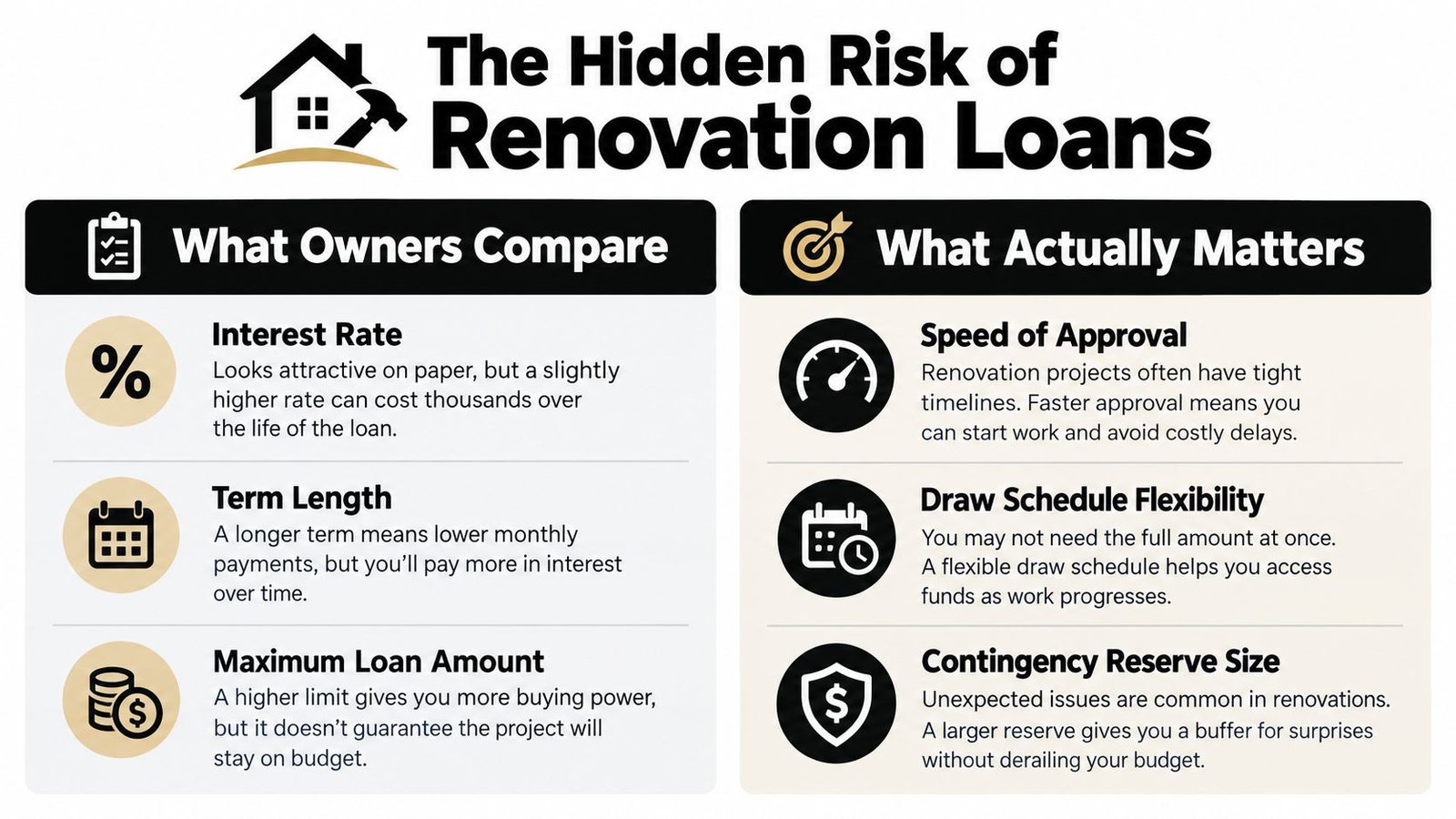
Establish who pays for the surprise
A renovation-loan disclosure describes contingency access as requiring an approved change order and draw request, while leaving the borrower responsible for costs beyond the reserve (TEG Federal Credit Union's renovation-loan disclosure).
For your financing, get the overrun procedure in writing:
- Category overruns: Can approved savings elsewhere cover the increase?
- Scope changes: Who must approve the revision before work starts?
- Valuation changes: Could the lender require another review or additional borrower cash?
- Unfunded expenses: Which costs remain entirely your responsibility?
Use Home Pro's Remodeling & Repairs' material on how to prevent scope creep in construction as a starting point for a written owner-contractor change protocol.
My recommendation is straightforward: don't authorize changed work until you understand both its construction cost and its funding source. A verbal agreement with the contractor doesn't establish the lender's consent.
Choosing a Lender and Preparing to Apply
Choose a lender by testing its process against your project, not by accepting a generic claim of construction expertise.
Lender-selection checklist
- Comparable projects: Ask about experience with your property use and renovation type.
- Administration: Identify who orders inspections, reviews packages, and resolves discrepancies.
- Timing: Request the expected turnaround after a complete submission.
- Changes: Confirm contingency approvals, budget transfers, and escalation procedures.
- Coordination: Ask whether the lender will review payment expectations with your contractor before closing.
Application-readiness checklist
- Defined project: Prepare the intended use, scope, itemized budget, and schedule.
- Verified contractor: Check applicable licensing, insurance, references, and contract terms.
- Approval map: Identify permits, landlord permissions, and required completion documentation.
- Document ownership: Assign responsibility for invoices, waivers, and change records.
- Liquidity plan: Identify available cash for reimbursement gaps and operating disruption.
Then stress-test the proposal with a delayed inspection, a disputed invoice, and an unexpected scope change. Ask the lender to explain what you would submit, who would decide, and what you would pay yourself.
Start by preparing a concise project summary and a separate cash-flow forecast. Bring both to a lending conversation before committing to contractor payment terms.
Business Loan Warrior offers construction financing, business loans, and lines of credit as options for owners evaluating renovation and operating-capital needs. Visit Business Loan Warrior with your project summary, budget, and cash-flow forecast to discuss funding that fits both the build-out and the business you need to keep running.