
You can have a full dining room, decent weekly sales, and still get that sinking feeling when the lender says no. The problem usually isn't that your restaurant is broken. It's that restaurant financing gets judged through a much tighter lens than most owners expect, and the numbers have to tell a clean story.
That's why restaurant business loans are rarely won on concept alone. Lenders look at cash flow, seasonality, collateral, and whether your operation can carry more debt without choking itself. If you're trying to open, remodel, buy equipment, or bridge a slow season, the right answer is usually not “get any loan you can.” It's “pick the right debt for the job, then package it the way underwriters want to see it.”
Table of Contents
- Why Restaurant Owners Struggle to Get Funded
- Restaurant Business Loan Types and When to Use Each
- Eligibility Requirements and Underwriting Criteria
- Application Preparation Checklist for Restaurant Owners
- Restaurant Loan Rates and Terms You Should Expect
- How to Choose the Right Restaurant Business Loan
- Alternatives and Contingency Plans for Restaurant Funding
Why Restaurant Owners Struggle to Get Funded
A restaurant owner walks into the bank with a packed Friday night, a good lease, and a plan to replace aging kitchen gear. The banker still leans on the numbers, not the vibe. That's where a lot of owners get blindsided.
Restaurant lending is a big market, with industry reporting estimating that restaurants receive more than $20 billion in small-business loans annually, but the approval path is still rough. Traditional bank approval rates for restaurant borrowers typically land between 18% and 25%, which sits 15 to 25 percentage points below the broader small-business average, according to the same data set from Crestmont Capital. The sector's thin economics are a big reason why. Average restaurant net margins are cited at just 3% to 9%, so lenders see very little room for error. restaurant loan statistics

What lenders are actually reading
Underwriters aren't asking whether your food is good. They're asking whether your cash flow can support another fixed monthly payment without breaking. That's why restaurant files often get treated as high risk even when sales look healthy on the surface.
Government-backed lending has become a major outlet for that reason. More than 8,000 SBA 7(a) loans are reported to go to restaurants each year, which tells you conventional bank money is only part of the picture. If you want a broader view of how restaurant funding has shifted over time, the industry history around SBA lending is worth studying in context. restaurant lending history
Practical rule: if your application reads like a growth plan, not a cash-flow survival plan, lenders tend to take it more seriously.
The owners who get funded usually do one thing better than everyone else. They make the business look predictable. That means clean books, a realistic borrowing request, and a clear explanation of how the money gets repaid. Rejection is often less about business quality and more about presentation, timing, and borrowing power.
Restaurant Business Loan Types and When to Use Each
The wrong loan can cost you more than money. It can leave you short on cash, locked into payments that don't fit your seasonality, or stuck with a product built for a different kind of business. Restaurant owners need to match the loan to the actual use case, not the label.
The main options that deserve attention
SBA 7(a) loans are the anchor product for established restaurants, acquisitions, and bigger expansion plans. They're designed for longer repayment structures and are often the first place owners look when they need substantial capital for growth. If you're buying out a partner, opening a second location, or funding a major buildout, this is usually the product that deserves serious consideration.
Term loans make more sense for defined projects, like a kitchen remodel or a piece of equipment that will pay for itself over time. You borrow a set amount, pay it back on a fixed schedule, and keep the use case clean. That predictability matters when you're trying to protect day-to-day cash flow.
Business lines of credit fit seasonal restaurants, catering-heavy operators, and any owner who needs breathing room between busy and slow periods. You draw what you need, repay, and draw again. That flexibility is useful when the problem isn't a single project, but uneven cash flow.
Equipment financing belongs in a separate bucket. When the asset itself is the point, this product often beats a general-purpose loan because the structure is tied to the gear you're buying. A broken walk-in, a worn-out oven, or a register upgrade should not be funded the same way as a full expansion.
Fast money deserves more caution
Merchant cash advances can look tempting when you need funds quickly, but they're usually the wrong first move unless you've exhausted better options and the need is urgent. Restaurant owners get into trouble when they use expensive fast money to patch a structural problem. That's not financing, that's delay.
For a straightforward comparison of how owners think through these choices, this restaurant financing options smart ways to fund growth guide is a useful companion.
| Loan Type | Best For | Typical Range | Repayment |
|---|---|---|---|
| SBA Loan | Expansion, acquisition, larger projects | Government-backed restaurant financing | Longer-term, structured payments |
| Term Loan | Equipment, renovation, one-time projects | Fixed lump sum | Fixed installments |
| Business Line of Credit | Seasonal gaps, working capital | Revolving access | Pay what you draw |
| Equipment Financing | Kitchen upgrades, replacement gear | Asset-specific funding | Tied to the equipment purchase |
Eligibility Requirements and Underwriting Criteria
Restaurant owners often assume the lender is mainly checking credit score and time in business. Those matter, but the decision comes down to whether the debt fits the cash flow. That is why a lot of otherwise solid operators still get turned down.
Debt service coverage is the deal breaker
The most technical metric in restaurant underwriting is debt-service coverage. Lenders commonly want adjusted EBITDA to cover annual debt service at 1.25x or better, which means the business needs at least $1.25 of cash flow for every $1.00 of principal and interest due. If your numbers do not clear that bar, the rest of the file turns into a negotiation instead of a yes. restaurant underwriting guide
That requirement compresses borrowing power fast. One industry guide notes many restaurant approvals land around 2.5x to 4.0x annual EBITDA restaurant underwriting guide, even when SBA 7(a) and 504 program limits are higher, because cash flow and collateral drive approval size more than headline caps. Seasonal revenue makes this harder. A strong summer does not erase a weak winter if the lender does not see consistent coverage through the slow months.
Lenders do not finance hope. They finance repayment capacity.
What lenders are reading
Credit history still matters, but it is only one piece. Collateral matters too, especially if the loan size is meaningful relative to the business's existing assets. Time in business also shapes how much confidence the underwriter has in your projections.
Restaurants with volatile revenue patterns need to be especially careful. A busy weekend schedule does not automatically translate into acceptable debt coverage if off-season months are tight. Clean applications explain volatility upfront instead of pretending it does not exist.
If you want to see how lenders think about the business plan side of that review, the beyond the bank what modern restaurant lenders want in your business plan article lines up with the way underwriters work. For operators in packaged or multi-unit formats, the restaurant industry packaging guide also helps frame the operational side of the file.
The bottom line is simple. You do not beat underwriting by being optimistic. You do it by showing disciplined cash flow, responsible use of capital, and a repayment story the lender can believe.
Application Preparation Checklist for Restaurant Owners
Loan applications don't fail because owners are careless. They fail because documents show up late, numbers don't match, or the story behind the business never gets organized. If you want a faster review, preparation has to happen before the lender asks for it.
Start with the file, not the pitch
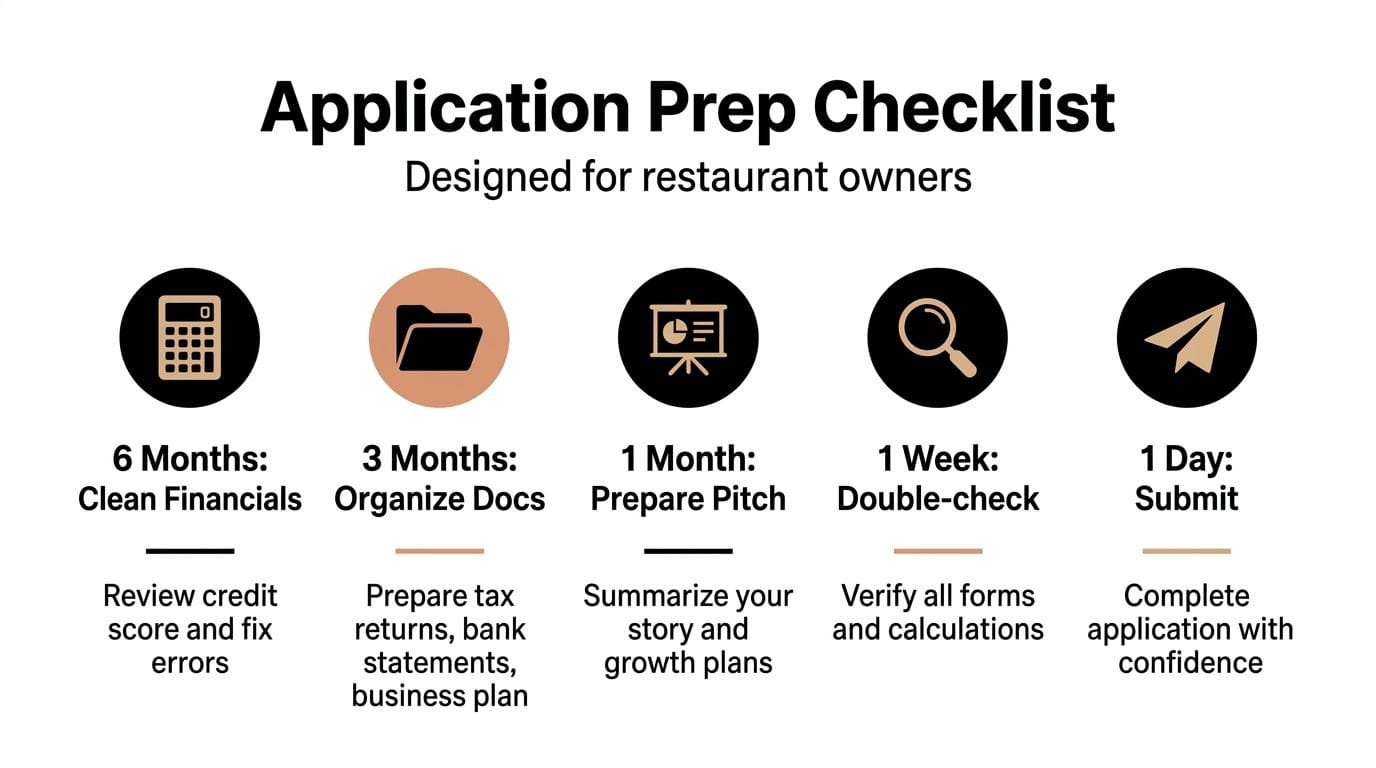
Sixty days before applying, get your financials clean. That means reconciling statements, reviewing credit reports, and checking for errors that could muddy the underwriting process. If your books are messy, fix that first. Lenders see disorganization as risk.
At the 30-day mark, gather the supporting docs in one place. Tax returns, bank statements, lease documents, equipment quotes, and any ownership paperwork should be ready before the lender asks. For seasonal operators, this is also the time to explain the swings instead of letting the numbers speak for themselves.
Build the lender view of your business
The final two weeks are for tightening the presentation. Your business plan should explain how the loan supports operating reality, not just expansion dreams. If you're using the funds to stabilize cash flow, say that clearly. If the money is for growth, show the path from project to repayment.
For owners who want a quick way to sanity-check whether a new payment fits the business, a break-even tool can help frame the decision. The ViralRef calculator for studio owners is built for a different niche, but the logic is the same, you want to know how much revenue covers fixed costs before you take on more debt.
- 60 days out: clean up books, pull credit reports, and correct obvious errors.
- 30 days out: organize tax returns, bank statements, business plans, and collateral records.
- Final two weeks: verify all figures, prepare your loan narrative, and make sure every form matches the financials.
- Final submission: send a complete packet and respond fast to follow-up questions.
The what documents do you need checklist is useful if you want a clean document list in one place.
Best practice: if a lender has to hunt for a document, your file has already gotten harder to approve.
Restaurant Loan Rates and Terms You Should Expect
Loan offers can look similar and still be radically different in cost. Restaurant owners get burned when they focus on the payment amount and ignore the structure underneath it. The core question is whether the debt is cheap enough to create value after repayment.
Read the offer as a cash-flow tool
I'm not going to pretend there's one “normal” rate for every restaurant loan. The better way to think about it is by product and purpose. SBA-backed loans generally fit longer-horizon uses, while equipment and term financing are more project-specific, and lines of credit are built for repeated use rather than a one-time spend.
Here's the practical test. If the loan funds a purchase that should generate returns over time, longer repayment can make sense. If the loan is covering a short-lived gap, stretching the debt too long just adds cost.
Use the purpose to judge the terms
A $100,000 SBA 7(a) loan should be evaluated differently from a $50,000 equipment loan or a $75,000 line of credit. The first is usually about strategic growth. The second is about a discrete asset. The third is about flexibility and cash-flow timing. If a lender tries to sell you one product for the wrong job, push back.
The right benchmark is whether the payment fits the business after normal operating expenses, not whether the lender says the offer is approved. Owners get in trouble when they borrow for survival with a product priced for expansion.
| Scenario | What It's Doing | What to Watch |
|---|---|---|
| SBA 7(a) for expansion | Funding a larger growth project | Keep the repayment horizon aligned with the payoff |
| Equipment loan for kitchen gear | Paying for a specific asset | Make sure the gear really improves operations |
| Line of credit for seasonality | Covering short-term cash gaps | Avoid relying on it as permanent capital |
A competitive offer should feel usable, not desperate. If the structure makes your monthly budget tighter instead of easier, the loan is probably wrong for the job.
How to Choose the Right Restaurant Business Loan
The right loan depends on the problem you're solving. That sounds obvious, but a lot of restaurant owners blur growth and survival together and end up with the wrong capital. Expansion money and emergency money are not the same thing.
Match the debt to the outcome
If you're opening a second unit, use financing that gives the project time to mature. If you're replacing equipment, choose a product tied to the asset. If you're trying to survive a slow stretch, a revolving solution may fit better than a fixed installment loan.
Use these questions as a filter:
- Will this debt create new revenue, or just buy time?
- Can the business handle fixed payments during the slow months?
- How much collateral are you comfortable risking?
- Do you want to keep the option to borrow again later?
A renovation, for example, deserves a different answer than a payroll gap. Renovation should improve the asset base. A payroll gap is usually a sign to look for working capital flexibility or cut the burn rate, not to stack another long-term payment on top of a problem.
Make the decision like an operator, not a borrower
The best financing choice is the one that fits your plan and your tolerance for pressure. If you're debt-averse, don't take a large term commitment just because it's available. If your revenue is volatile, avoid rigid payments that assume every month looks like your best month.
Choose the loan that solves the problem without creating a second problem.
Business Loan Warrior is one option that lets owners compare a mix of restaurant business loans, SBA loan processing, lines of credit, equipment financing, construction loans, invoice financing, and acquisition loans through a single application. That kind of menu matters when you're deciding whether a growth project or a cash-flow fix needs a different funding path.
The cleanest decision is the one you can defend six months later. If the loan isn't helping the business get stronger, it's probably the wrong move.
Alternatives and Contingency Plans for Restaurant Funding
Sometimes the right answer is not a standard loan at all. Restaurant owners who force the wrong product onto the business usually end up paying for it later through tighter cash flow or stress they didn't need. If the main application doesn't fit, pivot with a plan.
When the usual loan isn't the right tool
Invoice financing makes sense when the money is tied up in receivables, especially for catering or banquet work where payment arrives after the job is done. Equipment financing still stands on its own when the purchase is specific and operationally necessary. Merchant cash advances can solve an emergency, but they should stay in the “last resort” bucket because the cost structure can be punishing.
There's also a bigger question many guides skip. Should you borrow at all? If the debt is for growth and the project should produce returns, borrowing can be rational. If the debt is only plugging a hole in a weak operation, that's a warning sign. Sometimes owner capital, partner investment, or a revenue-sharing structure is the cleaner answer.
For operators still early in the journey, the coffee business startup guide offers a useful example of how launch-stage funding decisions differ from mature-restaurant financing.
If the application gets declined
Don't immediately reapply for the same product. First, ask why the file failed. Then fix the specific issue, whether that's cash flow, documentation, collateral, or debt load.
Your next three moves should be direct:
- Protect liquidity by slowing nonessential spending.
- Tighten the file by correcting the weakness the lender flagged.
- Revisit the funding mix with a different product or a smaller request.
That approach keeps you from burning time and credit on the wrong application. A decline is a signal, not the end of the road.
If you're comparing restaurant financing options and want a practical path instead of a sales pitch, Business Loan Warrior can help you review loan types, SBA processing, lines of credit, equipment financing, and invoice financing in one place. Visit Business Loan Warrior to compare funding paths for your restaurant and move forward with a clearer application strategy.