
A founder can make every “right” decision and still get trapped by the calendar. You land a $40,000 growth opportunity, hire ahead of demand, or buy inventory for a campaign, then a weak month arrives. A fixed loan payment that felt harmless in January can become the bill that forces you to delay payroll, pause marketing, or spend down the cash buffer you built carefully.
That tension explains the appeal of revenue based financing for startups. Instead of a fixed installment, the funder receives an agreed share of revenue until the company reaches a contractual repayment cap. The payment can move with sales, but that flexibility doesn't make the capital automatically cheap. The cap, revenue share, reporting rules, and default language determine whether RBF supports growth or drains it.
The practical question isn't whether RBF avoids dilution. It's whether the repayment structure fits your actual growth curve better than equity, venture debt, or a traditional loan.
Table of Contents
- When Fixed Payments Do Not Fit a Growing Startup
- What Revenue Based Financing Actually Is
- How Repayment and Term Structures Work
- RBF Compared to Equity and Traditional Debt
- Sample Math With Two Real Scenarios
- Who Qualifies and What the Contract Really Says
- When RBF Is the Right Call and When It Is Not
- Your Application Roadmap and Next Steps
When Fixed Payments Do Not Fit a Growing Startup
Maya runs a small bootstrapped SaaS company. A potential distribution partner offers a growth opportunity worth $40,000, but the timing is uncomfortable. A product launch created a burst of sign-ups, then churn rose sharply the following month. Her existing loan payment, $3,200, was easy to absorb in January. In March, with fewer renewals and higher support costs, that same payment competes directly with customer retention work.
A fixed installment doesn't care whether the month was strong or weak. Maya owes the same amount while she waits for annual renewals, rebuilds a post-launch usage pattern, or works through a seasonal dip. She can improve her position by following a disciplined cash flow improvement process, but the immediate financing problem remains: the business needs capital now, while its receipts won't arrive evenly.
Why timing creates pressure
Subscription businesses can experience lumpy renewals. Retailers often receive most of their sales during particular periods. Service companies may invoice after completing projects, leaving payroll and supplier bills due before customers pay. A fixed loan turns those timing differences into a recurring cash obligation.
RBF changes the shape of that obligation. If the agreement requires a share of gross revenue, the payment rises when receipts rise and falls when receipts fall. That can preserve more operating cash in a difficult month, although the balance still needs to be repaid later.
Practical rule: Flexible repayment protects cash flow timing, not business economics. If the underlying unit economics are weak, a variable payment only makes the strain less predictable.
Maya still has to answer the harder question. Will the $40,000 opportunity generate enough additional gross profit to cover the RBF cap and leave cash for the rest of the company? RBF can buy flexibility, but it can't turn uncertain demand into proven demand.
What Revenue Based Financing Actually Is
Revenue-based financing is a non-dilutive capital arrangement. A provider advances a lump sum, and the startup repays it by sending a fixed percentage of gross revenue until it reaches a pre-agreed total, known as the repayment cap.
Three features define the structure:
- No ownership exchange. The provider doesn't receive shares, voting rights, or a percentage of the eventual sale proceeds for advancing the capital.
- Variable remittance. The amount paid during a period depends on the revenue included in the contract's definition.
- A fixed maximum payout. The founder knows the total contractual repayment once the cap is expressed as a multiple of the advance.
That makes RBF different from a term loan. A term loan generally requires scheduled principal and interest payments whether sales are strong or weak. RBF instead links the payment to operating receipts, so the timeline can shorten during growth and lengthen during slower periods.
It also differs from equity. Equity doesn't require monthly repayment, but founders give up ownership and part of their future economic upside. RBF leaves the cap table unchanged while placing a claim on future cash flow.
The revenue data anchor
Providers still need evidence that revenue exists and can be monitored. They may review bank activity, payment processor records, accounting reports, customer concentration, and sales consistency. That revenue-centered underwriting helps explain why some providers can make decisions faster than traditional lenders, but speed shouldn't replace contract review.
The phrase “revenue” also needs careful attention. Gross receipts, collected cash, subscription revenue, refunds, taxes, chargebacks, and pass-through amounts may receive different treatment. If a dispute later arises about what counts as sales or turnover, a resource covering forensic accounting for revenue disputes can help clarify the financial evidence involved.
Merchant cash advances and royalty arrangements may look similar because they also connect repayment to receipts. Their legal terms, collection mechanics, and pricing can differ substantially, so founders shouldn't assume that every percentage-of-sales product is RBF.
How Repayment and Term Structures Work
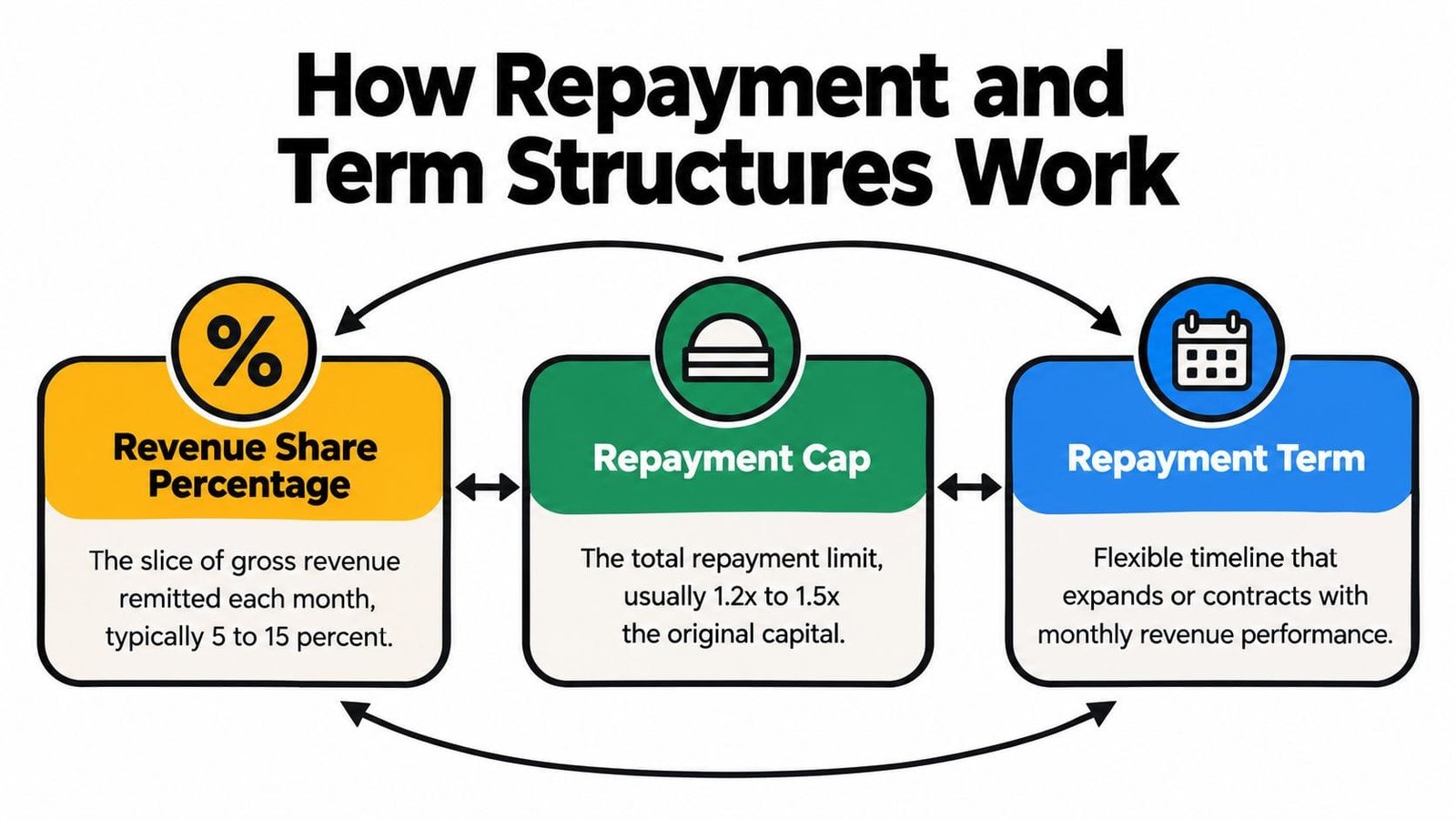
Founders should read an RBF offer through three structural levers, not one headline advance amount.
Revenue share percentage
The revenue share is the portion of eligible gross revenue sent to the provider. Plan notes often describe a range of 5% to 15%, but the exact rate depends on the offer and the risk assessment. A higher share pays down the balance faster, yet it also removes more cash from each strong month.
A lower share feels easier operationally, but it can stretch repayment. That matters because the provider may continue taking its share while the company carries the obligation through a longer growth cycle.
Repayment cap
The cap sets the total contractual payout. Academic work on small-enterprise RBF describes total payback commonly ranging from 1.5x to 2.5x the original advance, as documented in this academic analysis of revenue-based financing. Other market summaries describe caps around 1.1x to 1.5x, so founders should compare the actual contract rather than rely on a category average, as discussed in this non-dilutive funding market summary.
A $100,000 advance with a 1.4x cap requires $140,000 in total repayment before fees or separate charges. The cap doesn't tell you how painful the payments will be during a weak month. It only defines the destination.
Holding period and collection method
The holding period is the time required to reach the cap. Strong growth accelerates repayment. Weak growth extends it. Some providers collect weekly through ACH and reconcile against monthly revenue reports, while others connect directly to systems such as Stripe, Shopify, or QuickBooks.
Look for payment floors, ceilings, true-up provisions, and audit rights. A “variable” payment may still have a minimum floor, and a weekly pull can create a different cash experience from a monthly percentage even when the annual math appears similar.
For comparison, a $100,000 advance at a 1.3x cap costs $130,000 before additional fees. At a 1.5x cap, it costs $150,000. The revenue share determines how quickly you reach that total, while the cap determines how much capital leaves the business overall.
The structure also has an empirical complication. Transaction-level evidence from a South African payment platform found that firms accepting RBF processed 16% less revenue through that platform after eight months than comparable non-takers, consistent with revenue diversion that can slow repayment and make monitoring harder. The finding doesn't prove that every RBF deal causes diversion, but it shows why founders and providers need a clear definition of reportable revenue.
RBF Compared to Equity and Traditional Debt
A founder choosing capital is usually choosing which constraint to accept. RBF preserves ownership but claims operating cash. Equity preserves operating cash but shares future value. A term loan offers a known schedule, yet that schedule can become difficult when revenue drops.
| Dimension | Revenue Based Financing | Equity Round | Term Loan |
|---|---|---|---|
| Ownership | No ownership dilution | Founders exchange part of the company for capital | No ownership dilution |
| Payment pattern | Share of eligible revenue until the cap | No required repayment schedule | Fixed principal and interest payments |
| Slow-month burden | Payment may decrease, subject to floors and contract rules | No debt payment | Scheduled payment remains due |
| Total cost | Defined by the cap, fees, and repayment timing | Depends on the value of ownership given away and future company value | Interest, fees, collateral costs, and possible guarantees |
| Upside impact | Provider receives no equity, but takes a share of future receipts | Investors participate in future value and exit proceeds | Lender generally doesn't share in upside |
| Main risk | Cash drain during growth or a long repayment period | Dilution, governance, and reduced founder proceeds | Default risk when cash flow falls |
The cost question
Suppose a startup needs $250,000. An RBF provider might define a fixed cap, but the founder must calculate the cash share required to reach it and any added fees. A term lender may quote interest and an installment, but the founder should add origination charges, collateral requirements, and personal guarantees. An equity investor may require no scheduled payments, but the economic cost can be substantial if the company becomes highly valuable.
That comparison can't be reduced to one universal winner. If the business has predictable, high-margin revenue, an RBF cap may be easier to model than giving away ownership. If revenue is uncertain, equity may be more forgiving because it doesn't pull cash from operations. Venture debt can suit a venture-backed company with a clear financing plan, but it brings its own covenants and repayment obligations.
Founder lens: Compare the financing cost with the constraint that could actually kill the plan. Losing ownership hurts future upside. Losing cash can stop the company before that upside exists.
Also distinguish RBF from a merchant cash advance before comparing contracts. This merchant cash advance explanation is useful because similar collection language can conceal materially different obligations.
Sample Math With Two Real Scenarios
The math becomes useful only when it reflects the business's revenue pattern. The examples below use the stated advance, share, and cap, but they don't assign unsupported monthly sales or an effective APR. A real APR calculation requires the actual payment schedule, fees, and timing of each cash flow.
| Metric | Scenario A: Steady SaaS | Scenario B: Seasonal Retailer |
|---|---|---|
| Advance | $150,000 | $100,000 |
| Revenue share | 10% | Contract-specific |
| Repayment cap | 1.4x, or $210,000 | Contract-specific |
| Repayment behavior | Strong months accelerate payments | Weak months extend the timeline |
| Total contractual repayment | $210,000 before separate fees | The agreed cap before separate fees |
| Effective cost | $60,000 before separate fees, timing-dependent | Must be calculated from actual cash flows |
Scenario A, steady SaaS growth
A SaaS company takes $150,000 with a 10% revenue share and a 1.4x cap, creating a total contractual repayment of $210,000 before any separate fees. If revenue grows steadily, the company sends larger payments as receipts expand and reaches the cap sooner than it would under a flat or declining sales curve.
The company hasn't made the capital free. It has exchanged $60,000 of contractual cost for access to cash without selling equity, and the timing of those payments affects its true cost of capital. If fees apply, they must be added to the $60,000. An APR-style comparison should use the actual dates of the advance and each repayment, not just divide cost by principal.
Scenario B, seasonal retail
A retailer takes $100,000 expecting a strong selling season, but winter demand arrives softer than planned. Its payment percentage produces smaller remittances during the weak period, so the holding period stretches. The cap still limits the contractual principal repayment, but the business carries the cash-flow claim for longer and may pay extra fees or encounter default consequences if the contract includes floors or reporting triggers.
The right conclusion isn't that the retailer pays “more than the cap” under a clean cap structure. It should not pay more than the contractual cap for the capped repayment itself. It can, however, face a higher effective cost because the money remains outstanding longer, and separate fees or enforcement costs may apply.
Calculation discipline: A slow repayment can make capital expensive without changing the cap. Model duration, fees, and cash availability separately.
Who Qualifies and What the Contract Really Says
RBF providers generally want evidence of operating revenue rather than an attractive pitch deck alone. Industry guidance cited for the category points to at least 6 months of steady revenue, minimum monthly revenue of about $10,000 to $15,000, and approval rates around 30% to 40% for startups under 12 months in one reported data set. These figures are screening context, not a promise of approval, and the industry statistics on RBF growth and approval trends should be read alongside each provider's current criteria.
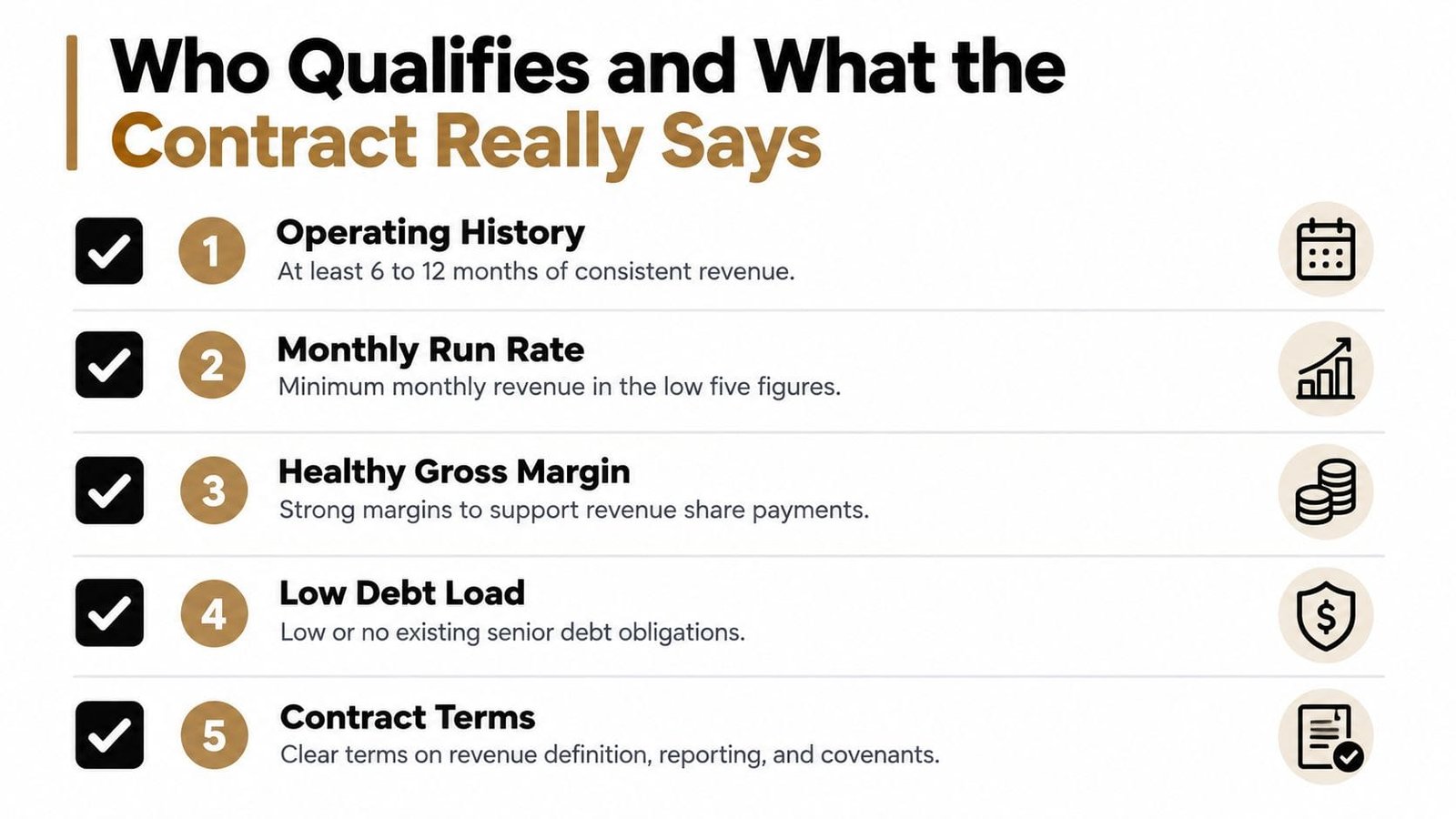
Prepare the operating evidence before applying:
- Revenue history: Bank statements and payment processor reports show whether sales are consistent and collectible.
- Accounting records: A current profit and loss statement helps the provider assess margins and operating pressure.
- Debt schedule: Existing loans, liens, and repayment obligations can affect available cash and priority.
- Business documents: The entity should be active and in good standing, with ownership information ready for review.
- Revenue explanation: A concise account of customers, sales channels, seasonality, and the use of funds helps explain unusual movements.
Clauses that change the deal
Read the definition of gross revenue first. Does it include refunds, taxes, chargebacks, affiliate payouts, marketplace proceeds, or only collected receipts? Then identify the reporting frequency, audit rights, and the consequences of incomplete data.
Default provisions deserve equal attention. Check whether a revenue dip triggers a cure period, a higher payment, an accelerated balance, or a right to enforce security. Review personal guarantee language, liquidation priority, restrictions on additional borrowing, and any minimum revenue covenant.
A founder can accept a reasonable cap and still sign an uncomfortable contract if the provider can demand repayment immediately after a reporting failure. Ask counsel or an experienced finance professional to review ambiguous language before funds arrive.
When RBF Is the Right Call and When It Is Not
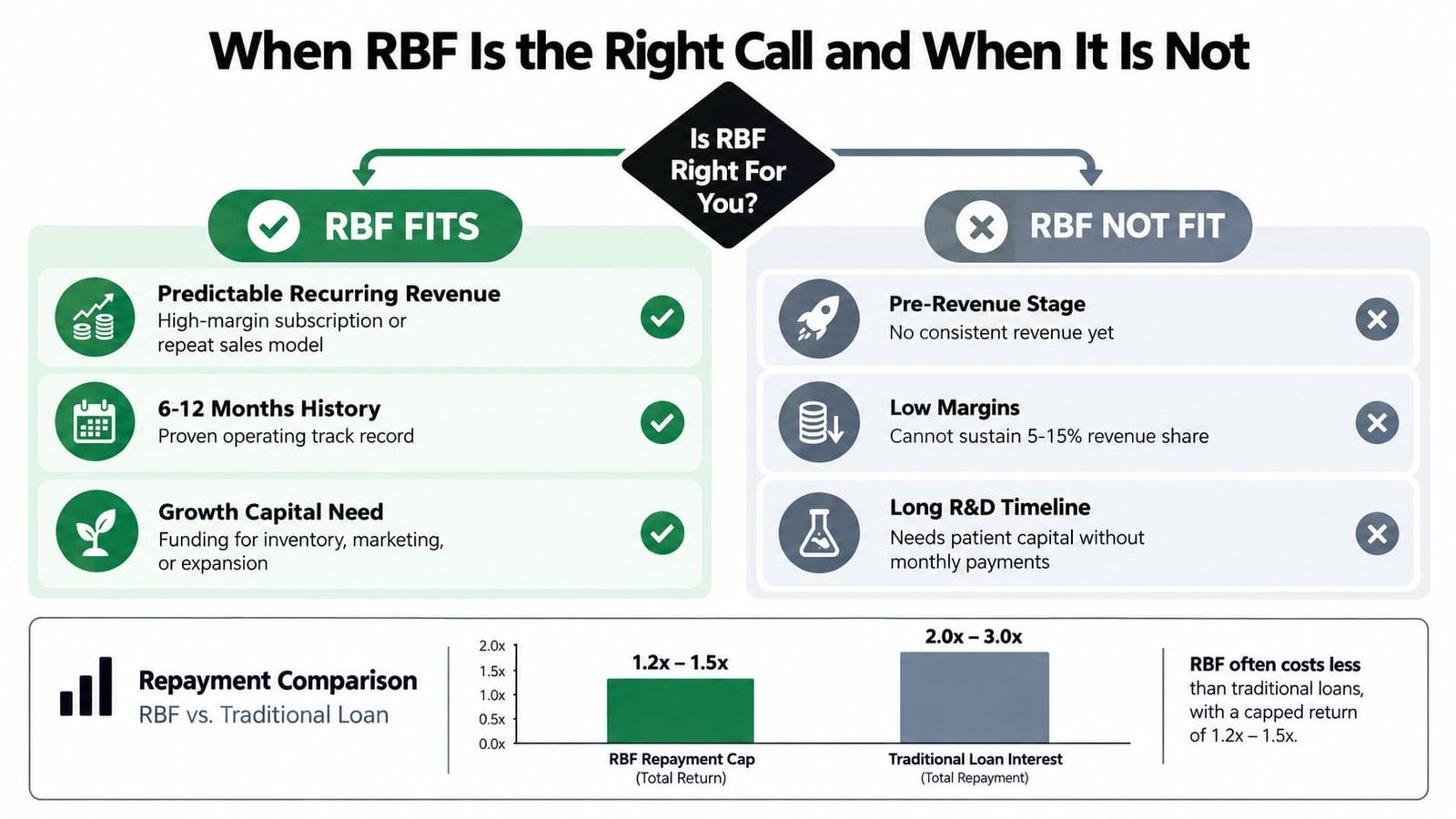
RBF fits a specific operating profile. The company already generates revenue, the revenue pattern is reasonably predictable, margins leave room for the remittance, and the capital will accelerate a channel that the team understands. It works better as growth capital than as emergency money for a business that hasn't proven demand.
A practical decision tree looks like this:
- Choose carefully when revenue is recurring and visible. SaaS, repeat-purchase commerce, and other businesses with dependable receipts can forecast the effect of a revenue share more clearly.
- Pause when sales are lumpy or seasonal. A variable payment may fall in a weak month, but the obligation remains and the repayment period can become difficult to plan.
- Avoid using it to fund open-ended research. Product development without a clear revenue path may need patient capital rather than a claim on current sales.
- Watch for stacking. Multiple RBF agreements can each look manageable while their combined revenue claims leave too little cash for payroll, fulfillment, or retention.
- Protect future financing options. A lien, covenant, or heavy cash obligation can complicate a later equity or debt raise.
Use three questions before signing:
- Is revenue already proven and reasonably forecastable?
- Is gross margin above 50%?
- Would a 25% revenue dip leave the business solvent?
Those thresholds are a founder's stress test, not universal underwriting rules. If the answer to the last question is no, preserve a cash buffer and consider capital that doesn't draw directly from receipts. If the answer to the first question is no, RBF is likely premature. Treat any advance as runway extension, not profit.
Your Application Roadmap and Next Steps
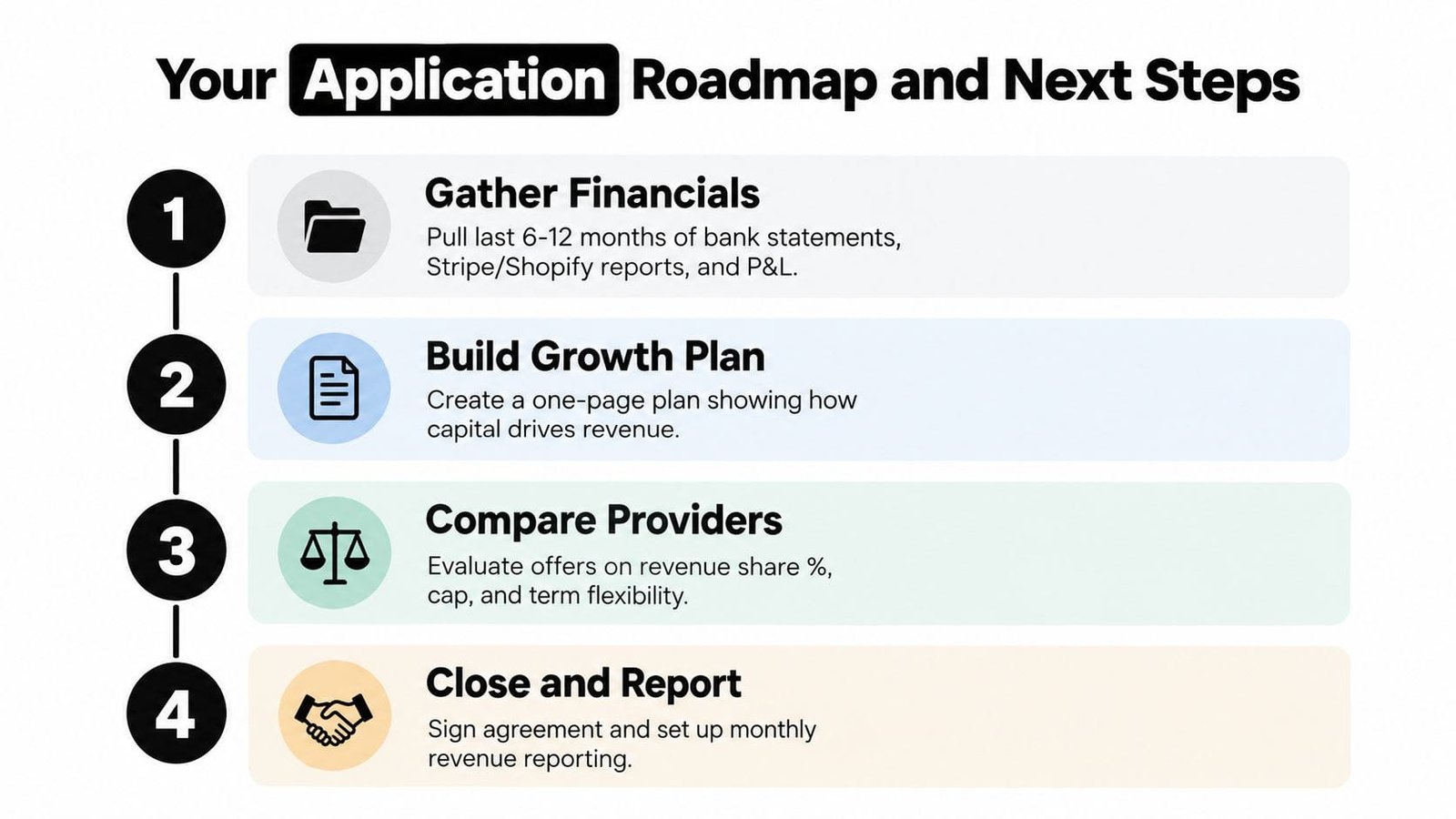
A clean application starts with clean evidence. Pull the last 6 to 12 months of bank statements, Stripe or Shopify reports, QuickBooks records, the current profit and loss statement, and a debt schedule. Add a one-page growth narrative that explains exactly where the money goes, what revenue signal should follow, and what could go wrong.
Build the repayment test
Calculate your trailing three-month average revenue, then model a weaker month rather than relying on the latest peak. Estimate the proposed remittance against cash needed for payroll, inventory, taxes, customer support, and existing debt.
The application should also include a forward-looking cash flow forecast for your loan strategy. A useful model shows the cash balance before funding, after the advance, after each revenue remittance, and after the growth expense. If the business can't remain solvent under a downside case, the advance is too large or the structure is wrong.
Compare offers line by line
Request term sheets from several providers and place these fields in one sheet:
- Advance amount: How much capital arrives, and is it drawn all at once?
- Revenue share: What percentage applies, and what revenue counts?
- Repayment cap: What total amount must be paid before the obligation ends?
- Fees: Which charges sit outside the cap?
- Collection cadence: Are payments weekly, monthly, or reconciled later?
- Default remedies: What happens after a missed payment, reporting issue, or revenue decline?
- Guarantees and liens: Does the founder provide a personal guarantee, and does the provider receive a senior claim?
- Additional borrowing: Can the company raise equity, debt, or another facility without consent?
Finally, check compatibility with existing equity documents, SAFE agreements, convertible debt, and lender covenants. Don't sign because an offer arrived quickly. Put the cap and take rate through your best case, base case, and downside case, then compare the resulting cash burden with equity and venture debt alternatives.
Business Loan Warrior offers a no-fee application, pre-approval checks that don't affect credit, funding comparisons, and a provider directory that can help owners evaluate alternatives across business loans, lines of credit, and other working-capital products.
Visit Business Loan Warrior to compare funding paths and review business financing options before committing to an RBF offer. Bring your revenue history, forecast, proposed cap, and take rate so you can benchmark the full cash cost, not just the amount deposited.