
You've got a project in mind, a lender has asked for financials, and the first question is whether the business qualifies for an SBA loan. But eligibility is only the first hurdle. The underwriter needs to see that your cash flow can cover the debt you already carry and the proposed payment, and that the documents support the story your numbers tell.
For practical SBA loan approval, prepare around that repayment test. A clean file can prevent avoidable delays, but paperwork can't repair a business that doesn't generate enough recurring cash to repay the loan.
Table of Contents
- SBA Loan Approval Criteria Lenders Check First
- Documents Lenders Require and What Each One Proves
- How the Underwriting Process Unfolds Step by Step
- Approval Timelines by SBA Loan Type
- Common Denial Reasons and What Each Signals
- When Approval Comes In Below Your Request
- Improve Your File and Check It Before You Submit
SBA Loan Approval Criteria Lenders Check First
Lenders approve an SBA loan based on the business's ability to repay, not eligibility alone. An applicant must be a for-profit operating business in the United States, meet SBA size standards, be creditworthy, demonstrate reasonable repayment ability, and show that comparable credit isn't available on reasonable non-government terms. Those are the SBA's eligibility requirements, but the lender still has to decide whether the deal works financially. The SBA's 7(a) program requirements describe this distinction and the factors lenders review.
Start with debt service coverage ratio (DSCR), a measure of cash flow available for debt payments divided by total annual debt service. Say the business has $150,000 available for debt service, pays $60,000 a year on existing loans, and would pay $70,000 a year on the proposed loan. Total annual debt payments would be $130,000, giving the business a DSCR of 1.15x ($150,000 ÷ $130,000). That's right at the guideline minimum used in this example, but individual lender targets can be higher.
| Criterion | What the lender checks | Typical benchmark |
|---|---|---|
| Eligibility | For-profit, U.S.-based business that meets the SBA size standard for its industry | Pass or fail |
| Debt service coverage (DSCR) | Annual cash flow divided by total annual debt payments, including the proposed loan | At least 1.15x in the example guideline |
| Owner and guarantor credit | Personal credit score, payment history, and existing obligations | Set by each lender, with no single SBA cutoff |
| Time in business | Operating history and revenue stability | Often 2 years or more |
| Equity injection | Owner cash put into the project | Commonly 10% to 20% of project cost, higher for riskier deals |
| Collateral | Business and personal assets pledged | Lender typically takes available business and personal assets |
| Personal guarantee | Owners holding 20% or more of the business | Typically required |
| Use of proceeds | Purpose must be SBA-eligible and supported by documents | Pass or fail |
These are typical underwriting benchmarks, not universal SBA approval guarantees. Lenders weigh the owners' and guarantors' credit history alongside business cash flow, equity, collateral, and repayment capacity. A strong eligibility case won't overcome weak repayment evidence. If you operate a shipping business, you can also check your FedEx business's SBA eligibility before building the full loan request.
To calculate your own DSCR, total the annual cash flow the lender can reasonably count, then divide it by annual payments on all existing debt plus the proposed loan. Use the actual payment estimate for the loan structure you're considering. If the result is thin, test how reducing the request, paying down debt, or adding equity changes the ratio before you apply.
Documents Lenders Require and What Each One Proves
An SBA loan file should tell one consistent story. The lender compares tax returns, current financial statements, bank activity, and debt schedules to see whether the figures line up and whether the requested loan has a clear purpose.
| Document | What it proves | Period usually requested |
|---|---|---|
| Business federal tax returns | Revenue, expenses, and taxable income | Last 3 years |
| Personal federal tax returns | Owner income and personal obligations | Last 3 years |
| Year-to-date profit and loss statement | Current trading compared with the prior year | Interim through the most recent month |
| Balance sheet | Assets, liabilities, and equity | Current and prior year-end |
| Business debt schedule | Every existing loan, lender, balance, and payment | Current |
| Bank statements | Cash movement and deposits matching reported income | 6 to 12 months |
| SBA Form 413 personal financial statement | Owner net worth and liquidity | Current, for each owner with 20% or more |
| SBA Form 1919 borrower information form | Ownership, affiliations, and business history | Current |
| Business plan and projections | Expected cash flow for startups, acquisitions, or expansions | 2 to 3 years projected |
| Lease, purchase agreement, or project quotes | Occupancy terms and project costs | Current |
Each document answers a different underwriting question. Tax returns establish a historical baseline. Interim statements show whether the business is tracking similarly now. Bank statements help verify that reported revenue reaches the business account, while the debt schedule shows the payments that reduce cash available for a new loan. Form 413 records an owner's financial position, and Form 1919 collects borrower and ownership information. For a practical walkthrough of the personal financial statement, use this guide to the SBA personal financial statement.
A frequent cause of delay is a mismatch between records. A profit-and-loss statement might show income that doesn't appear in the tax returns or bank deposits, or the business may have a loan payment on its bank statement that's missing from the debt schedule. The lender then has to ask for explanations or corrected documents before finishing the analysis.
File-prep rule: Build the package in the same order as the lender's checklist. Label each file with the business or owner name and the period it covers, such as “Business P&L, through June.”
Reconcile the numbers before submission, not after the lender flags them. If an item needs explanation, add a concise note with supporting detail instead of hoping the underwriter will infer what happened.
How the Underwriting Process Unfolds Step by Step
Approval turns on whether the business can cover its existing debt and the proposed payment from its cash flow. The lender originates and underwrites the loan, while the SBA guarantees part of eligible credit to reduce the lender's exposure. That guarantee supports the lender's decision; it does not replace the repayment analysis.
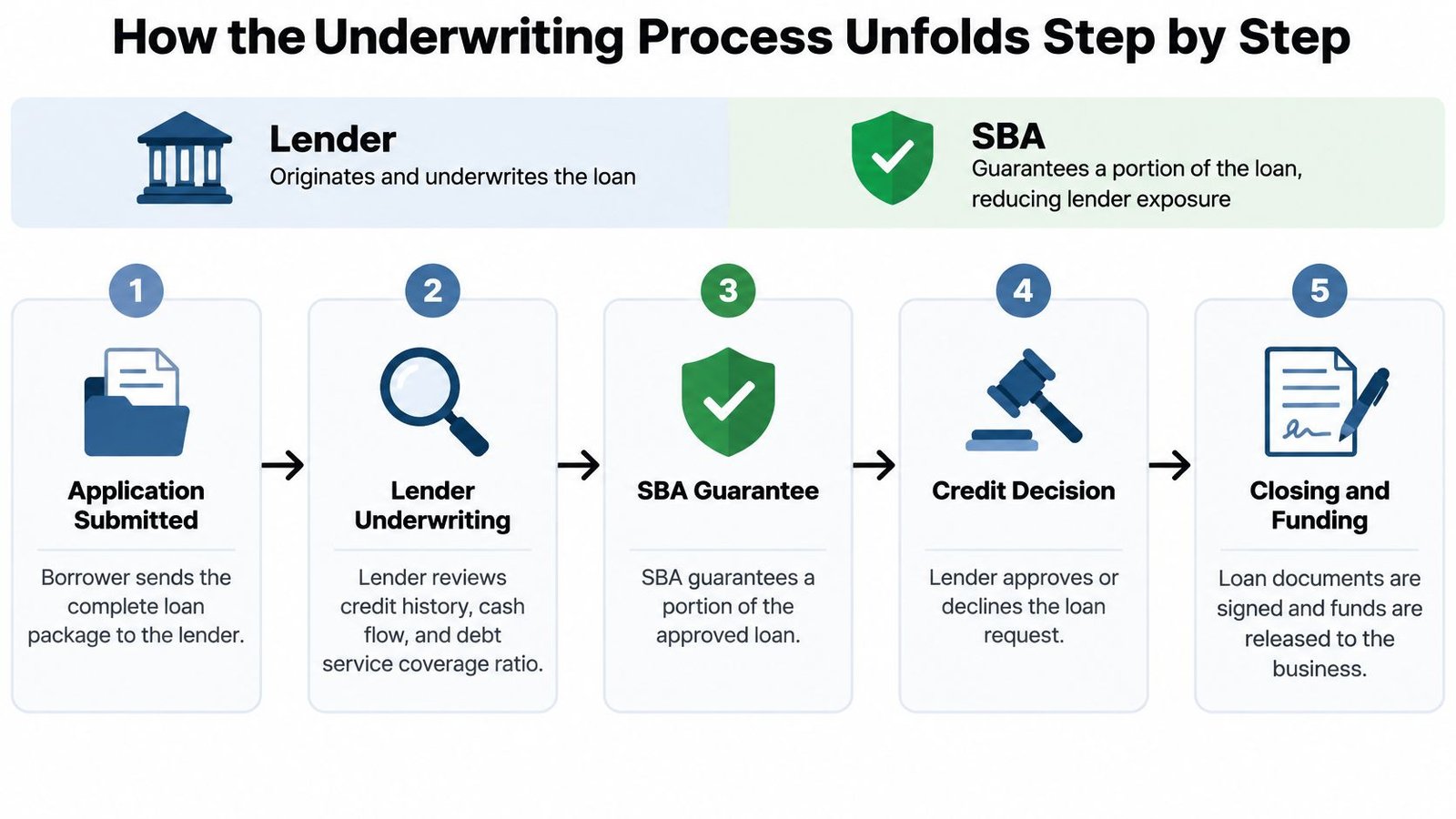
A standard 7(a) application generally passes through these stages:
Pre-screen. The lender checks business eligibility, size standards, use of proceeds, and credit profile before asking for the full underwriting package. This can surface basic fit issues early.
Intake. You provide the requested records. The lender organizes and “spreads” the financial statements, comparing figures across periods to establish a reliable basis for repayment analysis.
Cash flow analysis. The underwriter reviews historical and projected cash flow, adjusts for items such as owner compensation and distributions, then adds the proposed payment to existing debt service. The central test is whether the business has enough capacity for the requested amount.
Credit and collateral review. The lender checks personal and business credit, verifies the source of the owner's equity, and assesses available collateral. These findings can affect both the risk assessment and loan structure.
Credit memo and decision. The underwriter records the analysis and recommends approval, denial, or a lower amount. The lender's credit authority or committee decides based on the file.
SBA submission. For a standard 7(a) loan, the lender requests the SBA guaranty. The guaranty generally covers up to 85% of loans of $150,000 or less and 75% of larger loans, as described on the SBA 7(a) program page.
Conditions and closing. The lender clears remaining requirements, which may include insurance, appraisals, and title work. Funds can be released after the closing documents are signed and conditions are satisfied.
SBA Express follows a shorter path with more lender authority. The same cash-flow test still matters: a guaranty can reduce the lender's exposure, but it does not ensure approval of the amount requested.
Assign one person to collect lender questions and return complete answers. Scattered attachments or partial replies can prompt extra review cycles, especially when the underwriter must reconcile the same figures across several records.
Approval Timelines by SBA Loan Type
The timeline doesn't start when you first call a lender. It starts when the lender has a complete application package. A missing tax return, unexplained deposit, or unsigned form can hold the file while you gather what's needed.
| Loan route | Typical decision time | Loan ceiling | Main cause of delay |
|---|---|---|---|
| SBA Express | Lender decision often within a few business days; SBA responds on the guaranty within 36 hours | Up to $500,000 | Incomplete package or lender credit policy questions |
| Standard 7(a) | Commonly 30 to 90 days from a complete package | Up to $5 million | Missing tax years or SBA review questions |
| SBA 504 | Commonly 60 to 90 days, with a certified development company and bank steps | Project-based | Coordinating lender, development company, and appraisal |
| SBA Microloan | Often several weeks through a nonprofit intermediary | Up to $50,000 | Intermediary capacity and collateral requirements |
| Approval to funding, any route | Commonly 30 to 60 days after approval | Same as the approved loan | Closing conditions such as appraisals, title, and insurance |
The wait usually grows in three places: before a complete package reaches underwriting, while the underwriter requests missing or clarified information, and during closing conditions. For example, a borrower submits a package in early March, then the lender asks in week two for a missing prior-year tax return. The credit memo can't be completed until the return arrives and is reviewed, pushing the decision back.
These ranges are typical, not guaranteed. Lender workload, seasonal volume, complexity, and SBA review can all affect the schedule. A practical guide to SBA loan processing time can help you plan for the steps between applying and receiving funds.
The best way to keep a file moving is straightforward: submit the complete package on day one, answer follow-up questions promptly, and make sure your financial statements already reconcile. Speed comes from removing avoidable gaps, not from asking an underwriter to skip verification.
Common Denial Reasons and What Each Signals
A business can show a profit and still fail the repayment test. Underwriters look at whether cash flow can cover existing debt, owner withdrawals, tax obligations, and the proposed loan payment. Borrower financials are among the most commonly cited reasons for denial, alongside credit history and collateral. The Federal Reserve's 2026 report on employer firms provides survey findings on employer firms.
Some denials point to weak business performance: declining margins, uneven cash flow, heavy debt, or industry volatility can all weaken the repayment case. Others stem from fixable file problems, such as missing tax returns, financial statements that do not reconcile, or undisclosed debts. The distinction matters: paperwork can often be corrected before applying, while a business trend may take time to improve.
| Denial reason | What underwriters see | Fixable before applying? |
|---|---|---|
| Weak repayment capacity | Thin DSCR; cash flow cannot carry the new payment | Usually over time, by reducing debt or raising margins |
| Inconsistent financials | Tax returns, P&L, and bank statements disagree | Yes, by reconciling the records |
| Heavy existing debt | Large obligations absorbing most cash flow | Partly, by paying down or restructuring debt |
| Owner distributions drain cash | Withdrawals exceed profit kept in the business | Yes, by adjusting distributions before applying |
| Tax payment issues | Unpaid or delinquent tax balances | After balances are cleared and documented |
| Low or no equity | Owner has little cash at risk | Partly, by adding equity or reducing the request |
| Weak credit history | Late payments, collections, or high card balances | Partly, by bringing accounts current and reducing balances |
| Declining or volatile industry | Revenue trend or sector risk | Usually over time, through stable quarters |
| Ineligible use or size | Purpose or business size does not qualify | Usually not; restructure the request or choose another product |
Start with the cash-flow test. Compare recurring cash available for debt service with current obligations and the proposed payment. A profitable income statement alone cannot show whether the business can manage that added payment. Customer collections may come in unevenly, while existing debt, taxes, and owner withdrawals reduce the cash left to repay a loan.
Before applying, identify whether the main obstacle is weak performance or weak documentation. Reconcile records and disclose debts to address paperwork gaps. If cash flow is short, reducing debt or owner distributions may help, but improving margins or stabilizing revenue may require more time. For eligibility concerns, review common SBA loan disqualifiers and discuss the specific issue with a lender before submitting.
When Approval Comes In Below Your Request
Approval doesn't always mean the full request is funded. In the 2025 Federal Reserve Small Business Credit Survey, 41% of financing applicants received all the money they sought, 36% received part, and 24% received none. The survey also found that small-bank applicants were more likely to be fully approved than applicants using other lender types, 54% versus 41% overall, according to the Federal Reserve's 2025 report on employer firms.
A smaller approved amount may reflect underwriting discipline rather than a failed application. Before accepting it, test whether the revised deal still works:
- Recalculate debt service using the reduced loan amount and its proposed payment. Confirm the resulting DSCR meets the lender's target.
- Add the approved financing to owner equity and other confirmed sources. Check that the total still covers every project cost.
- Decide whether you can contribute any remaining cash without draining the working capital needed to operate.
For example, a $1,000,000 project receives $750,000 in approval, and the owners have $100,000 available. A $150,000 gap remains. The project must be resized, phased, or supported by another funding source before the borrower can close.
Possible adjustments carry real trade-offs:
- Reduce the request: Scale back the project, which means less capital and a smaller scope.
- Add owner equity: Cover more of the cost personally, while tying up cash that might otherwise support operations.
- Phase the project: Complete the work in stages, accepting slower growth and potentially more loan closings.
- Combine SBA and conventional debt: Fill the gap with another facility, while managing two sets of terms and covenants.
- Seek seller financing or another program: Negotiate additional financing, with terms shaped by the seller or program.
For a franchise project, review each startup expense before choosing what to cut. A founder's guide to franchising expenses can help you identify the cost categories that may be phased or restructured. Then choose deliberately: accept the approved amount, revise the project and request, or pursue another lender or financing route.
Improve Your File and Check It Before You Submit
Underwriters don't judge a business from one unusually good month. Give yourself time to strengthen the file over one or two quarters so the lender can see whether improved cash flow and cleaner records hold up.
Make the repayment case stronger
Start with the debt schedule. List every loan and other recurring obligation, including equipment financing and payments tied to guarantees. Then test whether paying off a small, high-payment debt would improve DSCR enough to matter. Don't use cash to retire a balance without checking the effect on working capital and the proposed loan calculation.
Review owner distributions next. If withdrawals leave the business short of cash, set a level the business can support and maintain it before applying. The lender needs to see that operating cash remains available for existing and proposed debt service.
Reconcile the P&L against filed tax returns and bank deposits. If the differences have a legitimate explanation, prepare a short written note with supporting records. Don't alter prior financial statements to make them appear consistent; correct errors transparently and explain timing differences or one-time items.
Address personal credit items early. Bring late payments current, lower high card balances where feasible, and avoid taking on new obligations while the lender is reviewing the application. Credit history reflects past behavior, so last-minute changes won't erase older issues, but a clean, stable pattern makes the file easier to evaluate.
Document the project and the money behind it
Show where the equity injection comes from, whether it's owner cash, retained earnings, or proceeds from an asset sale. Keep evidence that traces the funds to their source; unexplained large deposits can create new questions rather than strengthen the application.
Tie the use of proceeds to actual project documents. If the request includes equipment, provide quotes or invoices. For a purchase or expansion, include the relevant agreement, lease, or project costs. The lender should be able to connect each major dollar requested to a defined business use.
Choose lenders based on underwriting fit, not just advertised speed. Ask whether they regularly handle your loan size, industry, and transaction type, and find out what financial information they'll need to make an initial assessment. A lender familiar with the shape of your deal may spot a structure issue before it becomes a formal decline.

Run a go or no-go test
Before submission, check each item. If one fails, fix it or get a clear explanation ready before asking the lender to underwrite the request.
- Financials agree: Tax returns, the current P&L, and bank deposits cover comparable periods and tell a consistent story.
- Debt service works: DSCR includes the proposed payment and meets the lender's target, not merely a general guideline.
- Every obligation is listed: The debt schedule includes all loans, guarantees, and equipment leases.
- Forms are complete: SBA Forms 413 and 1919 are filled out accurately and signed by each required owner.
- Project costs are supported: The use of proceeds matches the invoices, quotes, or agreements in the package.
- Equity is traceable: You can document where the owner contribution comes from.
- Known weaknesses are addressed: Review the denial reasons and resolve any applicable documentation or credit issues.
If every check passes, submit after a strong quarter rather than a weak one. If a check fails, address that specific item first, then rerun the repayment analysis before applying.
Business Loan Warrior offers small businesses one application to explore funding options matched to their needs, including SBA financing, and tools to track applications and communicate with underwriters. If you're preparing an SBA request, visit Business Loan Warrior to review your options and get support organizing the next steps.