
You've found the property, acquisition target, equipment purchase, or working-capital opportunity. The seller wants proof that you can finance it, but you don't want to trigger a hard credit inquiry or spend weeks assembling a file that a lender rejects on a basic cash-flow issue. That's where SBA loan pre-approval should help, provided you treat it as an underwriting exercise rather than a paperwork formality.
A credible pre-approval tells you what a particular lender may support, what conditions remain, and which weaknesses could stop the deal. It doesn't mean the SBA has approved your loan or that funds are guaranteed. The practical question isn't, “Am I SBA eligible?” It's, “Can this lender defend my repayment capacity, ownership structure, equity source, and use of proceeds?”
Table of Contents
- What SBA Loan Pre Approval Actually Means
- Pre Qualification vs Pre Approval vs Conditional Commitment
- What Lenders and SBA Programs Look For
- The Documentation Pack Lenders Expect
- Timelines, Costs, and Fintech vs Bank Channels
- Why Pre Approvals Get Denied
- How to Improve Your Odds and Prepare
What SBA Loan Pre Approval Actually Means
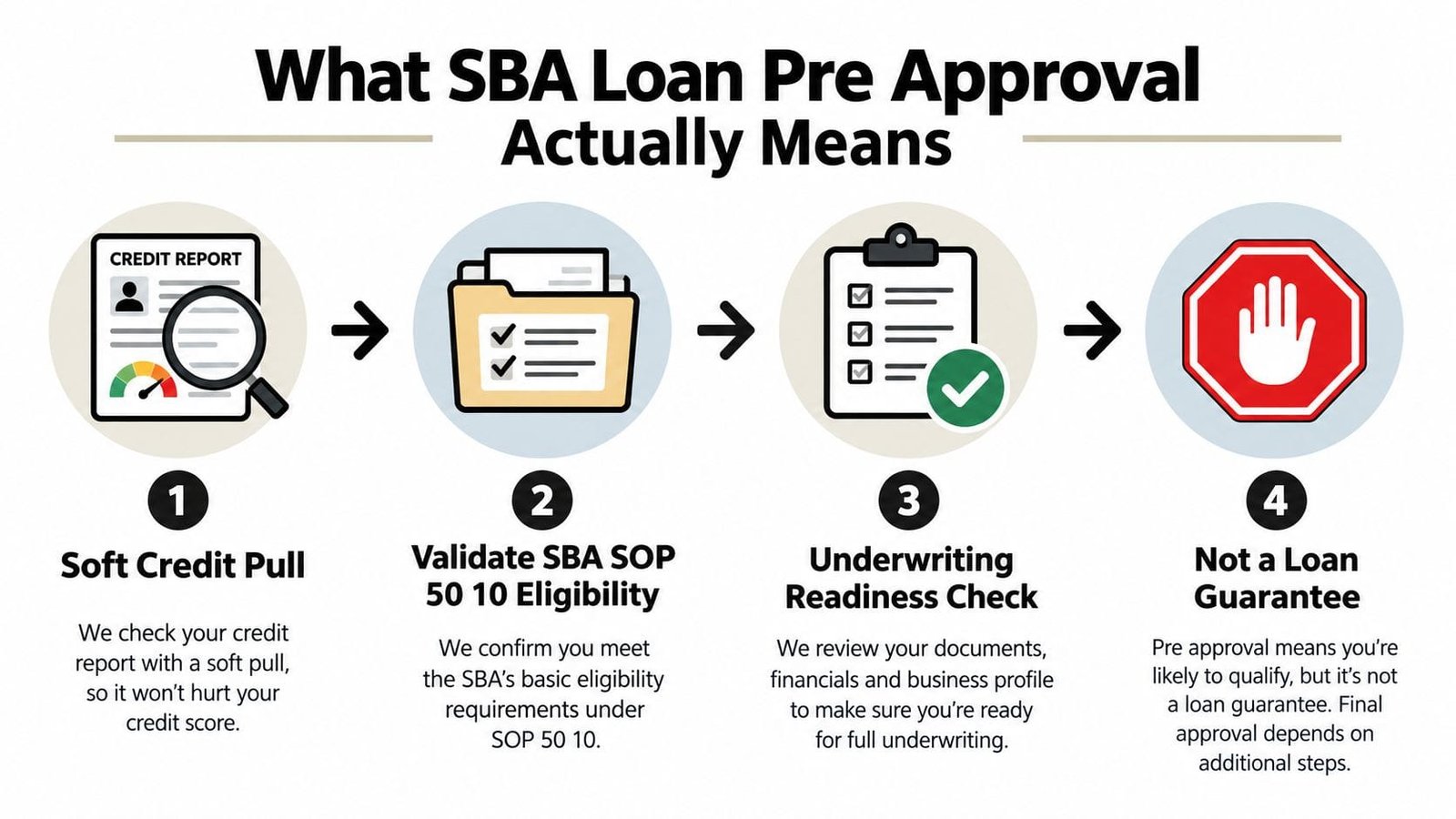
An SBA loan pre-approval is a lender-specific underwriting readiness check. A participating bank, credit union, non-bank lender, or Certified Development Company reviews your preliminary file and decides whether the request appears financeable under its credit policy and applicable SBA rules. The SBA itself doesn't issue your pre-approval. It may later support the lender through a guarantee, but the lender makes the initial credit decision.
Consider a service-business owner seeking $350,000 in working capital before bidding on a major contract. A quick online form might produce an estimated borrowing range. A genuine pre-approval requires the lender to test whether historical and current cash flow can support the proposed debt, whether the business qualifies for the intended program, and whether the requested proceeds fit an eligible purpose.
What the SBA desk tests first
A lender's preliminary review commonly includes:
- Credit screening: The lender may begin with a soft credit pull to identify major personal or business credit concerns without immediately treating the review as a final application.
- Eligibility validation: The underwriter checks the business's size, ownership, industry, location, and proposed use of proceeds against current SBA requirements and the lender's interpretation of them.
- Repayment capacity: The desk calculates debt service coverage using tax returns, financial statements, bank activity, and the proposed loan payment. Industry guidance commonly uses about 1.25x DSCR, meaning at least $1.25 of operating income for each $1.00 of debt service, as a practical benchmark. Bean Count's SBA approval guidance explains this underwriting workflow and documentation focus.
- Equity and conditions: The lender estimates the required owner contribution, identifies collateral questions, and lists the items needed before final approval.
The resulting letter should identify a proposed amount, rate range, term, expiration or review window, and conditions. It's conditional and revocable. A later hard pull, appraisal, environmental report, ownership verification, SBA guarantee review, or material change in financial performance can alter the decision.
Underwriting rule: A pre-approval is evidence that the file currently supports a lender's preliminary decision. It isn't evidence that closing is inevitable.
The distinction matters because public SBA performance data separates approvals from disbursements and notes that some approved loans are later cancelled. In fiscal year 2025, lenders approved 78,078 7(a) loans totaling $37.3 billion and 6,762 504 loans totaling $7.8 billion, according to the SBA loan performance data summary. Those figures demonstrate the scale of SBA-backed lending, not a guarantee for any individual borrower.
For a practical overview of how a preliminary review fits into the wider borrowing process, see this guide to business loan pre-approval. The most common mistake is submitting documents without rehearsing the lender's decision. Clean paperwork can't rescue a request with unsupported cash flow, an unclear debt stack, or an ineligible use of proceeds.
Pre Qualification vs Pre Approval vs Conditional Commitment
Borrowers often use these terms interchangeably, but they describe different levels of lender work and different levels of confidence. Choosing the wrong checkpoint can create a false sense of certainty, especially when a seller or commercial broker asks for financing evidence.
The three checkpoints compared
| Stage | Documentation | Credit Pull | Lender Obligation | SBA Role | Validity |
|---|---|---|---|---|---|
| Pre Qualification | Mostly self-reported information and a basic conversation | Usually soft or no meaningful pull | Informal estimate, usually no firm commitment | Usually none | Short-lived and highly changeable |
| Pre Approval | Tax returns, financial statements, bank activity, debt details, ownership information, and use of proceeds | Often a soft preliminary pull, followed by later verification | Written conditional decision with proposed amount and terms | Eligibility and program fit are screened, but final guarantee review remains | Commonly tied to a lender's stated decision window |
| Conditional Commitment | Full transaction details, purchase documents, third-party reports, and final underwriting items | Final credit procedures depend on lender policy and transaction stage | Formal commitment subject to stated closing conditions | SBA review and guarantee authorization become central | Remains effective only while conditions and facts remain satisfied |
Pre-qualification is useful for narrowing the field. A lender or financing platform may ask about revenue, time in business, credit quality, and the general purpose of funds. It can tell you whether a conversation is worth having, but it doesn't verify the figures or establish that the business passes SBA eligibility screening.
Pre-approval is the decision point that can support a bid, acquisition search, or property negotiation. The lender has reviewed actual documents, tested repayment capacity, and issued written terms with conditions. The letter still isn't final funding, but it gives you a defensible borrowing range.
Conditional commitment belongs later. The lender has identified a specific transaction, and the file may require environmental work, appraisal or valuation, purchase agreement review, source-of-funds verification, and SBA guarantee approval. The SBA's full involvement generally starts at this deeper stage, not at the moment a lender sends a preliminary pre-approval letter.
A pre-qualification helps you choose a lane. A pre-approval tells you whether your file can travel that lane. A conditional commitment addresses the actual transaction.
Borrowers should sequence the stages rather than skip randomly. Use pre-qualification to shortlist lenders, seek pre-approval before negotiating seriously, and move toward conditional commitment only after the target and transaction documents are identified. The SBA loan underwriting process becomes much easier to manage when each stage has a defined purpose and you don't mistake an estimate for an approval.
What Lenders and SBA Programs Look For
An SBA desk begins with program eligibility, then applies the lender's own risk overlays. That second layer explains why two lenders can review the same borrower and reach different conclusions. SBA eligibility opens the door. Cash flow, credit quality, equity, collateral, management experience, and policy fit determine whether a lender walks through it.
The practical underwriting benchmarks cited in SBA lender guidance include DSCR of 1.15x as a minimum, with 1.20x or higher as a stronger target, a common 10% equity injection for new businesses or acquisitions, and personal credit commonly around 680 or better for principals with material ownership. SBA Lenders USA's underwriting discussion describes the lender-overlay problem, including the difference between being technically eligible and being approvable under a specific lender's policy.
Program fit changes the questions
For 7(a) requests, lenders focus on the flexibility and risk created by the proposed use. Working capital, acquisitions, equipment, and owner-occupied real estate can fit the program, but the underwriter still needs a reasonable explanation of how the proceeds will produce or preserve repayment capacity. Industry experience, cash-flow consistency, existing debt, and a sensible working-capital cushion receive close attention.
For 504 financing, the analysis centers more heavily on the fixed-asset project, the senior lender's position, the CDC structure, equity evidence, occupancy, and project costs. A borrower with strong operating performance can still face delays if the project budget, ownership structure, or injection source isn't documented clearly.
Express and CAPLine structures may offer a faster route for suitable requests, but speed doesn't eliminate credit analysis. A lender may impose tighter internal criteria when its guarantee exposure, repayment risk, or industry concerns increase.
What changes a yes into a no
The pre-screen often stops when the use of proceeds doesn't match the program, the cash flow can't support the requested payment, the ownership structure creates an eligibility concern, or the applicant's time in business and management experience don't support the plan. The lender also checks for unresolved credit issues, tax problems, litigation, and inconsistencies between reported revenue and deposited revenue.
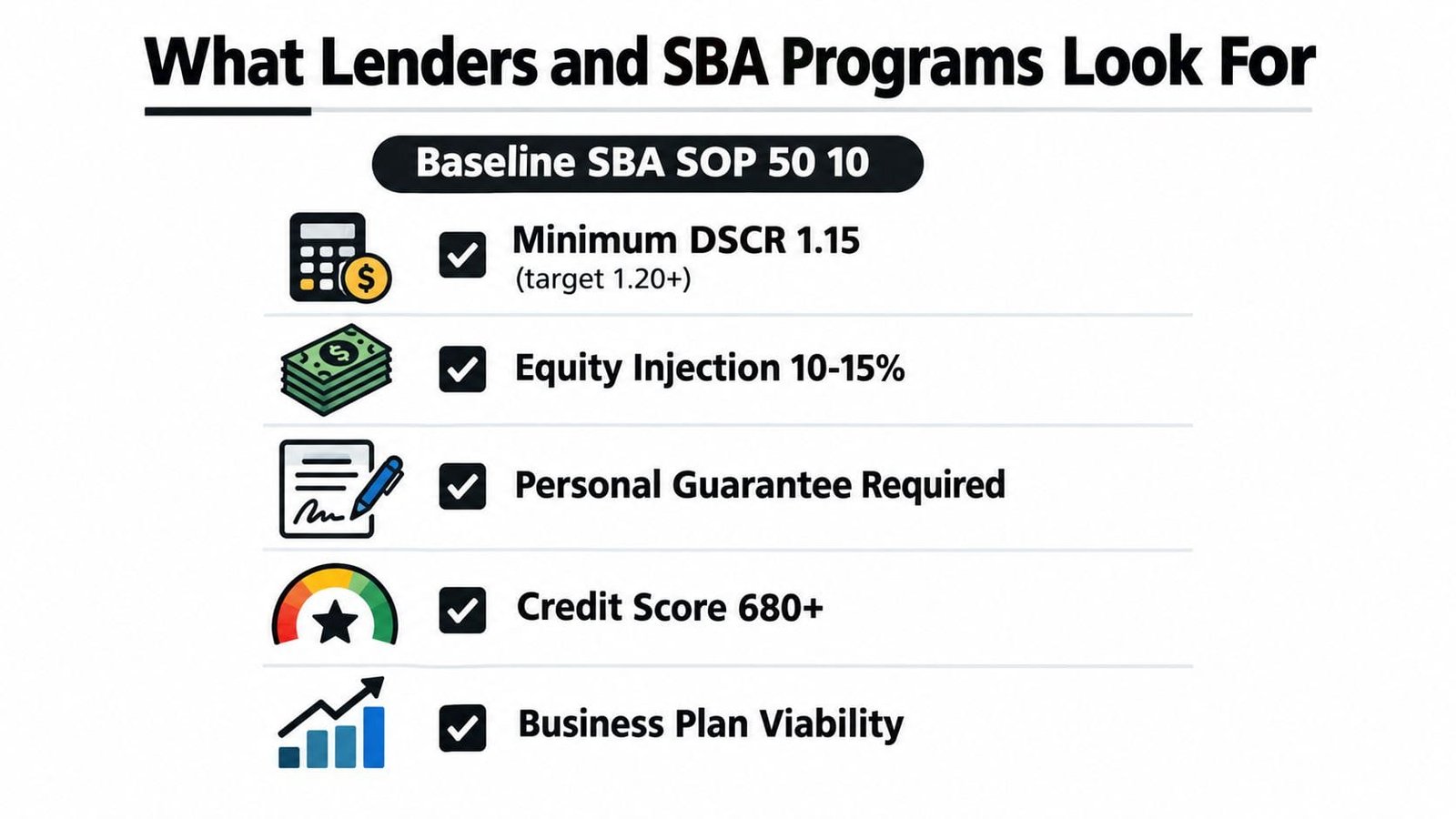
The policy environment has also become more flexible in one important area. The SBA moved to sunset the SBSS requirement for 7(a) Small Loans effective March 1, 2026, allowing lenders to use the credit scoring model they apply to similar conventional loans when permitted by their regulator and when the model doesn't rely solely on consumer credit scores. Credit Club's explanation of the SBA 7(a) scoring change also notes an industry data point reporting an average personal FICO of 710 among approved 7(a) borrowers in 2024, while many lenders continue to prefer the 650 to 680-plus range.
That shift doesn't make credit irrelevant. It makes the lender's broader underwriting judgment more important. Use this SBA loan qualification guide to organize the eligibility questions before you approach a lender.
The Documentation Pack Lenders Expect
A file can contain every required document and still create avoidable delays. Underwriters review how the package is assembled, labeled, and cross-referenced. Clear packaging reduces follow-up because the reviewer can locate the source for each figure, confirm who signed it, and connect the request to the proposed use of funds.
Create one index and use consistent file names, such as 2024 Business Tax Return or March Bank Statement. Separate borrower-level documents from business-level documents, then place supporting schedules immediately after the statements they explain. Combine complete statement sets rather than uploading isolated pages, and confirm that scans show all pages, signatures, and account identifiers needed for review.
The core file
Include these items in a clearly labeled package:
- Financial history: Business and personal tax returns, current year-to-date profit-and-loss information, a balance sheet, and supporting schedules.
- Bank evidence: Recent operating-account statements, including at least three months of business bank statements requested by the Business Loan Warrior application process, where applicable.
- Debt schedule: Creditor, original balance, current balance, payment, maturity, and collateral for every business obligation. Match each entry to the corresponding statement or account.
- Legal identity: EIN documentation, formation records, operating agreement, licenses, permits, franchise documents when relevant, and a current ownership breakdown. Make sure names and ownership percentages are consistent across these records.
- Purpose of funds: A written allocation showing exactly how proceeds will be used, supported by quotes, purchase information, invoices, or a transaction summary.
- Collateral information: Real estate, equipment, inventory, receivables, or other assets available to secure the request, with ownership and valuation support where requested.
Reconcile before submission, not after the lender returns questions. Tie the debt schedule to statement payments, label transfers between related accounts, and explain deposits that do not represent ordinary sales. If a figure changed because of a correction, acquisition, seasonality, or a one-time event, attach a short explanation and supporting record. A concise explanation is easier to review than a series of follow-up emails.
Program-specific differences
| Document | SBA 7(a) | SBA 504 |
|---|---|---|
| Tax returns and current financials | Core underwriting evidence | Core underwriting evidence |
| Bank statements and debt schedule | Used to reconcile liquidity and leverage | Used to verify operating strength and injection capacity |
| Use-of-proceeds statement | Required for working capital, acquisition, equipment, or real estate | Tied to the eligible fixed-asset project |
| Project cost breakdown | Needed when funding a defined purchase or buildout | Central to the senior loan and CDC package |
| Equity injection evidence | Required where the structure calls for owner funds | Particularly important because the project structure depends on verified equity |
| Organizational and ownership records | Used to confirm control and guarantees | Used to confirm project ownership, guarantors, and CDC eligibility |
| Third-party reports | May arise during final underwriting | Commonly relevant to property and project review |
Before sending the package, check dates, signatures, totals, and page order. Common return items include missing schedules, stale financial statements, unsigned forms, mismatched ownership percentages, unexplained deposits, and a use-of-proceeds statement that only says “working capital.” Submit one organized record, with each material number traceable to its source.
Timelines, Costs, and Fintech vs Bank Channels
The quickest intake does not guarantee the strongest pre-approval. A fintech aggregator may collect data promptly, a community bank may understand a local industry, and a national bank may have a dedicated SBA team for complicated transactions. Select the channel according to the file's complexity, urgency, and the lender's credit appetite.
Industry guidance gives broad timing ranges. Fintech soft-check workflows may take one to two weeks, community banks and CDC lenders three to six weeks, and large banks six to ten weeks for more involved reviews. SBA Loan Options' lender-timing guidance also contrasts preferred-lender processing with slower non-preferred channels, citing 7 to 21 days versus 60 to 90 days. These ranges are not commitments. Missing records, complicated ownership, acquisition valuation, and SBA review can extend any channel.
Channel comparison
| Channel | Typical Timeline | Cost to Borrower | Best For |
|---|---|---|---|
| Fintech aggregator | Preliminary review may move quickly when connected data is complete | An initial application may have no fee, with later transaction costs disclosed | Early readiness screening and document collection |
| Community bank or CDC lender | Often involves several underwriting cycles | Bank, packaging, third-party, and program-specific charges may apply | Relationship-based review and local operating knowledge |
| Large national bank | Complex files may pass through multiple internal queues | Pricing and fees vary by lender and transaction | Established businesses with organized financials and larger requests |
Cost depends on how far the request advances. A preliminary review may be free, while the completed transaction can include packaging or application charges, third-party reports, and program-specific fees. CDC processing costs may arise in a 504 project. 7(a) guarantee fees depend on the final loan structure and may be financed or passed through under lender policy. Request a written fee schedule before approving paid work.
Fintechs are useful for bank-statement collection, preliminary credit screening, and a centralized document dashboard. They do not replace the institution that underwrites the credit or manages the SBA relationship. Banks provide program judgment and execution, but their queues may be slower, and their documentation standards may expose weak cash flow, thin equity, or a heavy existing debt load earlier in the review.
The lender channel should match the underwriting problem, not the advertised response time.
A complex acquisition with multiple guarantors needs coordinated review of valuation, ownership, and repayment capacity. A straightforward working-capital request may benefit from fast data collection first, followed by submission to a lender whose policy fits the borrower's cash-flow profile. Pre-approval works best when the channel can evaluate the file's actual risk, rather than only process its paperwork quickly.
Why Pre Approvals Get Denied
An SBA pre-approval is an underwriting readiness check, not a rubber stamp. A lender stops the file early when repayment capacity does not support the proposed payment, the use of proceeds falls outside program rules, or ownership and guarantor details create an issue that more paperwork cannot fix.
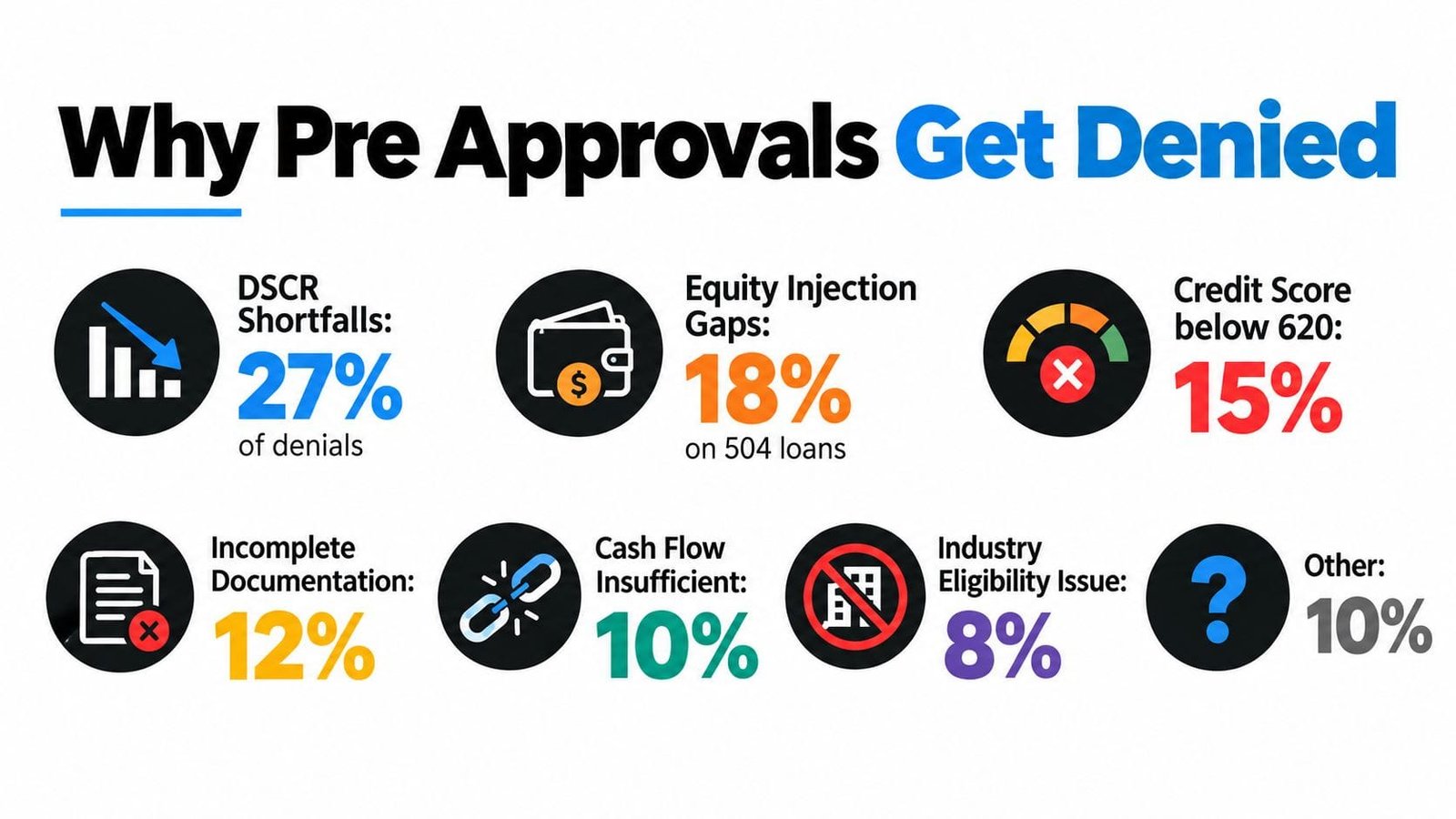
Denial patterns provide useful direction, but they are not an approval formula. Lender-reported summaries commonly identify low credit score, insufficient collateral, weak cash flow or revenue, limited time in business, and excess debt among the recurring reasons for rejection. Those categories can overlap, so a file may have several weaknesses at once. The practical question is which issue controls the credit decision.
What gets stopped early
Cash flow shortfalls often end a review first. If the proposed payment leaves too little room after existing obligations, the lender cannot defend repayment capacity. The same concern arises when global cash flow depends on aggressive projections, thin margins, large owner distributions, or revenue that has not appeared in bank deposits.
Credit events matter beyond the score. Recent collections, unexplained late payments, tax liens, judgments, or disputed tradelines raise questions about repayment behavior. A lender may request an explanation and supporting records. Hiding the issue usually creates a larger credibility problem.
Equity gaps can stop an acquisition or fixed-asset request when the borrower cannot document the source of funds. Borrowed injection money, unexplained transfers, and a last-minute deposit may trigger a deeper source-of-funds review.
Other pre-screen failures include:
- Ownership eligibility: Foreign ownership, guarantor documentation, and control rights require review under current policy.
- Existing obligations: Undisclosed debt, debt stacking, or unresolved SBA records can weaken the request.
- Industry and purpose: Restricted activities or an ineligible use of proceeds can disqualify an otherwise profitable company.
- Incomplete records: Missing tax schedules, stale financials, and unreconciled statements signal process risk.
A reported policy change affecting some non-citizen owners, including green-card holders, on certain SBA loan paths makes ownership verification an early underwriting task. Business Cash Guide's discussion of ownership and denial issues explains why the lender should review the cap table and guarantor structure before building the file. If those details require correction, discovering it during final underwriting wastes time and may force the transaction to be restructured.
How to Improve Your Odds and Prepare
A lender should be able to defend the decision from the file itself. Build the request around repayment capacity, verified ownership, documented equity, and a consistent financial narrative. Treat pre approval as an underwriting readiness check, not a document-upload exercise.
Start with credit hygiene before submission. Pull personal and business credit reports early, dispute errors, explain adverse items, and resolve collections or filing problems. The SBSS change discussed earlier may give lenders more flexibility in the scoring model used for some 7(a) Small Loan reviews. It does not remove the need for a credible credit profile or explain away unresolved problems.
Make the cash flow easy to underwrite
Calculate DSCR with the lender's proposed payment and every existing debt obligation included. If the ratio is weak, review recurring expenses, owner draws, revolving balances, and possible debt consolidation. Document the assumptions behind any projected improvement. A lender needs to see how the business will support the payment under a reasonable case, not only under optimistic projections.
Reconcile tax returns, profit-and-loss statements, balance sheets, and bank deposits before submission. Seasonal revenue or an unusual expense can be acceptable when the explanation remains consistent across the file. Changes between statements create questions about reporting controls and may delay pre approval.
Prove the equity and ownership story
Hold the intended injection in a verifiable account and document the source of every dollar. Avoid unexplained transfers through personal or business accounts immediately before applying. For an acquisition or fixed-asset project, maintain a clear trail from the source account to the project budget.
Review the cap table, operating agreement, licenses, franchise information, and guarantor records as one ownership package. Names, ownership percentages, control rights, and identification documents must match. Multiple owners or international ties warrant lender guidance before a formal review, because a mismatch can force changes to the structure or guarantor package.
Use a soft-pull readiness workflow to identify credit, documentation, and eligibility gaps before a hard inquiry. Then submit a complete package to one lender whose credit appetite fits the request. Scattered applications can create conflicting narratives and waste time. The strongest file answers predictable underwriting questions before they are raised.
Business Loan Warrior provides a no-fee application workflow for preliminary SBA funding review, bank-account connection, document collection, and communication with underwriters. Use the platform to check readiness, organize requested financial information, and prepare for the next lender conversation with a clearer file.