
You might be looking for a modest amount of capital, not a giant expansion loan. Maybe you need funds for inventory before a busy season, a replacement piece of equipment, or enough working capital to smooth out payroll and vendor timing. Then you call a bank and hear some version of the same answer: the amount is too small, the file is too thin, or the business is too early.
That's where the SBA Microloan Program becomes worth a serious look.
Most articles treat it like a simple yes-or-no eligibility question. That misses the practical reality. This program works through local nonprofit intermediaries, and that means your outcome often depends less on the headline rules and more on which lender you approach, how that lender underwrites, and whether it has capacity to lend right now. For many borrowers, that's the difference between a workable path forward and a dead end.
Table of Contents
- Why Small Borrowers Turn to SBA Microloans
- How the SBA Microloan Program Actually Works
- Loan Amounts Rates Terms and What You Can Use Funds For
- Eligibility Requirements and Documents to Prepare
- How to Apply Through an Intermediary Lender Step by Step
- How SBA Microloans Compare to Other Funding Options
- Next Steps to Secure Your SBA Microloan With Confidence
Why Small Borrowers Turn to SBA Microloans
A bakery owner needs a new mixer before holiday orders start. The price is too high for cash flow, too small for a bank to get excited, and too risky to park on a high-rate credit card. That borrower is often the right kind of fit for an SBA microloan.
Small businesses turn to this program because the need is often practical, not dramatic. They may need funds for inventory, a used vehicle, a replacement cooler, basic equipment, opening costs, or short-term working capital. In many cases, the amount is modest by commercial lending standards but still large enough to matter to the business. That middle ground is where microloans tend to make sense.
The program's track record reflects that role. It began as a 5-year pilot in 1991 and became permanent in 1997. By FY2017, it had produced more than 69,000 loans with an average size of $12,386, and SBA commentary in the hearing record said total lending had reached nearly $900 million and supported about 250,000 jobs, according to the congressional hearing record on the Microloan Program.
That average loan size matters more than many guides admit.
Yes, the stated program maximum is higher. But in real borrower terms, many applicants are competing in a channel where loan sizes are often much smaller than the headline cap. If you are seeking $8,000 to $15,000 for a clear business purpose, you are closer to the center of how this program is commonly used. If you need the full $50,000, the question is not just whether the program allows it. The question is whether a local intermediary is willing and able to make that loan right now.
That is a big reason borrowers turn here in the first place. They are not only looking for a rulebook that says "eligible." They are looking for a lender that will review a small request, spend time understanding the business, and sometimes offer technical assistance along with the loan. SBA microloans work more like a community-based lending channel than a standard bank product. The quality of that local channel matters.
Who usually benefits most
The borrowers who often benefit are those who fit the program's smaller-scale, hands-on model. In FY2021, a sizable share of loans went to startups, women-owned or controlled firms, and urban borrowers, as summarized in a Congressional Research Service report on the SBA Microloan Program. That does not mean the program is limited to those groups. It does show a pattern. Intermediaries often serve borrowers who are early in the business life cycle, need a relatively small amount, or do not fit neatly into a bank's standard credit box.
A useful way to view the program is this: SBA microloans are less like pulling a number off a shelf and more like applying through a local shop with limited inventory. Some shops have more capacity than others. Some are more comfortable with startups. Some may have funds available this month, while another may be full. That supply bottleneck is easy to miss if you only read the official maximum loan amount.
Practical rule: If your funding need is modest, your plan for the money is specific, and you want a lender that may provide guidance as well as capital, an SBA microloan is often worth pursuing. Just go in knowing that lender choice and local availability can matter as much as the basic eligibility rules.
How the SBA Microloan Program Actually Works
A borrower hears “SBA loan” and expects to fill out one federal application, wait for a yes or no, and move on. The microloan program works more like a local distribution network. The federal government supplies the program structure and funding. A nonprofit intermediary in your area decides whether to lend, on what terms, and how much hands-on support to provide.
The SBA describes the Microloan Program as an intermediary-lending program. It provides funds to nonprofit intermediary lenders, and those organizations make the loans to small businesses and certain not-for-profit childcare centers, with loan amounts of up to $50,000, as described on SBA's Microloans program page.
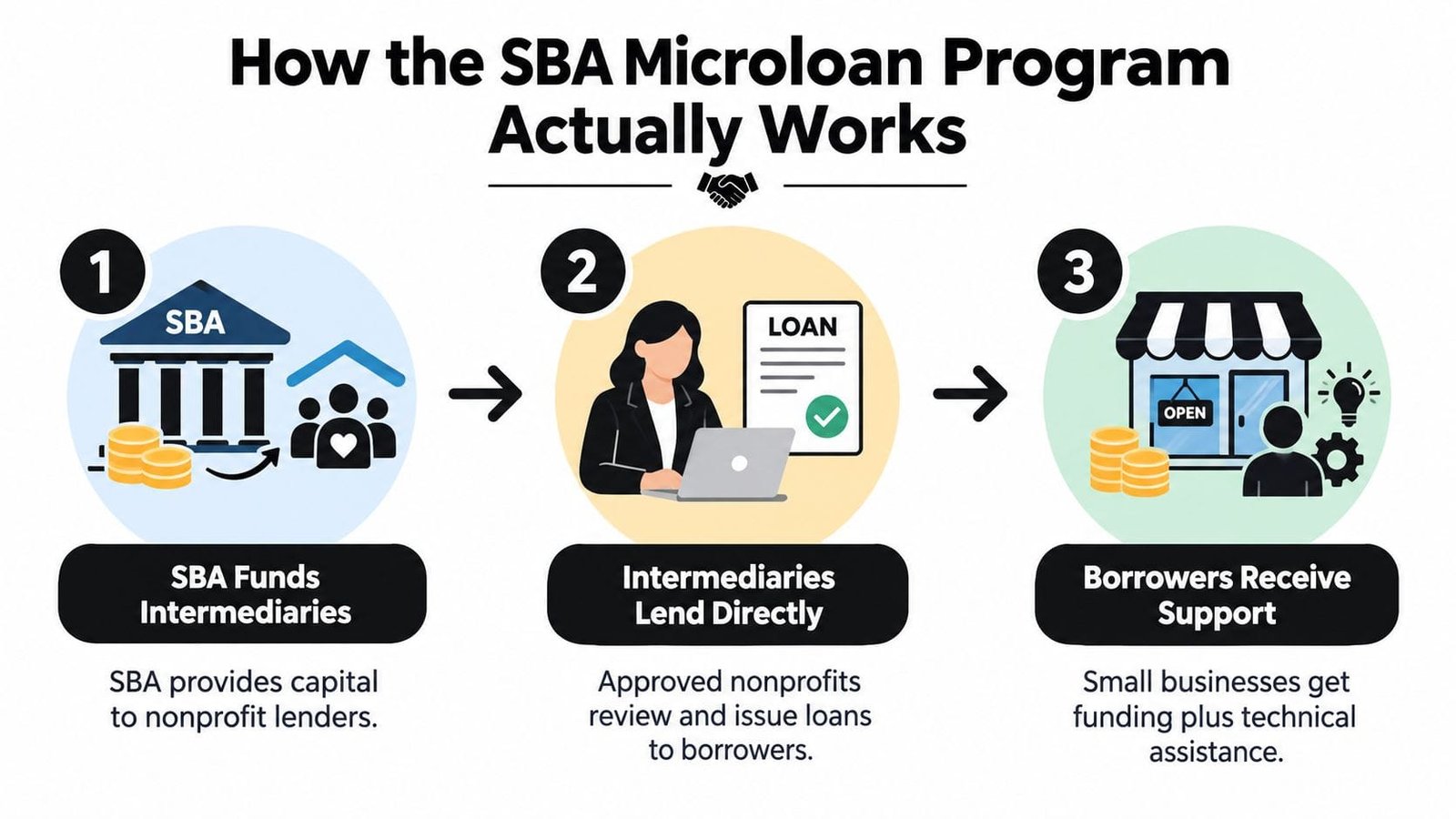
SBA works like the wholesaler, and the intermediary runs the storefront
That comparison helps explain why borrower experiences vary so much.
The SBA funds and oversees the program. The intermediary meets with applicants, reviews the file, decides whether the request fits its lending standards, closes the loan, collects payments, and often offers training or technical assistance. In plain English, the intermediary is the lender you experience.
That local control shapes nearly everything. One intermediary may be comfortable with a first-time owner who has a tight business plan and a small equipment request. Another may want stronger cash flow history, more documentation, or a narrower use of funds. The federal label is the same. The front-door experience is not.
Why lender choice matters more than many guides explain
A lot of advice about SBA microloans focuses on headline eligibility. In practice, lender fit and local capacity often decide whether your application gets traction.
That happens for two reasons. First, intermediaries have discretion in underwriting. Second, they have limited staff time and limited funds to place. So the useful question is often less “Am I eligible on paper?” and more “Which local intermediary has room, appetite, and experience with a borrower like me?”
A simple example helps. A food truck owner seeking $8,000 for a generator and prep equipment may be a strong fit for an intermediary that often works with early-stage service businesses. The same owner could get a colder response from another intermediary that prefers more operating history or larger down payments. Same program. Different lender judgment.
What this means for borrowers on the ground
Borrowers often picture the SBA microloan program as one door. It is closer to a hallway with several doors, and each one may open differently.
Here is what can change from one intermediary to another:
- Startup comfort level. Some intermediaries will spend time reviewing your plan and projections if your business is new.
- Underwriting focus. Some care more about recent repayment history, collateral, or management background.
- Available capacity. Some may have very limited room for new loans, even when an applicant looks promising.
- Hands-on support. Some pair the loan with coaching, training, or extra documentation help.
This is also where the supply bottleneck shows up. A borrower may meet the broad program rules and still struggle if nearby intermediaries are full, cautious, or focused on a different borrower profile. That is one reason the legal maximum can create the wrong expectation. On paper, the ceiling is $50,000. In real borrowing situations, many applicants are working within a much smaller practical lane, shaped by the intermediary's capacity and risk tolerance.
A clearer way to read the program
It helps to view an SBA microloan as access through a community-based lender that uses an SBA-backed funding channel.
That framing clears up a lot of confusion. You are not only trying to match a federal program. You are trying to match a specific intermediary that has money available, serves your kind of business, and believes your loan request is realistic for this program. Borrowers who understand that early tend to search more strategically, prepare better, and take a rejection from one lender as a signal to try a better-fit intermediary rather than as a final answer.
Loan Amounts Rates Terms and What You Can Use Funds For
Headline marketing and real borrowing experience often split apart.
Yes, the legal maximum loan size is $50,000. But many borrowers don't receive anything close to that. SBA lender guidance states that many microloans are capped at $10,000 unless the borrower shows it can't get comparable credit elsewhere and has strong prospects, while the legal maximum is $50,000 and repayment is generally within six years, according to SBA lender guidance on microloans.
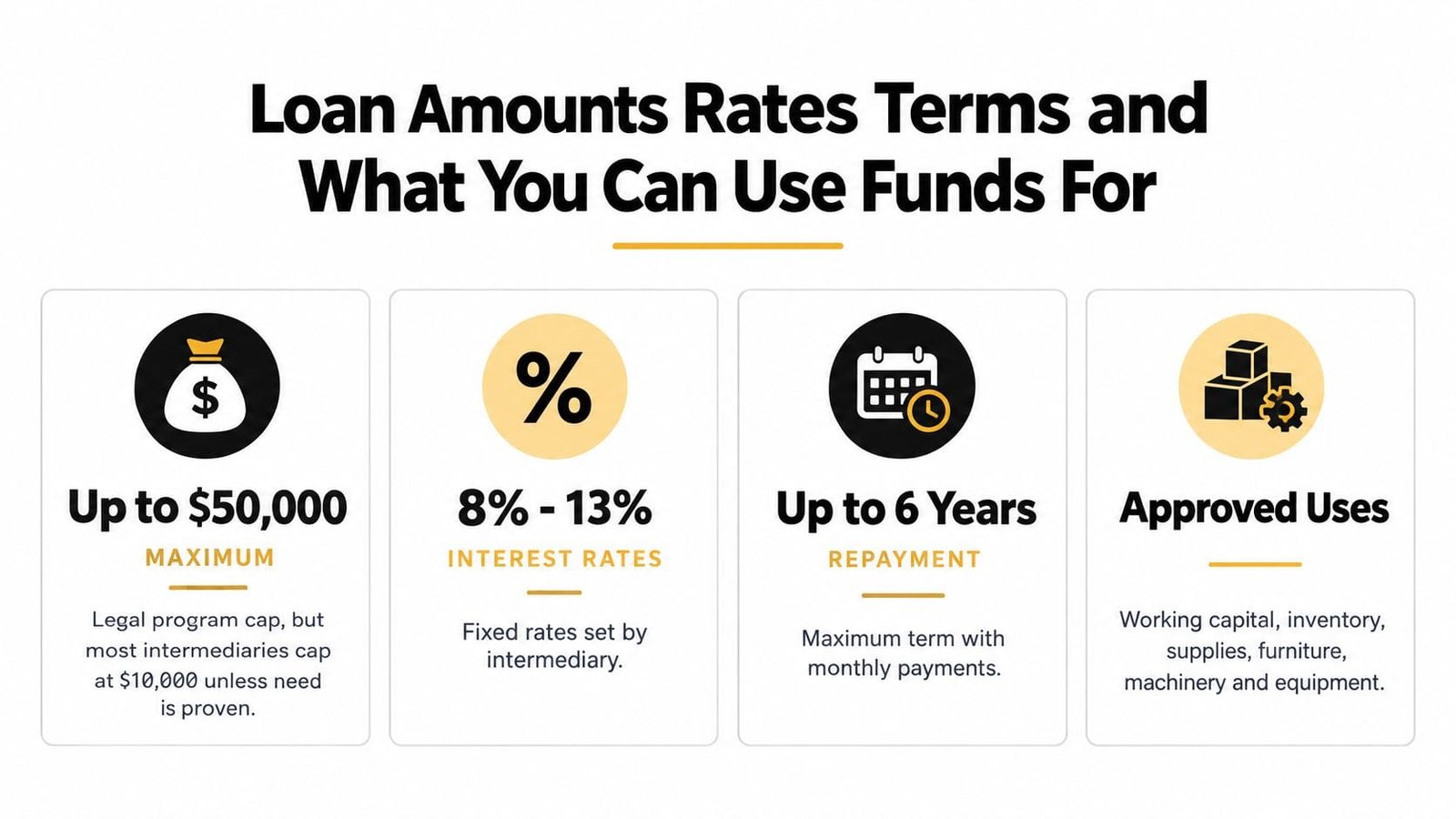
The practical cap most borrowers should plan around
If you walk in expecting an automatic $50,000 offer, you may be disappointed. A better starting mindset is this:
- Small requests may fit the program most naturally
- Larger requests usually need stronger proof
- The intermediary will want a clear reason your amount makes sense
In other words, if you need funds for a targeted purpose, such as inventory for a known sales cycle or a specific equipment purchase, your request is easier to explain than a broad “I just want a cushion” ask.
What rates and terms look like
In FY2021, intermediaries made 4,510 microloans totaling $74.6 million, with an average loan size of $16,557 and an average interest rate of 6.55%, according to the Congressional Research Service report on the SBA Microloan Program.
That average is useful because it puts the program in context. It suggests a market built around relatively small loans, not large expansion packages.
What you can usually use the funds for
Recent SBA materials reiterate that microloans can be used for working capital, inventory, and equipment, but not for buying real estate or paying existing debt, as noted in the 2026 SBA policy notice and lender materials update.
A few practical examples help:
| Use of funds | Usually fits the program | Why |
|---|---|---|
| Seasonal inventory | Yes | Clear short-term business purpose |
| Equipment purchase | Yes | Tied to operations and revenue generation |
| Working capital for normal operations | Yes | Common microloan use case |
| Buying a building | No | Real estate purchase is not an eligible use |
| Paying off older business debt | No | Existing debt payoff is generally not allowed |
If you can point to the exact thing the money will do inside the business, your request is usually easier for an intermediary to evaluate.
A strong request sounds concrete
“Need funds to support growth” is vague.
“Need funds to purchase a second commercial mixer, initial packaging inventory, and working capital for a new wholesale account” is stronger because the lender can see the business purpose and repayment logic. That doesn't guarantee approval, but it makes your file easier to underwrite.
Eligibility Requirements and Documents to Prepare
The best applications feel organized before the lender ever asks follow-up questions.
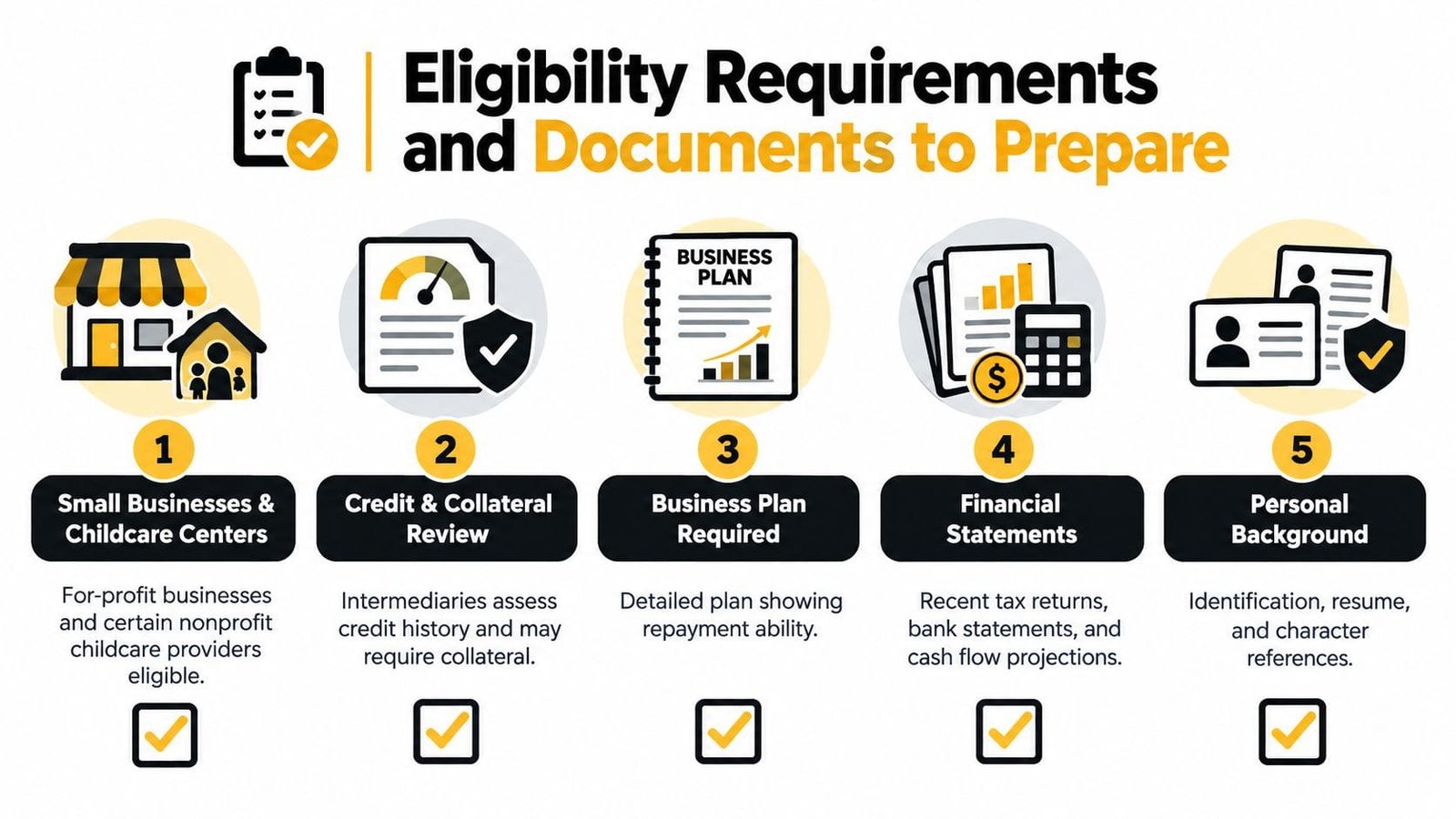
At a basic level, the SBA Microloan Program is for small businesses and certain not-for-profit childcare centers. But because the intermediary does the actual underwriting, your practical eligibility depends on more than a simple category match. The lender will usually want to understand who you are, what the business does, how the funds will be used, and why repayment is realistic.
The citizenship update borrowers shouldn't miss
There was a March 2026 SBA policy update revising citizenship requirements for the Microloan Program, effective April 1, 2026, and that may affect access for businesses with non-U.S. citizen ownership. If ownership structure is at all complicated, don't assume an older article is still accurate. Ask the intermediary how it applies the current rule set when you contact it.
What intermediaries usually want to review
Even though each lender has its own process, most are trying to answer a familiar set of questions.
- Who is the borrower: Expect requests for identification, background details, and owner information.
- What is the business plan: A lender wants to know how the business makes money and what the loan will accomplish.
- Can the business repay: Cash flow, sales history, and projections often matter.
- What support exists if things go sideways: Some intermediaries may ask about collateral or other backup sources of repayment.
If you want a useful primer before you start gathering paperwork, this guide on what documents lenders often ask for in a business loan application can help you organize the basics.
A practical document checklist
Bring structure to the conversation. Don't wait for the lender to drag each item out of you one by one.
Identification and ownership details
Government-issued ID, legal business name, ownership percentages, and formation documents if applicable.Business plan or loan narrative
Explain what the business does, who it serves, how it earns revenue, and exactly what the funds will be used for.Financial records
Recent bank statements, business financial statements if available, tax returns if available, and cash flow projections.Use-of-funds detail
Vendor quotes, equipment invoices, inventory lists, or a simple budget tied to the loan request.Owner background
Resume, industry experience, and a short explanation of any rough spots that may raise questions.
Borrowers get stuck when they make the lender guess. Clear documents reduce back-and-forth.
Where people lose time
The most common problem isn't always weak credit or thin history. It's often a file that doesn't tell a coherent story. If your requested amount, use of funds, and repayment plan don't line up cleanly, the intermediary has to do extra work to understand the deal. That slows everything down.
How to Apply Through an Intermediary Lender Step by Step
Once your documents are in shape, the process becomes more manageable. The key is to treat this less like submitting an online form into a giant machine and more like starting a lending relationship with a local organization.
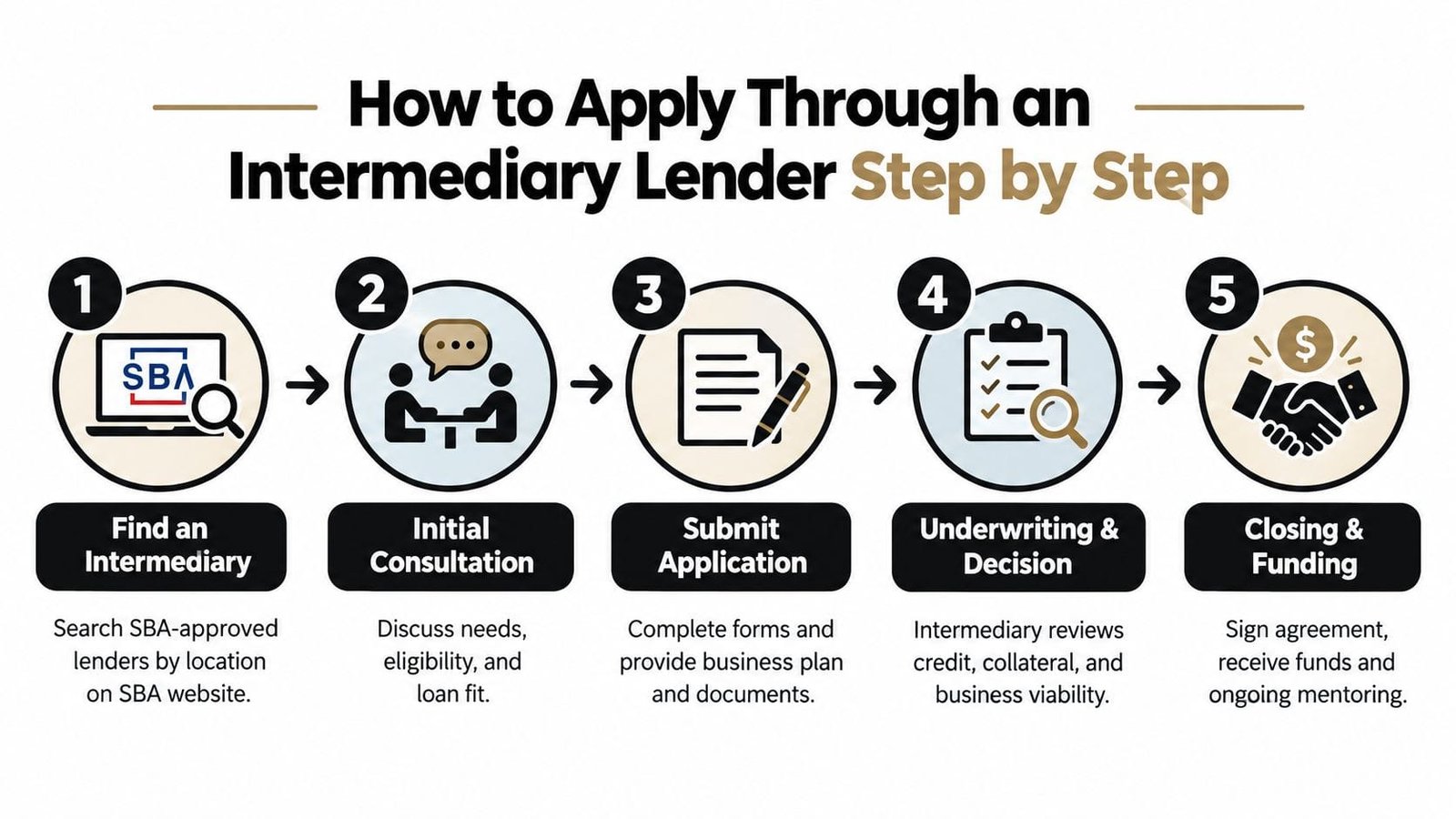
Step 1 through Step 3
Find the right intermediary.
Start with SBA-approved microlenders in your area or those serving your market. Don't just ask whether they offer the program. Ask whether they actively lend to businesses like yours, at the amount you need, for the purpose you have in mind.
Have an initial conversation.
You learn a lot. A strong first call can tell you whether the lender is startup-friendly, how it thinks about working capital, what documents it expects, and whether technical assistance is part of the process.
Submit a focused package.
Send a complete application set. If you need a broader overview of how SBA applications are typically organized, this walkthrough of the SBA loan application process for small business owners can help you map the workflow.
Step 4 and Step 5
Go through underwriting.
The intermediary reviews the file and may ask for clarification, additional documents, or mentoring participation. Because this is a high-touch channel, the back-and-forth can be more personal than with a large automated lender.
To see the process visually, this short video gives helpful context before you start contacting lenders.
Close and receive funds.
If approved, you'll sign loan documents and move into disbursement. Some intermediaries stay involved after funding, especially if technical assistance is part of their approach.
How to choose between two intermediaries
If you have more than one option, compare them on practical fit, not just approval odds.
- Use-case fit: One lender may be more comfortable with inventory financing, another with equipment.
- Communication style: If a lender explains its process clearly and answers specific questions, that matters.
- Support level: Some borrowers need more guidance than others.
- Capacity and responsiveness: A good lender with a full pipeline may move slower than a smaller shop with room to process files.
One practical note belongs here. The bottleneck isn't always your profile. Sometimes it's local lender capacity. That's why contacting more than one intermediary can be smart.
How SBA Microloans Compare to Other Funding Options
A bakery owner needs $8,000 for a used mixer, small ingredient order, and basic signage before opening. A contractor needs $60,000 for a truck, tools, and payroll cushion. Both need funding. Only one is a natural microloan fit.
That is the easiest way to compare options. SBA microloans work best for smaller, clearly defined needs where a local intermediary is willing and able to work the file. If your request is larger, more complex, or tied to real estate, another product usually fits better.
As noted earlier, the program's average loan size is much closer to the teens than to the $50,000 ceiling. In plain English, the headline maximum can distract borrowers from how the channel behaves in practice. Many applicants have a more realistic shot with a request around $10,000 to $20,000 than with a top-of-range ask.
A practical comparison
| Funding Option | Best For | Typical Amount | What to watch for |
|---|---|---|---|
| SBA Microloan | Small working capital, inventory, equipment, startup expenses | Usually smaller requests, often well below the program maximum | Approval depends heavily on intermediary fit, local capacity, and a focused use of funds |
| SBA 7(a) | Larger loan needs and broader business purposes | Often higher than a microloan | More paperwork, stricter underwriting, and a less personal process in many cases |
| SBA 504 | Owner-used real estate or major equipment projects | Larger fixed-asset financing | Narrow use case. Not built for general working capital |
| Business line of credit | Repeating short-term cash needs | Revolving access | Can be harder for newer businesses or borrowers with weaker credit profiles |
| Merchant cash advance | Very fast funding when other doors are closed | Varies | High cost can strain daily cash flow |
Where microloans stand out
A microloan is often the better tool when the request is small enough to explain on one page. Buy this oven. Cover this inventory gap. Replace this aging machine. Intermediaries may also spend more time understanding the borrower behind the numbers, which can help newer businesses and first-time owners.
The program also reaches many underserved borrowers, as noted earlier in the article. That does not mean every intermediary has the same appetite or the same room to lend. One local lender may be open to startups this month, while another may already have a full pipeline.
That supply bottleneck is one of the biggest differences between microloans and other funding products. With a bank line of credit or an online lender, the question is often, “Do I qualify?” With microloans, the question is also, “Is there a nearby intermediary that likes this type of request and has capacity right now?”
When another option is probably better
Choose another path if your situation looks like this:
- You need more than a local intermediary is likely to approve
- You need real estate financing
- You want revolving access for uneven cash flow, not a one-time term loan
- You need speed above all else and can accept the trade-off in cost or structure
A microloan works like a community-based access lane, not a large-volume lending machine. That is why lender choice matters more here than many guides explain.
If you want a side-by-side look at the SBA products themselves, this comparison of SBA 7(a), 504, and microloans gives a useful product-level overview.
Next Steps to Secure Your SBA Microloan With Confidence
A borrower asks for $35,000 because the program allows up to $50,000. The intermediary asks a different question: What, exactly, will this money buy, and why does this amount make sense for this business right now?
That gap explains why many SBA microloan applications stall. This program runs through local nonprofit intermediaries, not one central SBA lending desk. Your outcome depends on matching your request to a lender that serves your type of business, has room in its pipeline, and sees a clear repayment story.
For many owners, the stronger opening move is a smaller, sharper request. If you can clearly support a $7,500 inventory purchase or a $10,000 equipment need, you may have a more workable file than someone stretching toward the headline maximum without clean backup. The official cap matters. The practical cap often matters more.
A short pre-application check
Before you reach out, make sure these basics are in place:
- Your use of funds fits the program. Inventory, equipment, and working capital usually fit better than real estate or refinancing old debt.
- Your amount request is tied to a real need. Quote the machine, list the inventory order, or show the operating gap you need to cover.
- Your paperwork agrees with itself. Your application, bank statements, projections, and business plan should describe the same story.
- You have more than one lender on your list. A good fit on paper can still hit a local capacity problem.
- You are ready to ask about coaching or technical assistance. Some intermediaries help borrowers tighten the plan before and after funding.
Here is a simple way to frame it. Applying for an SBA microloan works a lot like applying to a small group of grantmakers, except repayment still matters like any other loan. Program rules set the outer boundaries, but each intermediary still has its own comfort zone, process, and pacing.
So treat your first round of outreach like lender screening, not just form filling.
What to do in the next 7 days
A practical plan helps more than more research.
Start with a one-page loan summary. Include what your business does, how much you want, what the funds will pay for, and how the loan payment fits your cash flow. If you run a food truck, for example, do not write “for growth.” Write “$8,200 for generator replacement and initial inventory for two new event routes.”
Next, gather the documents an intermediary is likely to request anyway. That usually means recent bank statements, basic financial statements, a business plan or business summary, identification, and any quotes or invoices tied to the request.
Then contact multiple intermediaries and compare their responses. Do they make loans at your requested size? Are they open to startups? How long is their current queue? Do they provide application help? Those answers often tell you more than a generic eligibility page.
If you want help organizing that search, Business Loan Warrior is one example of a platform that helps businesses check funding options through a single application and track progress in one place.
A final reminder. A rejection from one intermediary may reflect lender fit, loan size preference, or timing, not just your business quality. If your use of funds is eligible and your request is well supported, keep refining the file and keep calling. In this program, persistence and lender matching often matter just as much as eligibility.