
The contract is signed, the customer wants delivery, and your business bank account says the timing is impossible. Payroll, rent, inventory, and supplier invoices arrive before the customer's payment. Or a critical vehicle fails on Monday morning, just as a profitable expansion opportunity appears. Small business loans can help, but only when the financing matches the actual cash-flow problem.
The wrong product can turn a temporary gap into permanent pressure. A fast advance may solve an urgent shortage while consuming future revenue, while a slower loan may offer better economics but arrive too late. The practical question isn't only whether you can borrow. It's which structure your business can repay without damaging operations.
Table of Contents
- The Five Real Reasons Small Businesses Need Funding
- How Small Business Loans Actually Work
- Main Loan Products and When Each One Fits
- What Underwriters Look At Before They Approve
- Matching the Right Loan to Your Business Situation
- Why Most Applicants Get Denied or Under Funded
- A Practical Checklist for Choosing and Applying Smart
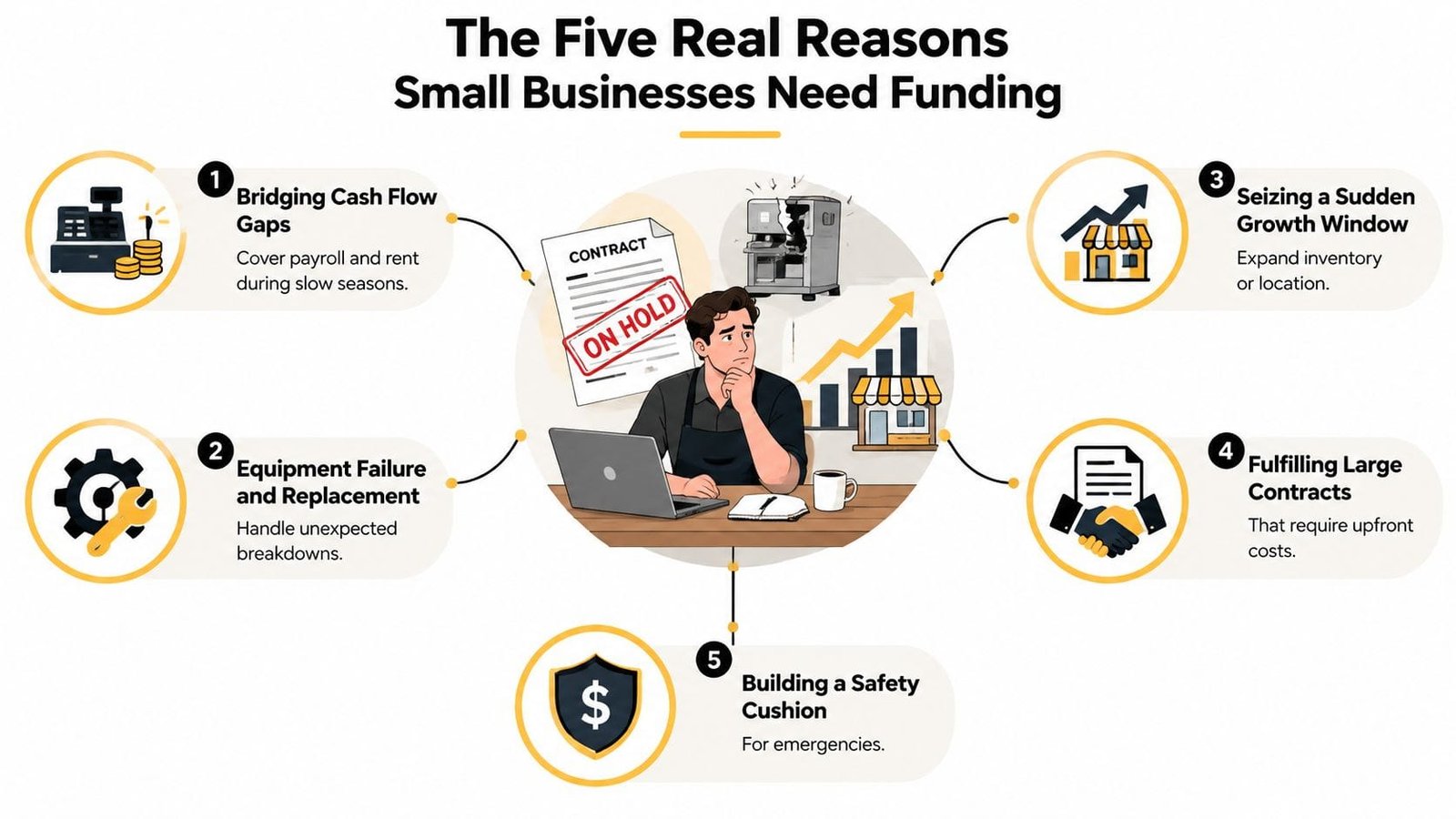
The Five Real Reasons Small Businesses Need Funding
A commercial contractor discovers the need for capital when a signed project requires materials before the first customer payment. A restaurant owner reaches the same conclusion when a refrigeration unit fails during a busy week. A retailer sees it when a supplier offers a limited inventory opportunity just before demand rises.
Those situations look similar from the outside, but they call for different financing.
Bridging a cash-flow gap
You have invoices outstanding, but payroll, rent, taxes, and vendors won't wait. This is a timing problem, not necessarily a profitability problem. A business line of credit usually fits better than a large term loan because you can draw only what the gap requires and repay as receivables arrive.
Doing nothing can mean late payroll, strained supplier relationships, or missed opportunities to accept new work. Before borrowing, map the exact dates when cash leaves and enters the business. The lender needs to see that the gap closes through ordinary operations.
Seizing a growth window
A landlord offers a suitable second location, a distributor presents a valuable inventory opportunity, or a customer wants you to add capacity quickly. Growth financing makes sense when the opportunity has a clear path to revenue and your existing operation already produces dependable cash flow.
The cost of waiting is lost market share or a contract awarded to a competitor. A fixed term loan or SBA financing can work when the expansion requires a defined amount and the repayment period should match the project's useful life.
Replacing failed equipment
A broken service van, oven, machine, or point-of-sale system can stop revenue immediately. Equipment financing is usually the cleanest solution because the asset being purchased can secure the loan, preserving working capital for payroll and normal operating expenses.
The cost of doing nothing is operational downtime. Don't use a revolving facility for an asset that will generate value over a longer period if equipment financing offers a repayment structure aligned with that asset.
Surviving a seasonal trough
Retailers, hospitality businesses, and specialty food companies may spend months preparing for a revenue peak. Inventory, staffing, and marketing costs arrive before the sales cycle catches up.
A line of credit can provide controlled access during the trough, while invoice financing may help a B2B company waiting on customer payments. The danger is borrowing without a repayment event. If the business can't identify the revenue that will retire the balance, the financing isn't solving seasonality. It's postponing a structural problem.
Repairing the balance sheet
A setback can leave a business with expensive debt, depleted reserves, or weak working capital. Capital may also be needed to strengthen liquidity before pursuing a larger contract or expansion.
This is the most delicate category. Borrowing to refinance or stabilize can be sensible, but only when the new structure reduces pressure and the business has a credible operating plan. Otherwise, new debt just hides the original weakness and limits future borrowing capacity.
Funding rule: Identify the cash-flow problem first. Product selection comes second.
How Small Business Loans Actually Work
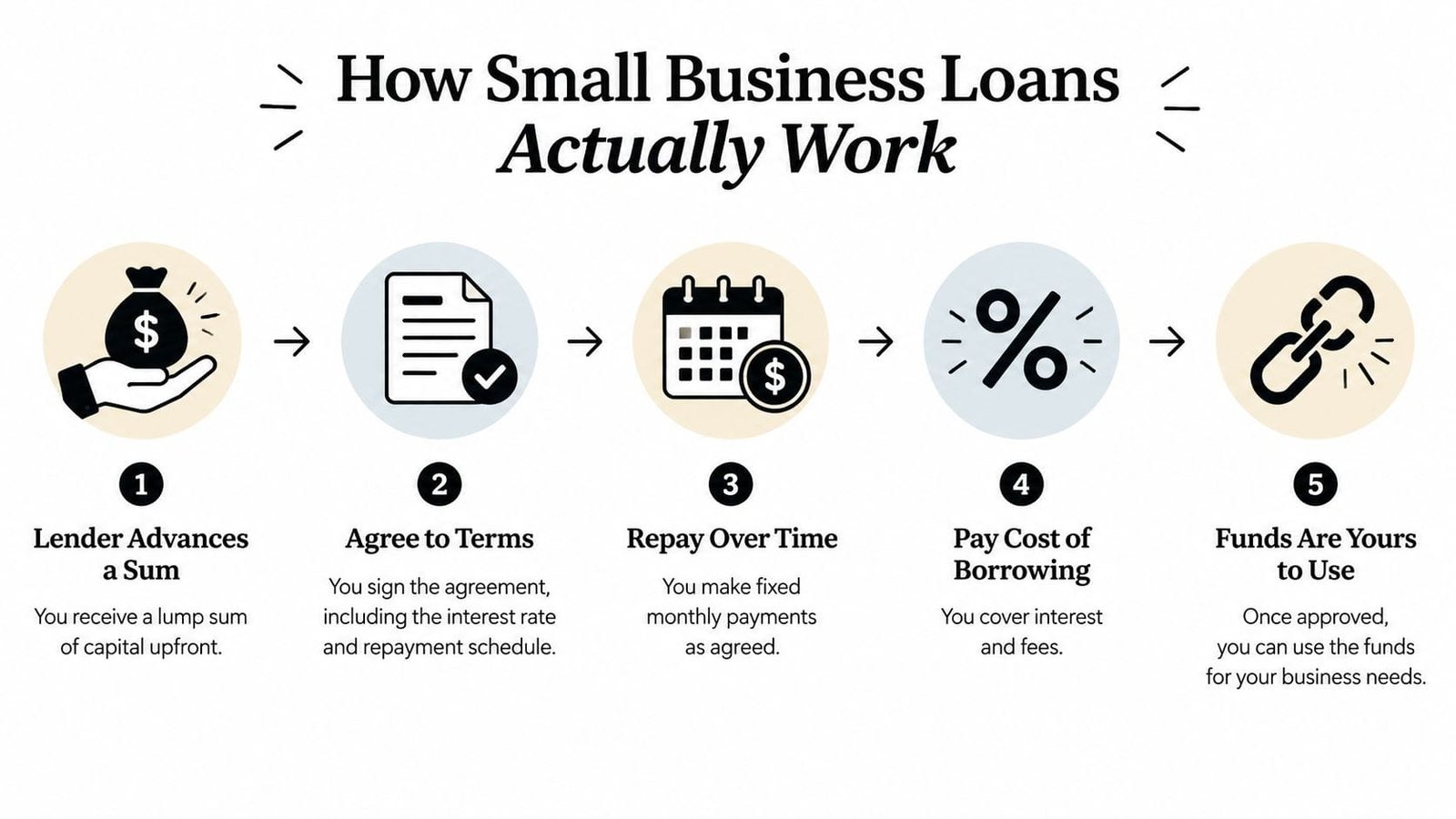
A small business loan is straightforward in principle. A lender advances money, or makes a credit limit available, and you repay the principal plus interest and fees under an agreed schedule. The lender may require business assets, a personal guarantee, or both, depending on the product and risk profile.
The application process is less mysterious when you view the lender as a skeptical co-signer. That person would ask three questions before putting their name behind you: Can the business repay? What supports the obligation if repayment fails? What evidence shows the owner manages risk responsibly?
From first inquiry to a lender decision
The funnel typically follows this sequence:
- Initial inquiry: You describe the amount, purpose, timing, revenue model, and business age. Some lenders can provide an early indication using a soft credit review.
- Formal application: You submit owner information, business details, financial statements, tax returns, bank statements, and a debt schedule.
- Credit review: A hard inquiry may occur once you authorize formal underwriting. The lender examines personal and business credit history, existing obligations, and repayment behavior.
- Underwriting: An analyst tests cash flow, debt capacity, collateral, industry exposure, and the stated use of funds.
- Term sheet and closing: The offer sets out the amount, rate or factor structure, fees, repayment schedule, guarantees, collateral, and conditions.
- Funding and repayment: After signing and satisfying closing requirements, funds are disbursed. You then make payments or remittances under the contract.
Traditional bank and SBA applications normally demand more documentation and move more slowly. Online lenders and fintechs often prioritize speed and automated bank-data analysis, but flexibility usually comes with a higher borrowing cost or shorter repayment window.
The SBA's fiscal year 2025 report illustrates the scale of one major lending channel. The agency guaranteed 84,400 small business loans totaling $44.8 billion through its 7(a) and 504 programs, including 77,600 7(a) loans worth $37 billion and 6,750 504 loans worth $7.8 billion. It also reported an average of about 1,600 guaranteed loans per week worth more than $860 million in that period. The SBA's fiscal year 2025 annual report shows that government-backed small business lending operates at substantial scale, not as a niche option.
Here's the practical takeaway: the lender isn't asking for paperwork for its own sake. Each document answers one of the co-signer's questions. Bank statements show actual cash movement, tax returns establish reported performance, the debt schedule reveals existing claims on cash flow, and the use-of-funds statement explains how the loan should produce or protect repayment capacity.
Main Loan Products and When Each One Fits
No product is universally good. A loan is useful when its payment pattern, speed, security, and cost match the business event it funds.
| Product | Best For | Typical Cost | Funding Speed |
|---|---|---|---|
| Term loan | A defined project, asset, or expansion | Usually lower than fast alternative products, with pricing based on credit, security, and lender | Slower than revolving or online options |
| SBA loan | Broad-purpose financing where lower cost and longer repayment justify documentation | Generally competitive, with lender pricing, guarantee fees, and closing costs | Usually slower because of detailed underwriting |
| Business line of credit | Uneven cash flow and recurring short-term needs | Interest applies to drawn funds, with pricing based on risk and lender | Often faster than a conventional term loan |
| Merchant cash advance | Urgent capital for a business with strong card receipts | Factor-rate pricing can be expensive because repayment is tied to future sales | Often very fast |
| Invoice financing or factoring | B2B companies waiting on customer invoices | Fees depend on invoice quality, customer credit, and time outstanding | Often quick once invoices are verified |
| Equipment financing | Vehicles, machinery, and revenue-producing equipment | Often supported by the asset, which can improve structure | Usually tied to vendor and asset verification |
Term loans for a defined investment
A term loan gives you a lump sum and predictable payments. Choose it for a service van, buildout, acquisition, or expansion with a clear budget and a return that can be explained.
Don't use a term loan to cover a recurring weekly shortfall. Fixed payments remain after the immediate crisis has passed, and that rigidity can make ordinary cash management harder.
SBA loans for patient, flexible capital
SBA-backed financing is my preferred starting point for an established owner who can tolerate a detailed process. The government guarantee can reduce lender risk, supporting competitive pricing and longer repayment structures, while the 7(a) program accommodates a broad range of business uses. The trade-off is documentation, lender review, and a timeline that rarely suits an emergency.
Owners comparing fixed-asset financing should understand the difference between the two principal programs. This SBA 7(a) and 504 comparison helps clarify which structure fits general-purpose funding versus major fixed assets.
Lines of credit for uneven cash flow
A line of credit is a reserve, not free money. You draw when needed, pay for the amount outstanding, repay, and potentially draw again under the agreement. It fits receivables timing, seasonal inventory, and unexpected operating expenses.
The advantage is control. The risk is leaving the facility permanently drawn and treating it as a substitute for adequate margins.
Merchant cash advances for speed at a steep price
A merchant cash advance can deliver funds quickly to a business with dependable card sales. Repayment commonly comes through a percentage of future receipts or scheduled withdrawals, and pricing is often expressed as a factor rate rather than an APR.
That distinction matters. Compare the total payback, expected repayment period, and effect on daily cash flow. Use this option only when the capital produces cash quickly enough to absorb the remittance.
Invoice financing for B2B receivables
If established customers pay slowly, invoice financing can release part of the invoice value before the customer pays. Factoring may also transfer collection responsibility, depending on the agreement.
Review recourse provisions, customer notification, reserve amounts, and what happens if an invoice is disputed. This is a receivables solution, not general-purpose growth capital.
Equipment financing for productive assets
Equipment financing is the right call when the borrowed funds purchase a specific asset that directly supports revenue. The asset typically provides security, and the repayment period can be aligned with its productive life.
For businesses evaluating bookkeeping, cash-flow planning, or finance operations alongside borrowing, scalable finance and accounting services can help organize the information lenders need before an application reaches underwriting.
What Underwriters Look At Before They Approve
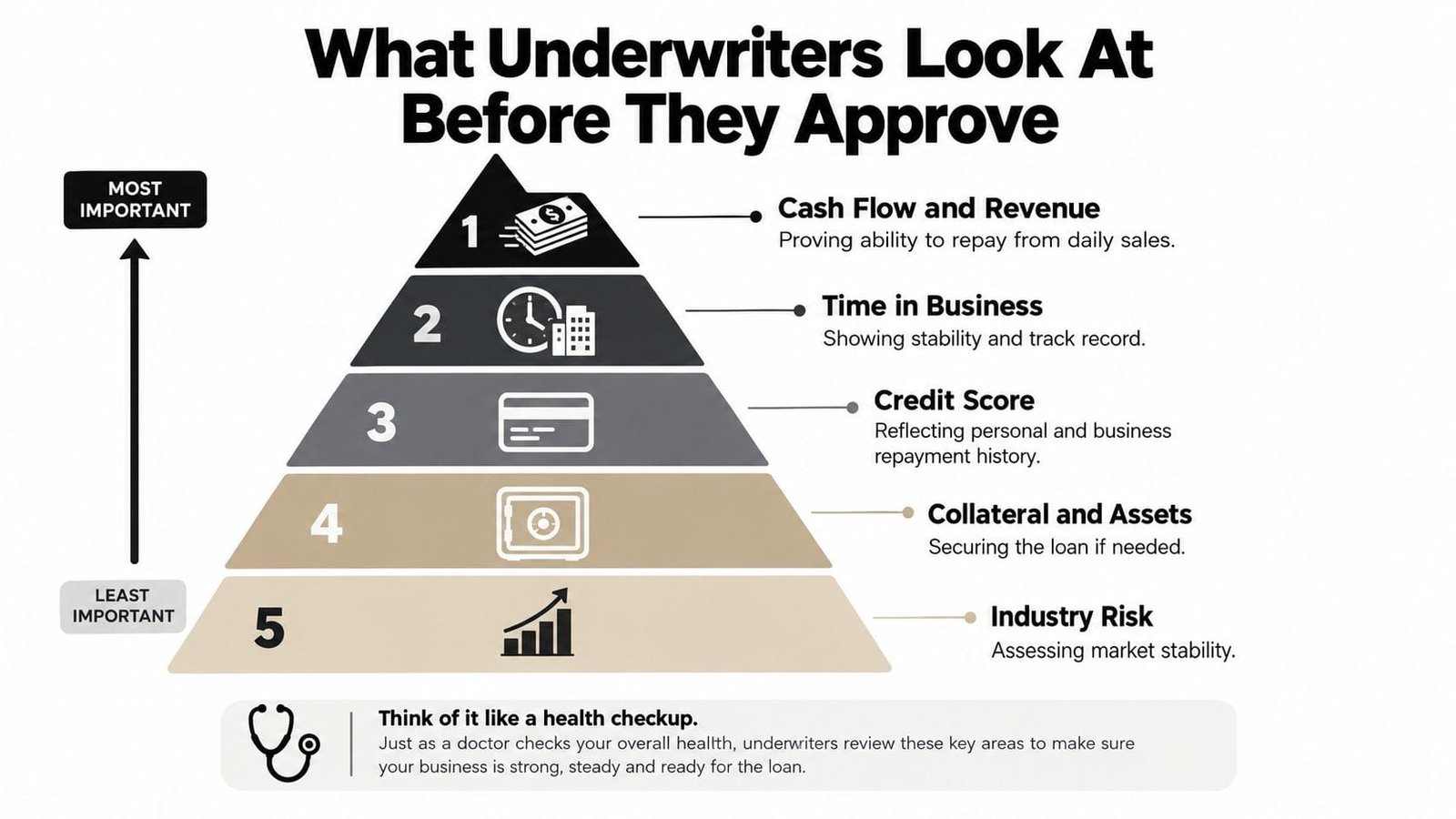
Underwriters read an application like a doctor reads a patient intake form. Credit blemishes and missing collateral matter, but they don't replace the vital signs. If the business can't demonstrate repayment capacity, a strong score won't rescue the file.
The precise order varies by lender, but experienced credit teams usually begin with operating cash flow and business stability, then examine credit, security, and industry exposure.
Cash flow and revenue
The first question is whether normal operations generate enough cash to cover current obligations and the proposed payment. Underwriters compare bank deposits, reported revenue, profit and loss statements, debt service, owner distributions, and cash balances.
Bring current statements, tax returns, and a defensible forecast. A lender won't accept a revenue projection that conflicts with deposits or has no explanation for uneven months.
Time in business
Operating history gives the lender evidence about customer demand, management decisions, seasonality, and resilience. A newer business may still qualify, but the owner usually needs a stronger personal profile, more security, or a lender designed for early-stage risk.
Credit history
Personal credit can matter heavily, especially when the company has limited business credit history. Underwriters look beyond the score for late payments, utilization, defaults, public records, and whether the owner has explained past problems transparently.
Pull reports before applying. Correct errors and prepare a concise explanation for legitimate setbacks.
Collateral and guarantees
Collateral gives the lender another recovery path. A personal guarantee makes the owner personally responsible if the business defaults, so don't treat it as routine wording. Ask which assets are pledged, whether a blanket lien applies, and what obligations survive a default.
Industry and customer concentration
Lenders assess whether the business operates in a volatile sector and whether one customer, contract, or channel produces too much revenue. Concentration creates repayment risk even when current sales look strong.
Underwriting insight: A denial often means the lender rejected the file structure, not the owner's entire business.
For a deeper explanation of how analysts test repayment capacity, collateral, and risk, review this guide to the business loan underwriting process.
Commercial bank data also show why lenders care about portfolio concentration. The delinquency rate on business loans at all commercial banks was 1.27% in Q2 2026, compared with 1.85% for banks outside the 100 largest in the Federal Reserve series. The FRED business-loan delinquency series indicates why smaller institutions may scrutinize borrower cash flow and collateral carefully when risk is concentrated across a narrower portfolio.
Matching the Right Loan to Your Business Situation
Consider an HVAC contractor that has operated for five years, serves steady commercial accounts, and needs $120,000 to add a crew and purchase a service van. The request combines expansion and equipment, but the contractor shouldn't fund the entire project with a merchant cash advance.
A term loan, equipment facility, or SBA 7(a) structure is more defensible. The contractor has operating history, identifiable assets, and commercial accounts that can support a repayment narrative. A relationship lender, such as a credit union or community bank, should review the request before an online lender because the business has enough substance to justify fuller underwriting.
The second example is a specialty food brand that has operated for two years and needs $40,000 to build inventory before the holiday selling period. This is a timing need with a defined repayment event, not a permanent asset purchase.
A business line of credit is the first choice. Invoice financing may fit if wholesale customers have approved invoices, while a short-term facility could work if the brand can show reliable post-season receipts. A long-term term loan is the wrong tool because it keeps the owner paying after the inventory cycle ends. An expensive cash advance may also consume the very sales revenue needed to replenish stock.
| Scenario | Chosen Product | Lender Type | Typical APR Range | Term Length | Why Alternative Was Rejected |
|---|---|---|---|---|---|
| HVAC contractor expanding with a crew and van | Equipment financing combined with a term loan or SBA structure | Community bank, credit union, or SBA-approved lender | Depends on credit, collateral, guarantees, and lender pricing | Match the asset and expansion repayment period | A merchant cash advance can divert operating receipts and is poorly suited to a durable asset |
| Specialty food brand preparing seasonal inventory | Business line of credit | Community lender, credit union, or online lender with seasonal underwriting | Depends on draw history, revenue consistency, and lender risk | Revolving access through the inventory cycle | A long term loan remains outstanding after the seasonal need, while factoring requires eligible receivables |
The matching framework is simple:
- Need money for a defined asset or project? Start with equipment financing or a term loan.
- Need flexible access during uneven months? Start with a line of credit.
- Need to turn unpaid B2B invoices into capital? Examine invoice financing.
- Need broad-purpose capital and can handle documentation? Explore SBA financing.
- Need funds immediately and have strong card receipts? Consider a cash advance only after calculating total payback and daily impact.
Why Most Applicants Get Denied or Under Funded
Approval isn't the only outcome to analyze. Federal Reserve survey data indicate that 42% of small business financing applicants received the full amount requested, while another 25% were partially approved. The survey summary covering the Federal Reserve's 2025 Small Business Credit Survey shows why a signed offer can still leave an owner unable to complete the planned project.
A separate 2026 survey summary says 54% of applicants were denied or received less than requested, and Treasury notes that women- and minority-owned firms face higher denial rates even after controlling for similar risk profiles. This overview of small business lending access highlights the problem many guides avoid: creditworthy owners can still receive an inadequate offer because the file, lender, or requested structure doesn't fit.
The frequent file problems
The lender doesn't fit the profile. A seasonal retailer applying to a rigid bank may get a worse result than the same retailer approaching a lender that understands seasonal deposits. Corrective move: compare lender requirements before authorizing a hard pull.
Financial statements are stale or incomplete. Underwriters can't validate current performance from old reports alone. Corrective move: produce current profit and loss statements, reconcile bank deposits, and explain major variances before submitting.
Customer concentration is hidden. A business dependent on one account may look profitable but fragile. Corrective move: disclose concentration and provide contracts, payment history, and a plan for diversification.
Personal and business credit tell different stories. Strong revenue doesn't erase recent personal delinquencies or excessive utilization. Corrective move: review credit reports, correct errors, and reduce avoidable balances during the preparation period.
The request exceeds repayment capacity. Owners often ask for the amount needed to complete the dream rather than the amount current cash flow can support. Corrective move: phase the project, contribute equity, or request a smaller first facility.
Partial approval isn't usually a negotiating tactic. It signals that the lender sees a viable business but limited capacity, collateral, or evidence. Read the offer as diagnostic information, not as permission to stack another expensive loan on top of the first.
For SBA-specific denial patterns and corrective actions, use this guide to common reasons SBA loans get denied.
A Practical Checklist for Choosing and Applying Smart
Start with the cash-flow math, not an application form. Write down the amount required, the date funds must arrive, the exact use of proceeds, and the payment the business can absorb in a weak month. If you can't explain how the loan will be repaid, you aren't ready to borrow.
Prepare a lender-ready file
Gather:
- Tax returns: Provide the business and owner returns the lender requests.
- Current profit and loss statement: Make sure it reconciles with actual bank activity.
- Balance sheet: Show assets, liabilities, and owner equity clearly.
- Business bank statements: Include the recent operating history required by the lender.
- Debt schedule: List every lender, balance, payment, maturity, and guarantee.
- Use-of-funds statement: Name each planned expenditure and explain how it protects or produces cash flow.
- Legal and ownership documents: Keep licenses, formation records, leases, and ownership details accessible.
A structured intake can reduce missing fields and inconsistent answers when several people contribute to the application. Teams building their own workflow may find a loan form builder for teams useful for standardizing requests and document collection.
Choose the lender after choosing the need
Approach a bank or credit union for established businesses seeking lower-cost, relationship-based financing. Consider an SBA-approved lender for broad-purpose capital when the business can support extensive documentation. Online lenders can make sense when speed matters and the owner has compared total cost, while community development financial institutions may offer more context-sensitive underwriting for borrowers underserved by conventional channels.
Ask every lender about prepayment penalties, personal guarantees, UCC filings, collateral releases, payment frequency, late fees, renewal conditions, and total payback. A low advertised payment can conceal a short term or expensive fee structure.
Walk away when the APR exceeds the return the project can reasonably produce, the term extends beyond the useful life of the asset, or the salesperson pressures you to sign before you understand the agreement. Verify the provider's licensing where applicable, review its BBB profile as one screening input, check complaints and contract disclosures, and have counsel review unusual guarantees or security provisions.
Business Loan Warrior offers a single application for owners seeking matched funding options, including business loans, SBA processing, lines of credit, equipment financing, invoice financing, and merchant cash advances. Visit Business Loan Warrior to compare a funding path against your cash-flow need, prepare the file, and move forward only when the repayment structure makes sense.