
Your commercial customer says the payment is coming in 60 days. Payroll is due Friday, the supplier wants payment before delivery, and a $40,000 cash-flow gap is turning a profitable job into an immediate threat.
That's the position many owners face. A 14-employee HVAC contractor can win a $90,000 retrofit contract, have the skills and demand to complete it, and still lack enough cash for two weeks of wages and materials. The problem isn't weak sales. It's the timing mismatch between outgoing costs and incoming receivables.
Small dollar loans can bridge that gap when the repayment source is clear and the amount fits the business. But the products aren't interchangeable. A microloan, installment loan, merchant cash advance, and invoice facility each solve a different cash-flow problem, and choosing the wrong one can turn a short delay into expensive debt.
Table of Contents
- The Cash-Flow Gap Small Dollar Loans Were Built to Fix
- What Small Dollar Loans Mean for a Small Business
- The Four Main Types and When Each One Fits
- True Cost of Small Dollar Business Funding
- Eligibility and the Documents Lenders Actually Want
- When to Use a Small Dollar Loan and When to Walk Away
- Preparing to Apply Without Hurting Your Credit
- How a Fintech Matchmaker Simplifies the Whole Journey
The Cash-Flow Gap Small Dollar Loans Were Built to Fix
The HVAC contractor has three choices. It can delay the project and risk damaging a valuable customer relationship, ask suppliers for terms they may not grant, or find capital quickly enough to cover the work until the commercial invoice is paid. Waiting 60 to 90 days for a conventional approval may be sensible for expansion, but it doesn't solve Friday's payroll.
That's where a small dollar business loan earns its place. The loan isn't meant to finance an entire company or cover years of growth. It bridges a specific, temporary gap, ideally one connected to a purchase order, signed contract, invoice, or predictable seasonal sales cycle. Owners should first map the inflows and outflows in a practical cash-flow improvement plan before borrowing.
The market has moved toward smaller business funding
The SBA's recent 7(a) activity reinforces the point. In fiscal year 2025, 81% of approved 7(a) loans were $500,000 or less, and more than half were $150,000 or less, according to Independent Banker's coverage of small-dollar SBA loans. Businesses aren't always seeking a large expansion check. Many need modest working capital to buy inventory, repair equipment, or complete a contracted job.
The practical issue is speed versus cost. An SBA-backed product may offer more affordable long-term repayment, but the process can take longer. A fintech product may move faster, but the price and repayment mechanics demand much closer scrutiny.
Funding rule: Borrow against a named repayment event, not against hope that next month will be better.
This guide focuses on four routes: microloans, short-term installment loans, merchant cash advances, and invoice financing. The right choice depends on whether your cash arrives through ordinary operating revenue, card receipts, or unpaid B2B invoices.
What Small Dollar Loans Mean for a Small Business
A small business usually uses small dollar loans for working capital below $150,000, often for far less. That range now represents a meaningful part of the SBA 7(a) pipeline. The amount alone, however, tells you little about the deal. A bank-backed loan, fintech installment product, invoice facility, and merchant cash advance can carry very different costs, contracts, and repayment demands.
The borrower and the repayment source determine what the financing really is. Consumer small-dollar products address household emergencies, personal bills, or short-term income gaps. Business funding is tied to commercial revenue, business assets, unpaid invoices, card receipts, or the owner's commercial obligations.
Start with the borrower and repayment source
Before comparing offers, identify the contract you are signing. It may be a commercial loan agreement, a revenue-purchase contract, or a security agreement. The quoted price may appear as an interest rate, APR, fee, or factor rate. Those figures do not measure the same thing. Ask for the total repayment, payment schedule, and conditions that can increase the cost.
Consumer safeguards do not automatically apply to commercial borrowing. The FDIC small-dollar loan pilot covered loans of $2,500 or less, APRs of 36% or less, minimal fees, efficient underwriting, and terms of 90 days or more, according to the Congressional Research Service report on the FDIC pilot. Those parameters describe a consumer-focused pilot. They are not a universal limit on business financing.
| Attribute | Business Small Dollar Loan | Consumer Small Dollar Loan |
|---|---|---|
| Primary purpose | Working capital, equipment, inventory, or invoice timing | Household emergency or short-term liquidity |
| Repayment source | Business revenue, receivables, or card receipts | Personal income or deposits |
| Common pricing language | APR, interest, fees, or factor rate | Usually APR and disclosed fees |
| Underwriting | Bank activity, revenue, business history, and owner credit | Income, expenses, deposit history, and consumer credit |
| Main risk | Expensive repayment can consume operating cash | Payment stacking, fees, or repeated borrowing |
The business label does not make costly funding affordable. Review payment frequency, total repayment, personal guarantees, collateral, and default provisions. Match the product to the way your revenue arrives. If the lender will not explain those terms plainly, reject the offer. A fintech matchmaker should route you toward the structure that fits your revenue cycle, not the fastest approval.
The Four Main Types and When Each One Fits
Treat these products as tools, not as a menu of interchangeable offers. The best match depends on the timing of your revenue, the stability of deposits, and whether you can tolerate daily or weekly payments.
| Loan Type | Typical Amount | Typical APR / Factor | Term | Best Use Case |
|---|---|---|---|---|
| Microloan | $500 to $50,000 | 8% to 13% APR | One to five years | Startups, owner-operators, and patient working capital |
| Short-term installment loan | $5,000 to $150,000 | About 20% to 45% APR | Three to 24 months | One-time equipment, inventory, or marketing expense |
| Merchant cash advance | Based on future card receipts | 1.10 to 1.45 factor rate | Usually tied to receivables | High, predictable card volume |
| Invoice financing | 80% to 95% of eligible receivables | Fee or discount structure | Until invoices are collected | B2B firms waiting on net-60 to net-120 invoices |
Microloans suit patient capital
SBA intermediaries and CDFIs are the natural starting points when you need a relatively modest amount and can handle a longer application. A microloan can fit a new owner buying tools, a food business purchasing initial inventory, or a service company funding a measured launch.
The trade-off is time. This is usually not the product for tomorrow's payroll crisis.
Installment loans fit one defined expense
A short-term installment loan works when you can point to one purchase and estimate the resulting cash generation. A commercial refrigerator, urgent vehicle repair, or targeted marketing campaign may qualify. Fixed payments make budgeting easier than a variable draw, but the repayment schedule still needs to fit the business's weakest months.
Owners comparing alternatives can use a broader guide to alternative business loans to distinguish fixed-payment financing from revolving and receivables-based products.
MCAs only fit dependable card revenue
An MCA exchanges a lump sum for a larger agreed repayment collected through a percentage of future card receipts or another collection method. It can move quickly, but the effective cost can become severe, especially when repayment is collected daily and sales soften.
Use it only when card volume is strong, consistent, and directly connected to the repayment plan. A business with uneven invoices or thin margins shouldn't use card-based repayment merely because approval is easy.
Invoice financing solves a customer-payment delay
Invoice financing is more logical for a wholesaler, agency, contractor, or other B2B firm with valid invoices and reliable commercial customers. The lender advances part of the receivable, then settles the balance after collection, less its charges.
It doesn't fix weak demand or disputed invoices. It fixes a timing problem between completed work and customer payment.
True Cost of Small Dollar Business Funding
A $50,000 advance can keep payroll current, but its repayment can also create the next cash-flow gap. Judge an offer by the total dollars leaving the business, the withdrawal frequency, and the cash remaining after each payment. The product must fit the company's revenue cycle, not offer the fastest approval.
The FDIC pilot provides a useful affordability reference for product design. It emphasized APRs of 36% or less, loans at or below $2,500, limited fees, and terms of at least 90 days. Business funding is not governed by that pilot, yet owners can use those principles to spot a short-term obligation that has become punitive.
Factor rates hide the time dimension
A factor rate shows total payback, not the annualized cost. A 1.15 factor on a $50,000 advance requires $57,500 in repayment before additional fees. Repaying that amount over six months costs more on an annualized basis than spreading the same payback across a year.
The same problem applies to a 1.18 factor. Daily or weekly withdrawals can strain a company that collects invoices slowly, even when the quoted factor looks manageable. Review the difference between APR and interest rate before comparing a factor-rate offer with a conventional loan.
Fees can change the decision
Read every line item before signing:
- Origination fee: Deducted before funding or added to the balance.
- Maintenance fee: Charged monthly, including during weak revenue periods.
- ACH fee: Applied to automated withdrawals or failed payments.
- Prepayment term: Early repayment may not reduce the total cost.
- Guarantee and default language: May expose personal assets or accelerate the balance.
The comparison below uses only the stated terms. The installment loan's payment and interest use standard amortization. The MCA shows contractual payback, not a universal APR, because its annualized cost depends on the repayment schedule and collection method.
| Cost Component | $50,000 Microloan, 24 mo | $50,000 MCA, 10 mo |
|---|---|---|
| Principal or advance | $50,000 | $50,000 |
| Quoted price | 12% annual interest | 1.18 factor |
| Total payback | About $56,390 | $59,000 |
| Approximate scheduled payment | About $2,350 monthly | About $5,900 monthly |
| Other fees | Review contract | Review contract |
| Main concern | Monthly affordability | High repayment intensity |
Read the payment first: If the scheduled withdrawal would force you to borrow again for ordinary expenses, reject the offer. It is extending the cash-flow gap, not fixing it.
Eligibility and the Documents Lenders Actually Want
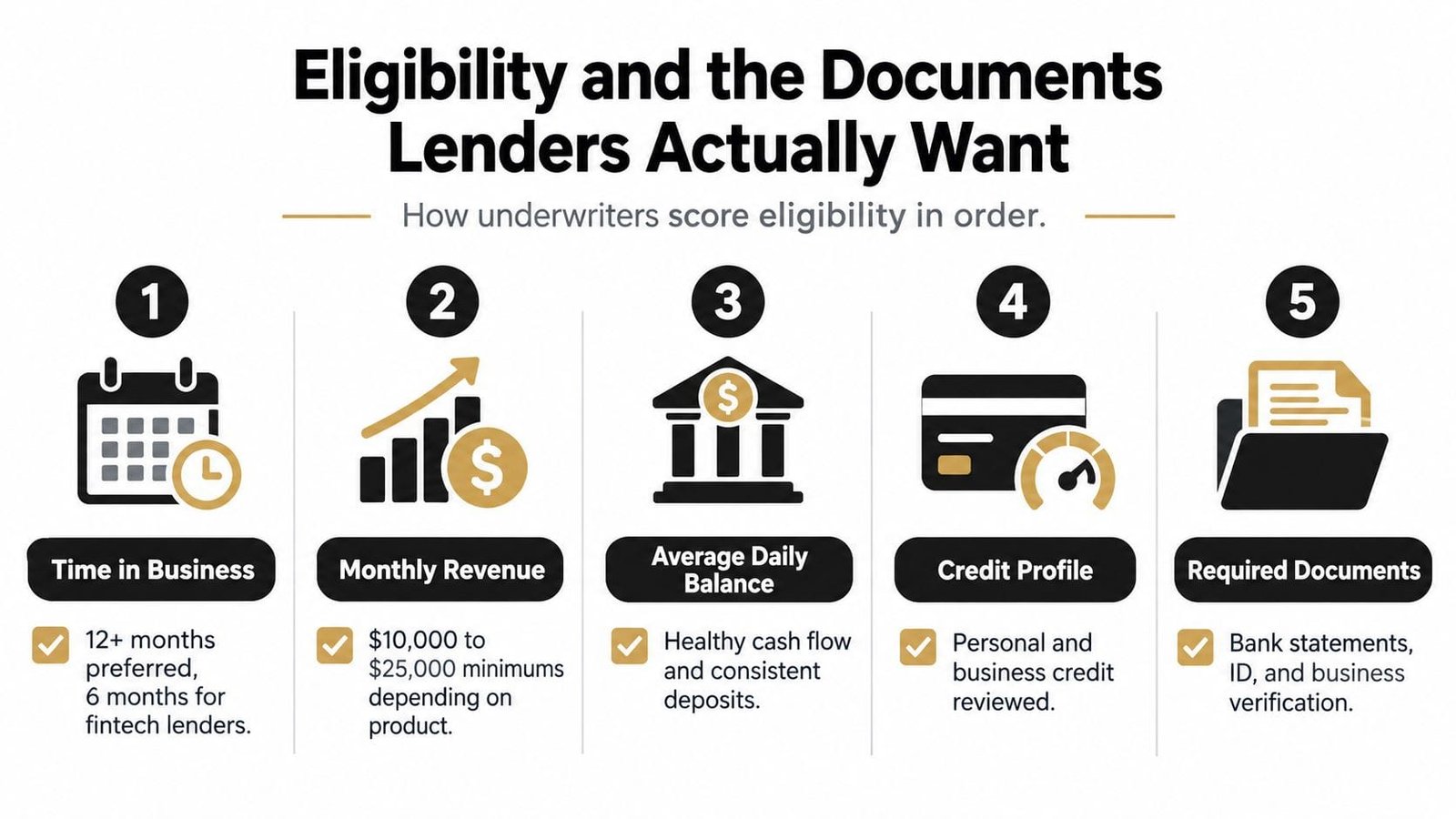
Underwriters usually start with operating history and revenue, then inspect bank activity and owner credit. Don't begin by filling out every application you can find. First determine which product your cash flow can support.
A lender may prefer 12 or more months in business, while some fintech products consider younger companies. Revenue requirements vary by product, and the lender will also examine the average daily bank balance. That balance is a practical health check. Consistent deposits with frequent negative days tell a different story from the same monthly revenue held with operating cushion.
Prepare the file before the application
Have these documents ready in one folder:
- Bank statements: Provide the requested recent months as PDFs, not screenshots.
- Tax records: Gather business returns, or 1099 records for a sole proprietor.
- Profit and loss statement: Make sure it matches the bank activity and tax story.
- Business verification: Include articles of incorporation, an LLC record, or DBA.
- Identity and funding details: Prepare government ID and a voided check.
Fix avoidable red flags
Recent NSF activity can make an otherwise profitable business look unstable. Tax liens, unexplained owner draws, and deposits that don't match reported revenue also create friction. Explain unusual transactions before the lender has to ask.
Owner credit still matters, especially for newer companies without a deep commercial credit file. Check the application for consistency. A clean package won't guarantee approval, but a disorganized one can undermine confidence before the lender evaluates the actual opportunity.
When to Use a Small Dollar Loan and When to Walk Away
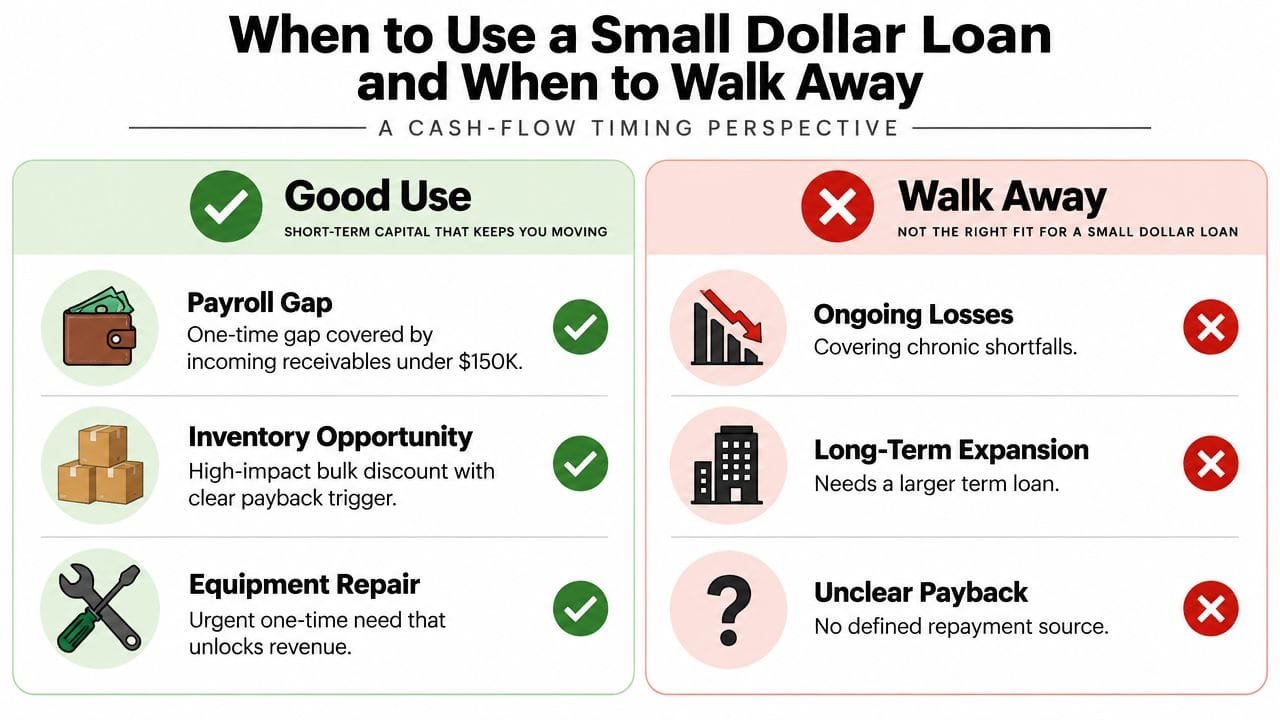
The decision is about cash-flow timing, not loyalty to a particular product. Borrowing makes sense when one event creates a temporary need and another identifiable event will repay the debt.
Good examples include payroll before a confirmed receivable, inventory purchased for a seasonal demand curve, or an equipment repair that immediately restores billable capacity. Each has a defined purpose, a limited amount, and a repayment trigger.
Walk away from structural problems
Don't use short-term capital to cover recurring losses, owner withdrawals, or a business model that can't produce enough cash to service debt. A loan can delay a hard decision, but it can't create a sustainable margin.
Consider a line of credit when the need will recur over multiple months and you can draw and repay repeatedly. Consider an SBA 7(a) loan when the business can wait for a longer process and needs a more durable structure. Revenue-based financing may fit a company with fluctuating sales better than a fixed daily withdrawal, but compare the full payback and revenue-share mechanics.
Owners who are still defining their funding strategy can also review resources on how to raise capital with live metrics, especially when lenders need evidence that the requested capital connects to measurable operating activity.
Borrowing test: Name the gap, name the repayment source, and name the date or event that closes it. If you can't do all three, pause.
Preparing to Apply Without Hurting Your Credit
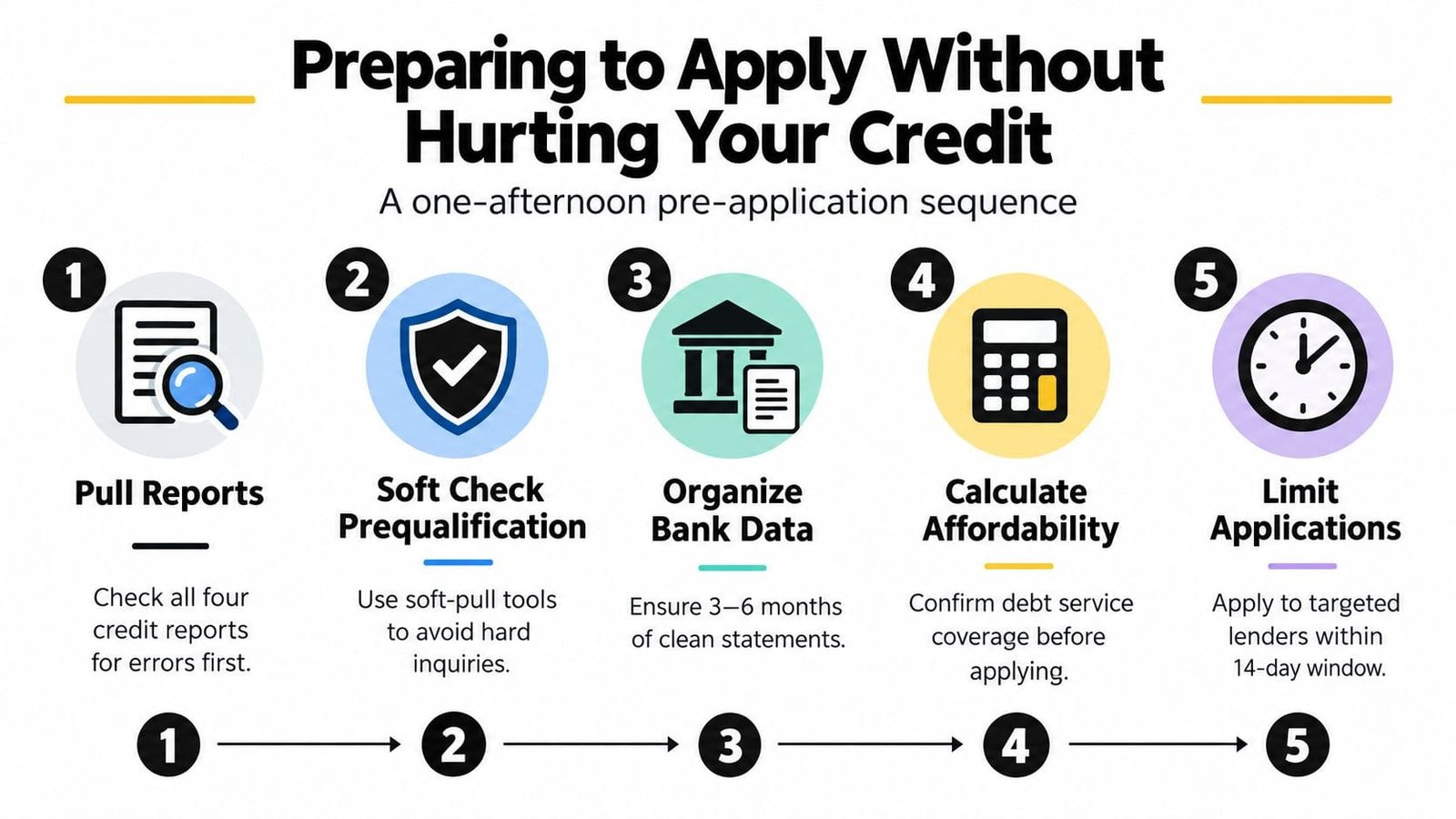
You can improve your application in one afternoon without submitting a stack of blind applications. The objective is to understand your own cash flow before a lender evaluates it.
- Consolidate bank data. Put recent business bank statements into one readable PDF. Calculate average monthly revenue and identify the lowest daily balance.
- Use soft-pull prequalification. Ask lenders whether the first review uses a soft inquiry. Prequalification can help you compare likely pricing without immediately authorizing a hard pull.
- Review credit files. Check personal and business reports for incorrect balances, outdated accounts, or identity errors. Business owners should pay attention to commercial scoring products such as Experian Intelliscore Plus, Paydex, and FICO SBSS where applicable.
- Stage supporting records. Keep your ID, voided check, profit and loss statement, tax records, and business formation documents together.
- Limit targeted applications. Apply only after you understand the product, payment, and repayment source. Ask how the lender handles inquiries and whether a bank connection is current.
Multiple applications can create unnecessary hard inquiries, particularly when owners submit forms across unrelated lenders. Outdated bank connections can also return revenue figures that don't match the statements you provide. Resolve those issues before you ask for a final offer.
A matchmaker can be useful here because it may compare soft-pull options across multiple products in one sitting. That doesn't remove the need to read the contract, but it can reduce the lender-by-lender guesswork.
How a Fintech Matchmaker Simplifies the Whole Journey
The traditional approach is repetitive. An owner fills out one form for a bank, connects accounts for an online lender, uploads statements to a broker, and still has to compare offers with different pricing conventions.
A fintech matchmaker compresses that process. You complete one application, connect business bank data through a secure process, and let the platform assess potential product matches. The useful output isn't a generic approval. It's a ranked comparison that makes the trade-offs visible.
What a useful matching process should show
Look for a workflow that presents:
- Product fit: Whether the offer is an SBA microloan, installment loan, line of credit, invoice facility, or revenue-based product.
- Repayment mechanics: Monthly, weekly, daily, percentage of receipts, or invoice settlement.
- Comparable pricing: Factor rates translated into an understandable total cost or APR equivalent where possible.
- Contract exposure: Personal guarantees, collateral, confession-of-judgment language, default triggers, and prepayment terms.
- Human follow-up: A clear way to ask the underwriter how the offer fits the business's revenue cycle.
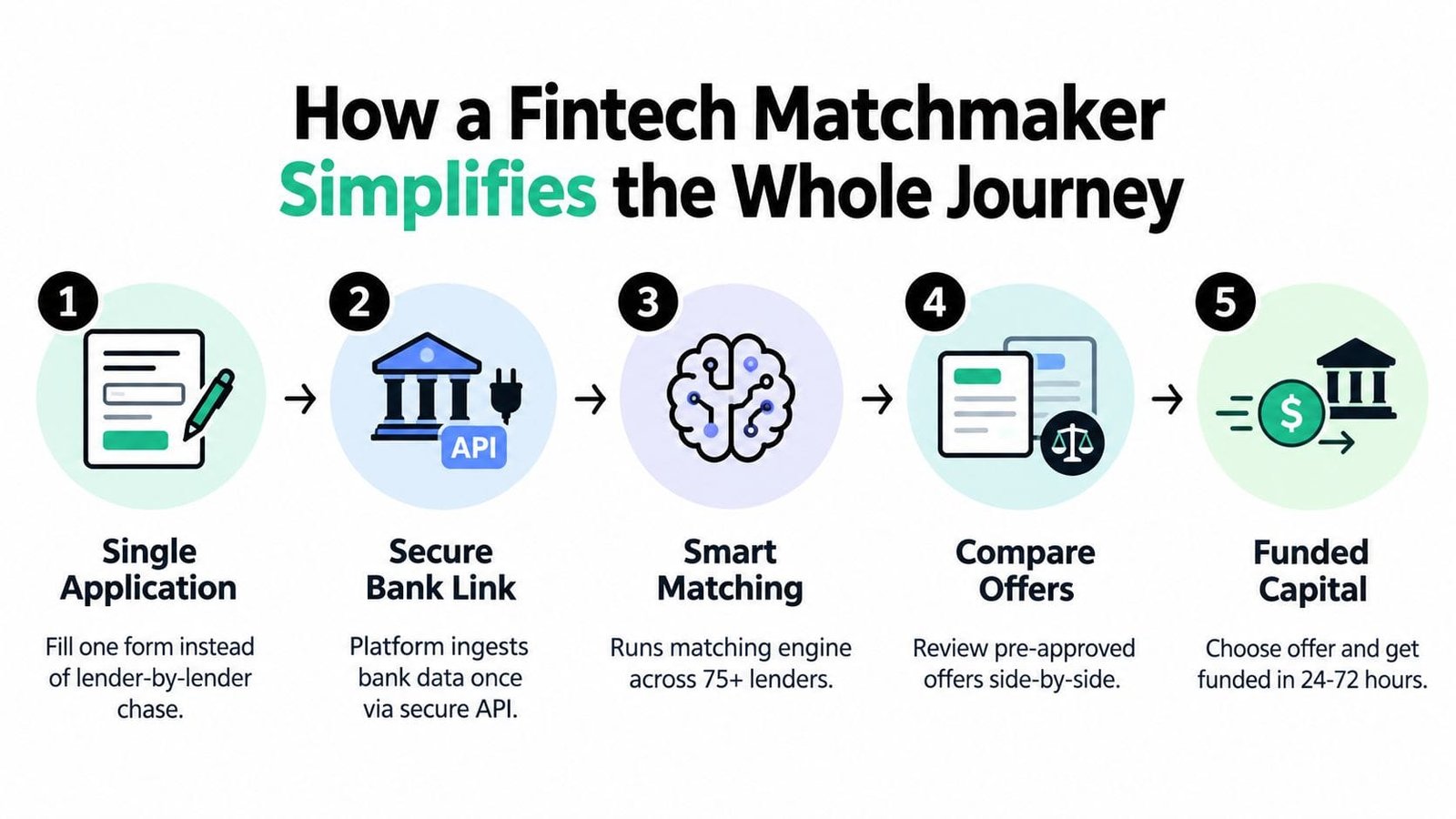
Business Loan Warrior is one example of this model. Its application supports requested amounts below $10,000, offers pre-approval checks without affecting credit, connects bank accounts, and provides a dashboard for approvals, repayments, credit insights, and communication with underwriters. It also handles several funding categories, including SBA processing, lines of credit, equipment finance, merchant cash advances, and invoice financing.
The platform doesn't eliminate the core decision. You still need to compare the total repayment with the cash the business will retain after debt service. Its value is in routing the application toward products that match the revenue cycle, then putting the terms in front of you quickly enough to make a deliberate choice.
If your company faces a short-term gap, start with the repayment source and work backward. Don't accept the fastest offer until you know its total cost, withdrawal schedule, and consequences if sales arrive late.
Business Loan Warrior offers a single application for comparing business funding, including small dollar loans, SBA options, lines of credit, equipment financing, and invoice financing. Submit your information to check potential matches without an automatic credit hit, then visit Business Loan Warrior to review funding options that fit your actual cash-flow cycle.