
You’re probably doing this right now. You post when you can, disappear when work gets busy, then wonder whether social media is helping your business or just stealing hours you can’t afford to lose. You know customers check your pages. You know an inactive profile makes the business look flat. But likes don’t cover payroll, and a few comments don’t make your company easier to fund.
That’s the core problem with most social media advice for small businesses. It treats social as a branding hobby. A serious owner needs it to do two jobs: bring in revenue and strengthen the business on paper. If your profiles show demand, consistency, customer satisfaction, and professional follow-through, they stop being just marketing channels. They start acting like business assets.
Table of Contents
- From Time-Sink to Tangible Asset
- Choosing Platforms That Drive Business Goals
- Your Simple Content Calendar for Consistent Growth
- Smart Organic Growth Without the Ad Spend
- A Practical Guide to Your First Paid Ad Campaign
- Turning Social Proof into a Loan Application Asset
- Your Blueprint for a Profitable Social Strategy
From Time-Sink to Tangible Asset
Most owners treat social media like unpaid extra labor. That’s why it feels frustrating. You’re trying to run operations, manage cash flow, deal with staff, and close sales. Then somebody tells you to “post more Reels.”
That advice misses the point. Social media isn’t valuable because it exists. It’s valuable when it proves your business is active, trusted, and capable of turning attention into revenue.
That matters because social media is no longer optional. Approximately 96% of small businesses globally now use social media as a core part of their marketing in 2026, up from just 12% in 2011, according to these small business social media adoption figures. When nearly everyone is on social, having an account doesn’t set you apart. The differentiator is whether your presence is organized, credible, and tied to business outcomes.
Practical rule: Stop asking, “What should I post?” Start asking, “What would a customer and a lender learn if they reviewed my last 20 posts?”
That question changes everything. A sloppy feed suggests a sloppy operation. A consistent feed with real customer activity, visible demand, and clear offers suggests a company that manages itself well.
You also need a system that doesn’t eat your week. If posting manually keeps breaking down, use a workflow built around effective social media automation so your content runs on a schedule instead of on your stress level.
Here’s my view. For social media small businesses, the right standard isn’t popularity. It’s utility. Your pages should help you sell, help you stay visible, and help a financing partner see that your business is real, active, and worth backing.
Choosing Platforms That Drive Business Goals
The fastest way to waste time is trying to win on every platform. You won’t. Small businesses rarely lose because they picked the “wrong app.” They lose because they spread weak effort across too many channels.
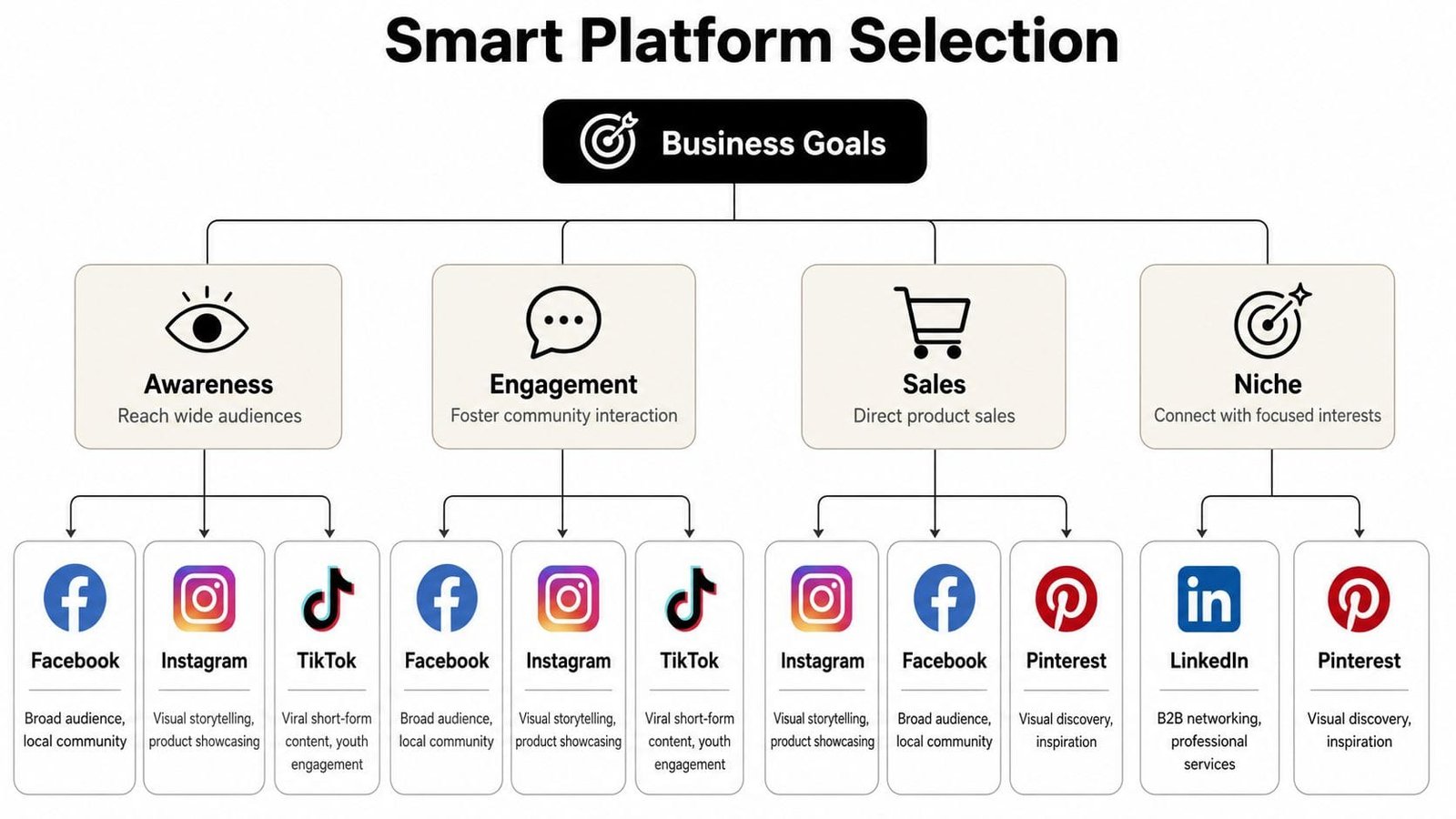
Pick one core platform and one support platform
Start with the business model, not the trend.
If you run a local service business, your social channel needs to answer basic buyer questions fast. Can this company do the job? Does it serve my area? Can I trust it? Facebook and Instagram usually handle that well because they support reviews, local credibility, before-and-after visuals, direct messages, and community visibility.
If you sell to other businesses, LinkedIn often pulls more weight than visually driven platforms. Buyers there expect expertise, proof, and professional communication. A commercial cleaning company, CPA firm, or logistics consultant doesn’t need viral entertainment. It needs authority.
If your business lives on visual appeal, Instagram and Pinterest can carry more of the load. A bakery, interior designer, boutique retailer, or med spa benefits from image-first discovery and portfolio-style content.
Use this simple filter:
| Business goal | Better platform fit | Why it works |
|---|---|---|
| Local inquiries | Facebook, Instagram | Good for location-based trust and direct contact |
| Visual product sales | Instagram, Pinterest | Strong product presentation and browsing behavior |
| B2B lead generation | Professional context and authority-building | |
| Community engagement | Facebook, Instagram | Better for comments, tags, and ongoing interaction |
Match the platform to the buying behavior
Don’t ask where your audience hangs out. Ask how they buy.
A roofer doesn’t need broad awareness from strangers across the country. That owner needs local homeowners who are ready to compare options. A specialty food brand may need visual storytelling because the purchase starts with appetite and presentation. A business coach may need LinkedIn because the sale begins with credibility.
If the platform doesn’t support the way your customer makes a decision, it’s a distraction.
One more thing. Platform choice should also help you document business quality. A restaurant can use Instagram to show packed nights, menu consistency, and customer experience. A law firm can use LinkedIn to share insights, wins, and community presence. Different channels. Same underlying purpose. Public proof that the business is active and trusted.
For social media small businesses, precision beats volume. One strong platform with regular activity and clean branding is more valuable than four neglected accounts with mismatched content.
Your Simple Content Calendar for Consistent Growth
Most businesses don’t have a content problem. They have a decision fatigue problem. Every day starts with the same question: what do we post today? That’s why consistency collapses.
A simple calendar fixes it.
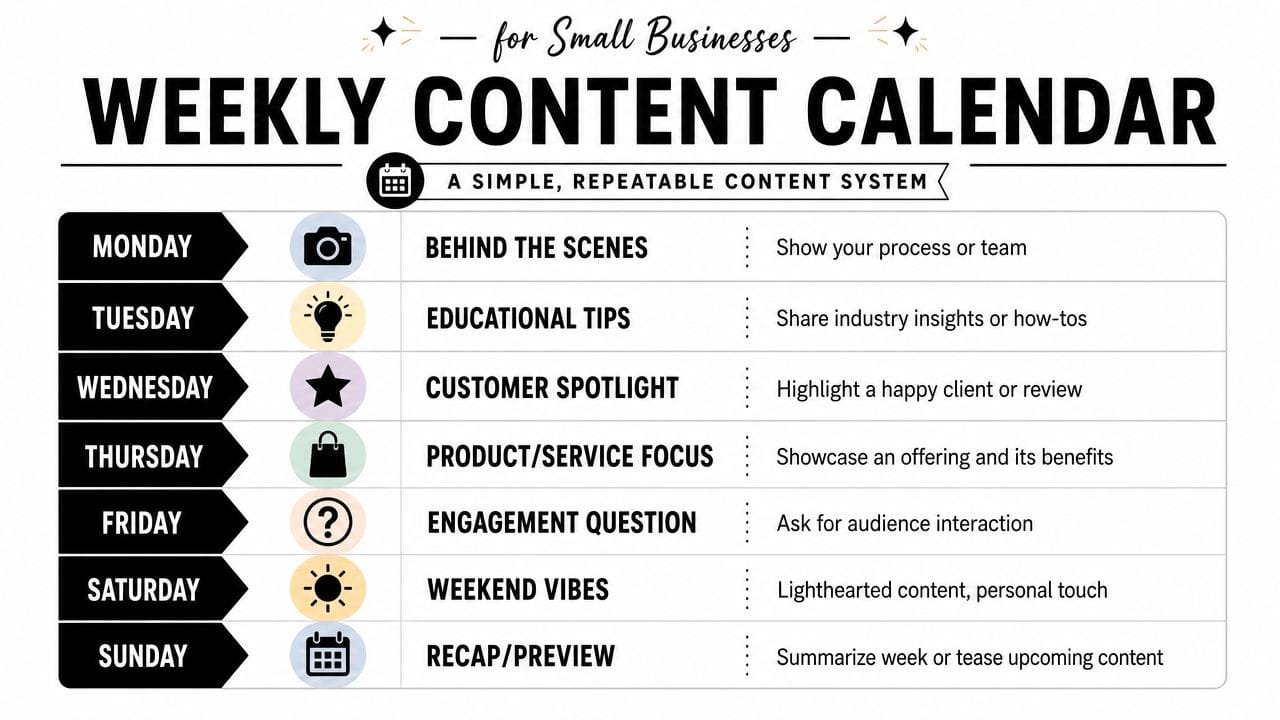
A practical method for improving ROI is to post 3 to 4 times weekly with platform-specific themes and review results every 30 days to repeat the top 2 to 3 posts. That cadence is realistic for most owners. It’s frequent enough to show life, but not so aggressive that it turns into busywork.
Use a weekly rhythm you can actually sustain
You don’t need a genius-level strategy. You need repeatable categories.
Try this weekly structure:
-
Monday proof post
Show completed work, a finished product, a cleaned-up job site, a plated dish, or a client result. This is your evidence post. -
Wednesday expertise post
Share one tip customers always ask about. A landscaper can explain seasonal upkeep. A dentist can address a common concern. A retailer can show how to choose between two products. -
Friday behind-the-scenes post
Put the people and process on camera. Team prep, packaging, inventory, setup, quality checks. This signals stability and professionalism. -
Optional weekend community post
Repost a customer tag, celebrate a team moment, or mention a local event. Keep it light and human.
This structure works because it covers the three things people need before buying: proof, competence, and trust.
Build one month of content in one sitting
Batching is how busy owners stay visible.
Set aside one afternoon. Walk the shop, office, warehouse, kitchen, truck, or job site with your phone. Capture short clips, a few photos, and customer-safe moments from the week. Then organize them into folders labeled Proof, Tips, Behind the Scenes, and Community.
Use a checklist like this:
- Collect visuals from recent jobs, products, and customer interactions.
- Write short captions that answer one question or highlight one result.
- Schedule the posts for the next four weeks.
- Assign inbox duty so someone replies to comments and messages consistently.
- Review monthly and keep using what produced inquiries or conversations.
If your team needs help staying organized across tools, approvals, and workflows, this roundup of small business essential tech tools is a useful operational companion.
Here’s the bigger point. A content calendar isn’t just a marketing convenience. It creates visible consistency. Anyone checking your business, including a lender, sees signs of routine, responsiveness, and active demand.
A page with a posting pattern feels like a business with operating discipline.
That’s the hidden value. Consistency tells the market you didn’t disappear. It also tells anyone evaluating your business that your customer pipeline doesn’t depend on luck.
Smart Organic Growth Without the Ad Spend
Organic growth still matters because it produces the kind of evidence paid traffic can’t fake. Real comments. Real reviews. Real customer interaction. That’s the public record of trust.
A coffee shop example
Take a neighborhood coffee shop. The owner posts a customer’s photo of a latte, thanks them in the caption, then asks followers which seasonal drink should come back next week. The next day, the shop reposts three customer stories. Then it replies to every comment, including the complaint about a long wait on Saturday.
That owner just did more than “engage the audience.” They showed future customers that people visit, care enough to comment, and get responses when something goes wrong. That makes the page feel alive.
Now think about it from a financing angle. A profile filled with current customer interaction signals traffic, loyalty, and service recovery. It doesn’t prove every financial detail, but it absolutely helps establish that the business has real demand.
A contractor example
A local contractor can do the same thing without trying to become an influencer.
One homeowner texts, “The crew left the place cleaner than they found it.” That message can become a testimonial graphic, a caption under a before-and-after photo, a story post about crew standards, and a pinned highlight labeled Reviews. One compliment becomes a week of useful content.
Use a few organic habits that compound:
- Reply fast to comments, reviews, and direct messages. Silence makes a business look understaffed or inattentive.
- Repost customer feedback with permission. Let buyers speak for you.
- Partner locally with adjacent businesses. A gym and smoothie bar, a realtor and staging company, a plumber and restoration firm can cross-reference each other naturally.
- Address negative feedback in public with calm, specific responses. Prospective customers watch how you handle friction.
Your best organic content often starts in your inbox, your reviews, or your customer photos. Not in a brainstorming session.
Most social media small businesses ignore this because they think growth requires new followers first. It usually doesn’t. It requires turning current customers into visible proof. That proof travels further than polished graphics.
Organic activity also gives you cleaner signals about what resonates. If certain customer stories pull comments and direct messages, you’ve identified trust-building content worth repeating later in your broader marketing.
A Practical Guide to Your First Paid Ad Campaign
Paid social works when you treat it like a direct response tool. It fails when you treat it like a lottery ticket.
Global social media ad spend is projected to exceed $300 billion in both 2025 and 2026, and 48% of social media users have purchased a product after seeing an ad. That tells you two things. Buyers are accustomed to discovering offers through social ads, and competition for attention is serious. You need a focused campaign, not a broad one.
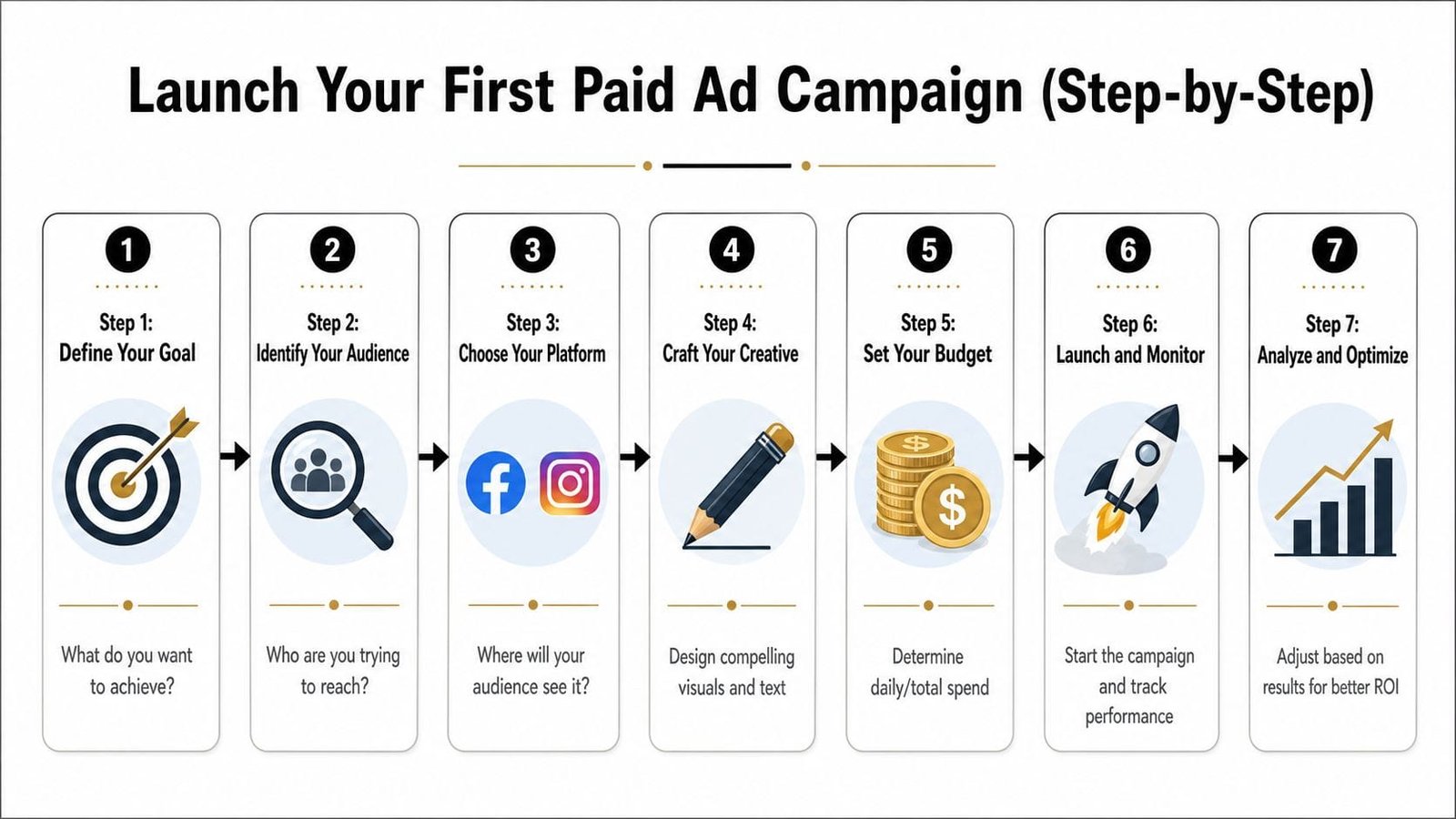
Build a local campaign with one clear offer
Start with one offer for one audience in one area.
A local med spa might run an ad for first-time consultations. A roofing company might promote free inspections after a storm. A restaurant might push a weekday lunch special. Keep it narrow enough that the response is easy to judge.
Use this sequence:
-
Choose one objective
Pick quote requests, bookings, calls, or store visits. Don’t pick “awareness” if you need sales activity. -
Define a tight audience
Think locally. Service radius, neighborhood, or business district. Keep the targeting close to where revenue can happen. -
Write plain copy
State the offer, who it’s for, and what to do next. Clear beats clever. -
Use one strong creative
Before-and-after images, a clean product shot, a short owner video, or a team-at-work visual usually outperform generic stock designs for local credibility.
Here’s a useful walkthrough before launch:
Track the business result, not the applause
The ad’s job is not to impress you. It’s to produce a measurable business action.
Track these basics in a simple sheet:
| What to track | Why it matters |
|---|---|
| Calls or form fills | Direct lead activity |
| Direct messages | High-intent questions from local buyers |
| Website landing page visits | Proof people moved beyond the platform |
| Closed jobs or booked appointments | Revenue outcome |
If paid social starts generating real inquiries but cash flow is tight, many owners use short-term working capital to support the push. A business line of credit can be especially useful when you need flexibility for ad spend, creative production, or follow-up operations. This breakdown of smart ways to use a business line of credit shows how to treat funding as a growth lever instead of a last resort.
One more opinion. Don’t scale a campaign because it got attention. Scale it because it produced lead quality your sales process can convert.
Turning Social Proof into a Loan Application Asset
This is the part most marketing articles miss. Your social presence can help shape how outsiders assess business quality. That includes underwriters.
Recent data indicates that 68% of lenders consider non-traditional data points, including digital presence, in small business underwriting. If lenders increasingly review signals beyond a standard credit file, then your online presence becomes more than a storefront. It becomes part of your credibility package.
What underwriters can infer from your profiles
An underwriter isn’t looking for a viral page. They’re looking for signs that the business is active, coherent, and customer-facing in a real way.
A strong profile usually signals:
-
Consistency
Posts appear regularly enough to suggest the business is operating, not dormant. -
Demand visibility
Comments, tags, reviews, and customer questions suggest actual market interest. -
Professional communication
Clear responses to inquiries and complaints show managerial control. -
Offer clarity
It’s obvious what the business sells, who it serves, and how to contact it. -
Brand stability
Photos, messaging, and business details line up across channels.
None of this replaces financial documents. It supports them. A healthy digital footprint can reinforce the story your statements and application are already telling.
The metrics that matter more than likes
Likes are weak evidence. They’re easy to inflate and often disconnected from revenue. Serious operators track signals that tie social activity to the sales funnel.
Watch these instead:
| Better KPI | Why it matters to the business |
|---|---|
| Link clicks | Shows movement from interest to action |
| Direct messages and inquiries | Often the clearest buying signal for service firms |
| Review quality and recency | Indicates current customer experience |
| Comment quality | Reveals real buyer questions and engagement depth |
| Response behavior | Shows whether your team follows through |
A lender doesn't need your page to be famous. They need it to look credible, current, and connected to customer demand.
If you want a clearer view of the broader picture, a structured financial health assessment can help you evaluate whether your marketing signals match your operational and funding readiness.
The most useful move is to curate your profiles with intention. Pin testimonials. Keep contact details current. Archive low-quality or outdated posts. Show actual work. Highlight milestones without puffery. If you've got strong customer feedback, make it easy to find.
For social media small businesses, this is the shift that matters. You're not only marketing to buyers. You're also building a public record that says the business is alive, organized, and bankable.
Your Blueprint for a Profitable Social Strategy
Social media becomes profitable when you stop treating it like casual promotion and start running it like an operating function. Pick platforms based on buyer behavior. Post on a schedule you can maintain. Turn customer activity into visible proof. Use paid ads only when the offer and tracking are clear. Then clean up your profiles so they support funding conversations instead of weakening them.
That's the playbook. Not more content. Better signal.
The most overlooked advantage is this: your social presence can help form a digital credit file. A lender reviewing your business may never care how many likes a post received. They will care whether your business looks active, responsive, trusted, and commercially real. That's what disciplined social media communicates.
If you want another perspective on building a practical content system, this roundup of Viral.new social media advice has useful ideas. Just filter every tactic through one standard. Does it help the business earn more, look stronger, or become easier to fund?
Run your social channels like assets. Owners who do that get more than attention. They build a business that looks ready for growth.
If you're preparing for expansion, need working capital, or want to see what funding options fit your business without turning the process into a weeks-long headache, Business Loan Warrior is built for that. You can check pre-approval through a single no-fee application, explore customized options, and move toward funding with speed and clarity.