

You're asking for financing, and the lender is asking for EBITDA. Two businesses may have similar revenue, assets, and customer bases, yet receive different loan terms because one owner can explain recurring operating earnings clearly while the other presents a confusing collection of add-backs. The difference isn't always business performance. Often, it's whether the earnings story survives underwriting.
Understanding EBITDA starts with a simple question: what does the business generate from its operations before financing choices, taxes, and certain accounting charges? The answer can help you compare performance, discuss valuation, and show a lender how much operating capacity may be available for debt service. It can also mislead you if you treat EBITDA as cash in the bank.
This guide builds the concept step by step. You'll see the formula, plain-language examples, a lender's approach to adjusted EBITDA, and the limits of using EBITDA for asset-heavy, seasonal, or inventory-driven companies. You'll also learn how a business in the $20 million to $50 million sales range can prepare an EBITDA package that buyers and lenders can test instead of just accepting.
By the end, you should be able to explain what EBITDA is, what it isn't, how it affects loan sizing, and which supporting metrics belong in your next funding conversation.
Table of Contents
- Introduction to Understanding EBITDA for Business Funding
- What EBITDA Really Measures and Why Lenders Love It
- Normalized and Adjusted EBITDA and Common Add Backs Explained
- How to Calculate EBITDA Step by Step With Real Examples
- How Lenders Use EBITDA to Size Loans and Set Covenants
- Where EBITDA Falls Short and What to Use Instead
- How to Improve and Prepare Your EBITDA Before You Apply
Introduction to Understanding EBITDA for Business Funding
A lender reviews two companies that appear similar on paper. Both have established operations and positive earnings. One submits clean monthly financial statements, a reconciliation from net income to EBITDA, and documentation for each unusual expense. The other reports a much higher “adjusted EBITDA” figure but combines owner expenses, projected savings, and recurring costs without clear support.
The first company may look safer, even if the second business claims stronger profitability. Underwriting depends on evidence. A lender needs to know which earnings are repeatable, which costs will continue, and how much cash remains after the business meets its obligations.
That's why EBITDA matters. It gives the lender a common operating starting point, especially when businesses use different financing arrangements or own different types of assets. EBITDA was developed in the 1970s by cable-industry investor John Malone to show the cash-generating ability of capital-intensive telecom businesses, and it gained wider traction in the 1980s during the buyout boom. Its history explains both its usefulness and its weakness. EBITDA began as a financing and valuation tool, not as a complete accounting measure of profit. Investopedia's EBITDA overview provides that historical context.
For an owner, the practical issue isn't memorizing an acronym. It's translating an operating result into lender language:
- What earnings come from normal operations?
- Which expenses are nonrecurring?
- How much cash does the company need for equipment, inventory, taxes, interest, and growth?
- Which version of EBITDA does the loan agreement permit?
The answers shape more than a presentation. They can affect analysis, coverage tests, covenant definitions, and the amount of debt a lender is willing to consider.
What EBITDA Really Measures and Why Lenders Love It
Think of a company as an engine. Revenue enters the engine, operating costs consume part of it, and the remaining output shows how powerfully the business runs before financing and certain accounting effects. EBITDA measures that operating output, not the cash sitting in the bank account.
EBITDA means earnings before interest, taxes, depreciation, and amortization. The most familiar formula is:
EBITDA = Net income + interest + taxes + depreciation + amortization
A second route starts with operating income, also called EBIT:
EBITDA = Operating income + depreciation + amortization
Each adjustment answers a different question. Adding back interest removes the effect of how the business is financed. Adding back taxes removes differences created by tax circumstances. Depreciation and amortization are accounting expenses that allocate the cost of assets or intangible items over time. They reduce reported earnings, but EBITDA temporarily sets them aside to focus on operating performance.
Key concept: EBITDA can show the engine's operating power, but it doesn't tell you how much fuel remains after every required payment.
The measure helps lenders compare companies with different capital structures, tax rates, and depreciation schedules. A company with significant debt may report lower net income because of interest expense, while another company with less debt may show higher net income even if their operations perform similarly. EBITDA creates a more consistent starting point for comparison.
That comparability also explains its role in valuation. A standard relationship is enterprise value divided by EBITDA, or EV/EBITDA. NYU Stern's sector data tracks EV/EBITDA across U.S. industries and presents it alongside other valuation measures, showing how routinely markets compare businesses on an EBITDA basis. NYU Stern's sector valuation data documents that use.
Why the lender removes certain expenses
A lender isn't asking only, “Did the company report profit?” The lender is asking whether the operating business can support debt under the proposed structure. Interest depends on existing and new borrowing. Taxes depend on the company's tax position. Depreciation depends partly on the asset base and accounting schedule.
Removing those items can make peer comparison easier, but it doesn't make the obligations disappear. A company still pays interest and taxes. It may also need to replace machinery, vehicles, software, or facilities. EBITDA is useful because it isolates one part of the analysis. It's dangerous when owners mistake that isolated view for the whole picture.
Normalized and Adjusted EBITDA and Common Add Backs Explained
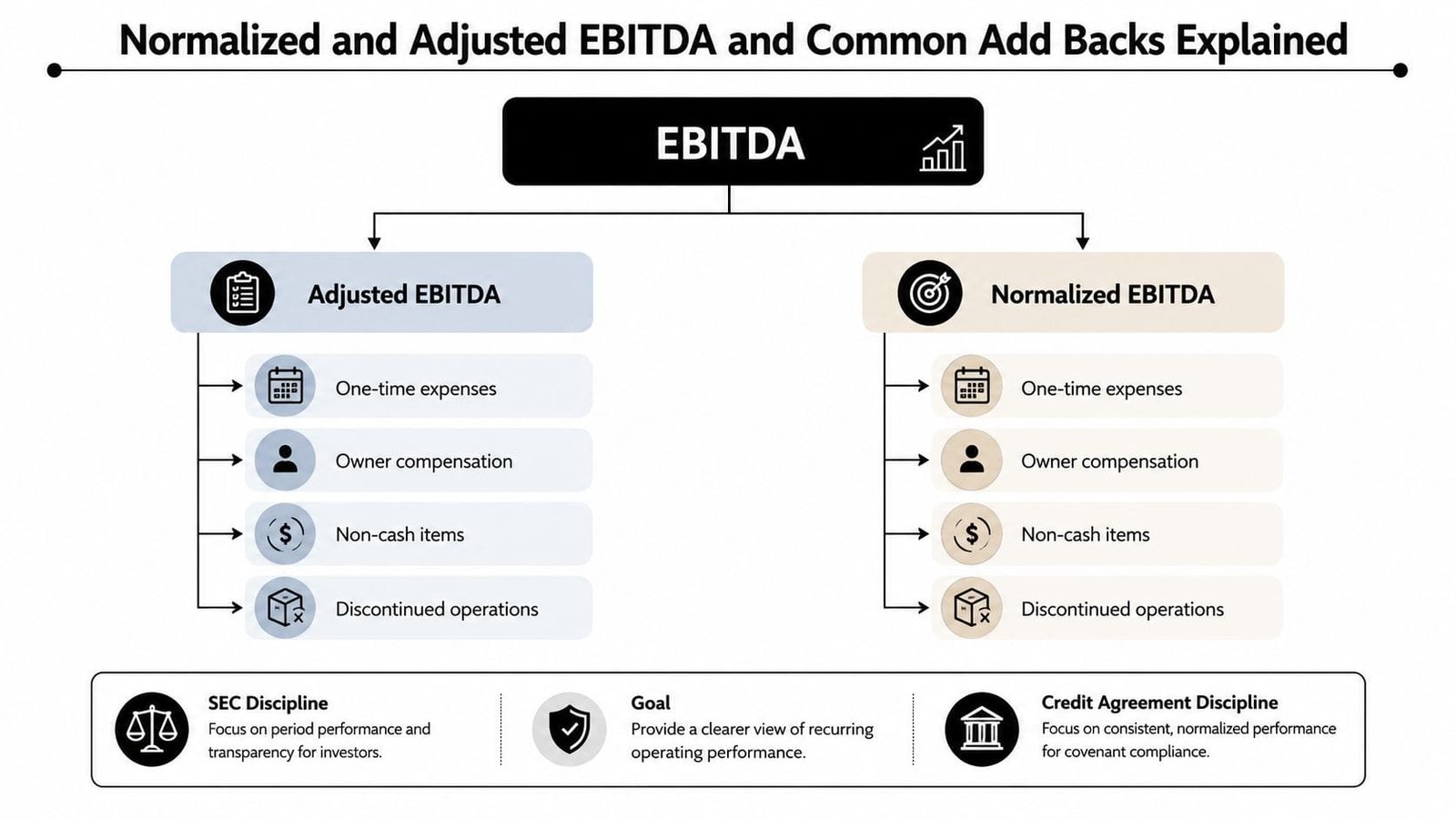
Standard EBITDA follows a defined formula. Adjusted EBITDA begins there, then removes or adds items management believes obscure recurring operating results. Normalized EBITDA applies a further judgment, estimating what earnings might look like under ordinary, sustainable operations after unusual events and owner-specific costs are reviewed.
The labels matter because a lender, buyer, and management team may accept different adjustments. The SEC classifies EBITDA as a non-GAAP measure and requires a reconciliation to net income when it is presented as a performance measure. Standard EBITDA has a narrow meaning. Extra adjustments should be identified as adjusted EBITDA, and SEC filings cannot present EBITDA on a per-share basis. Deloitte's SEC reporting guidance on EBITDA and adjusted EBITDA explains these requirements.
A lender then applies the credit agreement's definition. That definition may permit some adjustments and exclude others, so the EBITDA in an owner's presentation may differ from covenant EBITDA. For a business preparing for underwriting, especially one in the $20 million to $50 million range, the practical task is to build a documented bridge rather than present one attractive headline number.
Add-backs that may receive scrutiny
An add-back gains credibility when its cause is clear, its end point is identifiable, and the company can provide records. Common examples include:
- Excess owner compensation: A lender may consider the amount above a market replacement cost. If the owner performs a necessary operating role, removing the full salary would overstate earnings.
- One-time legal or restructuring costs: These may qualify when the event is isolated and invoices, contracts, or board records explain what occurred.
- Noncash expenses: Depreciation and amortization already belong in standard EBITDA. Other noncash charges need review because a charge without a current cash payment can still represent an economic cost.
- Discontinued operations: Costs from a closed division may be relevant when that division will not create future obligations or losses.
- Acquisition adjustments: Projected savings and synergies are less certain. A lender may ask for evidence that the savings are identifiable, achievable, and allowed by the agreement.
The underwriting question is practical: would a skeptical underwriter believe the expense will not recur, or that the business can operate normally without it? If the answer remains uncertain, show the item separately and let the lender assess it instead of folding it into recurring earnings.
Keep the bridge transparent
A lender-friendly schedule should start with reported net income, show the standard EBITDA adjustments, list each proposed add-back on its own line, and name the supporting document. A line labeled “one-time adjustments” hides the evidence a credit team needs.
Credit practitioners often recommend limiting pro forma and synergy adjustments to roughly 15% to 20% of unadjusted EBITDA, then testing covenant performance against at least a 15% EBITDA decline. The Deloitte discussion of EBITDA adjustments and credit agreement practice discusses these reference points. They are not universal rules. The signed agreement and the lender's policy determine which adjustments count.
How to Calculate EBITDA Step by Step With Real Examples
Start with the income statement, not a bank balance. EBITDA is an earnings calculation, so you'll need net income or operating income, plus the relevant expense lines. For net income, use the following bridge:
Net income + interest + taxes + depreciation + amortization = EBITDA
For operating income, use the shorter version:
Operating income + depreciation + amortization = EBITDA
The two methods should produce the same standard EBITDA when the financial statements classify items consistently. Don't add interest or taxes to operating income again, because operating income already excludes them.
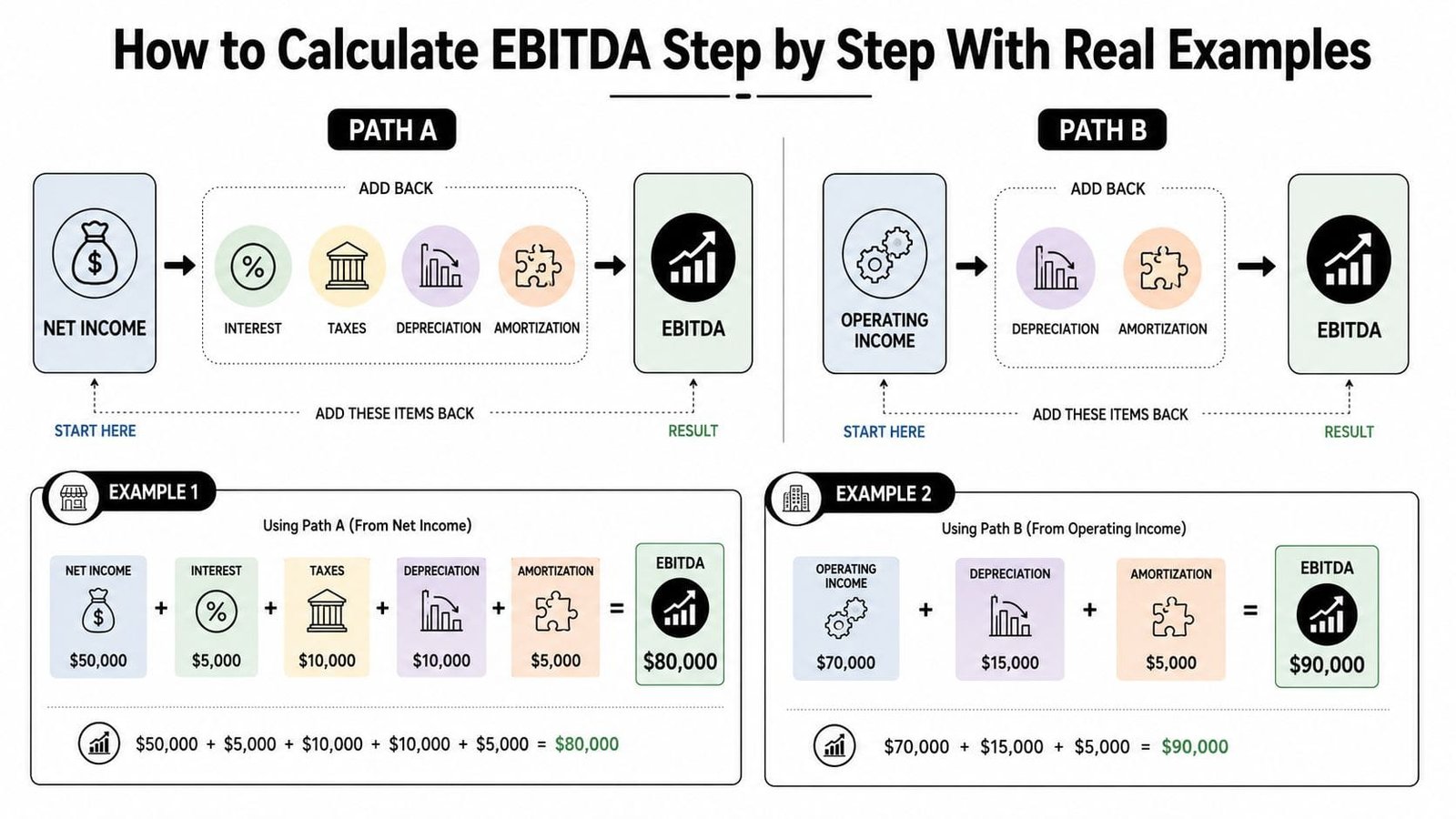
Suppose a service company reports net income of $50,000, interest expense of $5,000, taxes of $10,000, and depreciation and amortization of $15,000. Its EBITDA is $80,000. If a retailer reports operating income of $70,000 and depreciation and amortization of $20,000, its EBITDA is $90,000.
Those figures illustrate the mechanics, not the full underwriting answer. The retailer may need substantial inventory investment, while the service company may have lighter capital needs. Their EBITDA totals alone don't establish equal repayment capacity.
A reusable worksheet
Use a separate row for every adjustment and tie each amount to the financial statements.
| Line Item | Amount | Notes |
|---|---|---|
| Net income | $50,000 | Income statement |
| Interest expense | $5,000 | Add back for standard EBITDA |
| Income taxes | $10,000 | Add back for standard EBITDA |
| Depreciation and amortization | $15,000 | Confirm in statements or notes |
| Standard EBITDA | $80,000 | Reconciles to net income |
For a lender package, add another schedule below standard EBITDA for proposed adjustments. Include the date, vendor, general ledger account, explanation, and evidence for each item. A clear guide to finding net income can help owners locate the starting figure before building the bridge.
Depreciation and amortization often appear on the income statement and cash flow statement, though presentation varies. Check that the amount is recorded for the same period as net income. Then reconcile the final EBITDA number back to the statements so the lender can reproduce it without guessing.
This calculation can be assembled in a spreadsheet, accounting export, or financial reporting tool. The format matters less than consistency, period matching, and a clean distinction between standard EBITDA and management adjustments.
The calculation process is also available in this video format:
How Lenders Use EBITDA to Size Loans and Set Covenants
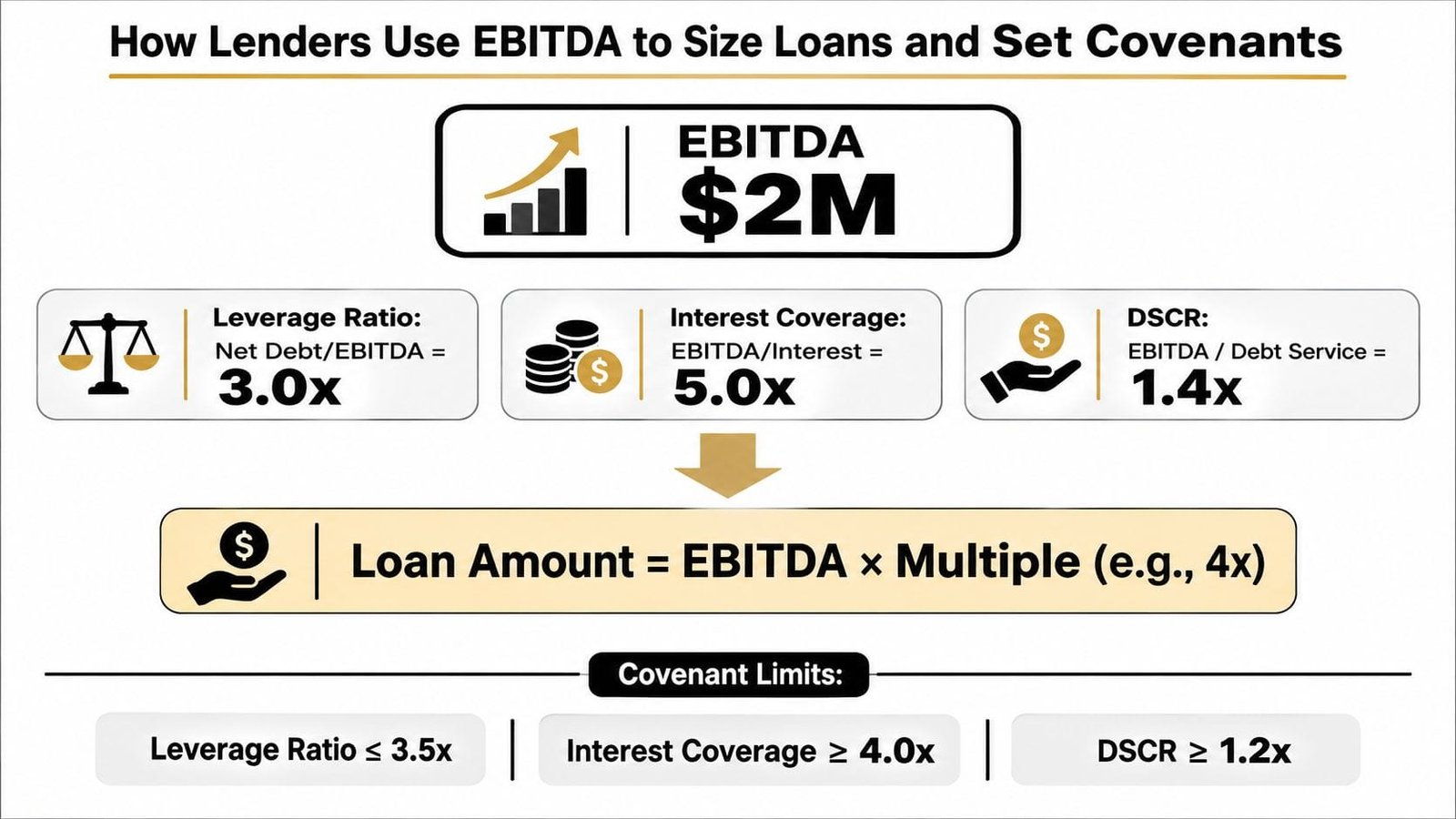
A lender turns EBITDA into a set of risk tests, much like a bank checks how much weight a bridge can carry before approving heavier traffic. The first test is often the debt-to-EBITDA ratio:
Net debt ÷ EBITDA = net debt-to-EBITDA ratio
If debt rises while EBITDA stays unchanged, the ratio increases. If EBITDA falls while debt stays unchanged, it also increases. The quality of each proposed EBITDA adjustment therefore affects borrowing capacity, not just the appearance of profitability.
Interest coverage asks a different question:
EBITDA ÷ interest expense = interest coverage
Debt service coverage goes further by testing whether the company can make required principal and interest payments. EBITDA may appear in the numerator, but a lender can adjust the calculation for taxes, capital expenditures, working capital, or other mandatory cash uses. The same EBITDA can therefore support different loan amounts depending on how much cash remains after operating demands.
Market covenant norms often place net debt to EBITDA around 4.5x to 5.5x, and interest coverage around 2.0x to 3.0x, according to the financial covenant materials from the Association of Corporate Counsel. These ranges are reference points, not approval promises. A lender may set tighter limits when cash flow is volatile, assets require replacement, or customer concentration creates uncertainty.
Why identical EBITDA can produce different terms
Two companies can report identical EBITDA and still have different borrowing capacity. One may require frequent equipment purchases and carry large inventories. The other may collect customer payments quickly and need little capital investment. The first business has less cash available after operating needs, even though both companies report the same EBITDA.
Underwriters compare several signals at once: interest coverage, debt service, cash conversion, working capital, collateral, repayment history, and revenue stability. Those findings influence the loan amount, pricing, amortization, reporting requirements, and covenant structure.
Owners preparing a funding request should review the underwriting process for business loans and build a bridge from management EBITDA to the credit agreement's definition. That bridge should show which adjustments the lender may accept and which require supporting evidence. Borrowers can also review South Florida commercial lending tips for documentation and legal requirements lenders may expect.
For a $20M-$50M business, run a 15% EBITDA decline sensitivity before submitting the package. Then test whether interest coverage and debt service remain acceptable under the lender's definitions. If the business fails, address the weak point before negotiations. EBITDA can help secure funding, but an aggressive adjustment can mislead the lender and weaken credibility once the numbers are tested.
Where EBITDA Falls Short and What to Use Instead
Positive EBITDA doesn't guarantee positive cash flow. A company can report strong operating earnings while cash leaves the business for equipment purchases, inventory, taxes, interest, or working capital growth. Small-business guidance on EBITDA and free cash flow warns that EBITDA should be read alongside free cash flow because it excludes important cash demands.
Asset-heavy companies show the problem clearly. Depreciation excludes the accounting allocation from EBITDA, but the underlying machine still wears out. Replacing it requires cash. A construction company may also face project timing gaps, while an inventory-driven retailer can report sales and EBITDA before customer collections replenish the cash used to buy stock.
Seasonality creates another trap. A twelve-month EBITDA figure may look healthy while a business faces a low-cash period before its next revenue cycle. In that situation, a lender may focus on borrowing-base availability, liquidity, monthly cash flow, and working capital rather than relying on an annual EBITDA figure. Owners can review the mechanics of working capital for businesses before presenting a growth or operating request.
Match the metric to the question
| Business question | More useful measure |
|---|---|
| How strong are core operations before financing choices? | EBITDA |
| What profit remains after all expenses? | Net income |
| What cash did operations generate? | Operating cash flow |
| What remains after necessary investment? | Free cash flow |
| How much earnings remain after depreciation? | EBIT |
| What can the owner personally receive from a smaller business? | SDE, when appropriate |
Valuation also depends on business size and buyer expectations. Private-company M&A data reported median selling price per EBITDA moving from 3.5x in Q4 2024 to 3.8x in Q2 2025, then back to 3.5x in Q4 2025, demonstrating that multiples can change within a year. Kreischer Miller's private-company M&A valuation coverage provides that transaction context.
Main Street businesses often use seller's discretionary earnings, while lower-middle-market companies more commonly use EBITDA multiples in the roughly 3x to 7x range, as described in the same valuation guidance. A company selling in the $20 million to $50 million sales range should therefore prepare more than a headline multiple. It should explain owner dependence, recurring earnings, capital requirements, working capital, and the exact earnings definition being used.
How to Improve and Prepare Your EBITDA Before You Apply
Improving EBITDA credibility starts with operations, not aggressive add-backs. Review pricing, gross margin, recurring revenue, staffing efficiency, vendor terms, and avoidable overhead. A lender is more likely to trust a documented improvement in ordinary operations than a large adjustment with no repeatable explanation.
Prepare a lender-ready file with:
- A monthly EBITDA bridge: Reconcile net income to standard EBITDA, then list adjusted items separately.
- Add-back evidence: Attach invoices, contracts, payroll records, board minutes, tax records, or other documents that establish what happened.
- Owner compensation support: Show the owner's actual role and the market replacement cost instead of removing all compensation automatically.
- Cash-flow detail: Include operating cash flow, free cash flow, capital expenditures, taxes, interest, and working capital movements.
- Covenant sensitivity: Show how the proposed structure performs if EBITDA weakens, expenses rise, or collections slow.
- Consistent periods: Make sure the income statement, balance sheet, cash flow statement, and EBITDA schedule cover matching periods.
For a larger company, give the lender both management EBITDA and covenant EBITDA. That distinction prevents a promising operating story from becoming a credibility problem during diligence.
Use a simple worksheet to calculate the bridge, document every adjustment, and identify the cash obligations EBITDA leaves out. Then submit the information through Business Loan Warrior to explore business funding options through a single application, connect your financial information, and move from an EBITDA discussion to a structured financing decision.