
Fixed expenses are the bills that stay the same regardless of sales volume, rent, insurance, loan payments, salaried wages, and subscriptions. They have to be paid even in slow months, which makes them the first number I look at when I judge whether a business can survive a cash squeeze.
If you own a business, you already know the feeling. Revenue comes in waves, but the rent doesn’t wait, payroll doesn’t pause, and the software bill still clears whether you had a busy week or a weak one. That’s why fixed expenses matter more than most owners want to admit.
Table of Contents
- Understanding Fixed Expenses in Your Business
- Fixed Expenses vs Variable Expenses
- The Hidden Complexity of Step-Fixed Costs
- Calculating Your Break-Even Point With Fixed Costs
- How Lenders Evaluate Your Fixed Expense Ratio
- Practical Strategies to Reduce Fixed Business Costs
- Planning for Inflation and Contract Resets
Understanding Fixed Expenses in Your Business
A founder sits down with last month’s P&L and asks a simple question, which bills would still hit the account if sales dropped tomorrow? The answer is usually the same list every time, rent, insurance premiums, loan payments, subscription fees, and wages that don’t rise and fall with output. Those are fixed expenses.
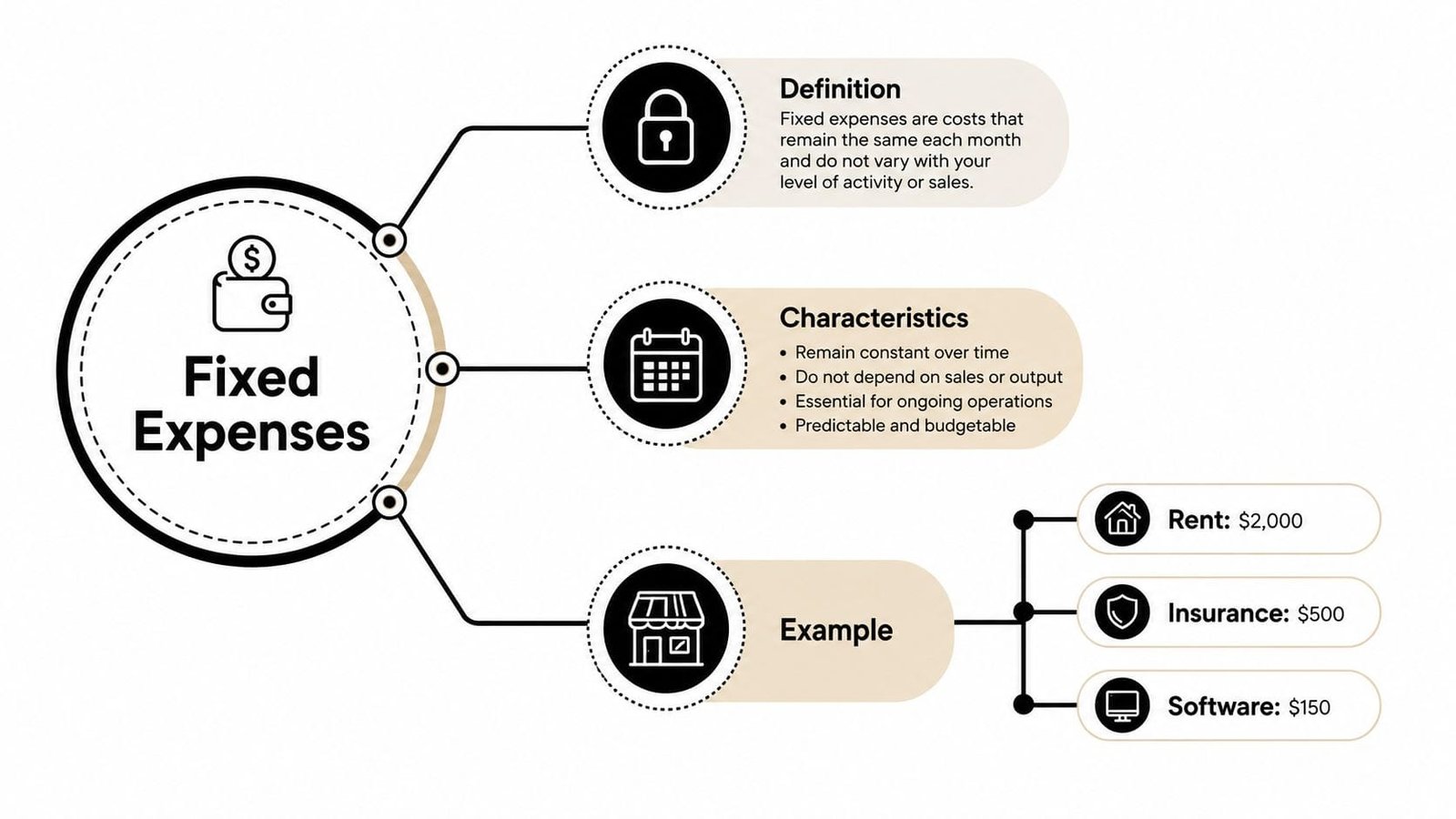
The accounting point is straightforward. A fixed expense is a cost whose total amount does not change within a relevant range of activity. In practice, that means a shop can sell 10 units or 1,000 units and still owe the same lease payment for that period, as accounting guidance describes it in this fixed expense definition.
Why owners should care
Fixed expenses form the baseline cash outflow a business must cover before profit shows up. That’s why they sit at the center of budgeting, cash-flow planning, and break-even analysis. If you don’t know your fixed cost floor, you’re guessing about the revenue floor too.
The list is familiar, but the impact is what owners underestimate. A restaurant might have the same rent in a slow Tuesday and a packed Saturday. A professional services firm may pay the same office lease and software stack whether five clients pay on time or fifteen do. Snyp’s guide to business expenses is a useful companion if you want to sort the whole expense picture instead of treating every bill as if it behaves the same way.
Practical rule: If a bill arrives on a predictable schedule and doesn’t move with sales, put it in your fixed expense bucket first.
That’s also why I tell owners to calculate overhead with discipline, not optimism. If you need a framework for that, use this internal guide on how to calculate overhead cost. Fixed expenses are the starting line, not the finish line.
Fixed Expenses vs Variable Expenses
A restaurant owner understands this difference the moment a slow week hits. The rent is still due, but the food bill drops because fewer plates went out. That’s the core split between fixed expenses and variable expenses.
Side by side, not blended together
Fixed expenses stay stable within a reasonable activity range. Variable expenses move with volume, more orders, more ingredients, more shipping labels, more card processing, more hourly labor in many businesses. Accounting and budgeting sources consistently separate the two because they behave differently when revenue rises or falls as outlined by Intuit’s budget categories.
| Dimension | Fixed Expenses | Variable Expenses |
|---|---|---|
| Predictability | High within the activity range | Changes with sales or production |
| Payment pattern | Often monthly, quarterly, or annual | Can change week to week or order to order |
| Cash-flow impact | Creates the baseline burden | Expands and contracts with volume |
| Budgeting use | Sets the minimum revenue target | Helps model margin and scaling |
| Owner control | Harder to exit fast | Easier to trim quickly |
Why lenders care about the mix
A business with heavy fixed expenses needs more dependable revenue to stay safe. A business with more variable costs can usually absorb a sales dip faster because its costs flex down sooner. That matters in underwriting, because lenders care less about how good revenue looks in a strong month and more about what happens when sales soften.
A healthy business doesn’t just sell well. It can survive the month when sales don’t behave.
I also push owners to classify recurring technology, utilities, and logistics carefully. Some costs look fixed at first glance, then move enough to matter. The distinction affects break-even math, cash reserve planning, and whether your forecast is useful. If you blur the categories, you’ll understate risk and overstate control.
The Hidden Complexity of Step-Fixed Costs
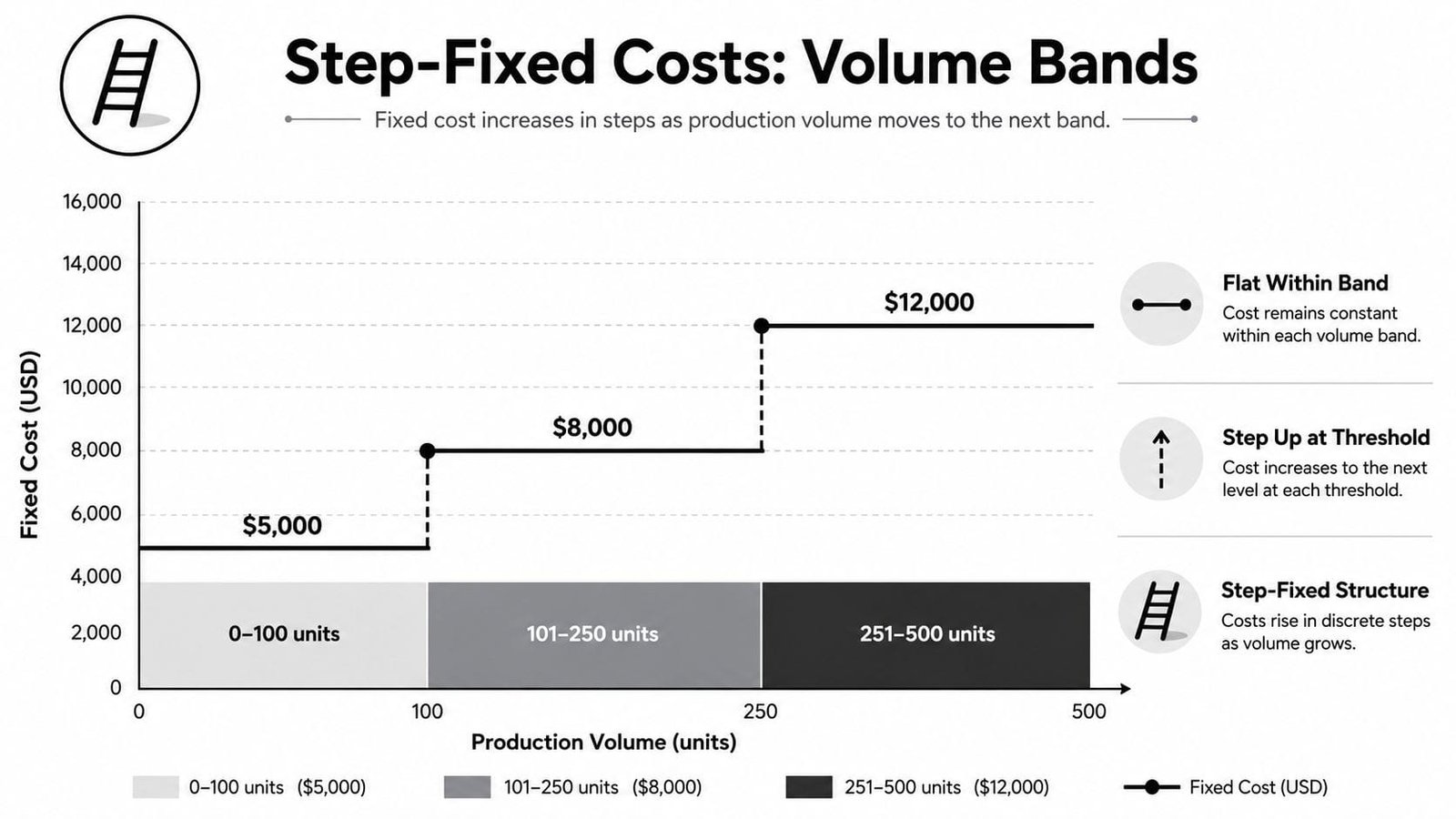
Most explainers stop at fixed versus variable. That’s too simple for a growing business. Real operations are full of step-fixed costs, expenses that stay flat inside one volume band and then jump when you cross a threshold, which is exactly the gap many guides miss as noted by Fora Financial.
Where the jumps show up
A warehouse may operate fine with one manager until volume forces a second shift lead. A software stack may hold steady until a vendor bumps you into a higher tier because headcount passed a line. A service business may keep the same admin team for a while, then need another coordinator once scheduling pressure becomes unmanageable.
These aren’t theoretical edge cases. They’re the costs that catch owners between growth and slowdown. A company can look profitable on paper and still run into a liquidity wall if it ignores the next staffing step, lease expansion, or equipment lease increase.
Why step-fixed costs matter in downturns too
The same pattern works in reverse. A cost can stay flat while business is shrinking, then become too large for the lower volume base. That’s why step-fixed expenses are especially dangerous during a soft landing or a messy recovery. They don’t disappear on cue, and they don’t always shrink when sales do.
If you’re running a scaling operation, model your costs in bands, not just line items. Mark the point where each cost changes, then ask what happens if volume stalls just below that threshold. That’s the underwriting view too, because lenders want to know whether your cost structure can handle a revenue wobble without breaking.
Calculating Your Break-Even Point With Fixed Costs
Break-even isn’t a finance buzzword. It’s the point where your revenue covers your costs, and fixed expenses are the main reason that point exists. QuickBooks puts it plainly, fixed expenses create the baseline cash outflow that must be covered before operating break-even is reached in its fixed expense glossary.
A clean way to run the math
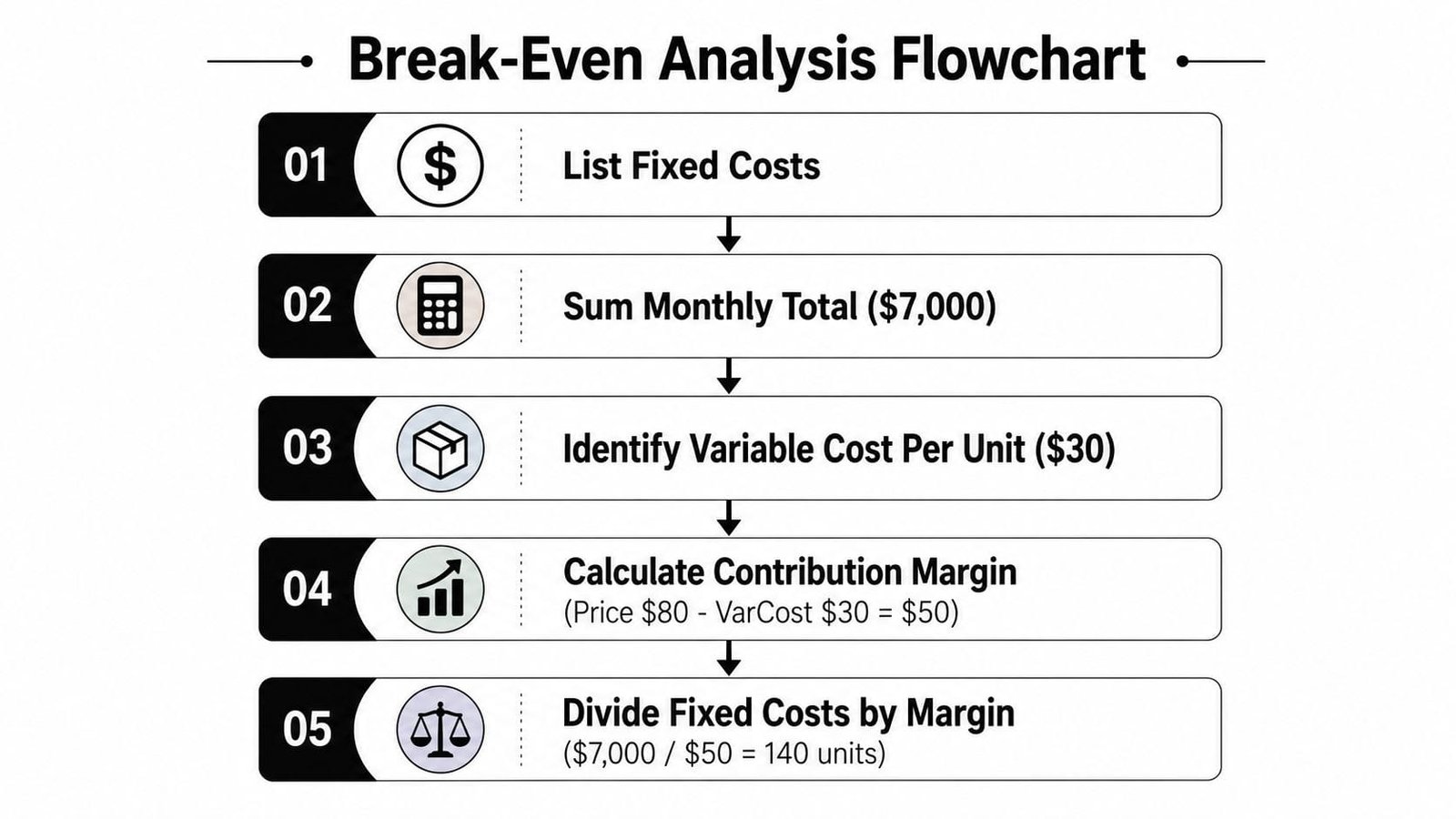
Use this order.
- List every fixed cost that shows up regardless of sales.
- Add them into one monthly total.
- Estimate the contribution margin per unit or per service.
- Divide fixed costs by that margin.
- The result is your break-even volume.
If a service company has a fixed base of $7,000 and a contribution margin of $50 per service, it needs 140 services to break even. That example is built into the chart above and is the kind of calculation owners should use before they sign a lease, hire a manager, or take on debt.
You can also find break-even analysis tools if you want to compare different scenarios quickly, but don’t let a tool replace judgment. The spreadsheet only helps if the inputs are realistic.
Why this matters before you borrow
I want owners to stress-test two things, a modest revenue dip and a delayed payment cycle. If either one pushes you below break-even for too long, your fixed cost base is too heavy for the business model. That’s when a lender starts seeing risk, even if the top line looks healthy today.
If you want the broader framework, this internal guide on what is break-even analysis gives you the mechanics. The main point is simple. Lower fixed costs lower the revenue floor, and that gives you more room to breathe.
How Lenders Evaluate Your Fixed Expense Ratio
Lenders don’t just ask whether revenue is strong. They ask whether the business can keep paying its obligations after the debt payment is added to the stack. That’s where your fixed expense burden starts affecting approval, pricing, and loan size.
What underwriters look at
Underwriters care about the relationship between recurring obligations and dependable cash flow. They pressure-test the business against weaker months, slower collections, and higher payments. If your fixed costs already take a big bite out of cash flow, there’s less room for new debt, even if the business looks busy.
That’s why a company with clean books and disciplined overhead usually gets a better hearing than a business that grows revenue but lets recurring obligations balloon. Fixed costs are not just an expense category, they’re a signal of operating discipline.
The ratio view, not just the line-item view
In practice, lenders study coverage, not just cost labels. They want to know whether the business has enough cash generation to support fixed obligations and new repayment. A high fixed-cost base tightens the margin for error. A lighter, more flexible base gives the lender more confidence that the deal can survive stress.
This is also where many owners misread their own financials. They focus on gross revenue, but lenders focus on whether the cash left over after fixed obligations can support the loan. If that buffer is thin, the application gets harder.
Borrowing truth: Strong sales don’t rescue a business from a rigid cost base if the recurring payments leave too little cushion.
For your file, bring clean bank statements, up-to-date debt schedules, lease terms, insurance bills, and payroll detail. Don’t hide step-fixed costs either. Underwriters usually find them anyway, and they’d rather see honest modeling than optimistic labeling.
Practical Strategies to Reduce Fixed Business Costs
Cutting fixed costs is not about panic slashing. It’s about attacking the biggest recurring obligations first and asking where the business is paying for capacity it doesn’t use. That discipline improves cash flow fast.
Start with the contracts that have leverage
Rent is usually the biggest fixed line, so start there. If you have unused square footage, sublease it. If renewal is coming up, negotiate term length, expansion options, and tenant improvement trade-offs before the landlord has an advantage.
Insurance deserves the same treatment. Bundle policies where it makes sense, review deductibles, and shop brokers before renewal. Don’t just accept the first quote because the policy is “annual” and therefore feels locked in. It’s not locked if the market gives you another option.
Software is the easiest category to audit because waste is usually visible. Cut inactive licenses, downgrade users who don’t need premium access, and move to annual billing only if the discount is real and the vendor is stable. If you want a broader playbook, proven cost reduction strategies for 2026 can help you pressure-test your vendor list.
Don’t ignore staffing and subscriptions
Salaried staff is harder to cut than software, but the answer isn’t always layoffs. Cross-train employees so one role can absorb another during slow periods, then outsource non-core work instead of carrying a permanent headcount you don’t need. That keeps capacity while reducing fixed payroll pressure.
Subscriptions are the junk drawer of business spending. Cancel what nobody uses, downgrade what doesn’t drive revenue, and review every auto-renewal before it rolls over. If you need a cash-flow tie-in, this internal guide on how to improve cash flow is the right next step.
Planning for Inflation and Contract Resets
A fixed cost isn’t fixed forever. It’s fixed until the lease renews, the insurer reprices, the vendor changes tiers, or inflation squeezes the next contract cycle. That’s the part many owners miss, and it’s why “stable” costs can still create real pressure later.
The Bureau of Labor Statistics reported that the U.S. CPI rose 2.9% year over year in December 2024, and shelter was one of the biggest contributors to inflation according to MetLife’s summary of that data. That doesn’t mean every business cost moved the same way, but it does mean the renewal on a lease or other shelter-linked obligation can land higher than the number you built into last year’s budget.
Budget for resets before they hit
Build a contract calendar. Track lease expirations, insurance renewals, software resets, and debt repricing dates in one place. Then reserve cash for the reset dates that you already know are coming instead of pretending those bills will behave like last month’s numbers forever.
Best practice: Treat a fixed cost as stable only inside a defined period and activity range.
That’s the cleanest way to think about it. A cost can be predictable and still drift upward at renewal. If you wait until the contract lands on your desk, you’ve already lost negotiation power.
For owners trying to preserve borrowing power, this matters as much as revenue. Rising fixed obligations reduce room for error, tighten repayment capacity, and make the next loan harder to absorb. Discipline here isn’t optional. It’s how you protect the business before the market, your landlord, or your vendor resets the price for you.
If you need a clearer read on how your fixed expenses affect borrowing power, cash flow, and loan readiness, visit Business Loan Warrior. It’s built for owners who want practical funding options, not vague advice. Use it to compare funding paths, understand what underwriters care about, and get a sharper view of where your cost structure stands.