
You’ve got the contract draft open, a vendor is waiting on a signature, payroll is creeping up, and somebody just asked whether your new partnership should be an LLC, an S corp, or something else. That’s the moment most owners start asking what a business law attorney does, and the answer is usually a lot more practical than people expect. A good one isn’t just there for lawsuits. They help you put legal structure around the deals, hires, policies, and approvals that keep a business from stepping on a rake later.
Table of Contents
- The Day-to-Day Work of a Business Law Attorney
- Core Services That Protect Your Business
- When to Hire a Business Law Attorney
- Understanding Legal Fees and Cost Expectations
- Red Flags to Watch for When Choosing an Attorney
- Your Step-by-Step Guide to Finding and Working With the Right Attorney
- Making the Decision That Fits Your Business Stage
The Day-to-Day Work of a Business Law Attorney
A bakery owner calls because a supplier wants to change payment terms, a contractor wants an exclusive relationship, and an employee handbook still lives in a Google Doc from three years ago. That owner does not need a courtroom hero. They need someone who can turn messy business decisions into clean legal documents, clear risk allocation, and realistic guardrails.
The work is mostly before there’s a problem
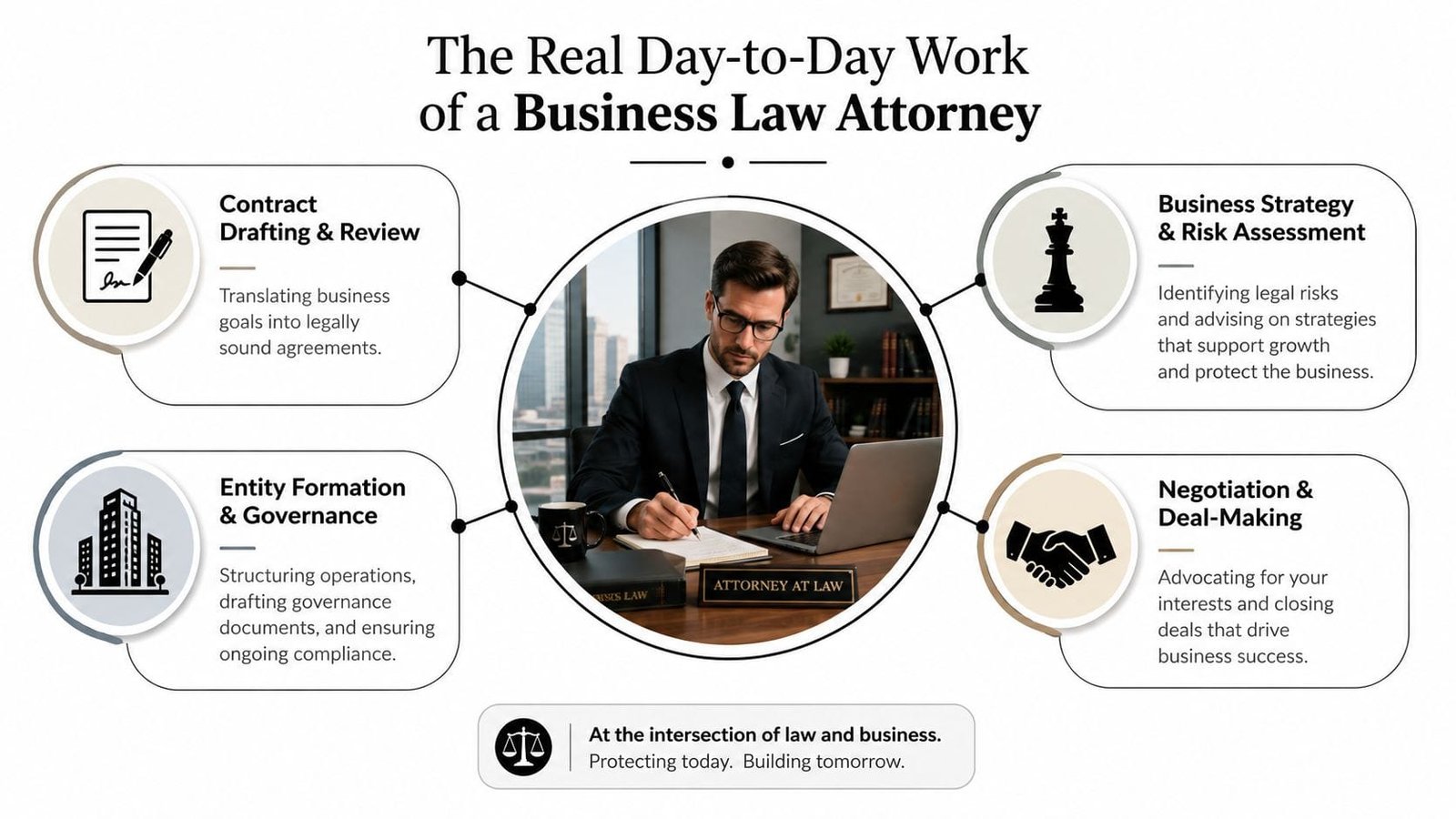
The U.S. Bureau of Labor Statistics says lawyers advise and represent clients in legal proceedings or transactions, and O*NET says they interpret laws and regulations, advise on business transactions and legal rights, negotiate contractual agreements, and draft legal documents such as contracts and leases. That is the job in plain view. A business law attorney reviews a lease, negotiates a vendor agreement, drafts an operating agreement, or helps structure how a new company starts life.
The value shows up in the details. The attorney turns a business goal into legal language that still works when payment slows, a deadline slips, or a partner changes position. The best day-to-day work looks routine from the outside, and that is exactly why it matters.
Practical rule: If a decision will affect who pays, who controls, who owns, or who gets sued, it belongs in writing before anyone shakes hands.
They also build the legal habits of the company
Yale Law School’s in-house counsel guidance says internal business lawyers often oversee a company’s legal relationships with investors, regulators, and other firms, while standardizing contracts and approval processes to reduce risk. That is the part many owners miss. A lawyer is not just reviewing one document. They are building the system that produces better documents next time.
That system can include approval workflows, template contracts, internal review triggers, and basic compliance checks. In a small company, those controls can separate a workable deal from a bad one. In a larger one, they can separate a company that scales from one that keeps tripping over its own paperwork.
The scale matters too. The BLS says there were about 834,000 lawyers employed in the United States in May 2023, which is a reminder that these advisory and transactional functions run through the whole economy, not just large corporations. A sharp business lawyer spends less time on drama and more time making sure your paperwork matches your risk.
A business lawyer also keeps an eye on the control points that owners ignore until they cause trouble. That includes licensing, local permits, contract sign-off authority, and whether your internal rules match how the business operates. If you want a basic starting point on that side of ownership, the guide on business license requirements is a useful place to check the operational items that should not be left to memory.
For entity basics, compare your state filing choices with the overview on operating agreement for California LLCs. Written agreements matter because informal understandings fall apart fast once money, control, or ownership rights are on the line.
Core Services That Protect Your Business
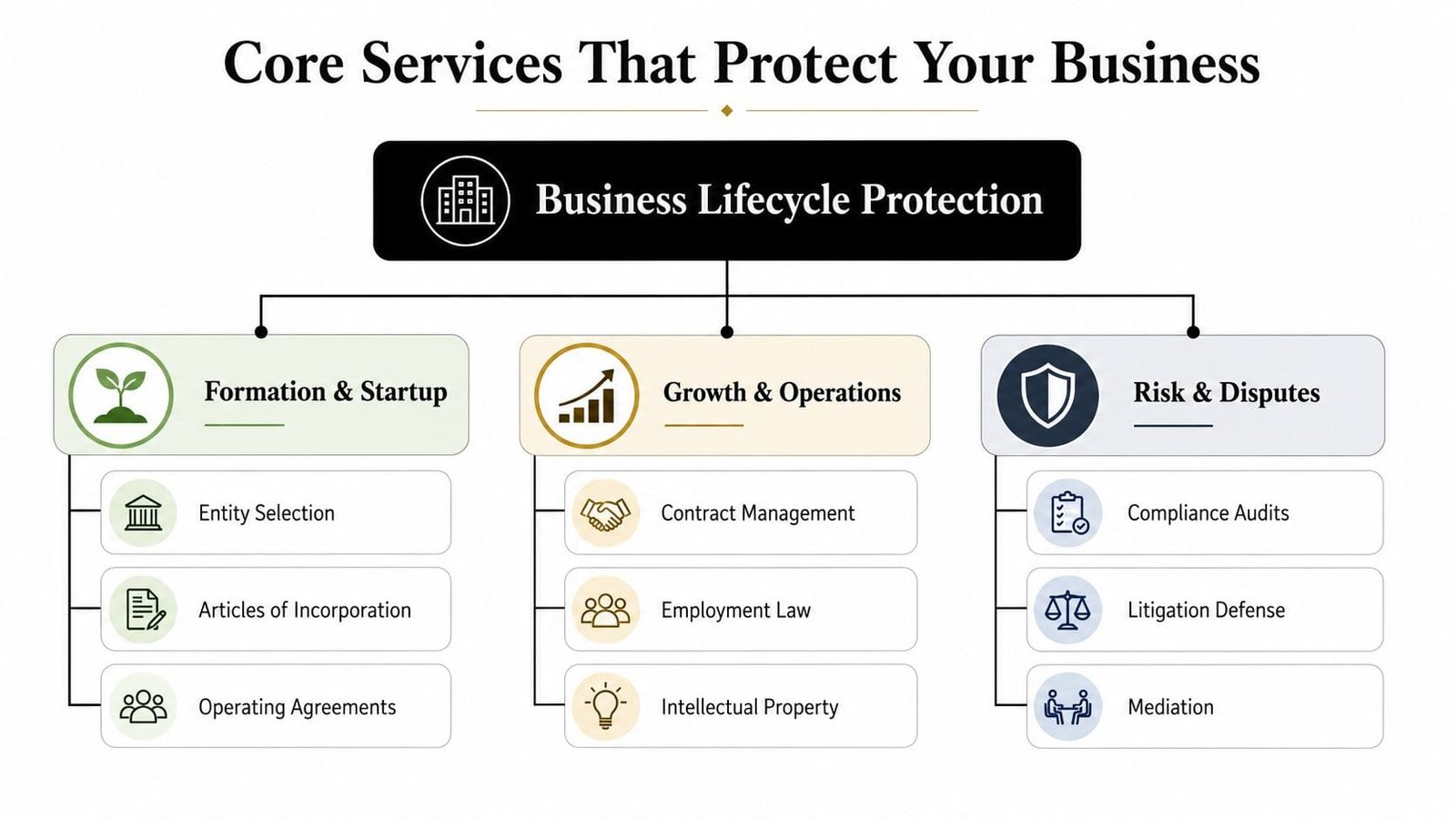
The cleanest way to understand a business law attorney is to follow the life of a deal. Formation comes first, then operations, then trouble, if you’re careless. The attorney’s job is to keep each stage from creating avoidable legal exposure.
Formation and early structure
At the start, an attorney helps choose the right entity, documents ownership, and separates business risk from personal risk. The right setup isn’t just a filing exercise. It shapes taxes, control, transfer rules, and how disputes get handled later.
If you’re trying to understand the operating rules behind an LLC, the guide on operating agreement for California LLCs is a useful example of how owners use written agreements to define decision-making and ownership rights. That kind of document matters because informal understandings fall apart fast once money or control becomes an issue.
For entity basics, compare your state filing choices with the overview on articles of incorporation vs. articles of organization. The point is not to collect forms. The point is to create a structure that matches how the business will operate.
Contracts are where the real risk lives
The American Bar Association describes lawyers as advisors, advocates, negotiators, and evaluators, and that role shows up most clearly in contract work. Good contract architecture assigns obligations, remedies, indemnities, and dispute procedures before anyone transfers money or data. That’s the actual protection.
A vendor agreement without clear delivery dates, late-fee terms, limitation-of-liability language, and forum-selection or arbitration clauses leaves the owner exposed to confusion and expensive fights. A business law attorney tightens those terms so the contract says who does what, who bears what risk, and what happens when things go sideways.
The cheapest contract is rarely the safest one. The expensive contract is the one you have to renegotiate after the relationship has already gone bad.
Compliance and governance are operational tools
Business law attorneys also act as regulatory control points. LinkedIn’s business-lawyer guidance and corporate-law resources from Indeed and Georgetown emphasize compliance with applicable laws, policy development, and advising directors and senior management on legal rights and obligations. In practice, that means drafting policies, board resolutions, retention rules, privacy notices, and escalation procedures that make compliance auditable.
For businesses dealing with licenses, permits, or local approvals, a practical starting point is the internal resource on business license requirements. That kind of issue is not glamorous, but it’s exactly where businesses get slowed down or fined when no one owns the process.
Disputes are the last line, not the first plan
When a dispute does happen, the attorney’s earlier work pays off. Clean contracts and documented policies reduce what needs to be fought about. They also make it easier to settle, mediate, or defend a position without improvising under pressure.
The point is simple. A business law attorney protects a company mostly by making sure the company has fewer weak spots to begin with.
When to Hire a Business Law Attorney
Owners usually wait too long. They tell themselves they’ll bring in counsel after they sign the lease, after they hire the first employee, or after the deal gets “bigger.” That is backwards. Legal help gets more valuable before the pressure hits.

Hire before commitments harden
Bring in counsel before you sign a lease, form a new entity, or lock in a co-founder arrangement. Once signatures are on paper, your options shrink and your bargaining power drops. That’s when cleanup costs rise.
A new business that needs entity setup, governance documents, and basic contract templates should not wing it. The attorney can set the ground rules while the business still has flexibility. That’s the cheapest moment to get it right.
Hire when the business starts taking on real obligations
The first employee changes the game. So does a major partnership, a supply agreement with meaningful payment exposure, or financing paperwork tied to collateral or personal guarantees. These are the moments when a mistake stops being theoretical.
For owners facing real financial stress, the right move is to get advice early rather than try to improvise under pressure.
Hire when a warning sign lands on your desk
A cease-and-desist letter, a regulatory inquiry, or a dispute over ownership or payment is not the time to “wait and see.” It’s time to get counsel involved immediately. The same is true if you’re entering a financing round or any arrangement that could affect control, compliance, or personal exposure.
If the issue can change your balance sheet, your governance, or your ability to operate, it’s already a legal issue.
The practical rule is straightforward. Hire when the decision is about to become binding, when the deal is unusually important, or when the downside would hurt the business, not just annoy it.
Understanding Legal Fees and Cost Expectations
The fear around legal fees is often exaggerated because owners don’t know what they’re buying. A business lawyer is not a mystery expense. The price should match the scope, the urgency, and the complexity of what you’re asking them to do.
Fee structures vary, and each fits a different job
| Fee Type | Best For | Typical Range |
|---|---|---|
| Hourly billing | Ongoing advice, disputes, negotiations, changing facts | Varies by attorney and market |
| Flat fee | Formation work, standard contract review, routine documents | Varies by service scope |
| Retainer | Ongoing access, recurring legal issues, growing businesses | Varies by monthly commitment |
| Contingency | Certain disputes where recovery is possible | Varies by case and risk |
Hourly billing makes sense when the work is open-ended. Flat fees make sense when the deliverable is defined. Retainers work when you need steady access instead of one-off help. Contingency arrangements usually show up in dispute-driven matters, not routine business advice.
What drives cost up or down
Experience, geography, transaction complexity, and urgency all matter. A seasoned attorney in a major market will usually price differently than a generalist in a smaller market. A simple LLC filing is not the same job as reviewing a multi-party agreement with custom indemnities and financing implications.
Owners can control cost by doing a few things well. Gather documents before the meeting, narrow the questions, and ask whether routine pieces can be handled efficiently with paralegal support. If you need several related documents, bundle them instead of spacing them out and restarting the learning curve each time.
Spend on prevention, not cleanup
Legal spend should be judged against the cost of uncertainty. A contract that prevents a dispute is cheaper than paying to fight about one. A clean compliance process is cheaper than explaining to a regulator why your process was improvised.
If you want one more benchmark for planning, ask for a written scope before work starts. A good attorney should be able to tell you what is included, what is not, and where the bill changes if the facts change.
Red Flags to Watch for When Choosing an Attorney
A lot of owners assume any attorney can handle business issues. That’s wrong. A lawyer who is great in one area can be a poor fit for your company if they’re vague, slow, or overly focused on billing instead of judgment.
Watch what they say in the first meeting
If an attorney promises a guaranteed outcome, walk away. Real legal work involves risk, not magic. Anyone selling certainty in a contested or negotiated business matter is overselling.
The same goes for vague fee explanations. If they can’t tell you how they bill, when they bill, and what triggers extra charges, that’s not a small oversight. It’s a management problem.
Fit matters more than a fancy title
Industry experience matters because business risk looks different across sectors. A retail operator, a contractor, and a software company do not face the same contract, employment, privacy, and regulatory issues. If the attorney doesn’t understand your business model, you’ll spend your time educating them instead of solving the problem.
Also watch for firms that delegate everything to junior staff without partner oversight, especially on important matters. And avoid attorneys who seem annoyed when you ask basic questions. If they can’t explain a clause in plain English, they may not understand the practical effect of the clause themselves.
A good business lawyer makes the trade-off visible. A weak one just hands you paper and hopes you don’t notice the risk.
Read the billable behavior
A red flag is a lawyer who treats every issue like a time entry. Efficient legal advice should solve problems, not create endless follow-up loops. That doesn’t mean cheap. It means purposeful.
If the conversation keeps drifting toward process without strategy, be careful. You want someone who can tell you what matters, what doesn’t, and what can wait. For example, if you’re trying to understand how a financing term can affect collateral exposure, the internal guide on what is a blanket lien is the kind of issue a good attorney should be able to unpack quickly and clearly.
Your Step-by-Step Guide to Finding and Working With the Right Attorney
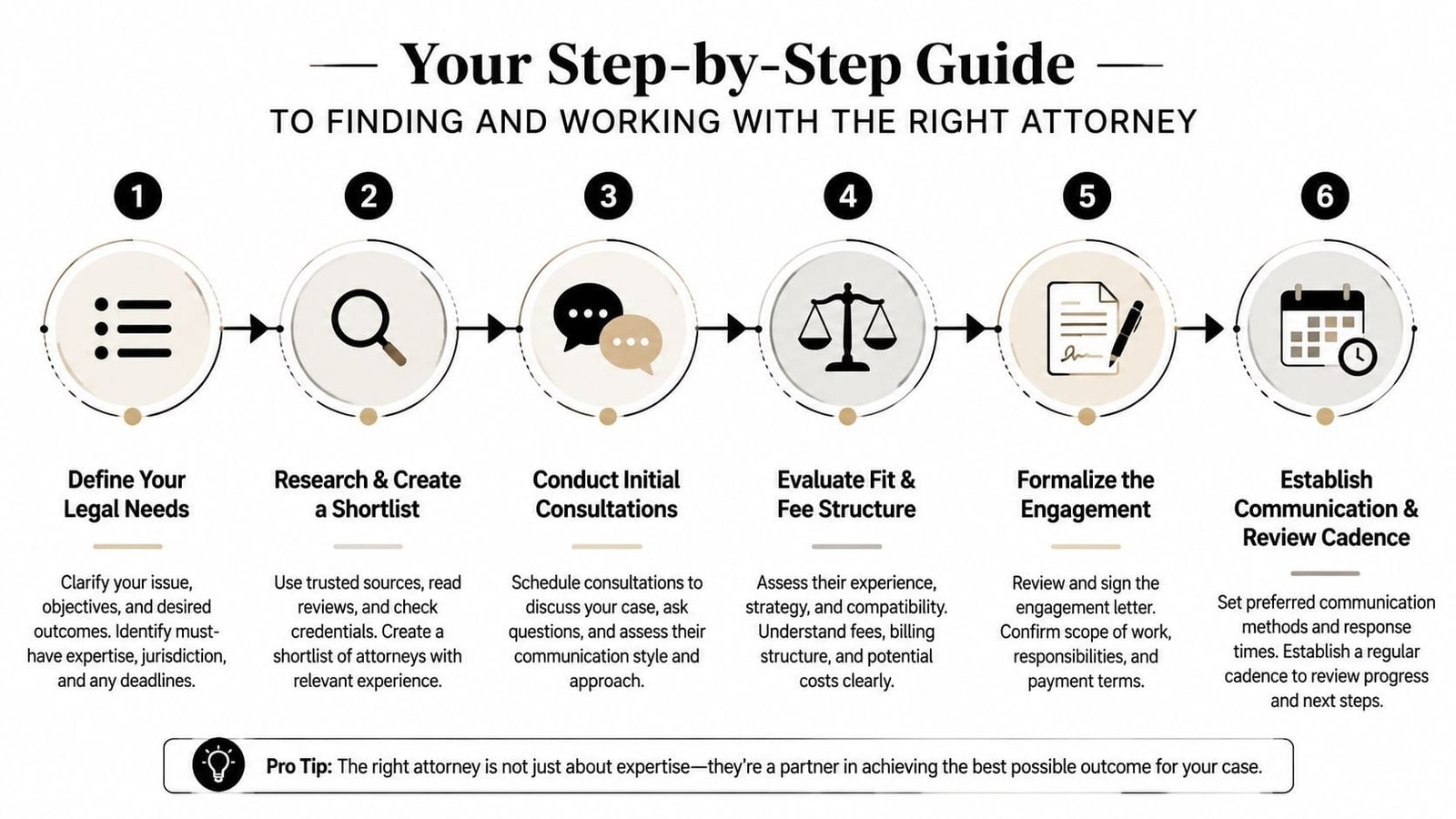
A good search starts with your actual need, not with a generic law firm website. If you don’t know whether you need formation help, contract help, or ongoing counsel, you’ll interview the wrong people and waste time on polished sales pitches.
Start with the problem you actually have
Write down the legal work you need in plain language. “I need help with a co-founder agreement,” is better than “I need a lawyer.” So is “I need contract templates for vendors and customers,” or “I need help getting compliant before hiring.”
That clarity helps you find the right type of attorney faster. It also keeps consultations focused on substance instead of introductions.
Shortlist based on relevance, not branding
Look for attorneys who do business formation, contracts, governance, and compliance work regularly. A general civil litigator may be a fine lawyer and still be the wrong one for transactional business issues. Ask what kinds of businesses they serve and what documents they draft every week.
Then check how they communicate. If their website is polished but their intake process is chaotic, that tells you something useful. Owners need competence and responsiveness, not just confidence.
Use the consultation to test judgment
Ask direct questions.
- How do you handle communication? You want a clear answer about who responds, how fast, and through what channel.
- How do you bill for scope changes? If they can’t explain that cleanly, expect surprises.
- What documents will you need from me? Good lawyers make preparation easier, not harder.
- How do you handle urgent issues? You need to know how escalation works before an emergency happens.
A solid attorney should also tell you what they don’t do well. That honesty is a positive sign.
Formalize the relationship and keep it current
Before work starts, get the scope in writing. Then decide when you’ll review contracts, policies, and risk issues again. Businesses change, and old templates age badly.
If you want a more hands-on way to stay organized, create a simple file with entity documents, contracts, insurance policies, licenses, and prior legal advice. Bring that file to the first meeting. It saves time and usually improves the quality of the advice you get.
Making the Decision That Fits Your Business Stage
Early-stage owners need structure, not a sprawling legal department. Focus on entity formation, founder agreements, and the first round of contracts that define how money and control flow. If you’re there now, hire for clarity and clean documentation.
Growth-stage businesses need stronger governance. The pressure shifts to compliance, employment policies, financing documents, and contracts that can stand up under heavier use. At this stage, you want an attorney who understands both risk allocation and operational workflow.
Established companies need legal counsel that can manage recurring relationships, standardize approvals, and keep the business audit-ready. At that point, the question is less “Do we need a lawyer?” and more “Do we have the right legal infrastructure?” The right answer depends on complexity, not ego.
Use that lens and you’ll stop treating legal help like an emergency expense. You’ll start treating it like part of the operating system.
If you want funding support alongside smarter business planning, Business Loan Warrior helps small businesses compare financing options and move through the application process with a single platform. If you’re sorting out contracts, compliance, and growth capital at the same time, that combination can make the next decision a lot cleaner.