

Most lenders want a debt service coverage ratio of at least 1.25x, while the SBA uses around 1.15x for many loans. Anything below 1.00x means your business can't cover its scheduled debt payments from operating cash.
You may already have a financing proposal on your desk, an equipment purchase waiting for approval, or an expansion that looks profitable on paper. Then the lender asks about cash-flow coverage, and suddenly your revenue growth isn't the main conversation.
My advice is to stop treating the lender's minimum as your business's target. A good ratio needs to satisfy the lender's formula, reflect the financing you want, and leave enough breathing room when business doesn't go according to plan.
Table of Contents
- The Number Lenders Use to Decide Your Loan
- How the Debt Service Coverage Ratio Actually Works
- Benchmarks Banks and SBA Programs Actually Use
- Industry Volatility and What 'Good' Looks Like in Practice
- Why a Good Annual DSCR Can Still Hide Cash-Flow Trouble
- Stress-Testing DSCR Before You Apply
- What Strong and Weak DSCR Profiles Mean at Underwriting
- Improving DSCR and Questions to Ask Before You Apply
The Number Lenders Use to Decide Your Loan
You sit across from a loan officer with financial statements, a list of equipment, and a confident explanation of why customers keep coming back. You expect questions about sales and collateral. Instead, the officer asks how comfortably your business can make its payments after the new loan closes.
That's the purpose of the debt service coverage ratio, or DSCR. It measures repayment capacity, not business size. A company can generate substantial revenue and still have little cash available after covering operating expenses.
The lending conversation becomes easier when you understand what the officer is evaluating.

Revenue gets attention, repayment capacity gets examined
The stakes are real: 67% of banks identified insufficient DSCR as a commonly reported reason for small-business loan denial, according to the FDIC's small-business lending findings. That doesn't mean coverage is the only approval factor. It means you shouldn't arrive without understanding yours.
Consider a roofing contractor preparing a working-capital request. Reviewing Blue Lake Roofing Supply's DFW flashing tape options can help the owner identify materials for the purchasing plan. But the financing discussion still needs to connect purchases, customer collections, operating costs, and scheduled loan payments.
The same principle applies to a restaurant expansion or an equipment purchase. Explain where repayment cash will come from, not just what the borrowed money will buy.
Underwriting rule: Present the loan as a repayment plan, not merely a spending plan.
Don't describe DSCR as a magic approval switch. Collateral, credit history, management, and the transaction still matter. Your job is to bring a defensible calculation, a realistic coverage target, and a clear explanation of what happens if cash flow weakens.
How the Debt Service Coverage Ratio Actually Works
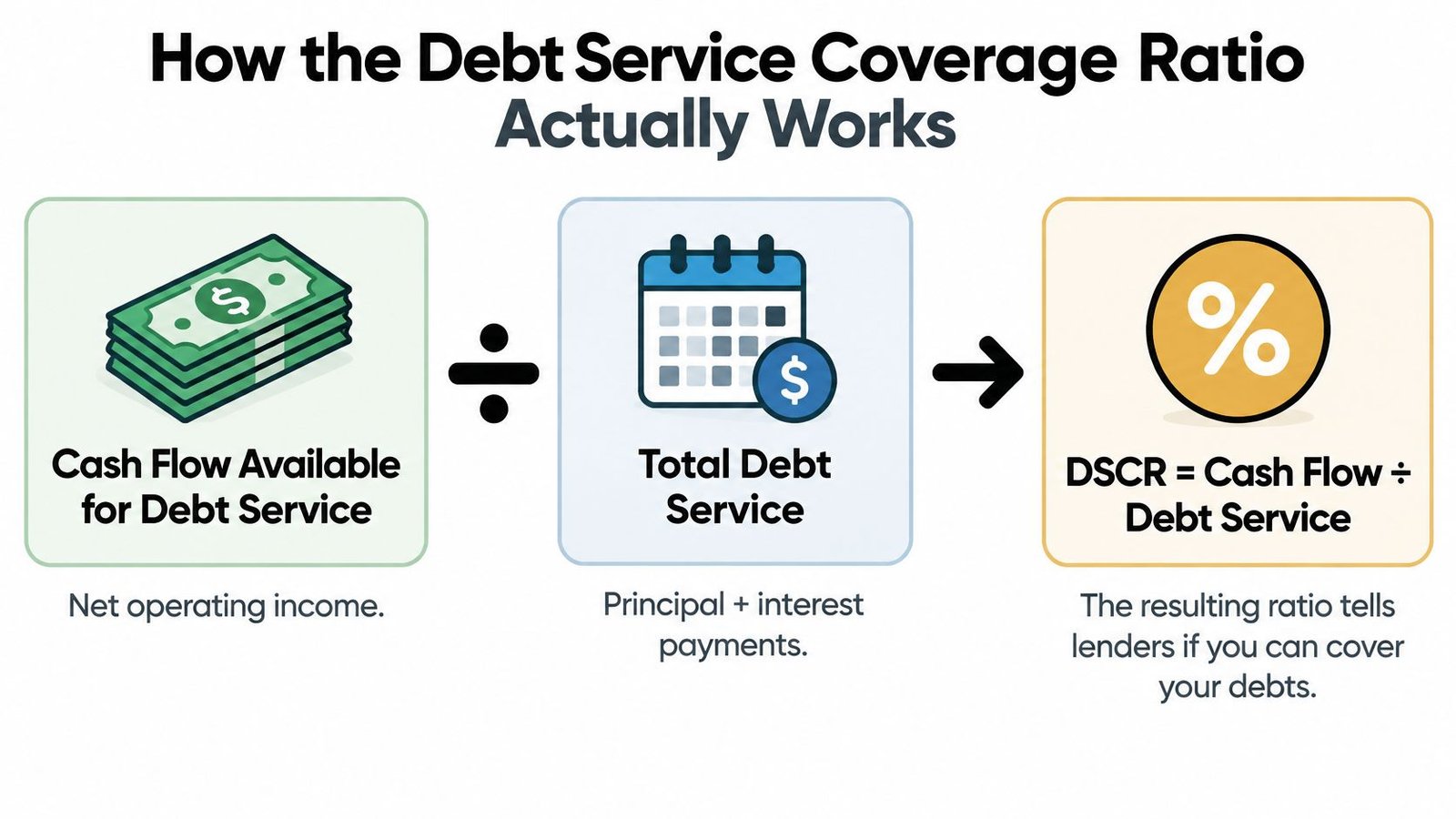
The formula is straightforward:
DSCR = Cash flow available for debt service ÷ Total annual debt service
The difficult part isn't division. It's agreeing on what belongs in each input.
This visual shows the calculation before you start reconciling your financial statements.
Build the inputs before trusting the result
Cash flow available for debt service is the numerator. Depending on the lender, that may mean EBITDA, adjusted operating cash flow, or cash flow after specified deductions for owner compensation and taxes.
Annual debt service is the denominator. Include required principal and interest on existing obligations and the proposed financing. Use matching periods for the cash flow and payments.
For a worked example, $250,000 in qualifying annual cash flow divided by $200,000 in annual debt service equals 1.25x, meaning $1.25 is available for every $1.00 owed and providing a 25% cushion above debt-service break-even, as explained in SME CPA's discussion of financial requirements for business borrowing.
Don't confuse that cushion with money you can automatically distribute. Your business may still need cash for inventory, taxes, equipment maintenance, or other uses outside the lender's particular calculation.
- Confirm the numerator: Ask the lender for its worksheet rather than substituting whichever profit figure looks strongest.
- Reconcile the payments: Use a business debt schedule to organize balances, payment obligations, and maturities.
- Document adjustments: Keep a separate explanation and supporting records for each proposed nonrecurring expense adjustment.
For another explanation of the calculation, use this video alongside your own worksheet.
The number you calculate internally is useful only if you can reconcile it to the lender's version. Ask about differences before submitting the application, not after an underwriter reduces your qualifying cash flow.
Benchmarks Banks and SBA Programs Actually Use
Ask three lenders what a good DSCR looks like and you can get three different answers. A published program minimum only marks where eligibility starts. What a lender wants to see depends on the loan program, the transaction type, and how much risk the rest of your file already carries.
That moving target shows up clearly in SBA lending. Under standards discussed for 2026, Standard SBA 7(a) loans above $350,000 may use a 1.15x minimum, while 7(a) Small Loans of $350,000 or less may use 1.10x when the transaction isn't a change of ownership, according to this SBA requirements overview. Ownership changes can require 1.25x historical coverage, and expansion transactions may sit at 1.15x.
How the floors compare
| Loan type | Published or typical minimum | What usually strengthens the file |
|---|---|---|
| Conventional bank term loan | Typically 1.20x to 1.35x; confirm the bank's own floor | Coverage comfortably above the floor plus stable collections |
| Standard SBA 7(a) over $350,000 | 1.15x | Cushion above the program minimum |
| SBA 7(a) Small Loan of $350,000 or less | 1.10x | Clean payment history and strong collateral support |
| SBA ownership-change financing | 1.25x historical coverage | Supportable post-acquisition projections |
| SBA expansion financing | 1.15x | Coverage that absorbs the new payment and added operating costs |
Two qualifiers matter more than any row in that table. First, the category. Buying an existing business is underwritten differently from buying equipment for a business you already operate, so ask the lender to name the exact program and transaction category before you measure yourself against any figure. Second, the basis. Get in writing whether the quoted minimum applies to historical results, projected results, or both.
Program floors say little about a specific lender's appetite. Compare the published threshold against the lender's own requirements, and review how to qualify for an SBA loan before assuming a borderline ratio will pass. If you run a restaurant or hospitality business, pair that review with MAJC's hospitality financial health guide, which gives your questions about operating performance a sharper starting point.
Shop for structure, not just the lowest published floor. A loan approved at 1.10x still has to be repaid while your business runs, so ask whether the payment schedule leaves enough working capital once repayment begins.
Industry Volatility and What 'Good' Looks Like in Practice
Two companies can report identical coverage and deserve opposite verdicts. Take a commercial cleaning firm with multiyear contracts and dozens of small accounts: its cash arrives on a schedule. Now take a lakefront retailer that earns most of its revenue across ten summer weeks. The annual math can look the same on paper while the repayment risk sits in different places.
That gap should move your target. For businesses with volatile sales, concentrated customers, seasonal revenue, or substantial expansion plans, I recommend holding approximately 1.35x to 1.50x rather than settling for the usual benchmark. Treat that as a planning cushion. No lender published it as a rule.
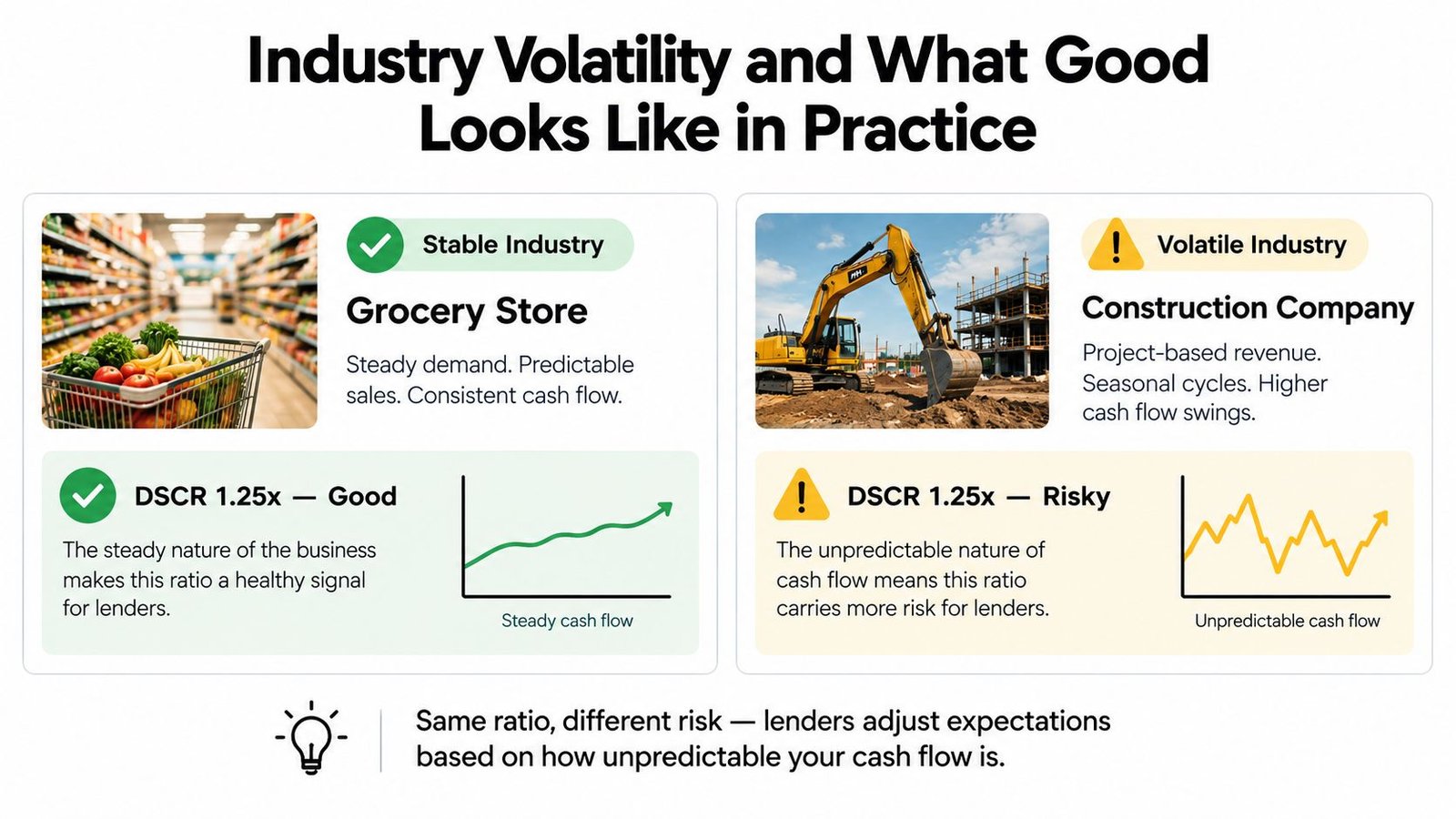
Set the target by asking what could interrupt the cash
Work backwards from the failure mode. A seasonal operator should size the target off the quiet months, because the payments still come due then. An owner whose revenue leans on one or two accounts should ask what a late payment, a reduced order, or a lost contract does to coverage in that quarter. Anyone planning a buildout or second location should count the hiring, the startup costs, and the months before new operations produce dependable cash.
Equipment-heavy businesses get one more question: what cash has to stay in the company to keep the assets productive? An accounting measure will not capture every practical demand on the business.
The right target reflects the cash flow you can defend under pressure, not the best year you can display.
Coverage enforcement gets stricter, not looser, as borrowing scales up. The reporting on Bradley University's covenant violation shows a lender-adjacent covenant failure producing real cuts after the fact. That is an institutional borrowing standard, so don't adopt it as your threshold. Adopt the lesson: covenant numbers get enforced.
So what is a good debt service coverage ratio for your business? Start with how predictable your model is, then pick a number you could still hit in a mediocre year.
Why a Good Annual DSCR Can Still Hide Cash-Flow Trouble
A business doesn't pay its lender with an annual average. It pays on the dates required by the loan documents.
A restaurant whose busy season generates strong cash can post a comfortable annual figure and still come up short on a February payment. If the owner distributes the surplus before the quiet stretch, the annual calculation does nothing to prevent the shortfall.
Retained liquidity is what the number never shows.

A retailer runs into a different version of the same problem: cash committed to inventory while a balloon payment approaches. Solid current-year coverage does not resolve a future maturity. That owner needs a credible repayment or refinancing plan in hand, and assuming another lender will step in is not a plan.
The FDIC discussion cited earlier makes the same point: annual coverage misses practical cash demands. So run through the gaps before you trust the ratio.
Working capital is the first gap. Customers owe you money while payroll and suppliers need cash now. Owner withdrawals and taxes come next: confirm what the lender deducts, then count whatever cash demands remain after that. Maintenance spending belongs in the review too, because repairs and replacements still cost money even when the coverage methodology ignores them. Pull the actual loan documents last and check floating-rate resets, amortization changes, and upcoming maturities against what you assumed.
Billing discipline sits inside the working-capital question. If overdue invoices keep recurring, Loopfour's billing best practices gives you a practical framework for tightening invoicing and follow-up. Faster collections and higher accounting profit aren't interchangeable. Better collections strengthen liquidity without changing the earnings figure your lender uses.
One last trap: don't wave away a nonrecurring expense just because it won't repeat. It still consumed cash. Separate what the lender will add back from the liquidity you have left.
Stress-Testing DSCR Before You Apply
Build a forecast that can disappoint you before an actual cash shortage does. A useful stress test shows where repayment becomes uncomfortable and which actions you can take before reaching that point.
A 1.25x base case leaves only 25 cents of annual cash flow per dollar of debt service, while a target near 1.50x provides more capacity to absorb volatility. Oregon State's financial metrics discussion explains the underlying relationship: coverage changes when operating cash flow or debt-service obligations change.
Build distinct scenarios, not cosmetic variations
Start with a spreadsheet that connects operating assumptions to cash flow and loan payments. A cash-flow forecast built around your financing strategy gives you a practical foundation.
| Scenario | What to change | What you need to learn |
|---|---|---|
| Base case | Use supportable operating assumptions and the proposed financing structure | Whether the intended transaction works without optimistic adjustments |
| Downside case | Reduce sales or margins, delay collections, and test adverse payment changes | Where coverage and cash balances become uncomfortable |
| Upside case | Model credible operating improvements | Whether stronger performance creates durable capacity rather than temporary relief |
Keep adverse borrowing changes in the downside case. An upside case shouldn't assume a higher interest burden or faster principal repayment and then be described as favorable.
Test payment timing as well as annual coverage
Ask your CPA to compare monthly receipts and expenditures with scheduled payments. The denominator should reflect the complete post-closing debt structure established in your calculation, not a continuation of payments that the new financing will replace.
- Use contract-based rate assumptions: For floating-rate debt, model unfavorable changes using the agreement's reset mechanics.
- Separate earnings and collections: A delayed invoice payment may hurt liquidity before it changes reported earnings.
- Identify corrective actions: Decide which spending can wait, what distributions can stop, and whether the loan request needs resizing.
- Record the warning point: Note when cash becomes tight, not merely when the annual ratio breaches a threshold.
Application test: If the downside case works only because you assume immediate refinancing or perfect collections, revise the transaction before applying.
Keep the assumptions visible. A lender should be able to understand why the downside is plausible and how management would respond.
What Strong and Weak DSCR Profiles Mean at Underwriting
Coverage is evidence, not a verdict. An underwriter still needs to decide whether the cash flow is recurring, the adjustments are supportable, and the proposed structure fits the business.
Chase's explanation of debt service coverage notes that banks often seek at least 1.25x, while SBA lending uses a 1.15x benchmark, with requirements varying by lender and transaction. Use those reference points to frame the conversation, not to demand approval.
Compare the quality of the repayment story
| Coverage profile | What deserves scrutiny | How to present it |
|---|---|---|
| Strong and recurring | Whether earnings and payments remain dependable | Bring reconciled financials and a supportable downside forecast |
| Borderline but explainable | Whether a temporary issue or proposed adjustment is legitimate | Document the issue and show recurring performance separately |
| Weak after proposed financing | Whether the transaction is too large or payments are too demanding | Rework the borrowing amount, timing, or structure |
A stronger profile gives you a better basis for asking about pricing, repayment terms, and covenant flexibility. It doesn't entitle you to specific concessions.
For borderline coverage, lead with evidence rather than optimism. Explain a nonrecurring expense with invoices and records. If owner compensation needs normalization, show the ongoing cost required to operate the business rather than assuming the owner's work becomes free.
Negotiate the obligation you'll live with
Don't focus exclusively on closing. Ask how the agreement will measure compliance afterward.
- Calculation rules: Establish which adjustments remain permissible after funding.
- Testing and reporting: Confirm when the lender measures coverage and what financial information it requires.
- Borrowing and distributions: Ask whether additional debt or owner withdrawals require consent.
- Shortfalls: Understand the contractual process if coverage falls below the agreed requirement.
Be cautious about a structure that looks affordable only during a temporary payment concession. Evaluate the later payment schedule before accepting the earlier relief.
Above all, don't confuse collateral with repayment cash. Offering more security doesn't improve the operating cash flow in your worksheet. If the transaction doesn't fit, address the economics rather than trying to explain away the result.
Improving DSCR and Questions to Ask Before You Apply
Improve the business or improve the financing structure. Don't spend your preparation time searching for a more flattering calculation.
The cause-and-effect relationship described earlier gives you the priorities: strengthen qualifying operating cash flow, reduce required debt service where practical, and preserve enough liquidity to withstand payment timing problems.
Choose changes that survive underwriting
- Repair weak margins: Review pricing, purchasing, staffing, and discretionary spending. Favor changes you can demonstrate in current results over savings you merely intend to achieve.
- Evaluate refinancing carefully: Compare required payments, fees, maturity, and total cost. A longer repayment period may ease current payments, but it isn't automatically cheaper.
- Use cash selectively: Before paying down debt, confirm whether the payment obligation will decline and whether you'll retain adequate working capital.
- Tighten collections: Invoice promptly and assign responsibility for overdue accounts. Treat liquidity improvement separately from changes to lender-defined earnings.
- Reduce the request if necessary: Stage an expansion or postpone a nonessential purchase rather than borrowing beyond supportable repayment capacity.
Don't time the application to conceal a weak period. Bring current information and explain the trend. An attractive snapshot won't substitute for a credible ongoing repayment plan.
Ask the lender these questions directly
Bring a written list to the initial conversation:
- Numerator definition: What cash-flow measure do you use, and which deductions apply?
- Minimum versus target: Is your threshold a hard floor, and does this transaction require additional cushion?
- Adjustments: What evidence do you require for nonrecurring expenses and owner-compensation changes?
- Seasonality: How do you evaluate uneven collections and low-revenue periods?
- Loan structure: Which proposed payments and future changes must the forecast reflect?
- Ongoing compliance: What happens if coverage deteriorates after closing?
Leave that meeting with the lender's formula and your next actions, not just a verbal impression that the deal looks promising. The strongest application is the one you've already put to the test.
Business Loan Warrior helps small-business owners explore funding through a single, no-fee application, with access to a secure dashboard and conversations with underwriters. Visit Business Loan Warrior to explore financing options, and bring your debt schedule, lender-defined DSCR calculation, and downside forecast so the discussion starts with repayment capacity.