
Credit utilization is the percentage of revolving credit you're currently using, calculated by dividing reported balances by total credit limits and multiplying by 100. Both your overall ratio and the ratio on each individual card matter, so one nearly full account can hurt even when your combined percentage looks comfortable.
A small-business owner can discover this at an especially frustrating moment. Revenue is solid, invoices are moving, and personal payments have been on time, yet a working-capital application stalls. The problem may not be sales or collateral. It may be the balances showing on revolving accounts when a lender reviews your credit file.
Credit utilization is one of the few parts of a credit profile you can often change before applying. You can identify the ratio, see whether the issue is personal or business-related, check which account is driving it, and time a paydown around the issuer's reporting date. The important question isn't only whether you're under a popular rule. It's which utilization number a lender will see, when that number will be reported, and whether lowering it would leave your business short of cash.
Table of Contents
- The Number Lenders Notice Before They Notice You
- The Basic Math Behind Credit Utilization
- How FICO, VantageScore, and Business Models Weight Utilization
- Business Utilization and What Lenders Actually Pull
- The 30% Rule Versus the Under-10% Sweet Spot
- Practical Strategies to Lower Utilization Before You Apply
- Why a Higher Utilization Is Not Always a Red Flag
- Your Pre-Application Utilization Checklist
The Number Lenders Notice Before They Notice You
You apply for funding after a strong year, expecting the lender to focus on revenue, time in business, and collateral. Instead, the application slows down or produces an unfavorable decision. A high reported revolving balance may be part of the reason, even if you intend to pay the card in full when the statement comes due.
Credit utilization is the percentage of revolving credit currently used, calculated as total reported balances divided by total credit limits, multiplied by 100, as FICO explains in its credit-score FAQs. Revolving credit includes accounts such as credit cards and certain lines of credit, where you can borrow, repay, and borrow again up to a limit.
The ratio matters because it gives a lender a quick view of how much of your available borrowing capacity is occupied. A borrower with a modest balance against a large limit may look different from one whose accounts are nearly full, even if both make payments on time.
Practical rule: Treat utilization as a reported snapshot, not a permanent label attached to your business.
This guide will help you calculate the number, separate aggregate utilization from account-level utilization, distinguish personal credit from business credit, and choose sensible steps before an application. It also helps separate a temporary reporting spike from a persistent cash-flow problem. If you're unsure how a new application could affect your file, review what a hard credit pull is before authorizing a lender to access your credit.
The Basic Math Behind Credit Utilization
The calculation is straightforward:
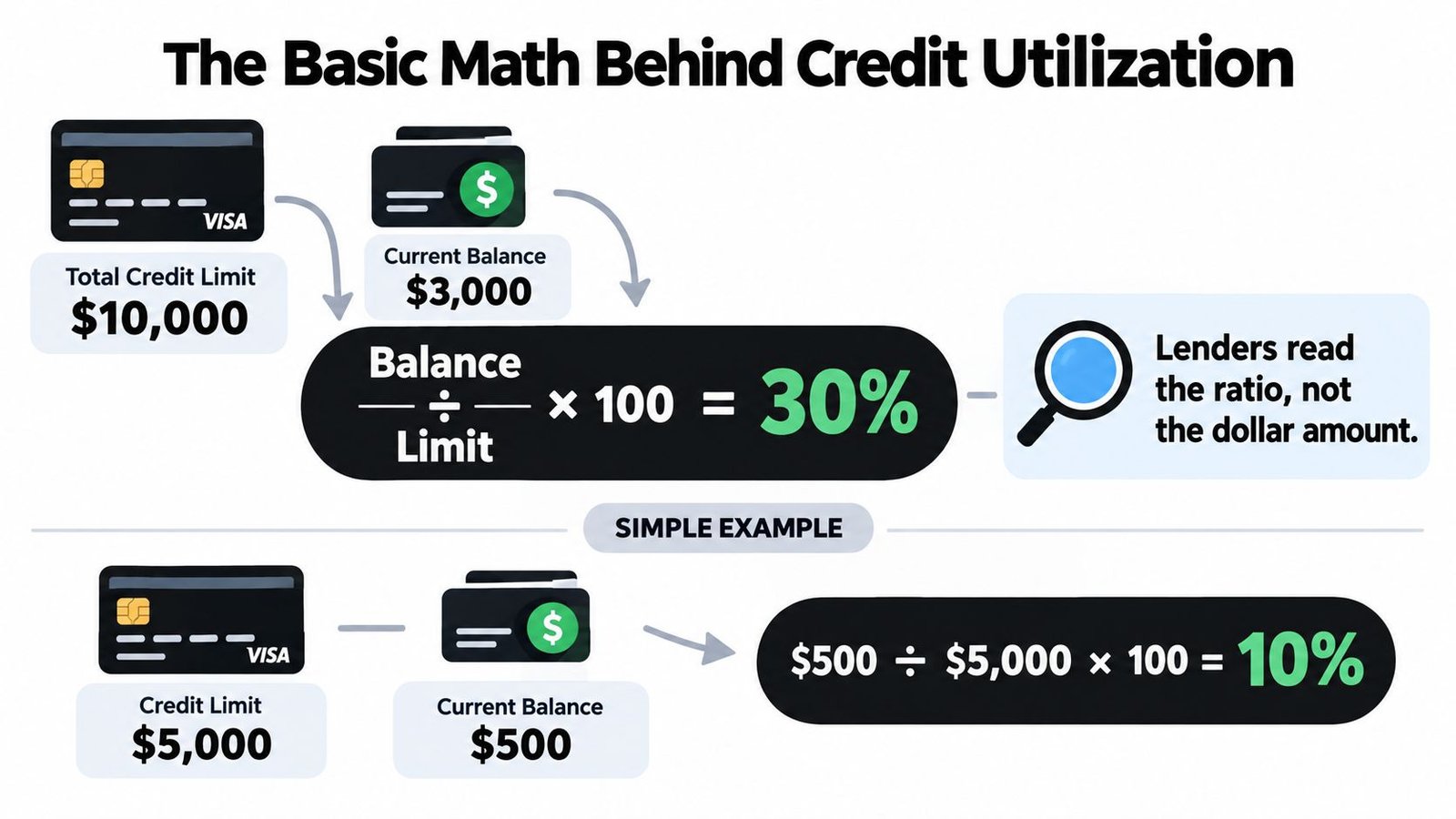
Credit utilization = reported balance ÷ credit limit × 100
Suppose one card has a $5,000 limit and a $1,250 balance. Divide $1,250 by $5,000, then multiply by 100. The result is 25% utilization. The dollar balance matters to your finances, but the ratio helps a scoring model compare your borrowing across accounts with different limits.
Aggregate and account-level ratios
With several cards, add the reported balances and add the credit limits separately. Then divide the first total by the second. That produces aggregate utilization, the combined ratio across revolving accounts.
Account-level utilization looks at each card on its own. Consider a borrower with $3,000 in balances against combined limits of $20,000. The aggregate ratio is 15%. But if $2,400 sits on a card with a $3,000 limit, that single card carries 80% account-level utilization. Scoring models evaluate both the combined ratio and individual accounts, so the 15% total doesn't erase the warning created by the nearly full card.
| View | Balance and limit | Utilization |
|---|---|---|
| Aggregate | $3,000 ÷ $20,000 | 15% |
| One account | $2,400 ÷ $3,000 | 80% |
The figures come from balances reported to credit bureaus. A mid-cycle payment may reduce what you owe in your banking app without changing the next reported balance if the issuer has already sent its data. For a broader explanation of lowering credit utilization score impact, focus on both the account driving the ratio and the total available credit.
How FICO, VantageScore, and Business Models Weight Utilization
Credit scoring models don't all read your file in exactly the same way. FICO identifies utilization within its “amounts owed” category as a major scoring input, but it doesn't publish one universal percentage that guarantees a particular score. VantageScore also considers available credit and recent balances, while business models may use bureau-specific information, payment behavior, and trade-credit data.
That means a personal score and a business score can tell different stories. A personal card may report to consumer bureaus, while a business card may report to business bureaus, personal bureaus, or both. Before applying, it helps to understand business loan credit score factors rather than assuming one score controls every funding decision.
What the utilization pattern shows
Experian reported the following Q3 2024 average utilization ratios by FICO score tier: 80.7% for poor, 61.4% for fair, 38.6% for good, 15.2% for very good, and 7.1% for exceptional scores, according to Experian's utilization guidance.
| FICO score tier | Average utilization |
|---|---|
| Poor | 80.7% |
| Fair | 61.4% |
| Good | 38.6% |
| Very good | 15.2% |
| Exceptional | 7.1% |
These figures show a nonlinear relationship. The difference between a high ratio and a moderate ratio may matter substantially, while moving from moderate utilization toward single digits can provide a stronger cushion for borrowers seeking a top-tier profile. The data are correlations, not proof that utilization alone caused each score range. Payment history, account age, inquiries, account mix, and derogatory information also affect scoring.
For a business owner, the practical lesson is simple: don't treat a score band as a utilization formula. Use the ratio as one diagnostic, then inspect the payment record and the report the lender is likely to pull.
Business Utilization and What Lenders Actually Pull
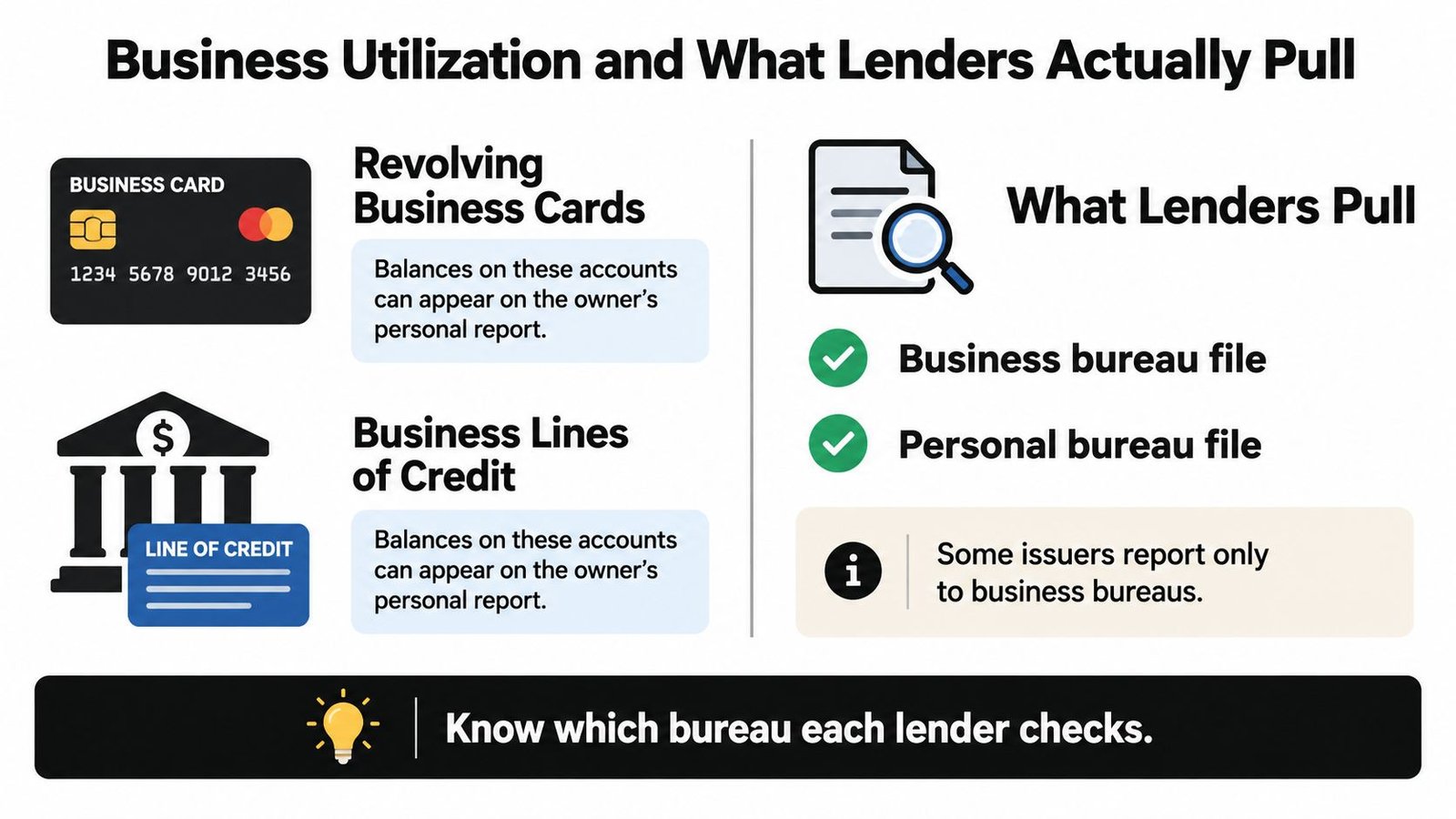
Personal utilization answers one question: how much of your consumer revolving credit is occupied? Business utilization asks the same question within the company's credit relationships, which may include revolving business cards, business lines of credit, and supplier trade-credit accounts.
The FDIC's small-business lending material defines utilization as credit used divided by available credit and highlights its relevance to business lenders and suppliers. A supplier may use business-credit information to set payment terms, while a lender may review business and personal files together, particularly when the owner provides a personal guarantee.
Four ratios that shouldn't be confused
- Personal aggregate utilization: The combined reported balances and limits on your consumer revolving accounts.
- Personal account-level utilization: The ratio on each personal card or revolving account.
- Business aggregate utilization: The combined use of eligible revolving business credit.
- Business account-level utilization: The ratio on a particular business card or line.
Business reports may also contain supplier trade-credit accounts, which don't fit neatly into a consumer-card formula but can still influence how lenders and vendors assess creditworthiness and payment terms. That's why paying down a personal card won't automatically repair a business report showing heavy use or late supplier obligations.
Before an application, ask which records the lender checks. Some underwriting processes may include a personal bureau file, a business bureau file, bank statements, or all of them. Some issuers report only to business bureaus, while others may report business activity to consumer bureaus depending on the product and agreement.
The right checklist is therefore broader than “What's my credit score?” Review every revolving business account, identify its reporting destination, and separate balances used for a temporary operating need from balances that remain high month after month.
The 30% Rule Versus the Under-10% Sweet Spot
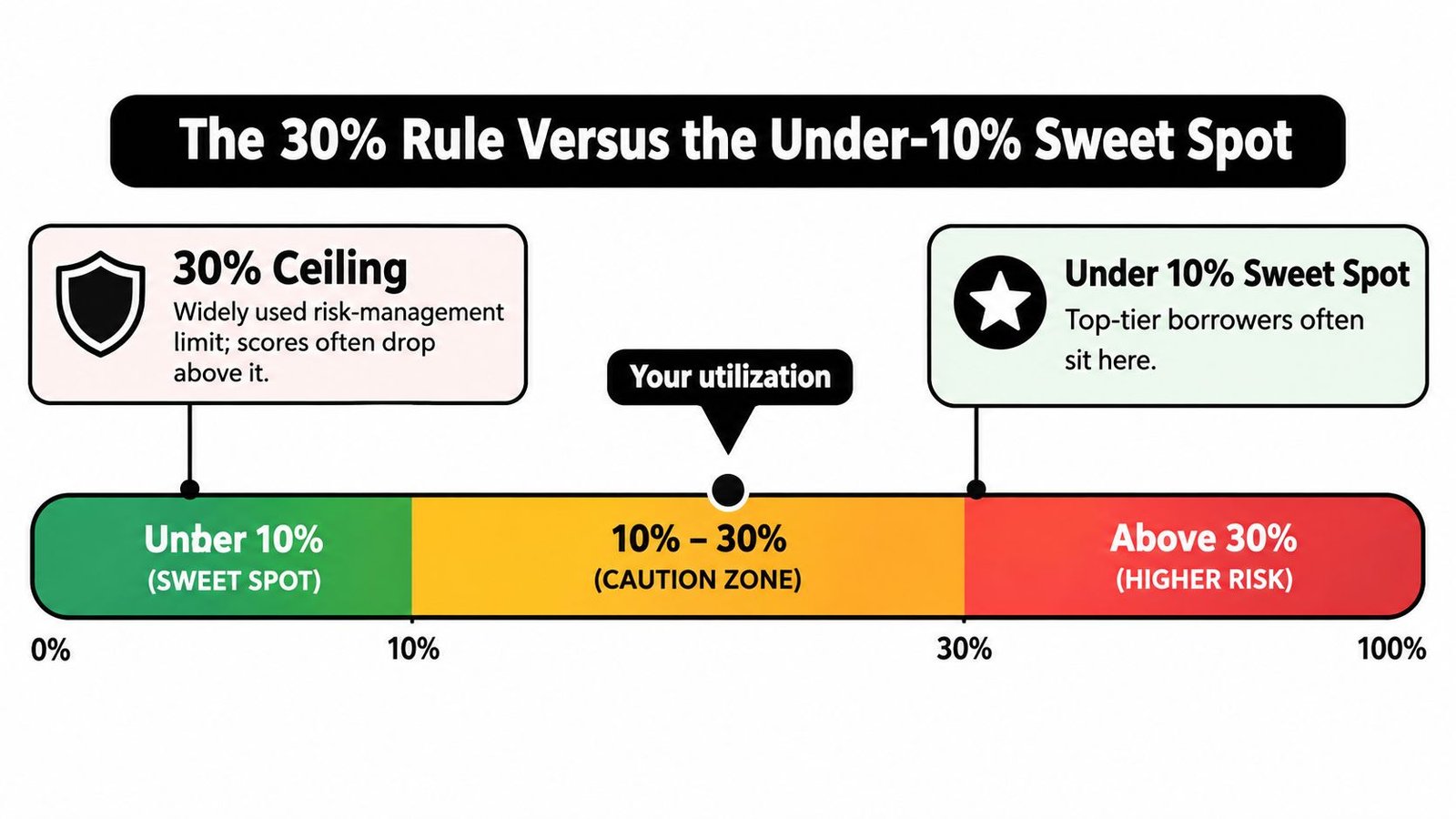
A business owner can be under 30% overall and still raise questions if one card is nearly tapped out right before a funding application. That is why the 30% ceiling works best as a guardrail, not a finish line. It helps you avoid looking stretched, but it does not always produce the strongest snapshot when a lender may review both your personal file and how each revolving account is being used.
The better way to read the rule is in layers. Under 10% usually signals plenty of breathing room on the personal side. 10% to 30% is often manageable, especially when balances are stable and spread sensibly across accounts. Above 30% is high enough to review both aggregate and card-level balances. A single card near its limit can still stand out even when the combined ratio looks acceptable.
As the score-tier table above showed, top-tier profiles cluster in single digits. Use that as context, not as a formula. If you are weeks away from applying, the goal is not perfection. The goal is to keep reported utilization from making a solid borrower look cash-tight on paper.
| Position | Practical interpretation |
|---|---|
| Under 10% | Strong buffer for a high-quality personal profile |
| 10% to 30% | Common management range, with room for model and account differences |
| Above 30% | High enough to review both aggregate and card-level balances |
| One card near its limit | Potential concern even if the combined ratio is moderate |
A practical example helps. Someone sitting at 25% may be fine leaving cash in the business if operations need it. Someone applying soon for a loan tied to a personal guarantee may get more benefit from paying down the highest card before its reporting date than from spreading cash evenly across every balance.
Practical Strategies to Lower Utilization Before You Apply
Lowering utilization shouldn't mean emptying the account that pays your employees or keeps inventory moving. Treat it as a controlled preparation exercise. Start by listing each account's limit, current balance, statement-closing date, and reporting destination.
Four levers with trade-offs
Pay before the statement closes. Issuers commonly report a balance based on their reporting schedule, so a payment before that date can reduce the balance visible to a scoring model. Paying two days after the statement closes may miss the next reporting cycle, while paying several days before it may be reflected sooner. Confirm the issuer's schedule rather than relying on the payment due date.
Request a higher limit carefully. A larger limit can lower the ratio mathematically if spending and balances stay unchanged. Some issuers may perform a hard inquiry, so ask about the review method before submitting the request. A higher limit only helps if you don't use the additional capacity to create a larger balance.
Distribute spending across available accounts. If business expenses must go on credit temporarily, spreading charges can prevent one account from appearing nearly full. This doesn't reduce total debt, but it can address the account-level problem that aggregate utilization can hide.
Keep unused accounts open when appropriate. Closing a card removes its credit limit and may raise aggregate utilization. Don't keep an account open if its fees, terms, or misuse risk outweigh the benefit, but understand the ratio impact before closing it.
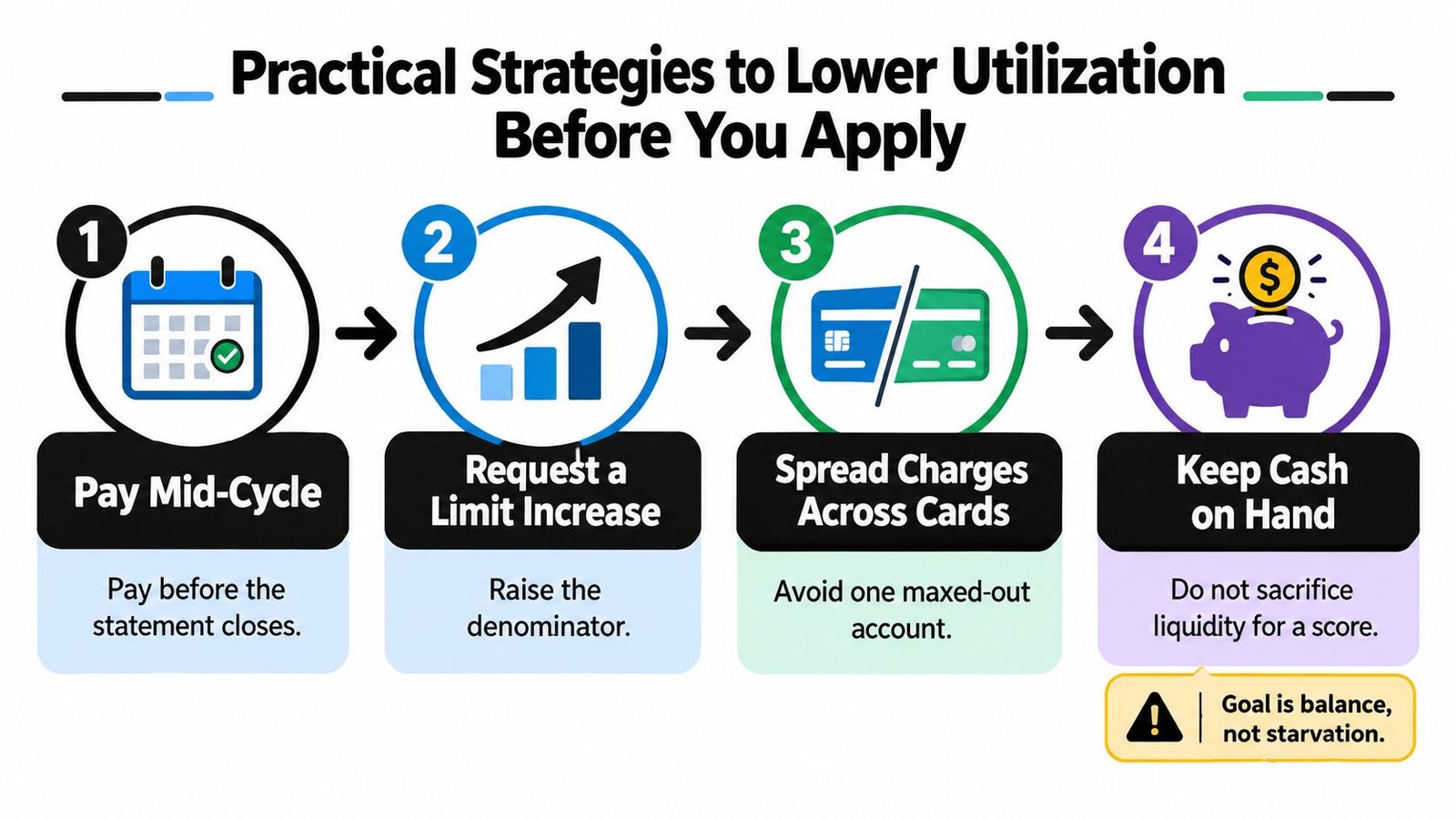
For a short-term gap, owners may also compare alternatives such as a cash advance, but the cost and repayment structure deserve careful review. The broader principle is to use credit wisely while protecting the liquidity that keeps the company functioning.
Why a Higher Utilization Is Not Always a Red Flag
A high reported ratio can mean several things. It may reflect chronic dependence on revolving debt, but it can also reflect seasonal inventory, a payroll bridge, or a one-time equipment purchase that the business expects to repay quickly. The percentage is a snapshot of reported balances, so it can look worse during a busy operating cycle than it does after receivables arrive.
CFPB data show average general-purpose-card utilization rose from 20% to 23% in 2023 across score tiers, while more recent market data indicate U.S. card utilization stayed just above 20% through 2025 and reached 20.9% in Q4, as reported in the CFPB's consumer credit card market report. Those figures describe market-level movement, not an individual borrower's risk, but they reinforce that utilization changes over time.
Read the balance in context
A lender may see a high ratio without seeing the business reason behind it. That's why you should be prepared to explain whether the balance funded inventory that is already selling, covered a temporary receivables gap, or represents an ongoing shortfall. A low ratio, meanwhile, doesn't prove that cash flow is healthy. Missed payments, weak deposits, or persistent losses can create concern even when revolving balances are modest.
Don't sacrifice working capital solely to make a credit dashboard look better.
The timing question matters. Issuers report according to their own schedules, and a lender may pull a bureau file after the issuer has reported but before your payment appears. A paydown can therefore affect a later snapshot rather than the exact balance you see today. Limit changes can also move the ratio without any new spending, so record both balances and available limits each month.
Build a monitoring habit
Use a recurring review that covers both personal and business credit:
- Record statement dates: Note when each issuer closes its cycle and when it generally reports.
- Compare two views: Track aggregate utilization and the highest account-level ratio.
- Watch limits: A reduction or closure can raise utilization even if balances stay unchanged.
- Preserve liquidity: Decide how much cash the business needs before making an accelerated paydown.
- Explain unusual spikes: Keep invoices, purchase orders, or cash-flow notes that show why a balance rose.
A secure lending dashboard can help organize the same information you'll need for an application, including credit insights, repayment activity, and current financial data. Use that kind of tool to time a paydown or application more intelligently, not to assume that a single percentage determines approval.
Your Pre-Application Utilization Checklist
A funding-ready profile starts with measurement, not a rushed payment. Use a 30-60-90 day plan that separates discovery, movement, and application.
First 30 days
Pull the personal and business reports relevant to your financing goal. List every revolving account, its credit limit, reported balance, account-level ratio, and likely reporting date. Mark which accounts appear on a consumer file, a business file, or both.
Days 31 through 60
Prioritize the account with the highest utilization, especially if the aggregate ratio conceals it. Pay before that issuer's reporting date when cash flow permits, consider a limit request only after checking for a possible hard inquiry, and avoid closing unused accounts without calculating the effect on available credit.
Days 61 through 90
Recheck the reports and confirm that the paydown or limit change appeared. Review both utilization and liquidity, then seek pre-approval through a process that doesn't affect your credit before submitting a full application. Enter underwriting with current bank information, on-time payments, and a clear explanation for any temporary balance spike.
The goal isn't a perfect score at any cost. It's a balanced profile that combines manageable utilization, reliable payments, sufficient cash, and a financing product suited to the company's actual need.
Business Loan Warrior helps small businesses compare funding options and check pre-approval without affecting credit, while giving owners a secure place to connect bank accounts, monitor approvals and repayments, and review credit insights. Visit Business Loan Warrior to assess your funding options before a utilization snapshot catches you unprepared.