
An SBA 504 loan is a long-term, fixed-rate small-business loan that combines a private lender, a Certified Development Company, and the borrower's own equity to finance major fixed assets like owner-occupied real estate and equipment. Its standard project structure is roughly 50% private lender financing, 40% SBA-backed debenture financing, and 10% borrower equity.
You may be looking at a building you've leased for years, planning a facility expansion, or comparing equipment financing options before committing to a major purchase. The central question isn't whether you can borrow money. It's whether your project budget can be arranged so the bank, CDC, and your business each take a clearly defined role.
The 504 program is built for that kind of project. It's less like a general-purpose business loan and more like a financing package assembled around a specific building, construction plan, or large piece of equipment. Once you understand the budget first, the program rules become much easier to follow.
Table of Contents
- The SBA 504 Loan in Plain English
- How the Three-Part Project Finance Structure Works
- What 504 Loans Can and Cannot Be Used For
- Real Project Scenarios for SBA 504 Borrowers
- SBA 504 vs SBA 7(a) vs Conventional Loans
- Application Process, Timeline, and Costs
- Pros, Cons, FAQs, and Next Steps
The SBA 504 Loan in Plain English
Suppose you operate a growing auto repair shop in a leased building. Your technicians are busy, storage is tight, and the landlord controls when you can renovate or expand. Buying a suitable property could solve those problems, but putting a large amount of cash into the purchase might leave too little money for payroll, inventory, and daily operations.
An SBA 504 loan is designed to help a qualifying small business finance major fixed assets while limiting the pressure on its initial equity contribution. The program commonly supports owner-occupied commercial real estate, buildings, land with improvements, construction, renovation, and substantial equipment. The SBA's official 504 loan description identifies the program as a source of long-term financing for major fixed assets and states that the maximum loan amount is $5.5 million, with higher limits available for certain energy-efficiency, manufacturing, and public-policy projects.
The word “owner-occupied” matters. The business generally needs to use the financed property for its own operations rather than buying a building solely as an investment. A restaurant that operates from the property, a manufacturer running production there, and a service company using offices there are different from an investor purchasing a property to rent to unrelated businesses.
The budget comes first
Start with the total project cost. That may include the purchase price, construction or renovation, eligible equipment, professional fees, and other costs connected to creating or improving the fixed asset. Then identify the funding sources:
- Private lender: Provides the first mortgage and usually covers roughly half of the project.
- Certified Development Company: Packages and services the SBA-backed portion, commonly covering roughly 40%.
- Borrower: Contributes the remaining equity, typically 10%, subject to the project and borrower's circumstances.
The SBA 504 program doesn't send you a general cash advance to spend wherever you choose. It connects a defined project budget with long-term financing. That distinction helps explain both the program's lower equity pressure and its restrictions on working capital, inventory, and speculative real estate.
How the Three-Part Project Finance Structure Works
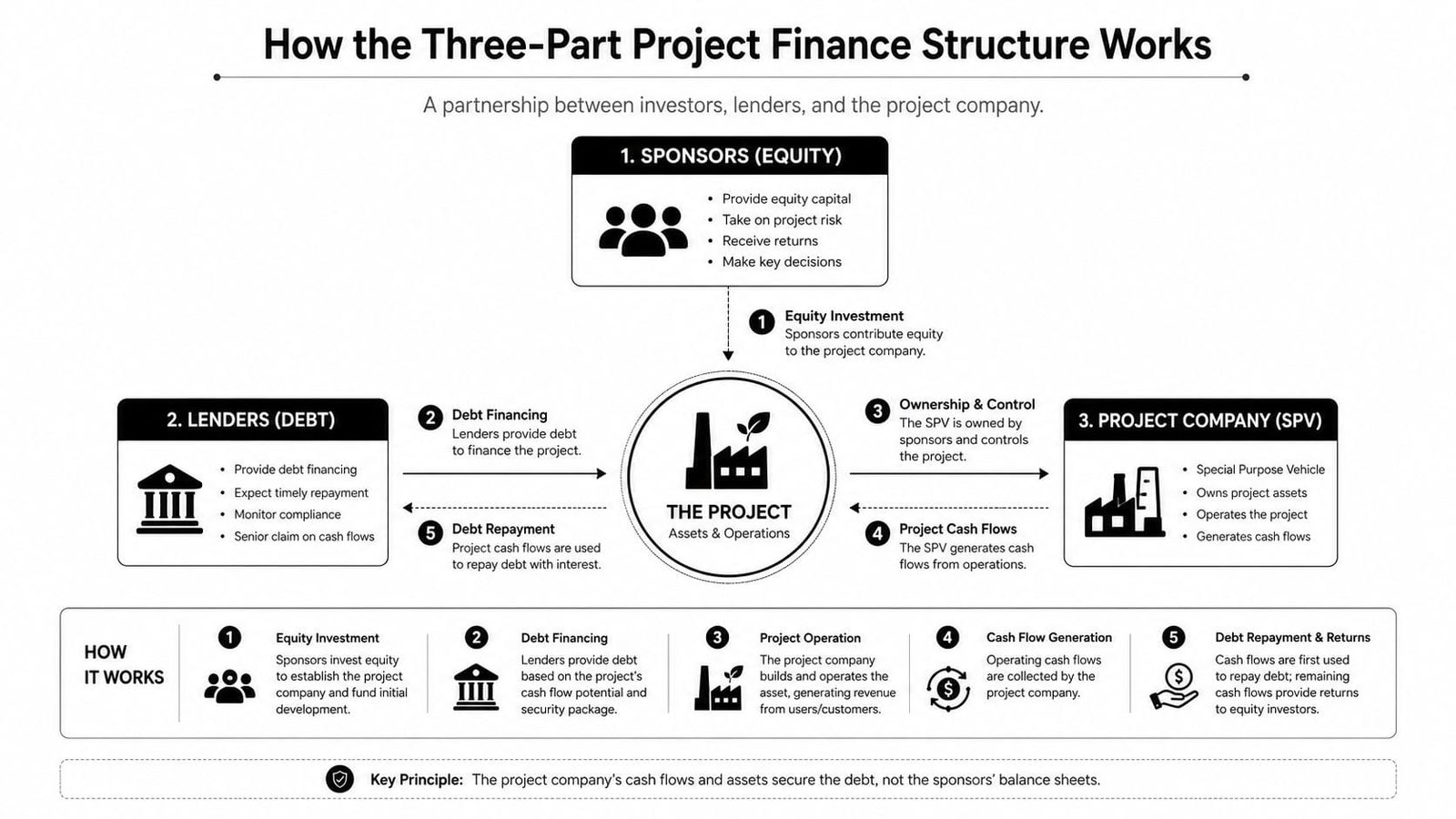
Take a hypothetical project with a total budget of $1.2 million. Applying the standard structure gives you a practical picture of how the financing pieces fit:
| Project component | Approximate share | Amount on a $1.2 million project |
|---|---|---|
| Private lender first mortgage | 50% | $600,000 |
| CDC-funded SBA-backed debenture | 40% | $480,000 |
| Borrower equity | 10% | $120,000 |
These proportions reflect the standard structure described by the Congressional Research Service overview of the SBA 504 program. The third-party lender provides at least half of the total project cost with a first lien. The CDC funds up to 40% through a debenture, and the borrower contributes at least 10% equity.
What the bank does
The private lender holds the first lien, which gives it the senior claim on the financed property or assets. It underwrites your business, reviews repayment capacity, evaluates the collateral, and sets the commercial terms for its portion of the financing.
The bank's loan isn't identical to the CDC debenture. It may have its own rate structure, underwriting requirements, covenants, documentation, and closing conditions. You'll usually make payments on both pieces, even though the loans are coordinated as one project package.
What the CDC and SBA do
The CDC works with you and the bank to package the 504 portion. It submits the project for SBA authorization, coordinates required documentation, and services the CDC-funded loan after closing.
The SBA itself generally doesn't lend the money directly in this structure. Instead, the SBA guarantees the CDC debenture. The guarantee supports the debenture market and helps make long-term, fixed-rate financing feasible for eligible owner-occupied real estate and qualifying fixed assets.
The $5.5 million maximum applies to the standard SBA 504 loan amount, with higher limits available for certain qualifying project categories, as stated by the SBA. When a project is larger than the CDC portion can support, the participating bank may finance more of the total project, while the borrower and lenders structure the transaction around the applicable SBA limit.
What 504 Loans Can and Cannot Be Used For
The safest way to evaluate a 504 loan is to describe the project in terms of the asset being created, purchased, improved, or installed. If the money is mainly funding a durable business asset, the project may fit. If it's mainly funding everyday operations, the 504 structure probably isn't the right tool.
Common eligible project uses
- Existing commercial real estate: A business can purchase a building it will occupy and operate from.
- Construction and major renovation: Ground-up construction, substantial improvements, and qualifying facility expansion may fit when the business will use the property.
- Long-life machinery and equipment: Equipment with a useful life of at least 10 years can be eligible when it supports the operating business.
- Land connected to a building project: Land acquisition may be included when it forms part of an approved facility project.
- Eligible soft costs: Architecture, engineering, environmental work, title services, and related project costs may be included when properly documented.
- Qualifying refinance: Certain existing commercial debt tied to eligible fixed assets may qualify for refinancing, but a refinance must satisfy program requirements.
The borrower also needs to meet program conditions. The business must be a for-profit company operating in the United States, and the SBA identifies financial eligibility thresholds including tangible net worth under $15 million and average net income under $5 million over two years. A financed building generally needs meaningful owner use, including the 51% owner-occupancy rule for an existing building.
Where borrowers often get confused
A 504 loan isn't a flexible substitute for a line of credit. It generally isn't intended for working capital, inventory, speculative property purchases, or a pure refinance of unrelated debt. Passive real estate ownership is another common problem because the program is designed around an operating small business using the asset.
| SBA 504 Loan Eligible Uses | Ineligible Uses |
|---|---|
| Owner-occupied commercial property | Passive or speculative real estate |
| New construction and major renovation | General working capital |
| Qualifying long-life equipment | Inventory financing |
| Land connected to an approved facility | Pure refinance of unrelated debt |
| Eligible architecture, engineering, environmental, and title costs | Investment property bought only for leasing |
Before you assume an equipment purchase qualifies, check the asset's useful life, business purpose, project budget, and ownership structure. For a broader look at alternatives, compare equipment financing for small business before choosing a fixed-asset program.
Real Project Scenarios for SBA 504 Borrowers
A project budget becomes easier to understand when you can see how different businesses might use the structure.
A restaurant buys its location
A family restaurant group has leased the same building and wants to purchase it for $900,000. Under a standard 504 structure, a 10% equity contribution would be $90,000, with the balance divided between a bank first mortgage and a CDC-funded debenture. The restaurant operates from the property, so the owner-occupancy question is central. The financing supports the real estate rather than unrelated payroll or food inventory.
The group should also budget for appraisal, environmental review, title work, legal documentation, and any approved improvements. Those details can affect the final project cost and therefore the size of each financing piece.
A machining company expands production
A precision machining company needs a $600,000 CNC production line and a small building expansion. Instead of treating the equipment and construction as unrelated purchases, the owners can ask whether both belong in one eligible fixed-asset project.
The answer depends on the equipment's useful life, the construction scope, the property, and the company's financial capacity. A combined project can make sense when the building improvement directly supports installation and operation of the machinery. The borrower still needs to contribute equity, while the bank and CDC coordinate the senior and subordinated financing.
An IT services firm moves into a larger facility
A growing IT services company doesn't need heavy machinery, but it does need a larger office and training space. The company may still benefit from 504 financing if it purchases or improves a building that it will occupy and operate from.
The key issue is not whether the business manufactures products. It's whether the property supports the company's operating activities and meets the owner-use requirements. A service business can have an eligible real estate project when the facility is used by the business rather than held as a passive investment.
Budgeting rule: Describe every dollar by its project purpose. A lender can evaluate “building purchase, renovation, and installed equipment” more clearly than “growth capital.”
SBA 504 vs SBA 7(a) vs Conventional Loans
The three options serve different borrowing problems. A 504 loan is purpose-built for major fixed assets. An SBA 7(a) loan is broader and can support uses such as working capital, while a conventional commercial loan may offer more flexibility if the borrower and project meet the bank's standards without an SBA structure.
| Feature | SBA 504 | SBA 7(a) | Conventional |
|---|---|---|---|
| Primary use | Owner-occupied real estate and major fixed assets | Broader business purposes, including working capital | Property, equipment, or other uses approved by the bank |
| Equity requirement | Typically 10%, subject to project details | Varies by lender and project | Often determined by lender risk policy |
| Maximum size | SBA states a maximum loan amount of $5.5 million, with higher limits for certain projects | Program limits and lender rules apply | Set by lender and borrower capacity |
| Rate type | CDC portion is structured as long-term fixed-rate financing | Commonly variable or adjustable | Fixed or variable, depending on the lender |
| Term approach | Long-term, fully amortizing fixed-asset financing | Varies by use and lender | Varies by asset and lender |
| Collateral | Financed fixed assets and lender requirements | Collateral expectations vary | Bank sets collateral and guarantees |
| Speed | CDC coordination can make the process more involved | Varies by lender and package | Often faster when the file is straightforward |
The 504 is compelling when your main need is a building, facility expansion, or qualifying equipment and you want predictable long-term repayment. It's less suitable when the project requires a large working-capital reserve, inventory purchases, or flexible use of proceeds.
A conventional loan can win on speed and simplicity, especially when the business has strong financials, substantial liquidity, and a project that fits the bank's normal credit box. The trade-off may be a larger equity requirement, different collateral demands, or less favorable repayment structure.
A 7(a) can be more practical when the project combines fixed assets with operating needs. Some borrowers explore a combination of programs, but the structure must be reviewed carefully so each loan finances an eligible and clearly documented use. This SBA 7(a) versus 504 comparison can help frame that decision, while broader commercial lending data provides useful context for comparing lending categories and market information.
Application Process, Timeline, and Costs
A 504 application starts with the project, not with a generic loan form. Before you negotiate a closing date or order reports, confirm that the property, equipment, ownership structure, occupancy plan, and business qualify for the program.
A practical sequence
- Choose a CDC and participating bank. Ask both parties how they divide responsibilities, what information they need, and how they handle the bank first mortgage and CDC debenture.
- Prepare the project budget. Separate real estate, construction, equipment, professional services, and other eligible costs. Keep bids, purchase agreements, estimates, and invoices organized.
- Complete underwriting. The bank evaluates repayment capacity and the first mortgage. The CDC reviews SBA eligibility and packages the debenture request.
- Receive authorization and complete diligence. Appraisals, environmental reports, title work, construction documents, and legal items may affect the schedule.
- Close and fund the project. The bank loan and the CDC portion are coordinated, with the debenture funding process handled through the CDC structure.
A clean transaction can move faster than a construction or renovation project. A realistic planning window is 60 to 120 days, depending on environmental review, construction complexity, lender workflow, and the completeness of your documents.
The cost picture has several layers. Expect to discuss a CDC processing fee, SBA guarantee fee, bank underwriting or participation fee, third-party closing costs, and the borrower's equity injection. Some CDC and SBA-related costs may be financed into the project, while certain bank, legal, appraisal, environmental, title, or recording expenses may be due separately at closing. Ask for a written estimate that identifies which charges are financed and which require cash.
For a document checklist and process overview, use this step-by-step SBA loan application guide.
Pros, Cons, FAQs, and Next Steps
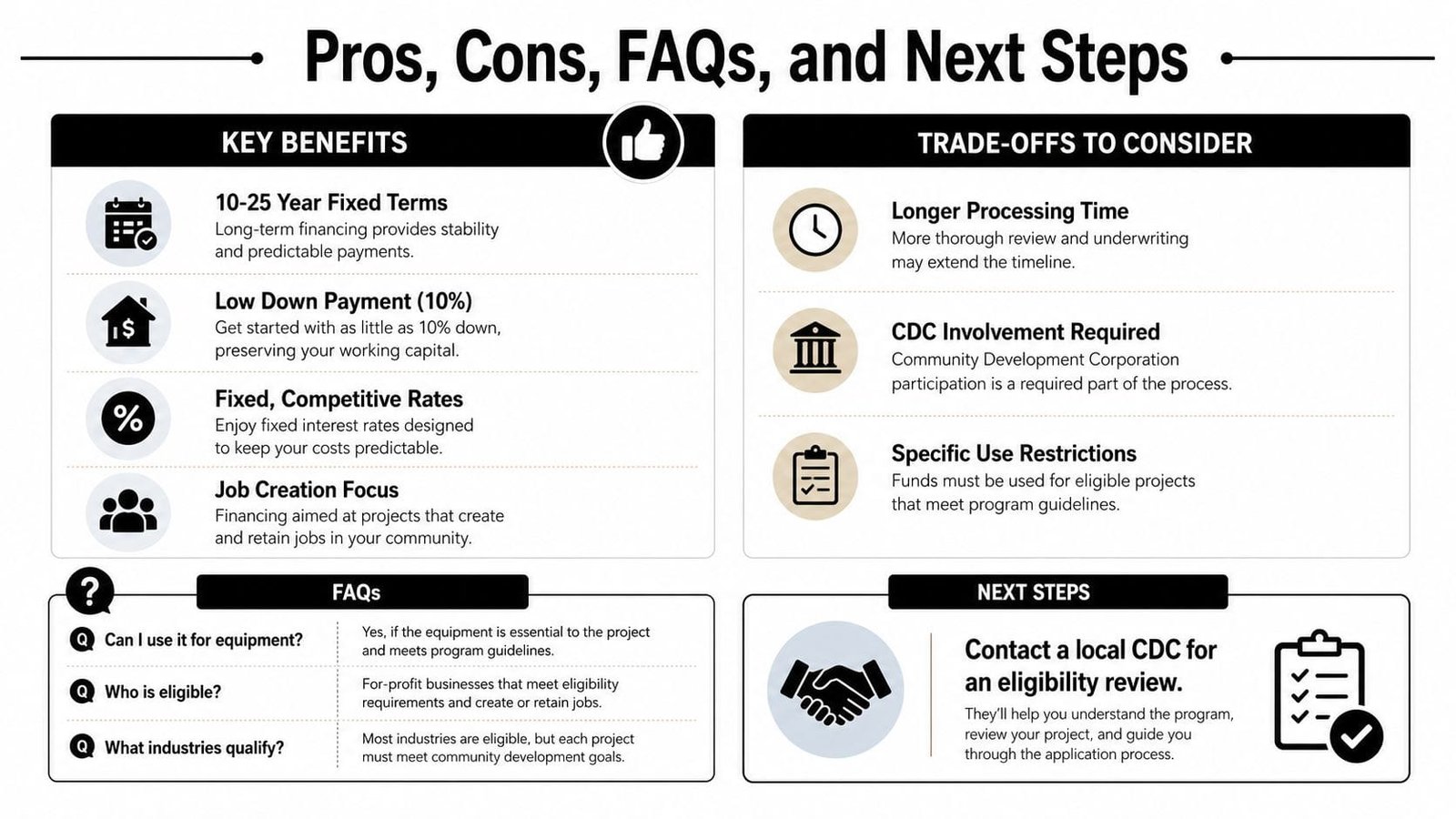
The strongest 504 projects have a clear asset, a realistic budget, and an operating business that can support repayment. The program's appeal comes from long-term fixed-rate financing and a relatively modest equity requirement, but those benefits come with use restrictions and coordination among the borrower, bank, CDC, and SBA.
Benefits and trade-offs
Advantages
- Predictable repayment: The CDC portion uses long-term, fixed-rate financing, which can make budgeting easier.
- Lower initial equity pressure: The standard structure typically asks the borrower to contribute 10%, rather than funding the entire project with cash or a conventional structure.
- Asset-focused financing: The program fits real estate, construction, renovation, and qualifying equipment.
- Fully amortizing structure: The borrower repays principal and interest over the loan term instead of relying on a balloon payment structure for the CDC portion.
Limitations
- Restricted use of funds: Working capital, inventory, and speculative real estate generally don't fit.
- Occupancy requirements: The business must use the financed building in accordance with SBA owner-use rules.
- More parties at the table: Bank and CDC coordination can create additional documentation and timing requirements.
- Not an emergency product: A 504 loan is usually a poor match for an urgent cash-flow gap.
Questions borrowers ask
Can a startup qualify?
A startup may be considered, but approval depends on the complete credit picture, management experience, projections, equity, collateral, and project eligibility. A strong fixed-asset plan doesn't remove the need to show that the business can repay the debt.
What happens when I refinance?
A refinance must be tied to qualifying commercial debt and meet applicable 504 requirements. It isn't a general method for replacing any business obligation with SBA-backed debt.
Can I pair a 504 loan with a 7(a) loan?
Potentially. A 504 may finance the building or equipment while a 7(a) addresses eligible working-capital needs, but the lender and CDC must define the uses clearly and avoid overlapping proceeds.
Can I lease the building later?
Future leasing may be possible only within the program's owner-use and eligibility rules. Don't assume you can buy an operating property through 504 financing and immediately convert it into a passive investment. Discuss any planned change in occupancy with the CDC and lender before acting.
Before committing to a site or equipment order, gather your business tax returns and current financial records, confirm that your company can satisfy the owner-occupancy requirement, compare CDC options, and get a project-level eligibility review. A clear budget gives the lender something concrete to underwrite and helps you identify whether a 504 loan, 7(a), conventional financing, or a combination is the better fit.
Business Loan Warrior helps small-business owners compare funding options, prepare financing information, and connect project needs with products such as SBA processing, equipment financing, construction loans, and business lines of credit. Visit Business Loan Warrior to review your options and take the next step toward financing an owner-occupied property, facility expansion, or qualifying equipment project.