
You're probably here because you typed “business quotes” into a search bar and got two completely different answers.
One result gave you polished one-liners about ambition, grit, and leadership. Another looked like a lender's offer, an insurance proposal, or a contractor's pricing sheet. Both are technically business quotes. Only one helps when you're deciding whether to borrow, insure, hire, buy, or delay.
That gap matters more than most articles admit. A lot of quote roundups are built for motivation, but owners usually need help with judgment. They need to understand pricing, terms, exclusions, repayment structure, and risk. That practical need gets sharper when cash is tight. Hiscox notes that only about one-third of small businesses have a dedicated cash reserve for emergencies, which is exactly why advice on cash flow and uncertainty beats generic inspiration for many owners (Hiscox on practical small-business quote needs).
Table of Contents
- What Are Business Quotes and Why the Confusion
- The Two Worlds of Business Quotes Explained
- Key Types of Practical Business Quotes
- How to Request and Compare Quotes Systematically
- Negotiation Tips and Sample Communication Scripts
- Simplify Financing Quotes with Business Loan Warrior
- Frequently Asked Questions About Business Quotes
What Are Business Quotes and Why the Confusion
The confusion starts with language. In everyday business, “quote” can mean a memorable statement from a founder or operator. It can also mean a formal offer that states what something will cost and under what terms it will be delivered.
Those are not small differences. One quote shapes mindset. The other affects cash flow, margin, repayment pressure, insurance protection, and vendor accountability. If you mix them up, you can end up inspired but underinformed.
A useful way to think about it is this:
- Inspirational business quotes help you decide how to think.
- Practical business quotes help you decide what to sign.
That second category has more operational weight. It shows up when you're comparing loan options, renewing coverage, hiring a marketing agency, buying equipment, or evaluating a construction bid. In each case, the quote is a decision document. It's not decoration.
Practical rule: If a quote can change your monthly obligations or lock you into terms, treat it like a financial tool, not marketing copy.
This is why most “best business quotes” articles miss the point for working owners. They give you slogans when you need decision support. A founder worried about payroll timing, inventory replacement, or an insurance renewal doesn't need another recycled line about hustle. They need a clean way to read terms, compare offers, and avoid expensive misunderstandings.
That's also why it helps to understand the system behind financing offers. If you've never used a marketplace model, this guide to how an online business loan marketplace works is a practical example of how owners receive and compare funding options without treating every quote like a separate mystery.
The Two Worlds of Business Quotes Explained
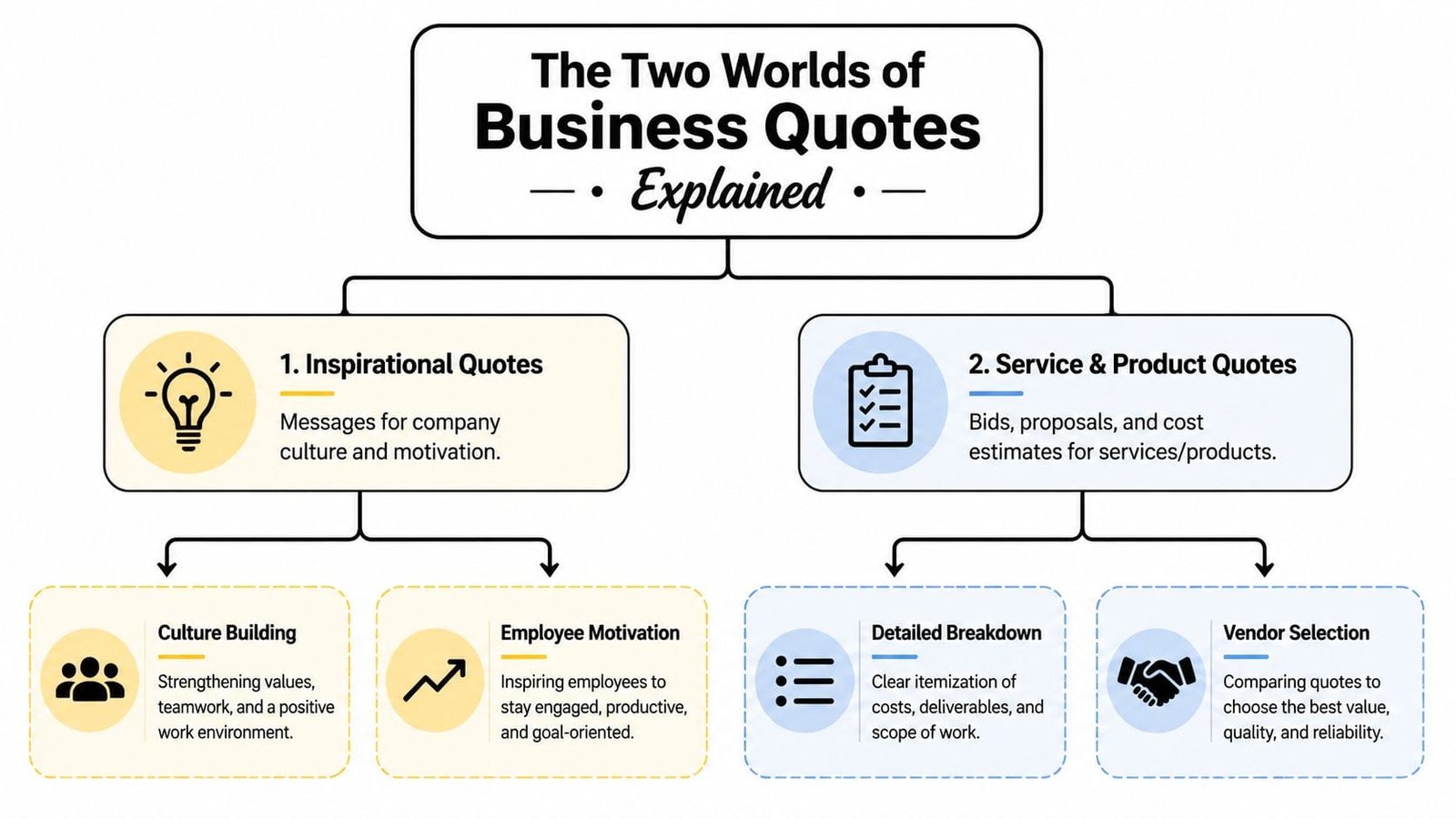
Some business quotes belong on a wall. Others belong in a spreadsheet. You need both categories, but you shouldn't use them for the same job.
Inspirational quotes still matter, but the bar is higher
A strong quote can sharpen culture. It can give a team language for discipline, speed, service, or resilience. That part is real. The problem is that most quote lists still lean on broad, timeless lines while the operating environment has changed.
Salesforce highlights that roughly 75% of knowledge workers use AI at work and hybrid work remains widespread, yet most quote roundup content still leans on older sayings instead of helping leaders think through hiring, management, and execution in a modern workplace (Salesforce on inspirational business quotes and modern work).
That matters because the best inspirational business quotes now do more than motivate. They help teams interpret new reality. A useful quote today should support questions like:
- How do we keep standards high when teams work across locations
- How do we use AI without lowering judgment
- How do we reward output instead of theater
- How do we keep accountability visible when work is less centralized
Older sayings about hard work still have value. But if they don't connect to current management trade-offs, they become office wallpaper.
Practical quotes are operating documents
The second world is where owners spend real money. A practical quote is a written proposal to provide financing, insurance, goods, or services under stated terms. It usually includes scope, price, timing, conditions, and exclusions.
Here's the difference in plain terms:
| Type | Main purpose | Best use |
|---|---|---|
| Inspirational quote | Reinforce values or mindset | Team culture, leadership, messaging |
| Practical quote | Define cost and terms | Loans, insurance, vendors, projects |
A practical quote answers questions that move a business:
- What am I paying for?
- What's included?
- What's excluded?
- What changes the price?
- What happens if timing slips?
- What obligation starts when I accept?
Aristotle Onassis is often credited with the line, “The secret of business is to know something that nobody else knows.” He lived from 1906 to 1975, and that quote became a durable business maxim in the mid-20th-century era of industrial expansion and global trade. Its staying power comes from a basic truth. Information advantage matters, but only if you use it well (historical note on famous business realism quotes).
That idea applies neatly to practical business quotes. The quote itself is information. Your edge comes from reading it better than the next operator.
Key Types of Practical Business Quotes
Not all practical business quotes look alike. Owners usually run into three buckets repeatedly: financing, insurance, and vendor or contractor proposals. Each one has its own language, blind spots, and pressure points.
Financing quotes
A financing quote tells you what capital costs and how repayment works. That sounds simple until you compare offers that present price in different ways.
One lender may emphasize the payment amount. Another may emphasize speed. A third may highlight flexibility. None of those are the same as total cost or fit.
When you review financing quotes, focus on:
- Repayment structure: Daily, weekly, or monthly repayment changes how cash leaves the business.
- Total obligation: Don't stop at the headline rate. Look at what you repay in full if everything goes according to plan.
- Prepayment treatment: Some products reward early payoff. Others don't.
- Collateral or guarantee language: Know what support the lender requires.
- Funding speed versus documentation: Fast money can be useful, but rushed review often leads owners to miss terms.
If you're sorting through nonbank options, this overview of alternative business loans helps clarify the kinds of products that can appear in quote comparisons.
A good financing quote doesn't just tell you what capital costs. It tells you how that cost will behave inside your operating cycle.
Insurance quotes
Insurance quotes look cleaner than they are. Premium is visible. Coverage quality is often buried.
A cheap policy can still be expensive if the exclusions are broad, deductibles are painful, or the coverage doesn't match the actual risk. I've seen owners compare only the premium and miss what matters more: whether the policy responds to the loss they're most likely to face.
Review insurance quotes with these questions:
- What events are covered
- What events are excluded
- What deductible applies
- What limits apply by claim or policy period
- Are key endorsements included or optional
- Does the business description match your operations
The sentence that describes your business matters more than many owners realize. If that description is sloppy, the quote may not fit the exposure.
Vendor and contractor quotes
These are the most common and often the most misunderstood. A vendor quote might come from a software provider, equipment seller, freight company, marketing firm, builder, IT consultant, or maintenance contractor.
The mistake owners make is comparing totals before comparing scope.
A better review looks like this:
| Element | What to check |
|---|---|
| Scope of work | Exact deliverables, milestones, and responsibilities |
| Materials or subscriptions | Brand, model, license level, or quality standard |
| Labor or service hours | Assumptions about effort, staffing, and timing |
| Change order rules | What happens if the project expands or shifts |
| Payment terms | Deposit, progress billing, retainers, final payment |
| Warranty or support | What happens after delivery |
Some proposals are short because the provider is efficient. Others are short because they've left room to bill later. Those aren't the same thing.
If you want cleaner vendor comparisons, ask every bidder to price the same scope. Once the scope changes from quote to quote, comparison turns into guesswork.
How to Request and Compare Quotes Systematically
Most owners don't struggle to get quotes. They struggle to normalize them. That's the true job.
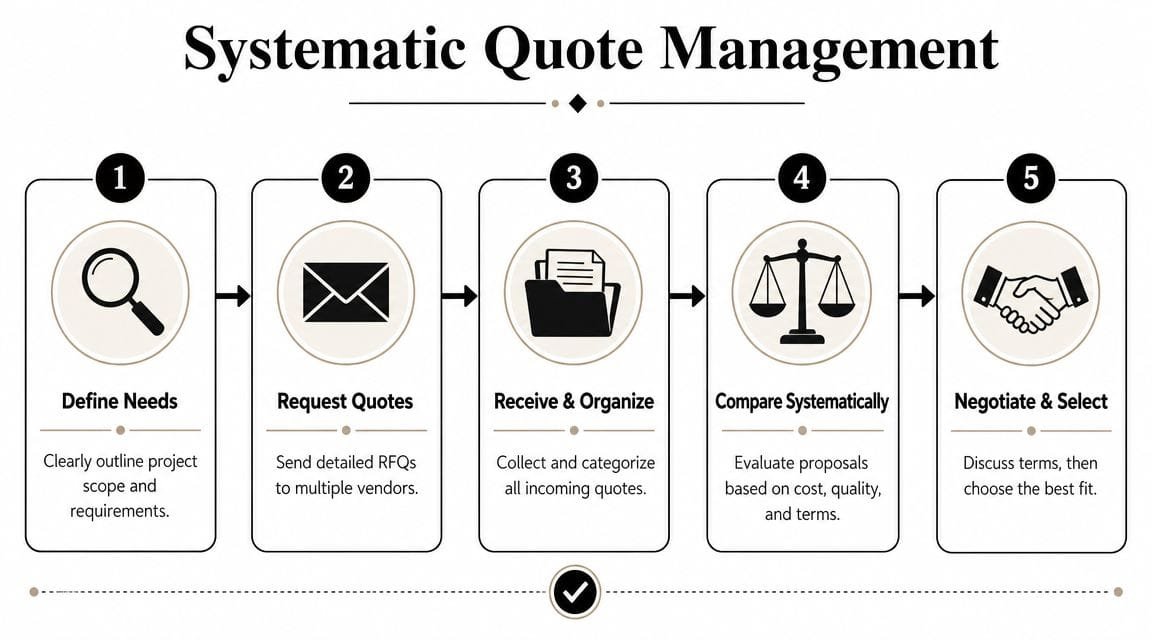
MIT Sloan cited Gartner research showing that only 20% of analytics insights would deliver business outcomes through 2022 (MIT Sloan on analytics insights and outcomes). That's a useful warning for quote review. Collecting offers is only data gathering. Value shows up when you convert that information into a better decision.
Start with a clean request
Bad quote comparisons usually start with vague requests. If you ask three providers for “pricing,” you'll get three different interpretations. One will bid the minimum. One will overbuild. One will leave out half the work and look cheapest.
Use a simple request package that includes:
- Business need: State the problem you're solving, not just the product you think you want.
- Scope: Define quantities, time frame, service level, and required outcomes.
- Constraints: Include deadlines, budget limits, operational restrictions, and approval needs.
- Required terms: List any must-haves such as delivery windows, support expectations, insurance requirements, or financing flexibility.
- Requested format: Ask providers to separate fees, recurring costs, setup costs, optional items, and exclusions.
This matters in lending too. If one quote assumes short repayment and another assumes a longer schedule, the headline numbers won't tell a fair story. For context on how pricing variables affect funding offers, review today's business loan interest rate factors.
A tight request saves time on the back end because it reduces reinterpretation.
Here's a useful visual for the process:
Compare structure before price
When quotes come in, don't rank them by total first. Put them into a spreadsheet or side-by-side table and line up the structure.
Use columns like these:
| Category | Quote A | Quote B | Quote C |
|---|---|---|---|
| Base price | |||
| Setup or origination costs | |||
| Recurring payment or premium | |||
| Contract length | |||
| Included items | |||
| Excluded items | |||
| Flexibility or cancellation terms | |||
| Service or response commitments |
Many “cheap” quotes lose their shine. One may include support. Another may charge for every revision. One financing offer may look more expensive at first glance but fit your cash conversion cycle better. One contractor may bid higher but carry less execution risk because the scope is fully specified.
Decision test: If you can't explain why one quote is cheaper, assume you're not comparing the same thing yet.
Use a simple review checklist
Once you've normalized the structure, review the quote as an operator, not just a buyer.
Ask:
- Can the business absorb the downside if this goes wrong?
- Does the timing fit the actual operating calendar?
- What assumptions did the provider make that I didn't approve?
- Which parts of the quote create future dependency?
- What would trigger added cost?
Then make the call with three lenses:
- Financial fit: Can you carry it without straining working capital?
- Operational fit: Will the terms create friction for your staff, systems, or customers?
- Risk fit: If there's a problem, are protections and responsibilities clear?
That's how business quotes become useful. Not because you collected several. Because you forced them into a format that supports action.
Negotiation Tips and Sample Communication Scripts
Negotiation gets a bad reputation because owners treat it like conflict. In most cases, it's clarification plus advantage. You're not trying to “win” a quote. You're trying to improve the fit.

What good negotiation looks like
Start with the truth. Many quotes are opening positions. Vendors expect questions. Lenders expect comparison. Insurers expect clarification. If you accept every first draft without review, you often pay for speed with margin.
Good negotiation usually focuses on one of four levers:
- Price: Ask whether there's room to improve the rate, fee, or premium.
- Terms: If price won't move, ask for a better payment schedule, reduced deposit, narrower guarantee, or stronger service terms.
- Scope: Remove items you don't need or separate optional work from required work.
- Risk allocation: Clarify who absorbs delays, change requests, support gaps, or implementation issues.
Plainly put, don't ask only, “Can you lower the number?” Ask, “Can you improve the structure?”
The strongest negotiators don't bluff much. They document, compare, and ask precise questions.
Sample email for an initial quote request
Subject: Request for Quote for [project or service]
Hello [Name],
I'm requesting a formal quote for [product, service, or financing need]. Our business needs [brief description of need], and we'd like pricing based on the following scope:
- [Requirement one]
- [Requirement two]
- [Requirement three]
Please include any setup fees, recurring charges, payment terms, timing assumptions, exclusions, and support details. If there are optional add-ons, list those separately.
Please send the quote by [date]. If anything in the scope is unclear, reply with questions before preparing the proposal.
Thank you,
[Your Name]
Sample email asking for clarification
Subject: Clarification Request on Quote Terms
Hello [Name],
Thank you for sending the quote. I'm reviewing it now and need clarification on a few points before moving forward:
- Is [specific item] included in the quoted price?
- What would trigger additional charges?
- Are the payment terms fixed, or is there flexibility?
- What support or follow-up is included after delivery?
Please reply in writing so I can compare your proposal accurately against the others under review.
Best,
[Your Name]
Sample email to open negotiation
Subject: Follow-Up on Quote and Terms
Hello [Name],
Thank you again for the proposal. We're reviewing a few options and your quote is under serious consideration.
Before we decide, I'd like to ask whether you can improve the current offer in one of these areas: pricing, payment terms, included support, or implementation timing. We've received another proposal that is stronger on [mention one area without oversharing], and I'd like to see whether you can narrow that gap.
If you're able to revise the quote, please send an updated version by [date].
Regards,
[Your Name]
The tone matters. Be direct. Be respectful. Don't ramble. Negotiation works better when the other side sees that you understand the document.
Simplify Financing Quotes with Business Loan Warrior
Financing quotes are often the hardest to compare because the documents look similar while the economics behave differently. One offer may look attractive because approval feels fast. Another may emphasize flexibility. A third may package terms in a way that conceals the trade-off for cash flow.
That's why owners benefit from a system that reduces duplicate applications and centralizes quote review.

Business Loan Warrior is built around that problem. Instead of chasing multiple lenders one by one, owners can use a single, no-fee application to check pre-approval, connect accounts, and review offers in one secure place. That matters because clean comparison beats fragmented comparison.
The practical advantage isn't just speed. It's visibility. When offers sit in one dashboard, owners can review structure, track progress, and ask underwriters direct questions before accepting terms. That reduces the chance of picking a quote based only on urgency or headline appeal.
For a business that needs working capital, equipment financing, a line of credit, or another funding structure, that kind of setup makes the quote process easier to manage and easier to trust.
Frequently Asked Questions About Business Quotes
Is a quote legally binding
Usually, a quote by itself isn't the same thing as a signed contract. It's an offer or proposal. The legal effect depends on the wording, the governing documents, and what happens when both parties accept.
Some quotes become binding once accepted in writing. Others are only preliminary and require a separate agreement. Read the acceptance language carefully. If the quote references terms and conditions, review those too.
What is the difference between a quote, an estimate, and an invoice
A quote is a proposed price for a defined product or service under stated terms. It is usually more specific than an estimate.
An estimate is a rough projection based on current assumptions. It signals expected cost, but it often carries more uncertainty because the scope or conditions aren't fully locked.
An invoice comes after goods or services are delivered, or after a billing milestone is reached. It requests payment for what has already been provided or contractually billed.
How long is a business quote valid
It depends on the provider, the industry, and how volatile costs are. A quote should state a validity window or an expiration date. If it doesn't, ask.
This matters when underlying costs move, availability changes, or underwriting conditions shift. Don't assume a provider will honor old pricing indefinitely just because you saved the PDF.
What should I do if two quotes are impossible to compare
Standardize them yourself. Put both into the same worksheet and break out base cost, fees, timing, support, exclusions, and acceptance conditions. Then go back to each provider with written questions.
If you still can't line them up, that usually means one or both quotes are underspecified. In practice, that's a reason to pause, not a reason to rush.
Should I always choose the lowest quote
No. The lowest quote is only the best choice when scope, quality, timing, and risk are equivalent.
A lower price paired with weak support, broad exclusions, inflexible repayment, or unclear change rules can cost more after the deal starts. The better question is which quote creates the best business outcome with acceptable risk.
If you're comparing funding options and want a faster, cleaner way to review offers, Business Loan Warrior gives you one place to check pre-approval, organize financing quotes, and move toward a decision with more clarity.