
You can have a good year and still feel stuck. The pipeline is busy, the website is getting traffic, the team is working, and yet the biggest opportunities still seem to come from a warm introduction, a trusted advisor, or a supplier who knows someone before your competitor does. That's where business network groups stop being social overhead and start acting like a real business asset, especially when you're running an established company and every hour has to justify itself.
A lot of owners at the $20 million to $50 million revenue level already know the problem. Marketing can create attention, but it doesn't always fix a brittle supply chain, open a financing door, or introduce a partner who can shorten a sales cycle. The right group can do those things because it gives you access to people who've already solved the kinds of problems you're facing now.
Table of Contents
- Beyond Business Cards The Real Value of Networking
- The Five Essential Types of Business Network Groups
- Measuring Tangible ROI from Your Networking Efforts
- How to Find and Evaluate the Right Group
- The Playbook for Maximizing Your Membership Value
- Connecting Your Network to Your Next Funding Round
Beyond Business Cards The Real Value of Networking

A manufacturing owner I worked with years ago had a business many would consider healthy. Sales were steady, the phones were ringing, and the team was stretched but functional. Then a major supplier problem hit, and the underlying issue wasn't demand, it was that no one in the company had fast access to a trusted replacement or a peer who could recommend one.
That's the point where business network groups earn their keep. They're not a collection of handshakes, they're a distributed problem-solving system, and the best ones are filled with people who've already lived through the same pressure you're under.
Networking works best when it solves a current business constraint
The most useful group is rarely the biggest room. It's the one where someone can introduce you to a lender, a vendor, an operator in a similar market, or a hiring contact who understands your industry. In that sense, networking is closer to buying access than chasing attention.
The member profile matters too. In one surveyed networking community, more than 60% of members had been involved for over a year, 75% were business owners aged 30 to 50, and the gender split was roughly 40% women and 60% men Entrepreneur. That pattern suggests the strongest groups don't just attract newcomers, they hold experienced operators who already know what good referrals, useful introductions, and practical advice look like.
Practical rule: If a group can't help you solve a real business problem, it's probably not a growth channel. It's a calendar event.
For owners who are also trying to grow visibility, there's still a role for channels like social media strategy for small businesses, but networking gives you something different. It adds human trust to the mix, and trust is what turns a name into an introduction and an introduction into a deal.
That's why serious operators should treat networking like an operational decision, not a social habit. The question isn't whether you should network. It's which group gives you access to the right counterparties faster than you could reach them alone.
The Five Essential Types of Business Network Groups
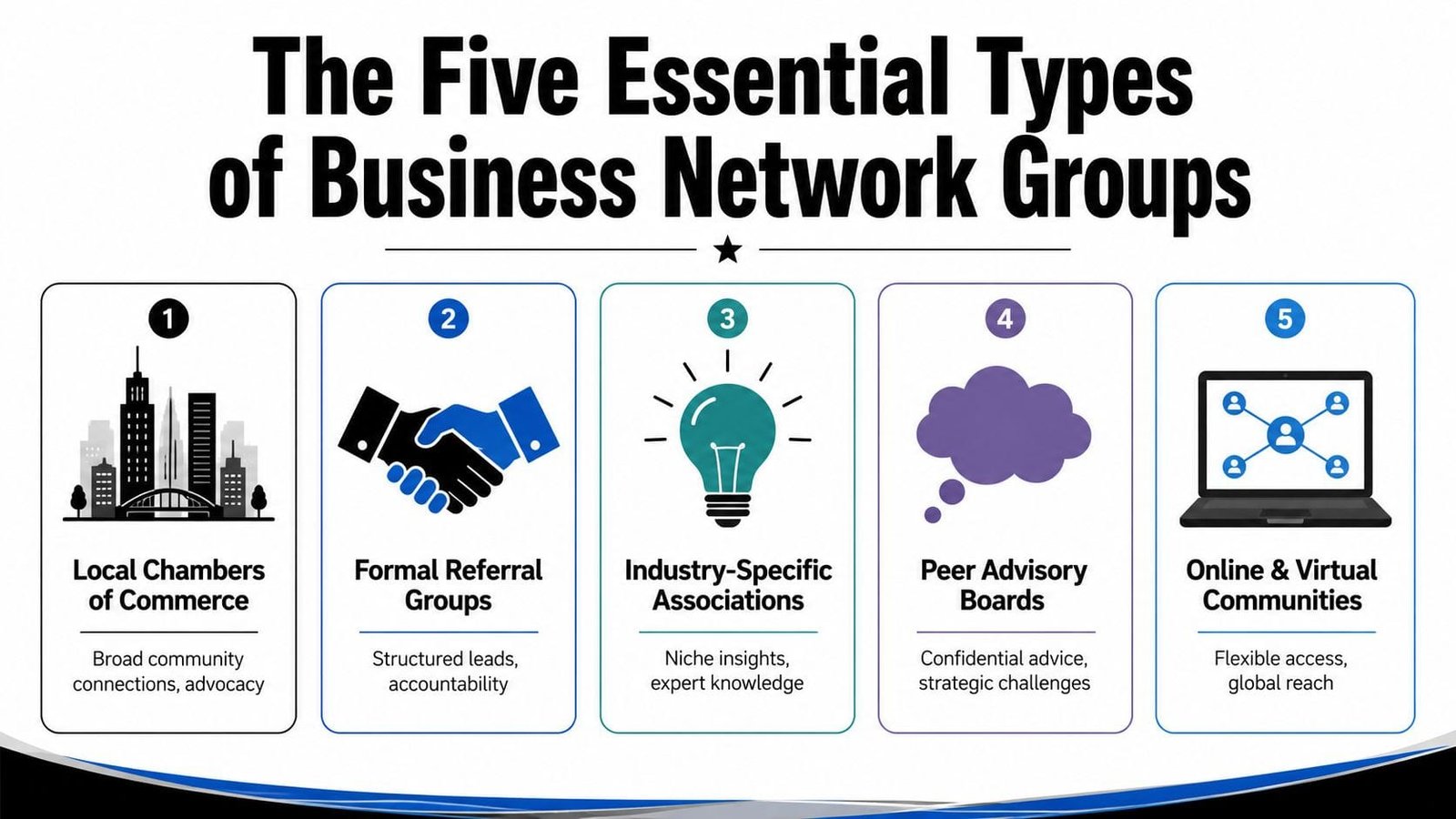
A business network group works best when it matches the job in front of you. A lender search, a supplier issue, a hiring gap, and a capital-readiness problem all call for different contacts, different norms, and different levels of confidentiality. Use the wrong group, and you burn time. Use the right one, and the network starts acting like a distribution channel for trust, introductions, and information.
For established companies, the value is not just visibility. The right group can improve deal flow, reveal stronger vendors, surface operators who understand your margin pressure, and shorten the path to financing conversations. That is why the category matters as much as the contact list.
The broad community option
Local Chambers of Commerce give you public credibility and a place to stay visible in your market. They help you meet other owners, local service providers, and civic leaders who already influence business activity in your area.
They work well for companies that sell locally, want a public presence, or need to stay close to regional decision-makers. The trade-off is depth. Chambers usually create broad awareness before they create measurable referrals, so they are better for relationship density than for a tightly managed pipeline.
The structured referral option
Formal Referral Groups are built around accountability, repetition, and measurable introductions. BNI is the clearest example in the market, and its scale is one reason structured groups get so much attention. BNI reported more than 340,000 members globally and said members generated $23.4 billion in referral business in 2024 WaveCNCT.
These groups work best for owners who want repeatable introductions instead of passive visibility. The price of entry is discipline. If you do not show up consistently, learn other members' businesses, and give useful referrals, the model loses its edge quickly.
The expertise and compliance option
Industry-Specific Associations often produce the most practical value for established firms. Members usually deal with similar vendor issues, labor constraints, compliance requirements, and customer expectations, which makes the conversations more useful than generic business chatter.
That matters once your company has outgrown startup-level advice. These groups are often stronger for benchmarking, standards, and trusted vendor discovery than for broad local promotion. They can also help you spot how peers handle risk, which matters when you are trying to strengthen your financial health assessment before a major funding discussion.
The private advisory option
Peer Advisory Boards and curated mastermind groups bring together owners or executives who need candid feedback from people operating at a similar level. They are useful for strategic decisions, succession planning, margin pressure, and capital planning, especially when the stakes are too high for generic advice.
Confidentiality is the currency here. If members will not speak plainly about what is working and what is not, the group will not improve decision quality.
The flexible digital option
Online and Virtual Communities offer speed and reach. They help with learning, quick introductions, and cross-market perspective, especially when geography gets in the way or your team is spread out. The downside is clear. Many online groups produce more chatter than business value, so the group has to earn its place on your calendar.
For marketers trying to tie relationships to measurable outcomes, an expert guide on marketing performance can help connect activity to results. The same discipline applies to networking. If the group cannot improve revenue, reduce friction, or improve access to capital, it is not pulling its weight.
| Group Type | Primary Goal | Best For | Typical Commitment |
|---|---|---|---|
| Local Chambers of Commerce | Community visibility and local relationships | Businesses that need local presence | Moderate, event-based |
| Formal Referral Groups | Structured introductions and accountability | Owners seeking repeatable referrals | High, ongoing participation |
| Industry-Specific Associations | Niche expertise and trusted peers | Complex or regulated sectors | Moderate to high |
| Peer Advisory Boards | Confidential advice and strategic input | Established owners facing bigger decisions | High, selective engagement |
| Online & Virtual Communities | Flexible access and broad reach | Busy owners and dispersed teams | Variable, often lighter |
For a closer look at how different group types serve different business needs, the best business networking groups guide is useful because it separates broad visibility from the more targeted needs of established firms. That distinction matters more than the label on the membership card.
Measuring Tangible ROI from Your Networking Efforts
A business network group earns its keep when it changes the economics of the company. The test is simple. Does it create revenue, reduce friction, or speed up decisions that would otherwise drain time and cash from the leadership team? If it does none of those things, it is a social expense, not a growth channel.
Sales matter, but the right structure matters more
Structured referral groups are built to generate repeatable introductions, and the scale of referral-based activity shows why they attract serious operators. Reports on BNI’s reach point to a large volume of referral business and referrals flowing through its member base in 2024 and 2025, which shows how organized networking can translate relationships into measurable commercial activity WaveCNCT. The lesson is not that every member gets equal value. The lesson is that a disciplined referral system can turn trust into pipeline, and pipeline into revenue.
If you want sales from a group, choose a structure that forces accountability for introductions. Casual mixers can build familiarity, but familiarity alone does not pay invoices. A firm with established revenue needs a network that behaves more like a deal flow engine than a room full of friendly contacts.
Partnerships can cut friction where marketing cannot reach
A strong network can surface the partner who keeps your warehouse running, the freight contact who solves a bottleneck, the attorney who understands complex deals, or the supplier who can handle larger orders without breaking service levels. Those relationships do not always show up in campaign reports, but they affect margin, speed, and resilience. One good introduction can save a quarter’s worth of operational headaches.
That is why it helps to track relationship channels with the same discipline you bring to paid media. If you already use an expert guide on marketing performance, apply that same habit to networking. Measure introductions, response times, follow-up quality, and whether the conversation turns into a contract, a vendor improvement, or a faster path to a decision.
Knowledge compounds in the right room
Established owners often get the highest return from peer insight, not from raw lead volume. A seasoned operator can help you avoid a hiring mistake, pressure-test a pricing model, or flag a contract term before it becomes expensive. That kind of advice is hard to buy from consultants and easy to overlook until a mistake lands on the profit and loss statement.
For businesses managing expansion, debt, or a funding conversation, networking also supports a broader financial health assessment. A strong group does more than exchange business cards. It helps leadership spot risk earlier, prepare cleaner answers for lenders, and build the credibility that makes capital conversations easier.
How to Find and Evaluate the Right Group
Choosing a group is closer to selecting a capital tool than joining a club. If your business needs leads, you want one kind of structure. If you need operating insight or lender access, you want another. The mistake most owners make is joining the first group that feels friendly instead of the one that matches the business objective.
Start with the outcome, not the event calendar
Before you attend anything, write down the one result you need most. It might be qualified referrals, operational advice, vendor access, or financing credibility. That single decision will narrow the field quickly and keep you from getting distracted by polished branding.
The strongest networks are typically structured, strong-contact referral groups rather than casual contact networks. As one practical guide puts it, if a group doesn’t produce trackable introductions or industry-relevant advice within a defined period, it may be branding, not a true growth channel QuickBooks.
Vet the people, not just the format
The shape of the group matters, but the members matter more. A room full of early-stage founders won’t solve the same problems as a room full of mature operators, and a local visibility group won’t do the same work as a referral engine. Therefore, Founder Connects’ BNI guide can help you understand how a formal referral model is typically organized before you decide whether that structure fits your business.
Ask members direct questions. What kind of introductions do they get? Do they close business from the group? Do they learn anything useful enough to change decisions? If people dodge those questions, pay attention.
Useful filter: A good group should improve either your pipeline, your judgment, or your access to trusted counterparties. If it does none of those, keep looking.
Test for fit before you commit
Attend as a guest at least twice if the group allows it. One meeting shows the theater. Two meetings show the rhythm. You’ll see whether the people prepare, whether the conversations go beyond surface-level small talk, and whether the group respects time.
Use this quick checklist while evaluating:
- Primary goal match: Does the group align with the exact business problem you’re trying to solve?
- Member relevance: Are the members close enough to your size, sector, or stage to be useful?
- Tracking discipline: Does the group measure referrals, follow-ups, or outcomes in a way you can verify?
- Cultural fit: Do members share information openly, or do they guard everything until after the meeting?
- Time realism: Can your team keep up with the participation required?
Good networking should feel intentional, not accidental. If the room can’t support the outcome you need, there’s no reason to keep paying with your time.
The Playbook for Maximizing Your Membership Value

Once you join, the difference between a mediocre return and a meaningful one usually comes down to process. The owner who treats each meeting like a transaction often gets ignored. The one who builds trust, follows up, and stays visible becomes easier to refer.
Make your pitch easy to repeat
Your short introduction should answer three things fast. What do you do, who do you help, and what should people listen for when they meet a possible referral? If someone can’t repeat it after hearing you once, you’ve made them do too much work.
A strong pitch isn’t flashy. It’s memorable enough that another member can use it in a conversation without sounding forced.
Give before you ask
The fastest way to build social capital is to make useful introductions without expecting immediate payback. That can mean connecting two members who should know each other, sharing a vendor name, or sending a note that helps someone prepare for a meeting. People notice who contributes before they request.
Practical rule: The member who solves small problems early usually gets remembered for bigger opportunities later.
Track follow-up like a real sales process
Treat every referral and introduction like a lead in your CRM or calendar. Put the next action date on the record, not in your memory. If you don’t track it, the lead disappears into the usual pile of good intentions.
A simple scorecard works better than a complicated one. Count referrals given, referrals received, meetings completed, and opportunities that turned into revenue. That’s enough to tell whether the membership is working.
Consistency is the ultimate win. A network only compounds when the follow-up does too.
Connecting Your Network to Your Next Funding Round
A funding conversation gets easier when the people around your company can vouch for how it operates. For established firms, the right business network groups help build capital readiness and connect you with trusted counterparties, which matters more than a crowded room or a packed event calendar. Lenders and investors rarely move on a story alone. They want to see a company that looks organized, credible, and backed by people who understand the business from the inside.
A strong peer group helps you test a funding request before it reaches a lender or investor. A vendor partner can confirm your operating history and reliability. An industry contact can make a warm introduction to the right capital source instead of leaving you to guess which door to open. Those signals do not replace underwriting, but they can improve how your company is read on the other side of the table.
If you are comparing financing structures, the Updated guide for startup funding is a useful reference point, especially if you want to see how early-stage capital logic differs from the needs of an operating company. Established firms usually need more than enthusiasm. They need a network that supports expansion, supplier confidence, and funding readiness.
That is why networking belongs inside your financing strategy, not beside it. The same relationships that help you win a better customer or secure a more dependable supplier can also make your company look less risky when you borrow, refinance, or expand. If you are planning your next round of capital, start by tightening the quality of the room around you, then use the capital stacking funding strategy to think through how relationships, lenders, and balance sheet structure fit together.
If you are deciding whether your current network is helping the business, map the introductions, advice, and counterparties it gives you today. Then use that map to decide where your next hour should go, because the right business network groups should make your company more fundable, more connected, and harder for competitors to outmaneuver.