

Most advice about small business grants Tennessee gets one thing wrong, it makes the search sound broader and easier than it is. Tennessee doesn’t run a big pool of simple cash grants for every owner who wants to expand. It routes most support through performance-based incentives, federal pass-through capital, and a few narrow grant channels that fit only specific projects and locations.
That matters because the wrong search strategy burns time fast. If your project is tied to jobs, wages, training, rural development, or commercialization, you may have a real path. If you’re looking for a general “small business grant” with no strings attached, Tennessee usually won’t give you one.
Table of Contents
- Why Tennessee Grants Are Not What You Expect
- Major Grant and Incentive Programs Available in Tennessee
- How to Prepare and Submit a Winning Application
- When Loans and Lines of Credit Make More Sense
- Local Resources and Rural Funding Opportunities
- Real Scenarios From Tennessee Business Owners
Why Tennessee Grants Are Not What You Expect

The biggest mistake Tennessee owners make is assuming grant money works like a normal vendor invoice. It doesn’t. State economic-development guidance shows that Tennessee’s support system is built around job creation, wage thresholds, and investment outcomes, not broad, open-ended awards for anyone with a good idea (Tennessee ECD resource links).
The state funds outcomes, not wish lists
That structure is why incentive programs matter more than generic grant lists. Tennessee’s Standard Job Tax Credit is worth $4,500 per job, and it rises to $22,500 per job in Tier 4 counties, with unused credit carryforward of up to 25 years (Tennessee ECD resource links). The message is blunt, if your business can’t show measurable economic impact, you’re probably not the right fit for the state’s main support tools.
Direct grants do exist, but they’re narrow. Tennessee’s own materials say they’re typically concentrated in just three areas, value-added agriculture, technology development and commercialization, and vocational rehabilitation or veterans’ self-employment programs. That’s why broad searches for “free money” almost always disappoint.
Practical rule: If your project doesn’t create jobs, improve wages, support commercialization, or serve a defined rural or veteran use case, stop expecting a traditional grant.
What actually helps owners win
The smarter approach is to match the project to the funding mechanism. A manufacturer expanding payroll has a different path from a tech founder seeking commercialization support, and both are different from a rural food producer looking at agriculture programs. Tennessee’s Fund Tennessee was built around that reality, with InvestTN for equity, LendTN for debt, and AssistTN for technical assistance, backed by $120 million in federal funding under the state’s SSBCI 2.0 deployment channel (Tennessee SSBCI page).
That’s not a traditional grant stack. It’s a capital-readiness system, and it rewards businesses that can prove they’re organized, bankable, and ready to deploy funding productively. If you understand that upfront, you’ll waste far less time chasing programs that were never meant for your business.
Major Grant and Incentive Programs Available in Tennessee
Tennessee’s funding menu is limited, and that is the point. Owners waste time when they treat every state program like a cash grant. Tennessee pushes support through performance-based incentives, job training help, rural programs, and federal pass-through capital. Match the program to the project type, county tier, and location, or the fit will be wrong.
Fund Tennessee is federal capital, not a broad grant program
Fund Tennessee sits under the federal State Small Business Credit Initiative, SSBCI 2.0, which allocated $10 billion nationwide for small-business financing and technical assistance. Tennessee says the program received $120 million in federal funding for entrepreneurs and small businesses, and it is organized into InvestTN for equity, LendTN for debt, and AssistTN for technical assistance.
That structure matters. This is not a broad grant portal. It is a capital-readiness system built for businesses that can use outside capital well, especially founders who need help becoming lender- or investor-ready.
The incentive programs favor job creators
Tennessee’s other incentives reward hiring and investment, not general overhead. The FastTrack Job Training Assistance Program supports training for new full-time employees, which fits employers planning actual headcount growth rather than short-term relief. The Standard Job Tax Credit follows the same logic, tying support to jobs, county tier, and long-term economic activity.
USDA rural support works in a different lane. Rural Business Development Grants are aimed at qualifying rural communities, so location can decide eligibility before the project details even matter (Tennessee rural grant resources). If your business is outside a rural area, this route may not help.
| Program Name | Funding Type | Eligibility Focus | Best For |
|---|---|---|---|
| Fund Tennessee, InvestTN | Equity | Capital-ready businesses seeking investment support | Startups and growth companies |
| Fund Tennessee, LendTN | Debt | Businesses that need financing and can support repayment | Expansion, equipment, working capital |
| Fund Tennessee, AssistTN | Technical assistance | Owners needing prep help for capital access | Early-stage and under-resourced teams |
| FastTrack Job Training Assistance Program | Training support | New full-time employee training | Hiring employers |
| Standard Job Tax Credit | Tax credit | Job creation, county tier, investment outcomes | Expansion-oriented businesses |
| USDA Rural Business Development Grants | Grant | Rural communities and qualifying projects | Rural businesses and local development efforts |
Which businesses usually fit best
Startups usually get the most value from AssistTN because it helps with readiness before any financing lands. Firms adding payroll or opening a new site should look first at Tennessee’s incentive programs, since that is where the state rewards growth most clearly. Rural businesses that fit USDA’s rules should also look at those programs, because county and location status can open a separate funding path.
For founders comparing financing paths, a guide to creating a balance sheet and what documents you need for a small business funding application can help you decide whether you are ready for equity, debt, or a lighter-touch support program. A more useful reference is a small business growth capital guide at Fundsprout, because it helps you sort capital options before you send another application.
How to Prepare and Submit a Winning Application
Grant and incentive applications fail for a boring reason, the paperwork is not ready. In practice, the submission itself is usually the easy part. The businesses that move fastest treat compliance like a project, not an afterthought.
Build the timeline backward from the deadline
Start with the due date and work backward. A practical Tennessee workflow starts with program matching, then document collection, then proposal writing, then submission and follow-up. One Tennessee-focused guide says the state’s average processing time is 30-60 days, which means the bottleneck is usually documentation readiness, not the button you click at the end (Tennessee application guide).
Good applicants do not rush the form. They arrive with the right entity records, financials, and attachments already cleaned up.
That is the right mentality. If you wait until the deadline week to collect documents, you are already behind.
The documents that trip people up
The highest-friction requirements are predictable. You need legal entity registration, an EIN, and for most federal and pass-through awards, SAM.gov registration with a UEI. You also need a Certificate of Good Standing and 2-3 years of clean balance sheets and profit-and-loss statements, or pro-forma projections if you are a startup (Tennessee application guide).
If your balance sheet is weak or incomplete, fix it before you apply. A useful guide to creating a balance sheet can help you build cleaner financials before you enter a funding process. For a deeper document checklist, the required business funding documents overview is a practical reference for what lenders and funders tend to ask for.
Use a simple submission checklist
- Confirm eligibility first: Make sure the project fits the program’s geography, industry, and purpose.
- Register the business cleanly: Entity, EIN, and federal registration should all match.
- Gather financial proof: Keep statements, projections, and tax records in one folder.
- Write for the program’s outcome: Show jobs, training, commercialization, or rural impact.
- Respond fast after submission: Follow-up delays hurt weak files more than strong ones.
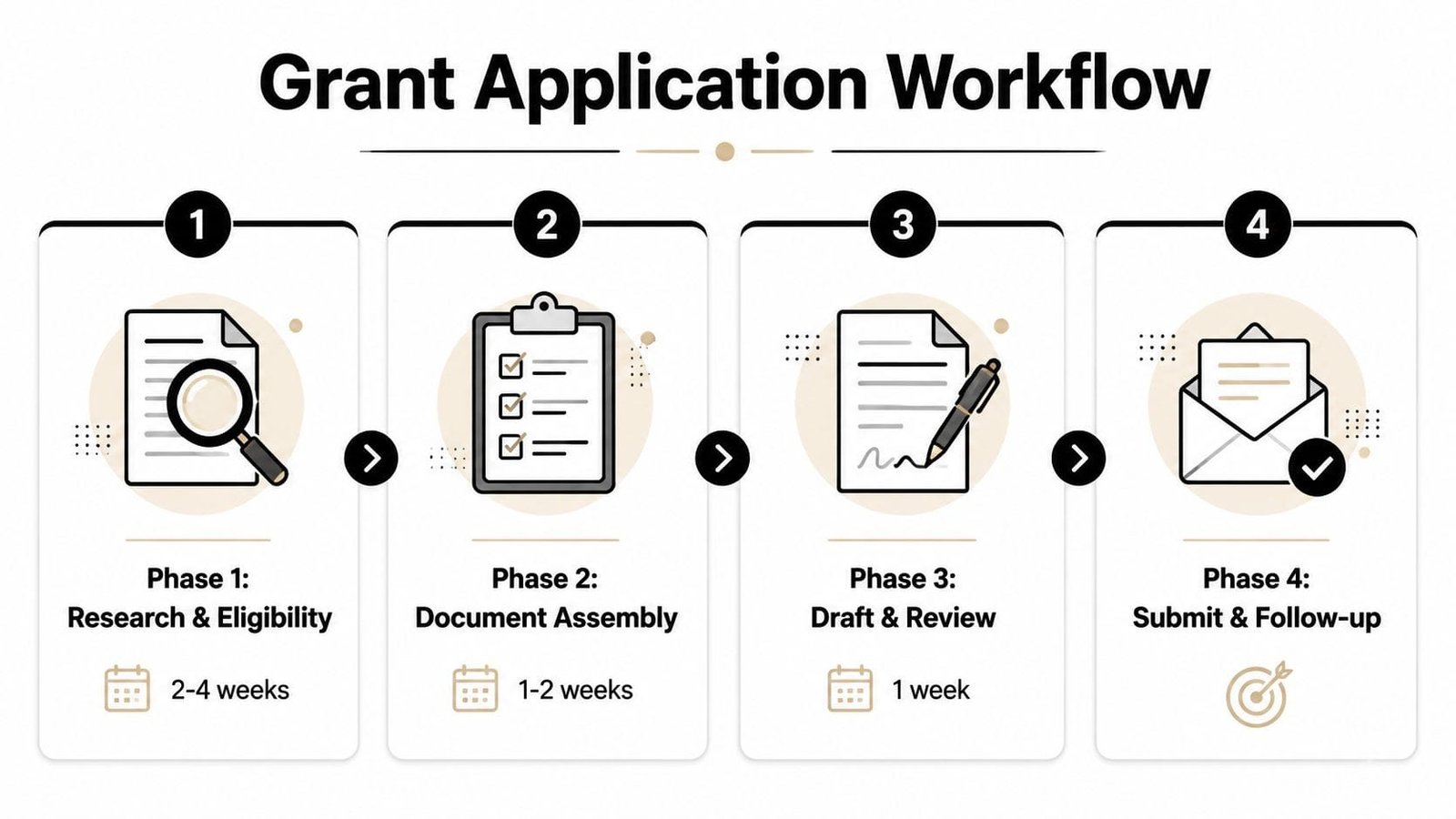
A clean file does more for you than a clever narrative. Put the documents in order, name them clearly, and make the proposal match the funder’s actual purpose.
When Loans and Lines of Credit Make More Sense
Grants look attractive because you do not repay them. That is exactly why they are slow, narrow, and highly competitive. If the business needs cash to act now, a loan or line of credit usually makes the better move.
Match the capital to the clock
Use a grant when the project fits the funder’s rules and you can wait. Use borrowed capital when timing matters more than perfect program fit. That is the practical choice for inventory purchases, payroll gaps, equipment replacement, and short-term expansion needs.
The right answer usually comes down to use case. A line of credit gives you reusable working capital and more flexibility. A term loan gives you one lump sum for a defined purpose. A grant gives you no repayment, but only if the project lands in the right lane.
Use bridge financing instead of waiting on a maybe
Strong owners do not bet the business on a single application. They keep the operation moving with short-term capital, then pursue grant or incentive money in parallel. That approach works for a company that needs to cover a cash-flow gap now and expects a longer-cycle funding source later.
For a clear decision framework between debt, equity, and non-dilutive support, the small business growth capital guide is useful because it forces the core question: what keeps the business funded without slowing the next move? For a direct comparison of revolving credit and fixed-purpose borrowing, the business loan versus line of credit explainer is worth reading before you apply.
If the opportunity expires before the grant is approved, the grant was the wrong first move.
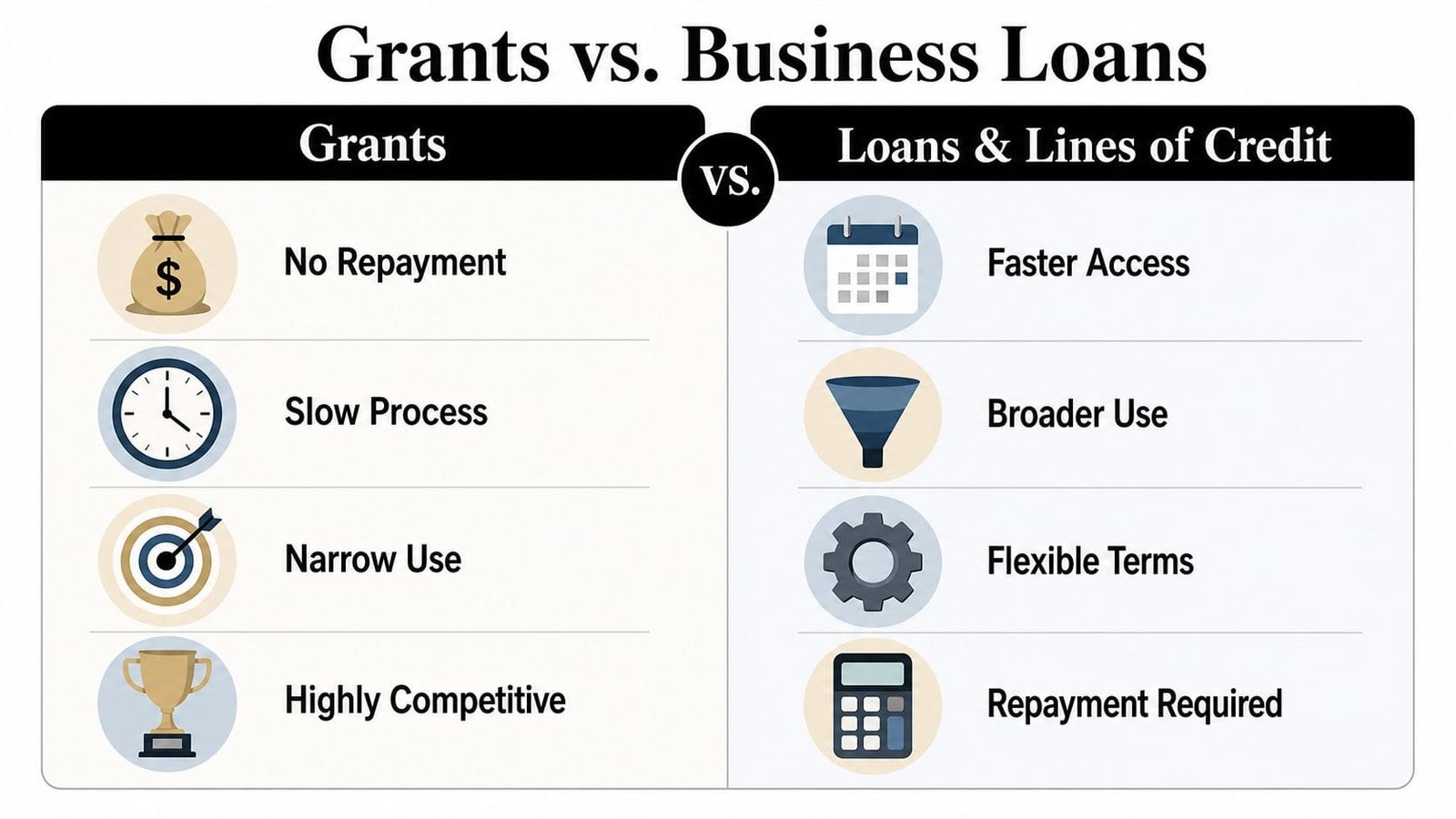
A quick decision rule
- Choose a grant or incentive if the project is tied to jobs, rural development, commercialization, or training.
- Choose a loan if you need a lump sum for a defined investment and can handle repayment.
- Choose a line of credit if you need flexible, reusable working capital.
- Choose both if you need bridge money now and a longer-cycle program later.
The best funding stack keeps the business operating today while you pursue lower-cost or non-dilutive support in the background.
Local Resources and Rural Funding Opportunities
Geography changes the funding menu in Tennessee more than most owners realize. The county you’re in can matter just as much as the business you run. Rural projects, urban expansion projects, and statewide commercialization efforts all sit in different lanes.
Rural eligibility opens different doors
USDA’s Rural Business Development Grants are explicitly aimed at rural communities, which means a business in the right county may qualify for resources that an urban competitor cannot access. Tennessee’s own rural resource pages point owners to separate searches and contacts, which is a clear signal that location changes the process, not just the paperwork.
That’s why the question “What grants are available in Tennessee?” is too broad to be useful. A better question is whether your county qualifies for a rural program, a job-creation incentive, or a commercialization path. If you skip that step, you’ll chase the wrong funding menu.
County tier still matters in practice
County tier affects incentive value, especially when you’re dealing with programs tied to employment and investment outcomes. The Standard Job Tax Credit shows this clearly because the per-job value rises sharply in Tier 4 counties. That makes the business’s location a real strategic variable, not a footnote.
Local support can also save time. Tennessee entrepreneurs should lean on regional economic development organizations, Small Business Development Centers, and industry-specific technical assistance providers, especially when they need help translating a project into funder language. If you’re looking at federally supported small-business development options, the SBA Community Advantage page is a good starting point for understanding where community-oriented lending fits alongside local resources.
What to ask before you apply
- Is my project rural or urban? The answer changes which programs are even on the table.
- Does my county tier affect incentive value? If yes, don’t ignore it.
- Am I chasing growth, training, or commercialization? Each one points to a different program family.
- Who can review my file locally? SBDC and regional development staff can catch weak spots early.
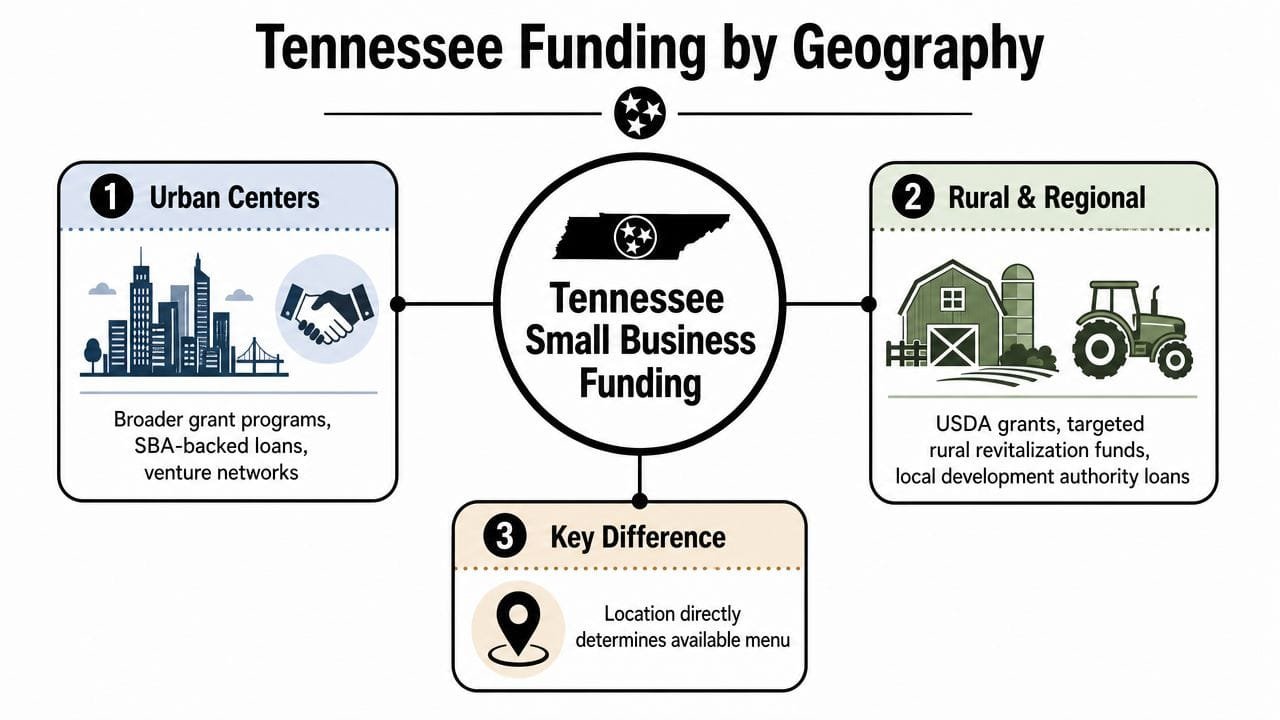
The owners who win are usually the ones who ask location-first questions. That’s how they avoid wasting time on programs that were never built for their county or their stage of growth.
Real Scenarios From Tennessee Business Owners
A rural agricultural producer in Tennessee usually has the cleanest path when the project fits value-added agriculture and USDA rural rules. In that case, the owner can use a rural grant or resource network for one part of the project, then layer local technical assistance on top. The key is that the project is rural-first, not grant-first.
A Nashville technology founder plays a different game. That owner may lean on InvestTN for equity, then use AssistTN to strengthen the application and improve capital readiness under Tennessee’s SSBCI structure. That’s a better route than chasing a general grant, because tech commercialization fits Tennessee’s targeted support model.
A manufacturing company in a Tier 4 county can extract more value from the state’s incentive structure than a broad grant search would ever reveal. If the company is hiring and investing in equipment, the $22,500 per job credit ceiling in Tier 4 becomes part of the financing strategy, while a short-term equipment loan can bridge the purchase before incentives flow. That combination is common because it solves timing without giving up the upside of incentive eligibility.
Veteran-owned service businesses often have a separate lane too. Tennessee’s materials point to vocational rehabilitation or veterans’ self-employment programs as one of the few places where direct grant support can exist. For practical risk planning, that kind of business should also keep its coverage tight, and a resource like Select Insurance Group, Inc. Tennessee commercial insurance can help owners think through business protection while they pursue funding.
The lesson from all four scenarios is simple. Match the project type first, then the geography, then the document stack. Owners who do that stop chasing fantasy grants and start using the funding channels Tennessee built.
If you’re trying to decide whether your Tennessee business should pursue grants, incentives, or faster financing, Business Loan Warrior can help you sort through the options without wasting weeks on the wrong path. Visit Business Loan Warrior to compare funding choices and move toward the capital that fits your business today.