
You're staring at a pile of receipts, the bank balance looks fine on paper but not in your head, and a lender just asked for year-end financial statements. That's usually the moment owners start searching what is the difference between accounting and bookkeeping, because the question isn't academic, it's operational. You need to know who keeps the records clean, who turns those records into decisions, and which one you need right now.
| Criterion | Bookkeeping | Accounting |
|---|---|---|
| Core job | Records and organizes daily transactions | Interprets records and turns them into financial insight |
| Typical output | Ledgers, transaction logs, reconciled cash records | Financial statements, forecasts, tax planning, strategic advice |
| Timing | Near-real-time and ongoing | Periodic and analytical |
| Main question answered | What happened? | What does it mean, and what should change? |
| Best use case | Keeping books current and auditable | Explaining profitability, tax position, and growth path |
Table of Contents
- The Confusion Every Owner Runs Into
- Bookkeeping and Accounting as a Two-Layer System
- Side-by-Side Comparison Across the Criteria That Matter
- Where AI and Cloud Software Are Rewriting the Line
- When Bookkeeping Is Enough and When You Need Accounting
- How the Choice Affects Loan Readiness
- A Practical Decision Checklist for Small Business Owners
The Confusion Every Owner Runs Into
A lot of owners don’t think about bookkeeping until something forces the issue. The tax deadline is close, receipts are in a shoebox, payroll ran, and a lender wants statements that make sense. At that point, the words bookkeeping and accounting stop sounding like jargon and start sounding like a decision you should’ve made six months ago.
The confusion is simple. Bookkeeping keeps the records current. Accounting tells you what those records mean for cash flow, taxes, and growth planning, which is exactly how major education and software sources frame the split. Intuit describes bookkeeping as the recordkeeping foundation and accounting as the layer that produces financial statements, tax planning, forecasting, and strategic advice Intuit’s bookkeeping versus accounting overview.
Practical rule: if your main pain is missing transactions, late reconciliations, or messy expense tracking, you need bookkeeping help first. If your pain is “what do these numbers mean for taxes, debt, or expansion,” you’re already in accounting territory.
That’s why generic comparison pages miss the point. Owners aren’t trying to win a vocabulary quiz. They’re trying to protect cash flow, satisfy tax obligations, and get financing approved without handing over a pile of disorganized records. The right question is not “Which title sounds more advanced?” It’s “Which function keeps me fundable and out of trouble?”
A clean books file is useful, but it’s not the finish line. It creates the audit trail. Accounting turns that trail into decisions. If you want the stripped-down mechanics of journal entry work before you hire anyone, this guide to journal entries is a solid place to start. For owners who just need the recording side handled, affordable small business bookkeeping is the type of service that keeps the day-to-day from turning into a month-end fire drill.
Bookkeeping and Accounting as a Two-Layer System
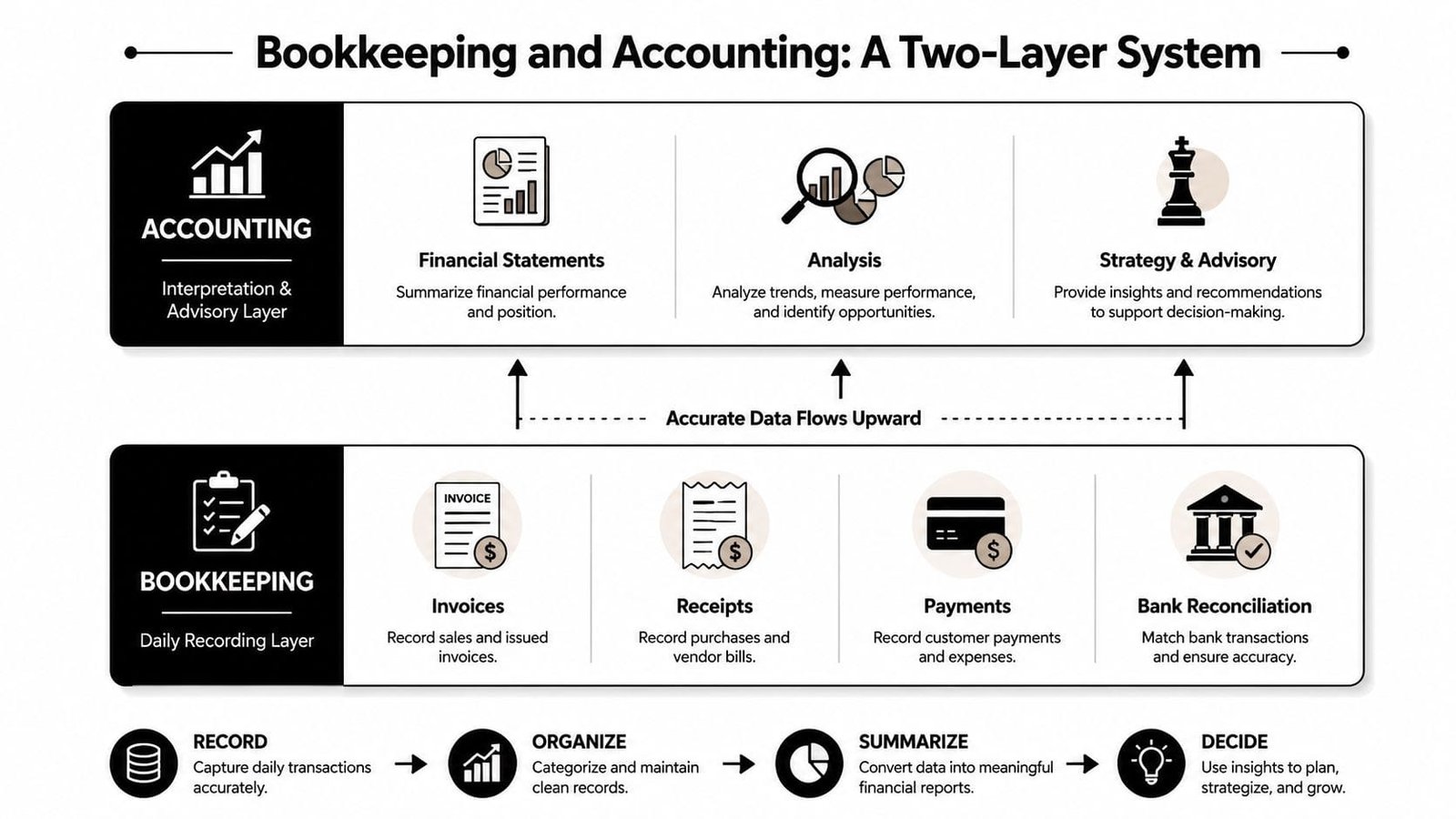
The cleanest way to separate the two is to treat them as a two-layer financial system. Bookkeeping is the base layer. It captures invoices, receipts, payments, and bank reconciliations so the records stay current and traceable. Accounting sits on top of that base. It turns those records into financial statements, tax planning, forecasting, and advice that guides the next move.
If your books are a mess, the accounting layer has nothing solid to work with. If the books are clean, the accountant can do the job owners pay for.
Daily recording comes first
Bookkeeping is the recordkeeping foundation. If entries are wrong, late, or missing, everything above them gets shaky fast. That is why bookkeepers spend so much time on the hands-on work, invoices, receipts, payments, bank reconciliation, and expense tracking. For a small business, that is the trail lenders, tax preparers, and accountants rely on later.
Bookkeeping answers the oldest financial question in business. What actually happened?
That is also why bookkeeping is usually the first finance function owners hand off. The work repeats, the deadlines do not wait, and it gets pushed aside the moment you are selling, staffing, and chasing customers. A clean ledger will not tell you whether your pricing is right, but it will show whether a payment cleared, whether expenses were categorized correctly, and whether the books are current enough to trust. If you want help with that foundation, affordable small business bookkeeping keeps the day-to-day from turning into a month-end scramble.
Interpretation comes second
Accounting starts where bookkeeping stops. It uses the records to classify adjustments, handle accruals, analyze variance, plan taxes, and forecast performance. The University of Cincinnati Online puts the split plainly. Bookkeeping tells you what happened. Accounting tells you what it means and what your financial position is now University of Cincinnati Online.
That difference matters because many small businesses do not run into trouble from missing data. They run into trouble from reading the data badly. A company can have perfectly recorded transactions and still misjudge hiring, debt, or expansion. Accountants fill that gap. They look at the records and turn them into decisions, not just reports.
If you want the mechanics behind the entries themselves, this guide to journal entries is a useful place to start. Once the records are in place, accounting makes them useful.
Side-by-Side Comparison Across the Criteria That Matter
A lot of owners want a clean comparison, not a lecture. Fair enough. If you’re trying to decide where to spend money this quarter, the difference shows up in the work itself, the outputs, and the kind of judgment involved.
| Bookkeeping vs Accounting at a Glance | Bookkeeping | Accounting |
|---|---|---|
| Scope | Daily transaction recording and organization | Analysis, reporting, forecasting, and advice |
| Typical tasks | Invoicing, receipts, payments, bank reconciliation, expense tracking | Financial statements, accruals, variance analysis, tax planning, forecasting |
| Output | Ledgers, logs, reconciled cash records | Profit and loss statements, balance sheets, cash flow statements, strategic reports |
| Timing | Near-real-time | Periodic, month-end, quarter-end, year-end |
| Skill emphasis | Accuracy, consistency, software fluency | Interpretation, classification, compliance, forecasting |
| Cost profile | Usually lower because the work is narrower | Higher because judgment and analysis are deeper |
The salary gap reflects that difference in responsibility. In one widely cited U.S. comparison, accountants earned a median annual salary of $73,570, which was reported as a 73% increase over bookkeepers’ pay Franklin University comparison. That doesn’t mean one role matters more than the other. It means accounting requires broader interpretation, more judgment, and more exposure to decisions that affect taxes, financing, and strategy.
What the tools actually do
Bookkeeping software is often built for entry and speed. Accounting tools assume someone can review adjustments, exceptions, and reporting logic. That’s why the workflow feels different even when both roles use the same platform. One person keeps the books current. Another person asks whether the books tell the truth about profitability and liquidity.
Why owners should care about the cost difference
A cheap bookkeeping setup can still become expensive if it leaves you with unusable reports, missed reconciliations, or tax problems. The better question is not “Who charges less?” It’s “Which work do I need this month?” If you only need transaction capture and reconciliations, bookkeeping is usually enough. If you need lender-ready statements or tax strategy, the extra accounting spend is justified.
Owner takeaway: pay for bookkeeping when you need clean records. Pay for accounting when you need decisions.
Where AI and Cloud Software Are Rewriting the Line
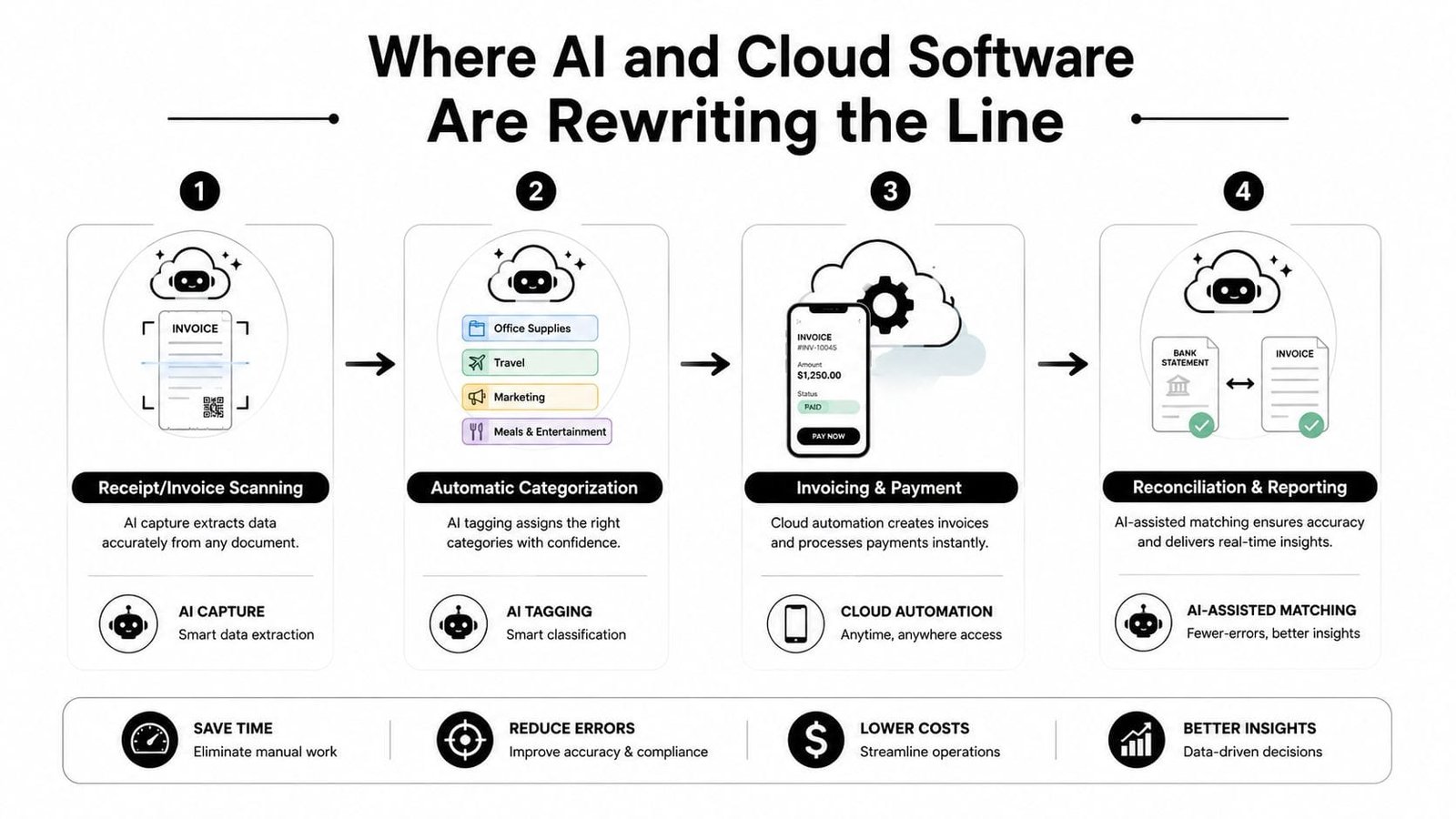
Cloud software has blurred the old job-title split. Modern systems can automate transaction capture, categorization, invoicing, reconciliation, and reporting, which pushes routine bookkeeping work out of human hands and into software Xero’s bookkeeping and accounting glossary. The fundamental shift is not just who enters the data. It is who reviews exceptions, explains what changed, and decides what the numbers mean for cash flow and lending.
Receipt scanning, bank feeds, and automatic categorization now handle a big share of the repetitive layer. That is why many owners see their books update almost as fast as the business moves. Software still does not replace judgment. It can match transactions, but it cannot explain why one month’s margin moved, why a liability looks off, or whether a trend should change your funding plan.
Automated books are not the same thing as lender-ready books.
That is where owners get tripped up. A cloud dashboard can make the finance side look finished while the records still need review, cleanup, and context. If you are preparing for financing, the accountant’s role matters more, not less, because underwriters care about the quality of the records, the explanations behind them, and the way the numbers trend over time. For a practical look at how automation can save time without sacrificing accuracy.
The better setup is simple. Let software handle the repetitive work, then keep human attention on exceptions, controls, and decisions. That matters even more when you are trying to keep your finance stack lean. If you are choosing tools, this small business essential tech tools resource is useful for deciding what should be automated and what still needs a person watching it.
When Bookkeeping Is Enough and When You Need Accounting
This is the part most comparison pages dodge. They define the roles, then leave you to guess when the boundary matters. It matters sooner than most owners think, especially if taxes, payroll, inventory, or financing are getting more complicated. Existing guidance says the issue is allocation of work and cost, not definitions AAT guidance.
Use bookkeeping alone when the business is still simple
Bookkeeping plus software is often enough when the business is early, the transaction count is manageable, the tax picture is straightforward, and you’re not asking anyone for outside capital. If you mainly need invoices sent, receipts recorded, bank accounts reconciled, and expenses organized, that’s bookkeeping work. You don’t need a full accounting engagement just to know whether bills were paid.
Bring in accounting when the decisions get expensive
Accounting becomes unavoidable when the business needs forecasting, tax planning, accruals, or statements that outsiders will rely on. Multi-state tax issues, payroll complexity, inventory, investor reporting, and lender scrutiny all push you past pure bookkeeping. Once your numbers need to explain performance, support a borrowing request, or defend a tax position, bookkeeping on its own is not enough.
You can use this rough rule. If the main job is keeping records current, stay in bookkeeping mode. If the main job is explaining the business position to a lender, investor, or tax authority, you need accounting. That’s not a soft distinction. It’s a different kind of work.
A simple growth example
A service business can start with basic bookkeeping and a cloud accounting app. That works while the owner is mostly tracking invoices, expenses, and bank activity. As the business grows, the owner usually needs stronger reporting, better tax planning, and forecast support, because cash flow gets tighter and the cost of a mistake rises. The business doesn’t suddenly “become accounting.” It gradually needs more accounting judgment as the stakes increase.
How the Choice Affects Loan Readiness
Lenders care about whether the books are clean, but they care even more about whether the numbers can be trusted. Bookkeeping gives them the raw trail. Accounting turns that trail into the statements and explanations they use to judge risk. The University of Cincinnati Online framing is useful here, because lenders want both layers, what happened and what it means now University of Cincinnati Online.
A business with reconciled bank statements, a clean general ledger, and organized expenses can look decent on an early application. That’s bookkeeping territory. But once the request gets bigger, underwriters usually want accrual-basis financial statements, trend explanations, and enough context to understand debt service and cash flow. That is accounting work, not just recordkeeping.
Loan rule of thumb: clean books get you into the conversation. Accounting-grade statements help you survive the diligence.
That matters because a lender is not just checking whether you paid bills on time. They’re checking whether the story in the numbers makes sense and whether future cash flow looks stable enough to support repayment. A bookkeeper can keep the records in order. An accountant helps make the case that the business is financeable.
If your goal is growth capital, line of credit expansion, or an SBA-style application, don’t wait until the month before you apply to think about the finance function. Use this financial health assessment to pressure-test whether your records and reporting are in shape before an underwriter asks hard questions. The distinction between bookkeeping and accounting becomes real fast when a funding decision is on the line.
A Practical Decision Checklist for Small Business Owners
Use this as your five-minute filter. If you’re mainly trying to keep the books current, start with bookkeeping. If you need tax planning, forecasting, or loan documentation, add accounting. If you’re somewhere in the middle, a hybrid setup is usually the most sensible move.
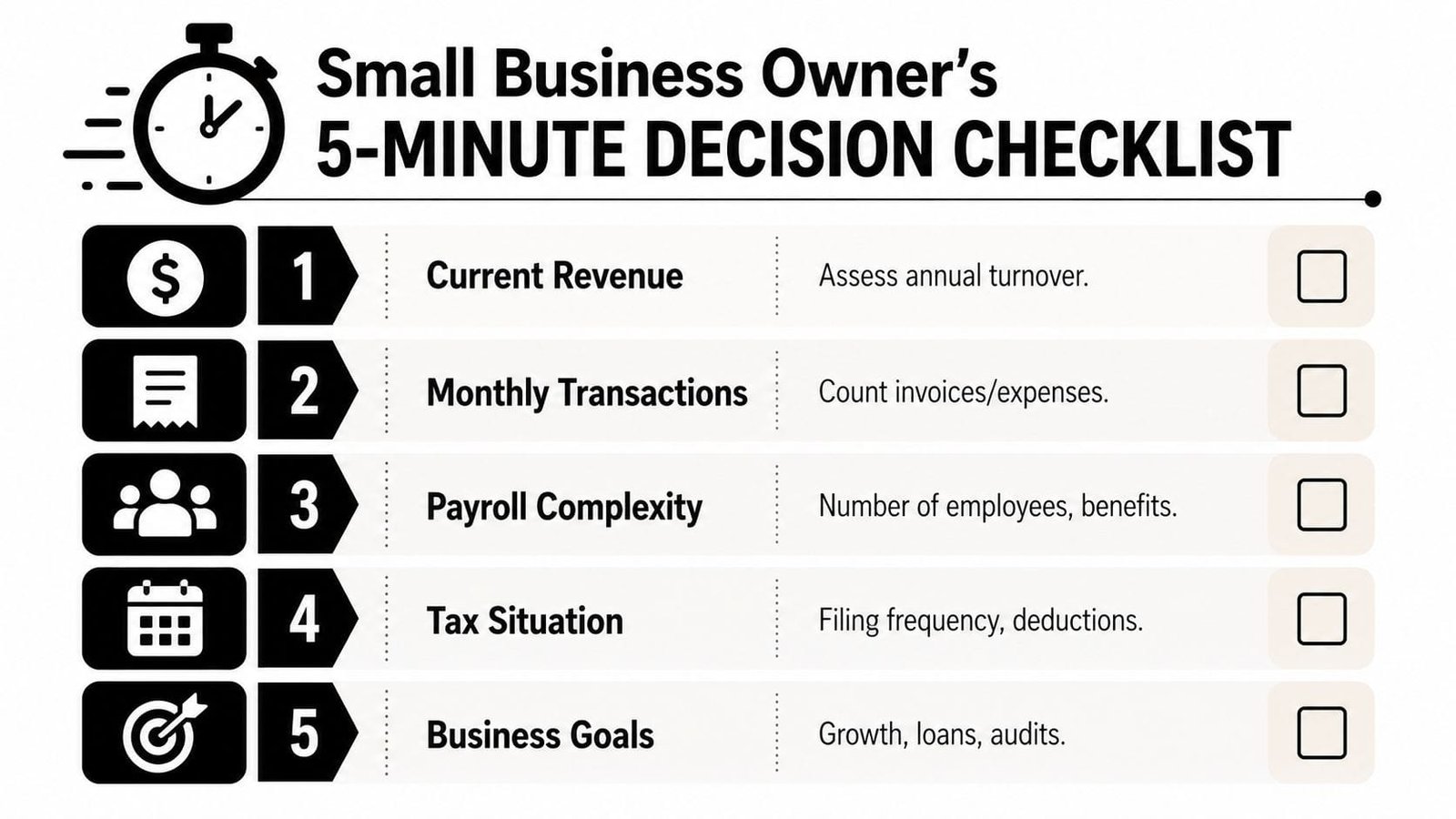
- Current revenue: if the business is still straightforward, bookkeeping may cover the basics. If the numbers now have to support debt, expansion, or tax strategy, add accounting.
- Monthly transactions: if you can stay on top of invoices, receipts, and reconciliations, bookkeeping works. If the volume is starting to create errors or delays, move up a level.
- Payroll complexity: no payroll or very simple payroll leans bookkeeping. Multiple employees, benefits, or more complex tax handling point to accounting support.
- Tax situation: simple filings can often live in a bookkeeping-plus-tax-prep setup. More complex tax exposure needs an accountant involved earlier.
- Business goals: if you just want clean records, bookkeeping is enough. If you want loans, audits, investors, or a better growth plan, accounting belongs in the room.
My blunt advice, start lean, but don’t stay cheap when the business outgrows the setup. Revisit the decision when you add a location, bring on an investor, take on inventory, or apply for financing. That’s when the difference between bookkeeping and accounting stops being semantic and starts affecting cash flow.
If you’re trying to decide what finance help your business needs, Business Loan Warrior can help you think like a borrower, not just a bookkeeper. Visit Business Loan Warrior to compare funding options with a clearer view of how clean books and stronger accounting support your next move.