
You're a year out from a bankruptcy discharge, the bills are steadier, and the business is still breathing, but the bank still wants more paperwork, more history, and a better story. That's the moment most owners hit when they ask the big question: can I get a loan after bankruptcy, or am I stuck waiting while opportunity passes?
The blunt answer is that financing is usually still possible, but the terms are worse at first and the lender's questions change. They care less about the old filing itself and more about time since discharge, current cash flow, collateral, and whether your business can prove it can carry new debt without falling apart. If you need a clean decision framework, not wishful thinking, you're in the right place.
Table of Contents
- Where You Stand Right Now After Bankruptcy
- How Lenders Actually See You After Bankruptcy
- Loan Types That Work After Bankruptcy
- What Underwriters Weigh Most After Discharge
- Rebuilding Credit Without Wasting Time
- Two Owners, Two Timelines
- Your 90-Day Loan Readiness Plan
- Choosing the Right Path Forward
Where You Stand Right Now After Bankruptcy
A restaurant owner one year after a Chapter 7 discharge usually doesn't feel “recovered.” Payroll is due, equipment is aging, and the landlord doesn't care that the bankruptcy wiped out old debt. The owner wants one thing, working capital that won't choke the business, and the question isn't whether financing exists. It's whether any lender will treat the file as a real application instead of a rejection waiting to happen.
That's the right starting point. Loan after bankruptcy decisions are rarely about a hard no forever, they're about where you are in the recovery curve and what kind of product matches that stage. In major U.S. data, many individuals regain some access to credit faster than they expect, but the terms are materially worse at first, and that matters more for a business owner because expensive money can create the next cash crunch. The business may be healthy enough to qualify, but not healthy enough to absorb a bad structure.
A practical view helps more than optimism. If you're early after discharge, you're usually dealing with smaller limits, tighter documentation, and lenders that want proof the post-bankruptcy story is stable, not just improving. If you're further out, the field opens up, but only if you've rebuilt, not just waited.
Practical rule: if the business needs money now, don't ask, “Am I approved everywhere?” Ask, “Which lender can price this risk without breaking my cash flow?”
The rest of this article gives you three things. First, a realistic timeline for access by product type. Second, the underwriting factors that really matter on a business file after bankruptcy. Third, a direct plan for getting ready so you don't waste applications, time, or credit pulls.
How Lenders Actually See You After Bankruptcy
Lenders don't think in terms of “bankruptcy or no bankruptcy.” They think in terms of risk that has already happened versus risk that is still present. The discharge date matters more than the filing date because discharge is when the legal obligation ends and the lender can start judging your post-bankruptcy behavior instead of the old debt stack.
The legal clock and the practical clock
The U.S. mortgage market shows how time controls access. FHA-backed loans generally become available two years after a Chapter 7 discharge, while conventional financing typically requires four years after Chapter 7 or Chapter 11 under Fannie Mae and Freddie Mac rules, as summarized in the mortgage guidance cited by AmeriSave. That is the legal clock. The practical clock is what the bank sees in your file today.
The Boston Federal Reserve's bankruptcy research gives the more useful business lesson. It found that 90% of individuals had access to some form of credit within 18 months after filing, and 75% had access to unsecured credit. The same work found the biggest revolving credit-limit loss happened around five months after bankruptcy, averaging $24,000, before improving to about $15,000 by 18 months. In plain English, access often returns before pricing normalizes, so you can get a yes while still paying for the risk. That's why many owners feel approved and trapped at the same time. Boston Federal Reserve research on post-bankruptcy credit access and pricing
Why Chapter 7, Chapter 11, and Chapter 13 aren't treated the same
Chapter 7 usually creates the sharpest short-term reset because the debt is wiped out and the lender now asks whether the borrower has rebuilt from zero. Chapter 11 and Chapter 13 can look different because the repayment structure suggests ongoing discipline, but the post-discharge file still has to prove fresh capacity. For business owners, the type matters less than the evidence that income is stable and the business can support a new payment.
A useful mental model is simple. Filing starts the legal process. Discharge ends the old obligation. The lender then looks at how long you've operated cleanly after discharge, because that tells them whether the borrower has moved from rescue mode to reliable repayment mode.
What the waiting periods mean for you
For a small-business owner, the waiting period isn't a moral test. It's the point at which your file starts to look less like a recovery story and more like a normal credit decision. FHA and conventional rules are especially relevant if your business owner plan includes buying property or refinancing personal debt tied to the business. For pure working capital, lenders often move on a different timeline, but they still anchor to the same idea, the more time and clean history since discharge, the better the odds and the better the pricing.
Loan Types That Work After Bankruptcy
The right product after bankruptcy depends on urgency, collateral, and whether you're borrowing for the business or for yourself. Too many owners chase the first approval they can get, then discover the payment structure is all wrong for a still-recovering company. The smarter move is to match product to stage.
| Loan Type | Earliest Realistic Access | Typical Cost Range | Key Requirement |
|---|---|---|---|
| Unsecured personal loan | Often after 1 to 2 years, sometimes sooner with alternative lenders | Roughly 18% to 36% APR for post-bankruptcy unsecured loans | Proof of income, clean recent payment history, smaller requested amount |
| SBA-style business loan | More realistic after 2 to 3 years, stronger with longer seasoning | Varies by structure, usually better than unsecured alternatives when approved | Documentation, business cash flow, and personal guarantee strength |
| Business line of credit | Usually easier once cash flow is stable and the file is seasoned | Pricing varies by lender and risk profile | Repeat revenue and manageable debt load |
| Merchant cash advance | Often available earlier than bank credit | Expensive, with cost tied to receivables flow rather than simple APR framing | Daily or weekly business revenue and tolerance for aggressive repayment |
| Equipment financing | Often accessible earlier if the asset holds value | Secured pricing can be materially better, with collateral reducing loss severity | Equipment value, down payment, and business use case |
| Invoice financing | Useful when B2B receivables are strong | Cost depends on invoice quality and advance structure | Verified invoices and creditworthy customers |
For unsecured personal loans, the main tradeoff is clear. LendingTree's post-bankruptcy guidance says approved borrowers often face about 18% to 36% APR and smaller balances around $1,500 to $10,000, which is exactly why these loans should be used for targeted needs, not vague “stabilization.” LendingTree's guidance on unsecured loans after bankruptcy
If your business can support collateral or receivables-based financing, take that route before you reach for an expensive unsecured loan.
For many owners, equipment financing is the most practical bridge because the asset itself helps the lender underwrite the deal. Invoice financing can also work well when your customers are reliable and you're waiting on payment, not hoping for future sales. Merchant cash advances are the fastest to access in many cases, but they're also the easiest way to turn a cash-flow issue into a repayment problem, so use them only when the revenue is predictable enough to absorb the takeout structure.
If you want a broader view of how bad-credit business borrowing gets priced and packaged, this guide on business loans with bad credit is a useful companion. It's not a shortcut around underwriting, but it does reinforce the reality that approval and affordability are two different questions.
What Underwriters Weigh Most After Discharge
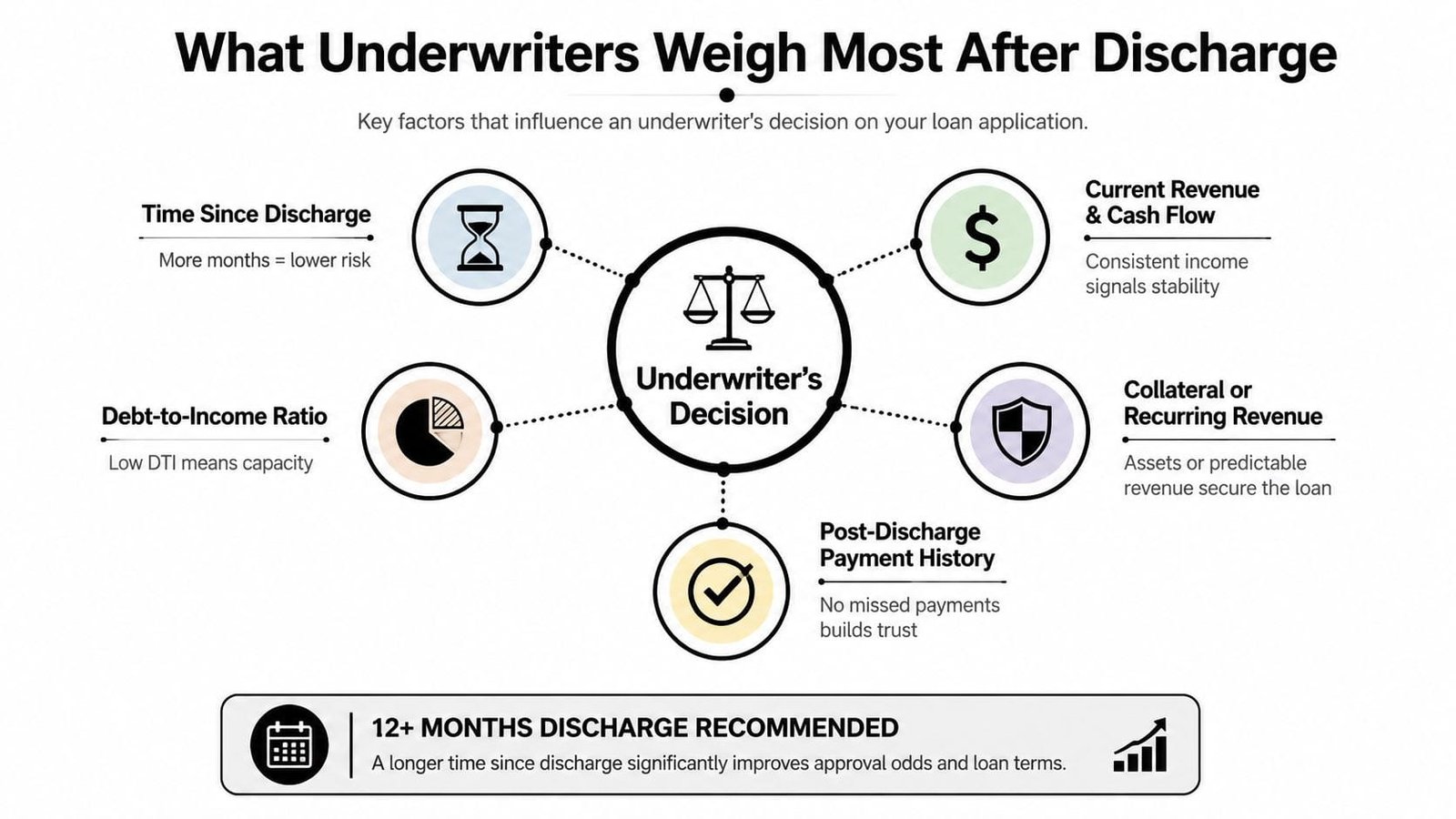
Underwriters want one answer: can this borrower make the payment without triggering a new default? Bankruptcy history matters, but it rarely decides the file by itself. The call comes from the mix of time since discharge, current revenue and cash flow, debt-to-income ratio, collateral or recurring revenue, and the strength of the personal guarantee.
Time, revenue, and debt load
Time since discharge matters because it shows whether the borrower has kept a clean record long enough for the old event to lose weight. Current revenue and cash flow matter because they show whether the business can repay today, not whether the owner has a convincing plan. Debt-to-income matters because even a healthy business can be stretched thin if too much income is already spoken for elsewhere.
A service business with strong recurring revenue and a recent Chapter 7 discharge may still beat a weaker retailer that is farther out from bankruptcy. That feels backward until you look at repayment capacity. Lenders can live with recent history if the deposits are steady. They cannot ignore thin margins or erratic cash flow just because more time has passed.
Collateral and guarantees change the conversation
Collateral cuts the lender's downside, which is why secured financing usually improves pricing. Business assets, equipment, or verified receivables give the lender something concrete to rely on if repayment breaks down. The personal guarantee still matters, but after bankruptcy it is usually judged alongside the business's actual earning power instead of standing on its own.
Underwriters also look at how much risk is already built into the file. A borrower who has rebuilt a checking pattern, cleaned up reporting issues, and kept obligations current sends a much stronger signal than someone who only waited for the bankruptcy to age. For a fuller view of credit positioning after discharge, this guide on business loan credit score explains how lenders read the file before they price the deal.
If you want a plain explanation of how underwriters think about risk, the underwriting process from My Policy Quote is a useful reference point. The core idea is simple. Paper rules matter, but lenders still want proof that future loss is controlled.
What to stop assuming
A credit score alone does not decide the outcome after bankruptcy. Post-discharge, lenders care more about bank statements, revenue consistency, and whether the business has stopped behaving like a rescue case. That is why a borrower with moderate credit and solid deposits can beat a borrower with a nicer score but weak cash flow.
Rebuilding Credit Without Wasting Time
Credit rebuilding after bankruptcy should be deliberate, not random. Owners waste months by opening the wrong accounts, applying too early, or ignoring report errors that keep old damage alive longer than necessary. The goal is to build a file that supports business borrowing, not just a score that looks better on paper.
Start with tools that create positive history
A secured credit card is usually the simplest first step because it creates fresh payment history without demanding major risk. A credit-builder loan can help too, especially if it adds an installment line to a file that's been too thin since discharge. Becoming an authorized user on a well-managed account can help, but only if the primary cardholder keeps the account clean and the balance low.
Keep utilization under control from the start. Low utilization tells lenders you aren't leaning on revolving credit to survive month to month, and that matters more after bankruptcy than it does for a borrower with a spotless file. If you're still carrying old-account reporting problems from the bankruptcy window, dispute inaccurate late-payment markers quickly, because errors can make a clean recovery look messier than it is.
Practical rule: don't chase every new credit product. Build one clean layer at a time, then let time do its work.
The pacing should be boring. Many owners benefit from a secured card around the first year mark, then a credit-builder tool later as payment history deepens, and by the two-year point the file often looks much more lender-friendly. That's when the price discussion starts to soften, especially if the business itself has stable deposits and a clear borrowing purpose.
Match the rebuild to the funding goal
If the end goal is business financing, the credit rebuild should support underwriting documentation. That means bank activity, on-time payments, and stable balances matter more than chasing a high score for its own sake. Lenders are usually looking for evidence that the borrower has become predictable again.
Two Owners, Two Timelines
One owner filed Chapter 7 and needed equipment financing about 18 months later. The business revenue was strong, the equipment had collateral value, and the lender approved the deal, but only with a higher rate and a stronger down payment than a prime borrower would see. That owner got the machine, protected operations, and accepted that speed came with a cost.
Another owner waited five years, rebuilt a 700-plus score, and approached an SBA-backed product with cleaner financials and a more patient profile. That borrower qualified at near-prime pricing because time had done part of the work, but so had disciplined reporting, stable income, and fewer surprises in the file.
The difference is not just credit score. It's the tradeoff between speed and cost. If a working-capital gap is hurting the business now, waiting can be more expensive than paying a premium. If the business can survive a little longer, patience may save far more than it costs.
Your 90-Day Loan Readiness Plan
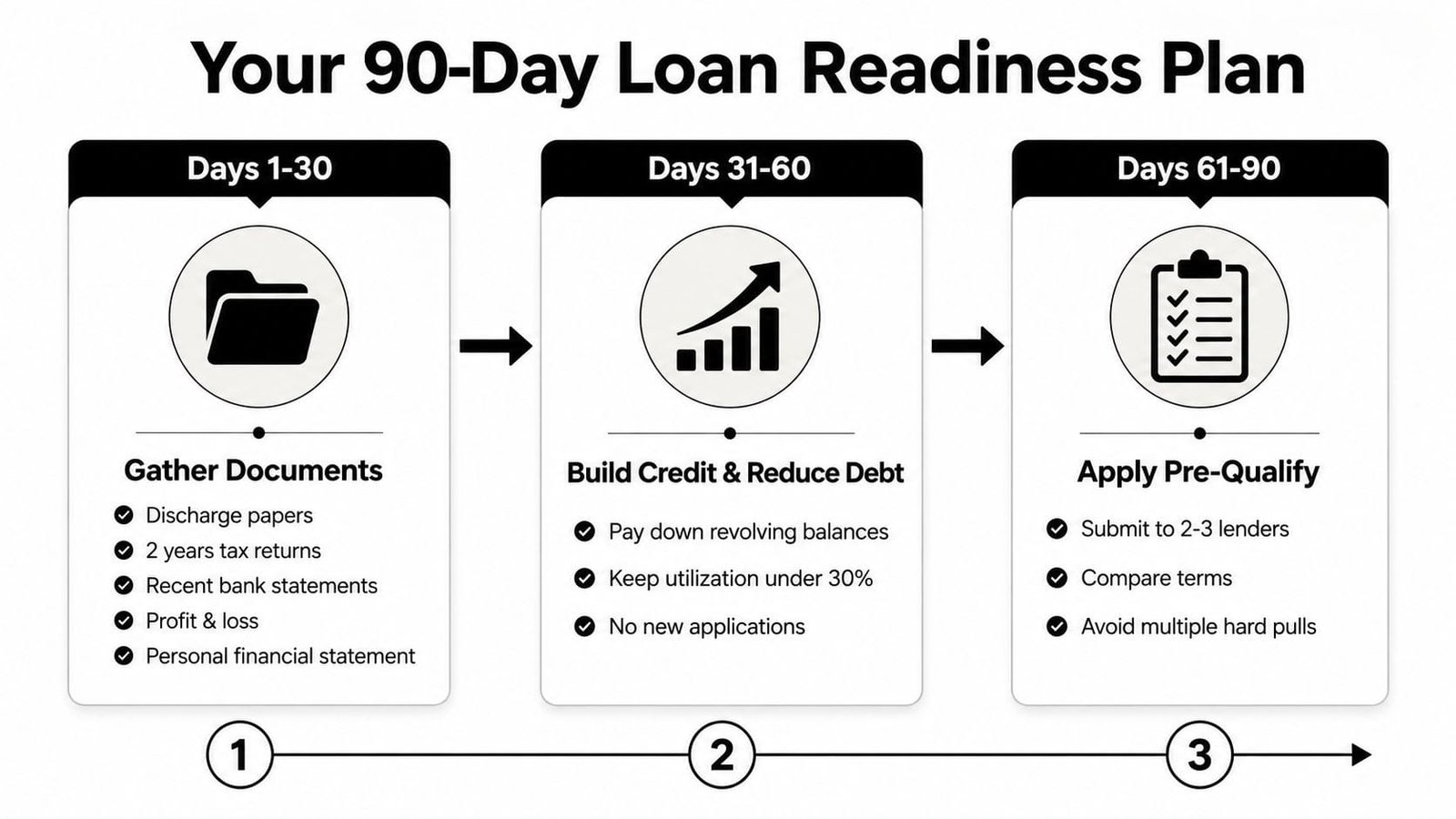
The next 90 days should be about making the file easy to underwrite. Gather your discharge papers, two years of tax returns, recent bank statements, profit and loss statements, and a current personal financial statement. If you don't have clean internal reporting, fix that first, because underwriters hate guessing and they trust consistent records more than explanations.
Use the documents to answer three questions before you apply. Can the business show current cash flow? Is there collateral, recurring revenue, or another repayment support? And does the requested amount match the use of funds? If the answer to any of those is fuzzy, tighten it before you send anything out.
For document expectations and file prep, this guide on what documents you need is a practical checklist to compare against your own records.
What to say in the first conversation
Bring the discussion back to facts. Explain time since discharge, current revenue, collateral if any, and the exact purpose of the loan. Don't oversell the recovery story and don't apologize for needing financing. Underwriters need clarity, not theatrics.
A single-application platform can save time by letting you compare pre-approval options before you commit to a hard pull or lock yourself into one lender's terms. That matters after bankruptcy because the right fit is often not the first approval, it's the most workable structure.
Choosing the Right Path Forward
If you're under 12 months out and need money now, focus on secured or revenue-based products and keep the amount tight. If you're between 12 and 24 months, push harder on equipment financing, invoice financing, and SBA-style options with strong documentation. If you're past 24 months and your credit has been rebuilt, shop for better terms instead of settling for the first lender who says yes.
The mindset shift is simple. Post-bankruptcy lending is not mainly about denial. It's about pricing, patience, and proof. The right borrower, with the right file, can move from expensive money to workable money faster than most owners think, but only if they stop guessing and start underwriting themselves the way a lender would.
If you're ready to stop guessing and compare real options, Business Loan Warrior can help you check pre-approval across lenders, review your funding fit, and move faster without wasting applications. Use it to match your discharge timeline, cash flow, and collateral to the loan type that makes sense for your business.