

You're staring at your accounting software the night before a lender meeting. The bank balance is one number, the vendor bills are another, and somewhere in the middle sits the business you've built, the truck, the equipment, the unpaid invoices, the loan, and whatever's left for you at the end.
That's where assets equals liabilities plus equity comes in. It's the simplest line in accounting, and also the one that sits behind every balance sheet a lender, tax preparer, or investor will ask to see. The whole point is straightforward, what your business owns is financed either by borrowing or by owners' claims, and the balance sheet has to show that relationship cleanly, every time, as the SEC summarizes in its beginner guide to financial statements (SEC balance sheet guide).
If you've ever wondered why this one formula matters so much, think of it as the spine of your books. Once you can read it, the rest of the financial story gets easier to understand, including the income statement, the balance sheet, and how lenders judge whether your business can handle more debt. If you want a companion explainer that compares those statements side by side, this guide from Business Loan Warrior is a useful reference.
Table of Contents
- Why Every Balance Sheet Tells the Same Story
- The Three Building Blocks of the Equation
- How the Equation Stays Balanced After Every Transaction
- What the Equation Reveals to Lenders and Owners
- Asset-Heavy Versus Asset-Light Businesses
- Common Misconceptions That Trip Up New Owners
- Practical Bookkeeping Habits to Keep Your Books Balanced
Why Every Balance Sheet Tells the Same Story
The night before a lender meeting, many owners open their accounting software and stare at the balance sheet without knowing where to start. One column shows what the business controls, another shows what it owes, and a third shows what remains for the owner after those obligations are counted.
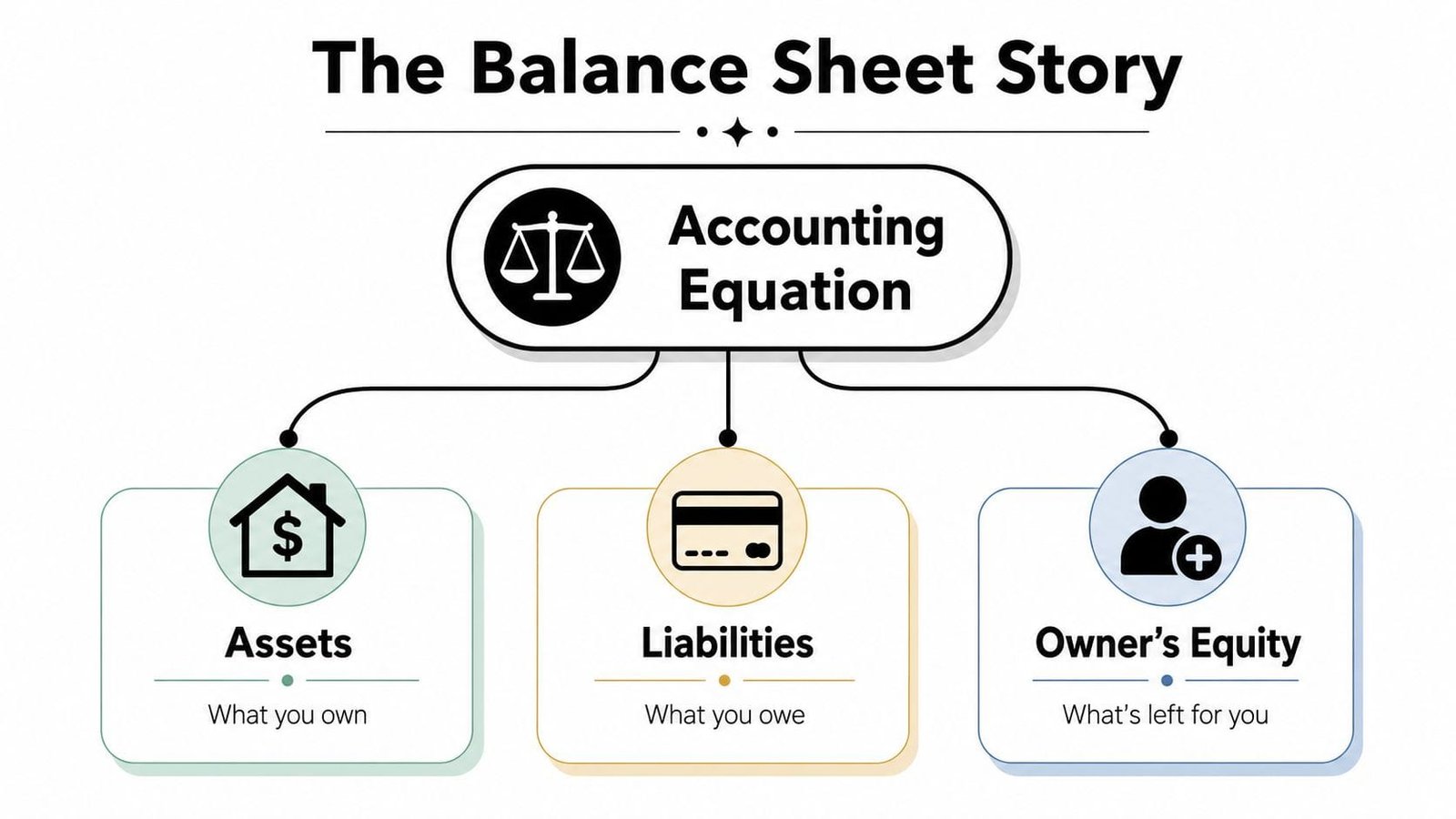
The reason the diagram helps is simple. Assets, liabilities, and equity are not separate stories, they are three parts of the same accounting equation, and the balance sheet only works when those parts stay in balance. That is the same basic structure used in standard financial statements, and the SEC balance sheet guide explains the statement in that same framework.
Practical rule: if the balance sheet does not balance, something was entered wrong or something is missing from the books.
That same structure is why a balance sheet cannot be read in isolation. The relationship between the balance sheet and the income statement shows how profits, losses, and owner decisions move through the business over time, which is why a clear comparison of the income statement and balance sheet helps owners see the full picture. A plain-language resource like Comfi financial reporting insights can also help you understand how this statement fits into the rest of financial reporting, not just the numbers on one page. The same logic applies whether you run a one-truck service company or a growing storefront with inventory, because lenders and owners are both reading the same underlying story about where the money came from, where it sits now, and how much of it is still tied to the business after obligations are paid.
The main point is straightforward. Once you understand this one line, you can read the rest of the balance sheet with less guesswork and more confidence. You can see how borrowing added resources, how owner draws reduced what belongs to the owner, and how the numbers connect to the cash story a lender wants to hear.
The Three Building Blocks of the Equation

A small business owner can read the balance sheet the same way a lender does by first sorting every item into one of three buckets. The accounting equation only works because each bucket has a clear role, and once you see that role, the whole statement gets easier to read.
Assets are what the business controls
Assets are the things the business owns or controls that have value. That includes cash, equipment, inventory, unpaid customer invoices, software, or a vehicle used in operations. If the business can use it to run, sell, collect, or support operations, it usually belongs in the asset column.
A helpful way to picture assets is a tool shed that holds everything the business uses to keep work moving. Some items are physical, like a truck or a cash drawer. Others are harder to touch, like a trademark, a license, or business software, but they still count because they help the business produce value.
Liabilities are what the business owes
Liabilities are the bills, loans, and obligations the business has promised to pay. These are claims other people or institutions have on the business's resources, including a bank, a vendor, a landlord, or a card issuer. If the business has borrowed it, deferred it, or has not paid it yet, it usually belongs here.
That matters in lending conversations because liabilities show how much of the business's resources are already spoken for. A lender looks at that side of the equation to see how much room is left for more borrowing and how much cash may already be committed to existing obligations. Book Tech's overview of small business accounting equation examples is useful if you want more practice sorting these pieces into the right bucket.
Equity is what's left for the owner
Equity is the owner's residual claim after liabilities are subtracted from assets. It is the accounting value left over for the owner after the business settles what it owes, not a stack of cash waiting to be pulled out. A business can show healthy equity and still feel tight on cash if money is tied up in receivables or inventory, which is why lenders and owners both look past the headline number.
The formula can also be written as Equity = Assets – Liabilities. That version is often easier to use when you want to see the owner's stake directly.
A simple example makes the math clear. If a business has $100 in assets and $30 in liabilities, then equity is $70 because $100 – $30 = $70. The balance sheet still balances, and the owner's stake is the remainder.
Plain-English check: if you can subtract what the business owes from what it owns, you have found equity.
How the Equation Stays Balanced After Every Transaction
The reason the equation holds up in real life is double-entry bookkeeping. Every transaction touches at least two accounts, so the books stay in balance as long as the entry is recorded correctly. That's the mechanical reason the balance sheet keeps working even when the business buys, sells, borrows, or pays.
A small business owner usually feels this as software behavior. You enter a transaction in QuickBooks, Xero, or another system, and the program ensures the two sides of the entry line up. If you want a hands-on walkthrough of the mechanics, this guide on how to do journal entries is a practical companion.
| Sample Journal Entries and Their Effect on the Equation | |||
|---|---|---|---|
| Transaction | Debit | Credit | Effect on Equation |
| Buy equipment with a loan | Equipment asset increases | Loan liability increases | Assets rise, liabilities rise, equation stays balanced |
| Pay a vendor bill | Liability decreases or expense is recorded | Cash asset decreases | One asset goes down, or a liability is reduced, balance remains intact |
| Collect cash from a customer | Cash asset increases | Accounts receivable asset decreases | One asset replaces another, total assets stay aligned |
| Take an owner draw | Owner's equity decreases | Cash asset decreases | Equity falls and cash falls by the same amount |
The key pattern behind every entry
The details can look different, but the pattern doesn't change. If you buy equipment with borrowed money, you gain an asset and a liability at the same time. If a customer pays an invoice, one asset turns into another asset, from receivable to cash.
An owner draw works the same way from the other side. When the owner takes money out, equity goes down because the owner's claim on the business has shrunk, and cash goes down because money left the company. Nothing breaks the equation, because the same transaction affects both sides.
A balanced set of books doesn't mean nothing happened. It means every change was recorded in a way that preserves the company's financial structure.
That's the hidden reason accounting software can produce a balance sheet at all. The software isn't guessing. It's enforcing the rule that every transaction must leave the equation intact, even when the business is actively growing or paying down debt.
What the Equation Reveals to Lenders and Owners
A lender reads the balance sheet as a risk picture, not as a trophy case. The first question is rarely whether the books balance. The first question is whether the business has enough cushion to handle more debt without getting squeezed.
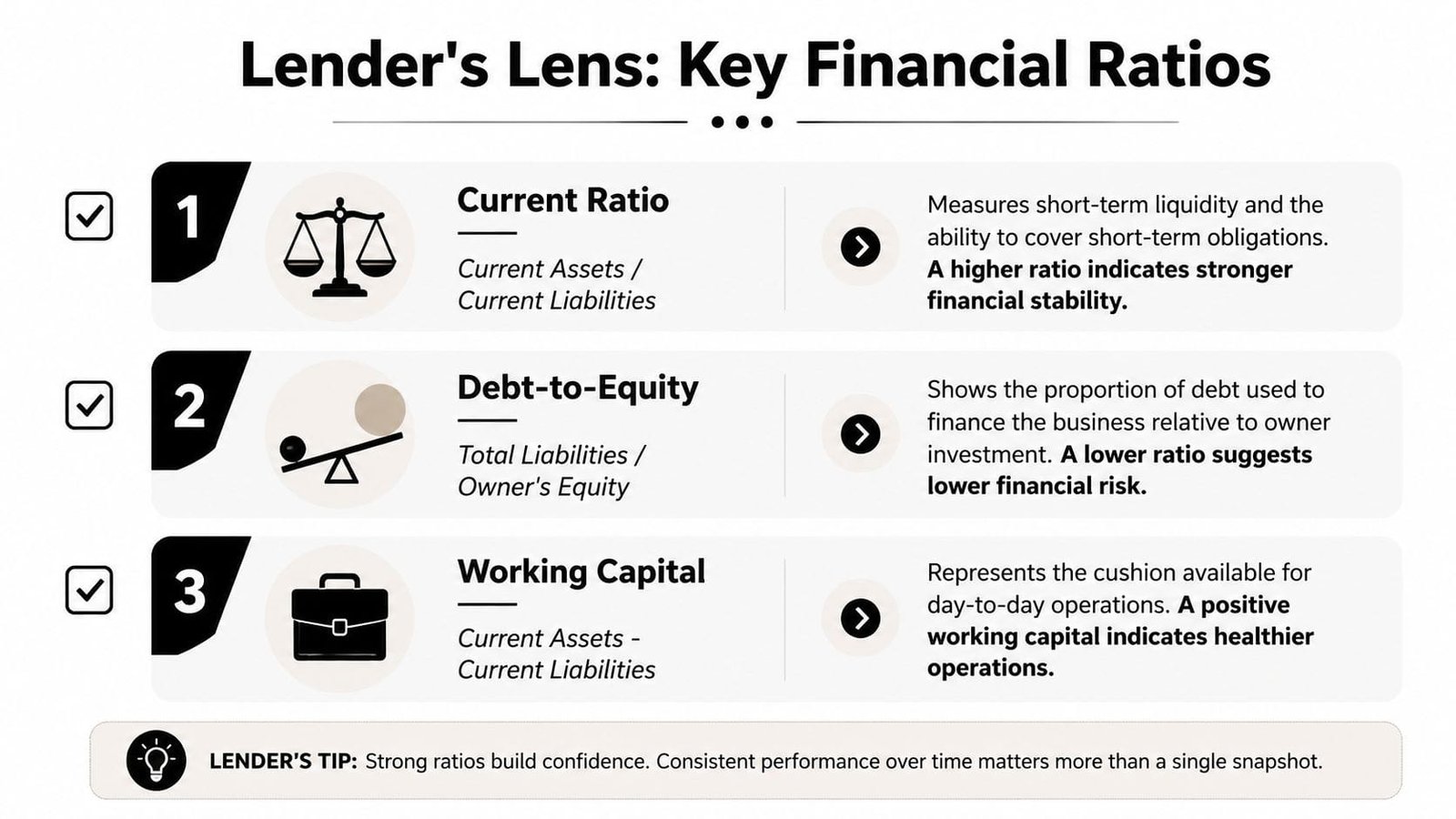
What the lender is really checking
An underwriter uses the equation to test whether the business can carry its obligations without straining day-to-day operations. Debt-to-equity shows how much debt supports each dollar of equity, which gives a quick read on how much of the company is funded by creditors versus owners. Working capital shows whether current assets can cover current liabilities, so the lender can see whether short-term bills have room to get paid. Equity cushion is the buffer that can absorb losses before creditors start to worry.
That reading is part of a broader financial health assessment, because a lender wants to know more than whether the arithmetic adds up. Cash flow and profitability still matter. A business can balance perfectly and still struggle to pay bills on time if cash comes in too slowly or debt payments are already tight.
Why balance is not the same as health
That distinction is easy to miss. The equation proves accounting integrity, not business strength. If assets rise while liabilities rise too, the books still balance, but the lender may still see pressure if cash flow is weak or if debt is getting heavy.
A useful way to think about it is this. A lender looks at the balance sheet the way a mechanic looks under the hood, not just at the paint job. The statement shows how much is tied up in receivables, inventory, cash, equipment, and debt, and the lender asks whether those pieces leave enough room for another loan payment. For that reason, the owner should read the balance sheet the same way, as a guide to whether the business can borrow, hire, buy equipment, or take money out without tightening the squeeze.
An owner also sees something lenders care about but do not always say out loud. Strong equity can make a file look steadier, while thin equity can make even a profitable company feel fragile. A business that has built up retained earnings has more room to absorb a bad month, a delayed payment, or a slow season. A business that has pulled too much cash out through draws can still show balanced books while its cushion shrinks.
A lender usually wants to see a healthy cushion, reasonable borrowing, and enough liquidity to keep the business moving. If liabilities climb faster than assets, equity thins out and the story gets weaker. If working capital is tight, even a profitable business can feel strained when bills come due.
Asset-Heavy Versus Asset-Light Businesses
A restaurant and a consulting firm can both show balanced balance sheets, but they often tell very different stories. One may own ovens, furniture, and equipment. The other may own little more than a laptop, a brand, and receivables from clients.
Why the same equation can look so different
In an asset-heavy business, the balance sheet usually carries more visible stuff. Equipment, vehicles, inventory, and lease obligations show up more clearly, so the lender can see how much capital is tied up in operations. That can be helpful if the business needs equipment financing, but it can also mean more debt and more depreciation to manage.
In an asset-light business, value often lives in places the basic balance sheet doesn't fully capture. Software, customer relationships, reputation, and future contracts may drive the business forward, yet they don't always appear in the same way that inventory or machinery does. That's why two companies can have similar totals on paper and still have wildly different risk profiles.
Why founders misread their own equity
Confusion usually starts when a founder looks at a clean balance sheet and assumes low equity means a weak business, or that high equity means cash is sitting there waiting to be used. Neither is always true. Equity is residual value, not a cash drawer.
It gets more complicated when a company uses leases, outsourced operations, or other financing structures that shape the balance sheet without telling the full market-value story. The formula still works, but it doesn't measure brand strength, future growth, or customer loyalty very well. That's why the equation is a starting point, not a final score.
Compare businesses with context, not just totals. A service company and a construction company can both balance, while their operating risks, cash needs, and lending stories look nothing alike.
For that reason, owners should explain their numbers clearly before asking for funding. A lender doesn't need the business to look like every other company. It needs the story behind the numbers to make sense.
Common Misconceptions That Trip Up New Owners
A balance sheet can be perfectly balanced and still describe a struggling business. That is the first point new owners need to get clear. Assets = Liabilities + Equity tells you what the business owns, what it owes, and what is left over for the owner, but it does not tell you whether the company earned enough to cover its costs. Profits and losses flow into equity over time, so a business can look stable on paper while still burning through cash in the world.
Equity can shrink even in a profitable year
Owners often read a strong year and assume equity must climb automatically. It can, but only if the business keeps enough of those earnings inside the company. If the owner takes large draws, pays out money aggressively, or pulls excess value out for personal use, equity can end up smaller than expected even after a year that looked profitable. That is one reason lenders look at both earnings and retained value. They want to know whether the business is building a cushion or sending too much of it out the door.
More debt does not create free money
Borrowing adds to assets and liabilities at the same time, so the equation still balances. A loan is not free cash. It is borrowed buying power that comes with repayment pressure.
A simple example makes the tradeoff easier to see. If a business borrows to buy equipment, the machine shows up as an asset and the loan shows up as a liability. The owner has not created value out of thin air, only turned borrowed funds into a tool that has to produce enough income to justify its cost. A lender looks at that kind of decision and asks whether the new asset will help cash flow or just add another payment.
Balance sheet value is not sale value
Another trap is assuming the numbers on the balance sheet match what a buyer would pay for the company. They usually do not. Book value follows accounting rules and recorded costs, while sale value depends on demand, future earnings, timing, and how attractive the business looks to a specific buyer.
That gap matters when owners plan for growth or financing. A machine that is fully listed on the books may not bring that amount in a sale, and a business with modest recorded assets may still attract a strong offer if customers, contracts, or cash flow look promising. Lenders know that difference too. They read the balance sheet as a record of position, then look at the cash-flow story and repayment ability before deciding how much risk they are willing to take.
When owners separate the mechanics of accounting from the actual health of the business, the numbers become easier to trust. The balance sheet stops feeling like a puzzle and starts working like a map. If you want a practical example of how that looks during cleanup, these account reconciliation examples show how regular checks keep the numbers tied to reality.
Practical Bookkeeping Habits to Keep Your Books Balanced
The cleanest balance sheet usually comes from boring habits done on time. Reconcile the bank account, reconcile the credit cards, keep business and personal spending apart, and record transactions before they pile up. Those habits matter because retained earnings, profits, losses, and owner draws all flow through equity over time, which is why the balance sheet can stay balanced while the story underneath keeps changing.
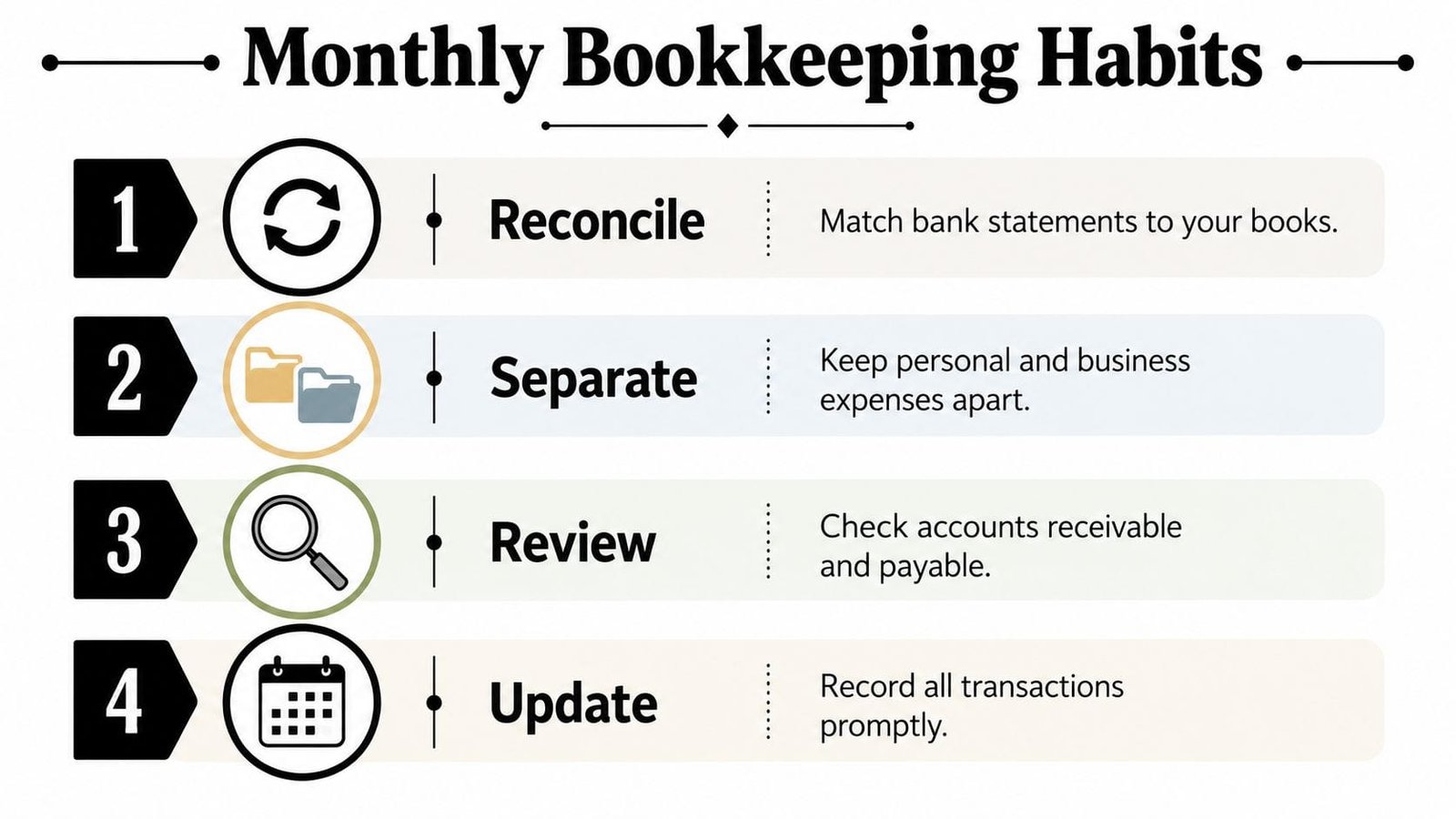
The monthly routine that saves headaches
A strong monthly process doesn't need to be complicated. It just needs to be consistent.
- Reconcile. Match bank statements and credit card statements to the books so missing or duplicated entries get caught early.
- Separate. Keep owner spending out of business accounts, because mixed transactions make equity harder to read.
- Review. Check accounts receivable and accounts payable so you know what's owed to you and what you owe others.
- Update. Enter transactions promptly so the balance sheet reflects reality instead of last month's guess.
If you want examples of what clean reconciliation looks like in practice, these account reconciliation examples are a useful reference point. They make the process feel more concrete, especially if you've only ever seen reconciliation as a vague accounting chore.
Why this matters before you ask for funding
Lenders like clean records because they make the story easier to trust. A business with organized books can explain owner draws, retained earnings, debt balances, and operating cash more clearly than one that's guessing at month-end numbers. That doesn't guarantee approval, but it does make the underwriting conversation smoother.
A funding advisor can help turn that clean balance sheet into a stronger loan story, especially when you're buying equipment, adding locations, or stabilizing cash flow. The better the books, the easier it is to show that the business can support new capital without overextending itself.
Monthly bookkeeping isn't about perfection. It's about making sure the numbers tell the truth before someone else asks for them.
If you want help turning a balanced balance sheet into a stronger funding case, Business Loan Warrior works with small business owners who need capital for growth, equipment, or stabilization. Visit Business Loan Warrior to explore funding options and get a clearer read on what your numbers can support.