
The 3Cs of credit are Character, your repayment reputation, Capacity, your ability to repay from cash flow, and Capital, your financial stake or available collateral. Lenders use these three factors to decide whether to approve your small-business loan and on what terms.
You may recognize the scene. Your business has revenue, your expansion plan is sensible, and you know exactly how you'll use the funds. Then the lender asks for bank statements, tax returns, credit information, debt details, and an inventory of your assets. The questions can feel excessive until you understand what each one measures.
The lender is trying to answer three practical questions: Will you repay? Can you repay? What can the lender recover if repayment fails? The 3Cs turn those questions into an underwriting framework you can prepare for.
Table of Contents
- Why Lenders Look at the 3Cs Before Approving Your Loan
- Character and Your Track Record of Repaying Debts
- Capacity and Your Ability to Service New Debt
- Capital and Collateral as Your Financial Safety Net
- How Different Lenders Weigh Each of the 3Cs
- Your Pre-Application Checklist to Strengthen All Three Cs
- Putting the 3Cs to Work for Your Business Funding Goals
Why Lenders Look at the 3Cs Before Approving Your Loan
A lender doesn't approve a business loan because the business has sales. Revenue can fluctuate, expenses can rise, and a profitable company can still run short of cash when payments come due. The lender needs a broader view of how you've handled obligations, whether current cash flow can support new debt, and whether another source of repayment exists if the business encounters trouble.
The traditional framework is commonly expressed as character, capacity, and collateral. Some business-credit guides use the broader five Cs, adding capital and conditions, but the three core factors remain useful because they map directly to underwriting decisions. Modern lender guidance on the three Cs describes character as repayment reputation, capacity as the ability to repay, and collateral as assets that may be seized after default.
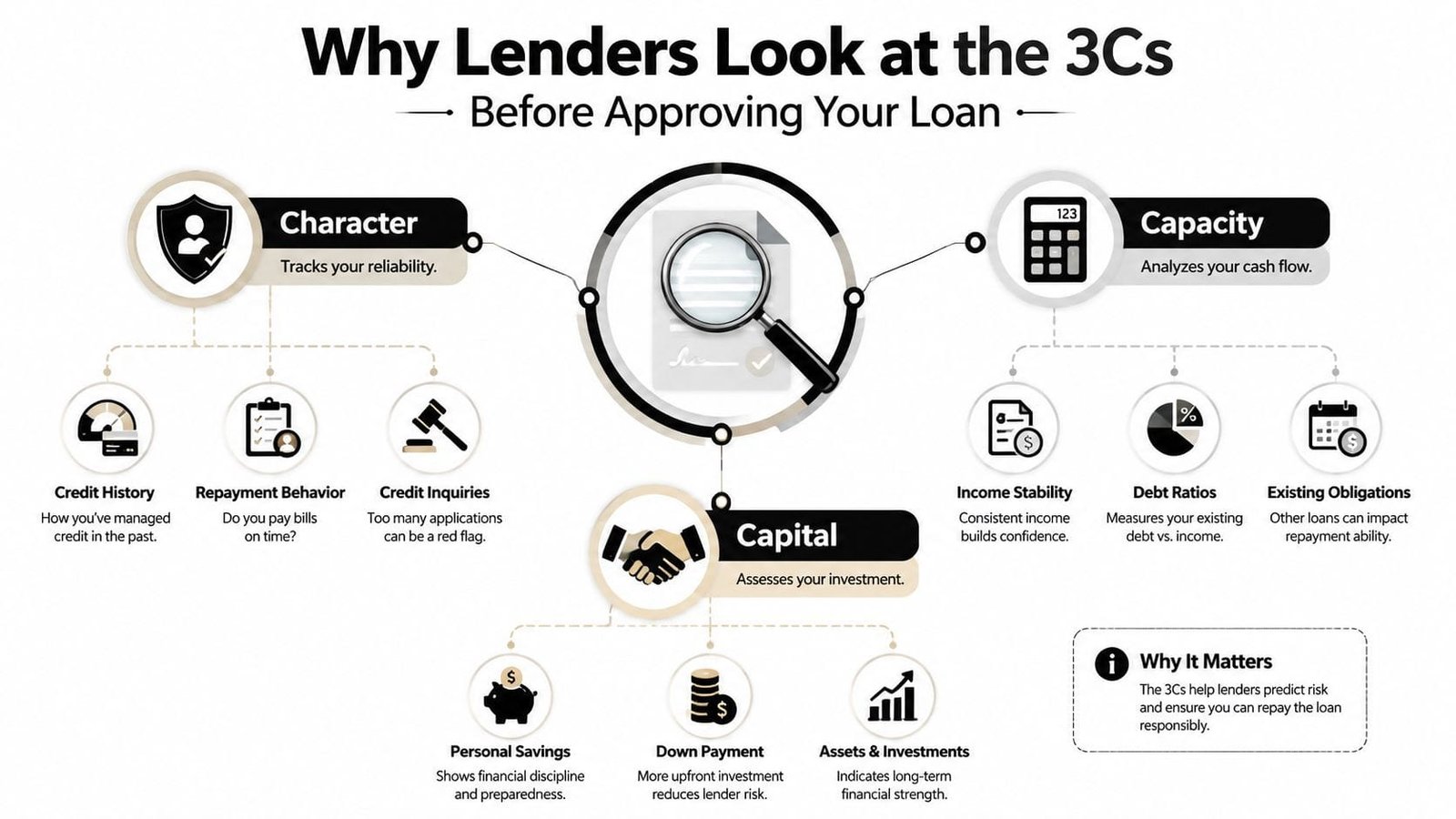
One application, three underwriting lenses
Suppose you own a service company and apply for working capital. Your credit report and payment history help the lender judge Character. Your income statements, bank activity, and existing debt show Capacity. Your equipment, receivables, inventory, or real estate may support Capital and Collateral.
These categories overlap, but they aren't interchangeable. A strong payment record doesn't prove that this month's cash flow can support another payment. Strong cash flow doesn't automatically provide an asset the lender can liquidate. The lender triangulates the evidence instead of treating any single score as decisive, as described in research on commercial underwriting and the interaction between credit history, cash flow, and pledgeable assets (commercial credit analysis framework).
Practical rule: Treat every requested document as an answer to one of the lender's three questions. That makes the application easier to organize and exposes weaknesses before underwriting does.
The result affects more than approval. The balance among the 3Cs can influence whether the lender offers unsecured credit, requests a personal guarantee, requires specific assets, or changes the loan structure. Understanding the framework lets you choose documents, products, and lenders more strategically.
Character and Your Track Record of Repaying Debts
Character is the lender's assessment of whether you've demonstrated reliable financial behavior. It isn't a judgment about your personality. Underwriters usually look for evidence in personal and business credit reports, payment history, existing obligations, public records, and explanations for serious negative events.
A strong profile generally shows accounts paid as agreed, stable handling of debt, and no unexplained pattern of defaults. A late payment can matter, but one isolated issue doesn't automatically tell the whole story. The lender will consider its timing, severity, frequency, and whether you corrected the problem.
What to review before applying
Start with both your personal and business credit reports if both will be part of the application. Check account ownership, balances, payment status, public-record information, and any unfamiliar inquiries. Errors can weaken your profile even when your actual financial behavior is sound.
Your credit report should also match the story you tell in the application. If an old delinquency resulted from a billing error, gather supporting records. If a business obligation was restructured, prepare a concise explanation showing what changed and how payments have been handled since then.
Before submitting an application:
- Review for errors: Dispute inaccurate account information with the relevant reporting agency and keep documentation of the dispute.
- Protect payment consistency: Put existing loan, card, lease, and vendor obligations on reliable payment systems.
- Avoid unnecessary new borrowing: New accounts or applications can complicate an otherwise stable credit picture.
- Prepare explanations: Address bankruptcies, defaults, tax issues, or unusual credit events directly instead of leaving the underwriter to guess.
For a deeper review of the information lenders may consider, use this guide to business loan credit scores. It can help you separate a score itself from the underlying behaviors that produced it.
Character is especially important when the business has limited operating history or when the owner must provide a personal guarantee. It can also help a lender distinguish between temporary stress and a repeated unwillingness to meet obligations. Presenting accurate context won't erase negative information, but it can make the file more understandable and credible.
Capacity and Your Ability to Service New Debt
Capacity asks whether the business can make the proposed payments from dependable cash flow. This is often the most measurable C because lenders can compare operating inflows, expenses, existing debt payments, and the expected payment on the new facility.
Revenue alone isn't capacity. A company can generate substantial sales while spending nearly all of its cash on payroll, inventory, rent, taxes, and existing obligations. Underwriters focus on what remains after normal operating costs and debt payments.
The cash-flow question
Lenders may review income statements, balance sheets, bank statements, tax returns, and cash-flow projections. They're looking for consistency, not just a strong month. A seasonal company should explain when revenue arrives, when expenses peak, and how it will cover payments during slower periods.
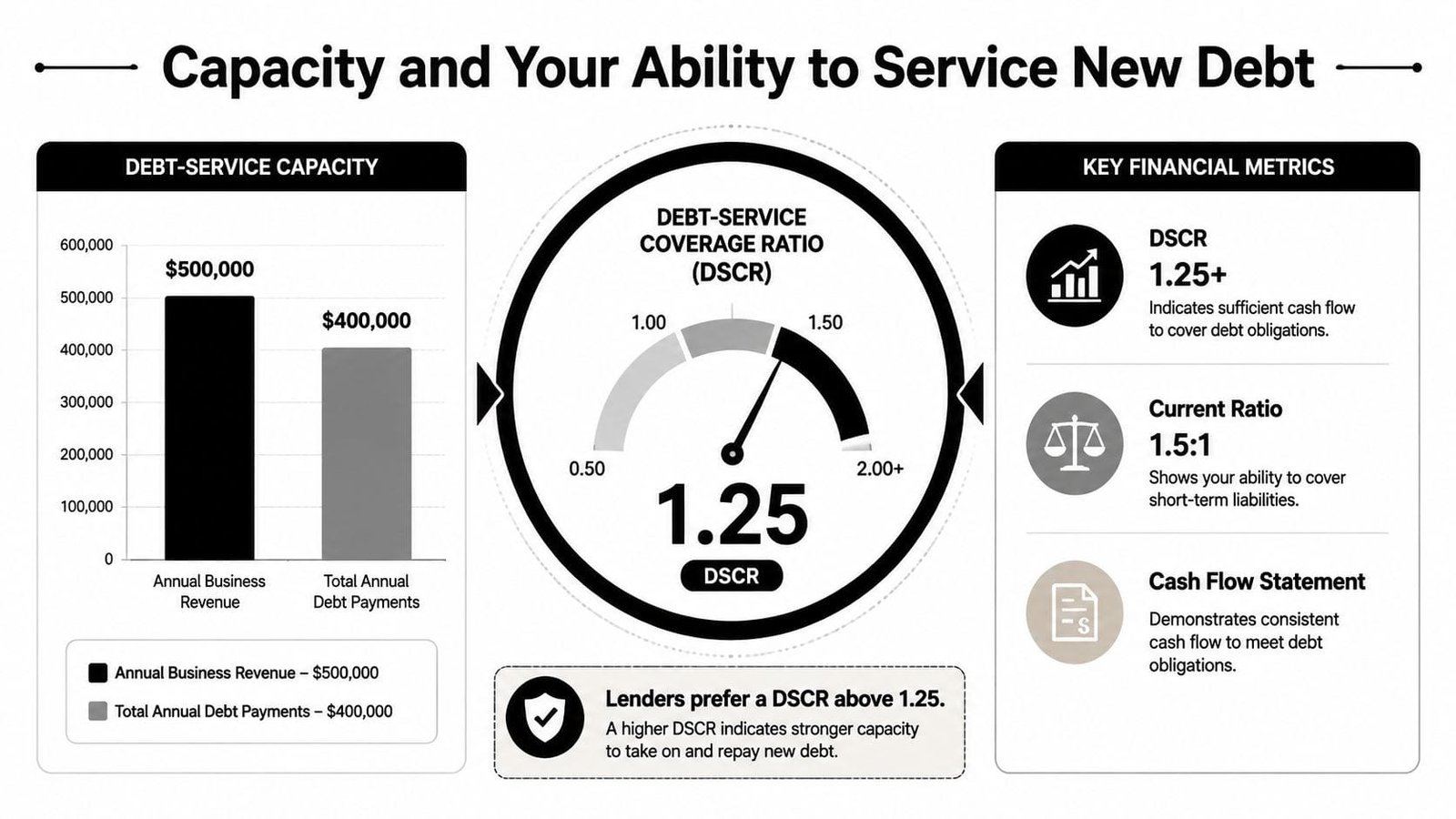
Debt-service coverage is one way to frame the analysis. The basic logic is operating cash available for debt service divided by required debt payments. A result above the lender's minimum indicates some repayment cushion, while a result close to the payment requirement leaves less room for an unexpected decline.
The exact threshold varies by lender, product, industry, and risk profile. Don't assume that a ratio shown in a generic calculator guarantees approval. Use it as a diagnostic tool, then ask the lender which definition of cash flow and debt service it uses.
A useful cash-flow model should connect the loan to a business purpose. If you're financing equipment, show the expected operating contribution. If you're adding inventory, explain the purchasing and sales cycle. A cash flow model for Web3 startups offers a useful example of how businesses can organize short-term inflows and outflows, even though the underlying model should be adapted to your own industry.
How to improve your capacity presentation
Review your current obligations before requesting more debt. Paying down or refinancing an expensive obligation may improve available cash flow, but only if the resulting structure lowers pressure and doesn't create a new liquidity problem.
Document recurring contracts, subscription revenue, purchase orders, and other predictable sources of income. Separate one-time receipts from normal operating revenue so the lender can see which inflows are likely to continue.
You can also prepare a downside view. Show what happens if sales soften, collections slow, or expenses increase. A realistic projection often carries more credibility than an aggressive forecast that assumes every month will be perfect.
For terminology and calculation guidance, review this resource on how to find net income. Net income isn't identical to cash available for debt service, but understanding the difference helps you explain why accounting profit and bank-balance movement may not match.
Capital and Collateral as Your Financial Safety Net
Capital and collateral are related, but they describe different forms of financial support. Capital is the owner's stake in the business, which may include personal investment, retained earnings, and overall net worth. Collateral is a specific asset pledged to secure the loan.
For example, an owner who has invested personal funds and retained profits has capital at risk. A company pledging a delivery vehicle, equipment, inventory, real estate, or accounts receivable is offering collateral. Business lending references commonly identify these asset categories when describing how lenders assess a secondary repayment source (business borrowing guidance).
Why the distinction affects approval
Capital tells the lender that the owner has financial commitment to the enterprise. It can also indicate whether the business has built reserves or has relied entirely on borrowed money. Collateral serves a different purpose. It gives the lender a possible recovery source if operating cash flow no longer covers the obligation.
A lender may accept a personal guarantee when the business has limited pledgeable assets, but a guarantee isn't the same as collateral. A guarantee creates a personal repayment obligation. Collateral gives the lender a claim against a defined asset, subject to the loan documents, lien position, valuation, and liquidation process.
The importance of this C depends heavily on the product and lender. Asset-based financing naturally focuses on the value and quality of pledged assets. An unsecured working-capital product may focus more on cash movement and repayment history. A bank may ask for both a guarantee and collateral even when the business has healthy revenue.
Strong cash flow can reduce the lender's dependence on collateral, but it doesn't make collateral irrelevant for every product.
To strengthen this part of your application, create an asset schedule. List major equipment, vehicles, inventory, real estate, and receivables, then gather ownership records and current supporting documents. Avoid overstating values. An underwriter will care about realizable value, existing liens, depreciation, and how quickly an asset could support repayment.
You can also demonstrate capital by keeping business and personal funds clearly documented, retaining a reasonable operating reserve, and showing how your own investment supports the funding request. Clear records make it easier for the lender to distinguish genuine owner commitment from temporary transfers.
How Different Lenders Weigh Each of the 3Cs
The 3Cs are consistent as a framework, but their relative weight changes by lender type, product, and data access. A bank may spend more time on conventional credit history and pledged assets. A fintech lender may examine connected-account cash flow and transaction patterns. An SBA lender still evaluates character, capacity, and collateral, but the structure and documentation can differ by program and participating institution.
| Lender Type | Character Weight | Capacity Weight | Capital/Collateral Weight |
|---|---|---|---|
| Traditional bank | High, with close attention to personal and business credit history | High, supported by financial statements and historical cash flow | High for secured facilities and conventional underwriting |
| SBA lender | High, including repayment history and owner credibility | High, with detailed attention to business cash flow and debt service | Important, with requirements shaped by the loan structure and available assets |
| Fintech or alternative lender | Important, often combined with behavioral and account data | Often central, especially where real-time cash-flow information is available | Varies widely, from limited collateral focus to asset-specific security |
These labels are directional, not a universal scoring system. A bank can approve a borrower with limited collateral when cash flow and character are compelling. A fintech platform can still require a guarantee or security interest. An SBA lender can examine all three rather than allowing one strong category to erase two weak ones.
Matching your profile to the channel
If your business has a long operating history, clean repayment records, organized financial statements, and meaningful assets, a conventional bank may be worth pursuing. If your main strength is consistent account activity but your financial reporting is less traditional, a lender that can analyze cash-flow data may offer a more relevant review.
The market also creates counterintuitive outcomes. In Australia, the Reserve Bank reported improved SME finance access over the prior year, including more unsecured funding and faster approvals, while long processing times and property or personal collateral remained common concerns (Reserve Bank of Australia SME conditions). In Canada, the same source reported that 75% of small businesses were required to pledge collateral in 2025, up from 66% in 2024, while approval rates reached 97% and rates fell to 5.8%. Those figures show why approval conditions can improve without making collateral less relevant across every market.
U.S. borrowers face a selective environment too. Big banks approved 13% of small-business applications in the second quarter of 2025, according to the Experian Main Street report. The Federal Reserve reported that more than a quarter of small businesses faced credit-availability challenges, while 37% of small employer firms applied for a loan, line of credit, or merchant cash advance in 2023 (Federal Reserve small-business credit data). For an owner with strong revenue but thin personal credit or limited collateral, lender fit matters as much as the abstract strength of any one C.
Your Pre-Application Checklist to Strengthen All Three Cs
Start before you need the money. A rushed application can turn a correctable documentation problem into a decline or a more expensive offer.
Character
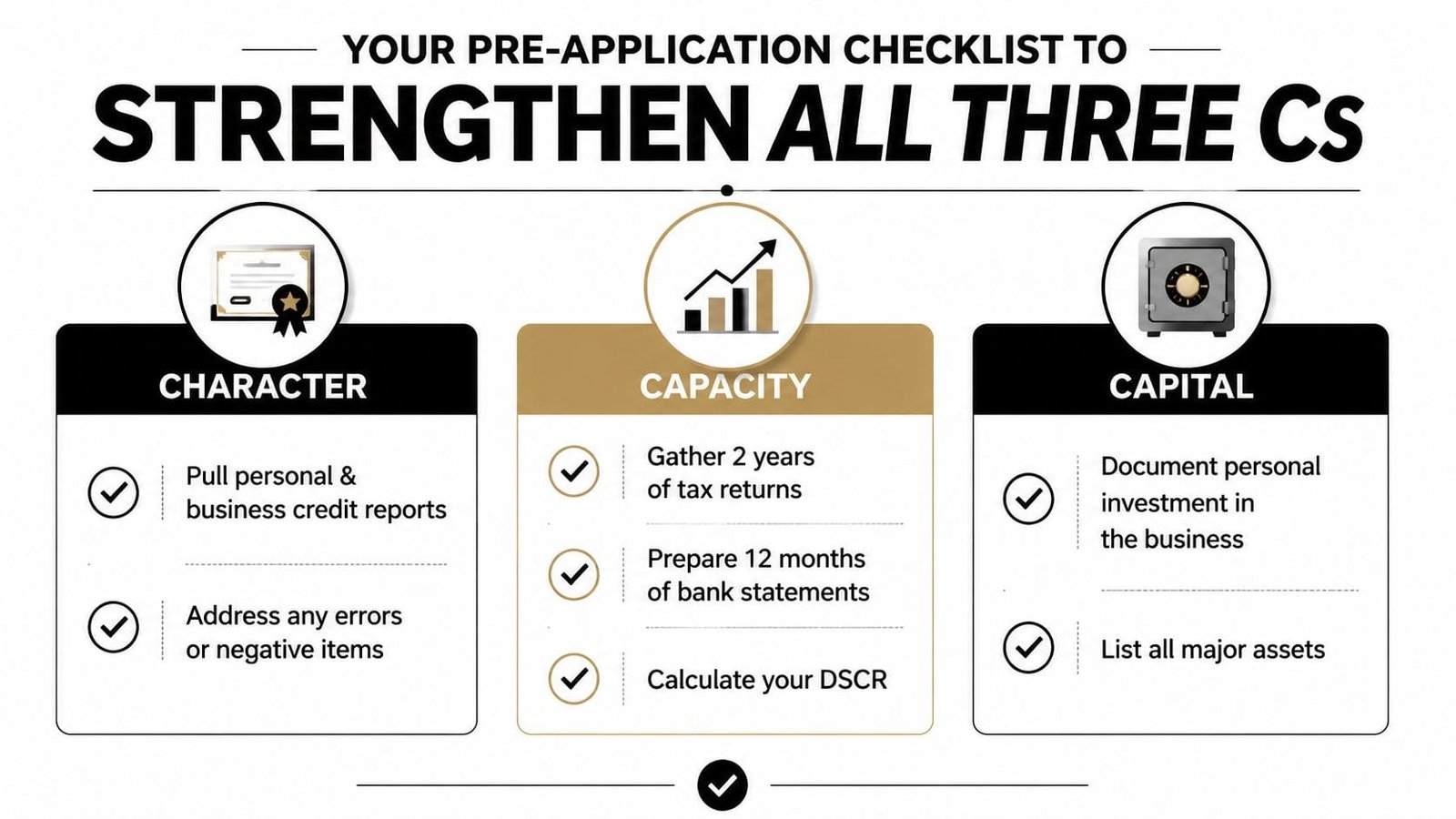
Pull personal and business credit reports, then review every account for inaccurate balances, ownership details, payment statuses, and public-record entries. Dispute errors early, preserve proof of payment, and prepare short explanations for legitimate negative items.
Keep existing obligations current while you prepare. Avoid taking on unnecessary debt, moving balances between accounts without a clear reason, or making financial changes you can't explain.
Capacity
Build a clean cash-flow file from business bank statements, accounting records, tax returns, and current accounts receivable. Calculate your existing debt burden, test the proposed payment under a slower-revenue scenario, and identify recurring income that may not be obvious from a single statement.
If you need a document-by-document preparation guide, use this checklist of documents needed for a business loan. Organized records reduce avoidable back-and-forth and help the lender evaluate the business on its actual performance.
Capital and collateral
List equipment, vehicles, inventory, real estate, and receivables that could support a secured request. Record ownership, estimated current value, existing liens, and the documents that verify each asset.
At the same time, document your investment in the business and any available operating reserves. If collateral is limited, strengthen the other evidence rather than hiding the gap. A lender may consider strong cash flow, a guarantee, a smaller request, or a different product, depending on its policies.
Use the 30 to 90 days before applying to correct errors, stabilize reporting, reduce avoidable obligations, and assemble explanations. The right preparation won't guarantee approval, but it gives underwriters a coherent file and gives you a better basis for comparing offers.
Putting the 3Cs to Work for Your Business Funding Goals
The 3Cs aren't just a lender's test. They're a planning tool for deciding how much debt your business can carry, which assets you're willing to pledge, and which funding channel fits your actual profile.
Character helps you establish trust. Capacity helps you avoid borrowing more than cash flow can support. Capital and collateral help you understand what financial protection you're offering and what a secured loan could put at risk. Together, they can shape approval, pricing, loan size, guarantees, and repayment flexibility.
Business Loan Warrior offers a single application flow where owners can check pre-approval without affecting credit, connect bank accounts to demonstrate current cash flow, and use a secure dashboard to track approvals and credit insights. Those features can be useful when you want to present capacity clearly while comparing business loans, SBA financing, lines of credit, equipment funding, or other products.
The practical next step is simple. Identify your weakest C, gather evidence for your strongest one, and choose lenders whose underwriting approach matches the way your business generates and documents money.
Visit Business Loan Warrior to review funding options and complete a no-fee application that can help connect your Character, Capacity, and Capital profile with suitable business financing. Use the process to organize your financial information, compare potential paths, and move forward with a clearer understanding of what lenders will evaluate.