
MCA debt is a purchase of your future receivables, not a traditional loan. You repay a fixed total, often 1.1x to 1.5x the advance, through daily or weekly holds on sales, making it one of the most expensive forms of small-business funding.
That structure explains why an MCA can feel manageable on the day the money arrives and suffocating weeks later. The funder gets paid from your incoming revenue, whether customers keep spending at the same pace or not. Once sales weaken, the payment takes a larger share of the cash your business needs for payroll, inventory, rent, taxes, and suppliers.
The risk becomes sharper when owners stack advances. A second MCA may cover the first withdrawal temporarily, but it adds another claim against the same revenue stream. Recent industry reporting cited $2.22 billion in combined MCA defaults in 2024, up from $1.40 billion in 2023, a 59% increase (Delancey Street's MCA default analysis). That's why the right question isn't only “What is MCA debt?” It's also, “When does this payment structure start consuming the business that's supposed to repay it?”
Table of Contents
- Understanding What MCA Debt Really Is
- How Factor Rates and Repayment Structures Work
- When MCA Debt Becomes a Cash Flow Trap
- Comparing MCA Debt to Smarter Funding Alternatives
- Legal and Regulatory Considerations You Should Know
- Strategies for Negotiating and Refinancing MCA Debt
- Your Action Plan for Managing Business Funding Wisely
Understanding What MCA Debt Really Is
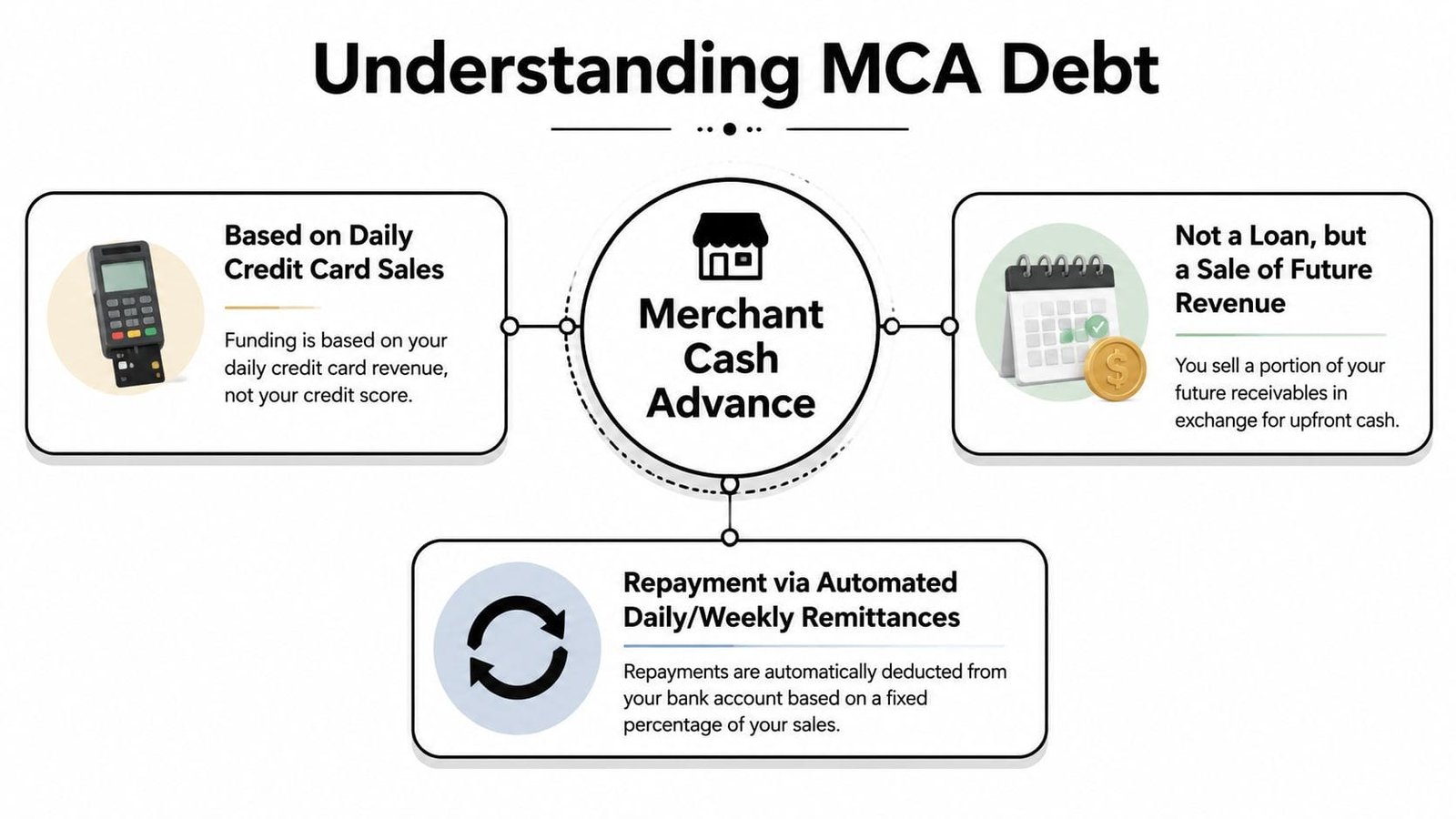
A merchant cash advance gives a business upfront capital in exchange for an agreed portion of future receivables. The receivables may come from credit-card sales, debit-card sales, or automated clearing house receipts. Instead of charging interest on a principal balance over a stated amortization schedule, the funder sets a fixed purchase price for those future receipts.
Suppose a funder advances capital today and expects a larger fixed amount in return. The contract may authorize daily or weekly withdrawals, or it may direct a payment processor to send an agreed share of sales to the funder. The business doesn't owe a balance that declines through ordinary loan installments. It has committed future revenue to satisfy the purchased amount.
That distinction matters because a receivables purchase and a conventional loan use different pricing language, contract terms, and legal arguments. The document may call the transaction a purchase, while the practical burden can still resemble debt if the business must repay a fixed amount regardless of actual performance.
Why MCAs expanded
The product developed from a niche receivables concept into a significant alternative-finance channel. A historical account reports that one major early MCA-originating firm funded $9 million in 1999, then reached $200 million in annual volume by 2006 across more than 14,000 clients (deBanked's history of MCA development).
The 2008 financial crisis accelerated demand for non-bank funding as tighter bank lending pushed more small businesses toward alternative providers. Restaurants, retailers, and other companies with steady card-heavy sales were natural targets because their receivables could support frequent remittances.
The appeal is obvious. An owner may receive a decision and capital faster than a bank can complete a conventional underwriting process. But speed comes with a tradeoff. The funder receives priority access to operating revenue, and the business carries the risk that its sales won't support both the remittance and normal expenses.
For a more detailed explanation of the structure, review this guide to merchant cash advance meaning. Before signing, identify exactly what revenue is being purchased, how payments are calculated, whether reconciliation is real and usable, and what happens after a missed remittance.
Advisor's rule: If the payment comes out of operating revenue every day, judge the advance by its effect on cash flow, not by the label on the contract.
How Factor Rates and Repayment Structures Work
MCA pricing starts with the factor rate. A factor rate isn't an interest rate, and it doesn't behave like an APR. It multiplies the amount advanced to produce the fixed total repayment.
The basic calculation is simple:
Advance amount × factor rate = total repayment
A $50,000 advance at a 1.3 factor rate creates $65,000 of total repayment. That means the financing charge is $15,000, but the contract may not describe that charge as interest. The business owes the agreed purchase amount even if it repays faster than expected.
Commonly cited MCA factor rates range from 1.1x to 1.5x, while effective APRs can range from roughly 40% to more than 350%, depending on the repayment term and structure (CFPB regulatory commentary). One regulator-commentary source notes that a 1.4 factor rate can annualize to roughly 101% APR, depending on the term and repayment speed.
The same factor can produce different effective costs
A factor rate hides the value of time. If a business repays the fixed amount slowly, the annualized cost may look lower than if the funder collects the amount rapidly. A fast collection schedule gives the business less time to use the capital while preserving the same fixed financing charge.
For example, a factor rate of 1.3 still produces $65,000 of repayment on a $50,000 advance. The effective annualized cost changes based on whether the business reaches that total through a longer schedule or through aggressive daily withdrawals. That's why comparing an MCA factor rate directly with a bank loan's interest rate produces a misleading result.
Holdbacks determine the pressure
The holdback rate is the portion of daily or weekly receipts directed to the funder. Typical holdbacks are often 10% to 20% of daily card or ACH receipts (Crestmont Capital's MCA default-rate overview).
| Factor Rate | Total Repayment on a $50,000 Advance | Estimated APR Range |
|---|---|---|
| 1.1x | $55,000 | Roughly 40% to over 350%, depending on term and repayment speed |
| 1.3x | $65,000 | Roughly 40% to over 350%, depending on term and repayment speed |
| 1.5x | $75,000 | Roughly 40% to over 350%, depending on term and repayment speed |
The table's APR range is broad because the factor alone can't reveal the annualized cost. You need the advance amount, total payback, holdback method, expected term, withdrawal frequency, and any additional fees.
Ask the funder for a written repayment schedule based on realistic sales, not optimistic projections. Then calculate how much cash remains after remittances on a weak sales day. If the business can't cover essential expenses under that scenario, the advance is too aggressive.
When MCA Debt Becomes a Cash Flow Trap
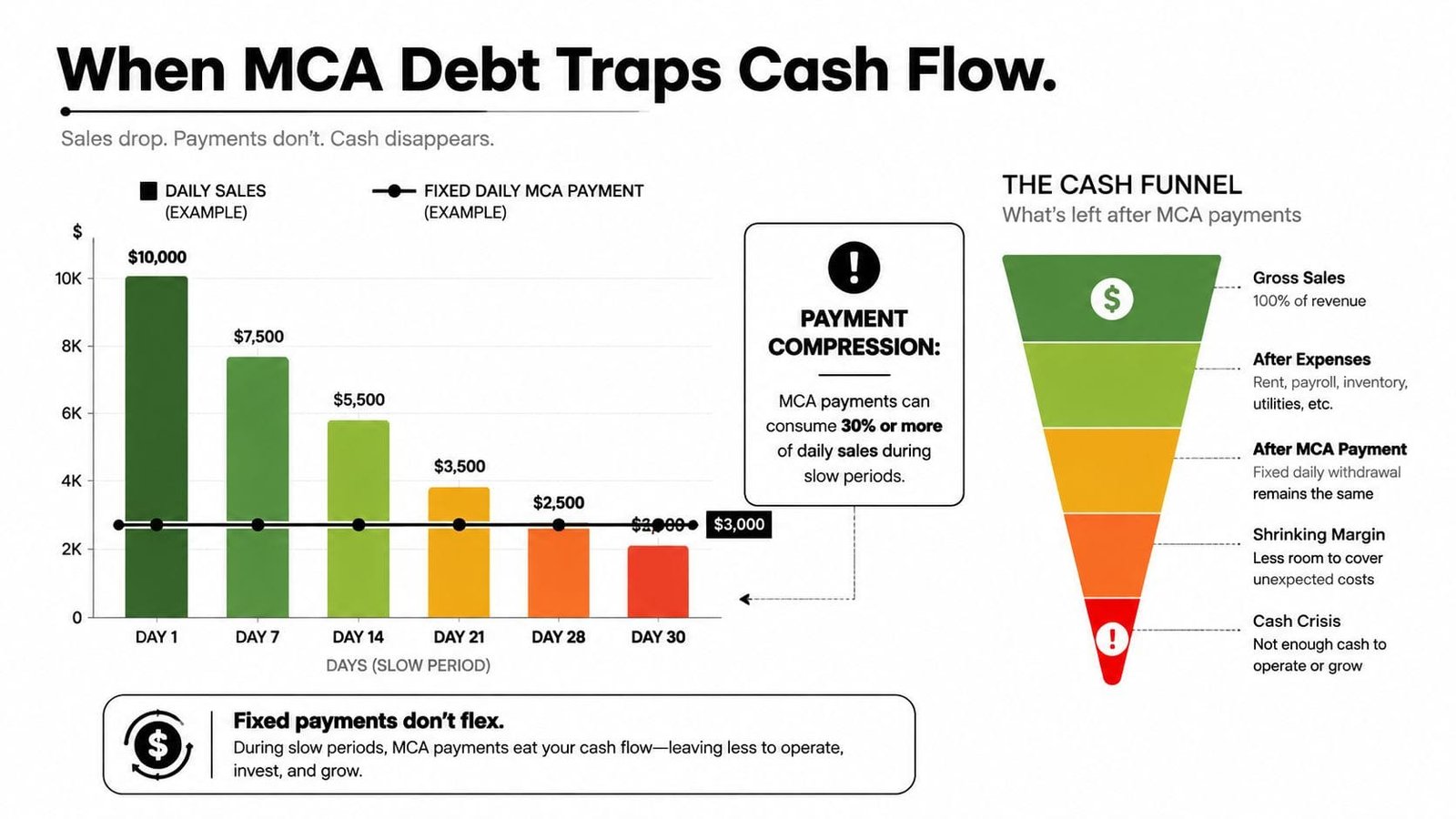
MCA debt becomes a cash-flow trap when revenue weakens but remittances keep draining the account. This payment compression turns a manageable withdrawal during a strong sales period into a much larger share of available cash when sales fall.
The sequence is predictable. Lower sales leave less money for payroll, vendors, inventory, and taxes, while daily or weekly remittances continue. The owner may delay bills or take another advance to keep the account funded. That new advance then claims more of the same revenue base, increasing the pressure on every future sales day.
Stacking changes the problem
Stacking means carrying multiple advances at once. Each funder may have a separate authorization, withdrawal schedule, or claim on receivables. The owner sees several separate payments, but the business feels one combined cash drain.
Industry estimates place MCA default or non-completion rates in the 10% to 25% range, with higher estimates for some subprime funders. Businesses carrying several stacked MCAs can face reported default rates above 40%, as discussed in Crestmont Capital's discussion of MCA defaults.
Watch for these warning signs:
- Borrowing to make remittances: A new advance covers an existing withdrawal instead of funding inventory, payroll, or a profitable project.
- Shrinking operating cash: Sales continue, but little remains after funder withdrawals and basic expenses.
- Multiple automated debits: Several funders withdraw from the same account, making reconciliation and forecasting difficult.
- Missed or returned payments: A failed ACH withdrawal shows that available liquidity no longer supports the payment structure.
- Pressure to refinance immediately: A broker or funder presents another advance as the only way to avoid default.
A recent industry dataset reported $2.22 billion in defaulted MCA debt in 2024, up from $1.40 billion in 2023, a 59% increase, according to ABNewswire's reporting on MCA defaults. Bankruptcy coverage also reported MCA-related debts in more than 230 small-business bankruptcy filings at their 2025 peak, as described in Scura Law Firm's bankruptcy discussion.
Act before a missed payment. Gather every contract, list each withdrawal, contact the funders, and build a cash-flow plan before remittances threaten operations. Refinancing with another MCA should not be the default response. It often postpones the shortfall while increasing the total claim on future revenue.
The following video provides another visual explanation of how MCA repayment pressure can affect a business.
Comparing MCA Debt to Smarter Funding Alternatives
The fastest offer isn't automatically the right offer. Match the funding structure to the way your business earns and collects money.
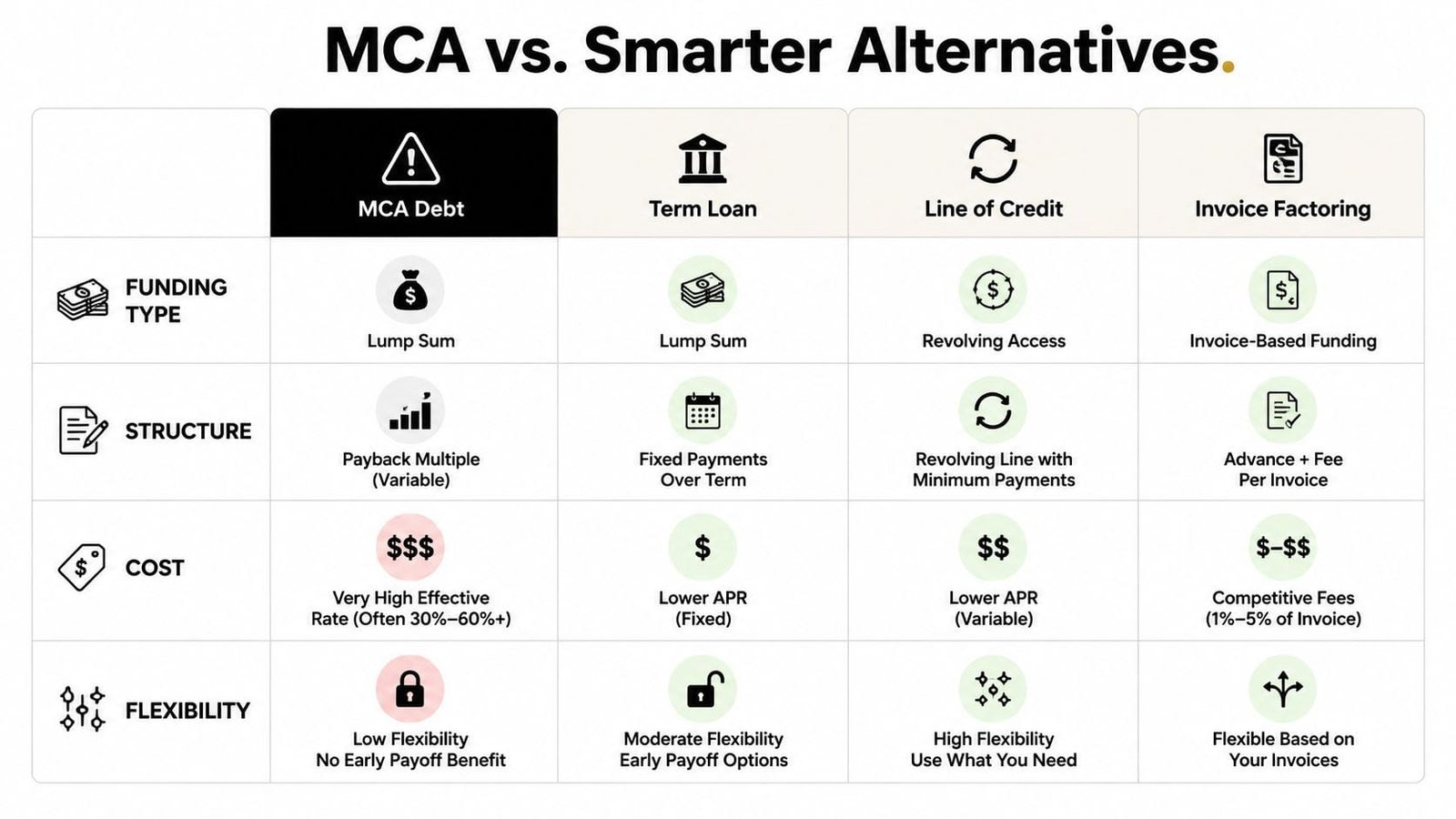
A term loan usually provides a defined principal amount, interest rate, repayment schedule, and maturity. A line of credit gives the business access to revolving capital, which can suit seasonal needs when the owner wants to draw only what's necessary. Invoice financing fits B2B companies that have issued invoices but must wait for customers to pay. SBA-backed financing generally involves more documentation and a slower process, but it can offer a more durable structure for qualified borrowers.
| Funding Type | Typical Cost | Funding Speed | Best For |
|---|---|---|---|
| MCA debt | Factor-based pricing, often costly, with effective APRs that can reach very high levels | Fast | Businesses with strong card sales and an urgent short-term need |
| Term loan | Interest-based pricing with scheduled payments | Slower than an MCA | Planned expansion, equipment, or a defined project |
| Business line of credit | Interest charged on drawn funds | Moderate, depending on underwriting | Seasonal working capital and recurring shortfalls |
| Invoice financing | Pricing tied to eligible invoices and collection timing | Moderate | B2B businesses waiting on customer payments |
| SBA-backed financing | Structured loan pricing, subject to program and lender terms | Slower application process | Longer-term growth, refinancing, or major investment |
Use a payback guide for operators to evaluate how quickly a financing decision returns value to the business. The key question is whether the project produces cash before the repayment obligation strains operations.
Choose by revenue pattern
A restaurant with reliable card volume may qualify for an MCA but should still compare it with a line of credit or equipment financing. A contractor waiting on commercial invoices should look first at invoice financing, not a daily card-receipts product. A growing company with documented profits and a longer planning horizon should investigate a term loan or SBA-backed option before accepting expensive emergency capital.
Review short-term business financing options only after you've mapped the full repayment burden. A short-term product can solve a temporary gap, but it can't repair a business whose underlying cash flow is already insufficient.
Speed is useful only when the repayment schedule leaves enough cash to operate.
Legal and Regulatory Considerations You Should Know
An MCA agreement may call the transaction a purchase of receivables, but that label does not answer every legal question. Courts and regulators can examine the economic substance, including whether the funder bears the risk of weaker receivables or whether the business must repay a fixed amount regardless of performance.
That classification can affect available remedies, disclosure duties, collection rights, and treatment during restructuring. Review personal guarantees, security interests, default provisions, and reconciliation language before signing. A reconciliation clause matters only when the business can invoke it and the payment adjusts to verified revenue.
State rules are changing
Texas enacted HB 700 for sales-based financing. Provider and broker registration, together with transaction-level disclosures, became effective in September 2025, and registration is scheduled to be due by December 31, 2026 (Venable's analysis of state commercial-financing disclosure laws).
California also updated its commercial-financing disclosure regime effective January 1, 2026, according to that analysis. A business's location, the funder's location, and the transaction structure can determine which information must be disclosed before signing.
At the federal level, the CFPB proposed excluding merchant cash advances from its Section 1071 data-collection rule in late 2025, leaving future federal reporting requirements uncertain. A state disclosure form does not make an expensive offer affordable. It improves visibility, while the owner must still test the payment against realistic cash flow.
Before accepting or renewing an MCA, request:
- The full contract: Include every addendum, broker agreement, guarantee, and security filing.
- A plain repayment calculation: Confirm the advance, purchased amount, holdback, estimated term, and all fees.
- Reconciliation instructions: Ask how to request an adjustment, what evidence is required, and how quickly the funder responds.
- Default consequences: Review ACH changes, collection provisions, liens, guarantees, and any confession-of-judgment language where applicable.
- Applicable law: Verify which state's rules govern the transaction and whether required disclosures apply.
For a multistate business, have qualified counsel review the documents before renewal. State treatment differs, and a familiar-looking contract may impose different obligations in another jurisdiction. That review can expose terms that turn a temporary cash-flow advance into a longer legal and financial burden.
Strategies for Negotiating and Refinancing MCA Debt
The best time to negotiate an MCA is before the first missed remittance. A failed payment leaves the funder with more collection power and the business with less cash to support a credible proposal.
Build one debt schedule before contacting anyone. Record each funder, original advance, purchased amount, current payoff, withdrawal frequency, remittance, remaining balance, personal guarantee, and security filing. Match that schedule with bank statements and a forward cash-flow forecast. The forecast must show what remains after payroll, rent, taxes, inventory, and required vendors.
Build a proposal from verified cash flow
Request a lower daily or weekly remittance, a longer repayment term, or a temporary adjustment backed by revenue records. Offer only an amount the business can maintain. A dependable reduction is better than an aggressive promise followed by another default.
Get every concession in writing. Confirm whether the agreement changes the payment, pauses enforcement, reduces the payoff, or adds another obligation. A phone call is not a completed restructuring.
Stacked advances require a separate review. A genuine refinance pays off the existing obligations and replaces them with a documented repayment schedule. Reverse consolidation may add financing while leaving the original MCAs active, increasing the total burden. As noted earlier, rising defaults have brought more attention to this structure, but its label does not prove that prior advances will be paid off.
Use MCA debt relief resources to organize the review. Compare any replacement debt with the current obligations line by line, including the payoff amount, term, remittance, fees, and total repayment. A lower payment may still cost more if the term expands or new charges are added.
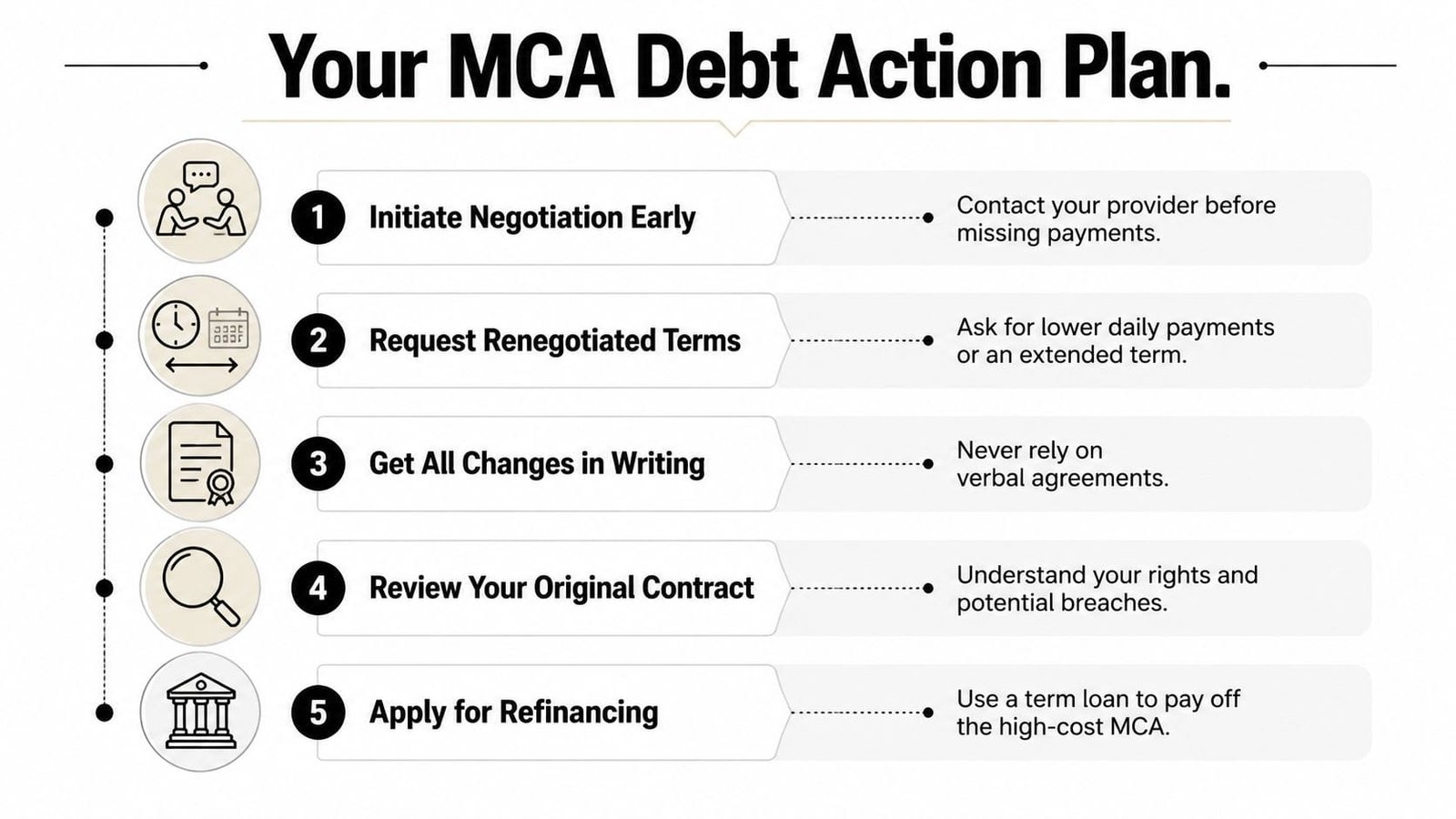
Negotiation standard: Do not accept “debt relief” language until you know which obligations disappear, which remain, and what the business will pay in total.
If the business still cannot meet the proposed plan, consult a qualified attorney promptly. The MCA's legal classification, contract wording, personal guarantees, and governing state law can change the available options. Do not take another advance just to preserve a payment schedule the business cannot sustain.
Your Action Plan for Managing Business Funding Wisely
Begin with a funding inventory, not another application. Pull every MCA contract and bank statement, identify each automated withdrawal, and calculate the cash remaining after remittances and essential operating costs. If you can't explain the payment schedule in one page, you don't yet have enough control over the debt.
Use this decision process:
- One advance, stable cash flow: Ask whether a conventional line of credit, term loan, or lower-cost product can replace the MCA before renewal.
- One advance, weakening cash flow: Contact the funder early and request written payment relief based on actual revenue.
- Multiple advances: Stop treating each withdrawal separately. Build a combined schedule and assess whether a genuine refinance can eliminate the stacked obligations.
- Missed payments or legal threats: Preserve every notice, contract, bank record, and communication. Seek professional financial or legal advice immediately.
- No sustainable repayment path: Discuss formal restructuring options rather than taking another advance to delay the problem.
A restaurant owner might accept an MCA during a busy period, then discover that slower sales leave too little cash for food purchases and payroll. The correct response isn't to keep adding advances. The owner should document sales, ask for a written adjustment, compare a refinance with a line of credit or term loan, and protect operating cash while professionals review the contracts.
Healthy financing decisions start with the payback source. If the capital funds equipment, inventory, or expansion, identify how that investment will generate cash and when the receipts will arrive. If the advance only covers another funder's withdrawal, the business is no longer financing growth. It's financing the financing.
Check the legal documents before moving money between accounts or changing payment instructions. A funder may have contractual rights over receivables or account activity, and an improvised workaround can create additional exposure. Keep communication factual, preserve records, and act before the account reaches a crisis point.
Business Loan Warrior offers a single application process for comparing business funding options, including loans, SBA financing, lines of credit, invoice financing, and merchant cash advances. Owners dealing with MCA pressure can visit Business Loan Warrior to review potential funding paths and start a conversation about a structure that better fits the company's cash flow.