

You're sitting across from a seller who wants a clean close, while your lender keeps asking a less comfortable question: what cash flow will still be available after the purchase price, debt payments, working capital needs, and your own compensation are accounted for? The answer usually won't come from finding one oversized business loan to buy a business. It comes from designing a capital stack that gives the company room to operate after ownership changes.
That distinction matters in 2026. The U.S. Small Business Administration's 7(a) program approved a record $37.3 billion across 78,078 loans in fiscal year 2025, up from $31.1 billion across 70,242 loans in FY2024, according to Acquisition Ace's acquisition financing data report. Acquisition finance is active, but lenders still care more about durable repayment capacity than headline deal size.
Table of Contents
- Why Buying a Business Feels Different From Starting One
- What a Business Acquisition Loan Actually Does
- Comparing the Main Ways to Finance a Business Purchase
- A Worked Example of Funding a $4M Acquisition
- What Underwriters Actually Look For
- Walking the Deal From LOI to Funding
- Rethinking the Capital Stack
- Your Pre-Application Checklist and Where Business Loan Warrior Fits
Why Buying a Business Feels Different From Starting One
The buyer is evaluating a $4 million HVAC services company with $1.1 million in seller-discretionary EBITDA. The seller points to recurring service calls, trained technicians, commercial contracts, and a long operating history. The buyer sees a platform with room to grow. The lender sees a question that has to be answered with documents and adjusted cash flow: will this business continue producing enough cash after the buyer takes over?
A startup loan underwrites a plan. An acquisition loan underwrites a business that already has customers, payroll, suppliers, contracts, equipment, and operating habits. That sounds easier, and in some respects it is. But the buyer isn't just purchasing revenue. The buyer is inheriting the risks embedded in that revenue, including customer concentration, inventory quality, key-employee retention, deferred maintenance, pending claims, and liabilities that may not be obvious from a seller's summary.
Deal-side rule: A lender doesn't finance the seller's story. The lender finances adjusted cash flow that can be verified, transferred, and sustained after closing.
The lender will examine how the seller calculates discretionary earnings, then remove expenses that won't disappear after the transaction and test assumptions that depend too heavily on the seller's personal relationships. If the owner personally handles estimating, sales, dispatch, or major accounts, the transition plan becomes part of the credit analysis. A strong business can become a weak loan if the buyer lacks the operating experience or management bench to absorb those responsibilities.

Before signing an LOI, buyers should understand how to purchase a small business as a financing exercise, not just a search exercise. The purchase price, transition obligations, working capital, and buyer equity must work together. A seller who insists on receiving every dollar at closing may force the buyer into excessive senior debt. A seller who carries part of the price can reduce the bank's exposure and preserve cash flow for the first operating year.
That's why acquisition financing deserves its own discipline. The lender is underwriting the business, the buyer, the transaction terms, and the handoff between them.
What a Business Acquisition Loan Actually Does
Think of acquisition financing as a mortgage for an operating company. The business's verified earnings take the place of a property appraisal, the buyer's equity injection works like a down payment, and the lender tests whether the company can cover the new payment after closing. The analogy isn't perfect, but it helps clarify why a lender focuses on normalized cash flow rather than the seller's asking price alone.
A properly structured loan may perform three separate jobs:
- Fund the purchase price. This is the obvious use, but it still requires an allocation between goodwill, equipment, inventory, real estate, and other assets.
- Provide operating liquidity. Payroll, supplier payments, customer receivables, and seasonal expenses don't pause while the buyer learns the business. Working capital can prevent a technically profitable company from experiencing a post-close cash crunch.
- Refinance transaction-related obligations. Existing seller debt or liens may need to be cleared so the buyer receives transferable assets and the lender receives the agreed security position.
The financing channel depends on the transaction. Senior bank debt generally provides the lowest-cost core funding when the buyer and company satisfy strict credit and collateral requirements. SBA-guaranteed financing can support acquisitions where conventional lenders won't provide the desired structure. The SBA 7(a) program is commonly used for change-of-ownership transactions and can combine acquisition costs with eligible working capital.
Seller financing is different from a traditional loan because the seller becomes part of the capital structure. A seller note can bridge a valuation gap, reduce the senior lender's exposure, and keep the seller economically connected to a successful transition. Earn-outs can serve a similar purpose when part of the price depends on future performance, although they create measurement and incentive issues that must be documented precisely.
Mezzanine capital and fintech acquisition products occupy other parts of the spectrum. Mezzanine financing can add debt but usually costs more and demands careful downside analysis. Fintech products may offer a faster process, but speed often comes with higher pricing, shorter repayment periods, or tighter repayment mechanics. Buyers considering bridge financing for business needs should distinguish temporary liquidity from permanent acquisition capital.
The useful question isn't, “How much will a lender approve?” It's, “Which combination of senior debt, seller paper, equity, and contingency liquidity lets the business survive the transition?”
Comparing the Main Ways to Finance a Business Purchase
The right financing option depends on more than the advertised rate. A buyer should compare cash required at closing, repayment burden, lender scrutiny, collateral, timing, and flexibility after closing. The table below uses qualitative descriptions where deal terms vary materially by borrower, lender, industry, and transaction.
| Loan Type | Typical Size | Equity Injection | Rate / Term | Closing Speed | Best Fit |
|---|---|---|---|---|---|
| SBA 7(a) | Suitable for many small-business acquisitions, with program borrowing limits | Often structured around a meaningful buyer contribution, subject to lender and transaction requirements | Competitive variable or fixed structures, with long amortization available for eligible uses | Slower than a streamlined fintech product because of documentation and eligibility review | Operating-company acquisitions where cash flow supports repayment |
| Conventional bank term loan | Depends heavily on collateral, buyer strength, and lender policy | Often higher when collateral or repayment history is limited | Usually attractive for strong borrowers, with terms shaped by asset quality and risk | Can be efficient for prepared borrowers, but underwriting remains detailed | Buyers with strong balance sheets, collateral, and clean financial history |
| Seller financing | Negotiated directly with the seller and sized around the seller's willingness to defer proceeds | Can reduce the amount of senior debt required, subject to lender rules | Negotiated rate, payment schedule, subordination, and maturity | Often negotiated alongside the purchase agreement | Valuation gaps, transition risk, and deals where seller confidence matters |
| SBA 504 | Designed primarily for eligible fixed-asset and real-estate financing rather than general goodwill | Depends on the project and participating lenders | Structured for long-term fixed assets, with separate capital sources | Requires coordination among lenders and program participants | Acquisitions that include substantial commercial real estate or fixed assets |
| Fintech acquisition loan | Product-specific and usually constrained by cash flow, history, and platform policy | Varies by product and risk profile | Often faster but more expensive or shorter-term than bank financing | Fastest when financial data and documents are ready | Time-sensitive opportunities or supplemental liquidity |
SBA 7(a) is often the workhorse for smaller operating-company acquisitions because it can align a substantial purchase with the company's future cash flow. Conventional bank debt can be cheaper when the buyer brings strong collateral and a conservative balance sheet, but it won't compensate for weak normalized earnings. Seller financing is the underrated lever. It may help the buyer meet debt-service requirements while giving the seller a reason to support the transition.
SBA 504 deserves separate attention because buyers sometimes confuse it with a general-purpose acquisition loan. Its strongest use is tied to eligible real estate and fixed assets, not just purchasing goodwill. A buyer acquiring a service business with valuable property may use a blended structure instead of forcing every asset into one product.
Fintech lending is the speed play. It can help when a closing deadline is tight or when a buyer needs an initial financing view before approaching a bank. The trade-off is that convenience doesn't erase risk. A fast approval with a heavy payment can damage the same cash flow that made the business financeable.
Founders comparing acquisition financing with earlier startup capital may also benefit from Steingard Financial's overview of funding stages for founders, especially when the buyer has previously raised equity rather than borrowed against operating cash flow. For a direct comparison of SBA structures, review SBA 7(a) versus 504 financing before assigning real estate and operating assets to a loan package.
A Worked Example of Funding a $4M Acquisition
Consider a buyer acquiring a $4 million-revenue HVAC services company for $3.2 million. The transaction includes operating assets, customer relationships, equipment, and goodwill. The buyer doesn't try to force the entire purchase into senior debt. Instead, the structure uses an SBA 7(a) loan, a subordinated seller note, and buyer equity.
The proposed stack is:
| Source | Amount | Rate | Term | Monthly Payment | % of Deal |
|---|---|---|---|---|---|
| SBA 7(a) senior loan | $2.05 million | Approximately 10.5% blended | Long-term acquisition amortization | Included in total debt service | Approximately 64% |
| Seller note | $640,000 | 6% | 7 years, with 2 years interest-only | Included in total debt service | 20% |
| Buyer equity | $510,000 | Not applicable | Not applicable | Not applicable | Approximately 16% |
| Total | $3.2 million | Approximately $22,800 total monthly debt service | 100% |
The buyer contributes roughly 16% of the purchase price, while the seller leaves meaningful capital at risk. The seller note's interest-only period gives the buyer time to retain technicians, validate customer relationships, and stabilize operations before principal payments increase. That isn't free money. It shifts repayment into later periods, so the buyer must understand the balloon or maturity obligations and negotiate them alongside the senior lender.
Projected available cash flow is approximately $31,500 per month, against total monthly debt service of roughly $22,800, producing a 1.38x DSCR. The calculation is straightforward:
Adjusted monthly cash flow ÷ monthly debt service = DSCR
In this example, the cash-flow cushion is more important than the headline loan amount. A fully financed conventional alternative might appear simpler, but it would place more repayment pressure on the company and fail stress testing after a 15% revenue decline. The stacked structure requires more buyer equity, yet it protects operating liquidity and reduces dependence on perfect performance during the first year.
Practical conclusion: The cheapest-looking capital source isn't always the least expensive decision. A payment the business can comfortably carry is worth more than leverage that forces a refinance after one bad season.
What Underwriters Actually Look For
Underwriters reduce an acquisition to repayment capacity, buyer commitment, and evidence. The central calculation is debt service coverage ratio, or DSCR. It compares adjusted post-acquisition cash flow with total annual debt service, and the widely used underwriting floor is 1.25x, meaning the business must generate at least 25% more cash than required for annual loan payments, as described in SBA acquisition lending guidance on DSCR.
A lender may adjust reported earnings for owner expenses, one-time costs, replacement management, rent normalization, and other items. Buyers should run the calculation using conservative adjustments, not the most favorable seller presentation.
The three credit questions
Cash flow comes first. Can the business pay the new senior loan, seller note, taxes, maintenance needs, and reasonable owner compensation without relying on aggressive growth?
Equity shows commitment. The lender wants the buyer to have real money at risk. Seller financing may count toward an equity requirement only when it meets the lender's stand-by and subordination conditions. The exact treatment must be confirmed before the buyer builds the offer around it.
Documentation proves the story. Expect the lender to request:
- Business tax returns: Historical returns, interim profit and loss statements, balance sheets, and debt schedules.
- Transaction documents: A signed LOI or purchase agreement, sources-and-uses statement, and clear purchase-price allocation.
- Independent validation: A third-party valuation and supporting due diligence materials.
- Buyer information: Personal financial statements, personal tax returns, credit history, resume, and operating plan.
- Repayment assumptions: Projections that explain customer retention, staffing, pricing, working capital, and the seller's transition.
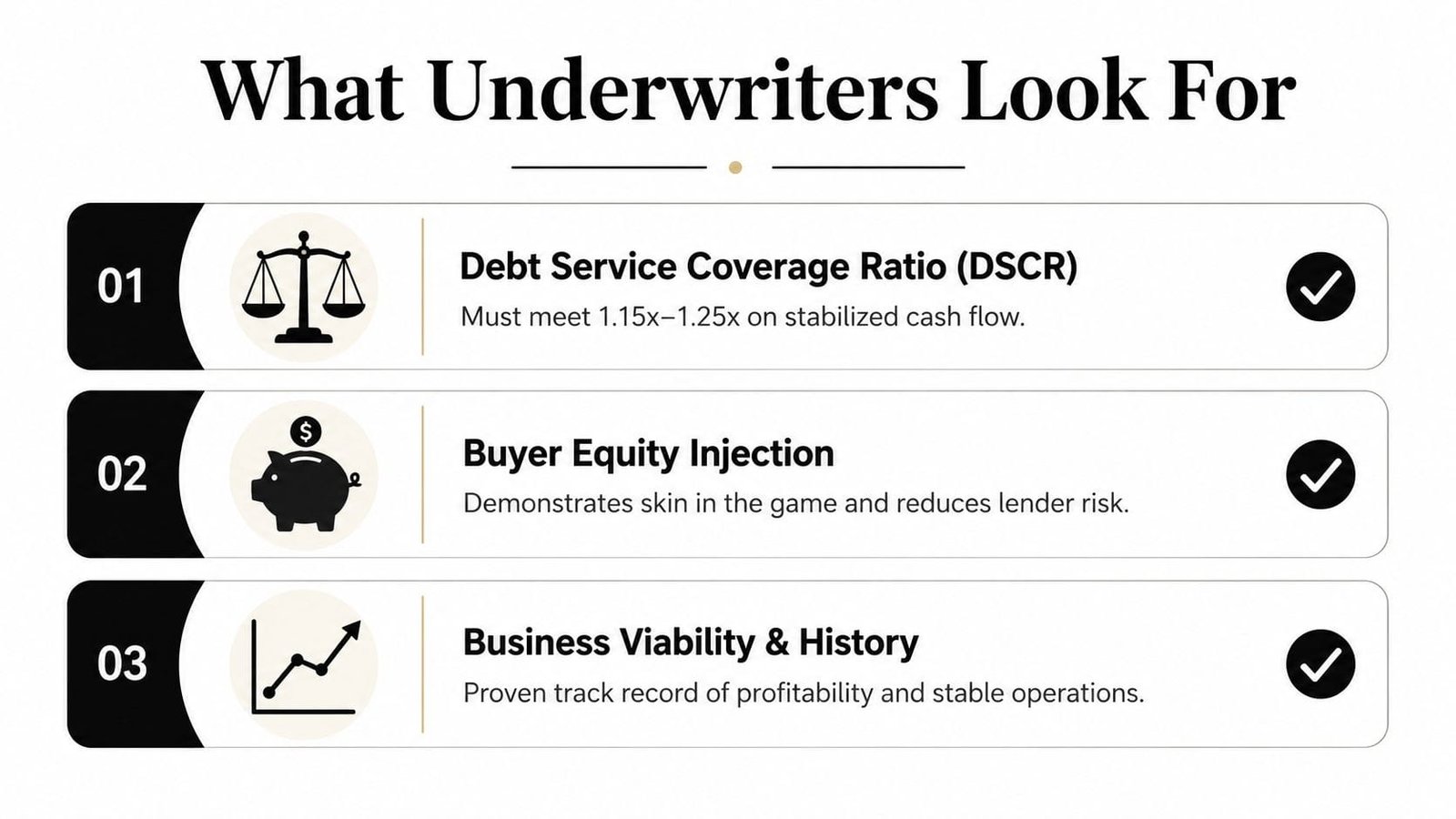
Before applying, ask whether your adjusted DSCR clears the lender's threshold, whether you can document the source of your equity, and whether the seller's financial records reconcile across tax returns, bank statements, and management reports. Non-arm's-length transactions, unexplained add-backs, unstable customer relationships, and a buyer with no credible operating plan can stop a deal even when revenue looks strong.
Acquisition loans have shown relatively low early default levels in historical industry analysis, but that doesn't make weak underwriting acceptable. Yale's review of the SBA 7(a) program%20Loan%20Program.pdf) reported a 1.22% annual default rate for business acquisition loans from 2019 through 2023, while a separate loan-level analysis cited in the verified market data found 0.71% defaults for change-of-ownership acquisition loans across FY2020 through FY2025. Those figures describe observed cohorts, not a promise about any individual transaction.
Walking the Deal From LOI to Funding
A deal rarely stalls because the buyer forgot the concept of borrowing. It stalls because a valuation arrives late, the seller changes a term, or the lender receives incomplete financial records after exclusivity has already started.
The financing path
Weeks 1 through 3 begin with the LOI. The buyer negotiates exclusivity, selects a lender, and starts pre-qualification. The LOI should leave enough flexibility for financing, valuation, diligence findings, working capital, and seller-transition terms.
Weeks 3 through 8 move into formal application and diligence. The lender reviews financial statements, orders valuation work, confirms SBA eligibility where relevant, and examines contracts, liabilities, equipment, leases, and customer relationships.
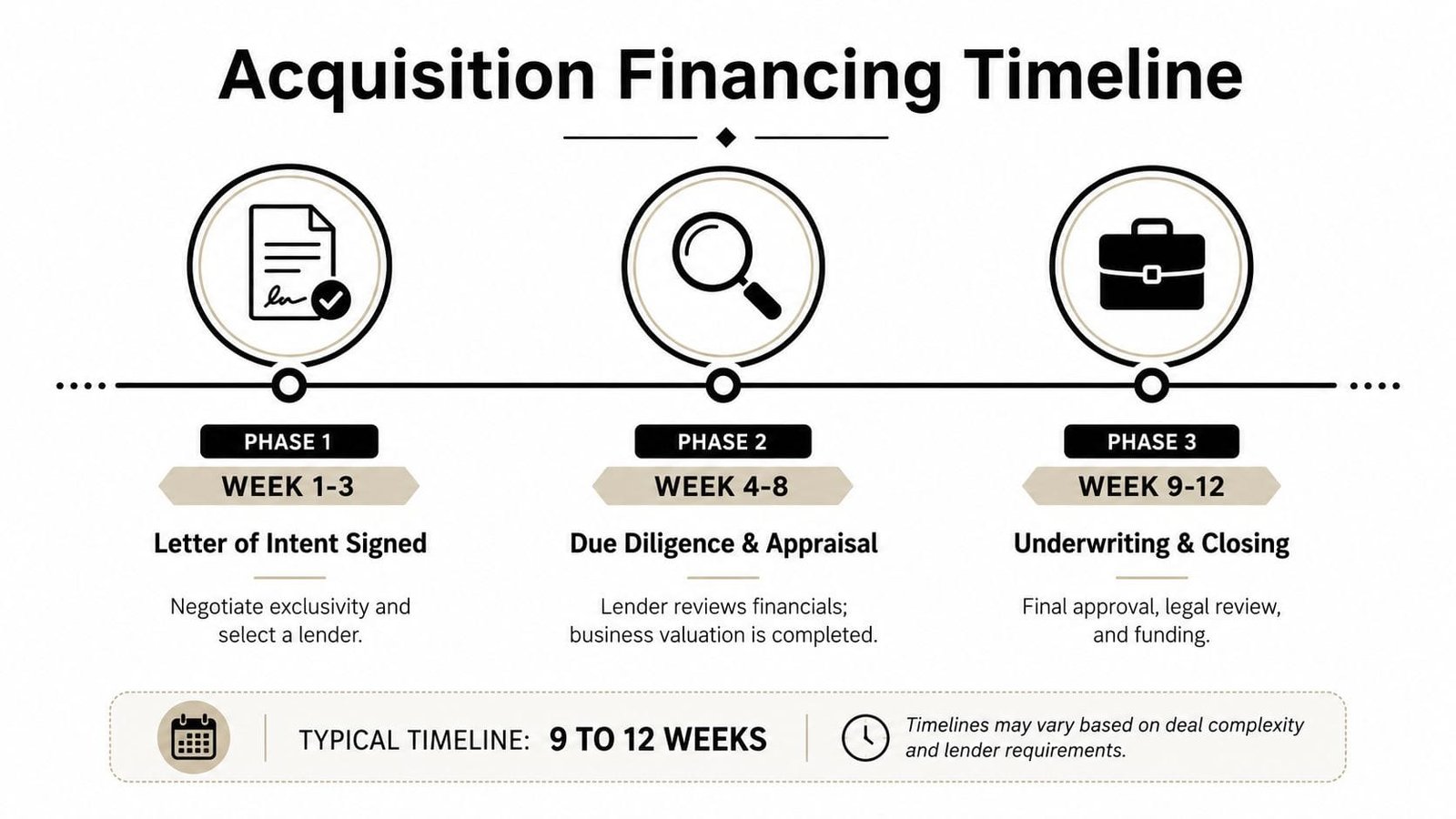
Weeks 8 through 14 are underwriting and conditional approval. The lender reviews third-party reports, reconciles adjustments, confirms the buyer's equity, and finalizes seller-note subordination. An optimistic purchase price can collide with a conservative valuation.
Weeks 14 through 18 involve committee approval and closing conditions. Lawyers draft loan and purchase documents, lien issues are cleared, insurance is confirmed, and every condition must be satisfied.
Weeks 18 through 20 are funding and transfer. Funds are wired, ownership changes, and the buyer takes responsibility for the operation. The seller's transition role should be specific, measurable, and compatible with lender requirements.
Environmental Phase I issues, missing SBA paperwork, and valuation gaps are common sources of delay. Operational readiness matters too. A business can have adequate historical earnings and still struggle if the buyer hasn't planned payroll authority, vendor access, customer communications, and key-employee retention. Charter Oak Strategic Partners' discussion of the operational risks that arise when revenue outpaces operations is useful context for buyers assessing whether the company can absorb new ownership.
Fintech platforms can compress the early application and lender-matching work by collecting documents, organizing financial data, and identifying product fit quickly. They can't eliminate valuation, legal diligence, or committee review. The fastest process is usually the one that exposes problems early rather than the one that promises a quick yes.
Rethinking the Capital Stack
A buyer may qualify for a large senior loan and still be buying too much business. Survivable debt is the objective, because the company must keep funding payroll, maintenance, working capital, and customer retention after closing.
A capital stack assigns different risks to different sources of money. Senior debt receives repayment priority and therefore requires dependable coverage. Properly subordinated seller financing sits behind the senior lender, giving the buyer more room while asking the seller to accept delayed payment. Mezzanine debt can fill a funding gap, but its higher cost makes soft cash flow more dangerous. Buyer equity absorbs the first loss, protecting the lenders above it.
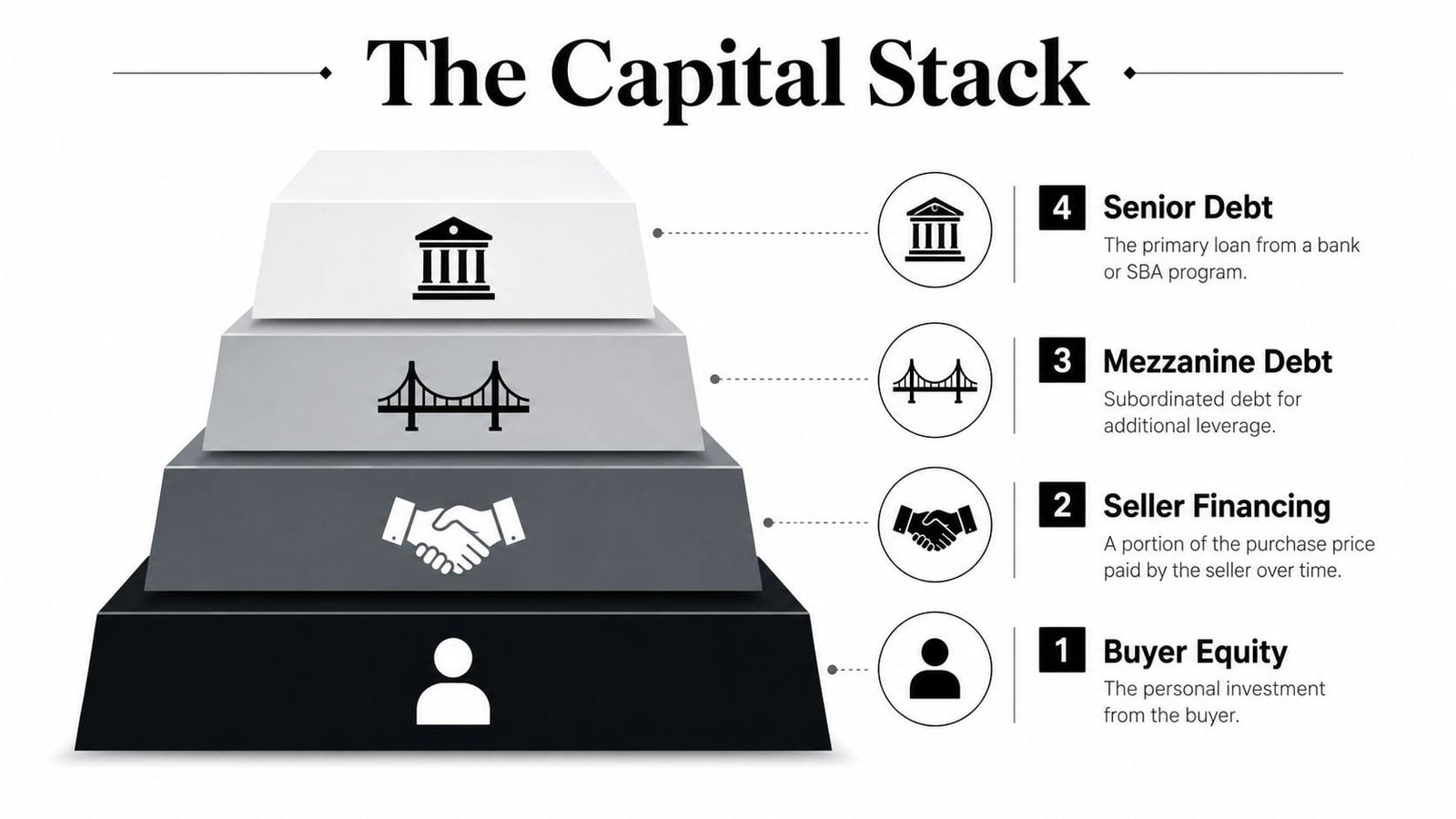
A seller note can strengthen a transaction when it reduces the senior payment and keeps the seller committed to a clean transition. An earn-out can align incentives when the seller's relationships or future performance materially affect value. Neither instrument fixes weak structure automatically. Vague earn-out metrics invite disputes, while an aggressive seller-note maturity can defer the same cash-flow pressure rather than solve it.
Verified market data supports this broader view. In 2025, nearly 60% of SMB transactions used some form of non-traditional financing, including seller financing, earn-outs, vendor rollovers, and deferred consideration, according to Biz Val Global's valuation and exit-readiness analysis. Buyers should ask which obligations the business can carry during weaker operating periods, not only how much senior debt a lender will approve.
Structure beats bravado: A stack that preserves cash for hiring, maintenance, and customer retention can outperform a fully debt-funded purchase that looks efficient at closing.
Shifting part of the price into seller paper may lower the senior payment and help a business pass coverage tests. The trade-offs are more negotiation, greater seller risk, and another payment that must be modeled under downside assumptions. The right stack preserves options through the second year, rather than minimizing the buyer's apparent equity contribution.
Your Pre-Application Checklist and Where Business Loan Warrior Fits
Before requesting terms, assemble the file a lender will underwrite. Separate what you can prepare from what requires the seller's cooperation.
You can prepare
- Buyer profile: Personal financial statement, personal tax returns, credit history, resume, and a clear explanation of your operating experience.
- Equity evidence: Bank records showing the source of your contribution and a sources-and-uses schedule that reconciles every dollar.
- Operating plan: A short plan covering management responsibilities, staffing, customer retention, working capital, and the seller's transition.
The seller must provide
- Historical financials: Business tax returns, interim profit and loss statements, balance sheets, debt schedules, and bank records.
- Transaction evidence: A draft purchase agreement, asset list, lease information, contracts, and details of liens or pending obligations.
- Business context: Customer concentration, employee roles, supplier terms, owner add-backs, and any personal relationships that support revenue.
A lender may also request a third-party valuation and additional diligence reports. Don't wait until formal underwriting to discover that the seller's financial statements don't reconcile or that the proposed equity source won't satisfy lender rules.
A fintech-enabled platform can be a practical starting point when speed and organization matter. Business Loan Warrior offers a single application process, document collection, lender matching across SBA and conventional channels, and a dashboard for tracking approvals and repayment information. That can help a buyer establish an initial financing view before committing to a structure.
The limits are just as important. Complex acquisitions involving substantial real estate, seller notes, earn-outs, mezzanine capital, or unusual ownership arrangements still benefit from a lender and advisor who can negotiate bespoke terms. Use technology to organize the process and surface options, but use human judgment to decide whether the business can carry the stack.
Business Loan Warrior offers acquisition-loan matching, SBA processing, conventional funding options, and an easy application for buyers preparing to finance an operating company. Visit Business Loan Warrior to start with your documents, compare potential financing paths, and determine which capital-stack structure deserves a lender conversation.