
You’ve found a business that looks good on paper, but the question is whether it will close, cash flow, and survive the first year in your hands. That’s where most buyers get stuck. They spend weeks refreshing listings, asking for teaser decks, and running numbers that never survive diligence, financing, or seller scrutiny.
A smart approach to how to purchase a small business starts long before an offer. It starts with a screen, a financing plan, and a sourcing strategy that reaches beyond public listings. The buyers who move forward cleanly usually act like acquisition operators, not browsers.
Table of Contents
- Why Buying Beats Building and What to Expect
- Finding Businesses for Sale Beyond Public Listings
- Valuing a Target Business Using Real Multiples
- Financing Your Acquisition in a Tight Credit Market
- Due Diligence Checklist for Financial Legal and Operational Risk
- Negotiating Deal Structure and Protecting Your Downside
- Closing the Deal and Your First 90 Days of Ownership
Why Buying Beats Building and What to Expect
A buyer once walked in with a spreadsheet full of restaurant listings, and every row looked like a shortcut to ownership. The problem was not a shortage of targets. He was treating the search like shopping, while acquisition works like a pipeline with gates, proof, and deadlines.
Buying an existing business can improve survival odds because you are stepping into existing cash flow, not starting from zero. Acquisition-focused commentary has found that businesses bought with existing cash flow fail at below 20%, while Forbes analysis citing broker and industry data says only 1 in 15 potential small-business buyers finalize a deal, and only about one-third of listings end in a sale. That combination says two things at once. The market screens out casual buyers, and closing a deal takes real work, not browsing and hope. Those figures come from the acquisition market overview in the buy-then-build guide.
Practical rule: if you are not ready to move on financing, diligence, and negotiation at the same time, you are not ready to buy.
A disciplined workflow beats a treasure hunt
The first mistake is to start with the business instead of the buyer. Define your priorities first, then source against them. That filter saves time and helps you avoid targets that may look attractive but will fail lender review or break under operational scrutiny.
The work then follows a clear sequence. You source deals, request financials, verify them, run confirmatory diligence, negotiate terms, sign the purchase agreement, and close. Independent acquisition guidance places the usual timeline at 3 to 12 months from search to close, depending on diligence and financing speed, so patience matters as much as urgency.
That same sequence appears in the real-world acquisition playbook. The useful part is not the theory, it is the friction. Deals stall when the buyer has not lined up financing, when the seller’s numbers do not reconcile, or when the business is too concentrated in one customer, one owner, or one local market to survive transition. A buyer who respects those constraints can move faster when a credible target appears. A buyer who ignores them burns months on deals that should have been rejected in the first pass.
The takeaway is simple. Buying works when the buyer respects the sequence and the pressure points. If you chase listings before you know your criteria, you will spend time on deals that should have been rejected in the first five minutes.
Finding Businesses for Sale Beyond Public Listings
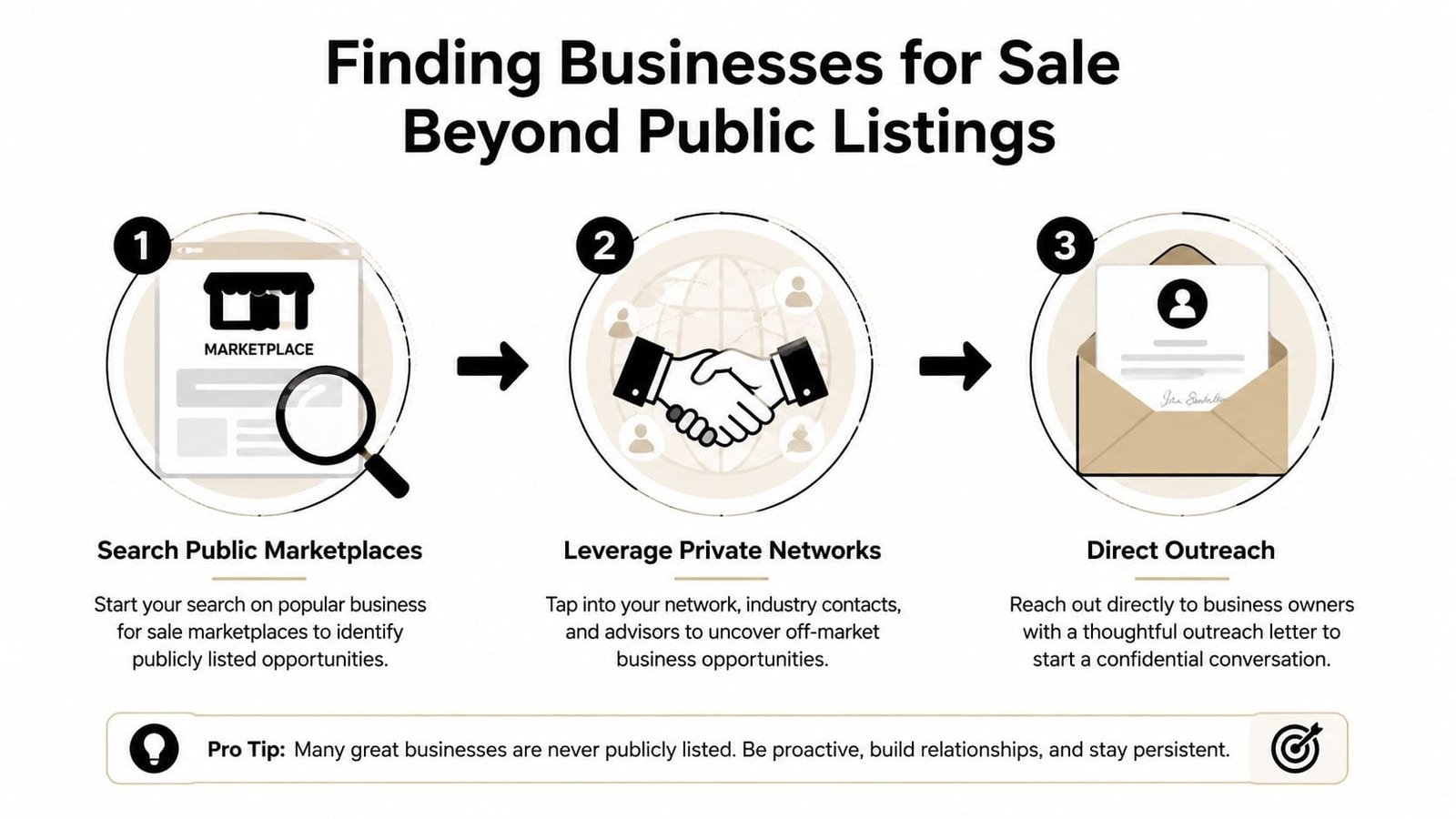
Most strong targets never hit a marketplace in clean, ready-made form. They’re owned by people who aren’t actively selling, or they’re spoken for before a broker ever posts them. That’s why the best sourcing strategy combines public listings with direct outreach and relationship channels.
Start with criteria, not excitement
Write down what you will and won’t buy before you contact anyone. Industry, geography, customer type, cash flow profile, and your own involvement level should be clear enough that a broker, owner, or banker can understand your fit quickly.
That clarity matters off-market too. An owner who gets a vague “Would you ever consider selling?” email can ignore it. An owner who sees a focused buyer, a realistic range, and evidence that the buyer can close is more likely to engage. The BizQuest guide on buying a business that isn’t listed emphasizes this same practical gap in how to approach a not-for-sale owner.
Use the channels that owners already trust
Brokers still matter, especially for owner-led businesses that want process and confidentiality. Marketplaces help with volume. Industry networking helps with credibility. Direct outreach helps with everything the public market misses.
A useful cold letter does three things. It explains why the business fits your background. It states a realistic price range instead of asking the seller to invent one. It also signals financing readiness without sounding desperate. Mention that you can move quickly if the fit is real, because many owners care as much about certainty as they do about headline price.
Owners respond faster when you remove friction. If your first note sounds like a research project, they’ll treat you like one.
Make the first offer easier to accept
Off-market sellers often care about hassle. Escrow costs, filing fees, and messy closing mechanics can kill momentum even when price is acceptable. An attractive initial structure removes those irritants and makes it easier for the owner to picture a clean exit.
That doesn’t mean lowballing. It means being specific, calm, and prepared. If the owner is “not for sale,” your job is to make the conversation feel professional rather than opportunistic. Buyers who do that well create a pipeline of private conversations instead of waiting for the same public listings everyone else sees.
Valuing a Target Business Using Real Multiples
Small business valuation usually comes down to normalized earnings or revenue, not asset value. That distinction matters because two businesses with similar sales can trade very differently once you account for margin, industry, and buyer demand. Sector-specific comparisons are essential before you make an offer.
Use the market benchmark, then narrow by sector
Across all businesses sold on BizBuySell nationally in 2025, the average asking price was 2.57× cash flow/earnings and 0.67× sales/revenue BizBuySell guide. By sector, food & restaurants averaged 2.24× cash flow and 0.42× sales, while online & technology averaged 3.33× cash flow and 1.09× sales in the same guide. That spread is the point, because a restaurant and a software-adjacent business don’t deserve the same framework.
| Small Business Valuation Multiples by Sector | Cash Flow Multiple | Revenue Multiple |
|---|---|---|
| All businesses sold nationally in 2025 | 2.57× | 0.67× |
| Food and restaurants | 2.24× | 0.42× |
| Online and technology | 3.33× | 1.09× |
If you're building a quick screen, a practical acquisition filter used by experienced buyers is to focus first on businesses with cash flow margins of roughly 15% to 35% of revenue, then value the target at about 2x to 4x cash flow. That screen is useful before formal diligence because it keeps you from wasting time on businesses that are either too thin or too expensive to support debt. That same first-pass approach appears in the acquisition training video on buyer screening and LOI sequencing.
The simplest way to use it is this, compare the asking multiple to the sector you're in, then ask whether the business has the qualities that justify the price. Recurring revenue, recession resistance, and barriers to entry support higher confidence. A business without them needs a better price or a more protective structure.
For buyers who want a professional valuation review, business valuation services can help anchor the conversation before you get emotionally attached to a target.
Practical rule: if you can't explain why this multiple belongs to this sector, don't move into diligence yet.
Financing Your Acquisition in a Tight Credit Market
Financing is where many strong-looking deals stall. Buyers assume that once they find the right business, the capital will come together automatically. In reality, lender appetite, seller expectations, and deal structure all have to line up at the same time.
Compare the capital stack, not just the loan label
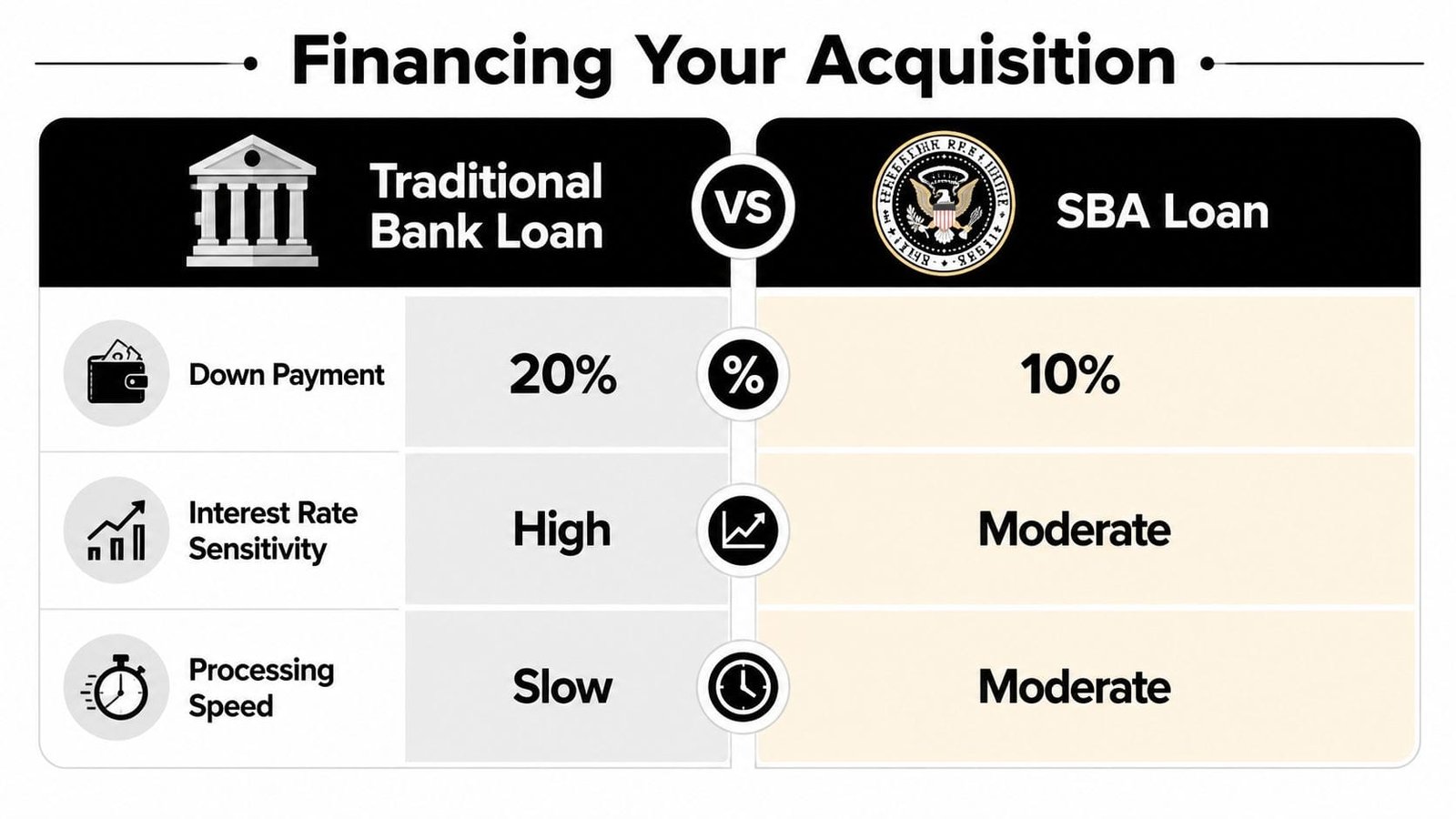
The Fed's 2025 Senior Loan Officer Opinion Survey reported continued tightening on commercial and industrial lending standards in parts of the market, while the SBA's 7(a) program kept a 75% guarantee on loans above the standard cap and 85% on smaller loans, which can materially affect whether a buyer can close U.S. Chamber summary. In plain terms, the guarantee can make a deal financeable when a plain bank loan would be too hard to underwrite.
Traditional bank acquisition loans can still work when the borrower profile is strong and the target cash flow is durable. SBA-backed structures often fit buyers who need longer repayment support and a lender willing to underwrite around the program's protections. Seller financing becomes especially useful when the buyer needs to bridge a gap in lender appetite or show the seller that the buyer is aligned with the business's future performance.
Pick the structure that matches the business
A single-source loan is clean, but it's not always realistic. A hybrid stack, often part bank debt, part SBA support, part seller note, can reduce pressure on any one source. That matters when debt service sensitivity is high and the buyer can't afford to over-lever the company on day one.
If you want to estimate how far a monthly payment might stretch a business purchase, use calculator for financing as a quick sense-check before you model the deal in detail. It won't replace lender underwriting, but it can help you test whether the numbers even live in the same neighborhood.
One practical resource in this area is Business Loan Warrior's acquisition loan page, which fits buyers who need to compare funding paths for a purchase. The point isn't to chase the biggest loan. The point is to assemble enough financial strength to close without starving the business after closing.
Show financing readiness early
Sellers compare buyers on certainty, not just price. If you can show clean financials, a credible source of funds, and a lender or advisor already in motion, you look more reliable than a buyer who is still asking what the market will allow. That credibility can matter as much as the offer itself.
Due Diligence Checklist for Financial Legal and Operational Risk
The most expensive diligence mistake is letting the legal papers set the tone while the numbers get a quick glance. In small-business acquisitions, the first problem is often financial misstatement, then concentration risk, then operational issues that were hidden by a polished broker package. Confirmatory diligence has to surface those faults before the purchase agreement stops being negotiable.
Verify the financial story before you trust the asking price
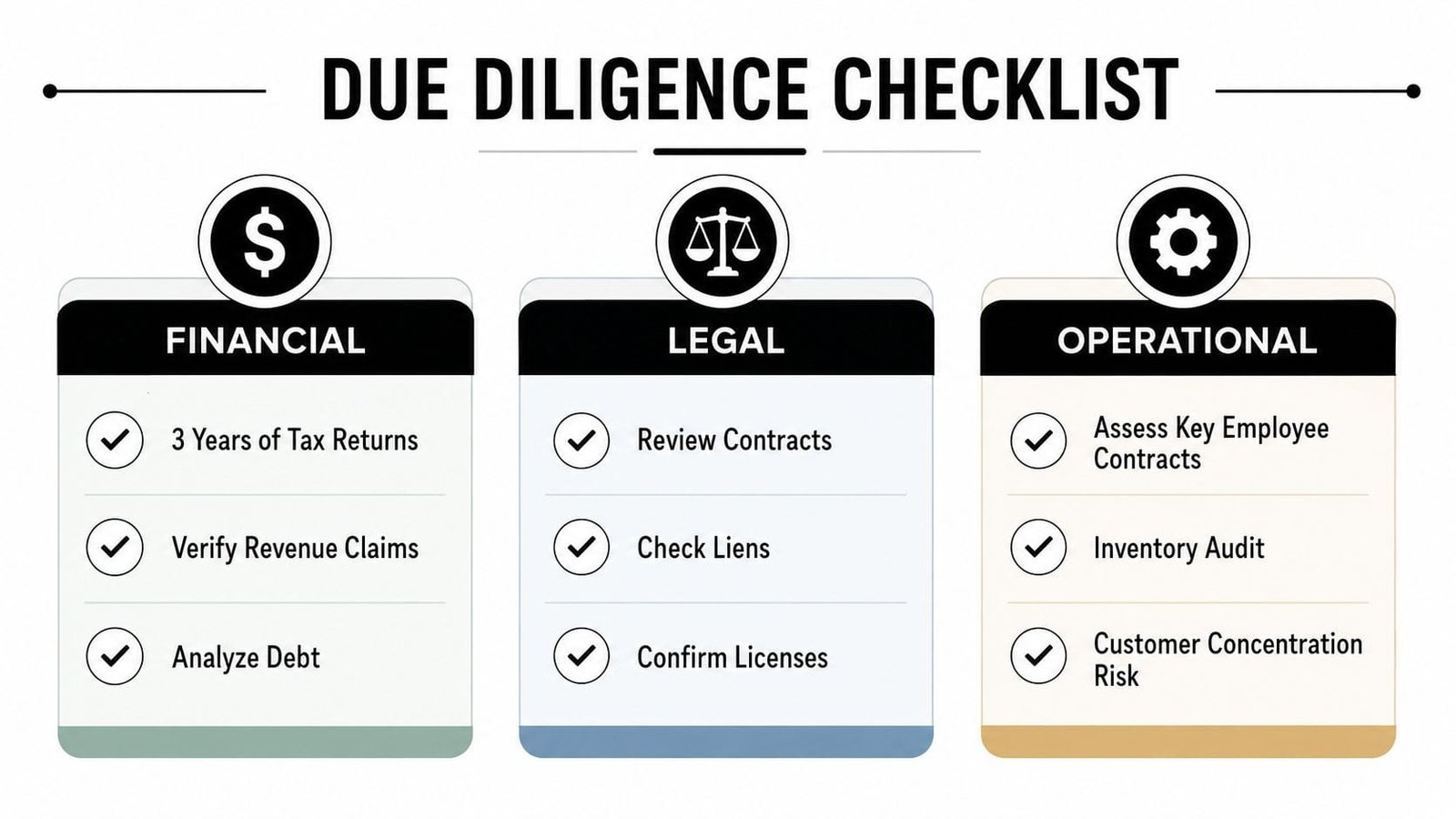
Ask for 3 to 5 years of financials, then compare them with tax returns, bank statements, and balance-sheet data. If the owner cannot reconcile those records cleanly, stop treating the asking price as a settled number until the gap is explained. The how to buy a small business playbook is useful here because it puts document review ahead of enthusiasm.
The first pass should focus on revenue quality, debt, seasonality, and unusual add-backs. Then look for signs that the business depends on one account, one channel, or one person. A deal can look fine in the teaser and still fail lender review if the numbers do not hold up under scrutiny.
Check the legal and operational issues that actually bite buyers
Legal diligence is broader than formation documents. Review leases, liens, licenses, contracts, and compliance records carefully, because those items can limit control after closing. If a lease transfer is messy or a key license cannot be renewed smoothly, the business may not justify the price you thought you were paying.
Operational diligence should focus on how the company really runs. Look at payroll, key employee agreements, inventory controls, vendor concentration, and customer retention. One customer taking more than a meaningful share of revenue creates concentration risk, so that issue deserves immediate attention rather than a passing note in the deal memo.
Practical rule: if the seller's story depends on one customer, one employee, or one undocumented process, you are buying fragility, not stability.
For a structured checklist and a founder-friendly format, the HireAccountants guide for founders is a useful way to organize the work before final signatures.
Know when the red flags justify walking
Some issues can be priced in. Others cannot. If the seller will not provide supporting records, if customer concentration is too high, or if liabilities appear off the books, renegotiation is the minimum response. Walking away is often the right response when the story and the evidence diverge too far.
The buyer who protects downside here does not need every answer on day one. They need enough proof to know whether the target is real, durable, and financeable. If seller financing is part of the structure, the definition of owner financing should be read as part of the risk review, because repayment terms can either soften a gap or mask a weak deal.
Negotiating Deal Structure and Protecting Your Downside
Once diligence is acceptable, the conversation shifts from “what is it worth” to “how is risk allocated.” That's the stage where experienced buyers separate themselves from enthusiastic ones. A good structure can make a fair price work, while a weak one can turn a decent business into an expensive headache.
Put the risk where it belongs
A purchase agreement should reflect what the LOI already established. Having counsel draft the agreement from the LOI terms reduces ambiguity and stops the deal from drifting during legal review. That matters because ambiguity is usually where sellers and buyers start re-litigating economics.
If the seller wants a clean exit, ask what problem they most want removed. Many want certainty of close, limited post-close hassle, and a fair transition period. The seller-financing overview at definition of owner financing fits naturally here, because seller notes often help bridge valuation gaps while keeping the seller invested in the business's success.
Use structure to keep the seller engaged
Escrow holdbacks protect against late-discovered issues. Earn-outs can bridge gaps when the buyer and seller disagree on future performance. Seller notes can align incentives and improve closeability when third-party credit is tight. None of these fixes a bad business, but they can make a good business financeable and safer.
The transition period matters too. Spell out training, handoff access, introductions, and what “support” means after closing. If the owner is the face of the business, the buyer needs a real transfer period, not a vague promise to “help if needed.”
Keep your exit rights alive until the last signature
Contingencies should survive long enough to protect you if final diligence uncovers something material. That can mean a change in customer concentration, a lease problem, or a financing issue that only becomes clear late in the process. The goal is not to punish the seller. The goal is to avoid being trapped by momentum.
A clean structure lets both sides keep moving. A messy one creates a deal that only looks finished until the first post-close surprise shows up.
Closing the Deal and Your First 90 Days of Ownership
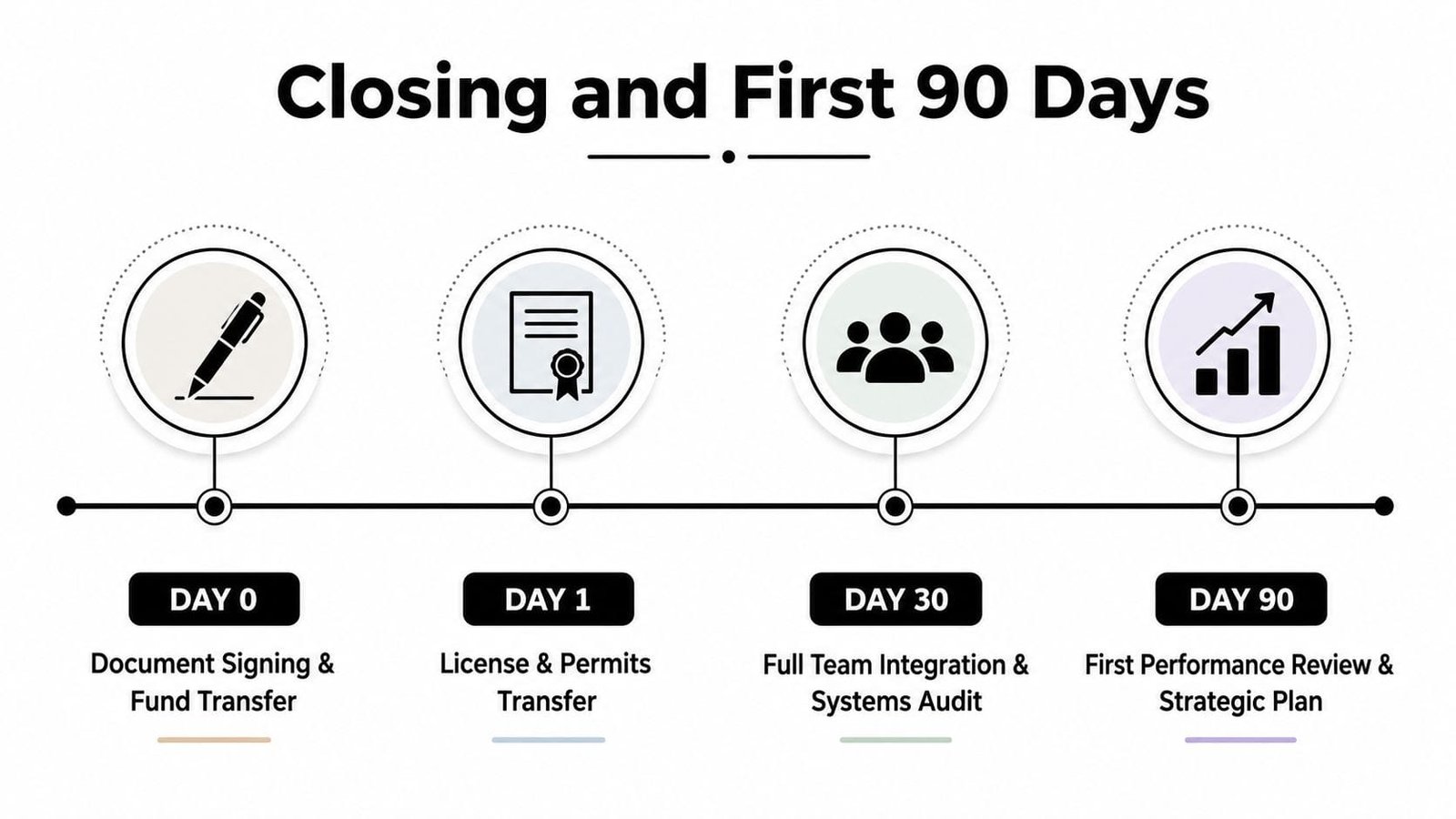
Closing day feels decisive, but ownership starts with a checklist, not a celebration. Documents get executed, funds transfer, licenses and permits move, and people start asking who signs what now. The buyers who handle this well treat closing as the beginning of control, not the end of effort.
Close cleanly, then stabilize fast
Coordinate closely with your lender, attorney, and seller on signing day so the documents match the funding flow. After that, move immediately on licenses, permits, bank authority, payroll access, and vendor records. Those details sound administrative, but they're what keep the business functioning while everyone else assumes the handoff is done.
The first week should also focus on communication. Employees need to know what changes and what doesn't. Customers and vendors need a confident message, not a dramatic announcement. If you've bought a business with a strong team, your job is to keep that team calm enough to stay engaged.
Use the first 90 days to learn before you optimize
A buyer who rushes into rewrites often creates avoidable damage. The better move is to observe the operating rhythm, verify the numbers, and identify the few changes that protect revenue or reduce obvious waste. A systems audit early on helps reveal where the business depends on memory instead of process.
If you're managing people, tools matter quickly. A simple platform like employee management software for small business can help track schedules, communication, and accountability without turning the transition into a spreadsheet project.
Measure what matters after the handoff
By day 30, you should know who your key people are and which processes need documentation. By day 90, you should have a first real read on performance, not just a feel-good impression. That's when strategic planning starts to replace firefighting.
The best first 90 days are boring in the right ways. Payroll runs. Customers stay. Employees know who to ask. The owner moves from uncertainty to control without pretending the business runs itself.
If you're working through a purchase, Business Loan Warrior can help you compare acquisition funding options, SBA processing, and other capital paths in one place. Visit Business Loan Warrior to review funding choices that fit a small-business acquisition and move forward with a cleaner financing plan.