
You've got a signed project, a crew ready to mobilize, and an excavator sitting on a dealer's lot. The machine costs $350,000, and the proposed down payment would consume cash you planned to use for payroll, materials, fuel, and bonding. Paying cash feels simple, but it can leave the company short of the working capital that turns backlog into completed revenue.
Financing construction equipment is less about finding the lowest monthly payment and more about choosing the structure that fits your project pipeline, utilization, balance sheet, and exit plan. The right loan can help you build equity without choking cash flow. The right lease can preserve flexibility when a machine's useful role is temporary. A sale-leaseback can release capital from equipment you already own.
Table of Contents
- Why Construction Equipment Financing Matters for Contractors
- The Main Ways to Finance Construction Equipment
- Choosing Between Loans, Leases, and Lines of Credit
- Who Qualifies and Why Approval Odds Vary by Lender
- Typical Rates, Terms, and Real Cost Examples
- The Application Process and Documentation You Need
- Practical Tips to Secure Better Financing Terms
- Making the Right Financing Decision for Your Business
Why Construction Equipment Financing Matters for Contractors
Construction equipment is a capital-intensive purchase, but the asset usually produces revenue over time rather than all at once. Financing lets a contractor match payments with the jobs that use the machine instead of taking the full hit on day one.
That matters because working capital has several jobs. It covers wages before customer invoices arrive, pays suppliers, supports fuel and repairs, and helps the company qualify for its next project. A large cash purchase can reduce the cash reserve that protects every one of those functions.
Construction machinery is also tied to the equipment-finance market. In ELFA's 2025 Survey of Equipment Finance Activity construction factsheet, construction equipment represented 17.5% of new business volume from equipment-finance member companies in 2024, compared with 16.6% in 2023. The construction industry itself represented 10.6% of new business volume, and an estimated 84% of construction machinery acquisition volume was secured through a lease, loan, or line of credit.
The cash-flow question
Suppose the contractor with the $350,000 excavator has enough money to make the purchase. That doesn't mean paying cash is prudent. The better question is whether the machine will generate enough productive revenue to justify tying up that capital, and whether the company has other uses for the cash during the same project cycle.
Financing spreads the acquisition cost across the asset's productive period. Interest and fees increase the total cost, but preserving liquidity can protect margins and prevent the contractor from turning down profitable work because cash is trapped in iron.
Practical rule: Treat cash as a production tool, not as proof that you should pay cash.
ELFA reports that 82% of businesses acquiring equipment and software used at least one form of financing. Leasing was the most common method at 26%, followed by secured loans at 16%, lines of credit at 14%, and unsecured loans at 8%, according to the same ELFA construction financing data.
By the end of the financing decision, you should know whether your business needs ownership, flexibility, liquidity, or a way to release value from an existing fleet. Those priorities matter more than the label on a lender's brochure.
The Main Ways to Finance Construction Equipment
Equipment financing comes in several structures. Each changes who owns the machine, how payments work, and what happens when the agreement ends.
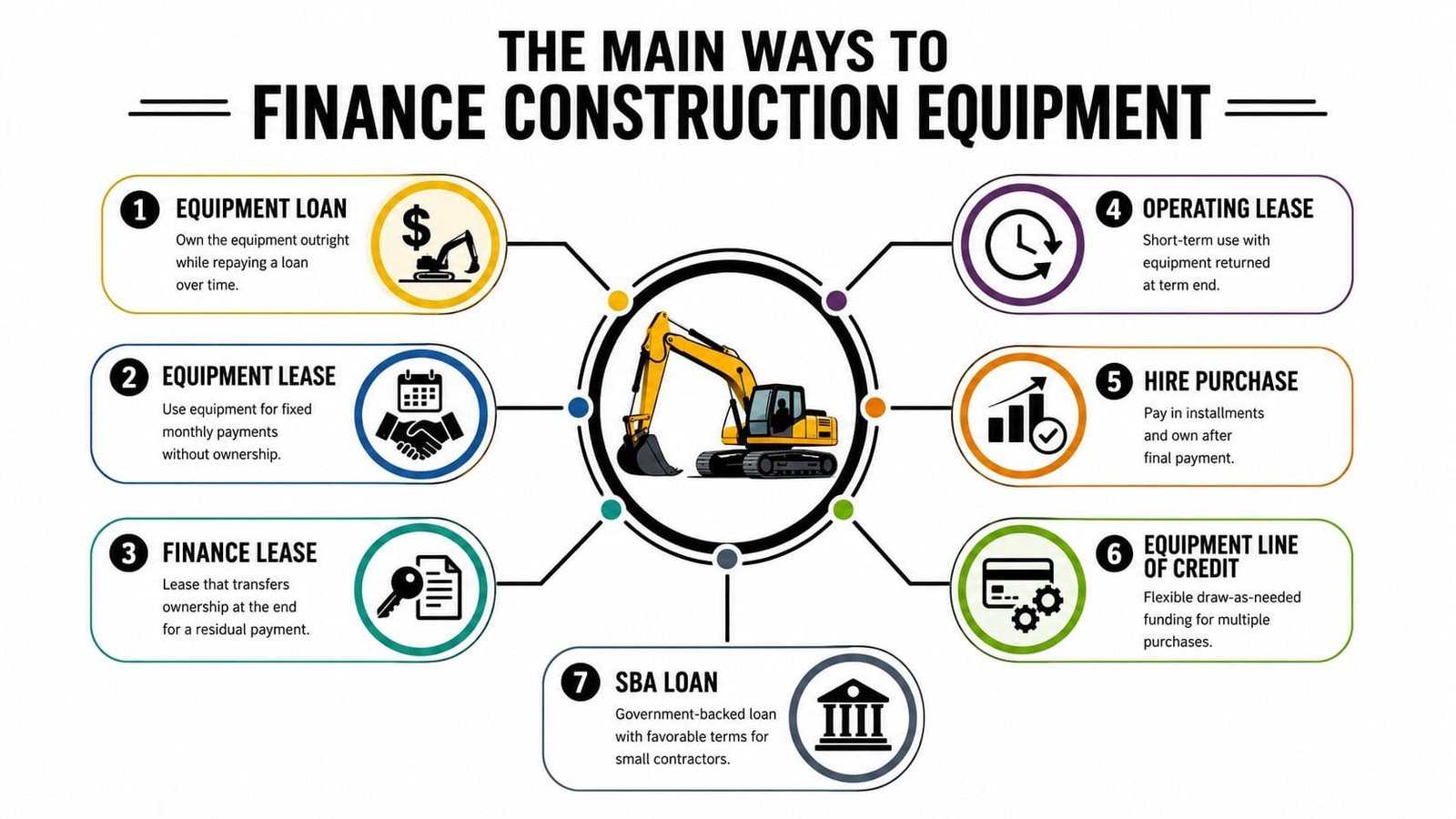
Seven structures in plain English
- Equipment loan: This is a mortgage on the iron. The lender advances funds for the purchase, takes a lien on the equipment, and you own the machine after repayment.
- Capital lease: Think of this as rent-to-own. You make scheduled payments, and the agreement usually provides a purchase option or residual payment that transfers ownership at the end.
- Operating lease: This works like a long-term rental. You use the equipment for agreed payments and typically return it, renew the lease, or replace it when the term ends.
- Equipment line of credit: This resembles a business credit card dedicated to equipment needs. You draw funds as purchases arise, rather than borrowing the full amount for one machine at closing.
- SBA 504 or 7(a) loan: These programs add government-backed support to bank financing. They can suit established small businesses that can handle heavier documentation and want a structured, longer-term facility.
- Vendor or captive financing: The manufacturer or its finance arm funds the machine. The equipment itself anchors the transaction, and the captive may coordinate directly with the dealer.
- Sale-leaseback: You sell equipment you already own to a finance company and lease it back. You keep using the machine while converting part of its value into working capital.
A plain-English guide to equipment finance can help first-time buyers distinguish a loan from a lease before requesting terms. Contractors who already understand the debt structure but need broader property or mortgage-related resources can also review ISU Insurance Services mortgage resources.
The critical distinction is ownership. An equipment loan and some finance leases build an ownership position. An operating lease prioritizes use and flexibility. A line of credit prioritizes repeated access to capital. Sale-leaseback prioritizes liquidity from assets already on the balance sheet.
The video below offers another visual explanation of equipment-financing concepts.
Don't choose a structure because the payment looks attractive in isolation. Compare the total cash outlay, residual obligations, maintenance responsibility, ownership outcome, and effect on your next borrowing request.
Choosing Between Loans, Leases, and Lines of Credit
The right structure depends on four questions. How much monthly debt service can the business absorb? Do you need to own the machine? How quickly might the equipment become obsolete or unnecessary? What treatment does your accountant recommend for your tax position and financial statements?
| Factor | Equipment Loan | Capital Lease | Operating Lease | Equipment Line of Credit |
|---|---|---|---|---|
| Monthly cost | Usually steady and tied to principal, interest, and term | Steady scheduled payment, possibly with a residual or buyout | Predictable payment for the right to use the machine | Varies with the amount drawn and repayment terms |
| Ownership | Contractor owns the equipment after repayment | Ownership may transfer through a purchase option or final residual payment | Lessor retains ownership | Contractor typically owns purchased equipment, subject to the facility terms |
| Flexibility | Moderate, with payoff and resale decisions controlled by the borrower | Moderate, but early exit can involve contractual costs | High for replacement or return at term end | High for recurring purchases, attachments, and smaller needs |
| Tax treatment | Interest and depreciation may apply, subject to professional advice | Depends on lease classification and agreement terms | Payments may be treated differently from ownership structures | Interest and asset treatment depend on the purchase and tax rules |
When each structure wins
Choose an equipment loan when the machine has a long working life, your backlog supports consistent utilization, and building equity matters. This is usually the strongest choice for an established contractor buying a core excavator, dozer, crane, or wheel loader that will remain productive across many jobs.
Choose an operating lease when the project pipeline is uncertain or the company expects to replace equipment regularly. A lease can preserve an exit route, but read the return condition, maintenance obligations, mileage or hour limits, and end-of-term options carefully.
Choose a line of credit for recurring equipment expenses, attachments, repairs, or multiple smaller purchases. It's a poor substitute for a properly structured term loan on a single large machine because the repayment pattern may not match the asset's useful life.
Choose a capital lease when you want a middle ground. You get scheduled payments and a path to ownership, but the agreement can include a residual obligation that deserves the same scrutiny as a balloon payment.
The monthly payment is only one part of the decision. A lower payment can conceal a longer obligation, a residual balance, or a return requirement that creates risk when the job ends.
Who Qualifies and Why Approval Odds Vary by Lender
Lenders evaluate the borrower and the machine together. They want to see repayment capacity, clean ownership records, credible revenue, and collateral that can be sold if the deal fails.
Approval conditions vary by channel, so don't assume one rejection represents the entire market. Equipment-finance activity reached a record $11.6 billion in new business volume in January 2026, while the approval rate fell to 76.8%, according to January 2026 U.S. equipment-finance coverage. The same report noted that bank volume declined 11.7%, independent-firm volume declined 2.5%, and captive volume rose 14.9%.
| Lender Channel | Best fit | What the lender emphasizes | Approval environment |
|---|---|---|---|
| Bank | Established contractor with organized financials | Cash flow, leverage, tax returns, collateral | Selective |
| Captive lender | Buyer of the manufacturer's equipment | Machine value, dealer invoice, borrower credit | Often more equipment-focused |
| Independent lender | Specialized asset or nonstandard file | Collateral, project economics, flexibility | Case-by-case |
| Fintech or broker channel | Borrower seeking speed or a packaged application | Bank data, revenue consistency, automated underwriting | Fast, but pricing and structure vary |
A contractor with strong financial statements and a standard machine may start with a bank or captive. A newer company, unusual asset, or complicated ownership structure may need an independent lender that understands the collateral. A fintech channel can simplify intake, but speed doesn't eliminate underwriting.
For a broader framework, review this guide to commercial equipment lenders and financing terms. Prepare the same core file regardless of channel: business financials, bank activity, tax history, equipment details, project backlog, and owner obligations.
Lenders remain cautious even in a healthier market. The referenced January report placed delinquency at 2.1% and industry losses at 0.46%, so a strong application still needs to show how the equipment will earn its payment.
Typical Rates, Terms, and Real Cost Examples
Pricing depends on credit quality, collateral, lender channel, term, down payment, and whether the lender is underwriting the invoice value or the machine's recoverable value. Don't compare offers by rate alone. Compare the amount financed, fees, residual obligation, prepayment terms, maintenance responsibility, and total cash required.
Heavy construction equipment is commonly structured to amortize over 5 to 7 years, according to this equipment-financing guide. A practical term-matching approach sizes debt to roughly 60% to 70% of useful life. The same guide gives the example that a machine with a 10-year useful life may be financed over 60 to 72 months, while a 15-year asset may support 84 to 96 months.
Advance rates also vary. Construction equipment loans and finance leases commonly cover about 80% to 90% of equipment value, leaving 10% to 20% as a typical down-payment range, while asset-based lenders may base advances on approximately 80% of net orderly liquidation value rather than invoice cost, as explained in this machinery advance-rate guide.
A useful comparison without false precision
A lender's quote should supply the actual payment and total repayment amount. Public examples that state a specific payment, rate, or total cost without showing the lender's assumptions can mislead, especially when fees, taxes, down payment, residual value, and insurance are omitted.
| Structure | What to compare | Main cost risk | Best question to ask |
|---|---|---|---|
| Equipment loan | Interest, fees, term, total repayment | Paying for a machine after its productive period | Can the machine cover debt service throughout the term? |
| Capital lease | Payment, buyout, residual, fees | Underestimating the end-of-term obligation | What exactly must I pay to own it? |
| Operating lease | Payment, return terms, hours, maintenance | Charges at return or expensive renewal | What happens when the project ends? |
| Line of credit | Draw rate, unused fees, repayment schedule | Using short-term capital for a long-life asset | Can the repayment pattern follow equipment revenue? |
The cheapest structure on paper can be the wrong structure operationally. A longer term lowers the monthly burden but may extend payments beyond the period when the asset generates reliable revenue. A shorter term can reduce total interest and preserve flexibility, but it raises debt service.
For rate-shopping context, contractors can review this equipment-loan rates resource. Use any quoted example as a starting point, then request an amortization schedule that includes every fee and end-of-term payment.
The Application Process and Documentation You Need
A clean application moves faster because the lender can verify the borrower, the machine, and the repayment story without chasing missing information.
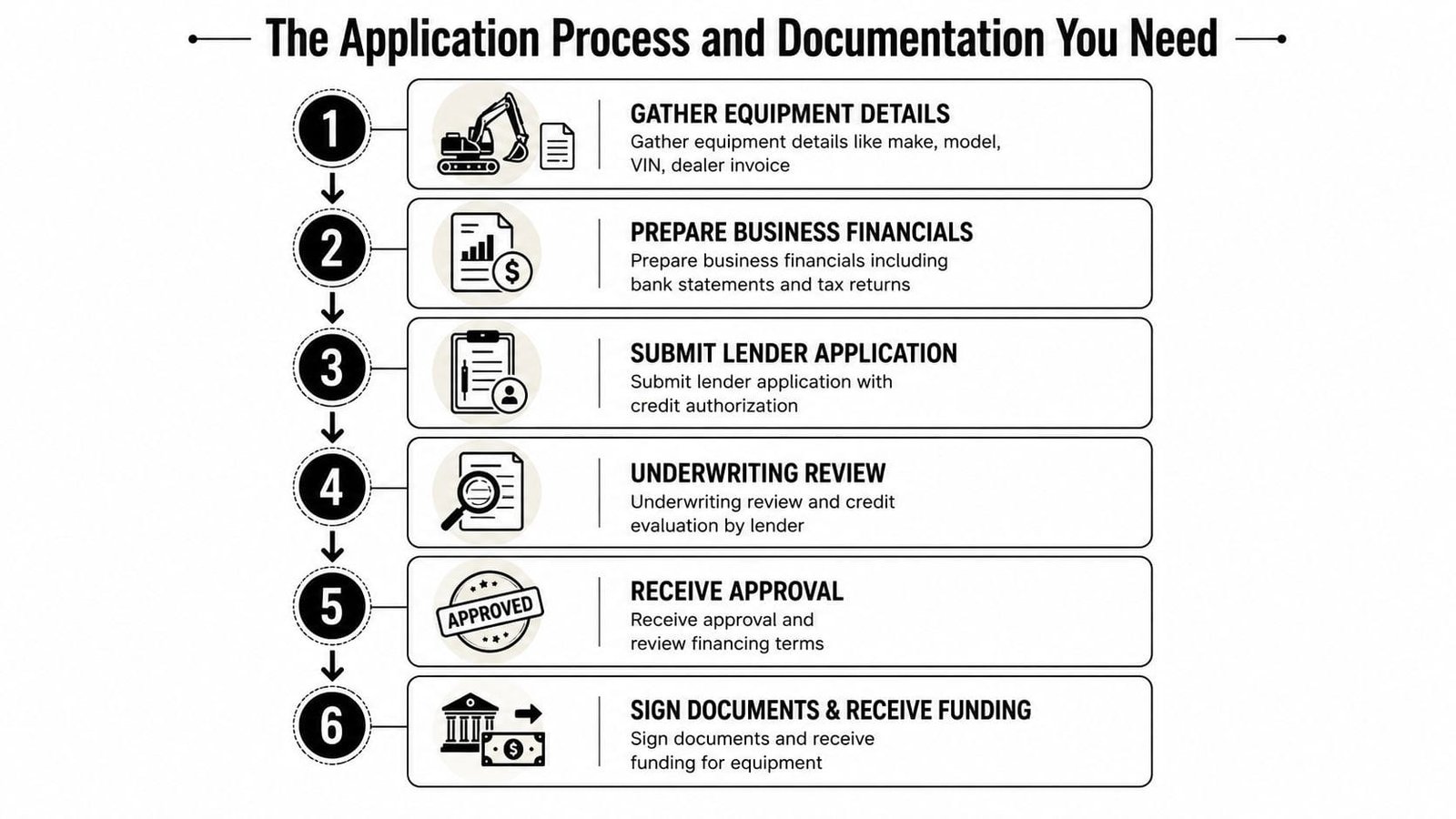
Six steps from quote to funding
- Gather equipment details. Collect the make, model, serial number or VIN, dealer invoice, attachments, warranties, and delivery information. A lender can't assess collateral properly from a vague description.
- Prepare business financials. Have business tax returns, a current profit-and-loss statement, balance sheet, and recent bank statements ready. Keep personal financial information available if the lender requires a guaranty.
- Submit the application. Expect authorization for personal and business credit reviews. Be consistent about legal business names, ownership, revenue, and existing obligations.
- Review underwriting questions. The lender may ask about project backlog, customer concentration, receivables, equipment use, and maintenance. Answer directly and provide supporting documents rather than sending general explanations.
- Examine the term sheet. Confirm the amount financed, down payment, rate, payment schedule, collateral description, guaranty, insurance requirements, covenants, prepayment language, and residual.
- Sign and coordinate funding. After documents are executed, the lender typically works with the dealer or seller to complete payment and transfer. Confirm delivery, lien notation, and insurance before the machine goes to work.
What slows deals down
Mismatched business names across tax returns, invoices, bank statements, and purchase contracts create avoidable friction. Aged receivables, unresolved tax liens, undisclosed owner obligations, and unexplained cash deposits can also trigger additional review.
SBA transactions require more coordination because the lender, the borrower, and the relevant processing partners must complete additional review. Build extra time into the project schedule rather than ordering equipment before the financing path is firm.
Practical Tips to Secure Better Financing Terms
The strongest negotiating tool is a clean explanation of how the equipment turns into repayment. A lender wants more than gross revenue. The lender wants to understand productive hours, project timing, customer payment patterns, and the collateral's condition at the end of the term.
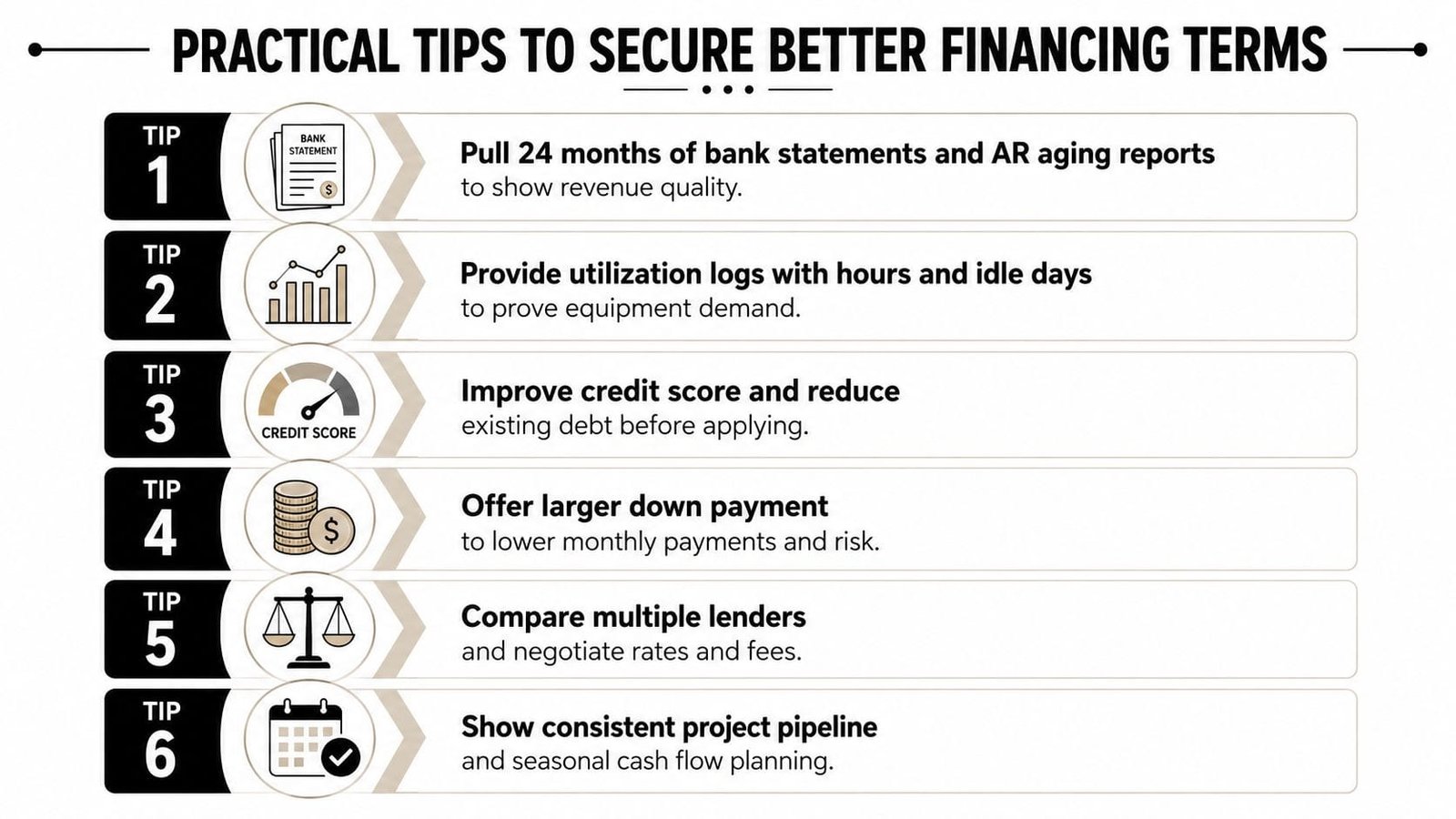
My ranking of the moves that matter
First, fix the documentation. Pull detailed bank records, an accounts-receivable aging report, current financial statements, tax returns, and a schedule of existing debt. Underwriters can price a transparent file more confidently than a file that requires repeated explanations.
Second, show utilization. Provide equipment schedules, hours, idle periods, maintenance records, and project assignments. Industry benchmarks often target 65% to 75% time utilization, and the machinery lending guide connects productive utilization with the payment-to-revenue relationship. Don't claim utilization you can't document.
Third, offer meaningful equity. A larger down payment reduces the lender's exposure and your principal balance. It also lowers the monthly obligation, but don't drain the cash reserve needed to execute the project.
Fourth, obtain comparable quotes. Request proposals for the same machine specification, term, down payment, and fee structure. Comparing unlike offers creates confusion instead of useful comparison.
Fifth, apply with a clear project story. Put the equipment, contract, expected start date, customer, and repayment source on one page. The lender should understand why this machine is needed now and what happens if the job starts late.
Finally, time the request around cash flow. Don't submit an application immediately after a seasonal cash drawdown if you can provide a better, fully explained period. Lenders care about the complete operating picture, so explain seasonal revenue rather than hoping the bank statements speak for themselves.
Underwriting advice: A documented utilization plan usually persuades more effectively than a confident description of future demand.
Making the Right Financing Decision for Your Business
Equipment financing is a balance-sheet strategy, not merely a purchase method. The decision changes how much liquidity stays available, who carries residual-value risk, and whether the company owns an asset after the project ends.
Start with three filters:
- Cash conversion: Can the machine begin producing billable work soon enough to support the payment?
- Tax position: Should your accountant prioritize ownership deductions, lease treatment, or interest expense for the company's current situation?
- Exit flexibility: Will you still want the machine when the project or contract ends?
If the equipment is tied to contracted work, has a long productive life, and will remain busy across your pipeline, an equipment loan usually wins. It builds equity and gives you control over resale, refinancing, and future deployment. If utilization is uncertain or the project is short, an operating lease can preserve optionality and limit the risk of owning an underused machine.
Existing fleets deserve a separate analysis. Sale-leaseback and refinancing can free up capital already invested in owned equipment without removing the machines from active operations. That can be more sensible than taking a new unsecured facility, particularly when the company has valuable, well-maintained assets but needs liquidity for payroll, materials, or expansion.
A practical financing decision ties the asset to a specific revenue plan. Match the repayment period to useful life, match the structure to the contract, and keep enough cash to finish the job. The lowest payment is not automatically the best deal, and ownership is not automatically the best outcome.
Business Loan Warrior helps contractors explore equipment purchases, construction financing, lines of credit, SBA-backed options, and other working-capital structures through a single application process. Visit Business Loan Warrior to compare funding paths and start with a financing request matched to your project pipeline and fleet needs.