
You're running an established restaurant group, the next location is ready, and the contractor wants a commitment before your bank has finished reviewing the file. A fast lender can put money in motion quickly, but the pricing may punish a business already managing payroll, food costs, rent, and debt. An SBA restaurant loan can offer a better long-term structure, but only if your cash flow and documentation can survive serious underwriting.
For operators generating $20 million to $50 million in annual sales, the decision isn't just whether you qualify. It's whether SBA financing fits the restaurant's current lifecycle, the purpose of the capital, and the cost of waiting. The right answer may be a flexible 7(a), a fixed-rate 504 structure, another financing product, or no new debt until the operating model improves.
Table of Contents
- Why Restaurant Owners Still Choose SBA Financing
- SBA 7(a) Versus 504 for Restaurant Deals
- The Restaurant Numbers Underwriters Actually Scrutinize
- Documents You Need and the Real Application Timeline
- When SBA Is the Wrong Financing Choice
- How to Strengthen Your SBA Restaurant Loan File
- Turning the Plan Into an Approved SBA Restaurant Loan
Why Restaurant Owners Still Choose SBA Financing
A multi-unit owner deciding whether to open a flagship location has to price more than the buildout. Equipment, opening liquidity, and the repayment schedule all affect whether the existing stores remain healthy. A faster lender may fund sooner, yet short-term payments can strain a business financing an asset meant to serve for years. SBA takes more records and more time, but its longer amortization and broader eligible uses can fit the project better.
That is why SBA remains part of the financing conversation for restaurant operators. Since FY1991, accommodation and food-services businesses have received 200,945 loans, with $102.6 billion approved and an average loan size of $511,000, according to SBA accommodation and food-services lending data. The history covers limited-service operators, full-service restaurants, and businesses at different stages of growth.
The lifecycle case for SBA capital
Restaurant capital needs change as the business matures. One year may require working capital for a seasonal squeeze. The next may call for equipment, an acquisition, a new location, or real estate for a flagship property. SBA programs can address several of those purposes, provided the loan structure matches the asset and the repayment comes from demonstrated cash flow.
Owners should also separate required purchases from attractive upgrades. A practical AQEEK Coffee equipment guide can help a coffee shop or beverage-focused concept identify equipment needed to operate versus improvements that can wait. Borrowing for every possible enhancement increases the payment before the new sales arrive.
For operators generating $20 million to $50 million in annual sales, this is a lifecycle decision, not a qualification exercise. SBA may fit a planned expansion, acquisition, or long-lived asset. It may not fit a cash shortage that becomes urgent next week, a purchase contract with no time for full underwriting, or a restaurant whose operating model cannot support additional debt.
Practical rule: Use SBA debt for an asset or growth plan that will serve the business for years. Do not use a slow process to cover an immediate liquidity problem.
The cost advantage requires patience. SBA files demand extensive documentation, lender review, collateral analysis, and clear explanations for the requested proceeds. For an established operator with reliable books and a defined use of funds, that friction can be justified. For a distressed restaurant or time-sensitive acquisition, another financing product, or no new debt until performance improves, may be the better decision.
SBA 7(a) Versus 504 for Restaurant Deals
Choose the program by the use of funds, not by the maximum advertised amount. 7(a) suits a mixed-purpose restaurant request. 504 is built for fixed assets, especially owner-occupied commercial real estate and substantial equipment.
Restaurant financing costs ran above 10% through much of 2024, then eased through 2025 and early 2026, according to the earlier rate discussion. Your lender will price the actual structure, so treat market movement as context, not a promised quote.
Match the loan to the asset
SBA 7(a) is the practical workhorse. Within program rules, it can cover working capital, equipment, tenant improvements, acquisitions, and refinancing. Choose it when the request combines several needs, or when you are buying a restaurant without its underlying real estate.
SBA 504 is narrower. The structure uses a bank first lien, a Certified Development Company second lien, and an owner contribution. Its fixed-rate feature fits a property purchase or major fixed-asset project where predictable payments matter more than broad flexibility. The SBA 7(a) versus 504 comparison explains the structural differences lenders evaluate.
| Feature | SBA 7(a) | SBA 504 |
|---|---|---|
| Maximum amount | Up to $5 million, as described in the SBA restaurant financing guide from Lendio | Project size depends on the eligible fixed asset and program structure |
| Term length | Up to 10 years for many non-real-estate uses and up to 25 years for real estate | Long-term fixed-asset financing, commonly structured around the property or equipment |
| Rate type | Generally variable, tied to the applicable pricing structure | Fixed CDC debenture component |
| Down payment | Often structured with an owner equity contribution, subject to lender and deal requirements | Commonly includes a bank first lien, CDC second lien, and owner equity contribution |
| Best-fit scenario | Buildout, equipment, working capital, acquisition, or mixed-purpose financing | Owner-occupied real estate or a major fixed-asset investment |
Financing judgment: A larger variable-rate 7(a) is not automatically better. If margins are thin and the project is primarily real estate, a smaller fixed-rate 504 structure may protect cash flow more effectively.
Write the sources and uses statement before speaking with lenders. If most proceeds fund a building or major fixed equipment, ask about 504 first. If the request includes payroll reserves, acquisition costs, leasehold improvements, and equipment, 7(a) usually offers the cleaner structure.
For operators in the $20 million to $50 million annual-sales range, the choice should match the business lifecycle. Use 7(a) for a mixed expansion or acquisition plan. Use 504 for a long-lived property or fixed-asset investment. If the restaurant needs cash immediately, neither program solves a next-week liquidity problem.
The Restaurant Numbers Underwriters Actually Scrutinize
Underwriters approve the restaurant's repayment capacity, not its concept description. They test whether cash flow covers current obligations, the proposed SBA debt, and normal swings in food costs, labor, and sales. For operators generating $20 million to $50 million in annual revenue, this analysis should happen before choosing a loan structure or submitting an application.
The central measure is DSCR, or debt service coverage ratio:
DSCR = Net Operating Income ÷ Total Debt Service
Recalculate it after adding the proposed payment. Include existing loans, required distributions, rent, taxes, insurance, and realistic payroll. A strong sales story cannot repair a repayment model that works only under optimistic assumptions.
Self-audit the P&L before submission
Review prime cost, occupancy, and operating profit together. The restaurant industry benchmark data from PeerSense places practical ranges for these measures at prime cost near 60% to 65% of revenue, occupancy around 6% to 10%, and operating profit around 8% to 15% before owner compensation. Prime cost above 70% materially weakens the file.
Prime cost combines food and labor. Remove distortions before the lender does. Disclose owner labor, unusual payroll transfers, vendor irregularities, and one-time expenses clearly. Underwriters will normalize the statements, and their adjustments may produce a less favorable cash-flow result than the internal P&L.
Occupancy includes rent or mortgage obligations and related costs. A location outside the practical range needs stronger sales productivity and a specific explanation of how the site supports debt repayment. Do not treat a high-rent location as a growth plan without evidence from the operating results.
Operating profit margin must reflect repeatable performance. One unusually strong month does not offset weak recurring results, especially after the proposed payment is included.
| Metric | Target range | Red flag threshold |
|---|---|---|
| DSCR | Lender-specific, with stronger coverage improving the file | Weak coverage after adding the proposed debt |
| Prime cost, food plus labor | Near 60% to 65% of revenue | Above 70% |
| Occupancy | Around 6% to 10% | Persistently outside the practical range without a credible explanation |
| Operating profit before owner compensation | Around 8% to 15% | Insufficient recurring profit to support debt service |
If the adjusted P&L cannot support the new payment, pause the SBA application. Fix pricing, labor scheduling, occupancy economics, or the loan size first. An SBA restaurant loan is premature when repayment depends on sales assumptions the business has not yet proven.
Documents You Need and the Real Application Timeline
A strong restaurant file arrives in the order the lender needs to analyze risk. Start with the owners, then prove the operating business, then document the project. Sending a scattered bundle of files creates questions and slows review.
Build the package in lender order
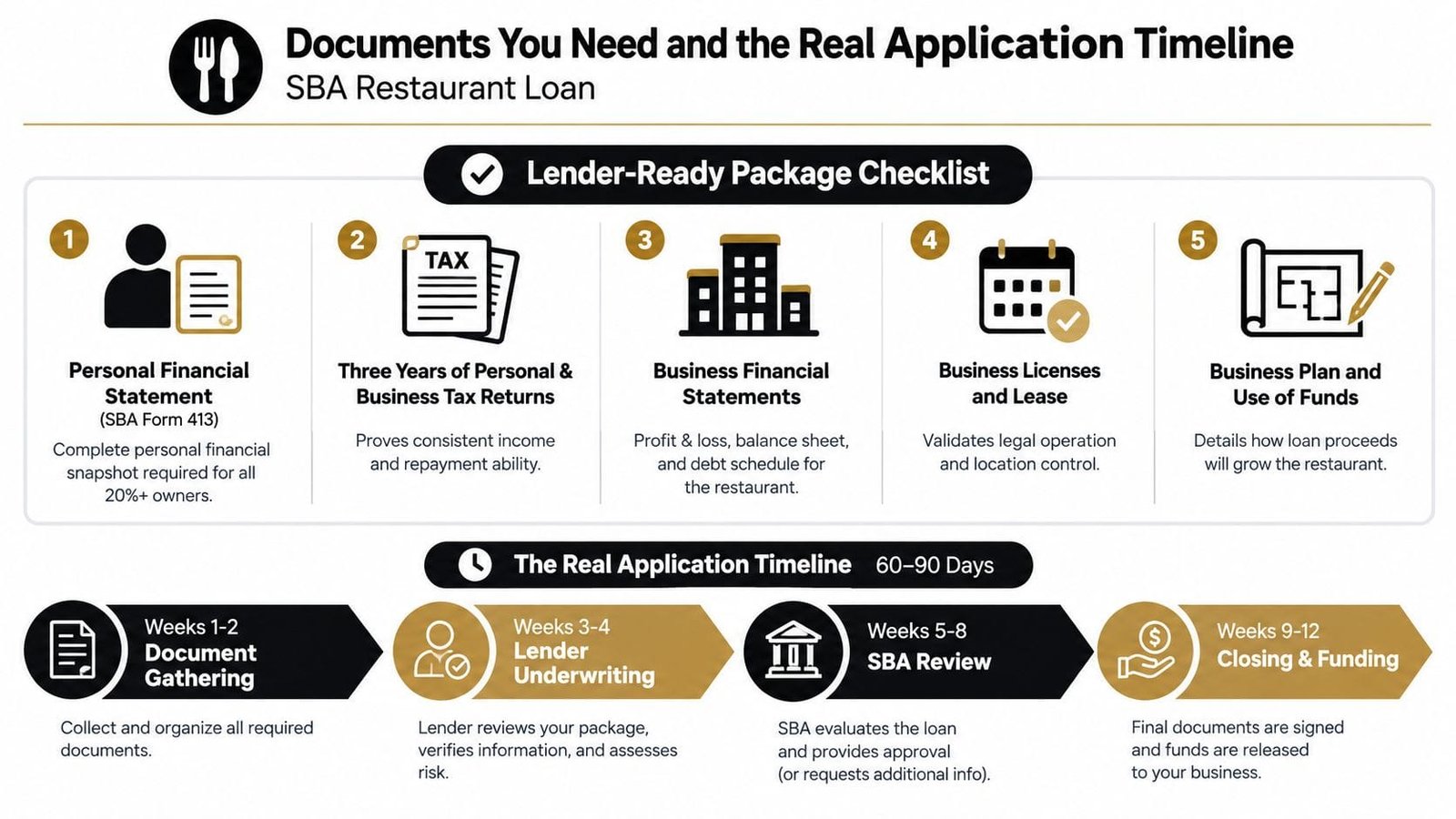
Personal financial statement: Each required guarantor should provide a complete personal financial snapshot. The lender uses it to understand liquidity, obligations, assets, and contingent liabilities.
Personal tax returns and authorization: Prepare three years of personal tax returns and the required 4506-C authorization. Missing signatures or inconsistent income reporting can stop the file before business underwriting begins.
Business financial records: Provide three years of business tax returns, current year-to-date profit and loss statements, a balance sheet, a debt schedule, trailing twelve-month revenue, and 90 days of bank statements for every operating account.
Restaurant-specific evidence: Include food and labor cost breakdowns, the franchise agreement if applicable, the lease, licenses, permits, equipment quotes, and any purchase contract.
Use-of-funds explanation: A concise concept overview and sources-and-uses statement should show exactly what the loan will purchase, what the owner will contribute, and how the investment supports repayment.
For a broader checklist, use this guide to the documents needed for business loan applications. It helps owners identify missing financial records before a lender asks for them.
Expect a 60-to-90-day process
The first two weeks should focus on document gathering, clarification, and preliminary lender screening. A serious applicant should respond quickly, but speed on the borrower's side doesn't eliminate third-party work.
During weeks three and four, underwriting usually becomes more detailed. Appraisal ordering can stall a deal around week three, especially when real estate, construction, or specialized restaurant improvements are involved. By weeks five through eight, the file may move through SBA or lender committee review, where questions about cash flow, collateral, ownership, or projections often surface.
Weeks nine through twelve are typically associated with closing conditions, insurance, final legal documents, and funding mechanics. Review the SBA loan application process video alongside your lender's checklist, but rely on the lender for the controlling timeline because every structure differs.
When SBA Is the Wrong Financing Choice
SBA financing has a strong reputation, but that reputation causes owners to use it when it doesn't fit. A long-term government-backed structure won't fix a weak P&L, and a lower expected rate doesn't compensate for missing a purchase opportunity or a critical equipment replacement.
Four situations that should change your decision
You need capital inside 30 days. A standard SBA file usually requires too much review for an emergency payroll need, urgent repair, or rapidly expiring acquisition opportunity. A revenue-based product, bridge line of credit, or equipment financing may be more appropriate, provided you understand the total repayment cost.
The concept is young and the guarantor profile is weak. A single-location restaurant with limited operating history and no strong guarantor may spend time assembling an SBA package that never clears underwriting. Private debt or a Community Development Financial Institution may offer a more practical path, although the pricing and terms require close scrutiny.
The seller demands certainty of closing. SBA approval can introduce conditions that make a seller uncomfortable. A bridge paired with conventional takeout can preserve the transaction if the economics support it. Otherwise, walk away rather than forcing a structure that leaves the buyer with excessive debt.
The loaded DSCR is below 1.10. Recalculate after every proposed obligation, including existing debt and the new payment. If the restaurant can't show adequate coverage, fix pricing, labor deployment, menu mix, or occupancy economics before borrowing.
| Scenario | SBA fit | Better alternative |
|---|---|---|
| Capital required inside 30 days | Poor fit for a standard file | Bridge line, equipment financing, or carefully priced revenue-based capital |
| Young single-location concept with weak guarantor support | Usually difficult | CDFI or private financing, with strict cost review |
| Seller requires speed certainty | Conditional fit | Bridge financing with planned takeout, or a different transaction structure |
| Weak cash flow after proposed debt | Wrong tool | Operational restructuring before new borrowing |
| Planned property purchase with stable operations | Strong fit | Compare 504 against conventional real estate financing |
The headline rate also understates the full cost. Guarantee fees, packaging fees, and the repayment structure can make the effective cost higher than the advertised rate. Price the complete transaction, not just the interest rate.
How to Strengthen Your SBA Restaurant Loan File
Lenders price the file they can verify. They don't price the story the owner intended to tell. A clean package reduces avoidable questions, gives the underwriter confidence in the numbers, and makes weaknesses easier to address before submission.
Make five moves before applying
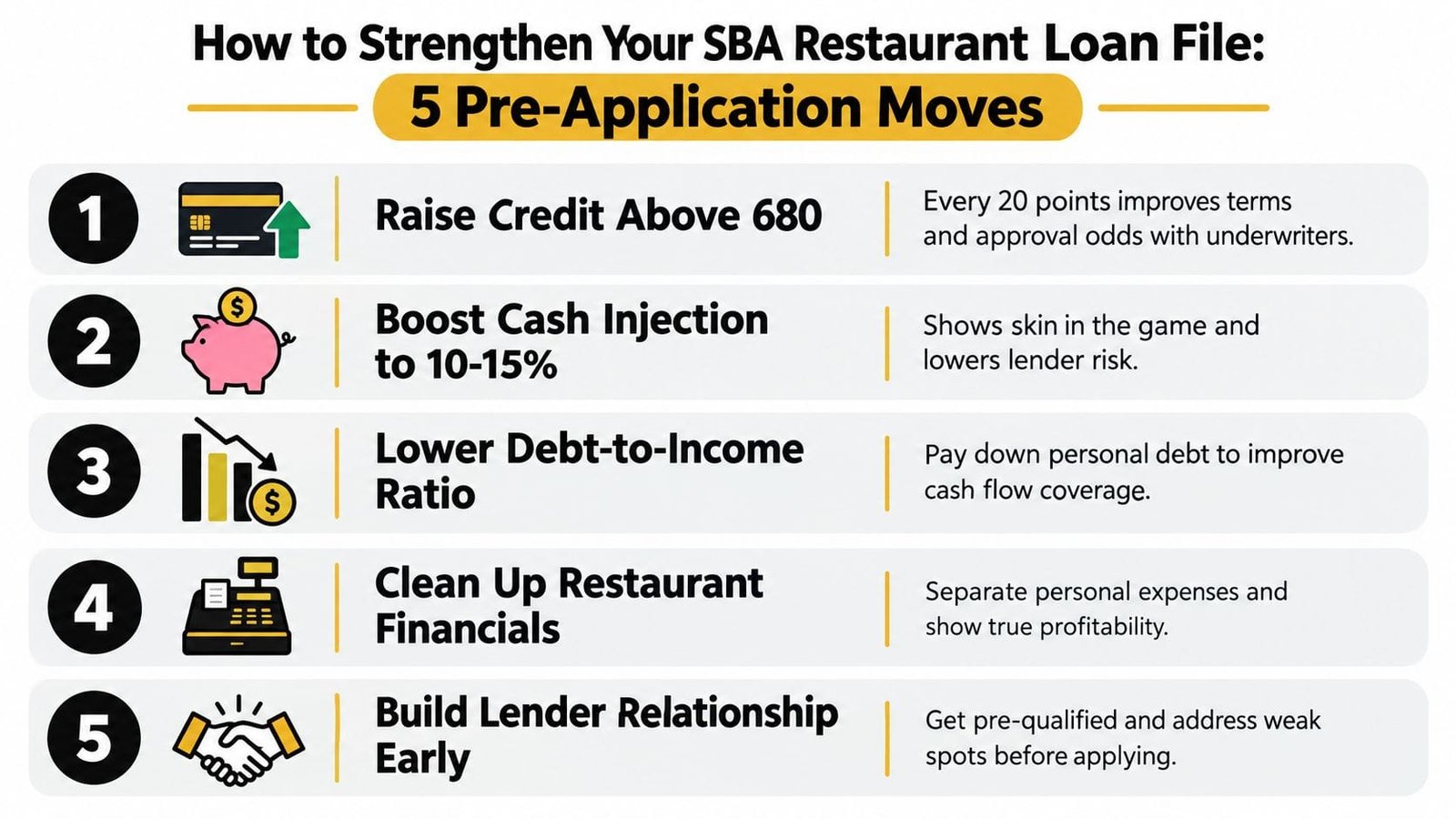
Raise personal credit above 680. Treat this as a preparation project, not a last-minute task. Review errors, reduce revolving balances where possible, and avoid new borrowing that complicates the credit picture.
Clean the last 90 days of business banking. Your statements should clearly show operating activity. Negative balances, nonsufficient-funds events, unexplained transfers, and personal spending mixed into restaurant accounts invite questions that can delay or weaken the file.
Prepare a one-page concept snapshot. Put the menu mix, average check, unit history, location strategy, and four-wall margin in front of the underwriter. The document should answer one question quickly: why will this restaurant produce enough cash flow to repay the request?
Tie proceeds to a tangible outcome. “Growth capital” is too vague. Explain whether the funds purchase equipment, complete a second-location buildout, acquire a property, refinance an obligation, or support a clearly defined expansion.
Resolve contingencies early. Obtain insurance details, finalize the lease or franchise agreement, collect contractor bids, and identify required permits. A lender shouldn't discover a missing lease term after approving the economics.
Use this guide to common SBA loan denial reasons as a pre-submission review. It's more efficient to correct a documentation gap before underwriting than to explain it after a conditional approval.
Lender perspective: A clean file doesn't turn a bad deal into a good one. It lets the lender see a good deal without making them search for it.
Don't inflate projections to make the request work. Show conservative assumptions, explain seasonality, and separate one-time expenses from recurring operating costs. If the restaurant's profitability depends on unproven sales growth, say so and reduce the request or stage the investment.
Turning the Plan Into an Approved SBA Restaurant Loan
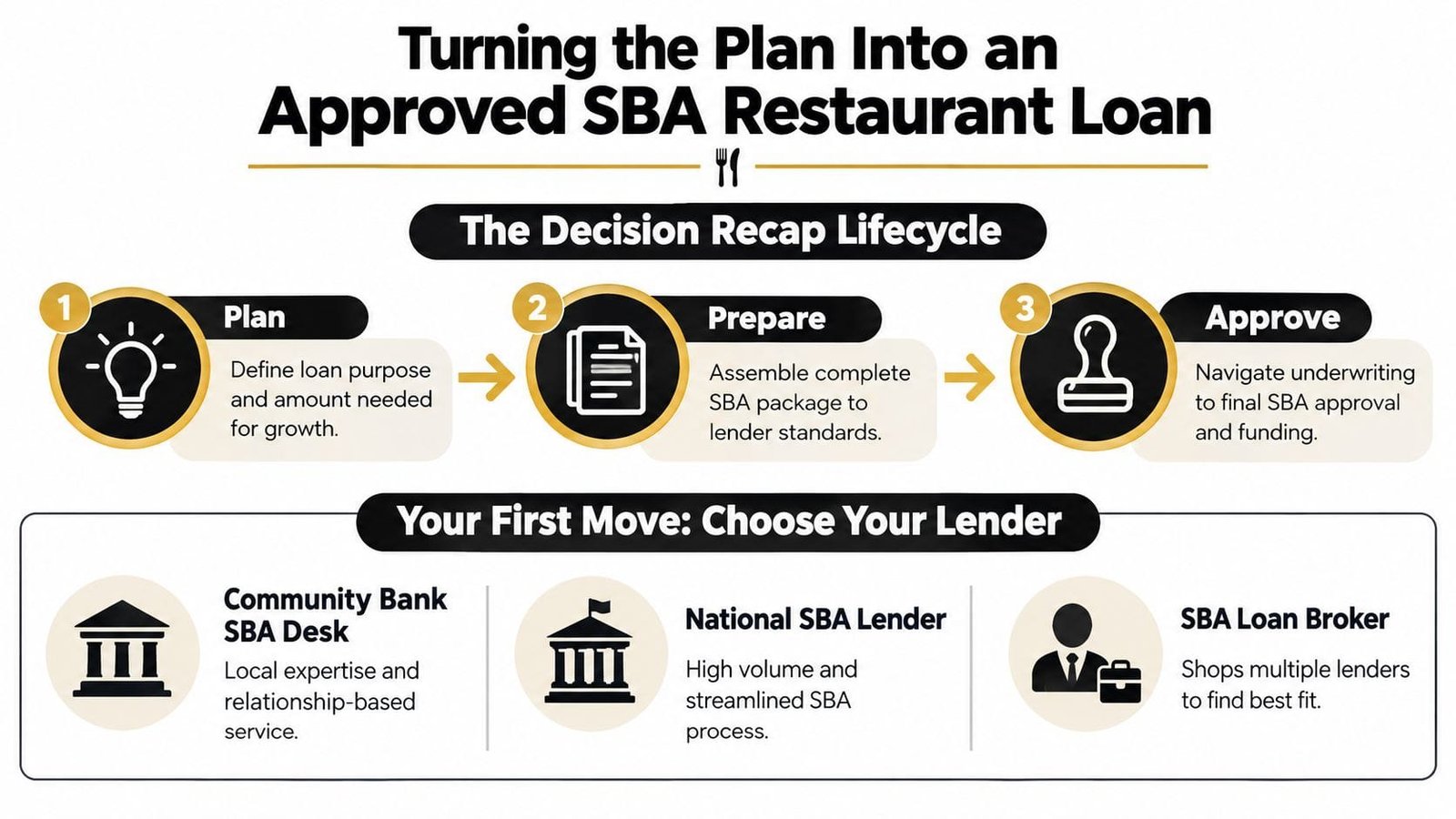
An SBA request should fit the restaurant's current stage, not just its proposed use of funds. Choose 7(a) when the project needs flexible proceeds, consider 504 when fixed assets and stable payments drive the decision, and reject SBA financing when the timeline or repayment burden threatens operations. Full-service restaurants remain active users of the program. The sector recorded 2,961 SBA loans in FY2025 and 14,114 loans since FY2021, according to SBA data for NAICS 722511 full-service restaurants.
Choose the lender that matches the file
A community bank can bring local market knowledge and relationship coverage, but expect detailed documentation and direct scrutiny of the operating history. A national SBA lender may offer a more standardized process and higher transaction volume. A broker can compare lender appetites when ownership, collateral, or cash flow falls outside a routine profile.
Business Loan Warrior is another platform restaurant owners can evaluate for SBA processing and other business funding options. Its application flow gathers business information and financial records, allowing borrowers to compare financing paths without treating SBA as the automatic answer.
A lender's initial response may arrive within 5 to 15 business days, while a conditional commitment may take 30 to 60 days, depending on the file and lender. Treat those ranges as planning inputs, not promises. Coordinate sellers, contractors, and landlords around the slower timeline, and do not commit to a funding date until the lender confirms the remaining conditions.
Construction details can determine whether the loan remains workable. For a franchise or expansion project, review restaurant general contractor resources in Colorado before locking the sources-and-uses budget, contractor scope, and draw schedule.
Your next 14 days
- Finalize 24 months of profit and loss statements, explaining unusual changes.
- Pull a tri-merge personal credit report and correct reporting errors.
- Hold soft pre-qualification discussions with two SBA lenders.
- Prepare a one-page brief linking the request to a specific unit, property, equipment purchase, or revenue objective.
- Recalculate cash flow after proposed debt, existing obligations, owner distributions, and realistic operating costs.
Before submitting, answer three questions:
- Can conservative cash flow support the new debt?
- Is the use of funds specific enough for an underwriter to verify?
- Does the owner have enough liquidity for the contribution and continued operations during the project?
If the answers are yes, submit the complete file and respond quickly to lender requests. If not, delay the SBA application. Fix the operating weakness first, reduce or stage the investment, and borrow only when repayment capacity supports the plan.
Business Loan Warrior helps restaurant owners compare SBA financing with lines of credit, equipment loans, construction financing, acquisition loans, and other business capital through one application. Visit Business Loan Warrior to review options matched to the restaurant's purpose, timing, and repayment capacity.