
You're probably here because the timing matters. Payroll is coming, a seller wants a firm close date, equipment lead times are getting tighter, or you finally found a location worth expanding into. Then the lender asks for another statement, another explanation, another revision to your debt schedule, and the file seems to stop moving.
That's the SBA loan underwriting process. It isn't usually a quick yes or no. It's a documented argument the lender has to build around your business, your cash flow, and your ability to carry the new debt under SBA rules.
The biggest change in 2026 is that many business owners can't lean on a simple score-first shortcut for 7(a) Small Loans the way they used to. For those files, underwriting is more manual, more narrative, and less forgiving of messy records. Strong revenue still helps, but it no longer carries the deal by itself if the bank statements, debt load, affiliate exposure, or cash flow story don't line up.
Table of Contents
- The Reality of SBA Underwriting Timelines
- How Lenders Evaluate Repayment Capacity
- Required Documentation for a Strong Application
- Factors Influencing Approval Timelines
- Understanding the 2026 Underwriting Shift
- Improving Your Odds in a Tighter Market
The Reality of SBA Underwriting Timelines
Most owners start with the same assumption. They submit the application, answer a few questions, and expect the money to follow shortly after. Then underwriting begins, and urgency runs into process.
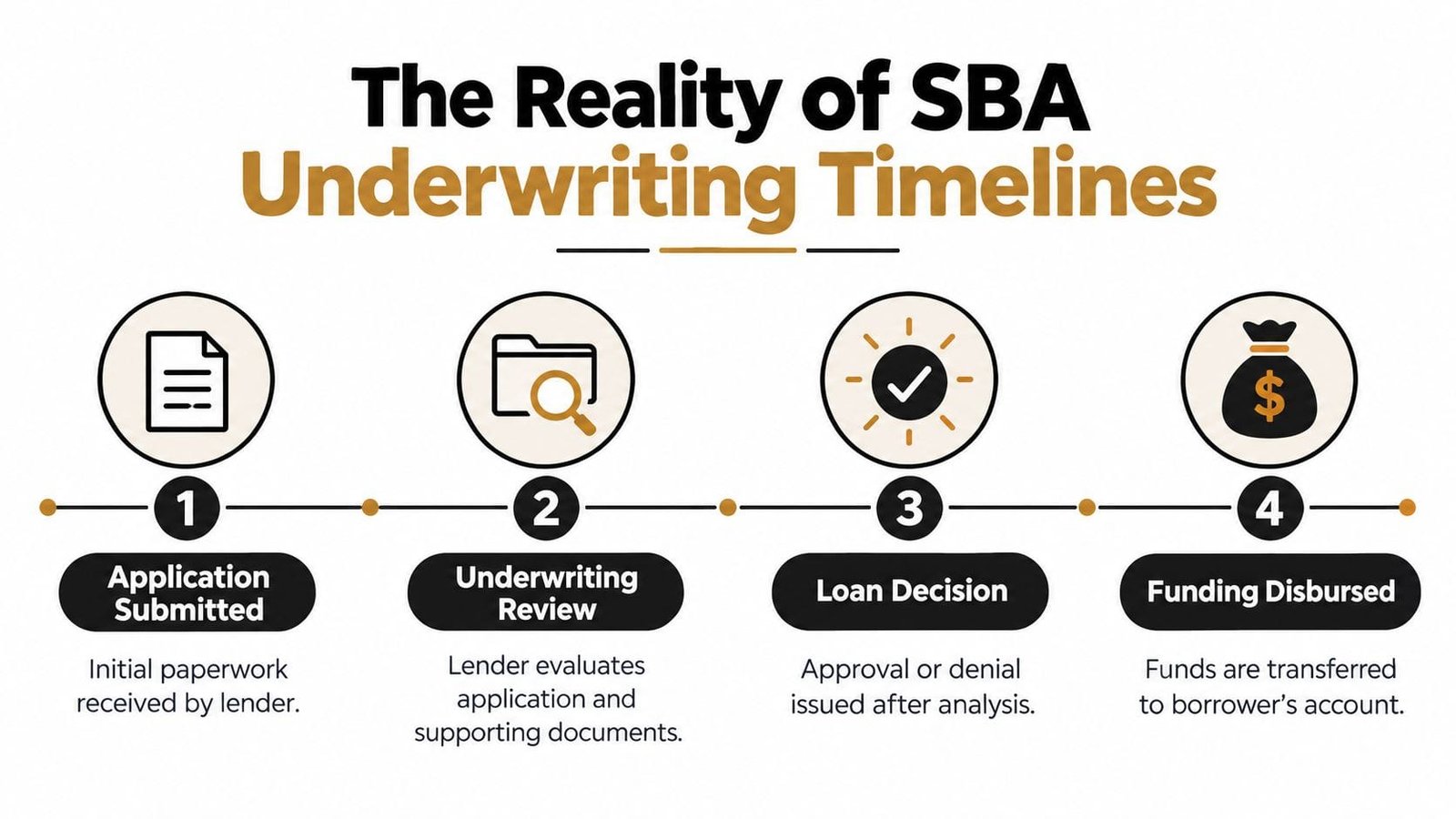
The friction is normal. The FDIC reported that three-quarters of banks approve the typical small business loan in two weeks or less, while SBA 7(a) loans commonly take longer because the lender still has to complete eligibility checks, cash-flow analysis, collateral review, and documentation before authorization in the FDIC's small business lending survey section on underwriting and approval. That gap is why many borrowers feel blindsided. They compare an SBA loan to a standard small business loan when the workflows aren't comparable.
Why the file slows down
A conventional loan can move faster because the bank is mostly following its own credit policy. An SBA file adds government program compliance on top of normal bank underwriting. The lender isn't just deciding whether it likes the risk. It also has to show that the loan fits SBA rules.
That's why underwriting becomes the bottleneck between application and funding. If you want a realistic frame for the whole sequence, this guide on realistic timelines for small business funding from application to cash in your account is worth reading before you promise a vendor or landlord a funding date.
Practical rule: The SBA loan underwriting process rarely breaks because one big item is missing. It usually breaks because ten small inconsistencies force the underwriter to stop and ask questions.
What business owners get wrong
Owners often think speed depends mostly on loan size. In practice, preparedness matters more. A smaller request with unclear use of proceeds, uneven bank activity, and incomplete financials can move slower than a larger, clean file.
If you want a candid borrower-level perspective on the trade-offs, these confessions about SBA financing are useful because they frame the process the way owners experience it. SBA financing can offer attractive structure, but you pay for that structure in documentation, follow-up, and time.
How Lenders Evaluate Repayment Capacity
At the center of the SBA loan underwriting process is one question. Can this business repay the debt from operating cash flow?
That sounds simple. It isn't. The lender has to translate your tax returns, interim financials, existing obligations, and requested loan terms into a credit memo that shows repayment capacity clearly enough to survive review.
Cash flow matters more than collateral
Collateral still matters, and lenders will review it. But for SBA 7(a), the credit case is built around repayment ability from business cash flow, not around whether the lender can liquidate assets later. Under the SBA SOP, lenders must document a Debt Service Coverage Ratio, or DSCR, that meets the SBA floor of 1.15x for standard 7(a) loans and 1.10x for 7(a) Small Loans of $350,000 or less in the SBA SOP 50 10 7.1 requirements.
Here's the simple version of what that means. The lender looks at operating cash flow, then compares it against all required debt payments, including the new SBA payment. If the margin is too thin, the file gets weaker fast.
SBA DSCR Requirements by Loan Size
| Loan Type | Minimum DSCR |
|---|---|
| Standard 7(a) loan | 1.15x |
| 7(a) Small Loan | 1.10x |
What underwriters actually look for
A lot of owners focus only on top-line sales. Underwriters don't. They care about how much cash the business retains after expenses and whether that cash is stable enough to support debt.
They also look for the classic lending themes, even if they don't present them to you as a neat framework:
- Capacity: Can the business carry the payment from operations?
- Character: Do the records, explanations, and payment history support trust?
- Capital: Is the balance sheet strong enough to absorb stress?
- Collateral: Is there secondary support if performance slips?
- Conditions: Does the loan purpose make sense for the business and market context?
If you need a cleaner understanding of the earnings side of the analysis, this explainer on understanding EBITDA helps, especially if your lender is adjusting reported earnings to arrive at usable cash flow.
Underwriters rarely kill a file because revenue is weak in isolation. They kill it because revenue doesn't convert into dependable debt service.
Where good businesses get tripped up
The most common issue I see is debt stacking. The owner took a line, then equipment financing, then a short-term product to cover a gap, and now wants an SBA loan to stabilize everything. The revenue may look solid, but once all current obligations and the new payment hit the denominator, DSCR tightens quickly.
The second issue is unsupported projections. If a borrower says the new location or equipment will improve earnings, the lender will want that story tied back to actual performance, contracts, historical trends, or some other credible support. Narrative matters, but unsupported optimism doesn't count as repayment capacity.
Required Documentation for a Strong Application
The strongest SBA files feel boring. Dates match. Deposits make sense. Tax returns, interim statements, and debt schedules tell the same story. The lender doesn't have to play detective.
That matters more now because recent guidance expects lenders on 7(a) Small Loans to analyze debt service coverage, the two most recent months of commercial bank activity or statements, and projected earnings where applicable, as outlined in this review of the updated 7(a) Small Loan underwriting requirements. Short-term volatility in those statements can change the underwriter's view of consistency.
What to gather before you apply
Start with the core package. If any of this is missing, expect delays.
- Business bank statements: Provide the most recent statements and make sure unusual transfers, large withdrawals, or non-operating activity can be explained.
- Business financial statements: Your profit and loss statement and balance sheet should be current, internally consistent, and aligned with your tax reporting.
- Debt schedule: List every business obligation. Include lender names, payment amounts, remaining balances, and whether any related entities are also liable.
- Tax returns: Make sure the returns support the operating story you're telling the lender.
- Use of proceeds summary: Be precise. “Working capital” by itself is weak unless you break down what the capital is for and why it's needed.
- Ownership and legal records: Formation documents, ownership breakdown, leases, licenses, and any agreements tied to affiliates or related entities.
For a broader checklist, this resource on what documents do you need is a practical starting point.
What underwriters notice in the bank statements
Bank statements aren't just there to prove the account exists. They show operating behavior.
An underwriter is checking whether deposits are recurring, whether revenue appears concentrated, whether balances swing sharply, and whether transfers suggest hidden debt or affiliate support. If your statements show heavy month-end sweeps, unexplained cash injections, or large owner draws while you're requesting working capital, expect questions.
Clean statements don't mean perfect statements. They mean the activity matches the story in the application.
How to package the file better
You don't need fancy software to improve a file. You need discipline.
- Reconcile first: Make sure your interim financials tie back to the bank activity you're submitting.
- Label exceptions: If one month is distorted by a one-time event, explain it in writing before the lender asks.
- Separate personal and business flows: Mixed-use accounts create noise and invite extra review.
- Organize delivery: Use one file naming system, one document list, and one point of contact on your side.
If your lender or closing team still relies on signed and scanned forms, a guide to online fax for small business can be surprisingly useful. It's not glamorous, but document friction still slows real deals.
Factors Influencing Approval Timelines
Two SBA loans with similar borrowers can move at very different speeds. The biggest reason is lender authority.

Industry estimates collected in 2026 place SBA 7(a) underwriting at roughly 10 to 20 days for many deals, with preferred-lender programs often moving faster because the lender can authorize in-house rather than wait for separate SBA review, according to these SBA lending timeline statistics. The same source notes that one industry breakdown places lender underwriting at about 21 to 45 days within a broader 60 to 90 day end-to-end cycle, while another notes preferred lenders may compress approval to roughly 1 to 2 weeks and standard lenders may need 45 to 90 days overall.
Preferred lender versus standard lender
A preferred lender has delegated authority. That matters because fewer handoffs usually mean fewer pauses. It doesn't guarantee approval, but it can reduce waiting once the credit case is ready.
A standard lender may still be a good fit, especially if the team knows your industry well or is more willing to work through complexity. But if speed is critical, delegated authority should be part of the conversation before you apply.
The other variables that slow a file
Timeline isn't only about lender type. It also depends on:
- Completeness of the package: Missing schedules or stale statements create immediate follow-up.
- Quality of financial reporting: If the lender can't reconcile your numbers, the file stalls.
- Collateral and affiliate complexity: Related entities, shared obligations, and layered ownership add review time.
- Responsiveness: Some deals sit because the borrower takes too long to answer questions.
The practical takeaway is simple. If funds are tied to a closing date or expansion deadline, don't ask only what rate a lender can offer. Ask how that lender underwrites, whether it has preferred status, and what it typically needs to issue a clean credit decision.
Understanding the 2026 Underwriting Shift
The biggest mistake borrowers make in 2026 is acting like a 7(a) Small Loan still works like a score-gated product. It doesn't.
As of March 1, 2026, guidance around 7(a) Small Loan underwriting shifted away from the old assumption that an automated SBSS prescreen would carry the file through the early decision stage. Current guidance says lenders must now document a commercial credit analysis, repayment ability, insurance, collateral, working-capital justification in some cases, and the effect of affiliates, while supporting the 1.10:1 DSCR floor with two recent months of commercial bank activity or statements in most cases, as summarized in this analysis of SBA loan underwriting guidelines for the new Small Loan framework.
What replaced the old shortcut
What replaced the score-based shortcut is a narrative-driven file. The lender has to explain not just that you meet a threshold, but why the loan makes credit sense under SBA rules.
That changes borrower behavior. Strong revenue no longer guarantees an easy path if the cash conversion is uneven, the affiliate picture is unclear, or recent statements show stress the financials don't explain.
The four issues to pre-check now
Borrowers should review the same points an underwriter now leans on most heavily:
- Bank-statement consistency: Are deposits and balances behaving the way your financials suggest they should?
- Debt stacking: Have you layered obligations that shrink repayment cushion more than you realize?
- Affiliate exposure: Do related businesses, guarantees, or shared debt create hidden obligations?
- Projection support: If you're showing future improvement, can you reconcile it to actual cash flow and operating history?
If your lender has to write the story for you, the file is already harder to approve.
The shift also changes how denial risk shows up. Before, some borrowers assumed they either passed the score gate or they didn't. Now the result is often less binary and more judgment-based. That means a well-prepared explanation can help, but sloppy documentation can hurt even a sound business.
Improving Your Odds in a Tighter Market
The market is less forgiving than many owners expect. The Lendio SMB Lending Index fell from 73 in Q1 2025 to 69 in Q2 2025, signaling weaker access to capital, and Experian's reporting noted that banks are maintaining more conservative terms, including smaller credit lines, higher risk premiums, and stricter covenants, according to the Q2 2025 Lendio SMB Lending Index.
For businesses in the $20 million to $50 million revenue band, that matters. Many assume scale alone will smooth out underwriting. It won't. Larger revenue can still come with volatility, margin pressure, concentrated customers, or layered debt that makes the file harder, not easier.
What actually improves approval odds
Preparation is the lever you control most.
- Tighten the story: Your use of proceeds, repayment source, and recent performance need to line up without contradiction.
- Clean up debt visibility: List every obligation clearly, especially if there are related entities, partner guarantees, or subordinate notes.
- Normalize your statements: If recent months include one-off events, explain them before the underwriter interprets them as trend.
- Pressure-test projections: Make sure future earnings assumptions can be traced back to contracts, backlog, historical seasonality, or proven operating changes.
What doesn't work anymore
What fails most often is assuming the lender will “figure it out.” Underwriters aren't there to reconstruct your business from fragments. They're there to decide whether the file supports repayment and whether the lender can defend that decision.
Another weak move is applying before internal records are ready. A fast submission with unresolved inconsistencies usually creates a slower process than waiting briefly to package the file correctly.
If you want a more efficient way to gather and submit materials, one option in the market is Business Loan Warrior, which lets applicants complete a no-fee application, connect bank accounts, and track underwriting-related steps through a secure dashboard. Tools like that can help with document flow, but they still don't replace the hard part, which is presenting a coherent credit case.
The practical mindset shift
Treat underwriting like a credit memo you're helping the lender write. Every statement, debt entry, and explanation should answer the next obvious question before it gets asked.
That's the difference between a file that moves and a file that lingers. In a tighter market, good businesses still get funded. The ones that move fastest usually aren't the ones with the loudest growth story. They're the ones that make the underwriter's job easy.
If you're preparing for an SBA request and want a clearer path through underwriting, Business Loan Warrior offers application support, document collection workflows, and funding guidance that fits the realities described above. If your file has cash flow complexity, recent statement volatility, or layered debt, it's worth reviewing your package before you submit it and let underwriting define the story for you.