
You've got payroll due, inventory arriving, or a profitable expansion waiting on the other side of a cash gap. The instinct is to apply everywhere and take the first offer that appears. That approach often produces the wrong loan size, the wrong repayment schedule, or a partial approval that leaves the original problem unresolved.
The practical answer to how to get business capital isn't shopping harder. It's matching the request to the business need, cash-flow cycle, documentation strength, and lender category. A short-term working-capital gap calls for a different structure than equipment, acquisition, construction, or expansion funding. The right match can protect cash flow. The wrong one can turn a manageable timing issue into a costly obligation.
Table of Contents
- Why Getting Business Capital Feels Harder Than It Should
- How to Pinpoint How Much Capital You Actually Need
- Comparing Your Best Options to Get Business Capital
- Preparing a Lender-Ready Application That Gets Approved
- How to Compare Offers and Choose Without Overpaying
- Managing Your Capital After Funding and Planning Next Steps
Why Getting Business Capital Feels Harder Than It Should
A business owner can go years without outside funding, then need cash in a matter of days. That shift is normal. Federal Reserve reporting found that only about 15% of businesses formally applied for new credit in 2020, excluding pandemic-specific programs, while its 2023 survey data showed 37% of small employer firms applied for a loan, line of credit, or merchant cash advance in the prior 12 months. Capital is often an occasional decision, not a routine purchase. Federal Reserve small-business credit data
Once the need shows up, owners often reduce it to “I need more cash.” That shortcut hides very different problems.
- Working capital: You are covering payroll, inventory, rent, or receivables timing while sales continue.
- Growth capital: You are adding capacity, equipment, employees, locations, or a new revenue channel.
- Emergency capital: You are responding to an unexpected repair, disruption, or urgent obligation.
- Acquisition capital: You are buying another business or its assets and need a longer repayment structure.
Each use case changes the lender's question. Working capital depends on timing and repayment visibility. Growth funding needs a credible return path. Emergency funding puts speed first, and speed often costs more. Acquisition financing requires deeper review because the lender is looking at both the existing company and the transaction.
The amount you request changes the conversation
Small-business capital requests are usually modest, not institutional raises. In the Federal Reserve's 2023 data, half of applying firms requested $100,000 or less, and 30% sought $50,000 or less. The request needs to be large enough to solve the problem, but small enough that the payment does not strain operating cash flow.
Partial approvals happen too. One recent benchmark found that 41% of applicants received the full amount requested, 36% received partial funding, and 24% were denied. LendingTree business loan data A partial approval is only helpful if it still solves the need. If you need the full amount to finish a buildout, buy equipment, or launch, a smaller offer can leave the underlying problem in place.
A practical rule applies here: start with the business constraint, not the product. Once you know what the money must accomplish and when repayment is realistic, the lender category becomes easier to match.
Capital can support a sound plan, bridge a predictable timing gap, or finance an asset that produces revenue. It cannot fix persistently weak unit economics, unclear pricing, uncontrolled expenses, or a business model that loses money before debt service. Diagnose the trigger first. Then build the request around a specific outcome.
How to Pinpoint How Much Capital You Actually Need
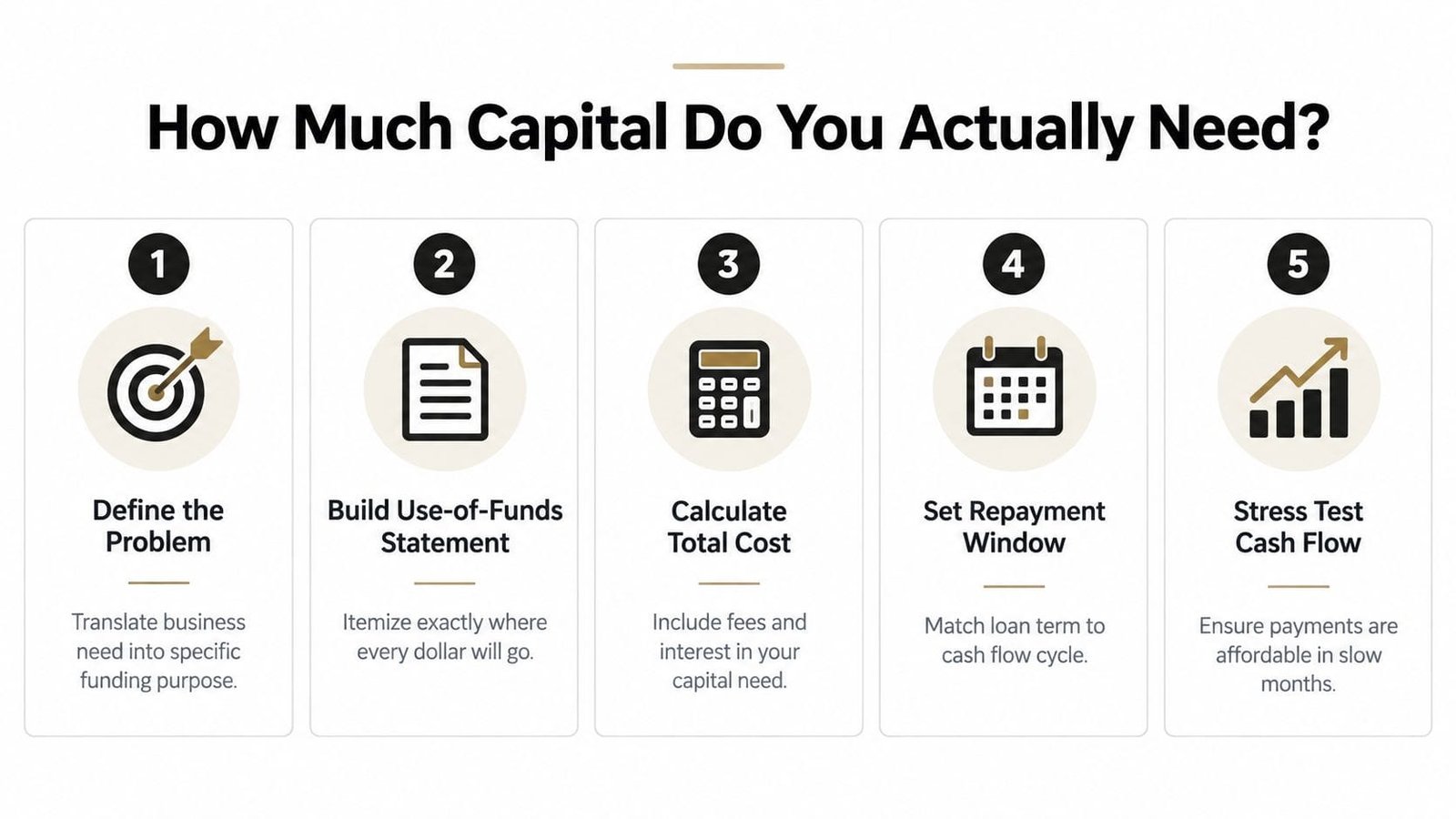
Lenders don't approve a business need. They approve a defined request supported by repayment capacity. Your job is to convert “we need cash” into an amount, use-of-funds statement, and repayment window that another person can verify.
Start with the funding trigger
Write one sentence that finishes this statement: “This capital will allow the business to…”
A strong answer names the activity and the timing. “Purchase inventory for a confirmed seasonal order” is stronger than “support growth.” “Replace a failed commercial oven so the restaurant can resume normal service” is more specific than “cover an emergency.” The sentence becomes the foundation of your application narrative.
Separate expenses that generate or preserve revenue from expenses that merely delay a problem. If the money will fund a project, identify the milestone that proves the project is working, such as completed installation, shipped inventory, signed customer contracts, or a functioning new location.
Build the number from line items
Create a use-of-funds worksheet with four columns:
- Expense: Name each purchase, project cost, or operating obligation.
- Amount: Use quotes, invoices, payroll records, or historical expenses where available.
- Timing: Record when the cash leaves the business.
- Evidence: Attach the document that supports the estimate.
Include lender fees, closing costs, required deposits, and an appropriate operating cushion. Don't inflate the request with unrelated spending, but don't understate it to make approval feel easier. Underfunding a project can leave you with debt and no completed outcome.
Your repayment window should follow the cash cycle of the use. Inventory that sells quickly shouldn't automatically receive a long amortization, while equipment expected to support revenue for years shouldn't be paired with a repayment schedule that drains cash immediately.
For a more detailed planning method, use this guide on building a cash flow forecast for your loan strategy. Your forecast should show existing obligations, expected collections, payroll, taxes, recurring overhead, and the proposed payment under both normal and slower conditions.
Stress-test the repayment
Review the request against your weakest realistic months, not your best month. Ask whether the business can make the payment if a customer pays late, sales soften, or the project takes longer to launch.
The defensible request is the smallest amount that fully completes the stated use of funds without creating an unmanageable payment.
Document your time in business, business and personal credit profile, current debt, collateral, and ownership structure before speaking with lenders. These factors influence which channels are realistic. A clean worksheet won't overcome insufficient repayment capacity, but it can prevent avoidable confusion and show that you understand the obligation.
Comparing Your Best Options to Get Business Capital
The best funding source depends on the job the money must do. A bank term loan may be economical but slow. An online product may move quickly but require frequent payments. An SBA structure may support a larger expansion while demanding more documentation and patience.
| Funding Option | Best For | Typical Speed | Cost and Term Trade-off |
|---|---|---|---|
| Bank term loan | Established businesses with strong records | Slower underwriting | Usually lower cost and longer terms, with substantial documentation |
| SBA 7(a) | Expansion, working capital, acquisition, or refinancing | Slower than many online products | Longer-term financing and government support, balanced against heavier underwriting |
| SBA 504 | Owner-occupied real estate or major equipment | Structured and deliberate | Designed for fixed assets and longer repayment, with project and collateral requirements |
| Business line of credit | Recurring working-capital gaps | Varies by lender | Flexible draws, but limits, renewal terms, and variable pricing require attention |
| Equipment loan | Machinery, vehicles, or specialized assets | Often tied to the asset | The equipment supports the financing, but the asset may have resale and valuation limits |
| Construction loan | Buildouts, renovations, or development | Project-dependent | Disbursements may follow milestones, with inspections and detailed budgets |
| Invoice financing | Businesses waiting on customer invoices | Often faster than bank lending | Converts receivables into cash, but fees reduce the value of collected revenue |
| Merchant cash advance | Urgent funding tied to card or sales volume | Fast | Repayment can be expensive and frequent, making it risky for thin-margin businesses |
| Equity or crowdfunding | Businesses with a growth story and investor appeal | Variable | No scheduled loan payment, but ownership, control, or campaign obligations may change |
SBA-backed financing deserves careful consideration for owners who need longer terms or smaller down payments than conventional borrowing may provide. In fiscal year 2024, the SBA approved roughly 70,000 7(a) loans and about 7,500 504 loans, with total guaranteed loan volume of about $56 billion. SBA loan volume overview The scale shows that SBA lending is a mainstream channel, not a niche product.
SBA guarantees can cover up to 85% for loans up to $150,000 and 75% for larger loans, according to recent lending guidance. SBA lending report overview That support doesn't make approval automatic. SBA loans generally require stronger records and more patience than many unsecured alternatives.
A line of credit makes sense when the need repeats and the amount fluctuates. Equipment financing makes more sense when a clearly identified asset drives the request. Invoice financing can bridge a collection delay, but it won't solve weak margins. Merchant cash advances should be reserved for situations where the speed has a clear economic justification, because frequent repayment can strain operating cash.
If you're deciding between a term loan and revolving access, compare the structures in this guide to business loans versus lines of credit. Shortlist two or three realistic fits instead of submitting scattered applications to every lender you can find.
Preparing a Lender-Ready Application That Gets Approved
A lender-ready file answers four questions fast: what the money will fund, whether the business can repay it, what other obligations already claim cash, and what happens if results come in below plan.
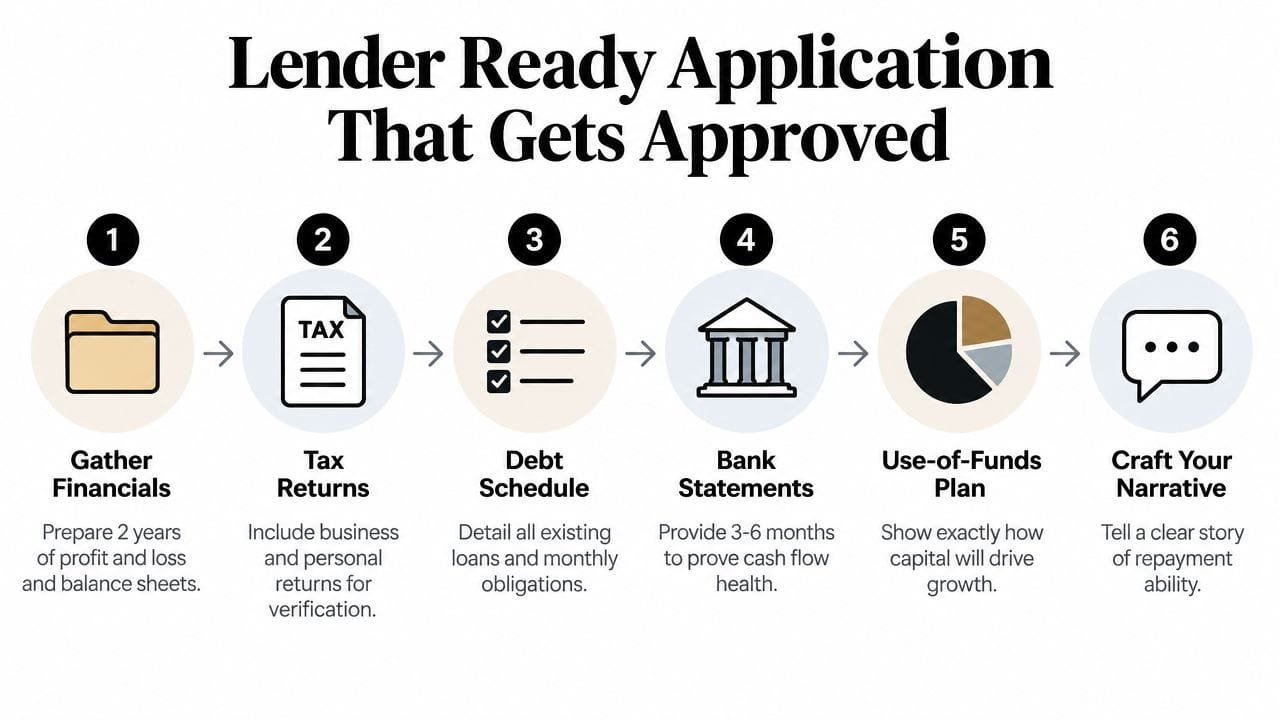
Build the package before you apply. For a conventional or SBA request, that usually means at least two years of financial statements, business and personal tax returns, a current debt schedule, recent bank statements, and a clear use-of-funds plan. If the request supports an expansion, acquisition, construction project, or other future-facing investment, add cash-flow projections that show how repayment will work.
Make the file easy to underwrite
Organize the application so a credit analyst can understand it without calling you. Keep company names, dates, revenue figures, and ownership percentages consistent across every document. Explain unusual deposits, revenue swings, tax-payment arrangements, prior defaults, or major changes in the business before a lender has to ask.
A practical pre-submission checklist includes:
- Financial statements: Provide current profit and loss statements and balance sheets, with accounting classifications that match your tax records.
- Tax returns: Include the requested business and personal filings, including schedules that affect income or liabilities.
- Debt schedule: List every lender, outstanding balance, payment, maturity, and collateral position.
- Bank statements: Show operating activity, deposits, withdrawals, overdrafts, and existing debt payments clearly.
- Use of funds: Tie each dollar to an invoice, project budget, asset, payroll need, or documented operating purpose.
- Repayment story: Explain which cash flows will service the new obligation and when those cash flows begin.
For a document-specific checklist, review what documents lenders typically require. Missing a return or leaving out a recent account on the debt schedule slows underwriting and can weaken the file before review even starts.
Match the file to the lender
Approval rates differ by lender type, and that should shape where you submit. Recent lender-type approval data show that small banks approved a higher share of applications than several other channels, including finance companies, online lenders, large banks, and credit unions. LendingTree business loan data That does not make a small bank the right answer for every borrower. It does show why the lender fit matters as much as the request itself.
SBA applicants need to show that the structure fits program rules and that the business can support the debt. Online lenders may care more about recent bank activity and speed, but faster review does not reduce the cost of repayment. Apply where your profile fits instead of sending incomplete files to every channel.
Business Loan Warrior offers a single no-fee application, bank-account connection, pre-approval review that does not affect credit, and a secure dashboard for tracking approvals, repayments, credit insights, and underwriter conversations. Use a platform like this to organize the process, not to replace careful sizing and document preparation.
How to Compare Offers and Choose Without Overpaying
Approval is only the midpoint. An offer can look attractive because it arrives quickly, yet become dangerous when daily or weekly payments collide with uneven receipts. Another can take longer to close but preserve cash flow through a longer term and lower overall cost.
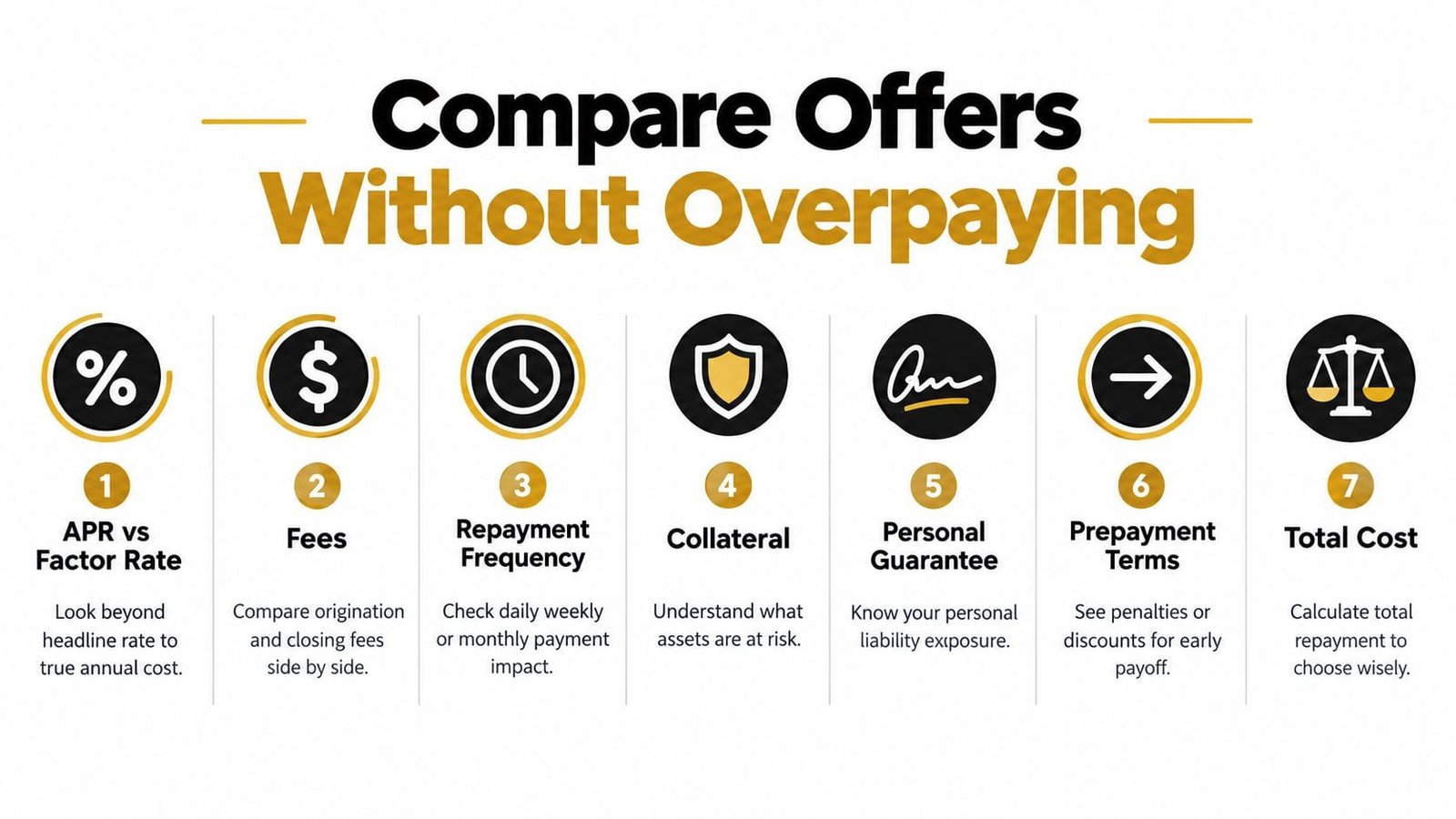
Start by translating every offer into the same language. For a loan, compare annual percentage rate, total repayment, origination fees, closing costs, payment frequency, maturity, collateral, personal guarantee, and prepayment rules. For a merchant cash advance, a factor rate isn't an interest rate. Convert the factor into a total repayment amount and assess how the remittance interacts with sales volume.
The current affordability problem makes this comparison more important. In 2025, 81% of small-business owners who applied for a loan or line of credit said affordable capital was difficult to access, 51% said current interest rates made borrowing unaffordable, and 49% said they had to halt expansions. Equifax small-business financing report A fast offer may be justified when delay would cause a documented loss, but speed alone isn't a financial strategy.
Put each offer through the same test
| Evaluation Criteria | What to Check | Red Flag |
|---|---|---|
| APR or factor rate | Calculate the true annualized or total cost | The provider avoids explaining the pricing method |
| Fees | Compare origination, closing, servicing, and broker charges | Fees are disclosed only after you commit |
| Repayment frequency | Model daily, weekly, or monthly withdrawals against receipts | Payment timing conflicts with collection timing |
| Collateral | Identify assets pledged and lien priority | The agreement secures broad business assets without a clear reason |
| Personal guarantee | Understand personal liability if the business can't repay | You're asked to sign without reviewing enforcement terms |
| Prepayment terms | Check for penalties, discounts, or no benefit from early payoff | Early repayment doesn't reduce the amount owed |
| Total cost | Add principal, fees, and all required repayment | The headline payment hides a much larger obligation |
Decide whether speed earns its premium
Use a simple decision matrix:
- Wait for lower-cost financing when the project is optional, the business has adequate liquidity, and the application needs stronger records.
- Choose a faster structure when the use is time-sensitive, the repayment source is visible, and the total cost is small relative to the value preserved or created.
- Take a smaller offer only when it completes a useful phase. Partial capital that funds half a renovation or insufficient inventory purchase may leave you with debt but no revenue-producing result.
- Decline the offer when payments depend on optimistic sales, the contract contains unclear guarantees, or the lender won't provide a complete repayment schedule.
Recent survey coverage found that only about 51% of firms reported having all financing needs met, while 34% had shortfalls and 15% had unmet needs altogether. Small-business financing gap report That makes partial funding a planning issue, not merely an approval statistic. Before accepting less than requested, rewrite the use-of-funds plan and confirm that the reduced amount still produces a meaningful business outcome.
Managing Your Capital After Funding and Planning Next Steps
Funding should create a controlled operating plan, not a larger account balance with no assigned purpose. Separate proceeds from ordinary spending where practical, pay vendors according to the approved use, and retain invoices, payroll records, contracts, and project receipts. Those records protect accountability and make the next financing conversation easier.
Automate repayments only after confirming the withdrawal schedule against your collection cycle. Monitor cash weekly, track debt service separately, and review any covenant or reporting requirement before a missed deadline becomes a technical default. If the capital funded equipment, inventory, hiring, or a location, measure the expected business result against actual revenue, gross margin, capacity, or customer retention.
Build better terms through operating discipline
Keep clean books and maintain a current debt schedule after closing. Pay obligations on time, avoid unexplained overdrafts, and preserve a cash buffer that reflects the volatility of your business. Lenders want evidence that the company can manage debt after the initial funding event, not just qualify on the day of application.
Refinancing may make sense when expensive short-term debt has been used for a durable asset or when the company's financial profile has strengthened. Don't refinance to lower one payment if the new structure extends cost or adds collateral without improving the overall position. Recalculate total repayment and confirm that the new term matches the asset or cash-flow cycle.
Some owners also need capital structures that combine investment with a clearly defined business outcome. For that situation, this resource on structuring outcome-based founder deals can help frame the discussion around milestones, incentives, and accountability rather than vague promises of growth.

Your next steps are straightforward: reconcile the funded use of funds, schedule repayment monitoring, measure the result of the financed activity, and update your lender-ready file while the records are current. Treat the next capital search as a planned matching exercise, not an emergency response.
Business Loan Warrior can help you compare business funding options through one no-fee application, with pre-approval review that doesn't affect your credit and a secure dashboard for tracking approvals and repayments. Visit Business Loan Warrior to organize your capital request around the right amount, lender type, and repayment structure.