
A strong personal credit score isn't a construction loan pre approval. It may get a lender's attention, but it won't rescue an incomplete project. Commercial construction lenders are deciding whether the land, budget, builder, timeline, collateral, and repayment plan can survive scrutiny, not merely whether you pay your personal bills on time.
Treat pre approval as a test of project readiness. Your job is to present a build that a lender can price, monitor, complete, and exit. If the plans are vague, the contractor is unverified, or the budget ignores site work and contingency reserves, your application isn't ready, regardless of how polished your credit profile looks.
Table of Contents
- Why Project Readiness Matters More Than Your Credit Score
- Assembling the Required Documentation and Financials
- How Underwriters Test Your Deal and Calculate Risk
- Navigating the Modern Pre Approval Timeline
- Strategic Moves to Improve Your Approval Odds
- Next Steps After Securing Conditional Pre Approval
Why Project Readiness Matters More Than Your Credit Score
Construction borrowing differs from a standard term loan because the collateral often doesn't exist in finished form. The lender advances capital while the asset is incomplete, exposed to delays, change orders, contractor problems, permitting issues, and market shifts. That makes the project itself a central credit decision.
Construction lending also has a history that explains the caution. In an FDIC analysis of construction loans originated between 2005 and 2010, 25% were originated in 2007 and 63% were originated between 2006 and 2008. The same study found that the noncurrent rate for acquisition, development, and construction loans peaked at 16.8% in 2010, compared with 8.1% for single-family loans, while other major loan categories stayed below 5%. Lenders learned that construction credit can deteriorate much faster than broader real-estate lending.
The lender is underwriting three risks
First, the lender evaluates you and your business. That includes liquidity, repayment capacity, existing obligations, tax filings, operating performance, and the strength of any guarantor.
Second, it evaluates the builder and execution plan. A credible general contractor, complete plans, realistic pricing, proper licensing, insurance, and a workable draw process reduce the chance that the lender will be left with a half-built asset.
Third, it evaluates the exit strategy. Will the completed property support permanent financing? Will operating cash flow cover debt service? Is the plan to sell, refinance, occupy, or lease the building? A lender needs a defensible answer, not a sentence saying the property will be worth more when finished.
Neutral lender guidance makes the point clearly. A construction loan can be substantially underwritten and still remain subject to later review of plans, specifications, the builder contract, insurance, and builder financials, as explained in construction financing FAQs from Johnson Financial Group.
Practical rule: Don't ask, “Will my credit qualify?” Ask, “Could an independent lender understand, value, monitor, and complete this project from the package in front of them?”
That change in mindset prevents a common failure. Many borrowers approach a lender with a personal financial profile and a rough construction idea. Experienced borrowers bring a bankable project package. Credit is the entry requirement. Project readiness is the gatekeeper.
Assembling the Required Documentation and Financials
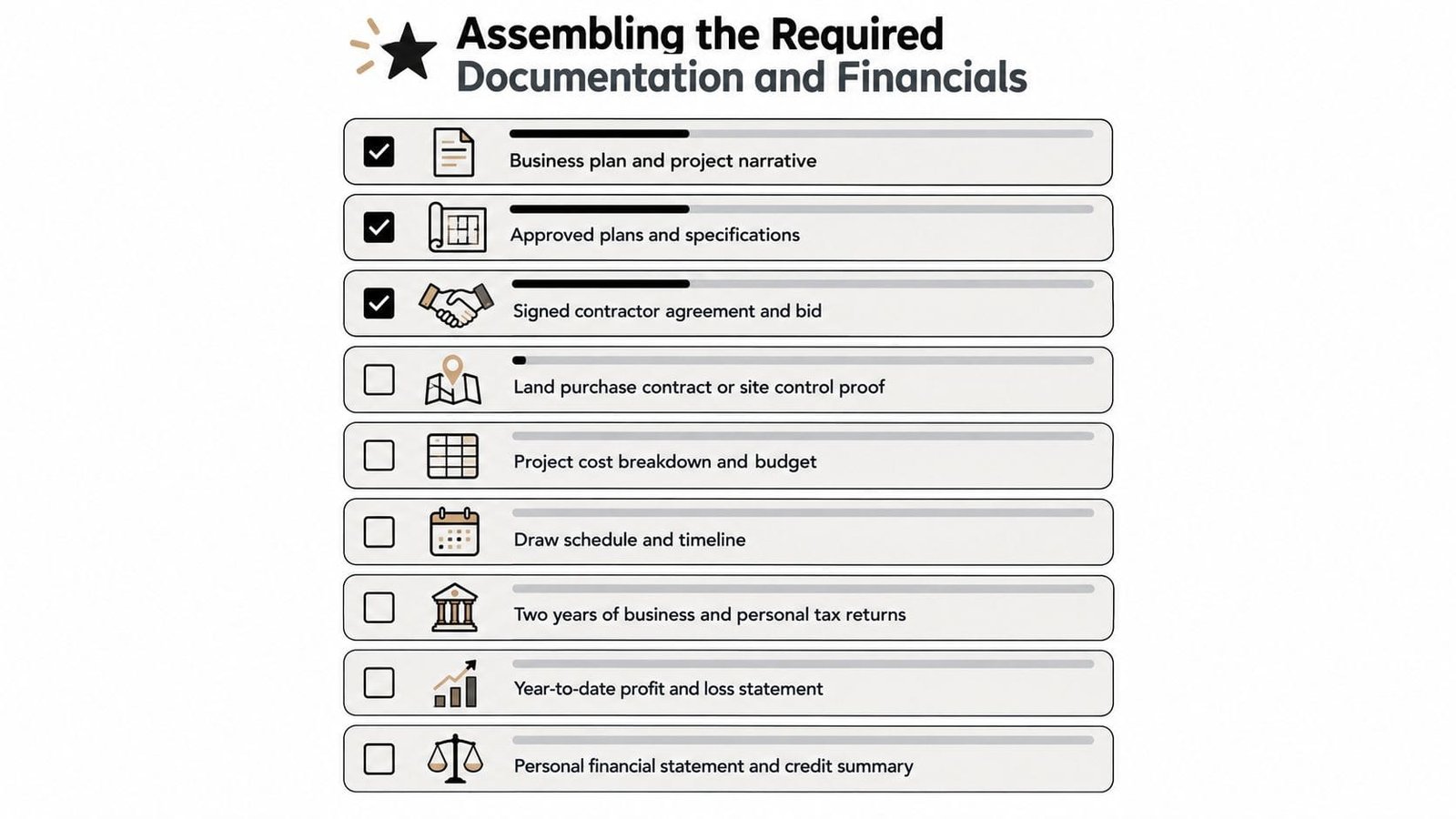
A strong credit score will not rescue an incomplete project file. Build the package before requesting construction loan pre approval, and organize it so an underwriter can verify borrower capacity, project costs, and repayment without chasing missing documents.
Start with borrower and business capacity
Prepare two years of business and personal tax returns, current year-to-date profit and loss statements, balance sheets, bank statements, a personal financial statement, and a schedule of existing debt. Business lenders may also request projections, ownership documents, accounts receivable and payable aging, and explanations for unusual liabilities or revenue changes. Use this guide to the documents lenders commonly request to check the file before submission.
Give the numbers context. If the latest interim statement shows a margin decline, explain whether the cause was temporary, project-related, or structural. If multiple entities are involved, identify which entity will own the property, sign the debt, operate from the site, and provide repayment cash flow.
Write a concise borrowing narrative that answers five questions:
- Borrower: Who owns the business, property, and borrowing entity?
- Purpose: What will be built, and how will it support the company?
- Contribution: What cash, land equity, or other capital will the borrower invest?
- Repayment: Which operating income, sale, or refinance proceeds will repay the loan?
- Liquidity: What funds remain available after closing for overruns and business operations?
Then document the project itself
Lenders size the facility from the cost plan, so the project file must show the same numbers the underwriter will model.
- Project narrative and business plan. Explain the use, location, market, customer demand, operating assumptions, and completion objective.
- Site control. Provide a deed, purchase agreement, option, or other evidence that you control the land. Include title information and known liens.
- Architectural plans and specifications. Submit drawings detailed enough for the lender, appraiser, contractor, and inspector to understand the finished asset.
- Builder information. Include the contractor license, insurance certificates, comparable project experience, references, ownership details, and financial statements when requested.
- Signed construction contract or active bid. Identify the scope, price, allowances, schedule, change-order rules, retainage, and responsibility for omitted work.
- Detailed cost breakdown. Separate land, hard costs, soft costs, permits, professional fees, utilities, site work, interest, insurance, and contingency.
- Draw schedule. Match funding requests to observable construction milestones, inspections, and invoices.
- Exit strategy. Show the permanent loan, sale assumptions, lease-up plan, or operating cash flow that will repay the construction facility.
- Insurance and third-party reports. Plan for builder's risk, liability coverage, title work, appraisal, environmental review, and required engineering reports.
Cost estimating deserves the same discipline as the rest of the package. A lender underwrites the submitted budget, not an optimistic guess. For a plumbing-heavy project, Exayard plumbing estimating software can help the project team prepare a defensible trade estimate before the lender reviews the budget.
According to the construction loan sample presented at the 2019 American Economic Association conference, the average facility had a principal balance of nearly $450,000, a term to maturity of roughly 14 months, average origination fees of 0.2%, and about 75% loan-to-completed-value, as reported in the American Economic Association paper. Treat these figures as sample benchmarks, not loan terms. They show that construction facilities are evaluated against defined size, timing, fee, and completed-value constraints.
Keep one file naming convention, one source of truth for the budget, and one current version of the plans. Confidence drops quickly when the contractor bid, spreadsheet, and project narrative describe different scopes. A bankable file makes every document support the same project, cost, and repayment story.
How Underwriters Test Your Deal and Calculate Risk
Underwriters don't start with the question, “How much can this borrower borrow?” They start with, “What will this project cost, what will it be worth when complete, and how much of the risk is the borrower absorbing?”
The core calculation is loan-to-cost, or LTC. It compares the proposed loan with the total project cost, including eligible construction and related expenses. Current land value matters, but it isn't enough. A lender doesn't want a low borrowing ratio based on an attractive parcel while the completed building remains underfunded.
The two valuation tests
The first test is cost. The lender reviews the acquisition price, construction contract, soft costs, financing costs, and contingency. Missing costs can make the LTC appear stronger than it really is.
The second test is value. The lender orders an appraisal based on the as-completed property, not merely the dirt today. If the completed value doesn't support the requested facility, the borrower must reduce the loan, increase equity, revise the scope, or abandon the deal.
Typical mainstream construction underwriting uses 65% to 75% LTC, and the loan is generally sized against the as-completed appraisal. A contingency reserve of about 10% of construction costs is a common benchmark, increasing to roughly 20% when the borrower acts as its own general contractor, according to construction loan underwriting guidance from Lender Analyzer.
| Metric | Standard Benchmark | Owner-Builder Adjustment |
|---|---|---|
| Loan-to-cost | 65% to 75% | Lower leverage may be required |
| Contingency reserve | About 10% of construction costs | Roughly 20% when borrower is the general contractor |
| Value basis | As-completed appraisal | Same, with more scrutiny of execution risk |
The owner-builder adjustment isn't a punishment. It reflects the fact that a borrower managing its own construction may lack the independent controls, purchasing systems, staff depth, and track record that a lender expects from an established general contractor.
Model the deal before submission
Create a sources-and-uses schedule. Sources should identify the requested loan, borrower equity, land contribution, and other committed capital. Uses should identify every project cost. Then test the deal under a higher-cost scenario, a delayed completion scenario, and a lower-appraisal scenario.
Your underwriting file should make three things obvious:
- Equity is real: Show where the contribution sits and whether it remains available after closing.
- Costs are complete: Include site work, permits, professional fees, interest, insurance, and contingency.
- Repayment is credible: Tie the exit to documented operating cash flow, a refinance plan, or a realistic sale.
For a plain-English explanation of lender analysis, review this guide to the underwriting process. The best application doesn't hide risk. It identifies the risks and shows who controls each one.
Navigating the Modern Pre Approval Timeline
Fast initial decisions have changed borrower expectations. They haven't removed the work required to close a construction facility.
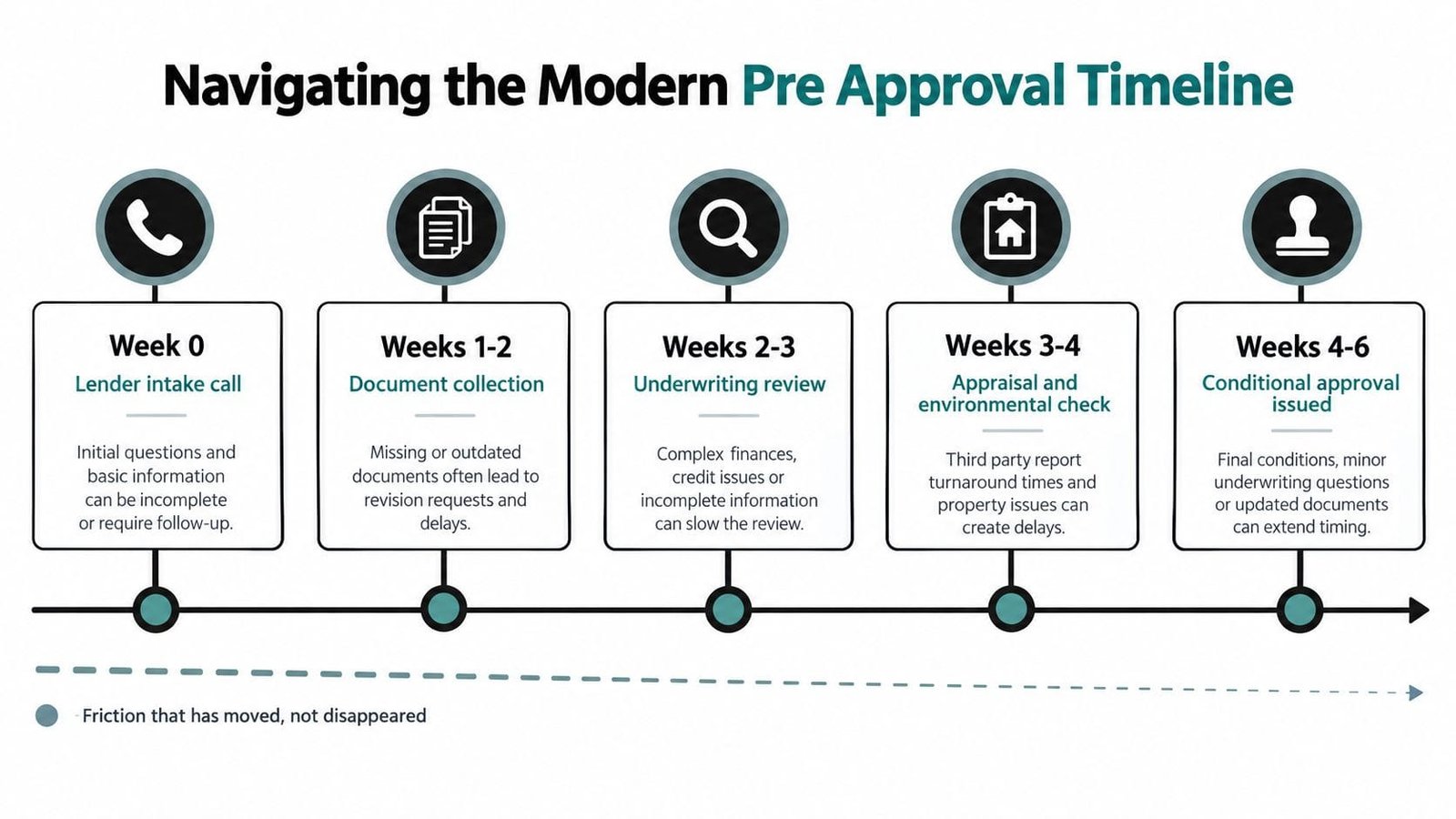
A qualified file may receive an initial decision in as little as 4 hours, while other construction business financing reviews describe 24 to 48 hour approvals once documentation is complete, according to Credibly's construction business loan guidance. Those are useful front-end speeds, especially for an owner deciding whether to pursue land, negotiate with a builder, or revise the scope.
They aren't the same as final approval, closing, or access to the first draw.
What the modern process looks like
The first conversation establishes the project, borrower, requested amount, intended use, and rough timeline. A lender may provide an early financing range or identify an obvious mismatch. This stage is valuable because it prevents you from spending heavily on a project that doesn't fit your capacity.
The second stage is document assembly. The lender collects tax returns, interim financials, debt schedules, bank statements, site information, plans, bids, and the budget. This is the stage where many “quick” files slow down. Missing pages, inconsistent numbers, expired statements, and unexplained deposits create repeated requests.
Underwriting then tests repayment capacity, LTC, completed value, builder qualifications, and exit strategy. Third-party work may include appraisal, environmental review, title work, plan review, and inspections. A conditional approval arrives only after the lender has identified remaining conditions, and those conditions must be cleared before closing.
Speed changes the first answer, not the lender's responsibility for the final loan.
Plan your land and contractor commitments around the full approval path, not the marketing claim attached to the initial response. Don't schedule mobilization based on a preliminary email. A lender can move quickly and still require a detailed final package.
Insurance is another early coordination point. Before the project reaches closing, get professional guidance on developer coverage, builder's risk, liability, and related requirements, such as the developer finance advice from ABS Insurance Brokers Pty Ltd. The exact coverage depends on the asset, location, contractor, lender, and project structure.
The practical lesson is simple. Prepare for a fast intake and a demanding back end. A complete file can move efficiently. An incomplete file doesn't become complete because the first response was quick.
Strategic Moves to Improve Your Approval Odds
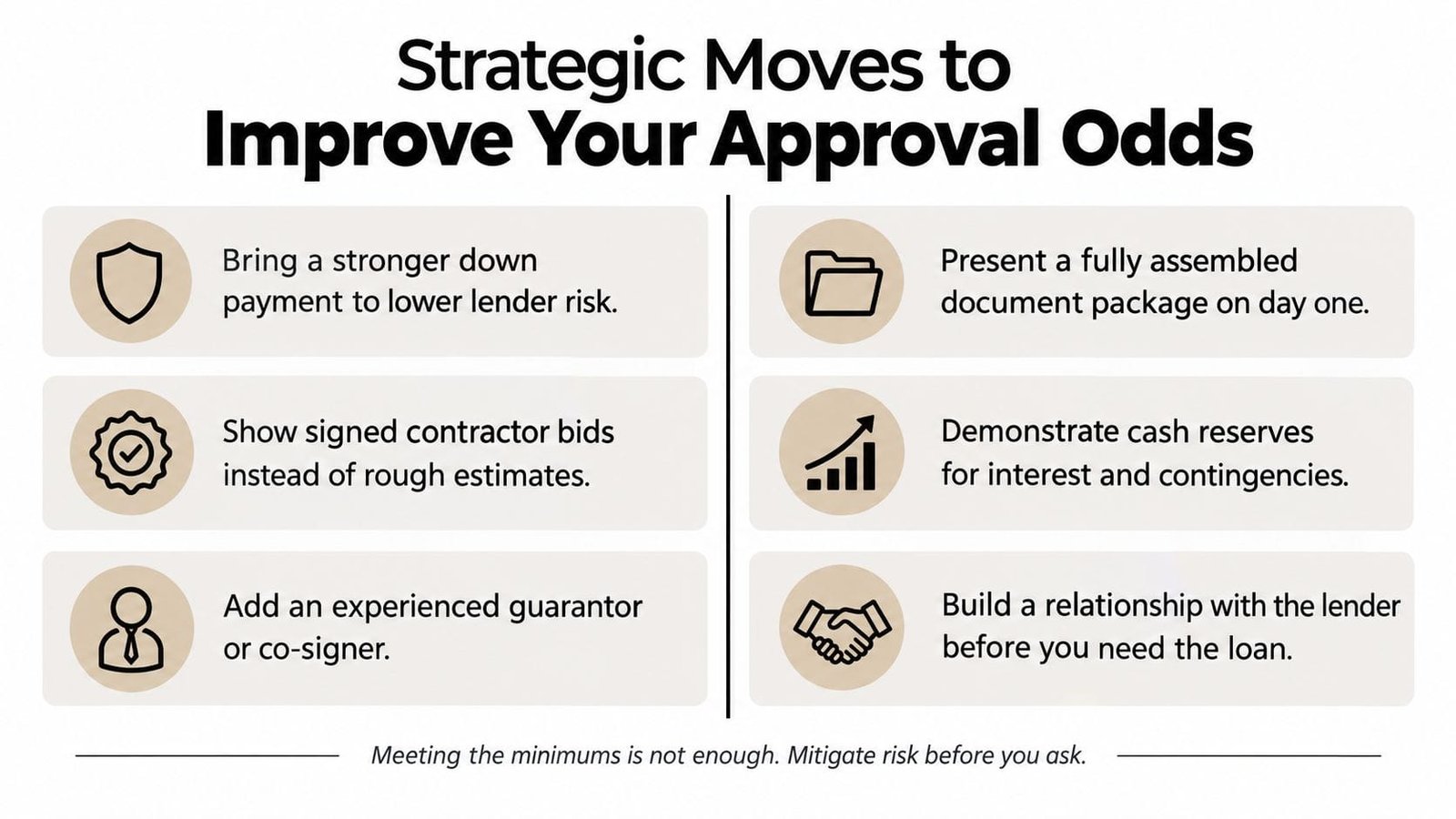
Underwriters approve controlled risk. The strongest borrowers don't merely meet minimum requirements. They remove uncertainty before the credit committee has to ask about it.
Make the budget auditable
Give the lender a cost schedule that traces every major amount to a bid, contract, estimate, allowance, or documented assumption. Separate committed costs from estimates. Flag volatile items instead of burying them inside a broad “miscellaneous” line.
A lender can work with an assumption. It can't work with an unexplained gap.
Your contractor agreement should also control change orders. Require written approval, identify who can authorize changes, explain how the change affects the budget and schedule, and preserve the lender's right to review material modifications. Informal approvals between an owner and a subcontractor create funding disputes later.
Treat draw controls as credit protection
Draw administration isn't clerical work. It is how the lender confirms that released capital matches completed work.
Manual pay-application processing carries a 3% to 5% error rate, and on a $25 million project, those errors can translate into about $1 million in billing errors, according to GetBuilt's construction finance risk guide. The same source identifies underfunded contingencies, weak contractor oversight, and delayed or inconsistent inspections as risks connected with overruns, draw fraud, and lien exposure.
Build controls into the project before closing:
- Use a standardized draw package: Require pay applications, invoices, conditional and unconditional lien waivers, updated schedules, and evidence of completed work.
- Tie requests to milestones: Release money against inspected progress, not a contractor's cash-flow emergency.
- Separate approval duties: The person preparing a request shouldn't be the only person verifying it.
- Track the budget monthly: Compare original cost, approved changes, committed costs, paid costs, and remaining exposure.
- Fund contingency properly: Don't treat contingency as unused profit. It protects the completion plan.
- Set inspection expectations: Agree on who inspects, what evidence is required, and how unresolved deficiencies affect a draw.
Strengthen the people around the deal
An experienced guarantor can help, but a stronger team is better than a stronger signature. Use a builder with relevant completed projects, reliable financial capacity, and a clean approach to documentation. Give the lender access to the architect, contractor, estimator, and property manager when their expertise supports the credit case.
Keep cash reserves separate from the construction budget when possible. The lender wants to know that an unexpected expense won't force you to choose between funding the building and keeping the operating business alive.
Underwriting advantage: Every major risk should have an owner, a control, and a documented response.
That standard produces a more persuasive application than a high credit score presented without a credible execution plan.
Next Steps After Securing Conditional Pre Approval
A conditional pre approval letter is a checkpoint, not permission to start spending. It means the lender will proceed only if you satisfy the listed conditions and keep the project aligned with the approved scenario.
Turn every condition into an owner, deadline, and evidence requirement. Maintain one closing checklist for the builder contract, final plans, specifications, budget, insurance, title, appraisal, environmental reports, entity documents, and equity verification. Documents submitted during intake may need updates before closing, so confirm acceptance with the underwriter rather than assuming the file is complete.
Protect the approved project
Notify the lender before changing the footprint, materials, contractor, scope, ownership structure, or repayment plan. Any of these changes can affect the appraisal, budget, insurance, permits, or loan size. Get written approval before committing to a revision that could alter the credit case.
Finalize a construction contract that matches the lender's budget. Resolve allowances, exclusions, retainage, completion obligations, change-order authority, and default remedies. The builder should understand the draw process before closing, including required inspections and supporting documents.
Obtain the required insurance and verify that certificates name the correct parties. Coordinate title and lien requirements. Give the appraiser the final plans, specifications, and cost information so the completed-value analysis reflects the building the lender is financing.
Conditional approval also has a validity window. Confirm how long the approved terms, appraisal, and rate hold remain in force. Ask what re-underwriting occurs if permits, closing, or construction slips past those dates. A delayed start can otherwise force new documentation, updated valuations, or revised loan terms.
Move cleanly into draws
Before the first advance, confirm the draw schedule, inspection procedure, notice requirements, documentation standards, and payment timing. Keep the project account disciplined, pay contractors through a traceable process, and maintain current lien waivers.
Use a written construction loan draw schedule that matches the builder's work breakdown and the lender's inspection milestones. It should identify the work required before each release and show how the remaining budget supports completion, rather than functioning as a generic calendar.
Your post-approval objective is continuity. Keep the scope stable, answer requests quickly, document every change, and protect the contingency. The lender does not require a flawless project. It requires evidence that the project will remain controlled from closing through completion.
Business Loan Warrior helps small businesses pursue construction, equipment, SBA, and expansion financing through a simple application and lender-matching process. If you're preparing a construction loan pre approval package, visit Business Loan Warrior to explore funding options and organize the next step with a lending team.