
SBA-backed acquisition loans typically finance up to 90% of the purchase price, with buyers usually contributing 10% equity. In some eligible structures, the buyer may contribute 5% cash while the seller provides the other 5% as a fully standby note.
You've found a profitable local company with loyal customers, trained employees, and years of operating history. The seller is ready to move on, but your excitement quickly turns practical: how much cash do you need, what will the lender examine, and can the business support the debt after you take over?
An SBA loan for buying an existing business can make that transition possible without requiring you to fund the entire purchase from personal savings. The lender still expects careful preparation, reliable financial records, a defensible valuation, and a credible plan for ownership transition. The rules have also shifted. Changes introduced in 2025 and tighter underwriting under SOP 50 10 8.1 mean the structure of your deal now matters as much as the headline purchase price.
Table of Contents
- Why Buying an Existing Business Is Different From Starting One
- SBA 7(a) and 504 Loan Programs for Business Acquisitions
- The Step-by-Step SBA Acquisition Loan Process
- How Equity Requirements Have Changed for 2025 and 2026
- Essential Documentation for a Successful Acquisition Application
- Why SBA Acquisition Lending Is Booming Right Now
- Proven Tips for Packaging Your Acquisition Deal
- Getting Started with Your SBA Acquisition Loan
Why Buying an Existing Business Is Different From Starting One
A new business loan asks a lender to believe in a plan. An acquisition loan asks the lender to test an operating business, its history, its obligations, and the buyer's ability to preserve or improve performance.
Suppose you're buying a neighborhood retail store. The seller gives you several years of financial statements showing steady sales, but the store also has an equipment lease, seasonal inventory needs, and a lease renewal approaching. You'll need money not only for the purchase itself, but also for payroll, inventory, professional fees, and the inevitable transition expenses that arrive after closing.
That makes an acquisition less like buying an empty building and more like taking over a moving vehicle. The business is already traveling at speed, and the lender wants confidence that you can take the wheel without losing control.

The lender is financing cash flow, not just assets
A startup may have little more than projected revenue and the founder's experience. An established company gives the lender historical evidence, but that evidence must be normalized. One-time expenses, unusual owner compensation, personal expenses running through the company, and revenue that won't transfer to the buyer can all change the true earnings picture.
The buyer also has to account for existing debt, customer concentration, employee retention, supplier relationships, and seller transition support. A business can look healthy on paper and still struggle if its owner personally manages the most important customers.
The SBA describes the 7(a) program as a guarantee rather than direct lending. An approved lender issues the loan, while the SBA guarantees a portion under program rules. For a change-of-ownership transaction, the buyer commonly takes full ownership of the business. The SBA's business planning guidance provides the federal framework behind this arrangement.
Practical rule: Treat the seller's financial statements as evidence to investigate, not as a substitute for your own underwriting.
The strongest applications connect the purchase price to sustainable cash flow, explain how the buyer will operate the company, and preserve enough liquidity for the first months after closing. That preparation begins before you sign a letter of intent.
SBA 7(a) and 504 Loan Programs for Business Acquisitions
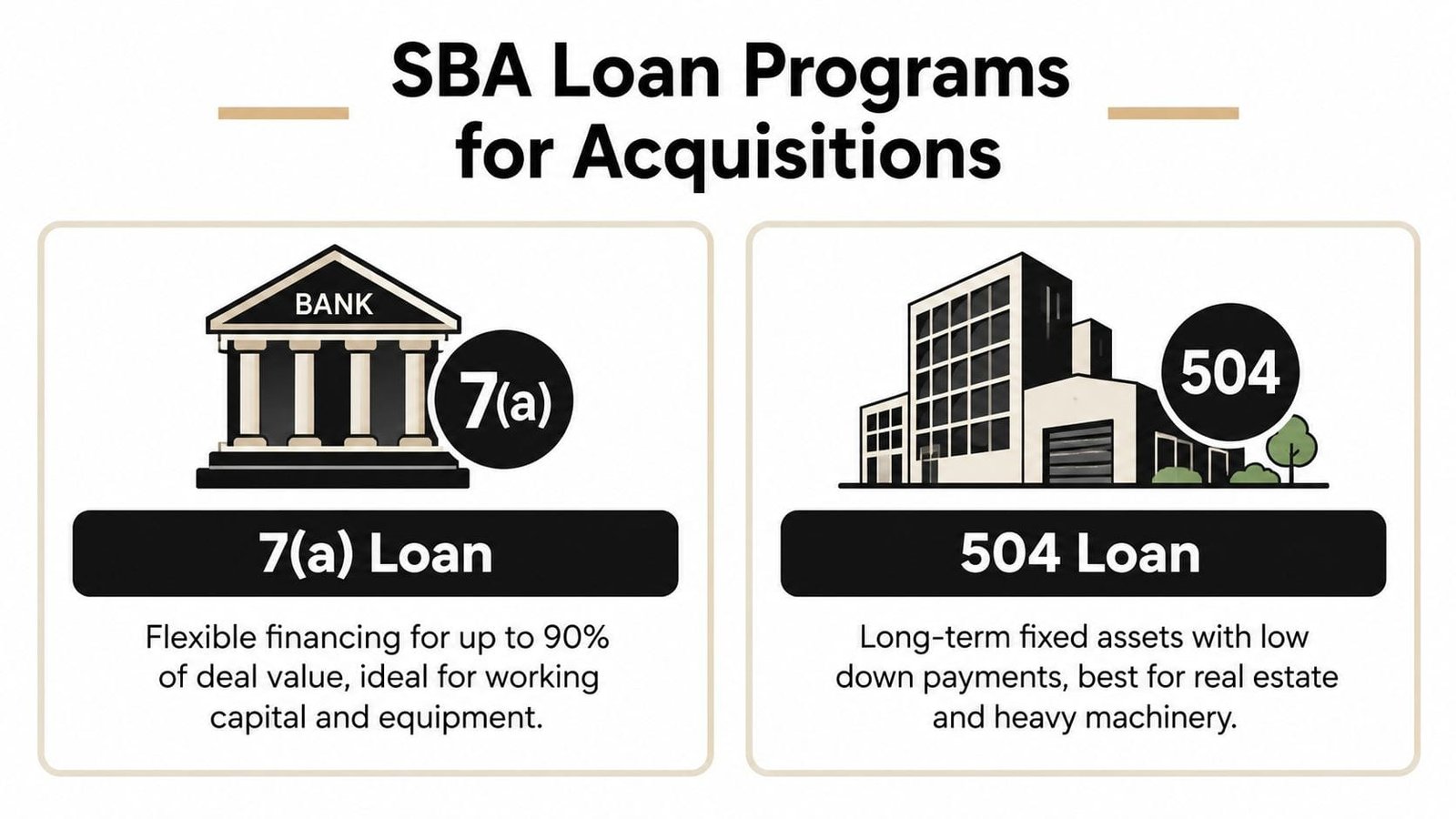
The SBA 7(a) program is generally the more flexible choice for buying an operating business. It can support a broader acquisition package, including the business purchase, working capital, equipment, and eligible transaction costs. The standard maximum loan amount is up to $5 million, and business acquisition debt commonly carries a 10-year repayment term. If the project includes real estate, the term can extend to 25 years. These parameters are outlined in the SBA's growth guidance for small businesses.
The longer repayment period matters because a buyer often faces expenses immediately after closing. A lower annual debt burden can leave more cash available for payroll, repairs, marketing, inventory, or integration. The lender will still size the loan around the company's projected operating cash flow, not merely the value of its equipment or other collateral.
When 7(a) fits the transaction
A 7(a) structure is usually appropriate when the purchase includes goodwill, customer relationships, inventory, working capital, or a combination of operating assets. It can also support certain ownership transfers, provided the buyer and transaction meet SBA and lender requirements.
Think of 7(a) as a flexible acquisition budget. Instead of arranging separate financing for the business purchase and post-close operating needs, the lender may evaluate an eligible package as one transaction. That can simplify the capital plan, although every proposed use of funds must be documented and approved.
When 504 deserves consideration
The SBA 504 program is more closely associated with long-term financing for major fixed assets, such as commercial real estate or substantial machinery. It may be relevant when the real estate is central to the acquisition and the transaction can be separated into an operating-business component and a fixed-asset component.
It's not automatically the right fit for a purchase dominated by goodwill or working capital. Ask the lender whether a 504 structure can accommodate the asset mix, ownership arrangement, and operating needs of your deal. For a more detailed comparison, review this guide to SBA 7(a) versus 504 financing.
The decision should follow the transaction rather than the other way around. If the value lies mainly in an operating company and its cash flow, start with 7(a). If a large portion of the project involves eligible real estate or heavy fixed assets, ask whether 504 financing creates a better long-term structure.
The Step-by-Step SBA Acquisition Loan Process
An acquisition loan becomes easier to manage when you treat it as a sequence of decisions rather than one large application.
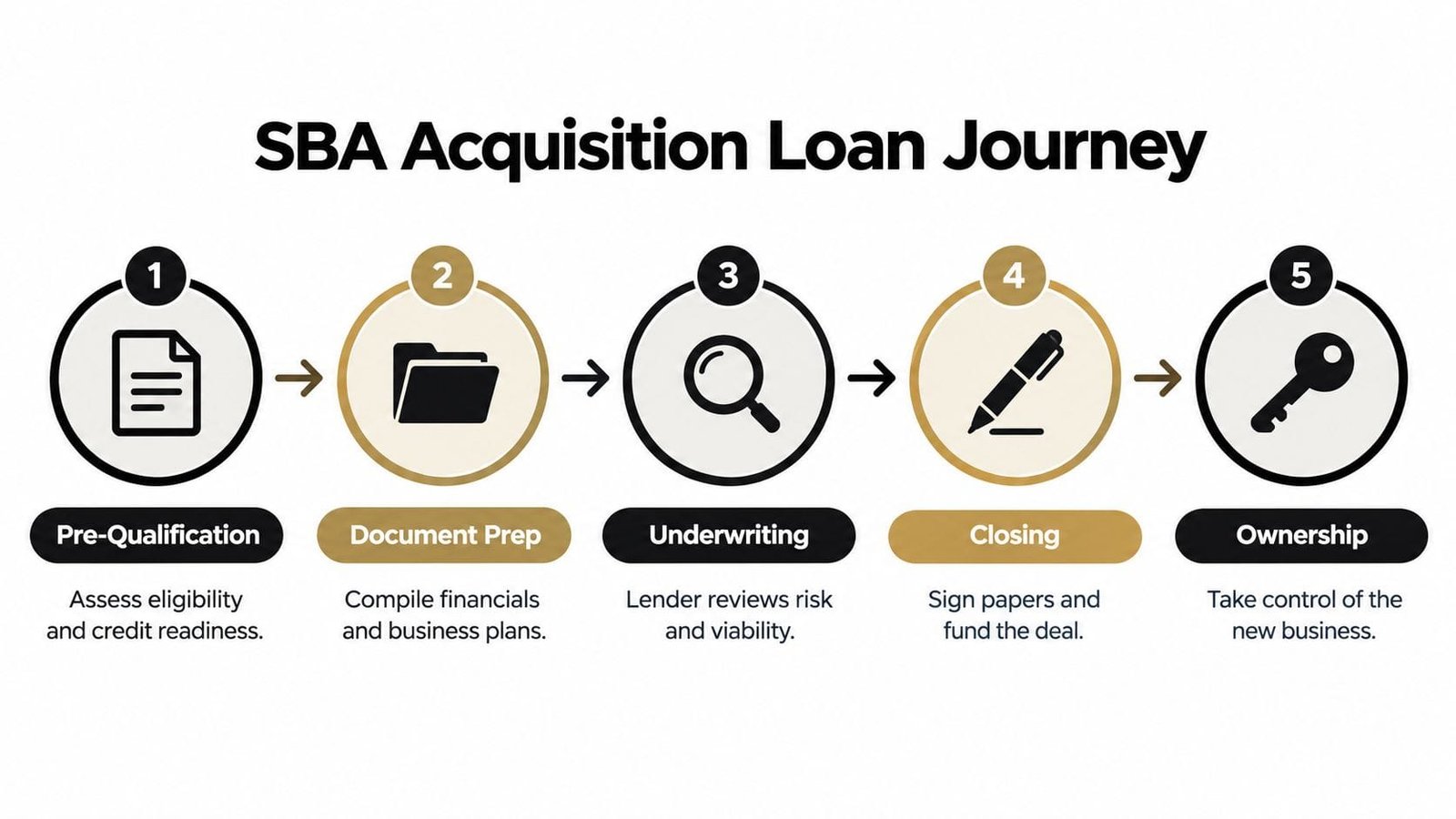
1. Pre-qualification
Start with your personal financial profile, relevant operating experience, available equity, and the target company's earnings. A lender can help identify whether the proposed purchase appears supportable before you commit to an aggressive offer.
Pre-qualification isn't approval. It's an early reality check that can keep you from negotiating a purchase price the business cannot service.
2. Document preparation
Collect the seller's financial statements, tax records, debt information, lease documents, customer and supplier details, and proposed purchase terms. Prepare your personal financial information, résumé, business plan, and explanation of how you'll manage the company.
Organize documents by category and label each file clearly. Missing or inconsistent records create avoidable questions during underwriting.
3. Due diligence and underwriting
The lender tests whether the historical earnings are transferable and whether the business can repay the proposed debt after the transaction. The review may include a valuation, financial analysis, legal diligence, management assessment, and verification of the sources and uses of funds.
Optimistic projections receive the most scrutiny here. A lender may ask what happens if revenue softens, a key employee leaves, or the seller's role ends sooner than expected.
4. Closing
After approval, you'll satisfy final conditions, sign the loan and purchase documents, confirm equity funding, and coordinate the transfer of ownership. The purchase agreement, seller note, leases, insurance, licenses, and transition arrangements must all align.
Use this business acquisition loan resource to keep the financing discussion focused on the complete transaction, rather than only the amount paid to the seller.
5. Ownership and transition
At closing, you become responsible for operations, employees, customers, vendors, and debt service. A written transition plan should identify what the seller will do, for how long, and how knowledge will transfer.
A smooth closing is not the finish line. It's the point at which your underwriting assumptions become operating responsibilities.
How Equity Requirements Have Changed for 2025 and 2026
The familiar rule for a full acquisition is a 10% equity injection, but buyers shouldn't assume every ownership change is treated identically. In June 2025, SBA rules allowed a structure in which the buyer contributes 5% cash and the seller provides the remaining 5% as a fully standby note, preserving the overall 10% equity requirement while reducing the buyer's immediate cash need. The SBA acquisition lending guidance summarized here describes the broader role of change-of-ownership financing and this policy milestone.
The distinction between deal types became more important under SOP 50 10 8.1. Recent coverage describes tighter treatment for full change-of-ownership transactions, stricter standby expectations for seller notes, and potentially different treatment for owner buyouts. The exact result depends on the transaction structure and lender interpretation, so buyers should confirm the rule before signing final documents. This 2026 analysis of acquisition underwriting changes explains why the same assumed down-payment formula may not apply across all ownership transfers.
SBA acquisition equity requirements by deal type
| Deal type | Buyer cash required | Seller note allowed | Additional requirements |
|---|---|---|---|
| Initial full acquisition | Usually 10% total equity. A qualifying structure may use 5% buyer cash and 5% seller standby note. | The seller note must meet applicable standby conditions and lender requirements. | Full ownership transfer, defensible valuation, repayment analysis, and stronger review of the buyer's post-close liquidity. |
| Partial ownership change | Requirements can differ from a first-time full acquisition. | May be available, but treatment depends on the ownership change and current SBA and lender rules. | Confirm whether the transaction is classified as a change of ownership, partner buyout, or another structure before setting the capital plan. |
| Owner buyout | Don't assume the initial-acquisition formula applies. | Treatment may differ under current underwriting standards. | Obtain a lender's classification of the transaction early and document the remaining ownership, control, and repayment structure. |
The practical lesson is simple: structure the equity conversation before you negotiate the final purchase agreement. A seller note that looks acceptable in a preliminary discussion may fail to count as equity if its payment terms don't meet standby requirements.
Essential Documentation for a Successful Acquisition Application
A lender needs to understand three connected stories: what the business has earned, what you're paying for it, and how the company will perform after the transfer. A strong application makes those stories agree with one another.
For many acquisitions, lenders review at least three years of the target business's financial records and examine cash-flow coverage. They may also require a third-party valuation for transactions above $250,000, particularly to test whether goodwill and other intangible value support the proposed price. The acquisition lending documentation guidance from FNB describes these review practices.
Build the financial file first
Include the target's tax returns, profit-and-loss statements, balance sheets, debt schedule, bank statements, and explanations for unusual items. Then prepare a normalized earnings analysis that separates recurring operating performance from expenses or revenue that won't continue after closing.
Your personal file should include a personal financial statement, tax records, credit history, résumé, and evidence of relevant management experience. The lender isn't only buying the business with you. The lender is assessing whether you can operate it.
Add the transaction documents
A complete package typically includes the letter of intent, purchase agreement draft, allocation of the purchase price, seller financing terms, lease information, inventory details, equipment lists, and a schedule showing exactly how loan proceeds will be used.
For larger acquisitions, recent reporting indicates that quality-of-earnings reports are required for acquisition loans of $3 million or more under the newer underwriting approach. The 2026 market reporting on SBA documentation and credit scrutiny also discusses additional cash-flow and debt-service review.
Underwriting insight: Don't hide a weak month. Explain it, reconcile it, and show whether it changes the recurring earnings used to support repayment.
Package the documents in a logical order, reconcile figures across tax returns and financial statements, and address discrepancies before the lender finds them. A clean file doesn't guarantee approval, but a disorganized file makes confidence harder to establish.
For a practical document checklist, use this guide to the documents lenders request.
Why SBA Acquisition Lending Is Booming Right Now
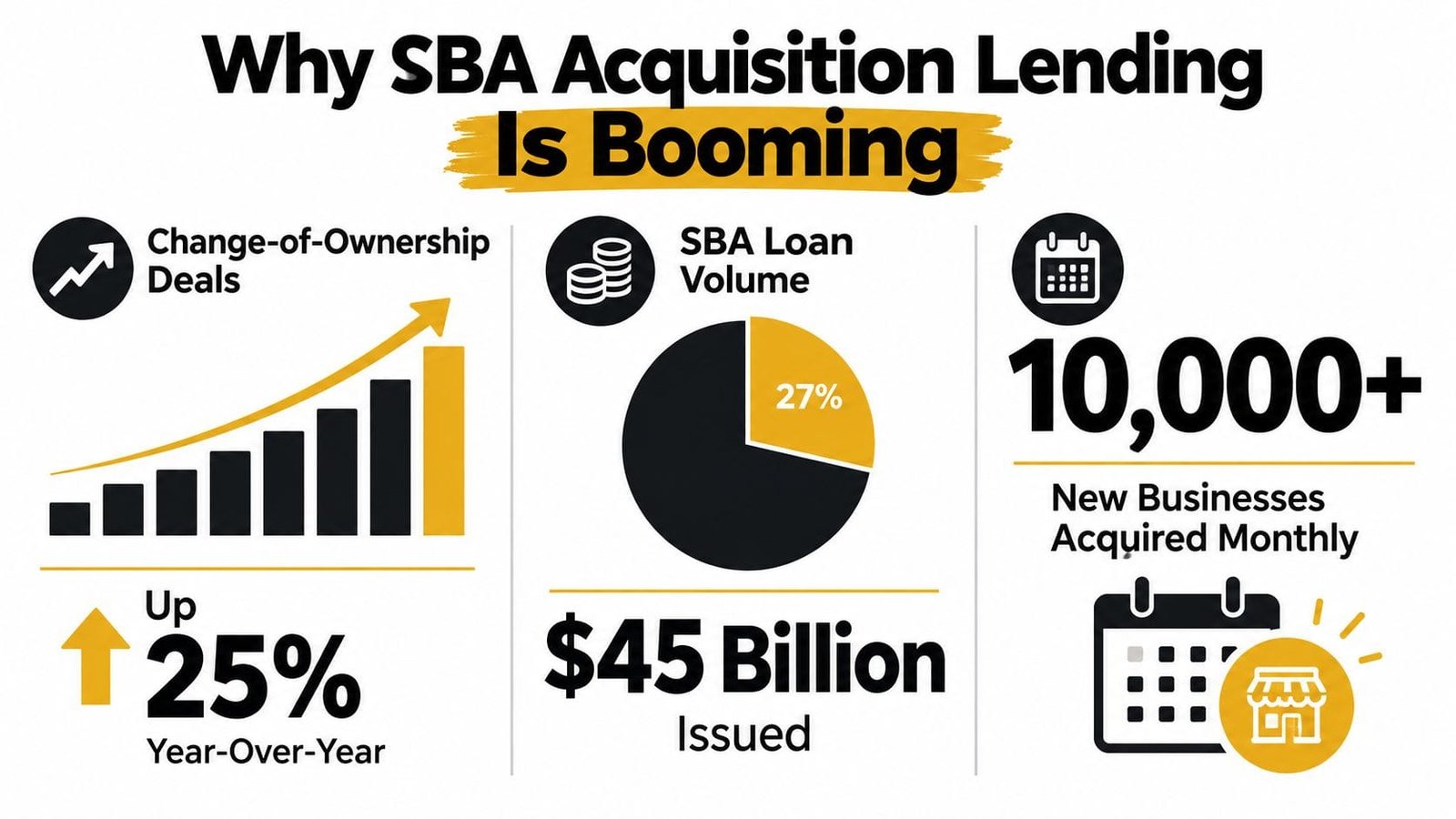
Change-of-ownership financing has become a substantial channel within small-business credit. Independent analyses of SBA data report approximately $7.71 billion across 6,627 approvals in fiscal year 2025, compared with $5.87 billion and 5,348 approvals in FY2024. Average approval size rose from approximately $1.10 million to $1.16 million over that comparison. The SBA acquisition lending report presents these figures and places them within the larger 7(a) program.
Another analysis using SBA activity data reports approximately $8.29 billion across 7,003 acquisition loans in FY2025, representing year-over-year growth of about 34.6%. The difference between the reported totals reflects differences in methodology and the transactions included, but both sources point to the same conclusion: acquisition lending is active and material, not a fringe use of SBA capital.
Why buyers should care about the activity
More acquisition activity can create opportunity for qualified buyers, but it can also increase competition for attractive companies. Sellers may receive multiple offers, and lenders may have less patience for incomplete financials, unsupported projections, or unclear ownership structures.
The wider 7(a) program is much larger than acquisition finance alone. The SBA reported 78,078 total 7(a) approvals totaling approximately $37.3 billion in FY2025, which shows that acquisition loans compete within a broad federal small-business credit system. The data doesn't guarantee that any individual buyer will receive financing.
Timing matters because a buyer who begins lender discussions early can identify equity, valuation, and documentation problems before becoming contractually committed. An active market rewards preparation, not just enthusiasm for the target company.
Proven Tips for Packaging Your Acquisition Deal
A lender should be able to understand your deal after reading the executive summary and reviewing the supporting file. If the reader has to reconstruct the purchase price, equity sources, seller financing, and post-close cash position, the package needs work.
Show the business after closing
Explain who will manage daily operations, which seller responsibilities will transfer, and how you'll retain customers and employees. Tie each assumption to evidence from the company's records rather than relying on broad growth claims.
Set out a conservative cash-flow model. Show debt service, payroll, rent, taxes, maintenance, inventory, and planned working capital. If the business needs a significant cash cushion after closing, include it in the sources-and-uses discussion rather than treating it as an afterthought.
Make the seller note precise
A seller note can help bridge a funding gap, but its treatment depends on its legal terms and the applicable SBA rules. State the principal, interest, payment schedule, maturity, and standby conditions clearly. Don't describe a note as equity until the lender confirms that it qualifies.
Present your experience honestly
A first-time buyer can still be credible, particularly when the operating plan includes experienced managers, industry advisors, or a structured seller transition. Focus on transferable skills, financial discipline, hiring plans, and the specific responsibilities you'll assume.
Keep your personal liquidity separate from funds committed to the purchase. The lender wants to see that you can close the transaction and still handle ordinary surprises after taking control.
Getting Started with Your SBA Acquisition Loan
Begin by separating the transaction into four questions:
- Can you operate the business? Match your experience to the company's customers, systems, staffing, and industry requirements.
- Can the business repay the debt? Analyze normalized cash flow, existing obligations, transition expenses, and working capital needs.
- Is the price supportable? Prepare for an independent valuation and be ready to explain goodwill.
- Can you fund the equity and remain liquid? Identify buyer cash, any proposed seller note, closing costs, and the reserve needed after ownership transfers.
Speak with an SBA-experienced lender before finalizing an offer. Early review can expose classification issues, seller-note limitations, valuation concerns, or cash-flow weaknesses while you still have room to renegotiate.
A digital lending platform can also help organize an application, connect financial accounts, provide pre-approval checks that don't affect credit, and give you a secure place to track requests and communicate with underwriters. Those tools don't replace diligence or lender approval, but they can make the document-collection process easier to manage.
The most durable acquisition plans combine a realistic purchase price with a clear operating plan and enough liquidity to handle the transition. Don't measure success only by getting to closing. Measure it by whether the business can serve customers, retain employees, and meet its obligations after you take ownership.
Business Loan Warrior offers SBA loan processing and business acquisition financing support through a digital application process that can help you check pre-approval options, organize financial information, and track progress in a secure dashboard. If you're evaluating an existing-business purchase, visit Business Loan Warrior to begin the financing conversation.