
Maria signed a lease for a 4,000-square-foot storefront in February. Her restaurant build-out needs new HVAC, a grease trap, and a walk-in cooler before the planned August opening. Her bank won't approve a conventional term loan because the finished collateral doesn't exist yet, while the SBA route seems designed for a business that's already operating and producing revenue.
That's the central challenge behind understanding how construction loans work. A traditional business loan finances assets, inventory, or operations that already exist. A construction loan finances the process of creating something valuable, so the lender must control not only the borrower's finances, but also the budget, contractor, timeline, inspections, and paperwork.
Table of Contents
- Why Construction Loans Feel Different From Any Other Business Loan
- The Core Idea Behind Construction Financing
- The Four Main Types of Construction Loans
- How Lenders Underwrite a Construction Project
- How Draw Schedules and Inspections Actually Work
- Costs, Timelines, and How 2026 Lending Conditions Changed the Math
- Risks That Derail Construction Loans and How to Mitigate Them
- Your Applicant Checklist and How Business Loan Warrior Speeds Up Funding
Why Construction Loans Feel Different From Any Other Business Loan
A term loan usually has one closing. The lender approves the borrower, documents the collateral, transfers the proceeds, and begins collecting scheduled payments. Construction financing has a similar initial closing, but the lender makes funding decisions repeatedly as the project advances.
For Maria, that means the lender won't deposit the full build-out budget into her operating account. The lender may approve a total facility, then release portions after the contractor completes defined work and an inspector verifies it. Her financing becomes connected to the physical progress of the restaurant.
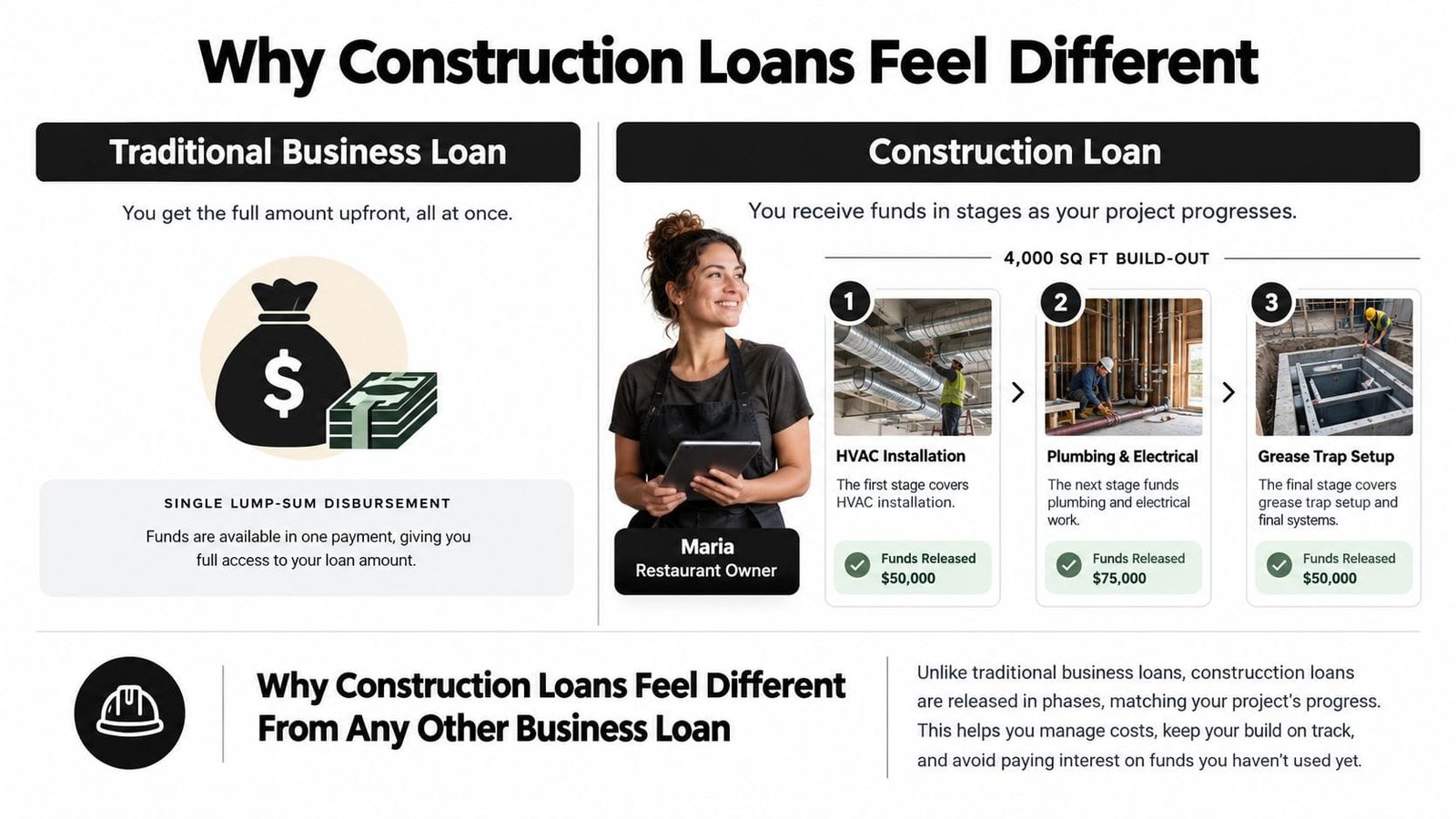
The collateral is still being created
The lender's risk changes throughout the build. At the start, the project may consist mostly of plans, permits, a lease or land interest, and a signed contractor agreement. Later, it includes installed equipment, completed walls, functioning systems, and eventually a usable commercial property.
That progression explains why construction lenders typically require third-party inspections, detailed budgets, contingency planning, and stronger reserves than a lender might require for ordinary working capital. The lender wants evidence that each advance has created identifiable value and that enough money remains to finish the job.
Practical rule: A construction loan isn't just a financing product. It's a monitored project budget with a credit facility attached.
The operational burden can surprise first-time borrowers. Maria still has to manage her architect, contractor, permits, vendors, payroll, and opening schedule. She also has to submit draw requests, collect lien waivers, update budgets, answer inspection questions, and resolve discrepancies before the lender releases the next advance.
One project becomes two
The restaurant build-out is Maria's main project. The draw process becomes a second project running beside it. A delayed invoice, incomplete waiver, missing change order, or disagreement about whether work is complete can interrupt cash flow even when the construction itself is progressing.
That's why borrowers should ask about draw administration before signing loan documents. Find out who orders inspections, which documents must accompany a request, how quickly the lender reviews a package, whether retainage applies, and what happens when the contractor submits work that doesn't match the approved budget.
The Core Idea Behind Construction Financing
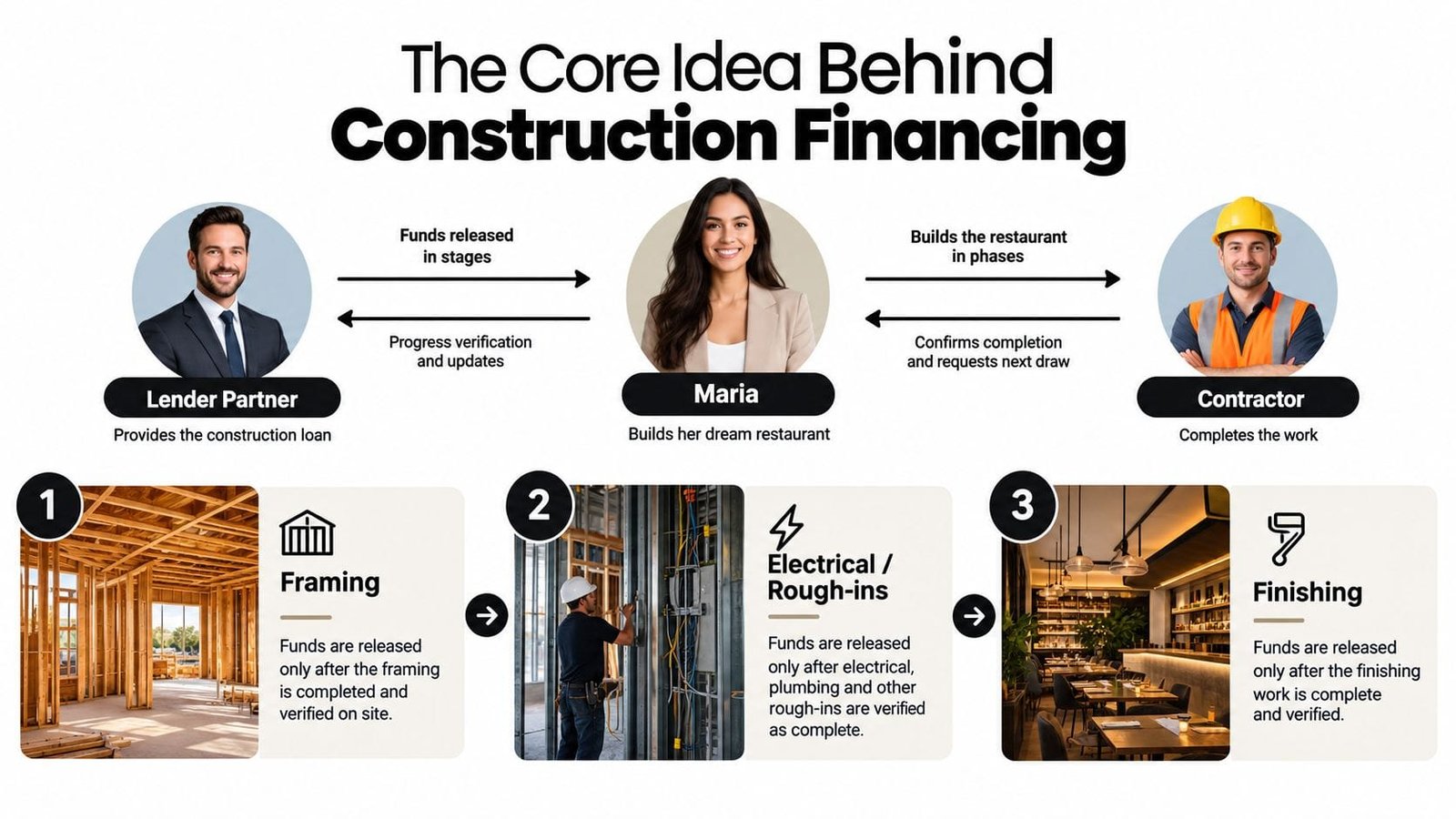
A construction loan is a short-term facility that pays for work as the project moves forward. The lender commits an approved amount, but the borrower accesses that amount in stages. Each stage corresponds to work that can be identified, priced, inspected, and reconciled against the construction budget.
Maria's lender might approve funding for the restaurant's full build-out, but the contractor won't receive every dollar on day one. Money may be released after framing, rough plumbing and electrical work, equipment installation, interior finishes, and final completion. The exact milestones depend on the project and the lender's agreement.
Three mechanics control the loan
Interest usually applies to the drawn balance, not the unused commitment. If the lender has approved a facility but only part has been advanced, the borrower generally pays interest on the amount outstanding. As additional draws increase the balance, accrued interest rises proportionally. Construction-loan guidance on staged funding and interest explains why borrowers often include an interest reserve in the project budget.
The maturity follows the build. A construction loan isn't structured like a conventional business loan with a long amortization schedule from the first day. The construction phase ends when the work is complete, the required approvals are issued, and the borrower either converts the balance to permanent financing, pays it off, or sells the completed project.
The lender underwrites completion risk. The key question isn't only whether Maria can make payments. It's whether the approved money, her equity, and the project's projected value are enough to create a finished asset that supports repayment.
Loan-to-cost matters early
Construction lenders usually focus first on loan-to-cost, or LTC. LTC compares the proposed loan with the total project cost. Guidance for ground-up projects commonly places construction LTC around 65% to 75%, while some lender structures extend to roughly 75% to 90% depending on lender type and risk profile. Construction lending guidance on LTC, LTV, and draw schedules explains why the borrower's equity contribution matters.
Loan-to-value, or LTV, becomes more important when the lender evaluates the completed property. The lender compares the proposed debt with the as-complete value, but that value remains an estimate until the project is finished. LTC protects the lender against cost overruns, while LTV helps protect against a disappointing finished valuation.
The Four Main Types of Construction Loans
The right structure depends on what you're building, who will occupy it, and what you'll do with the property after completion. Maria may want one facility that becomes permanent financing. A developer building inventory for sale needs a different repayment strategy.
Construction-to-permanent loans
This structure combines the construction phase with a permanent loan. After completion and the required approvals, the construction balance converts under the agreed terms. It can suit an owner-occupant who wants a coordinated financing plan instead of arranging a second lender at the end.
The trade-off is reduced flexibility. The borrower should understand the permanent rate, conversion conditions, appraisal requirements, and whether the lender will hold the loan or require another takeout arrangement.
Stand-alone construction loans
A stand-alone facility funds the build only. At completion, the borrower repays it through permanent financing, a sale, or another source of capital. Developers and experienced borrowers may choose this structure when they want to shop separately for construction pricing and permanent debt.
It creates another deadline, however. A borrower must arrange the exit before the construction maturity arrives, not after the project has already run out of time.
Owner-builder loans
An owner-builder loan supports a borrower who acts as the general contractor. Because the borrower assumes responsibility for scheduling, subcontractors, procurement, budget control, and quality, the lender examines construction experience and project-management capacity closely.
This option can fit an experienced builder, but it's a difficult structure for a business owner whose expertise is restaurant operations, retail, or professional services rather than construction.
Developer and speculative construction loans
These loans finance projects intended for sale or lease rather than the borrower's own occupancy. Underwriting focuses heavily on the project, contractor, market demand, absorption assumptions, cost controls, and repayment through sales or refinancing.
| Loan Type | Best-Fit Borrower | Underwriting Focus | Term / Conversion |
|---|---|---|---|
| Construction-to-permanent | Owner-occupant or long-term property owner | Borrower, project, and permanent repayment | Construction phase converts to permanent financing |
| Stand-alone construction | Experienced developer or investor | Project execution and exit financing | Construction loan is paid off or refinanced |
| Owner-builder | Qualified construction professional | Builder experience and self-managed execution | Depends on lender and project completion |
| Developer or speculative | Builder creating inventory for sale or lease | Market demand, budget, contractor, and exit | Repaid through sale, refinance, or operating income |
How Lenders Underwrite a Construction Project
A construction lender underwrites two connected risks. The first is borrower risk, including repayment capacity, liquidity, credit history, and financial strength. The second is completion risk, meaning whether the proposed team can deliver the project within the approved cost and schedule.
The ratios come first
The lender compares the requested debt with total project cost through LTC analysis. It also reviews LTV against the expected as-complete value. A project can look attractive under one ratio and weak under the other. For example, a controlled budget doesn't solve the problem if the completed property appraises below expectations.
The lender also wants meaningful borrower equity. Equity gives the owner an economic reason to solve problems rather than abandon the project, and it provides a cushion before the lender's capital is exposed to the full cost of completion.
The document package tells the story
Expect the lender to request a signed construction contract, plans and specifications, a detailed budget, contractor information, permits or permit status, title materials, and financial statements. Commercial borrowers may also need a market or feasibility study that supports the project's intended use.
The budget should separate hard costs, such as labor and materials, from soft costs, such as design, permits, financing, and professional fees. The lender wants to know what has been committed, what remains estimated, and which costs could move.
For a broader explanation of how lenders organize financial and operational review, the BatchData underwriting overview provides useful context. Borrowers can also compare project-specific documentation expectations in this guide to construction loan requirements.
| Document or Ratio | Typical Lender Requirement |
|---|---|
| Loan-to-cost | Analysis of requested debt against total project cost |
| Loan-to-value | Review of debt against the projected as-complete value |
| Construction contract | Signed agreement with defined scope and pricing method |
| Plans and specifications | Sufficient detail for cost and feasibility review |
| Project budget | Line-item hard and soft cost schedule |
| Contractor package | Experience, licensing, financial capacity, and references |
| Borrower financials | Business and personal statements, assets, liabilities, and repayment capacity |
| Title materials | Evidence of ownership, lien position, and applicable title coverage |
| Contingency | Controlled reserve for documented changes and unforeseen costs |
A lender may control contingency funds rather than making them freely available. If a change order appears, the borrower may need to provide revised pricing, an explanation, and evidence that the change is necessary before the reserve is released.
How Draw Schedules and Inspections Actually Work
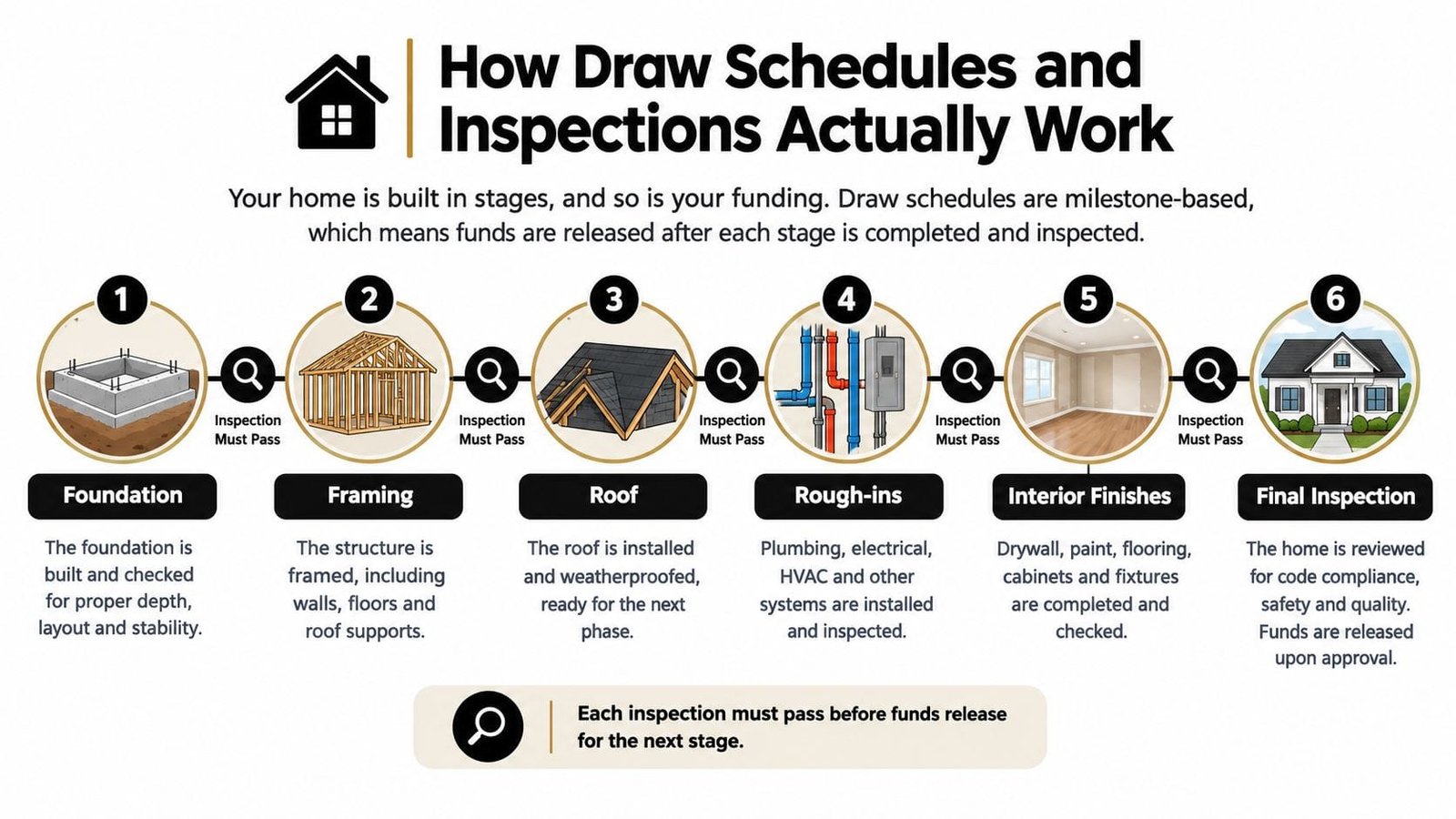
The draw schedule is the operating manual for the loan. It assigns a portion of the approved budget to milestones, then sets the evidence required before the lender advances the next amount.
A common residential schedule divides funding among foundation, framing, dry-in, mechanical, electrical and plumbing rough-in, interior finishes, and final completion or a Certificate of Occupancy. One documented schedule assigns 15% to foundation, 30% to framing, 12% to dry-in, 18% to rough-in work, 18% to interior finishes, and 7% to final completion. Residential construction draw schedule guidance shows how the percentages connect funding to verified progress.
Commercial projects can use more granular schedules. Industry guidance describes 8 to 16 draws over a 9 to 24 month build period in some commercial settings, with 5% to 10% retainage held until final acceptance. Construction draw schedule guidance for residential and commercial projects explains why commercial borrowers should negotiate the schedule before work begins.
The inspection cycle
The borrower submits a draw request with the required invoices, updated budget, schedule of values, and compliance documents. The lender then orders an inspection, either through an independent field inspector or its internal construction team.
The inspector compares visible progress with the approved budget. The lender may reconcile payments already made, apply retainage, confirm lien waivers, and calculate the amount eligible for release. If the request is incomplete, the lender may return it for correction rather than fund it.
The fastest draw is a clean draw. Treat the request as a closing package, not as a casual invoice submission.
Interest generally accrues on the cumulative amount disbursed. That reduces carrying costs early in the project, but it also means the borrower must forecast how interest will rise as more work is funded.
For practical guidance on managing cash flow in construction, focus on the timing gap between paying contractors and receiving lender advances. A detailed explanation of the construction loan draw schedule can also help owners map that gap before signing contracts.
Costs, Timelines, and How 2026 Lending Conditions Changed the Math
Construction financing costs more than the interest rate shown on a term sheet. Borrowers should review origination charges, inspection costs, title updates, legal work, appraisal fees, draw administration, and any unused-line or extension charges. The true cost depends on how long the project takes, how quickly the lender processes draws, and whether the borrower needs an extension.
The 2026 market has become more selective rather than inactive. Independent coverage reports that lenders have eased some commercial real estate terms, including higher maximum loan sizes and longer interest-only periods, while credit remains tight for acquisition, development, and construction lending. The same coverage notes higher effective interest costs for speculative and pre-sold single-family construction when lenders increased upfront points. Coverage of 2026 construction lending conditions provides the market context.
What changed for borrowers
The demand for construction capital hasn't disappeared. Outstanding one-to-four-family residential construction and land development loans reached $91.8 billion in the first quarter of 2026, up 0.8% quarter over quarter and 1.9% year over year, while credit conditions tightened slightly, according to the same coverage.
That combination creates a difficult underwriting environment. A viable project may still receive financing, but the lender's pricing, points, reserve requirements, draw controls, and completion conditions can determine whether the project works financially. Compare the full structure, not just the headline rate. The construction loan rates guide can help borrowers frame that comparison.
| Cost Component | Typical 2026 Range |
|---|---|
| Interest | Depends on lender, structure, risk, and drawn balance |
| Origination and upfront points | Varies by project quality and market conditions |
| Draw administration | May include inspection and processing charges |
| Title and legal work | Often incurred during closing and draw administration |
| Interest reserve | Budgeted to cover carrying costs during construction |
| Extension cost | May apply if the project exceeds the approved term |
A lender may offer more flexible terms while requiring stronger reporting or a larger equity contribution. Another lender may quote a lower spread but impose tighter draw conditions. Ask for a complete sources-and-uses schedule and a written explanation of every condition tied to the first and subsequent draws.
Risks That Derail Construction Loans and How to Mitigate Them
Construction loans fail operationally when the borrower runs out of money, time, documentation, or lender confidence. The strongest protection is to identify the failure point before the first draw.
| Risk | How It Derails the Loan | Mitigation Strategy |
|---|---|---|
| Cost overrun | The approved budget no longer covers completion | Maintain a controlled contingency and document changes early |
| Schedule delay | Interest and overhead continue while the project remains unfinished | Set realistic milestones and monitor the critical path |
| Contractor or subcontractor default | Work stops and the lender may pause advances | Review contractor capacity and use appropriate bonding where available |
| Appraisal shortfall | The completed value may not support the planned debt | Validate the market and order an early feasibility review |
| Draw dispute | Missing waivers, invoices, or inspection evidence delays funding | Pre-clear documentation and keep the schedule of values current |
A fixed-price general contract can reduce budget uncertainty, although it won't eliminate change orders or owner-requested upgrades. Borrowers should also ask whether payment and performance bonds are appropriate for major subcontractors and how the lender handles replacement contractors.
A partial draw freeze is often a documentation problem before it becomes a credit problem. Keep lien waivers current, submit change orders before the work begins, and ask the construction inspector to review unusual items early. The construction risk management guide offers additional perspective on organizing project controls.
Every risk eventually appears in the draw process. A cost problem becomes a budget variance. A schedule problem becomes an incomplete inspection. A contractor problem becomes an unpaid invoice or missing waiver. Borrowers who manage those signals early are more likely to preserve the funding cadence.
Your Applicant Checklist and How Business Loan Warrior Speeds Up Funding
Before applying, assemble the project file in the order a lender will review it:
- Site control: Signed purchase agreement, land contract, lease, or other evidence of the property interest.
- Design package: Architectural plans, specifications, permits, and the intended project scope.
- Construction agreement: Contractor contract with a line-item budget, payment terms, and change-order process.
- Financial documentation: Business bank statements, tax returns, personal financial statement, and proof of available equity.
- Repayment plan: Permanent financing, sale, lease-up, or operating-income strategy after completion.
- Project controls: Draw schedule, contingency policy, inspection process, and retainage terms.
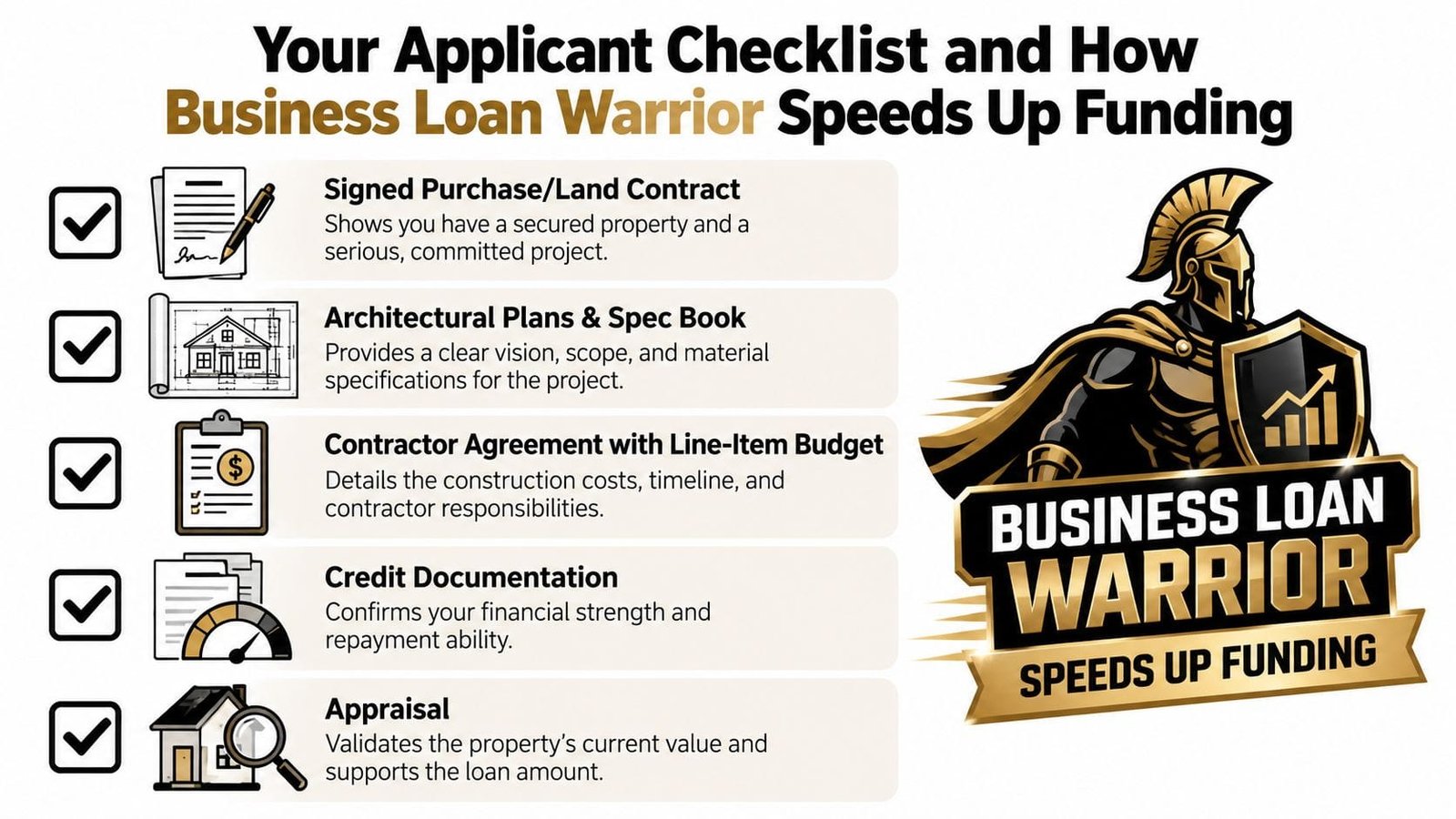
Business Loan Warrior offers a digital application for business funding, including construction and remodeling uses, with document collection, bank-account connection, approval tracking, and access to underwriters. That workflow can help an owner organize the project facts before a lender evaluates LTC, the draw schedule, contingency, and repayment strategy.
Start by uploading the plans, contractor agreement, budget, and financial records. Ask the lender to identify missing documents and draw conditions before you commit the contractor to a schedule.
Business Loan Warrior offers construction and remodeling financing options through a digital application designed to organize documents and connect borrowers with funding partners. Visit Business Loan Warrior to review your options and begin preparing your project for underwriting.