
Most construction-loan guides tell you to focus on the down payment. That's the wrong starting point. The question is: how much cash and documentation will you need from closing through the final draw?
A lender isn't financing a finished building. It's financing a plan, a contractor, a budget, a schedule, and an exit that may not exist yet. The headline requirements, such as credit, equity, loan-to-cost, and debt-service coverage, matter. They're just the entry screen. The deal usually breaks on lender overlays, weak project history, incomplete permits, thin liquidity, or a budget that doesn't survive scrutiny.
This guide takes the lender's view. If you're building an owner-occupied facility, expanding a business, or pursuing a commercial project in the $20M to $50M revenue range, you need to plan for the entire cash burden and the administrative friction, not just the advertised minimum. For a practical foundation, review this resource on navigating construction loan basics, then approach the lender with a project that has already been stress-tested.
Table of Contents
- What Lenders Actually Underwrite: Cash, Guarantees, and the Exit
- How Construction Lending Works: Draws, Verification, and Takeout
- Standard Lender Conditions and Underwriting Thresholds
- The Documentation Checklist That Gets Loans Approved
- Comparing Bank Construction Construction-to-Permanent and SBA Loans
- Sample Scenarios for Small and Mid-Market Borrowers
- How to Strengthen Your Approval Odds Before You Apply
What Lenders Actually Underwrite: Cash, Guarantees, and the Exit
The lender's first question is not “How much is the down payment?” It is whether you can carry the project from closing through the final draw, including overruns, delayed reimbursements, guarantees, reserves, and documentation demands.
For many residential construction loans, lenders commonly seek 20% to 25% down, although some programs allow 5%, and government-backed options may reach 3.5% or even 0% for qualified borrowers. Lenders often pair that equity requirement with a credit score near 620 to 680 and a debt-to-income ceiling around 45%, according to LendingTree's construction-loan overview. A $400,000 construction-to-permanent loan at a 20% down-payment level implies roughly $80,000 in upfront equity before closing costs and reserves.
That equity is only the opening cash requirement. You may also need money for contingency, interest carry, site surprises, change orders, delayed draws, and operating liquidity. Commercial lenders commonly underwrite construction facilities at 65% to 75% loan-to-cost, leaving the borrower responsible for the remaining 25% to 35% through equity or subordinate capital.
Your personal and business guarantees can matter just as much as the stated equity. The lender wants evidence that you can fund overruns without interrupting payroll, vendor payments, or existing debt service. For an owner-occupied facility or a mid-market build in the $20M to $50M revenue range, that means protecting operating cash while the project consumes attention and capital.
Three risks decide the approval
Your financial capacity: Can you absorb cost increases and timing gaps without weakening the business? Can you keep making payroll, paying vendors, and servicing current obligations?
The project: Is the scope complete? Are the costs credible? Does the builder have the staffing, insurance, experience, and balance sheet to finish the work?
The exit: Will the completed property support permanent debt, owner occupancy, a sale, a refinance, or another documented repayment path?
Practical rule: An application that explains only why you deserve the loan is incomplete. Show why the project will finish and how the lender gets repaid.
A favorable rate will not rescue a poorly controlled project. Documentation friction causes more trouble: inspections, reserve conditions, title defects, environmental reports, lender-specific forms, and draw disputes. Review navigating construction loan basics, then submit a project-finance package built around cash control, completion evidence, and a credible exit.
How Construction Lending Works: Draws, Verification, and Takeout
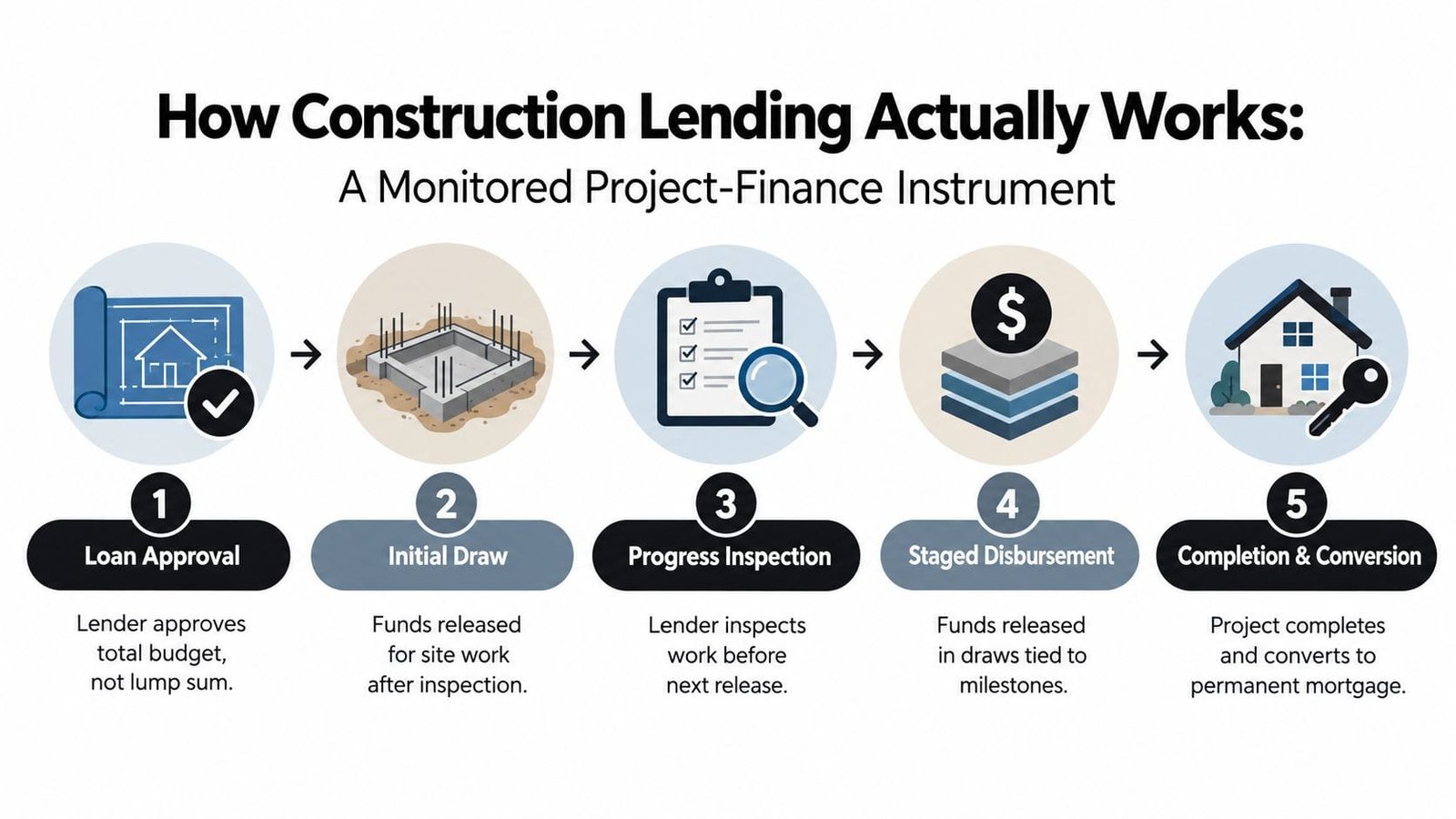
A construction loan is controlled project financing, not a lump-sum advance. The lender approves the budget and total commitment, then releases funds through staged draws tied to verified work. That process is the lender's main protection against paying for an incomplete or poorly managed project.
The sequence usually works like this:
- Approval and closing. The lender reviews the borrower, plans, builder, budget, appraisal, permits, title, insurance, and repayment strategy.
- Initial funding. After required conditions are satisfied, the first draw may cover eligible early work, including site preparation.
- Progress verification. A third-party inspector reviews completed work and compares it with the approved budget and schedule.
- Draw approval. The lender releases the next amount only after confirming that the request matches completed work and that earlier funds were used properly.
- Completion and takeout. Once the project is finished and receives required occupancy approval, the loan converts to permanent financing or is repaid through a refinance, sale, or another documented source.
Your cash flow carries the timing risk. Contractor invoices may arrive before an inspection is complete, while an approved inspection may still be followed by lender processing time. Keep enough liquidity to bridge those gaps without disrupting payroll, vendors, or existing debt service.
Pure construction versus construction-to-permanent
A pure construction loan is short-term debt. At completion, you must repay it with permanent mortgage proceeds, sale proceeds, or another refinance. That leaves you exposed to future interest rates, appraisal results, and qualification requirements.
A construction-to-permanent loan combines the building phase with long-term financing. With a one-close structure, the construction facility converts into permanent debt after completion, provided the agreed conversion conditions are met. Construction-loan guidance commonly includes 6 to 12 months of PITI reserves, documented plans, permits, and a licensed builder. The construction-loan explanation from Opendoor describes both staged draws and the one-close structure.
Interest is generally calculated on the amount drawn, not the full commitment. As more funds are released, the carrying cost rises. Construction terms may run from 6 to 24 months, depending on the product and project, so build time into the schedule for inspections, weather, permitting, material delivery, and punch-list work.
Use this construction loan draw schedule guide to align milestone funding with the actual construction sequence. An optimistic spreadsheet will not prevent a draw delay. Your operating cash must cover the difference.
Standard Lender Conditions and Underwriting Thresholds
Lenders do not approve construction loans because a project looks profitable on paper. They approve them when the borrower can absorb delays, cost overruns, weak early cash flow, and a failed takeout without losing control of the project. Requirements vary by property type, but the barrier is project-risk underwriting and each lender's overlay.
Residential underwriting centers on credit, income, DTI, down payment, and completed value. Commercial underwriting gives greater weight to LTC, feasibility, sponsor liquidity, builder performance, guarantor strength, and stabilized property economics. For an owner-occupied or mid-market borrower, the cash burden also includes reserves, contingency, interest, and the documentation needed to support every draw.
The figures below are benchmarks, not approvals. A lender can tighten any threshold based on location, property type, borrower strength, or construction complexity.
| Metric | Residential Construction | Commercial Bank Construction | SBA 504 / 7(a) |
|---|---|---|---|
| Upfront equity or down payment | Commonly 20% to 25%, with some programs allowing 5% and government-backed options reaching 3.5% or 0% for qualified borrowers (LendingTree) | Commonly 25% to 35% of total project cost when lenders use 65% to 75% LTC | Varies by program and lender overlay. Advertised equity may be lower, but reserves and contingency still add to the cash required (AmeriSave) |
| Credit | Often near 620 to 680, depending on program | Strong sponsor and guarantor profiles are often required. Current commercial coverage cites 700+ personal credit for guarantors (CLS CRE) | SBA requirements sit alongside lender standards, including financial verification for all SBA loans regardless of size |
| DTI or DSCR | DTI may be capped around 45% | Stabilized DSCR commonly around 1.25x to 1.30x (MMC) | Program and lender specific, with cash-flow verification layered over SBA eligibility |
| LTC or LTV | Completed-value and collateral analysis apply | Common construction LTC is 65% to 75%, with the lower of LTC or stabilized LTV governing after completion (MMC) | Depends on structure, collateral, and lender policy |
| Reserves | Some programs require 6 to 12 months of PITI | Commercial lenders may seek liquidity equal to 10% to 20% of the loan amount in tighter underwriting environments | Reserves and documentation remain lender-specific |
| Contingency | Include a credible project buffer | Hard-cost contingency commonly 5% to 10% of hard costs (The Credit People) | Must be reflected in the budget and funding plan |
LTC matters before DSCR
During construction, the property may produce little or no operating income. Commercial lenders therefore begin with LTC, then test completed value and stabilized cash flow for the permanent takeout. DSCR becomes more useful once the building can demonstrate its expected operating performance.
A strong appraisal does not solve an LTC shortfall. If the lender caps the construction facility at a conservative LTC, you fund the gap even when the completed building should appraise well. The lender is controlling exposure to unfinished collateral and rising costs, not estimating future value.
Reserves are not decorative
Plan for the lender's total cash demand, not only the equity shown in the term sheet. Tighter commercial overlays can require 25% to 40% equity, 10% to 20% liquidity, 65% to 70% LTC caps, and 18 to 24 month interest-only periods. Those conditions can leave a profitable company short of cash after closing.
That is why operating profit alone does not carry a construction approval. The sponsor still needs comparable project experience, credible guarantor support, and enough post-closing liquidity to keep the build moving through the final draw.
The Documentation Checklist That Gets Loans Approved
A construction loan package should move cleanly between your architect, general contractor, CPA, attorney, and lender. If each party sends partial information in a different format, the underwriter sees disorder before seeing the project's strengths.
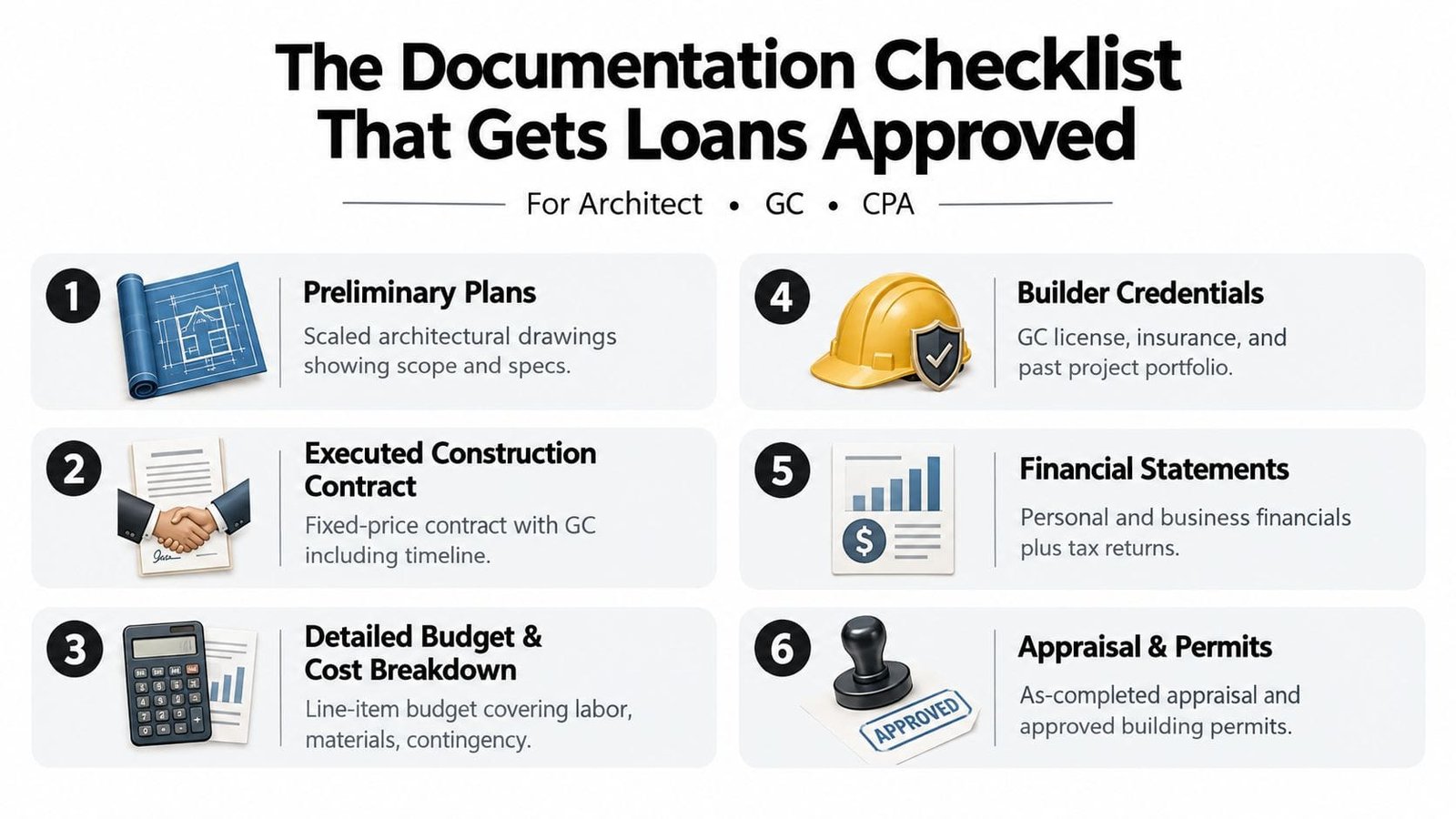
Start with the project itself. Submit preliminary or final plans, a construction contract, a detailed line-item budget, a construction timeline, zoning documentation, and permits or evidence that permits are ready. The lender needs to understand exactly what gets built, who builds it, what it costs, and what happens if the schedule slips.
Build the handoff package
- Plans and scope: Include scaled drawings, specifications, site plans, and a clear description of owner-supplied work.
- Executed builder contract: Give the lender the signed contract, payment terms, schedule, insurance, licensing, and change-order process.
- Budget and contingency: Break costs into land, site work, labor, materials, permits, professional fees, financing costs, and contingency.
- Builder credentials: Provide references, comparable project history, financial information, licenses, insurance, and evidence of completed work.
- Property and title records: Expect title commitment, survey material, lien information, zoning records, and environmental review where required.
- Valuation: Order an appraisal that addresses the completed project, not just the current land or unfinished structure.
- Borrower financials: Assemble personal financial statements, business tax returns, current-year profit and loss statements, balance sheets, debt schedules, and bank statements.
- Operating narrative: For an owner-occupied build, explain how the company will use the property, relocate operations, manage disruption, and support the projected debt service.
The most common friction points are incomplete budgets, unsigned contracts, missing permits, and a builder who can't demonstrate comparable work. Lenders also verify rather than accept. Third parties inspect progress before draws, title professionals check lien risk, appraisers test completed value, and environmental consultants may investigate site conditions.
Use a consistent document system with version control. A practical guide to real estate PDF tools can help your team combine plans, exhibits, approvals, and financial attachments into readable packages. You can also use this business-loan document checklist to organize the borrower-side file before underwriting begins.
Lender perspective: A clean package doesn't replace a strong project, but a disorganized package makes the lender work harder to find one.
Comparing Bank Construction Construction-to-Permanent and SBA Loans
The right product depends on what you value most: control, simplicity, repayment certainty, or flexibility. Don't choose based on the lowest advertised rate. Compare the full cash requirement, inspection process, fees, guarantees, covenants, and permanent-debt risk.
| Feature | Bank Construction Loan | Construction-to-Permanent | SBA 504 / 7(a) Construction |
|---|---|---|---|
| Best fit | Established businesses with strong financials and a credible project team | Owners who want one closing and a defined permanent takeout | Owner-occupied commercial projects that benefit from SBA support |
| Structure | Construction financing followed by payoff or refinance | Build loan converts into permanent mortgage after completion | SBA-backed structure layered over lender construction underwriting |
| Draw control | Detailed inspections and milestone releases | Same draw discipline, plus conversion conditions | Detailed documentation, lender oversight, and SBA compliance |
| Cash burden | Often driven by conservative LTC and sponsor liquidity | Down payment plus reserves, contingency, and conversion-related requirements | May offer lower equity for some qualified borrowers, but fees, documentation, and oversight add friction |
| Permanent financing risk | Borrower must qualify for the takeout later | Takeout is arranged at closing, subject to conversion terms | Longer-term SBA structure may help, but lender and program conditions still apply |
| Typical borrower | Local or regional company with a proven operating record | Owner prioritizing certainty and fewer closings | Owner-occupier willing to accept more process for program flexibility |
A conventional bank construction loan can be efficient when the borrower has clean financial statements, strong liquidity, and a builder the bank already trusts. The bank may still impose its own limits on borrowings, guarantees, interest-only duration, and project type.
A construction-to-permanent structure is attractive when refinancing risk would damage the business plan. It reduces the need to arrange a separate takeout later, but it doesn't eliminate underwriting. The lender still wants a credible completed value, a workable budget, and a conversion trigger that the project can meet.
SBA financing can fit an owner-occupied business that needs a long-term structure and wants to limit the equity burden where program rules and lender policy allow it. The trade-off is more verification, more forms, and less tolerance for undocumented changes.
Before you compare offers, review current construction-loan rates and structures alongside the term sheet. Ask the lender to identify every reserve, inspection, guarantee, fee, covenant, and conversion condition in writing.
Sample Scenarios for Small and Mid-Market Borrowers
Two borrowers can face the same construction loan requirements and receive completely different answers. The difference usually comes from sponsor depth, project complexity, operating history, and available liquidity.
Scenario one, a second restaurant location
An independent restaurant operator wants to build a second location with a $1.2 million project and plans to contribute 25% equity. The owner has strong personal credit but limited business history. An SBA 7(a) construction structure may fit because the project supports an operating business rather than a passive investment.
The lender still needs a fixed project scope, credible contractor, permits, detailed budget, equipment and furniture treatment, operating projections, business tax returns, personal financial information, and a clear explanation of how the existing location supports the expansion. Strong personal credit helps, but it doesn't cure a weak builder bid or an unrealistic opening schedule.
The deal usually breaks when the operator assumes the equity contribution covers everything. The borrower may still need contingency, interest carry, working capital, and enough liquidity to survive delays before the new location produces revenue. If the contractor's estimate excludes site work or permit-related costs, the lender will either resize the loan or ask the owner to fill the gap.
Scenario two, an owner-occupied industrial facility
A mid-market industrial services company in the $30 million revenue band wants a $9 million headquarters and warehouse build. The company may have substantial revenue and a strong operating history, but a regional bank will still examine sponsor liquidity, existing debt, owner-use assumptions, builder experience, environmental conditions, and the completed property's value.
The construction-to-permanent structure can reduce takeout uncertainty. It doesn't remove the need to demonstrate that the company can carry debt while construction proceeds, especially if the new facility doesn't immediately create additional cash flow.
The weak point is often not revenue. It's project history. A company can be excellent at industrial services and still lack experience managing a major ground-up build. The lender may respond with stronger guarantees, additional liquidity conditions, a lower LTC, tighter draw controls, or a requirement for an experienced construction manager.
A strong operating company isn't automatically a strong construction sponsor.
The restaurant needs to prove that a smaller business can absorb a new location. The industrial company needs to prove that a larger business can execute a complex project without weakening the existing operation. Both must show the lender a complete path from first draw to repayment.
How to Strengthen Your Approval Odds Before You Apply
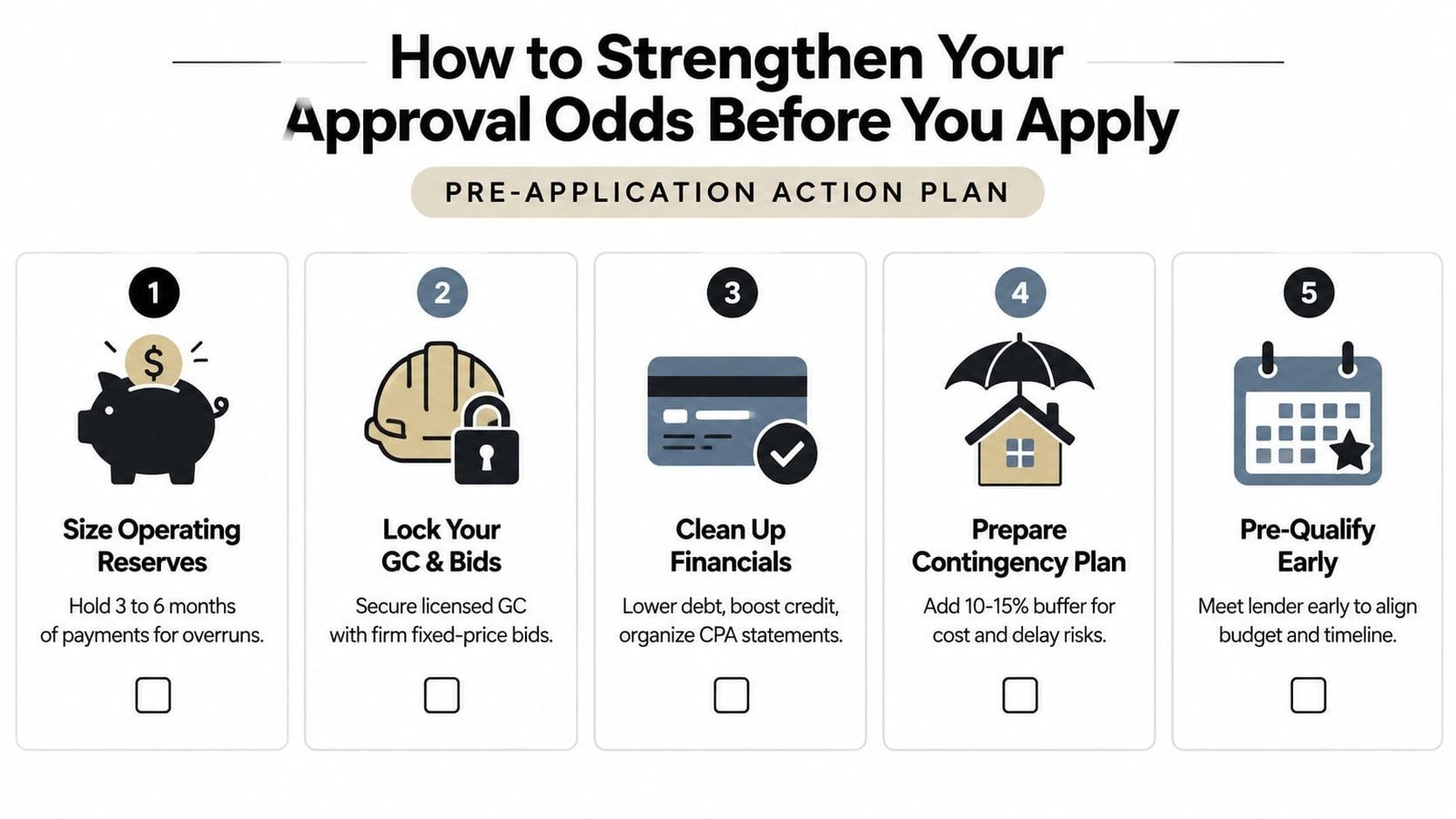
Start before submitting the application. Have your CPA, architect, contractor, and lender review one budget and schedule. Conflicting assumptions create underwriting questions and can delay approval.
Prepare the sponsor
Give the lender a one-page sponsor summary covering net worth, available liquidity, existing obligations, ownership structure, operating history, and relevant construction experience. Clean up personal and business credit early. Resolve liens, explain unusual deposits, reconcile debt schedules, and prepare current financial statements. For owner-occupied or mid-market projects, show who will manage construction without weakening the operating company.
Prepare the cash
Reserve 3 to 6 months of debt service and budget an 8% to 12% project contingency. Treat those as your preparation targets. Hard-cost contingencies commonly run 5% to 10%, while commercial lenders may expect liquidity equal to 10% to 20% of the loan amount, as established earlier.
Liquidity must cover more than the equity check. Account for interest during construction, change orders, delayed draws, operating shortfalls, and costs that fall outside the lender's eligible budget. A project can be profitable on paper and still fail when the owner cannot fund a timing gap.
Control the build
Use standardized draw requisitions and a current cost-to-complete report. Require written approval for scope changes. Before closing, confirm the lender's rules for inspections, retainage, stored materials, disputed invoices, and change orders.
Review the term sheet and conditions list before spending heavily on design or deposits. Flag contractor liens, unpermitted work, missing environmental reports, unclear title, and unsupported appraisal assumptions immediately. These problems become harder and more expensive after closing.
Business Loan Warrior provides construction financing, SBA loan processing, and other business funding through one application and secure dashboard. Applicants submit recent business bank statements and core business information for review. Use an organized intake, then require the lender to explain every construction condition from first draw through final funding.
If you are planning a commercial, owner-occupied, or SBA-backed build, visit Business Loan Warrior to review financing options and organize your application. Bring the budget, builder information, financial statements, and reserve plan. Use the discussion to identify lender conditions before they disrupt the project.