
Same-day funding is possible and common for qualifying small businesses, but it usually means the provider initiates an ACH transfer or check that day, not that cleared cash is immediately usable in your checking account. The Federal Reserve found that 37% of small employer firms applied for a loan, line of credit, or merchant cash advance, and among those applicants, 50% sought $100,000 or less while 30% sought $50,000 or less.
The call usually comes when the timing is uncomfortable. Payroll is approaching, a supplier wants payment, inventory must be replenished, or a critical repair can't wait for a conventional lender's review. An offer promising merchant cash advance same day funding can look like the obvious answer, especially after a bank has declined the application or moved too slowly.
The practical question isn't just whether an MCA can fund today. It's whether the provider can complete verification, execute the contract, initiate settlement before the relevant cutoff, and leave the business with enough operating cash after remittances begin. Speed helps only when the repayment structure still works during a weak sales period.
Table of Contents
- Understanding Same-Day Merchant Cash Advance Funding
- When a Merchant Cash Advance Is the Right Fit
- Required Documents and Application Steps
- How to Calculate True Cost and Avoid Surprises
- Red Flags and Pitfalls of Rushed Funding
- Tips to Improve Approval Odds and Prepare Smartly
Understanding Same-Day Merchant Cash Advance Funding
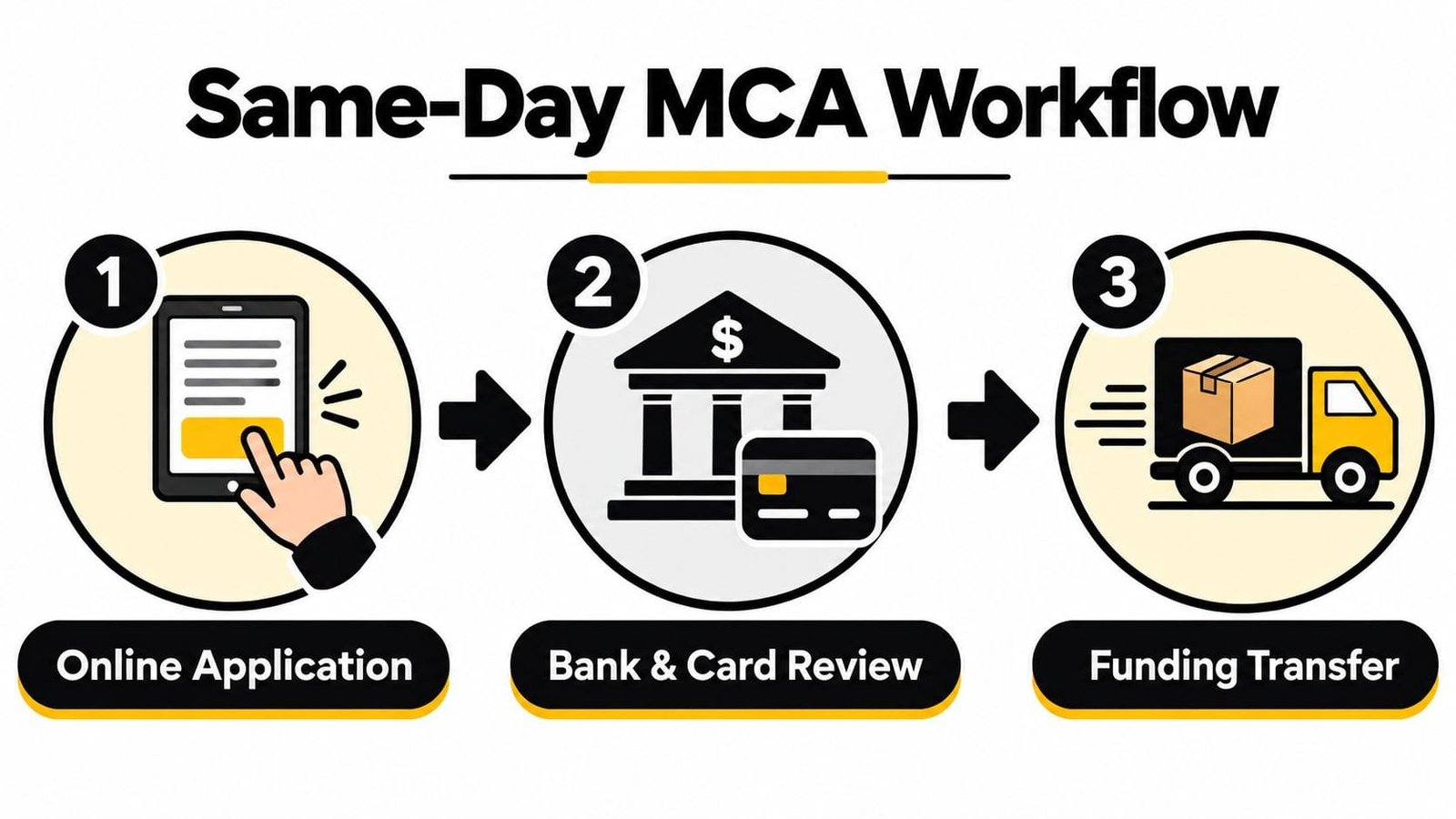
A same-day MCA is best understood as a rapid underwriting-and-settlement workflow, not a guaranteed cash-in-hand promise. The process normally starts with an online application, followed by permission to review business bank activity and, where relevant, card-processing deposits. The underwriter then evaluates recent revenue, deposit consistency, existing obligations, and the receivable stream that will support repayment.
Approval is only one milestone. After approval, you still need to review and sign the purchase agreement, confirm the remittance method, complete identity checks, validate the destination account, and meet the provider's settlement cutoff. The provider may initiate an ACH or issue a check that day, while your bank's processing schedule, verification holds, or cutoff times determine when the money becomes usable.
What the timeline actually includes
A realistic same-day sequence looks like this:
- Application submission: You provide the requested business details and authorize account connections.
- Bank and processor review: The provider checks deposits, card receipts, identity information, fraud signals, and existing financing.
- Offer and contract review: You confirm the purchased receivables, total remittance, holdback or debit, reconciliation terms, and any personal guarantee.
- Settlement initiation: The provider sends the funds through the agreed method, subject to bank and processing cutoffs.
- Funds availability: Your receiving bank makes the money available according to its own processing rules.
Ask the provider to state the exact funding deadline in writing. Also ask whether “same day” means approval, ACH initiation, or cleared funds, and whether the transfer is expected to arrive the same day or the next business day. Owners who need operational tools while managing customer communications can also start with YipSMS Inc. today, but that type of business software doesn't replace careful financing review.
Repayment may use a percentage withheld from daily or weekly card receipts, or a fixed daily or weekly ACH debit. Legal guidance reports factor rates commonly ranging from 1.2x to 1.5x, with effective annualized costs potentially reaching approximately 200% when repayment is rapid, as described in industry guidance on MCA decision-making. Model the fixed debit, not the advertised holdback, and verify that cash remaining after the debit can cover a low-sales week.
When a Merchant Cash Advance Is the Right Fit
An MCA belongs in the short-term working-capital part of the capital stack. It can make sense when the business has identifiable revenue, needs funds quickly, and can't wait through a conventional credit review. It may also be accessible when recent cash flow or credit history makes a bank loan difficult.
That accessibility has a cost. An MCA isn't automatically affordable because repayment is linked to sales, and a fixed ACH structure may not flex at all. The right decision depends on the purpose of the money, the likely repayment source, and whether the business can withstand the remittance if revenue weakens.
The Federal Reserve describes MCAs as relatively small-dollar, nonbank finance products generally offered in amounts below $100,000 and repaid through a percentage of sales or revenue rather than fixed periodic loan payments. In its survey, 37% of U.S. small employer firms applied for a loan, line of credit, or MCA during the preceding period, while 50% of applicants sought $100,000 or less and 30% sought $50,000 or less, according to the Federal Reserve's discussion of small-business credit.
| Financing Option | Typical Speed | Qualification Focus | Cost Profile | Best Use Case |
|---|---|---|---|---|
| Merchant cash advance | Rapid, subject to verification and settlement cutoffs | Recent revenue, deposits, and transaction activity | Factor rate and fees can produce a high effective cost | Urgent, short-term working capital |
| Traditional business loan | Slower review and funding process | Credit history, financial statements, repayment capacity, and sometimes collateral | Usually structured around interest and scheduled payments | Longer-term needs where lower cost matters |
| SBA-backed financing | Detailed review with multiple documentation requirements | Business history, financial condition, use of funds, and lender criteria | Often better suited to planned, longer-horizon borrowing | Expansion, equipment, or durable investments |
| Business line of credit | Access depends on approval and account terms | Credit profile, cash flow, and ongoing business performance | Interest and fees vary by product and usage | Repeated working-capital needs |
| Revenue-based financing | Varies by provider and data review | Revenue quality and future cash generation | Repayment may track revenue, but total cost still requires calculation | Businesses with recurring or predictable receipts |
Practical rule: Use an MCA for a defined short-term gap with a credible payoff source, not as a routine substitute for profitable operations.
Traditional loans and SBA products may take longer, but their structure can fit an investment that produces value over a longer period. A line of credit may be more useful than repeatedly taking advances when the business needs flexible access over time. Compare actual offers, not product labels, and don't treat a rapid decision as evidence that the capital is cheap.
Required Documents and Application Steps
Same-day execution depends heavily on whether the application package is complete before an underwriter opens the file. Missing statements, mismatched business names, unclear deposits, or an account-linking failure can turn a fast review into a delayed one.
Prepare the following before applying:
- Business bank statements: These show deposit patterns, average balances, overdrafts, existing debits, and the cash available after obligations.
- Card processor statements: These help identify card-based receivables and support the calculation of a holdback when repayment is tied to card sales.
- Year-to-date profit and loss statement: This gives context for revenue quality, operating expenses, margins, and the purpose of the requested capital.
- Existing financing information: Previous advances, payoff statements, UCC filings, and current debit schedules help the provider assess stacking and priority.
- Identity and ownership records: Names and business details must match the application, bank account, and executed agreement.
The Federal Reserve's 2025 Report on Employer Firms found that 59% of firms sought new financing during the covered period. Among applicants, 40% sought less than $50,000, while operating expenses were cited by 56% and expansion or a new opportunity by 46%. Only 41% received all the financing they sought, compared with 36% who received some and 24% who received none, according to the Federal Reserve employer-firm report.
A clean application sequence
First, connect the correct operating account and confirm that the provider can read the required transaction history. Next, upload statements and processor records in their original form rather than screenshots that omit dates or balances. Then answer questions about seasonality, recent revenue changes, use of funds, and existing obligations directly.
Before signing, compare the approved amount with the net amount you will receive after fees. Review the merchant cash advance requirements so you can identify missing documents before the day of application. Finally, verify the funding account and debit authorization against the executed contract.
How to Calculate True Cost and Avoid Surprises
An MCA quote often looks simple because the provider presents a factor rate. The calculation is straightforward, but the economic comparison is not. Multiply the advance amount by the factor rate to determine the contractual remittance, then add origination, underwriting, administrative, or other stated fees to determine the net proceeds and total repayment amount.
For example, a 1.2x factor rate means the total remittance is 1.2 times the purchased amount before applicable fees. It doesn't function like a conventional interest rate, and the annualized cost changes with repayment speed. A short repayment period can make the effective cost far higher than the headline factor suggests.
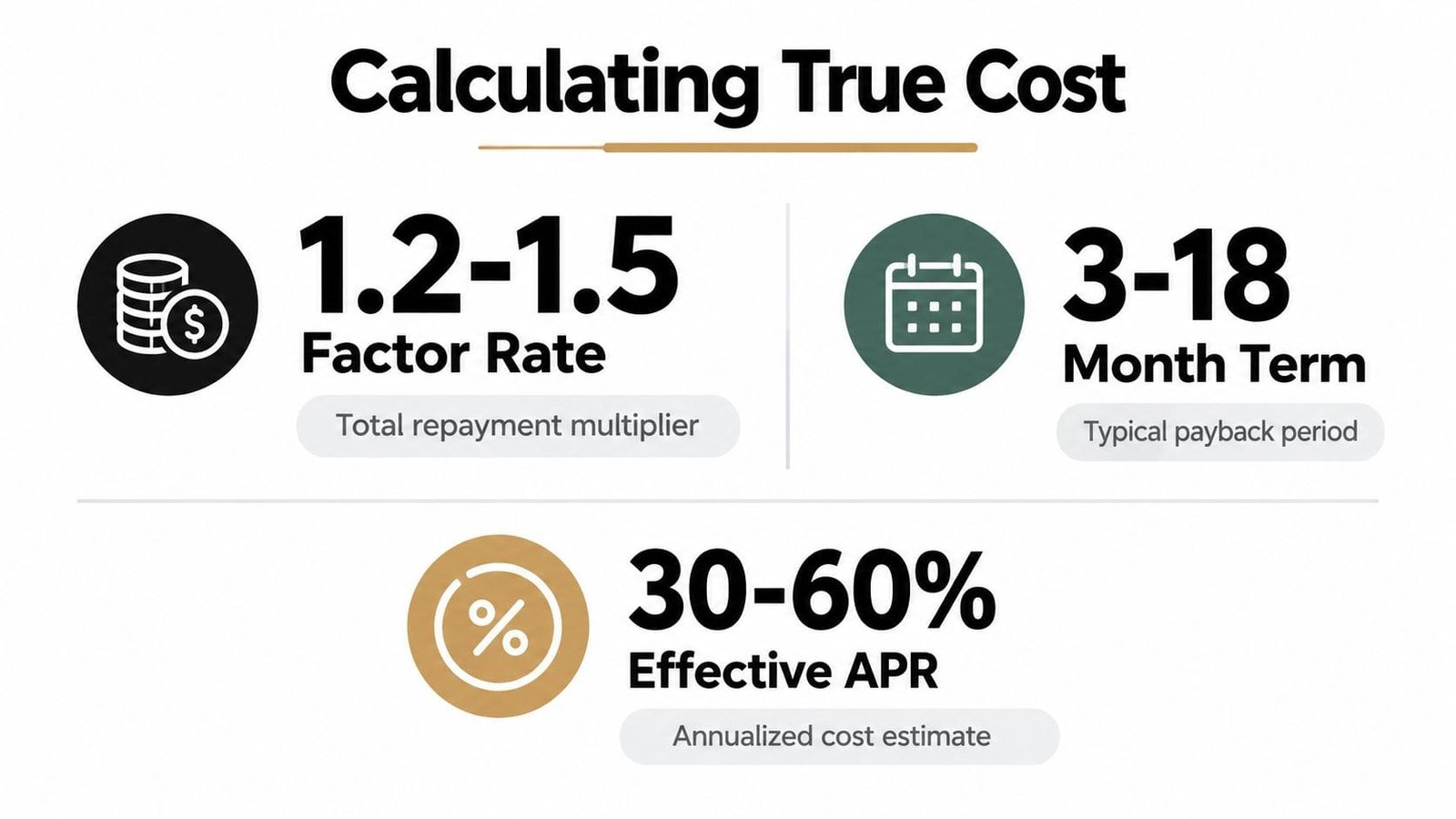
One industry comparison says a 1.10 to 1.50 factor rate can correspond to roughly 50% to 150% or more in annualized cost, depending on how quickly repayment occurs. The same analysis warns that fixed daily or weekly debits can continue when sales weaken, and that many MCAs don't reduce the total repayment when paid early. Review the factor-rate and financing-cost comparison before assuming early payoff will lower the bill.
Run the deal through a weak-sales period
Build a simple cash-flow worksheet with three cases:
- 20% revenue decline: Subtract the reduced receipts, then deduct the scheduled MCA debit and normal operating costs.
- 40% revenue decline: Check whether payroll, rent, taxes, inventory, and suppliers still receive priority.
- 60% revenue decline: Determine how quickly the business would exhaust its available operating cash if the debit remains unchanged.
If repayment is percentage-based, confirm the reconciliation procedure and the documents required to request an adjustment. If repayment uses fixed ACH, treat that debit as a senior cash obligation in every scenario. Use the merchant cash advance calculator to organize the calculation, then verify every result against the signed agreement.
A deal that works only in the best sales month isn't working capital. It's a liability waiting for a bad week.
The useful comparison is not “How much was approved?” It is “How much will arrive, how much must be remitted, and what cash remains after the debit under realistic revenue conditions?” That answer determines whether the advance supports the business or accelerates a cash shortage.
Red Flags and Pitfalls of Rushed Funding
The greatest danger in same-day funding is not the application itself. It's signing before you understand whether the agreement contains a genuine revenue-linked remittance or an absolute repayment obligation that behaves like fixed debt.
Start with the repayment clause. A percentage withheld from actual receipts should have a workable reconciliation process that lowers remittances when eligible revenue falls. A fixed ACH debit can continue regardless of sales, and aggressive default language, a personal guarantee, or a revenue decline treated as a breach can materially increase the owner's exposure.

Checks to complete before signing
- Separate approval from availability: Ask when the provider will initiate the transfer and when the receiving bank is expected to release the funds.
- Identify stacking exposure: List every existing advance, loan, automatic debit, and UCC filing before accepting another offer.
- Demand written reconciliation terms: Confirm what evidence is required, who reviews the request, and how an adjustment is calculated.
- Confirm the total payback: Get the dollar remittance, fees, debit schedule, and payoff terms in the contract, not in a phone call.
- Match the payment instructions: Verify that the funding account, payoff amount, and ACH authorization match the executed documents.
A UCC-1 filing generally establishes a perfected security interest and creditor priority. It isn't, by itself, a judgment authorizing immediate asset seizure, but it can complicate later borrowing and refinancing. Map all debits against payroll, taxes, rent, inventory, and other obligations before you authorize access to the operating account.
The FTC has pursued providers accused of advertising financing terms and guarantees that conflicted with their contracts. That enforcement history makes verbal promises especially weak evidence. Use the MCA debt relief resource only as a reminder to address unsustainable obligations early, not as a substitute for reviewing the agreement before signing.
Tips to Improve Approval Odds and Prepare Smartly
A fast application is not the same as a strong application. Underwriters need a clear picture of current deposits, existing withdrawals, ownership, and the reason the business needs capital. You can shorten avoidable delays by preparing that picture before submitting the form.
Keep bank and processor statements complete, current, and easy to reconcile. Don't move deposits between accounts merely to make one statement look stronger. A provider is looking for a coherent operating pattern, and unexplained transfers can trigger additional questions or fraud review.
Build a lender-ready file
Create a concise package with:
- Recent account records: Include the full statement pages, transaction detail, and the account used for normal operations.
- Revenue explanation: Note seasonality, unusual deposits, temporary disruptions, and whether recent sales are rising, stable, or falling.
- Use-of-funds plan: State whether the money will cover inventory, payroll, repairs, rent, taxes, or a specific growth opportunity.
- Existing obligation schedule: Show current daily or weekly debits, outstanding balances, and any prior advance payoff information.
- Ownership and identity documents: Make sure legal names, tax information, and bank records align.
If you have an existing advance, resolve unclear payoff balances and stacking questions before applying. A new provider that discovers several undisclosed debits during underwriting may reduce the offer, change the repayment structure, or decline the file. Transparency doesn't guarantee approval, but concealment creates avoidable risk.
Ask better questions than “Can you fund today?”
Ask whether the provider is a direct funder or an aggregator presenting offers from multiple sources. An aggregator may help you compare products, while a direct provider may give you a more direct line to the underwriting and servicing team. In either case, ask who will handle reconciliation after closing and whether that process is described in the contract.
Ask the underwriter to explain the purchased receivables, the total remittance, the expected debit, and what happens if revenue falls. Then request a written answer about early payoff, renewal offers, UCC filings, personal guarantees, and the exact settlement cutoff. A reputable process should withstand those questions without pressure to sign immediately.
Business Loan Warrior offers a no-fee application that can connect business owners with funding options, including loans, lines of credit, SBA processing, equipment financing, invoice financing, and merchant cash advances. If you need to compare a rapid MCA with other working-capital structures, visit Business Loan Warrior with your prepared documents and repayment scenarios ready.