

The popular advice is to find the lowest commercial construction loan rate and take it before the quote expires. That advice can produce an expensive project. Construction debt is drawn over time, priced against a moving benchmark, burdened by lender controls, and often repaid or refinanced before the building has reached its full earning potential. A slightly cheaper headline rate can lose its advantage through fees, delayed draws, extra equity, or an extension that forces the borrower back into a tighter credit market.
The better question is: What will this financing cost from first draw through repayment, and how certain is the funding when the project needs it? Commercial construction loan rates matter, but they're only one input in the project's capital stack. The useful comparison is the all-in borrowing cost, the cash required from the sponsor, the cost of unused capacity, the protection against rate increases, and the consequences if construction or lease-up runs late.
Table of Contents
- The All-In Cost of Construction Debt
- How Floating Rate Benchmarks and Spreads Work
- Comparing Major Construction Loan Types
- Market Conditions and Bank Underwriting Standards
- Modeling Rate Scenarios and Draw Schedules
- Actionable Strategies to Lower Your Borrowing Cost
- The Fintech Application and Approval Checklist
The All-In Cost of Construction Debt
Chasing the lowest quoted rate is how borrowers end up with a more expensive project. Construction debt is priced in layers, and the headline interest rate is only one of them. By the time a deal closes and funds start moving, total borrowing cost can also include origination charges, legal and appraisal bills, inspection costs, draw administration, unused-line fees, interest-reserve requirements, extension charges, and prepayment limits. Some of those costs hit at closing. Others show up later, usually when timing is tight and the borrower has less room to negotiate.
Sponsor equity has a cost too.
If one lender trims the spread but asks for materially more cash upfront, the interest savings may be offset by capital tied up in the job. That cash could otherwise support equipment purchases, inventory, a second site, or operating reserves. On paper, the loan looks cheaper. In practice, the project can produce a weaker return on invested capital and less flexibility if costs rise or lease-up takes longer than expected.
Practical rule: Compare financing offers by total project cost and execution certainty, not by the first rate shown on the term sheet.
Build the all-in comparison
Put each proposal into the same model and force every lender assumption into view. At minimum, compare:
- Rate mechanics: Identify the benchmark, spread, floor, reset frequency, and cap.
- Cash requirements: Include the required equity contribution, interest reserve, contingency, and any minimum liquidity covenant.
- Lender charges: Ask for origination, inspection, appraisal, legal, unused-line, wire, draw, and extension fees.
- Timing risk: Measure how a delayed approval, inspection, or draw affects contractor payments and the construction schedule.
- Takeout risk: Model the sale, refinance, or permanent loan that will repay the construction facility.
Commercial construction loans are usually short-term facilities with staged funding rather than one full disbursement at closing, a structure discussed in Crestmont Capital's overview of commercial construction financing. That changes the math. Interest should be modeled on expected draws over time, but the model also needs room for inspection delays, retainage, change orders, and any lag between a contractor pay application and lender funding. A term sheet with a lower spread can still cost more if the draw process slows the job or pushes the borrower into an extension.
Specialized components make this even more obvious. A project that includes an elevator may involve deposits, installation milestones, inspections, and lender-controlled disbursements that do not line up neatly with the broader construction schedule. Reviewing Crane Elevator Company financing solutions helps separate equipment-specific financing issues from the main real estate facility before the capital stack is finalized.
Rate still matters. On a fully drawn $10 million balance, a 1-percentage-point change shifts annual interest expense by about $100,000, before principal reduction or draw timing, based on Terry Dale Capital's commercial loan rate analysis. That is exactly why experienced borrowers model the whole structure instead of negotiating on the headline rate alone.
How Floating Rate Benchmarks and Spreads Work
The headline rate on a construction loan is only the starting point. What drives project cost is how the floating index resets, how wide the spread is, and whether the fine print adds a floor, a cap premium, or extension exposure that shows up later.
The basic pricing math is simple:
Borrowing rate = benchmark index + lender spread
That simplicity can be misleading. The benchmark reflects short-term market pricing. The spread reflects the lender's view of execution risk, sponsor strength, property type, cost control, and exit certainty. Two borrowers can face the same index on the same day and still get meaningfully different pricing because one has stronger liquidity, cleaner documentation, firmer leasing or presale support, and a more believable repayment plan.
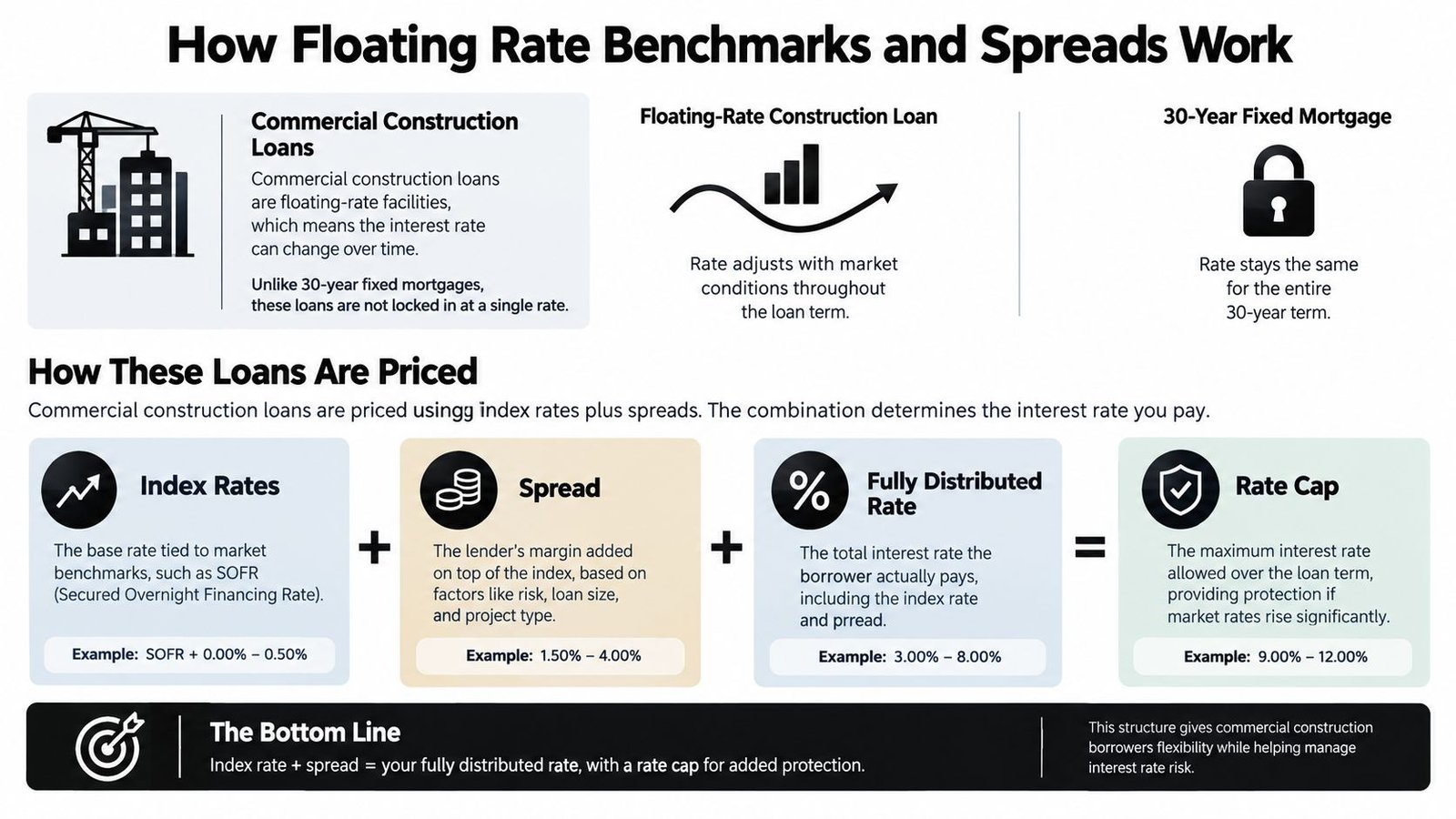
A current market snapshot helps. Recent U.S. estimates place bank construction pricing around 1-month Term SOFR plus 2.75 to 3.75 percentage points, or approximately 6.65% to 7.65% at the cited benchmark levels. Prime-based structures were estimated at prime plus 1.00 to 1.50 points, producing roughly 8.00% to 8.50%. Those estimates and the mechanics behind them are summarized in a construction loan rate overview. They are market examples, not a commitment for any specific deal.
What deserves close review is not just the quote, but the rate provisions attached to it.
Start with the index. Confirm whether the facility is tied to Term SOFR, Prime, or another benchmark, and ask how often it resets. A monthly reset creates different exposure than a quarterly reset, especially if the project timeline is tight and the interest reserve has little cushion.
Then review the spread. Some lenders will reduce the margin after completion, lease-up, or another milestone. Others will not. A slightly wider spread with a realistic step-down can be cheaper than a lower opening quote that stays in place through delays or extension periods.
The floor and cap matter just as much. A floor keeps the rate from falling below a stated level even if the benchmark drops. A cap limits upside, but it is not free. The premium may be paid upfront, financed into the deal, or recovered through other terms. Either way, it belongs in the all-in borrowing cost, not outside the analysis.
Construction debt adds another layer because interest is usually charged only on funds that have been advanced. That helps early in the project, but it also ties borrowing cost to draw timing, inspections, lien control, and document turnaround. If disbursements slip, the job can run longer, carry costs can rise, and extension risk can outweigh the benefit of a slightly lower spread.
I usually advise borrowers to model at least one higher-rate case, often 100 basis points above the starting index. The point is not to predict the market. It is to see whether the project still carries its interest reserve and supports post-completion debt service if rates move the wrong way. That is the test lenders care about, and it is the one that protects profitability.
Comparing Major Construction Loan Types
The best structure depends on the project's use, repayment plan, sponsor strength, and tolerance for documentation. A conventional bank facility may offer attractive pricing but demand extensive underwriting and predictable draw controls. A private lender may close faster but charge more because it's solving a timing or qualification problem.
The table below is a decision aid, not a promise of terms. Financial exposure, approval speed, and pricing vary by lender and project.
Construction Loan Types Comparison
| Loan Type | Max Leverage | Speed to Close | Best For |
|---|---|---|---|
| Conventional bank construction loan | Often constrained by completed value, borrower strength, and lender policy | Deliberate | Established sponsors with strong financial reporting and time to prepare |
| Construction-to-permanent facility | Based on construction underwriting and the permanent takeout structure | Moderate | Projects with a clear long-term hold and predictable stabilized cash flow |
| SBA 504 structure | Can support high project-cost coverage in qualifying owner-occupied situations, subject to program and lender requirements | Slower because multiple parties participate | Owner-users financing eligible real estate and major fixed assets |
| SBA 7(a) structure | Program and lender dependent | Moderate to slower | Small businesses needing a flexible combination of real estate, improvements, and business uses |
| Hard-money or private credit | Asset and sponsor dependent, often with more conservative collateral analysis | Faster when the file is complete | Time-sensitive acquisitions, bridge needs, or borrowers outside conventional criteria |
Conventional bank debt usually wins on cost when the borrower has a strong file and the project can withstand the bank's process. It often loses on flexibility. Private credit usually wins on speed and asset-based decision-making, but the borrower pays for that flexibility through rate, fees, tighter maturity, or more demanding collateral terms.
Construction-to-permanent financing can reduce the uncertainty of arranging a takeout later, but the borrower must understand the conversion conditions. A project that misses completion tests, leasing requirements, or financial covenants may not convert as expected. If the permanent debt remains a separate refinancing event, the borrower still carries interest-rate and approval risk.
For a project that needs short-duration capital, review the mechanics of short-term construction loans before assuming a long-term facility is the only answer. Owners of specialized assets, including self-storage, may also benefit from comparing self-storage capital solutions alongside conventional construction debt. The right comparison includes repayment timing, draw flexibility, collateral, and the cost of failure to close, not just the advertised spread.
Market Conditions and Bank Underwriting Standards
Quoted pricing matters less than many borrowers think. In this part of the market, the lender that posts the lowest spread can still be the more expensive option if it trims proceeds, slows draws, adds reserve requirements, or prices an extension aggressively. Construction debt is underwritten as a risk package, not as a simple rate quote.
That caution reflects real credit conditions. U.S. commercial real-estate lending growth slowed to 0.14% in the fourth quarter of 2024, the weakest quarterly growth since the first quarter of 2013, when the category contracted by 0.17%, according to the Federal Reserve Bank of St. Louis analysis of commercial real-estate loan growth. Because that category includes construction and land-development credit, a borrower can bring in a sound project and still see tighter proceeds, more cash equity, or more conditions around how and when funds are advanced.
Banks are judging the borrower, the job, and their own portfolio at the same time. A quote only reflects the first screen. Final credit approval usually turns on how the lender answers a set of practical questions:
- Sponsor capacity: Liquidity, experience, contingent obligations, and willingness to contribute more capital if costs rise.
- Project execution: Contractor strength, guaranteed maximum price or other contract protections, permits, plans, schedule, and contingency.
- Collateral and loan-to-value: Current value, completed value, location, property type, and the lender's maximum loan-to-value policy.
- Repayment: Sale assumptions, lease-up, operating cash flow, refinance availability, and permanent debt capacity.
- Bank exposure: Whether the institution wants more construction risk in that market or asset category.
The Federal Reserve's lending surveys show why those screens have stayed demanding. In the first quarter of 2025, banks reported tighter standards for construction and land-development loans, including lower loan-to-value limits and higher debt-service-coverage requirements. The second-quarter survey still showed moderately tighter standards for nonfarm, nonresidential commercial real estate and modestly tighter standards for construction and land-development loans, with standards remaining tight versus historical ranges, as reported in the Federal Reserve's April 2025 Senior Loan Officer Opinion Survey.
Regulatory treatment also affects what a project costs to finance. Federal Reserve research has cited an estimate that high-volatility commercial real-estate treatment increased loan rates by approximately 40 basis points, or 0.40 percentage points, relative to otherwise unaffected commercial real-estate loans. On a $10 million outstanding balance, that works out to about $40,000 in additional annual interest. Even when the quoted benchmark and spread look workable, rule-driven pricing can change the project margin.
This is why I treat underwriting prep as a cost-control exercise, not paperwork. A complete package shortens credit back-and-forth and lowers the odds that the bank solves uncertainty by cutting proceeds or adding conditions. Before requesting terms, assemble contractor financials, permits, environmental reports, leases or presales, the cost-to-complete schedule, sponsor liquidity support, and a takeout strategy. It also helps to compare contractor policies so the lender sees that coverage matches the project's actual construction risks. If you want a practical checklist, review these construction loan requirements before the file reaches credit.
Later Federal Reserve survey results showed weaker demand for commercial real-estate loans while standards remained relatively tight, including modestly tighter construction and land-development standards, according to the July 2025 lending survey. The practical takeaway is simple. Approval probability and closing certainty deserve as much attention as the stated rate. If the project runs long, extension fees, repricing, or a forced refinance can erase the benefit of a headline spread that looked cheap at the start.
Modeling Rate Scenarios and Draw Schedules
The quoted rate rarely decides whether a construction loan is cheap. Profit usually moves on timing. If draws fund later than planned, if interest reserves burn faster than expected, or if an extension adds fees and repricing, the all-in cost can drift well above the headline spread.
A useful model follows cash by month, because construction debt is earned on outstanding balance, not on the full commitment from day one. Start with the draw schedule, then map when interest is paid, when it is capitalized, and how much reserve remains if the project slips. That approach shows borrowing cost under the schedule you expect to build, not the one shown in a term sheet.
I usually pressure-test four moving parts at the same time: funding pace, rate path, reserve usage, and completion timing. A project can tolerate a higher rate if draws ramp slowly and the job finishes on time. The same project can become expensive if inspections delay advances, retainage holds back contractor cash, and the loan needs extra months to reach completion.
Build the model month by month, but keep it practical. Track the beginning balance, the scheduled draw, the applicable rate scenario, the monthly interest calculation using the lender's day-count method, the remaining reserve, and a delay case that pushes draws and completion later. Then compare the base case with a higher-rate case, a delayed-completion case, and a combined stress case.
The sequence of advances matters as much as the pricing. Early months often carry land, predevelopment, mobilization, and site work. Later months carry structure, systems, interiors, and closeout. On paper, that looks orderly. In practice, lender funding often trails the contractor's billing cycle because inspections, lien waivers, title updates, and change-order reviews take time. That gap can force the borrower to front cash temporarily or ask for more equity sooner than expected.
Use a detailed construction loan draw schedule guide to organize advance requests, document requirements, inspection checkpoints, and approval responsibility before the first draw is submitted.
Rate stress should also flow through the takeout analysis. Higher capitalized interest can eat into contingency and change the final loan-to-cost picture. If the project finishes late, the refinance or mini-perm underwriting may tighten just when debt service is higher. That is how a deal with an acceptable construction coupon still misses its profit target.
A strong model does not assume the clean case. It shows whether the deal still works after rate pressure, timing friction, and an extension risk hit the same file.
Actionable Strategies to Lower Your Borrowing Cost
Borrowers have more negotiating power when they reduce uncertainty before asking for a lower spread. A lender may not reward optimism, but it can recognize documented repayment strength, credible completion controls, and a structure that reduces exposure during construction.
Improve the lender's risk picture
Start with the project's revenue visibility. Executed leases, presales, purchase commitments, or a demonstrated owner-user need can make the completed asset easier to underwrite. They don't eliminate construction risk, but they help the lender evaluate the repayment path instead of relying solely on a speculative valuation.
Sponsor liquidity matters for the same reason. Keep enough cash available to fund overruns, reserve shortfalls, and operating needs without interrupting construction. Offering every dollar of liquidity as equity may reduce debt load, but it can leave the company too fragile after closing. The right amount is the amount that supports completion without starving the operating business.
Contractor selection also influences pricing. Provide a clear scope, realistic schedule, financial statements, references, insurance evidence, and change-order procedures. A lender is more comfortable when the sponsor can explain who controls costs, who approves changes, and what happens if a subcontractor fails.
Negotiate the structure, not just the margin
Ask lenders to price the entire facility, including:
- Spread flexibility: Request a step-down after completion, leasing, or another measurable milestone.
- Unused-line treatment: Clarify whether the fee applies to undrawn commitments and whether it changes as the commitment declines.
- Draw charges: Confirm inspection, wire, administrative, and reinspection costs in writing.
- Extension economics: Negotiate the extension fee, notice period, conditions, and whether an extension triggers repricing.
- Rate protection: Compare a cap's premium, strike level, duration, and termination provisions.
- Prepayment terms: Check whether a sale or refinance creates a penalty or minimum interest requirement.
- Covenant cure rights: Seek realistic cure periods and clear procedures for funding a reserve shortfall.
A lower rate with rigid draw controls may cost more than a slightly higher rate that keeps contractors paid on schedule. Delayed funding can trigger disputes, slow work, and create the exact completion risk the lender wanted to avoid.
The useful concession isn't always a lower spread. It may be a better cap, fewer draw fees, a longer extension option, or permission to substitute collateral.
Get competing proposals on comparable terms. Then ask each lender to explain the assumptions behind its debt, reserve, recourse, and draw conditions. The goal isn't to pressure a lender into an uneconomic loan. It's to identify which institution understands the project and can fund it through completion.
The Fintech Application and Approval Checklist
A digital application moves faster when the borrower treats it like an underwriting file, not a preliminary inquiry. Upload complete documents with consistent figures, label versions clearly, and explain unusual deposits, debt changes, or budget revisions before an underwriter has to ask.
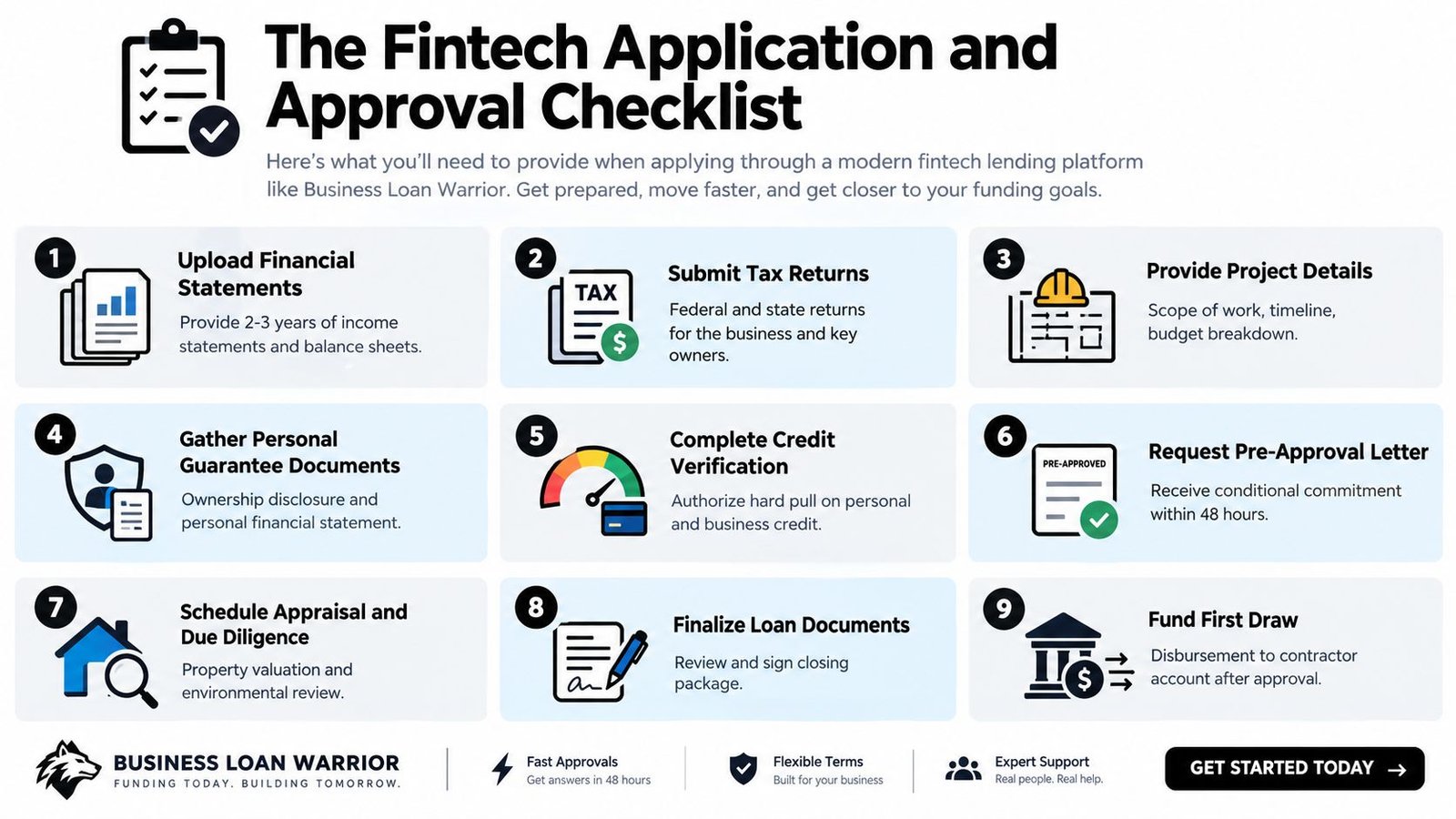
Prepare the file in this order:
- Financial statements: Provide current income statements, balance sheets, cash-flow information, and debt schedules.
- Tax returns: Include business and relevant owner filings requested by the lender.
- Project details: Upload plans, scope, budget, timeline, draw schedule, permits, and the intended property use.
- Contractor materials: Add the construction contract, contractor financials, insurance, references, and change-order process.
- Ownership and guarantees: Document ownership, personal financial information, guarantees, and contingent liabilities.
- Credit authorization: Complete the required personal and business credit verification.
- Collateral and diligence: Prepare appraisal, title, survey, environmental, zoning, and insurance materials as applicable.
- Repayment plan: Explain the intended sale, refinance, conversion, or permanent debt takeout, including timing assumptions.
- Draw readiness: Establish who approves requests, which lien waivers are required, and how inspection results are delivered.
Use the dashboard to track conditions, answer questions promptly, and maintain one current version of the budget. A lender should be able to reconcile the requested loan amount, project cost, sponsor equity, and repayment plan without searching through disconnected files.
The application should also disclose the uncomfortable scenarios. State what happens if costs increase, completion slips, leasing takes longer, or the permanent rate is higher than expected. That candor gives the underwriter a framework for managing risk and gives the borrower a clearer basis for comparing commercial construction loan rates.
Business Loan Warrior helps small and midsize companies compare funding options, including construction and expansion financing, through a single application and secure digital process. Visit Business Loan Warrior to prepare your financing request, organize project information, and connect the headline rate with the full cost and execution terms.